Posted on

SCCA Hoosier Super Tour – Buttonwillow The Circuit

High Performance Race Cars on Track at Racer on Rails.

The Setting: Why Buttonwillow Matters

The opening round of our 2026 SCCA season brought us to Buttonwillow Raceway Park for the first SCCA Hoosier Super Tour of the year, February 21 – 22, 2026.

We raced on The Circuit configuration — Buttonwillow’s newer layout that’s been operating for over a year now and we were here last year, for the very first competition race weekend and event ever held at the new track. Ron competed here twice last season. For the rest of the team, we’ve logged time here supporting customers. But this was our first time bringing the Nissan 370Z to this configuration in race trim.

Touring 3 remains one of the most competitive, tightly regulated classes in SCCA road racing. The cars are production-based, but execution is everything. Small setup shifts matter. Tire management matters. Driver discipline matters.

Buttonwillow’s The Circuit layout also brings a very different technical personality compared to the original “Buttonwillow 13CW” configuration that many West Coast racers grew up on. Traditional Buttonwillow rewards aggression, commitment over bumps, and managing long-flowing corner sequences with a little bit of chaos built into the surface and sightlines. The Circuit, by comparison, feels more modern and much more precise. The pavement quality is smoother, the transitions are faster, and the corners tend to stack technical decisions on top of each other.
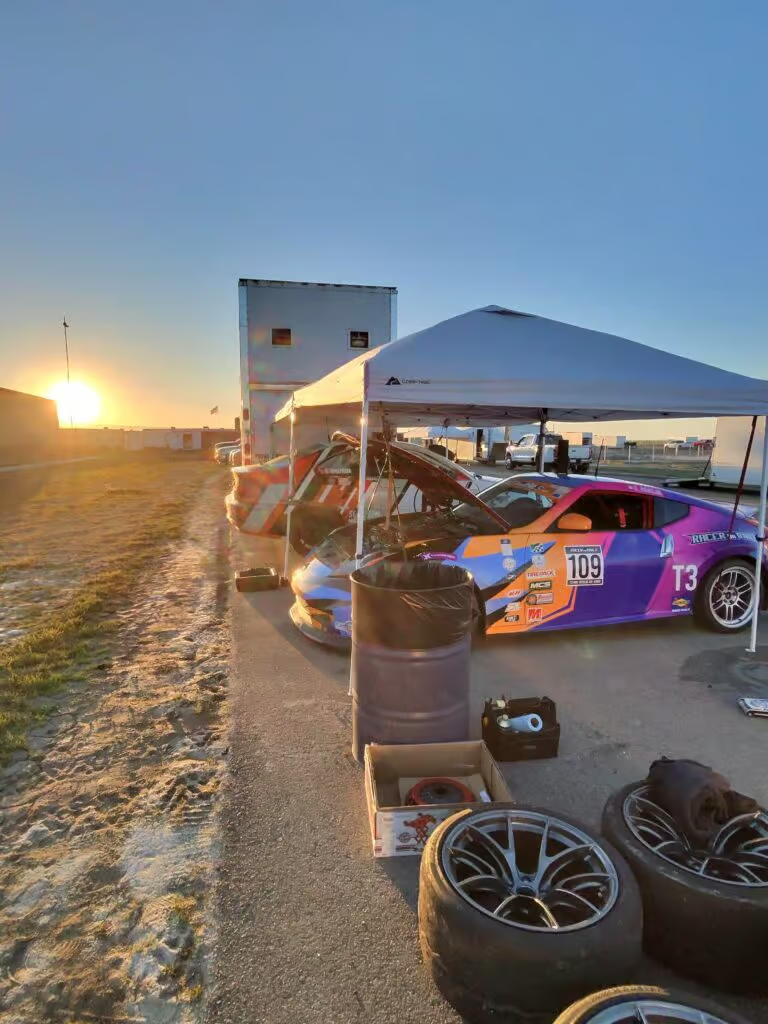
Sun is setting at Buttonwillow The Circuit – when the sun goes down, the air and track temps drop fast in February.

Several sections reward sacrificing entry speed to maximize minimum corner speed and throttle commitment on exit, while other complexes punish even tiny balance mistakes with lost momentum that carries for multiple corners afterward. It’s also a track where aero drag, mechanical grip, brake release timing, and tire temperature management all become more interconnected than people initially expect. A car that feels “pretty good” for one lap can quickly become difficult over a race run if the balance isn’t properly managed. In many ways, The Circuit feels less like old-school club racing Buttonwillow and more like a purpose-built modern technical circuit that rewards disciplined engineering and adaptable drivers.

At just over 2.5 miles in length, The Circuit combines roughly two dozen corners and transitional elements ranging from slow, technical rotation zones to fast, committed sweepers that reward precision and patience. The layout constantly shifts between decreasing-radius corners, long loaded exits, quick direction changes, and several areas where throttle timing matters more than outright bravery. For Touring 3 cars, gearing becomes especially important because many sections sit right on the edge between carrying momentum in a taller gear versus risking upsetting the platform with an additional shift.

The track surface itself is relatively smooth compared to the original Buttonwillow layouts, but the environment still plays a huge role in grip evolution. Located in California’s Central Valley, the circuit is frequently impacted by wind carrying fine dust and sand onto the racing line, while dramatic temperature swings between cold mornings and warmer afternoons can significantly change tire behavior and overall balance throughout a race weekend.

Buttonwillow’s Circuit layout rewards rhythm and precision. There aren’t many places to hide mistakes. It’s a track that exposes imbalance — mechanical or mental.

That made it the perfect place to start the year.


The Mindset: Process Over Outcome

Coming into the weekend, our objectives were clear:

  • Establish a stable performance baseline for the 370Z
  • Continue refining Ron’s throttle application and adaptability
  • Validate our tire pressure management process
  • Execute cleanly as a team

We intentionally chose to run lightly used tires instead of bolting on fresh rubber. Not to handicap ourselves, but to operate with discipline and long-term planning in mind.

For Ron, this season is about expanding his toolbox. He’s put in serious off-season work — simulator training, Porsche ice driving, DirtFish advanced programs — all focused on becoming more adaptable and decisive with inputs.
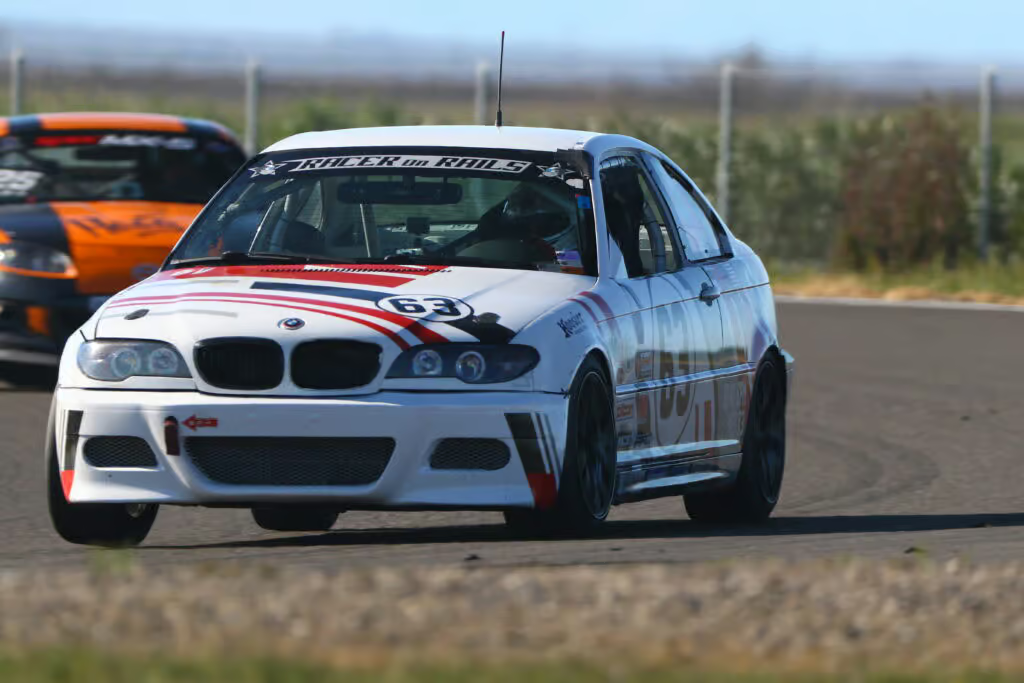
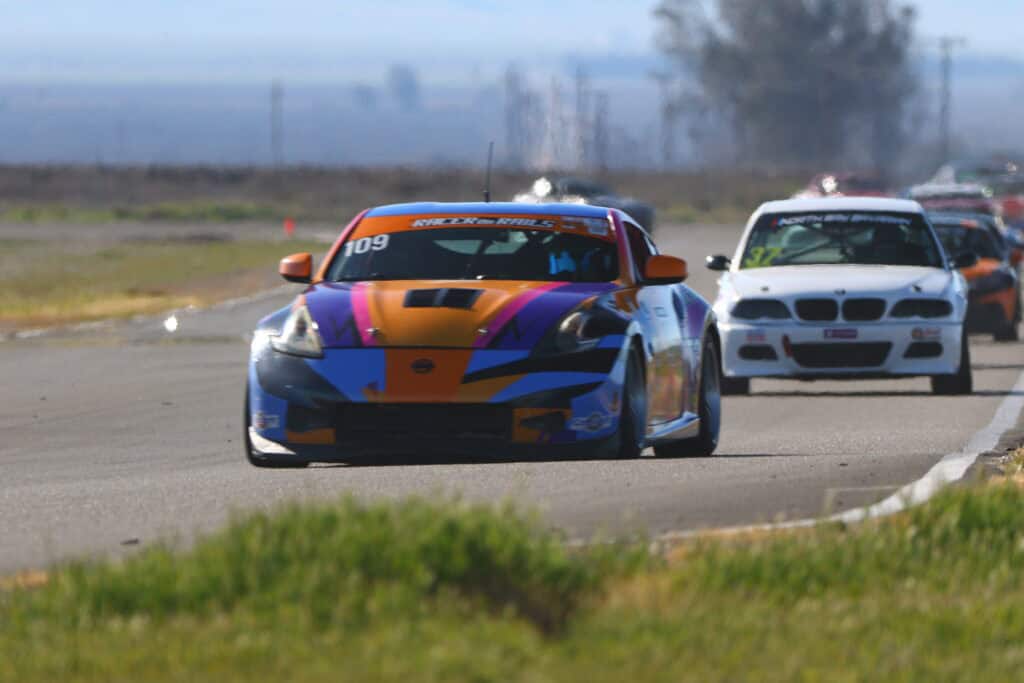
Ron Tanemura carving corners in his Touring 3 BMW Spec E46

For the team, this season is about raising our operational standard. When something breaks, we fix it properly. When development is needed, we create bandwidth for it.

No chasing. No scrambling.

Build it right.


The Weekend Story

The Journey South

Jordan and Ian drove the truck down through snow over the Oregon passes. Enough weather to keep things interesting, but they maintained traction and avoided chains. We arrived in California clean and on schedule.

That matters more than people think.


Testing: Cold Mornings, Steady Gains

Thursday brought cold temps and passing showers. Ron used early sessions to reacquaint himself with slip and rotation. By Friday he was back at 2:00.0 pace — only tenths off his personal best from last year at this track.

The 370Z test sessions were structured and deliberate. Controlled three-lap tire validation runs. Minor line adjustments through Turn 3, 5, 8, and 10. By Friday afternoon, we were consistently in the 1:56s with room left in the data.

The car was stable. Predictable. Repeatable.

Baseline established.


Mechanical Curveballs

Late Friday we discovered the Nissan’s clutch was nearing end-of-life.
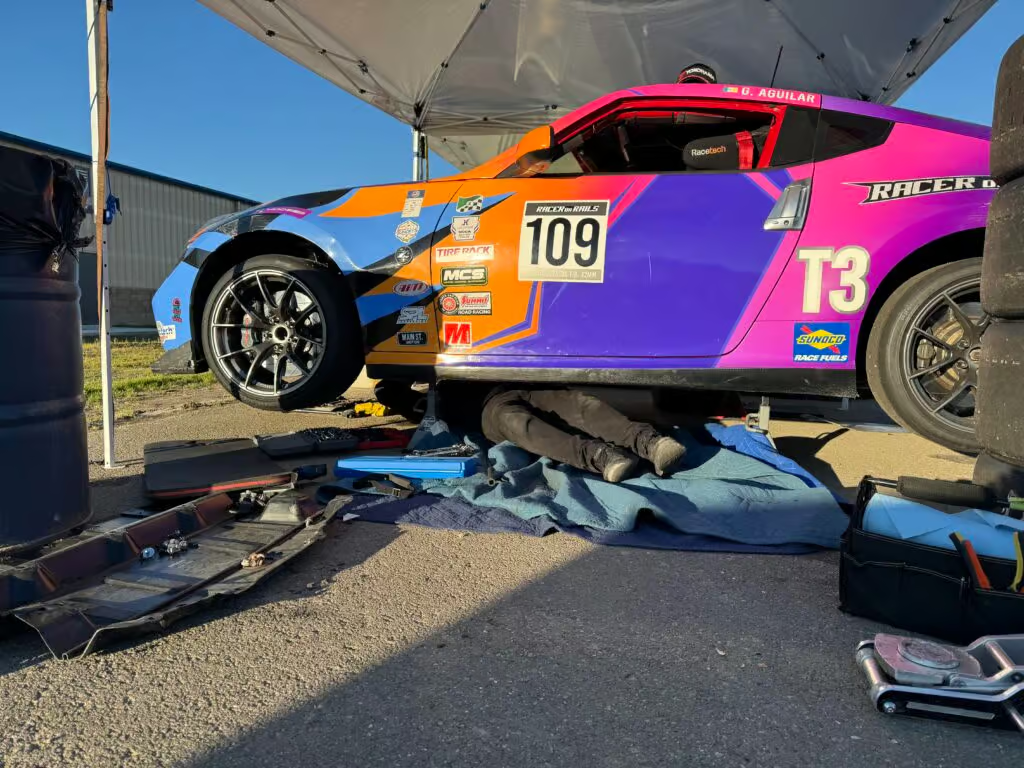
Ian working his tail and back off, getting the clutch replaced on the Touring 3 Nissan 370z Nismo

Saturday morning became paddock surgery.

Transmission out.
Clutch replaced.
Qualifying missed.

Ron’s clutch was also right at a season’s worth of cycles, so we proactively replaced his as well. Two clutch jobs in one weekend.

It wasn’t glamorous work, but it was done calmly and correctly.

That’s culture.


Saturday Race: From the Back

Starting P28 overall after missing qualifying, the only direction was forward.

The opening lap was tight but clean. From there, it was controlled aggression and patience.

Twenty-two passes in twenty-five minutes.

Finished:

  • P6 overall
  • P2 in Touring 3

Fastest lap of the race would have placed us P2 on the grid for Sunday.
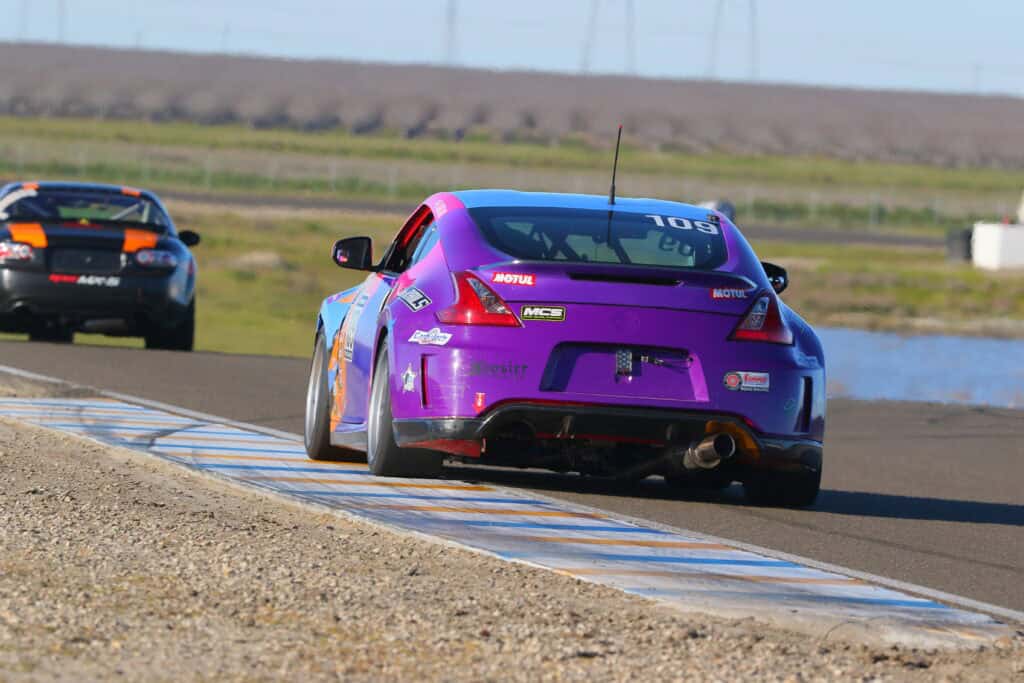
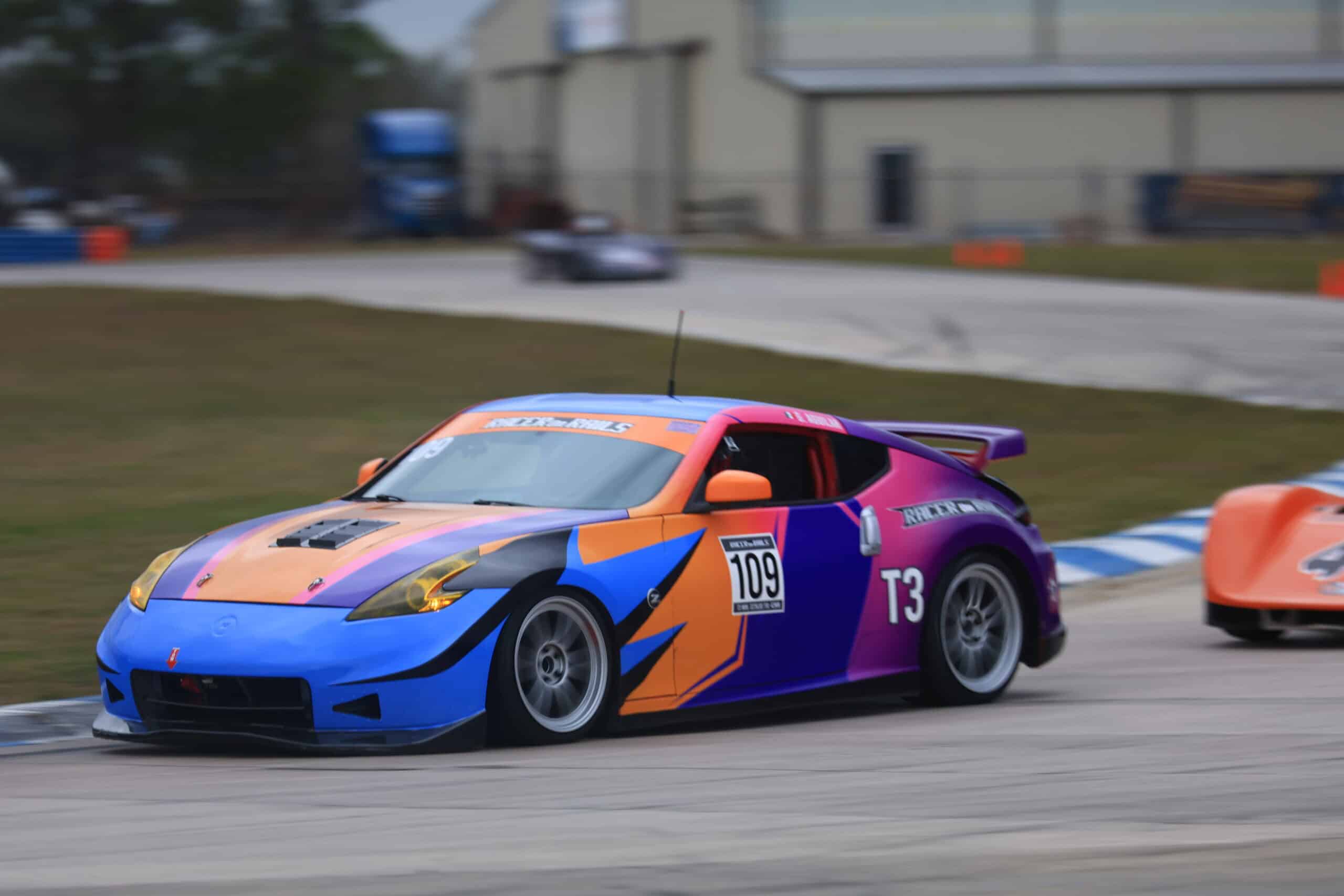
Gama in his Nissan 370z Nismo working his way through field during race 1.

All on used tires.


Sunday: Clean Execution

Sunday qualifying required careful temperature management after diagnosing a cooling fan issue. Despite traffic on both flying laps:

  • P2 in class
  • P4 overall
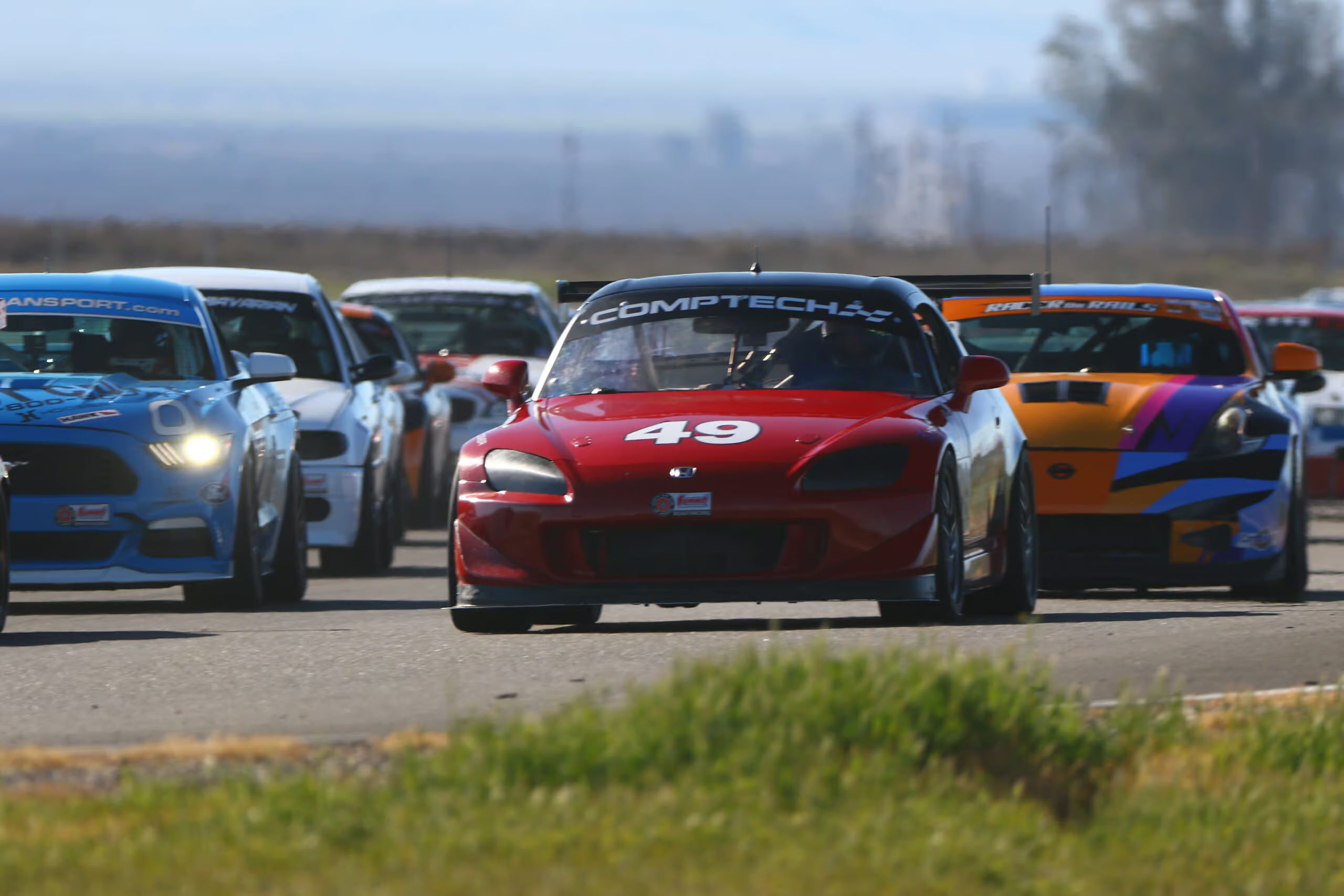
Gama and Ron making laps and loving every braking zone at Buttonwillow The Circuit

The race start was steady. The leaders stretched a gap as the rear tires began to show their age around lap five. Turn 1 required finesse and progressive inputs to manage increasing rotation.

Post-race inspection confirmed tire edge wear consistent with heavy cycling.

Final result:

  • P2 in class

Not quite the fight for P1 we would have liked, but an honest and disciplined run.
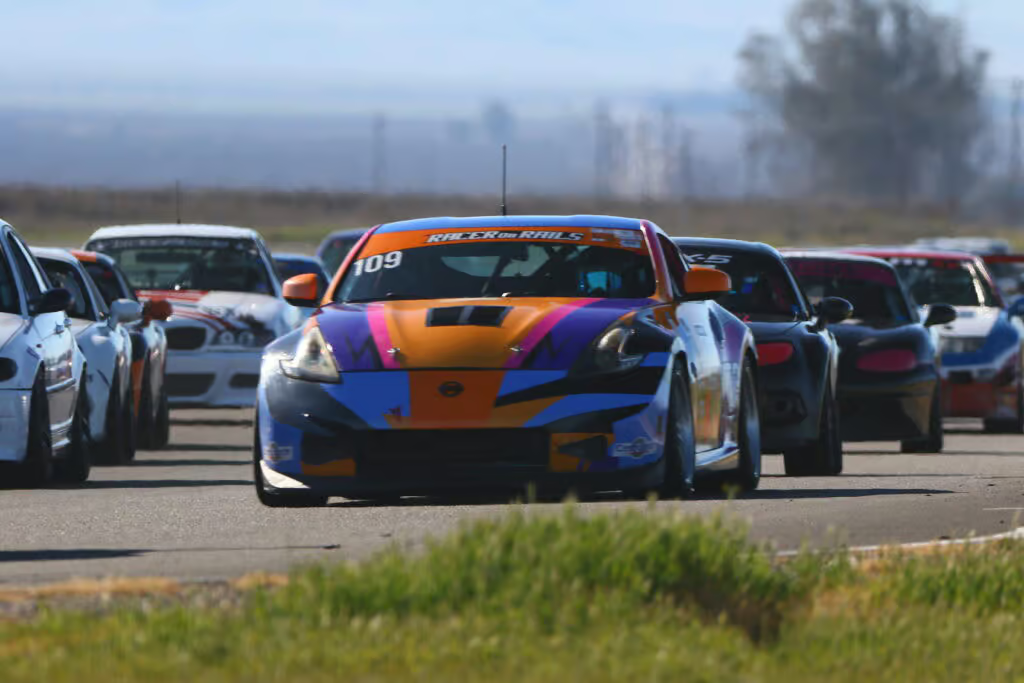
Starting the Race 2 from the front of the grid but not enough pace to truly challenge for P1.

Ron: Double Podium Weekend

Ron started P3 in class Sunday and battled closely with Spec MX-5 cars running in STL for additional seat time. Those cars were quick and the racing was tight.

There was side-to-side contact exiting Turn 3 that pushed him wide, but he stayed composed and fought back.

He finished:

  • P3 in class
  • Double podium weekend

Both races resulted in an all-Pacific Northwest podium sweep, with Scotty B White completing the trio.
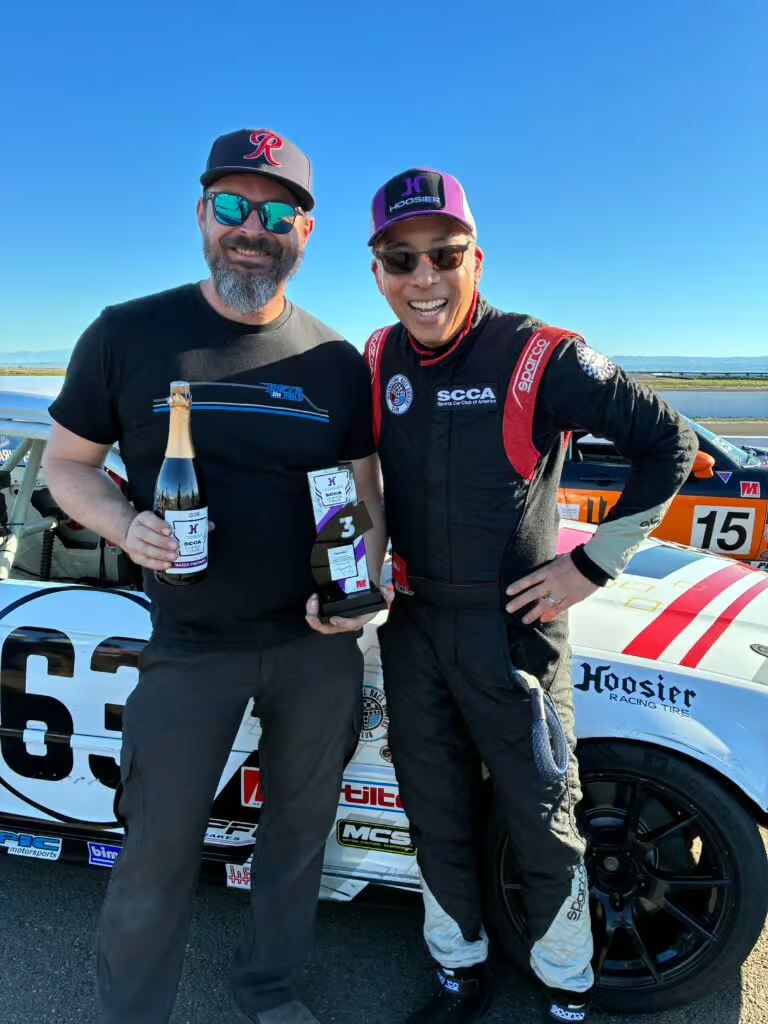
Ron left energized and sharper. More sensitive to the car. More decisive on throttle. Clear on what to improve next.

That’s exactly what this weekend was for.
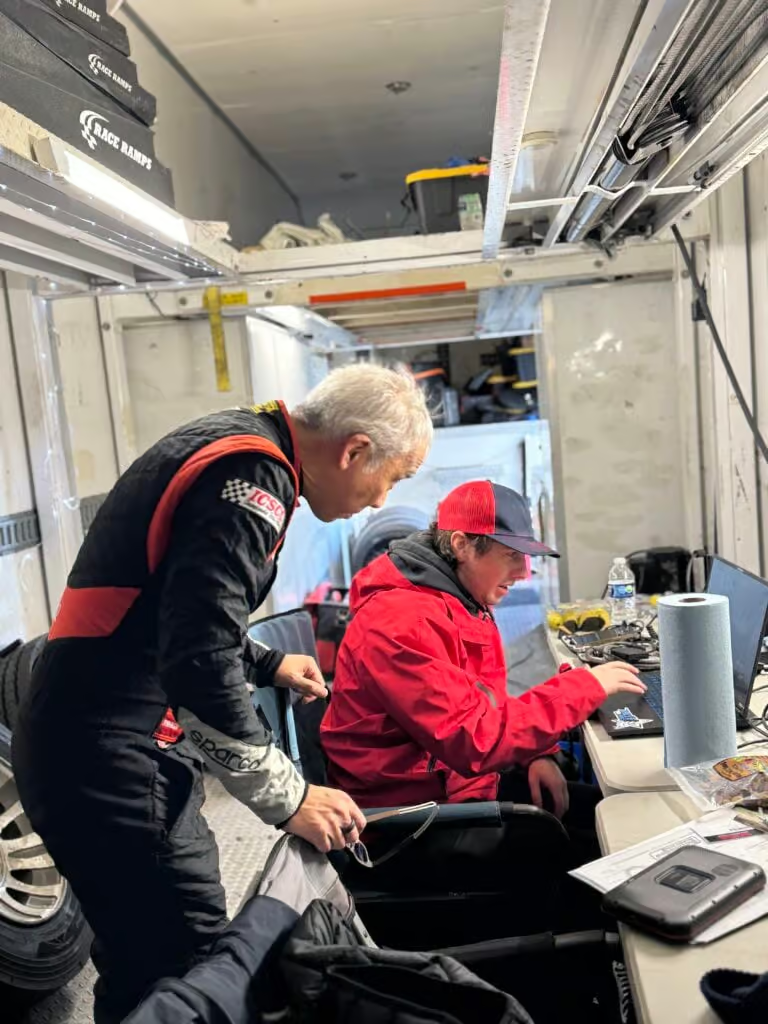
Tyler and Ron obsessing over the data, trying to figure out how to go faster, faster!

What We Take With Us

We worked through:

  • Snow-covered travel
  • Two clutch replacements
  • Cooling fan troubleshooting
  • Traffic-filled qualifying sessions
  • Tire degradation management

None of it materially impacted our results.

More importantly, the 370Z now has a clear and repeatable performance baseline. The upgraded big brake kit performed flawlessly. The car responds predictably to setup changes.
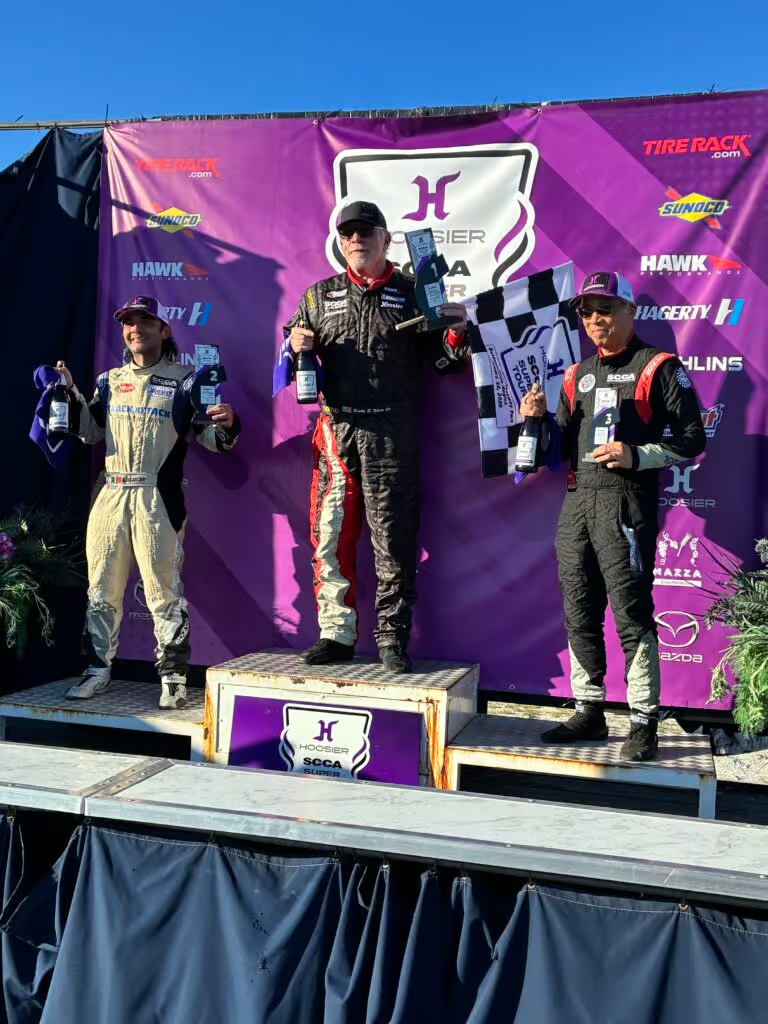
That’s a full PNW podium sweep for the Buttonwillow Hoosier Super Tour

We leave Buttonwillow not chasing something unknown — but building on something understood.

That’s the difference.

Goals were pursued with discipline.
Smiles were earned in the paddock and at dinner tables.
Memories were made in the moments that required composure.

Next stop: Sonoma Raceway with NASA.

The foundation is set.
Now we build.
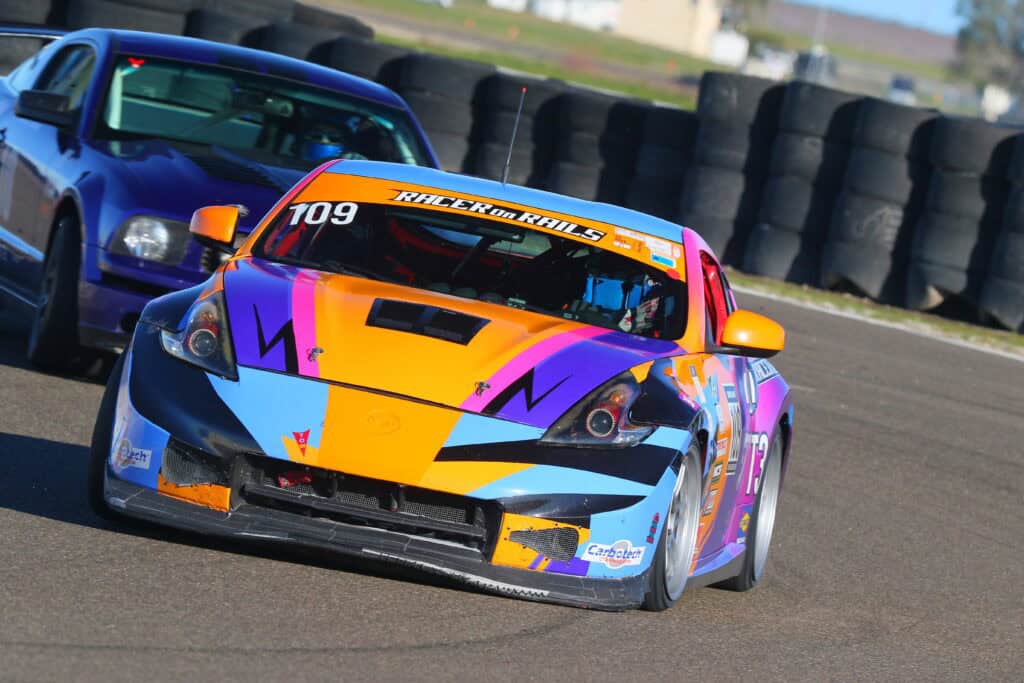
Gama making most of the camber near corner apex to get the most speed through the corner.
Posted on

2024 Hoosier Super Tour Race 1 – Sebring International Raceways

After a very short “off-season” coming off the 2023 SCCA Runoffs held at Virginia International Raceways for the second year in a row, the team regrouped, got cars turned and headed to Sebring, FL for the first race of the year.

With a new racing year, we have some changes on the team. For the first race, we brought down Simon Asselin in his 991.1 Porsche GT3 Cup Car, racing in the GT2 class for a second year in a row. Dave Orem has moved from a BMW Spec E46 in Touring 3 class, to the 2023 Touring 3 National Championship winning BMW Z4 M. Gama Aguilar returned in his freshly rebuilt Nissan Nismo 370Z, also competing in Touring 3 class.

Ann Doherty is in the middle of transitioning into a new car and new class for 2024 – stay tuned for updates! Thad Berger will be focusing on his Porsche Cayman GT4 MR in Touring 1 class but will miss the first couple of races and join the tour at Road Atlanta in March.

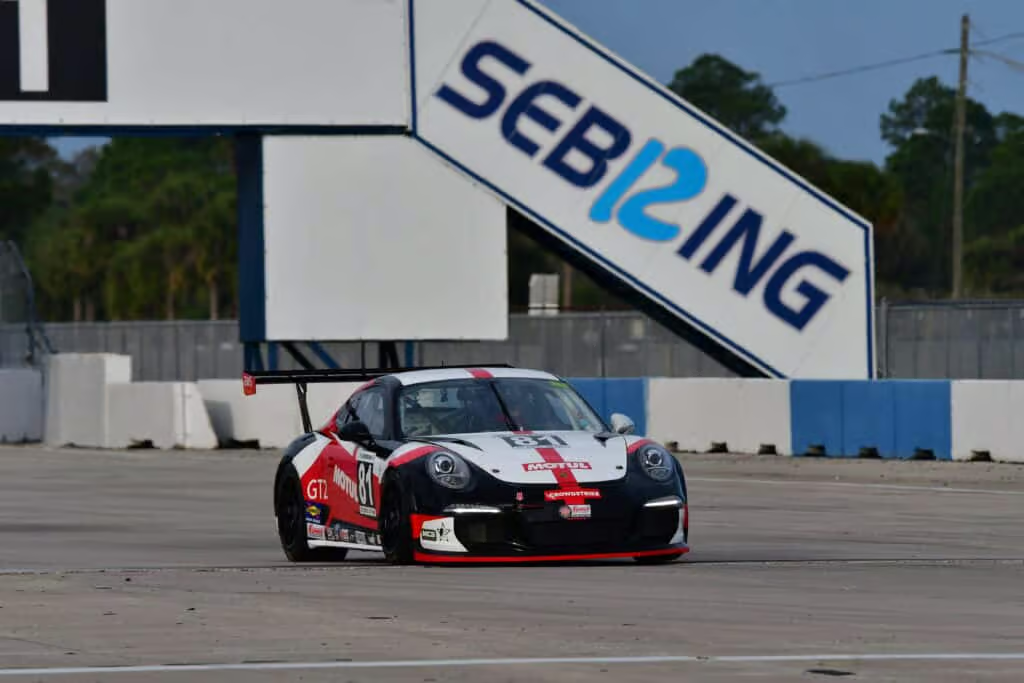
Simon Asselin Porsche 911 GT3 Cup Car in GT2 Class

Simon took official delivery and got his first laps in his Cup Car at this race last year. Since last year, Simon has had several solid race weekends, upgraded suspension with Motion Control Suspension (MCS) 3-ways, experimented with different tires, and iterated on both dry and wet setups. With a stronger foundational knowledge of the car and seat time, the goal for the weekend was to build on that and maximize competitiveness.

With the changing conditions throughout the weekend, it was a challenge to iterate on the dry setup but Simon made the most of the conditions for qualifying on Saturday AM with a P5 in full wet conditions and only 1 second separating him from P2.

At the start of the race, Simon lost a couple of positions but quickly got on his horse to recapture the positions and before a full course yellow came out that ended the race, Simon secured P5 and most importantly, improved on his PB at Sebring by 2 seconds!

Simon Asselin in his Porsche 991.1 GT3 Cup Car, racing in the GT2 class.
Simon Asselin piloting his Porsche 991.1 GT3 Cup Car at Sebring International Raceways at the SCCA Hoosier Super Tour.

On Sunday, the forecast was for cloudy skies but dry pavement. Well, the forecast didn’t pan out that way, and not at all. We awoke to passing showers and rain started properly falling before lunch. By race time, it was a full wet race and the first race group after lunch would be the GT2 race.

Right as the cars came around Turn 17 (Sunset) for the green flag, many cars moved into pit lane to change onto wet tires which shuffled the starting grid and created some confusion. A car on the second row lost control of the car at the green flag, tried to keep it together but unfortunately the car hooked right and ultimately making contact with several cars, including Simon who properly collected the other car. Simon had nowhere to go and thanks to all the safety equipment and design of the Porsche GT3 Cup Car, the energy was disbursed, eliminating major physical harm to Simon. He walked away from the incident and has been recovering well. The car took a significant hit to the front end and a more minor hit to the rear. That was the end of the race and we are actively getting the car evaluated and on a path to repair.

Dave Orem BMW Z4 M-Coupe in Touring 3 Class

Building off another solid year of driver development in the Spec E46, wanting to continue developing as a driver but also wanting to have a material chance to podium at our events, Dave couldn’t pass up on the opportunity to purchase the 2023 SCCA Touring 3 National Championship winning car.

The BMW Z4 M-Coupe is essentially an E46 M3 but with a smaller body that can punch through the air more effectively and a much lower center of gravity. At tracks like Road America where the Runoffs will be run over the next two years, where we spend a material amount of time over 100mph, this car is one of the favorites to continue competing for the top steps.

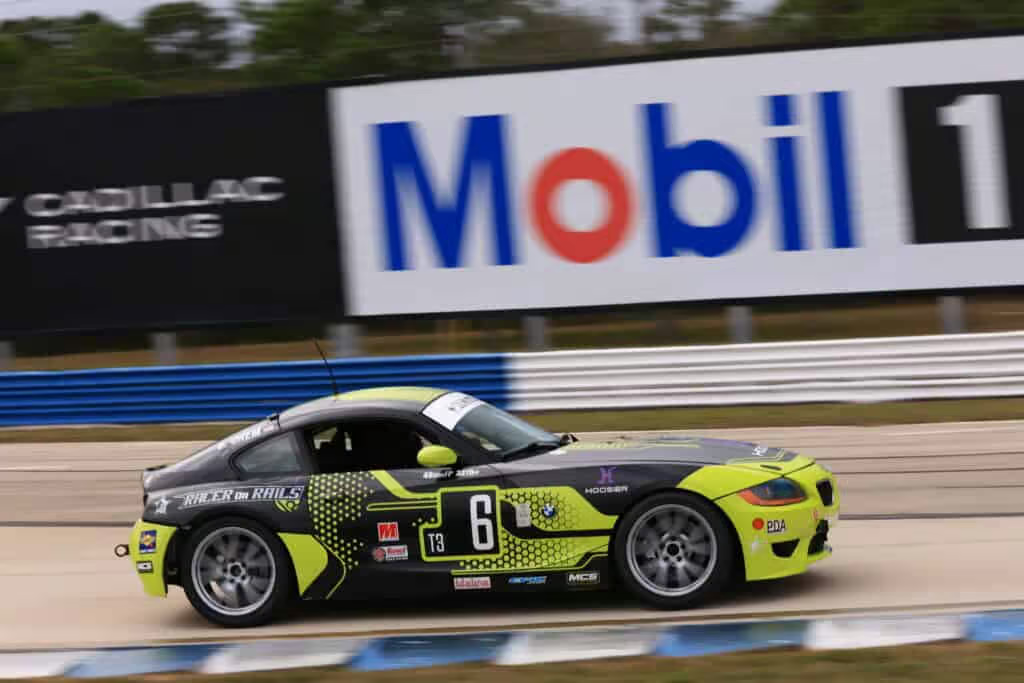
Dave Orem getting used to his new-to-him BMW Z4 M-Coupe in the SCCA Touring 3 Class at Sebring International Raceways

Dave only had limited testing before the trip and in cold/wet conditions so the goals for the weekend were simple: learn the car, build confidence and drive it into the trailer at the end.

During the Thursday Test day, Dave started building confidence in the car and getting used to the taller gearing compared to the Spec E46 but in the last session, he lost what would end up being an axle shaft (no drive), which left the team sourcing parts and getting the car fixed on Friday, thus missing practice on Friday. Saturday he qualified P7 in his first competitive wet session, while dropping time each lap. In the race, he lost a few positions in the start battling with T2, SMX and T3 cars, got himself settled in and started picking away at the cars one at a time. By the time a black flag came out that would eventually end the race, Dave had hit his best lap time in the car and feeling/seeing where the big chunks of time were left.

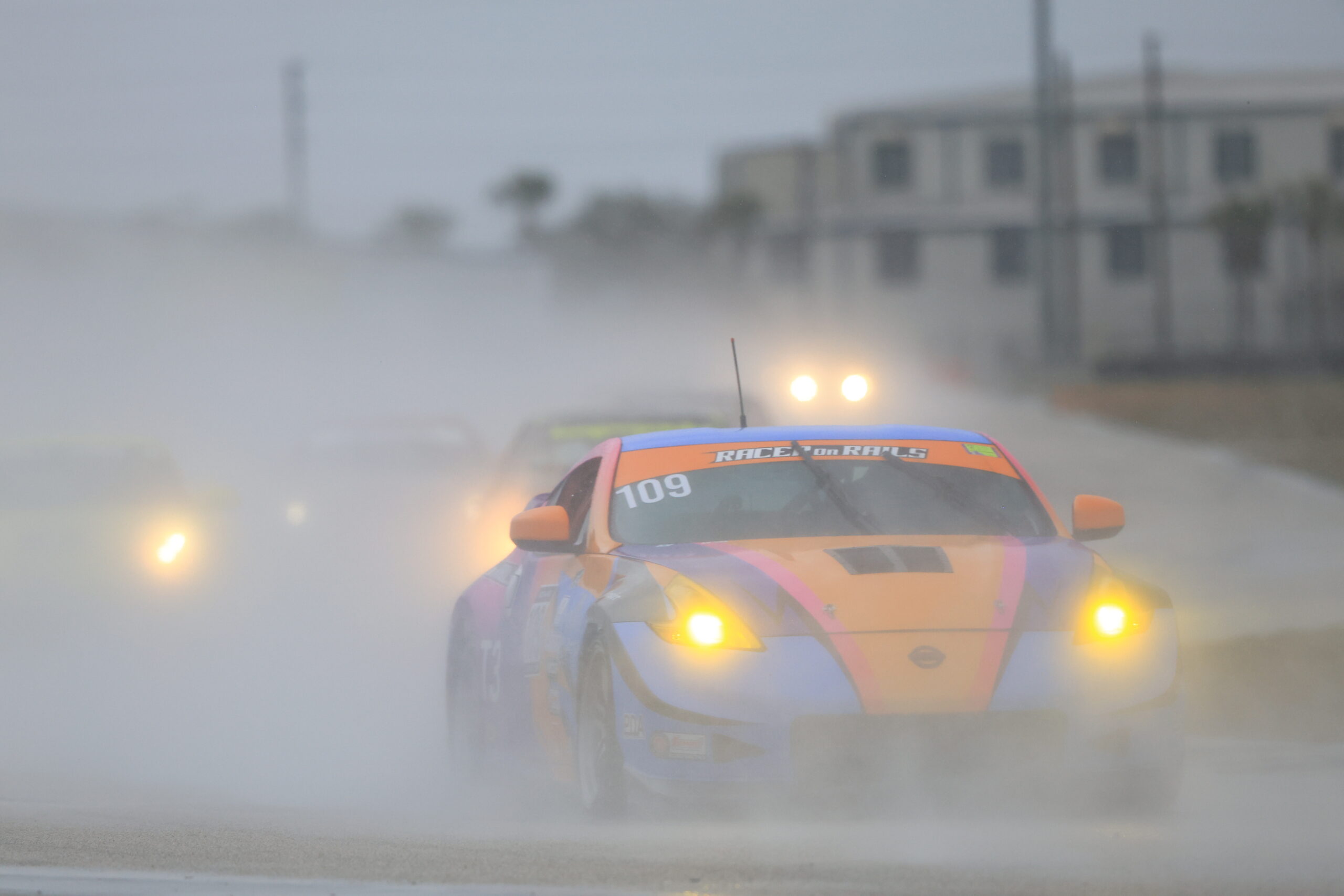
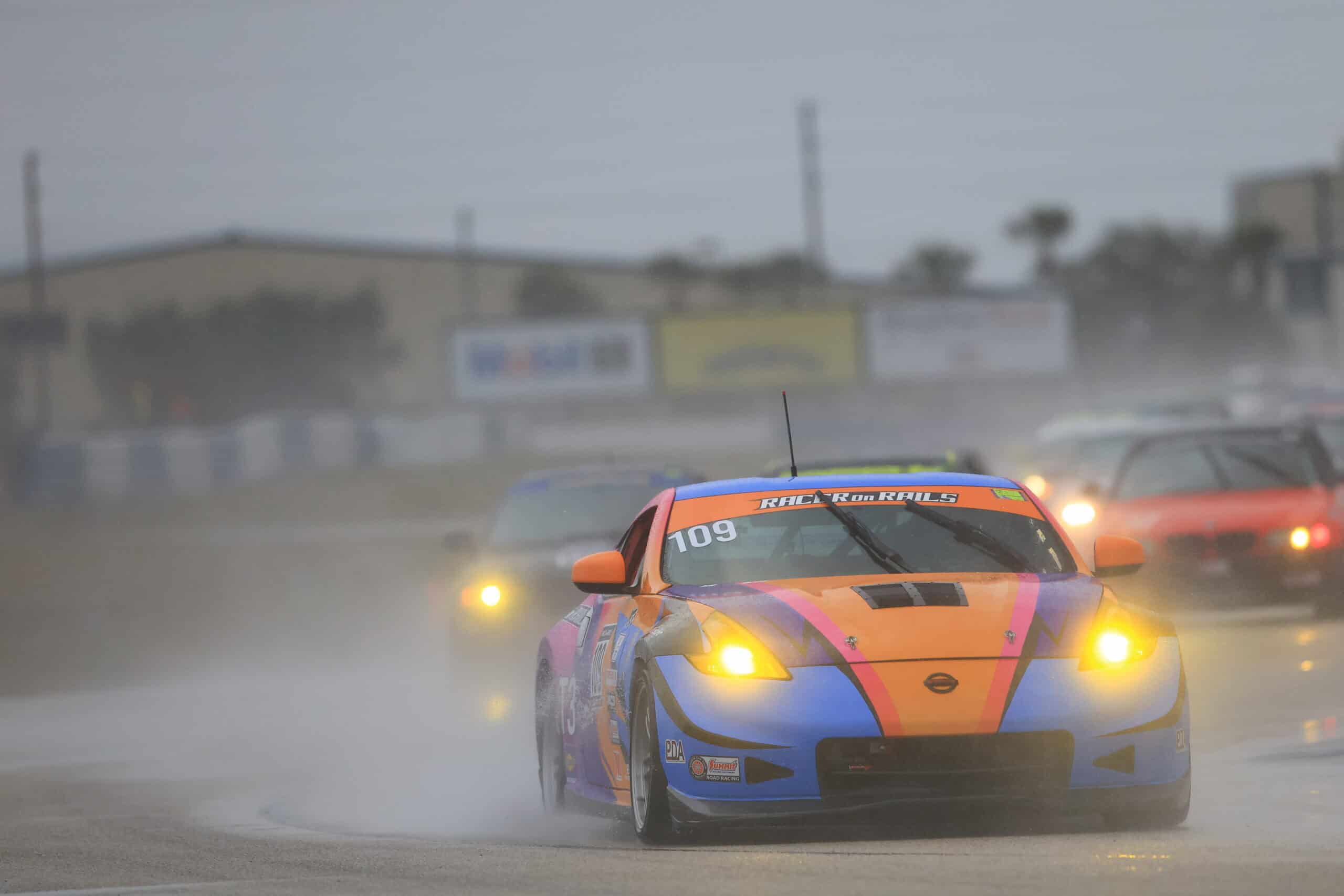
On Sunday, the Touring 3 race was the race right after Simon’s GT2 race, with full wet conditions. Dave started P16 overall, lost a few spots in the first few laps due to the visibility but after a full course yellow to move Gama’s 370Z that lost electronics due to the wet weather, Dave got moving and got back all but one position.

Overall given the inconsistent conditions throughout the weekend and battling through a lost day of running on Friday, Dave had an excellent first race weekend in his new-to-him race car.

Gama Aguilar Nissan 370Z Nismo Touring 3 Class

Gama debuted his 370Z at the 2023 Runoffs but unfortunately suffered from a catastrophic “Ice Mode” situation at Oak Tree corner where the car suffered significant front end damage, along with injuries that took 2.5 months to mostly recover. In that recovery time, Gama, Tyler Mayer and the team dug deep and got the car fixed and tested in time to make the Sebring race weekend.

Similar tone to Dave’s goal for the weekend, we only had a couple of goals for the weekend: first was to experiment, document, and share results on different potential solutions to better understand and mitigate the risk to “Ice Mode” and second, establish a baseline pace and characteristics to truly start leaning on the car.

Gama shaking down and testing things to figure out the brakes in his 2011 Nissan Nismo 370Z in SCCA Touring 3 Class

One of the leading theories behind Ice Mode is that the brake booster in the 370Z is WAY over-powered. That means that for every pound of pressure/pedal effort the driver makes on the brake pedal, the power assisted brake booster, magnifies that force into the braking system. This is normal in power boosted and ABS based braking systems and it makes sense for normal street driving where the cars are not being subjected to the G-forces that are seen in racing conditions and with extremely sticky tires. Normal drivers don’t need to hit the brakes very hard to get to maximum braking and they are usually on street tires with much less grip.

In our conditions, what we’ve found is that this overly powerful brake booster contributes to the ABS system freaking out and potentially locking the driver out of the braking system. Not good! So to test this theory, we installed an AIM Brake Pressure sensor and a Sakebomb Garage Variable Brake Booster Vaccum Controller. This device in installed in-line between the engine and the brake booster and can adjust the amount of vacuum fed to the brake booster and thus adjusting the maximum about of brake boosting, the booster can provide.

Learnings

After installing the vacuum controller, we turned it all the way “off” in that it didn’t apply any adjustment to the vacuum levels, we hit the brakes (with ending running) with a 10/10 brake pedal effort hit and saw the impact to the brake pressure sensor —> 2,000psi! Holy moly! That is insane. Now granted, that took a massive pedal effort that frankly isn’t realistic in any conditions but our normal pedal effort braking still resulted in ~1,800psi of brake pressure. That is still insane – not even Motorsport ABS systems can handle those levels of brake pressure in a system. We then modulated the pedal effort to see what it took to keep brake pressure below 1,000psi (generally accepted as about the max range most braking systems can handle *and* slow the car down – anything above these levels will not only make the ABS system overwork but it won’t effectively further slow the car down). The result was that it was dang near impossible to repeatedly be that gentle with the brake pedal and the modulation window from 600-900psi was even more difficult.

We don’t know 100% that this is the root of the issue behind Ice Mode but this sure as heck isn’t helping things. So we found the adjustment level where the max brake pressure we could possibly hit was ~1,000psi.

We also tested 2-piece rotors from Paragon, which have a more Motorsport focus hat design for better heat consistency across the rings and hats and we experimented with different brake pads, with all of them being in a direction of less aggressive pads.

Catching the overall theme here? All experiments were around making it harder for the OEM ABS system to freak out from sudden spikes in brake pressure and/or changes in wheel speeds.

The results? We’re going in the right direction. Prior to adjusting the controller to max ~1,000psi brake pressure, we didn’t hit ice mode but were able to get the wheels to consistently lockup in “heavier” brake application. Interesting that a functional ant-lock braking (ABS) system, still allowed tires to lock up. Hhhhmmm….

After making the adjustment and going straight into a race due to the transmission failing during the last test day session, the brake pedal was MUCH better and finally allowed me (Gama) to start building confidence in the brakes.

I started at the very back of the Touring field (split start) in P24. By the end of the race, I’d moved up 13 positions total, finished in P8, right on the tail of the next few cars in class and ending with the 3rd fastest lap of the race! Starting to cook with some real fire!

For Sunday’s race, we’d start closer to the front but in full wet conditions. The start was okay, picking up a position but not able to be more aggressive because how bad the spray was in front – literally couldn’t see more than 10-15 feet in front. Once the cars started stringing out, made up some more positions and mid-way through second lap was in P2 in class. Then suddenly the electronic controls inside the car went dead but the car was still running – clearly water had gotten in somewhere and started causing shorts.

Gama Aguilar moving to P2 before an eventual DNF due to water in electronics.

Going into T17, I broke early and soft but with the amount of water on the track and how bumpy the track is, I ended up spinning along with several other cars and thankfully, came to a stop before making contact with anything. With no functioning electronic controls in the car, I wasn’t able to get it running again and had to DNF.

Making Lemonade out of Lemons

To top things off, a fellow competitor in Touring 3 decided to protest me in the 370Z for running an illegal part, even though we had been openly discussing and sharing the testing plan, as the goal was to figure out how to make these cars safe, not to achieve a performance advantage. We were prepared and okay with this potential scenario but it was still disappointing for someone to protest the car when the focus was on safety *and* that competitor finished ahead of me on both races – e.g. no impact to his or anyone in the podium position places.

Despite that, we leave Sebring optimistic about what we’ve learned to make these cars safe for people to race in Touring 3 class. We are not only going to make a rules change proposal to allow this non-in-car adjustable controller for the Nissan 370Z and we are looking at ways in which we can still limit the vacuum to the booster, without the addition of a controller in case that proposal doesn’t go through.

What’s next? Round 2 at NOLA Motorsports Park!

The next round in the 2024 SCCA Hoosier Super Tour is at NOLA Motorsports Park in New Orleans, LA in February. Dave and Gama will be there for sure. Simon is TBD based on the outcomes of repairing the Cup Car and Ann is targeting to join at NOLA. This will be a new track for everyone so lots of time in the simulator is in store for all of us between now and the weekend of February 18th!

Big shout out to the whole Racer on Rails crew who made getting the cars ready and transported across the country, happen!