Posted on

One More Weekend, Plenty More to Learn: Haunted Horsepower at the Ridge

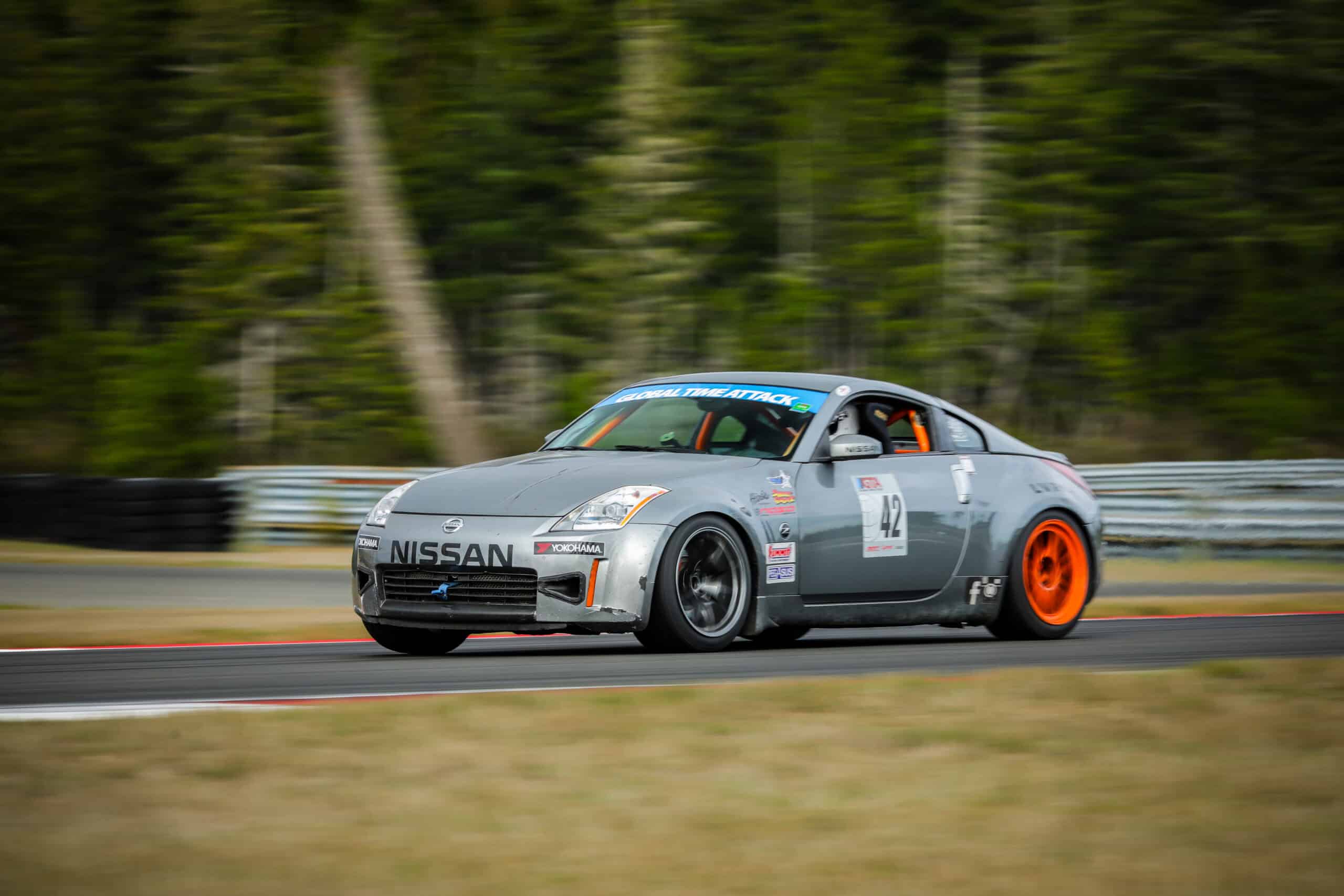
Silver-grey Nissan 350Z number 42 with an orange rear wheel cornering on a racetrack at the Ridge

There are worse ways to finish October than spending two consecutive weekends at the Ridge.

On October 24 and 25, Racer on Rails returned to Shelton for NASA Northwest’s Haunted Horsepower weekend. It was the closing chapter of our Pacific Northwest racing season, and we arrived with three cars, a few ideas to test, and an open mind about what we might learn.

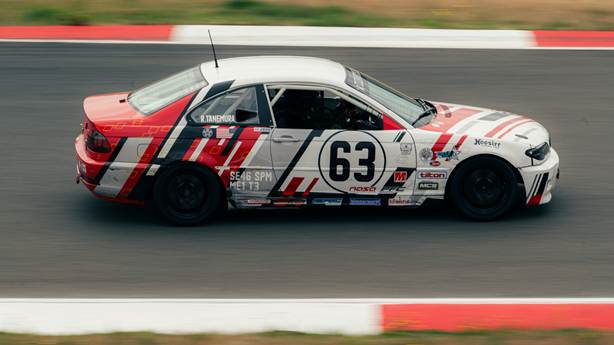
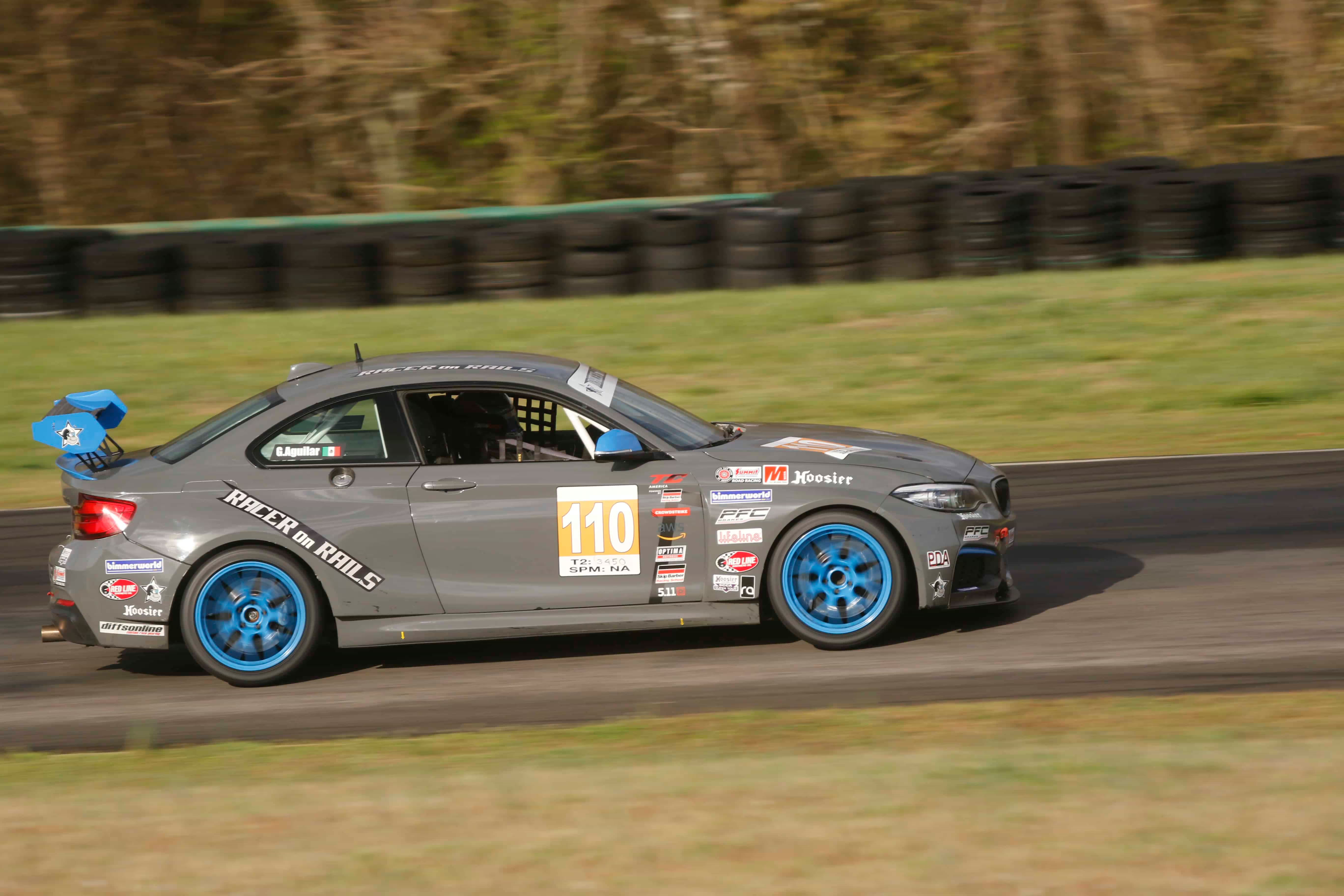
Ron brought his number 63 Spec E46. Gama drove our number 36 Silver Bullet — the numbers conveniently reversed. Joel Bergman joined us in his Nissan 350Z for his first NASA Time Trial weekend.

We also spent the weekend alongside Mario, whom we’d met at the previous event and helped get ready for this one, and Lawrence from GT Exchange, who was working toward his NASA racing license.

By Sunday afternoon, we had a new personal best to celebrate, a promising direction for our Spec E46 development, a mechanical mystery explained, and more reasons to be excited about the people joining our racing community.
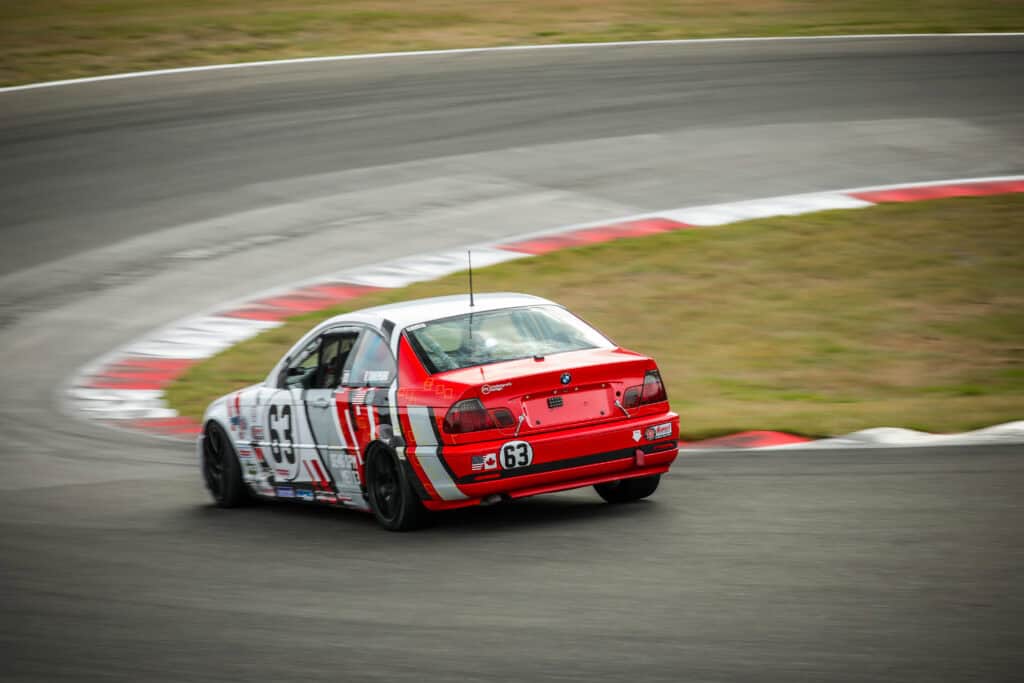
Red and white BMW Spec E46 number 63 cornering on a racetrack at the Ridge
Ron’s #63 Spec E46 at speed at the Ridge. Photo: Kirk Myhre / MC Motorsport Design

NASA’s Return Brings More Ways to Get on Track

NASA — the National Auto Sport Association — returned to the Pacific Northwest in 2026. One of the most valuable things it brings is a connected set of opportunities for drivers at different stages.

  • Arrive for your first-ever day on a racetrack and start in HPDE1 with an instructor.
  • As your skills develop, progress through HPDE 1, 2, 3, and 4.
  • From there, drivers who want to compete can work toward Time Trial or wheel-to-wheel racing, with the training and licensing each requires.
  • Or keep enjoying driver education for its own sake. Racing doesn’t have to be the destination.

For someone looking at all the different organizations and wondering where to start, that structure helps. NASA brings instruction, advanced driving, timed competition, and racing into the same event community. This weekend gave us examples of almost that entire journey right in our own paddock.

Making the Most of a Quieter Weekend

Late October comes with some realities in Northwest racing. Budgets have been stretched over a long season. The weather is turning. Some drivers have already packed things away for winter.

The race fields were light, and we weren’t arriving with a championship to settle. We saw an opportunity to spend time testing, comparing, and developing.

Ron, Tyler, and Gama had been discussing whether lessons from our 370Z, Cayman, and other car-development work could translate to the Spec E46. Those conversations led us toward a substantially different setup direction from what we’d previously used.

Saturday’s expected dry, consistent conditions gave us a chance to evaluate it.

We didn’t know whether it would be faster. We didn’t know whether we would like it. We came prepared to drive it, listen to what the cars told us, and see where the evidence led.

The Silver Bullet Gives Us Something to Work With

Almost immediately, the Silver Bullet felt different.

The car was settled, compliant, and willing to put power down. Gama’s first impression was that it might be the most compliant Spec E46 he had ever driven.

That confidence mattered. Instead of constantly anticipating the car breaking loose, he could gradually ask more of it and explore where the limit actually was.

The lap times came into the one-minute-fifty-twos quickly. Getting into the fifty-ones took more commitment, but soon the laps were repeating: a 1:52.0, a 1:52.1, a 1:51.9, a 1:51.7.

The encouraging part was how consistently the car allowed that pace.

There was still work to do. Gama felt there was more time available in the braking and corner-entry phases, and more to explore through small setup changes. This was an initial day of testing, with room left to refine both the car and the driving.

We’ll keep the technical details in our notebook. What we can share is that we left Saturday with a clear reason to keep pursuing this direction.
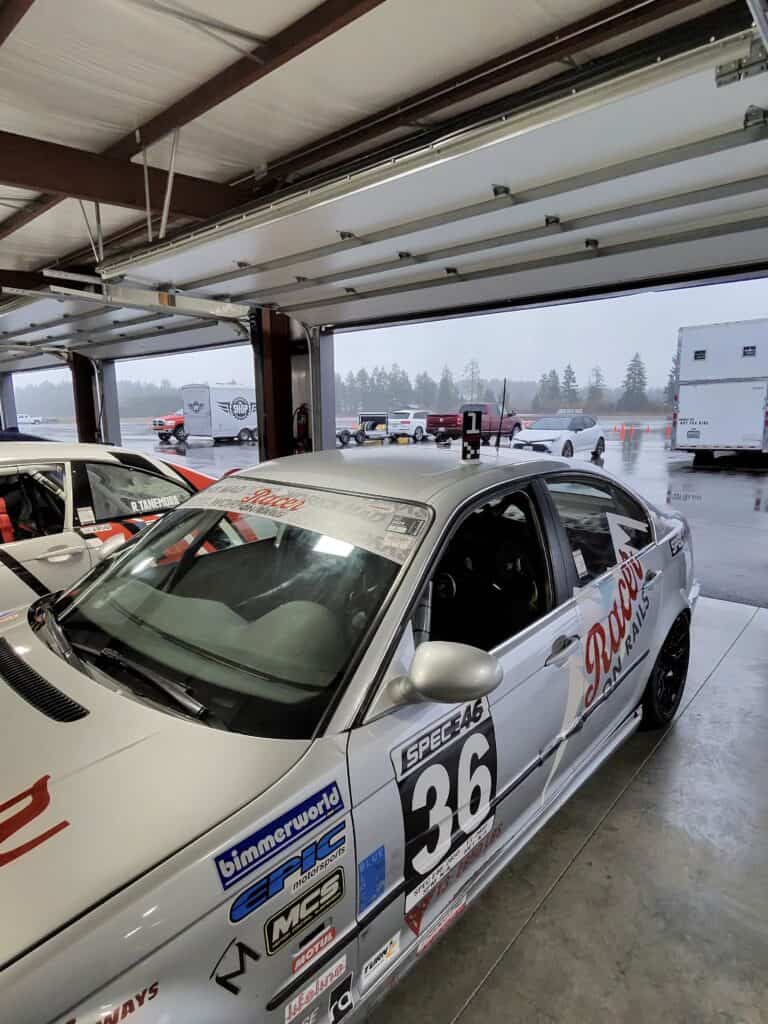
View from inside a race garage looking out at a wet paddock, with the roof of a race car in the foreground
The #36 Silver Bullet in the garage at the Ridge.

Two Similar Setups, Two Different Experiences

Ron felt an improvement in his car, too. But his feedback included something Gama wasn’t experiencing in the Silver Bullet.

His number 63 remained edgy, especially under power. It felt more compliant than before, but it still wanted to step out. He couldn’t lean on it with the same confidence.

For Saturday’s final race, we swapped cars.

Gama drove Ron’s car, and Ron drove the Silver Bullet. That gave both drivers a direct comparison and helped us separate what was specific to the car from what might have been a difference in driving.

Gama came back with a similar assessment to Ron’s. The car was moving in the same general direction, but it didn’t fully settle. There was still an underlying nervousness.

The intended setups were the same. The experience behind the wheel wasn’t.

Sunday morning, Jordan found a significant clue while preparing the cars: a front sway-bar mounting component on Ron’s car had failed, leaving the bar connected at only one end.

That gave us a mechanical explanation consistent with the feedback. We couldn’t say precisely when the failure occurred, but we could say that Ron had identified a real difference, the car swap had reinforced it, and the inspection had uncovered a problem.

That’s a valuable development process: listen to the driver, compare carefully, and investigate.

Wet-Weather Learning — and Choosing the Best Seat Time

Sunday brought rain and a different assignment.

For the first wet race, Gama returned to the Silver Bullet and Ron drove his own car. Gama used his pace to give Ron a moving reference, watching the gap and increasing speed as Ron gained confidence.

Ron responded. He adapted, found speed, and at points maintained the gap even with the unresolved issue affecting his car.

For the final race, we decided the most useful thing we could do was give Ron the Silver Bullet.

That put him in a car we knew was behaving predictably, so he could concentrate on his wet driving without the sway-bar problem complicating every sensation and every piece of feedback.

Gama stepped out, and Ron took the seat.

With limited track time left in the season, that was where we felt it could provide the most value.

Joel’s 350Z: Preparing the Car for the Driver’s Next Step

Joel came into the weekend having already made significant progress in his 350Z.

Most of his recent experience had been with OnGrid, including timed competition. He was still building his fundamentals, but the development since earlier in the year had been substantial.

The Ridge is the track he knows best. When we saw another Time Trial opportunity there, with lighter attendance and the prospect of plenty of track time, Gama encouraged him to come out.

Joel jumped on it.

Before the weekend, though, we had a problem to address.

At his previous event, we had been managing brake heat and damaged caliper seals. Refurbished replacement calipers of the same general type hadn’t solved the underlying limitation.

Fortunately, our 370Z development had left us with some useful hardware. After Gama’s T3 car moved to Paragon six-piston calipers, its former Akebono calipers became available. Gama gave those to Joel, along with spare Paragon two-piece rotors.

Combined with fresh brake consumables and ducting, that gave Joel an upgraded front braking package.

Across two days of driving, we monitored the temperatures and were pleased with the results. The brakes delivered strong, consistent performance throughout the event.

That meant Joel could focus on driving.

An Early Mistake, Then a Deliberate Reset

Saturday didn’t begin exactly as Joel hoped.

On his first flying lap, a little too much enthusiasm at the carousel sent him wide, with a tire dropping into the dirt. He checked in with the Time Trial group leader, and the opening session passed without a useful flying lap.

He reset.

Between sessions, Joel reviewed his previous onboard laps and spent time visualizing what he wanted to do. We revisited the priorities from his last visit: finding the apex with his eyes, getting the car pointed, and coordinating throttle application with the release of steering angle.

The goal was to feel how those inputs worked together — to add power with intention, understand the car’s response, and manage the exit rather than hesitate through it.

His second session produced a small improvement.

The third brought a more significant step, into the low one-minute-fifty-fives and toward the fifty-fours. Traffic made it difficult to repeat the best laps, but the potential was there.

For his final session, the assignment was to put it together consistently.

He did.

In the clear laps near the end of that session, Joel repeatedly ran in the one-minute-fifty-fours. By our count, five of his final seven laps were in that range.

He finished with a personal best of 1:54.32 — approximately a second and a half faster than his August best.

That’s a substantial improvement. Just as satisfying was watching him back it up with multiple laps at a similar pace.

His theoretical best, combining his strongest sectors, was down in the low one-minute-fifty-threes. Sunday’s rain meant we didn’t get another dry day to see whether he could connect those pieces, but he left with a clear opportunity to pursue next time.

A mistake in the first session became a small part of a much better story: regrouping, applying a plan, and developing speed he could repeat.
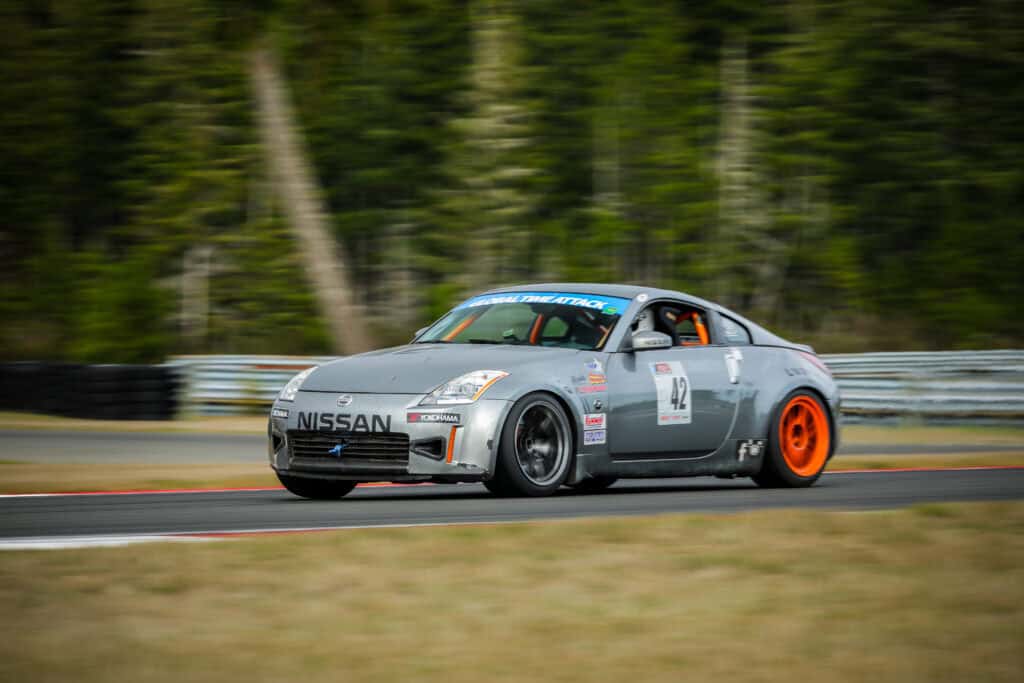
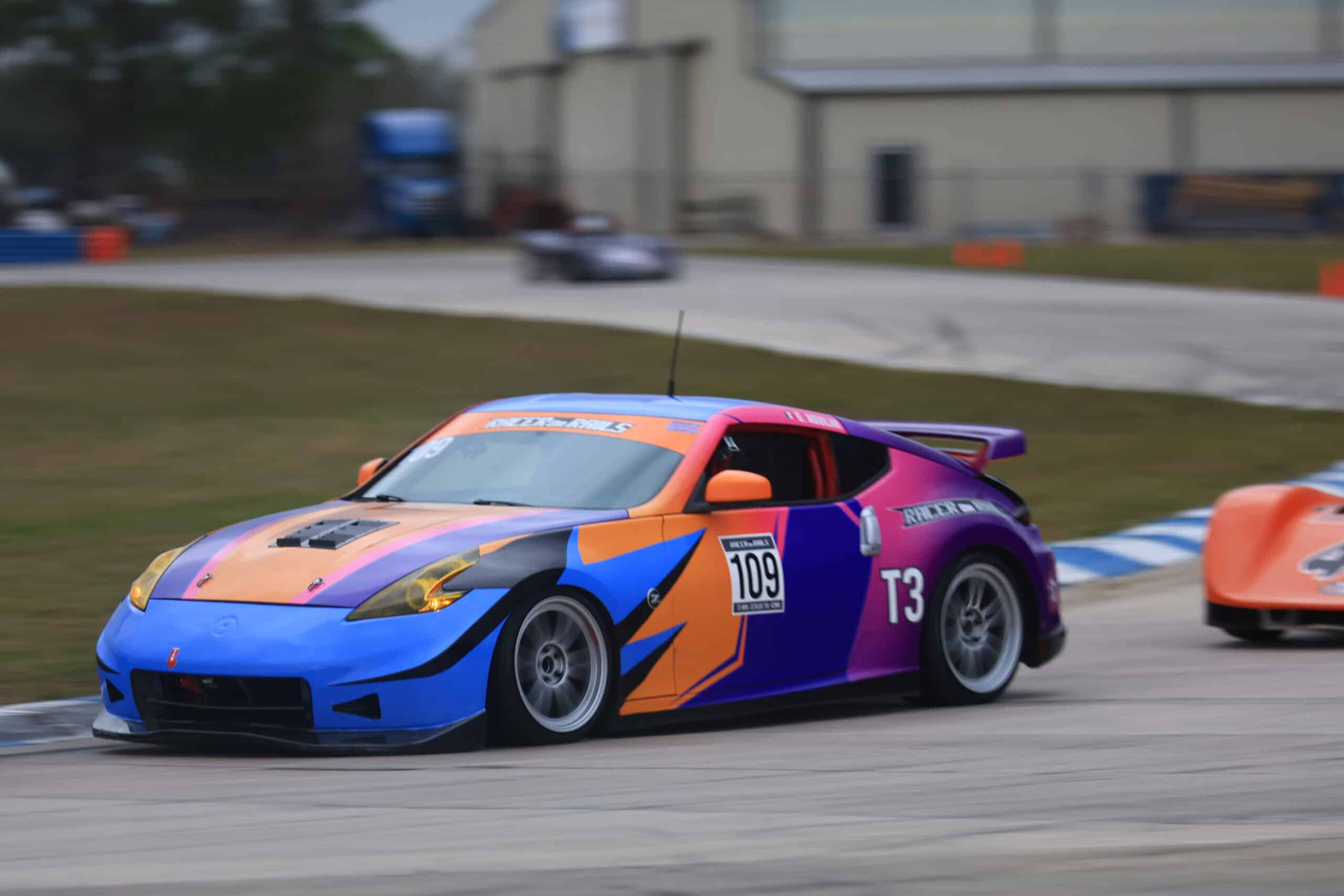
Silver-grey Nissan 350Z number 42 with an orange rear wheel cornering on a racetrack at the Ridge
Joel’s 350Z at the Ridge. Photo: Kirk Myhre / MC Motorsport Design

A Thank-You to NASA Northwest for Opening the Door

Lawrence’s weekend highlighted another reason we appreciate having NASA Northwest here.

He already had considerable track-day and time-attack experience, with serious speed in his Porsche GT3 Cup. He wanted to take the next step into wheel-to-wheel racing, including opportunities with the new Washington Enduro Cup.

But by late October, finding an available competition school was becoming difficult.

Being fast is one part of the preparation. Racing alongside other cars requires its own skills, judgment, and training, and Lawrence needed an opportunity to complete that work.

Gama connected him with Jason Perry, knowing NASA Northwest could accommodate individual competition-school instruction during race weekends.

Jason and Danielle Perry helped put a plan together. Lawrence completed the competition coursework over the weekend and participated in races, including some excellent, respectful battles with Mario.

A huge thank-you to Jason, Danielle, and the NASA Northwest crew for their flexibility and effort.

They helped an experienced driver find a practical path through the required training and onto the grid before the season ended. Growing motorsports takes people willing to make those opportunities possible.
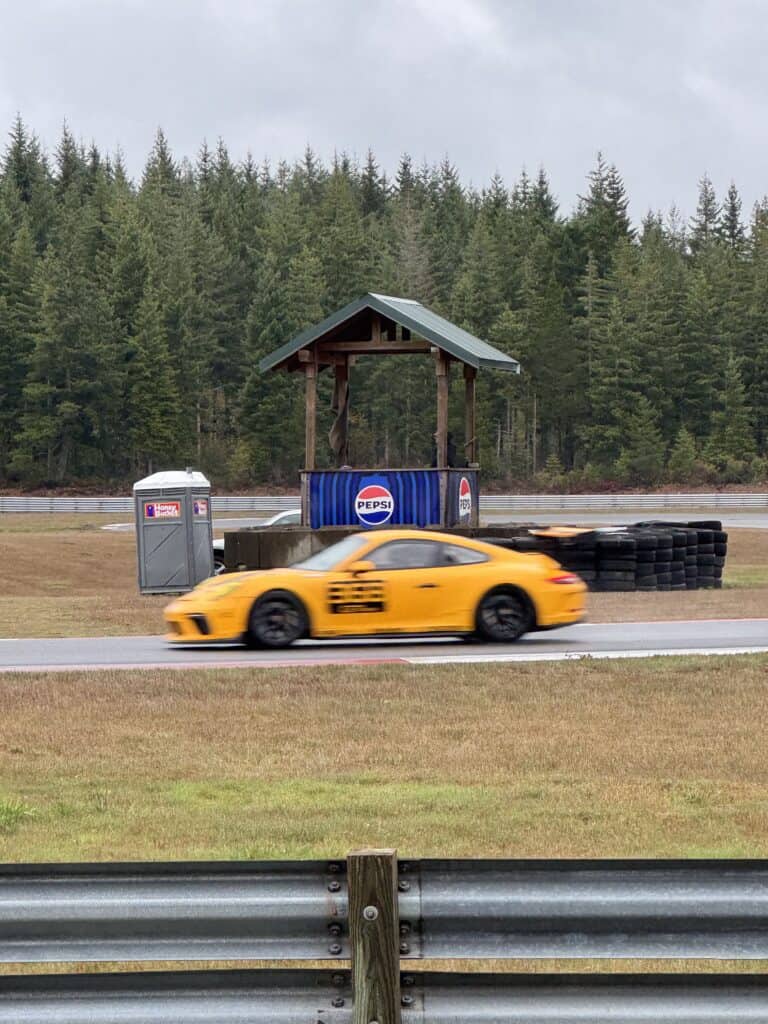
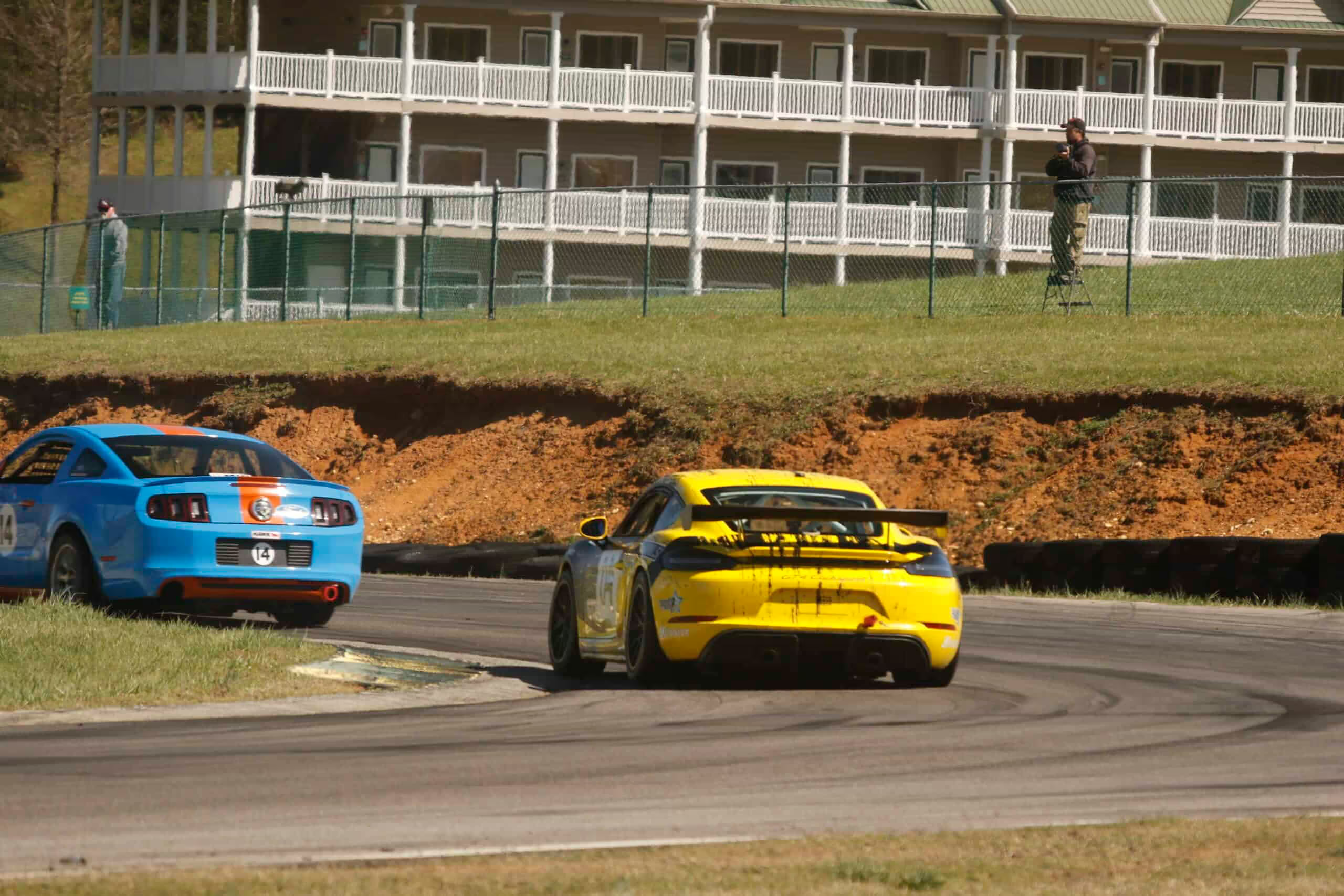
Yellow Porsche GT3 Cup race car at speed on a wet racetrack at the Ridge
Lawrence’s GT3 Cup at speed at the Ridge. Photo: Charlie.
Charlie capturing Lawrence’s GT3 Cup from the fence. Video: Meta Ray-Bans.

That weekend was also Charlie’s first race weekend with us — days at the track, nights in the RV, and a game night playing Minecraft Dungeons 2.

Looking Ahead With the Spec E46 Community

We also left the Ridge feeling grateful for the Spec E46 community and excited about what comes next.

The development work was encouraging, but the level of driving deserves recognition, too. The pace we’re seeing from Ron and several other drivers is the kind that puts people in contention for podiums and race wins.

Over the past several years, and especially this season, we’ve watched drivers become faster, more consistent, and better able to explain what they feel and act on what they learn.

That progress takes effort. It comes from reviewing laps, asking questions, trying something different, and showing up ready to work again.

Getting to be part of that process is one of the most rewarding things we do.

There are also more people interested in joining the class.

We enjoyed spending time with Mark and hearing about his interest in purchasing a Spec E46. A friend of his, racing an S2000 that weekend, was also considering the move. A longtime track driver and Honda enthusiast, he was drawn to a spec class because he wanted to focus on developing his driving through close competition.

We love hearing that.

Looking toward next year, we have drivers interested in continuing to compete here in the Northwest and traveling to California and other West Coast tracks. There are new challenges to take on and more opportunities to learn from one another.

Thank you to everyone who has raced with us, trusted us with their cars and development, shared feedback, or stopped by the paddock to talk about getting started.

Thank you to Tyler, Jordan, and the crew for the preparation, coaching, and problem-solving that made this weekend productive. And thank you to the organizers, instructors, volunteers, and workers who gave us one more opportunity to get on track.

We came to the Ridge ready to experiment.

We left with a faster Joel, a promising direction for our Spec E46s, valuable lessons from Ron’s feedback, and more people taking steps toward the racing they want to do.

That’s a pretty good way to finish a season.
Posted on

Racing for Linda: IRDC’s Blackburn Memorial Invitational at the Ridge

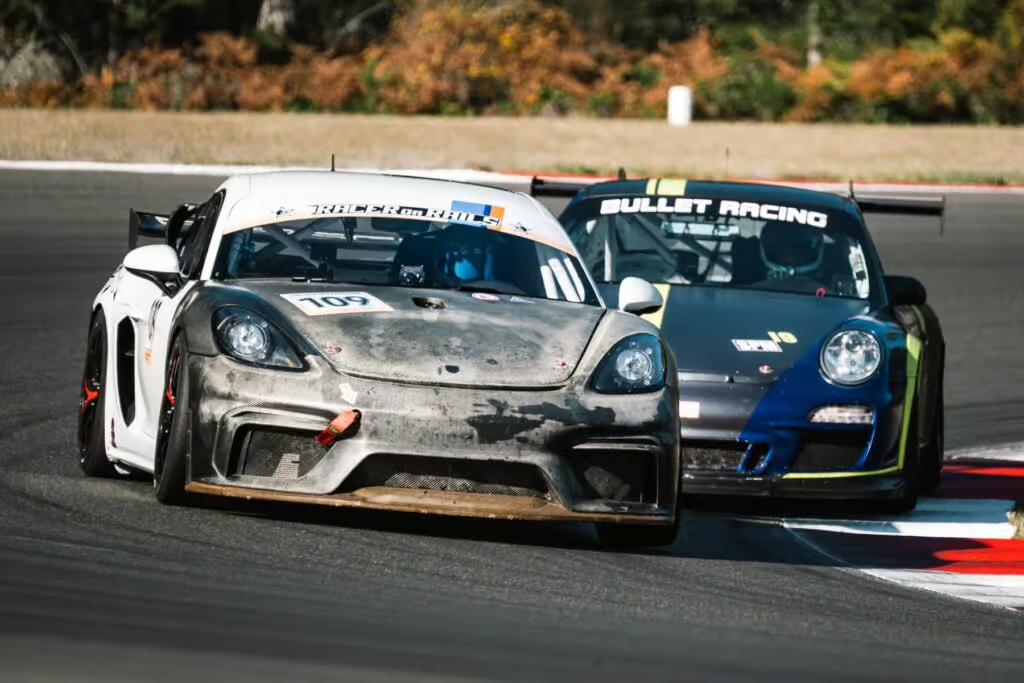
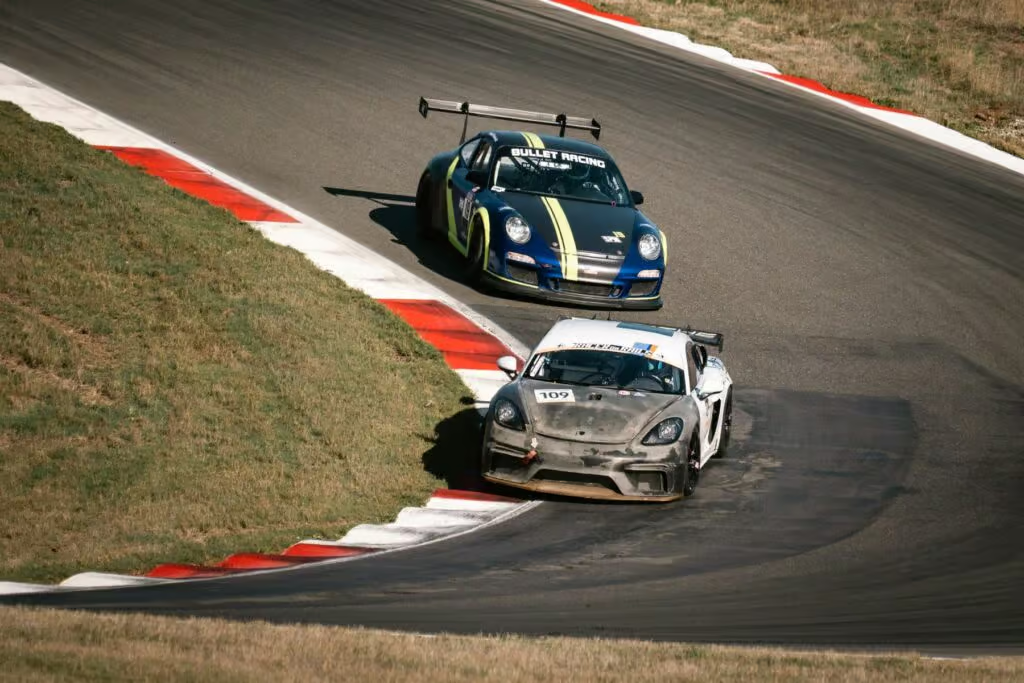
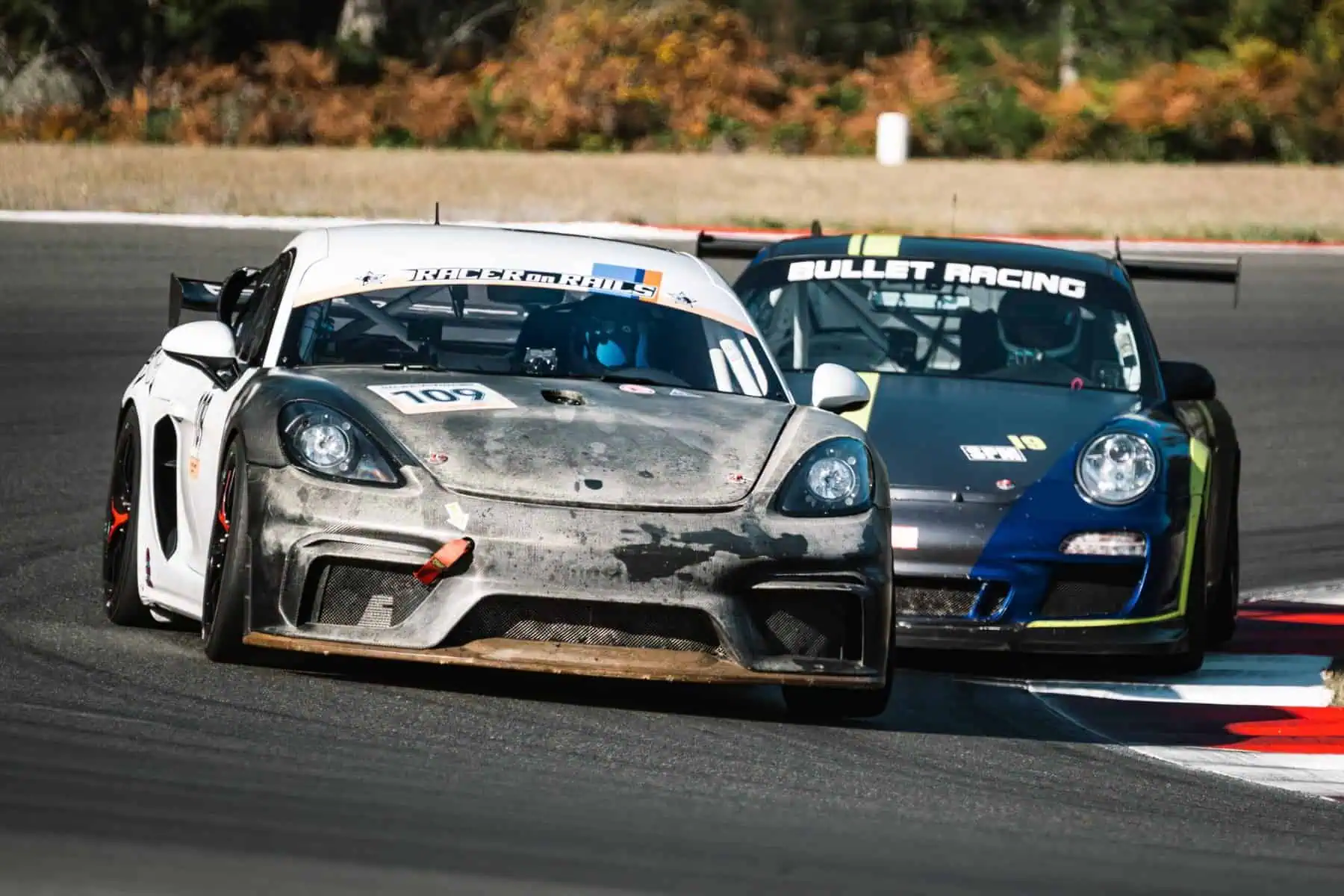
Gama in Racer on Rails' #109 Cayman GT4 MR battling Michael Conatore's #19 Porsche 997 GT3 Cup car at The Ridge.

IRDC’s Linda Blackburn Memorial Invitational | October 17–18, 2026 | The Ridge Motorsports Park

Gama in Racer on Rails' #109 Cayman GT4 MR battling Michael Conatore's #19 Porsche 997 GT3 Cup car at The Ridge.
Gama in Racer on Rails’ #109 Cayman GT4 MR battling Michael Conatore’s #19 Porsche 997 GT3 Cup car at The Ridge. Photo: Peng Du.

October racing in the Pacific Northwest is a gamble.

By the middle of the month, summer is usually a distant memory. Rain becomes increasingly likely, temperatures drop, race cars start getting winterized, and drivers suddenly remember all the things they promised their families they’d do once racing season ended.

So when the International Race Drivers Club (IRDC) decided to add a brand-new October race weekend at The Ridge Motorsports Park, there was some risk involved. But there was also a really good reason to try.

The Linda Blackburn Memorial Invitational, held October 17–18, was a new non-championship event sanctioned by ICSCC, with Friday testing hosted by our friends at Turn 2 Lapping. It gave Northwest racers one more opportunity to get on track, helped build momentum for the newly established Porsche & Ginetta Cup, and brought the club together for something it hadn’t done since before COVID: an IRDC year-end banquet.

And the weather? Well, we got lucky. After a damp start to Saturday, beautiful fall sunshine and cool temperatures gave us plenty of opportunities to make race cars go fast.

For Racer on Rails, we arrived with three cars, some new hardware to test, a new-to-us Porsche Cayman GT4 MR, and a whole bunch of reasons to be excited about what’s ahead.

Remembering Linda Blackburn

Before getting into the racing, we need to talk about the person this weekend was named for. If you’ve been around Conference racing for any meaningful amount of time, you know that the people who make our sport happen aren’t just the people sitting behind steering wheels.

Linda Blackburn was one of those people who helped make everything possible. I’ve been involved in Conference racing for somewhere around 15 years, and for as long as I can remember, Linda was simply always there.

She spent many years volunteering with Cascade Sports Car Club and the broader Conference community, helping with registration, timing and scoring, club administration, and the countless other responsibilities involved in putting on amateur road racing events. Her contributions stretched back many years, including receiving Cascade’s Outstanding Membership award in 2012.

Linda passed away in 2025, leaving behind a remarkable legacy of service to Northwest motorsports. What I particularly appreciate about naming this event after her is that it celebrates the work of somebody who spent so much of her life helping other people enjoy the sport.

We racers tend to measure our weekends in lap times, positions, and trophies. But none of that happens without the people handling registration, waving flags, managing timing and scoring, staffing race control, organizing the paddock, and doing all the work behind the scenes.

Thanks, Linda. And thanks to everyone who continues that tradition.

A New Porsche Chapter for Racer on Rails

One of our biggest objectives for the weekend was to shake down our newest addition to the Racer on Rails fleet: a 2020 Porsche Cayman GT4 Clubsport MR, carrying number 109.

Earlier this year, we sold the Cayman GT4 Clubsport Track Day Edition that had been part of our program for the past few years. We’d purchased that car after it had been damaged, brought it back to life, developed it further, and enjoyed a whole lot of driving and racing with it. The #109 represents the next chapter in that journey.

We’re making a bigger investment in Porsche performance and driver development at Racer on Rails, and part of that means having the right equipment to support the programs we want to build.

For this car, the initial objective was straightforward: complete our post-purchase inspections, bring the maintenance current, address anything requiring attention, and get it onto the racetrack to validate that everything was functioning properly.

Longer term, the #109 is intended to become an important training and development platform for our drivers. We also want to have it on the grid throughout the 2027 Porsche & Ginetta Cup season, helping support the growth of that new series. But before we could start inviting other people to drive it, we needed to make sure we understood the car ourselves.

And, naturally, there was already a small adventure involved.

When we received the GT4, its steering wheel was missing two buttons needed to operate the car properly. Through our friends at Avants, we were connected with Paul, another Cayman GT4 MR owner, who was incredibly gracious in allowing us to borrow his steering wheel so we could validate the car and get it ready for the weekend.

That’s no small favor when you’re talking about specialized Porsche motorsport equipment. Paul, seriously, thank you! We couldn’t have done this weekend without your help, and we’re looking forward to returning the favor with simulator coaching with Tyler and some time together at the track.

It’s another example of something I love about the motorsports community. A shared passion for these machines has a funny way of turning strangers into people who are willing to help each other out.

Getting acquainted with the #109 GT4 MR during its first race weekend with Racer on Rails.
Getting acquainted with the #109 GT4 MR during its first race weekend with Racer on Rails. Photo: Peng Du.

Dirk’s Cayman: One Limitation at a Time

Joining us for Friday testing was my good friend and RoR driver Dirk Groeneveld, back in his 2010 Porsche Cayman Base that we’ve been developing for SCCA Touring 3 competition.

We’ve already gotten several test days and a full race weekend under our belts with this car, and it’s become a really fun engineering and driver development project.

One of the principles we’ve been trying to follow is that rather than immediately throwing the entire Porsche performance parts catalog at the car, we want to understand its limitations and address them methodically. Identify the current constraint, make a thoughtful change, validate the result, and then move on to the next opportunity.

At our previous weekend at The Ridge, we’d established that the first major limitation was the braking system, particularly the thermal performance and longevity of the factory rotors.

For this event, we installed DBA one-piece slotted brake rotors and fresh pads. Based on our prior experience with DBA products, we thought they might offer a meaningful improvement without immediately requiring expensive two-piece racing rotors or a complete brake system overhaul.

We also have additional brake cooling and PDK cooling upgrades in the works, but some of those parts didn’t arrive in time. That’s okay. We still had plenty to test.

Friday went really well. Dirk was running on used Hoosier tires and was already back into the low-1:50 range, continuing to build confidence and familiarity with a car that is proving to be seriously quick for its class.

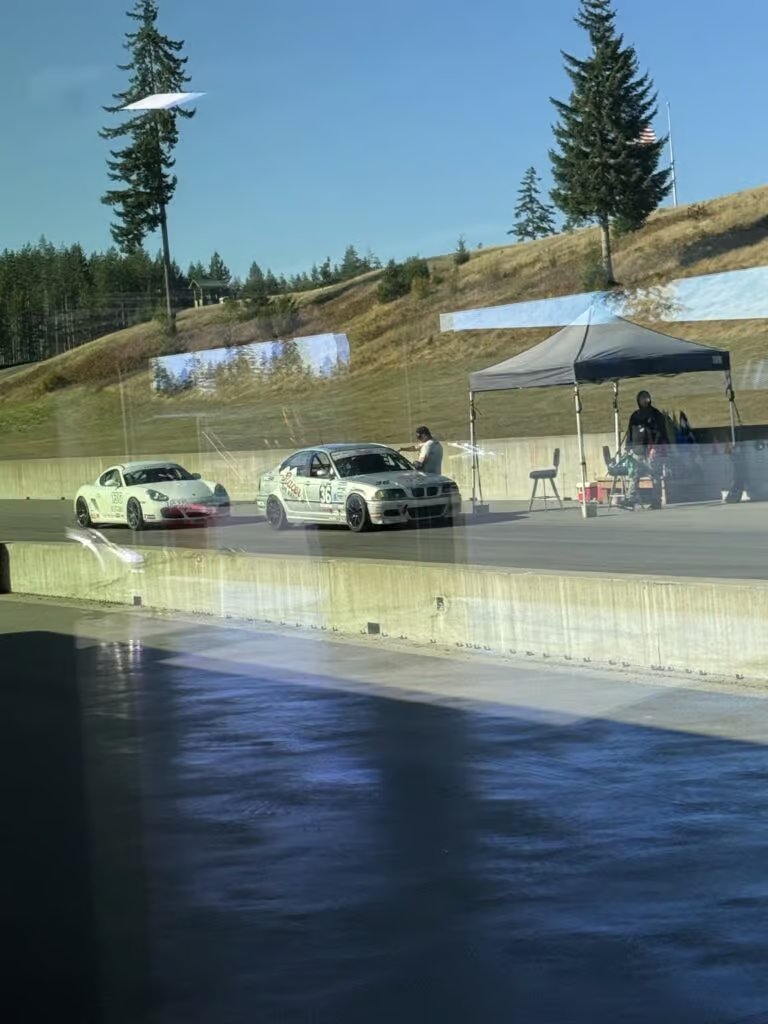
Dirk and Tim lined up for Friday testing. Two drivers, two very different race cars, and another opportunity to work on their craft.
Dirk and Tim lined up for Friday testing. Two drivers, two very different race cars, and another opportunity to work on their craft. Photo: Gama Aguilar / Racer on Rails.

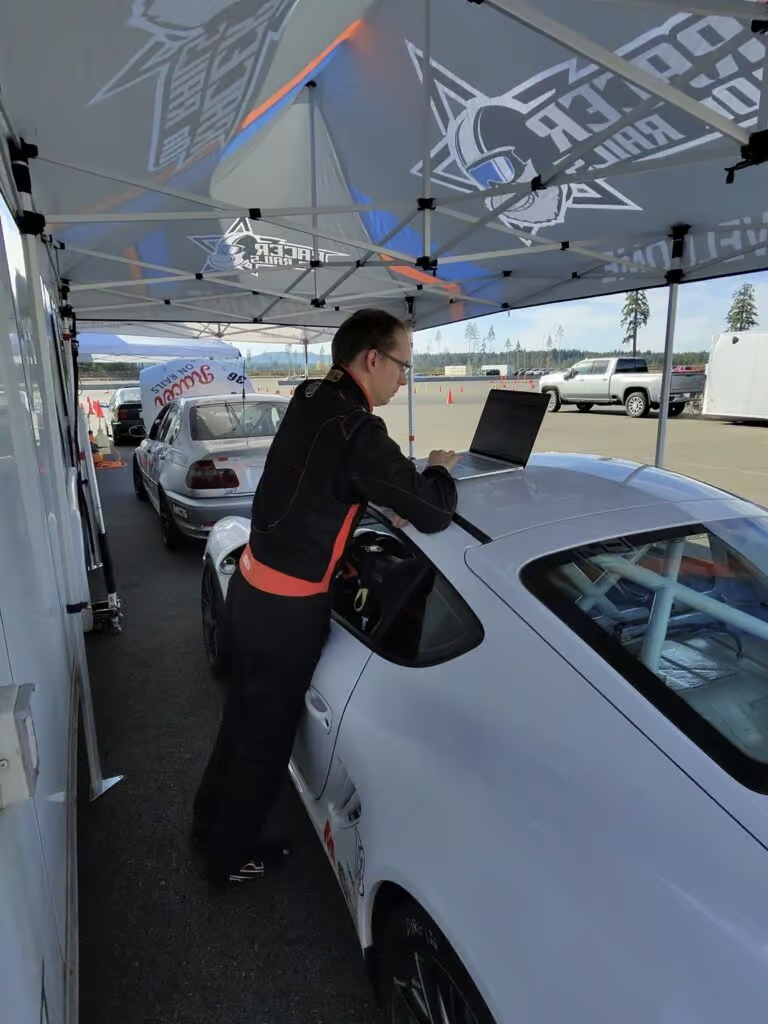
Equally important, Dirk was spending time between sessions reviewing data, evaluating his driving, and helping us understand how the car was responding.

Dirk reviewing session data between runs. Every session is another chance to understand the car, refine the driving, and build speed.
Dirk reviewing session data between runs. Every session is another chance to understand the car, refine the driving, and build speed. Photo: Gama Aguilar / Racer on Rails.

This was exactly the kind of Friday we wanted. Good pace, useful feedback, and more information to guide the next round of development. With Dirk looking toward a national SCCA Touring 3 program in 2027, every weekend like this helps us prepare both the driver and the car for what’s ahead.

Then Saturday morning happened.

A Coolant Line, a Deadline, and a Different Porsche

Saturday began with damp conditions for the first Porsche & Ginetta qualifying session. Dirk went out in his T3 Cayman, but with the track still transitioning from wet to dry, it wasn’t really a session for chasing outright pace.

Later that morning, Dirk completed his other qualifying session with an official best lap of 1:50.617. Unfortunately, when he returned to the paddock, the Cayman was losing coolant.

We traced the problem to a small cut in one of the coolant hoses. Thankfully, he made it back before the car overheated, but we now had a repair to manage and an approaching race start.

René and Bryce jumped on it, and we were able to source a replacement hose. Unfortunately, replacing the failed component is only part of the adventure on a mid-engine Porsche. The engine lives in the back, the radiators live in the front, and coolant travels through lines running nearly the entire length of the car. That’s a lot of opportunity for trapped air, and properly bleeding the system can be frustratingly time-consuming.

We established a deadline: if we couldn’t get the car fully repaired, bled, and confidently ready with enough time before Dirk’s next race, we weren’t going to rush it.

One of my principles when we’re supporting drivers at the track is that our customers aren’t spending all this time and money to watch their cars sit on jack stands. They’re coming to have a driving experience.

Of course, mechanical failures are part of motorsport, and we can’t always prevent them. But when we have an appropriate alternative available, and we’re working with an experienced driver we trust, I’d rather find a way to keep that person driving.

Dirk certainly qualified. He’s also one of my best friends. So when it became clear that his T3 Cayman wasn’t going to make the race, I offered him the keys to our new #109 GT4 MR.

The only wrinkle? Dirk had never driven the car at full throttle. In fact, the very first time he got to experience full throttle in the GT4 MR was when the green flag dropped for his first race.

🤣 Welcome to motorsport!

Bryce helping Dirk get situated in the #109 GT4 MR. Sometimes the best way to save a race weekend is to find another car to race.
Bryce helping Dirk get situated in the #109 GT4 MR. Sometimes the best way to save a race weekend is to find another car to race. Photo: Peng Du.

To Dirk’s credit, he approached the whole thing exactly as an experienced driver should. He was conservative initially, spent time understanding the brakes and power delivery, gradually built confidence, and avoided asking more of the car than he understood.

In his first Porsche & Ginetta Cup race, Dirk finished sixth in the Porsche class, recording a best lap of 1:45.772. That’s a pretty respectable introduction to a car he’d never driven at speed!

Then he went out again in Group C, this time competing in the ST class. He brought home the class win and dropped his best lap to 1:45.193. That’s more than half a second faster than his first race, while still learning an unfamiliar race car.

It wasn’t the weekend we’d planned, but Dirk got to race, we collected some excellent shakedown experience with the #109, and we all learned a little more about the car. That’s a pretty good recovery from a failed coolant hose.

Beyond the racing, one of my favorite parts of sharing these weekends with Dirk is simply getting to spend time together. We usually sneak away for dinner, reconnect as friends, and talk about our families, businesses, life, and whatever else is happening outside the paddock.

Those conversations have become an important part of our race weekends together. Dirk had family commitments that kept him away Sunday, but I’m glad we were able to make his Friday and Saturday memorable.

Silver Bullet Returns, and Anthony Raises the Bar

Our other car for the weekend was the #86 Spec E46, affectionately known as Silver Bullet, with longtime friend and RoR driver Tim Wisner behind the wheel.

Silver Bullet had recently received a fresh engine after a failure during our previous race weekend at The Ridge. We’d also taken the opportunity to refresh the car, so this weekend was a chance to validate the work and get it back into competition.

Friday went well, with Tim quickly finding his rhythm and getting down into the high-1:51 to low-1:52 range. Because of family obligations, Tim wasn’t able to participate on Saturday. Under the event’s race format, that meant starting from the back when he returned Sunday.

Tim came back ready to go and put together a pair of excellent Spec E46 races. He worked his way forward, finished third in class in both races, and had some particularly entertaining battles with Pete Bristow, someone he’s raced hard with before.

And the results show just how close those battles were. In Sunday’s first Spec E46 race, Tim finished 0.485 seconds behind Pete. In the afternoon race, the gap was even smaller at 0.430 seconds. Less than half a second separating the two drivers at the finish, twice in one day!

Considering this was only Tim’s second race weekend of 2026, with his previous outing back in June at Oregon Raceway Park, that’s some really excellent driving. He also participated in the SPM race group, adding more racing experience to an already busy Sunday.

But there was somebody else in the Spec E46 field who has been raising the standard all season: Anthony Lo. What a year this guy has had.

We’ve talked about Anthony’s development in previous race reports, and it’s been incredibly rewarding watching him continue to elevate his driving across Pacific Raceways, Portland International Raceway, Spokane, and The Ridge.

At this event, Anthony won both of Sunday’s Spec E46 races, turning fastest laps of 1:50.623 and 1:50.766. Those are seriously quick times for a Spec E46, and the most impressive part is that his performance isn’t confined to a single circuit or one good weekend.

He’s developed into a consistently fast, highly capable racing driver. And now we can officially celebrate something even bigger.

Anthony Lo is the 2026 ICSCC Spec E46 Champion!

He finished the championship with 261 points, having moved from fifth place in 2025 to the top of the standings this season. That also means Racer on Rails drivers have now won the Spec E46 championship two years in a row, following Robin Adrianse’s 2025 title.
That’s what’s up!!! 🏆

Tim Wisner and Anthony Lo after Sunday's racing. Great performances from both drivers, and a reminder that the relationships are every bit as important as the competition.
Tim Wisner and Anthony Lo after Sunday’s racing. Great performances from both drivers, and a reminder that the relationships are every bit as important as the competition. Photo: Gama Aguilar / Racer on Rails.

We’re incredibly proud of both drivers, and even more excited about what this says about the potential of the Spec E46 community.

The field at this October invitational was relatively small, but that’s not particularly surprising for a late-season non-points weekend. Looking toward 2027, we’re optimistic about the continued growth of Spec E46 in the Northwest, and we think there’s a realistic opportunity to see average grids in the neighborhood of 12 to 15 cars.

That would make for some really excellent racing, especially when you’ve got drivers like Anthony setting the benchmark and motivating everyone else to continue getting better.

The Porsche & Ginetta Cup Is Finding Its Feet

One of the biggest motivations for IRDC to add this October event was to create a second race weekend for the newly established Porsche & Ginetta Cup.

Steve and Rebecca have been championing the concept, with the goal of creating a dedicated place for Porsche and Ginetta owners to enjoy competitive wheel-to-wheel racing in an environment that puts a high priority on safety, respect, and having fun.

The series had only made its debut in August, but here we were two months later with 13 starters in Saturday’s first race, including eight Porsches and five Ginettas. That’s a pretty encouraging start, especially considering the event was being held in October, long after many people have already wrapped up their racing seasons.

I’m particularly excited about the opportunity this creates for owners of factory-built Porsche race cars. There are plenty of Cup cars, GT4s, and other amazing Porsche race cars around the Northwest, and I’d love to see more of them coming out to do what they were designed to do: race! Not just sit in garages, get polished, or show up for the occasional lapping day.

And the philosophy behind the series is one that I strongly support: race hard, give each other room, avoid contact, and have a great time doing it. I got to experience exactly what that kind of racing can look like on Sunday.

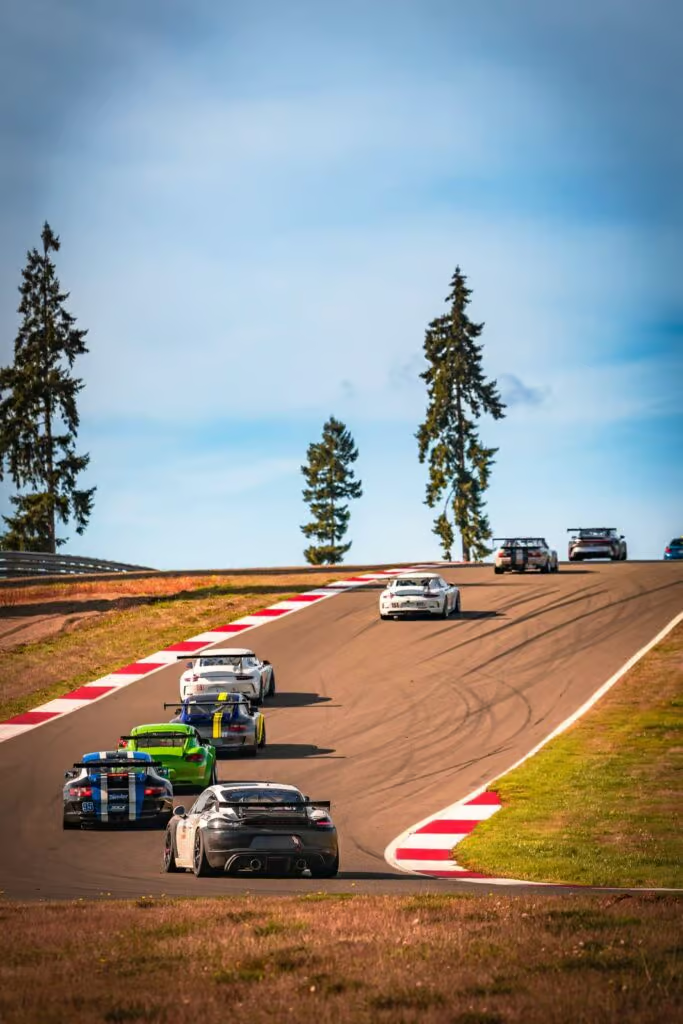
Porsches making their way up the hill at The Ridge during the Linda Blackburn Memorial Invitational.
Porsches making their way up the hill at The Ridge during the Linda Blackburn Memorial Invitational. Photo: Karl Noakes.

An Epic Battle with Michael Conatore

For Sunday’s races I was back in the #109 GT4 MR, and one of the drivers I ended up racing against was Michael Conatore, driving his #19 Porsche 997 GT3 Cup car.

We had a really entertaining mismatch between the two cars. Michael was on full racing Michelin slicks, while I was running Toyo’s new Proxes R tire, its DOT racing tire that replaces the Proxes RR. The Toyo is a perfectly serviceable racing tire, but it certainly isn’t a Michelin slick. And it was fascinating seeing how those differences played out around The Ridge.

Our GT4 MR was excellent through the medium- and high-speed sections, particularly Turns 1 and 2 and the transition toward Turn 3. The car felt composed and capable, and I could create some breathing room in those sections. But once we moved into the slower, more mechanically grip-dependent corners, Michael’s tire advantage really started to show itself.

In our first race, I got a great start and was able to put a few seconds between myself and the cars behind me while they battled among themselves. Eventually, Michael worked his way clear of that group. Then suddenly there he was in my mirrors, and he stayed there.

For lap after lap, I was working to protect the inside when necessary, maximize the GT4’s strengths through the faster sections, and avoid giving him an easy opportunity to use his superior mechanical grip to get alongside me. It was an absolutely fantastic race.

The deciding moment came on the final lap as we approached the Carousel. I’d been protecting the inside, and Michael finally decided to take a shot around the outside. He carried enough momentum to establish overlap, and as we approached the exit, I made sure to leave him room.

That put him on the inside heading toward Turns 8A and 8B. At that point, my tires were pretty well used up and I was struggling to put the power down cleanly. I could have continued fighting for the position, but I decided he’d earned the opportunity and there was no reason to turn an excellent race into an unnecessarily risky one.

Michael completed the pass, and we finished the race. The official timing sheets show Michael finishing fourth in the Porsche class, with me in fifth, just 1.150 seconds behind him after 15 laps. I recorded a best lap of 1:44.423, while Michael’s best was 1:43.456.

But the lap times and finishing positions don’t really capture just how much fun that race was. Afterward, it was handshakes, hugs, high-fives, and big smiles.

That’s exactly the kind of racing we want. We’d pushed each other hard, spent lap after lap trying to find an advantage, and both brought our cars home without contact.

The #109 Cayman GT4 MR leading Michael Conatore's #19 Porsche 997 GT3 Cup car during Sunday's racing.
The #109 Cayman GT4 MR leading Michael Conatore’s #19 Porsche 997 GT3 Cup car during Sunday’s racing. Photo: Peng Du.

In our other Sunday race, the positions were reversed. Michael got ahead early, and I spent most of the race chasing him. I could close the gap through the faster corners and sometimes get right up to him approaching Turns 1 and 2, but by the time we reached the slower sections, he’d use that grip advantage to create just enough separation that I couldn’t put together a clean pass.

We finished fifth and sixth in the Porsche class, respectively, with only 2.749 seconds separating us after 12 laps. Michael’s fastest lap was 1:44.481, compared with my 1:45.072. And I had just as much fun.

We learned a lot about how the GT4 MR behaves, its strengths and limitations, and what we might want to focus on as we continue developing the car for ourselves and our future drivers. Perhaps most importantly, we confirmed that we have a functional, capable Porsche race car that’s ready to become part of the Racer on Rails program.

A Healthy Paddock and a Club Coming Together

The Porsche & Ginetta Cup wasn’t the only part of the weekend that had me excited about the future of Northwest motorsports.

The relatively new Rush SR class was represented by a handful of cars, and it’s been fun to watch that community get established. The cars look like an absolute blast, and hopefully we’ll see more of them on the grid next season.
Meanwhile, PRO3 was doing what PRO3 has been doing exceptionally well for years: bringing a healthy field of cars together for competitive, accessible racing. Even this late in the season, they had a strong turnout and plenty of great battles.

And then there was Spec E46, still growing, developing its drivers, and building toward what we hope will be another exciting season in 2027.

I find it encouraging to see these different racing communities developing alongside each other. There doesn’t need to be one universal answer for what somebody should race. Some people love the simplicity of a lightweight purpose-built race car. Others love the familiarity and accessibility of a production-based BMW. Some want to drive a factory-built Porsche Cup car.

All of those are legitimate paths into the sport, and the more opportunities people have to find the right one for themselves, the healthier our community becomes.

But there was another particularly cool part of the weekend that had absolutely nothing to do with lap times. IRDC held its first club banquet since before COVID.

On Saturday evening, we gathered in the event space at The Ridge, shared a meal, caught up with friends, and celebrated several club members who had made important contributions throughout the year. It was great to see everyone together in a setting where nobody was worrying about their next qualifying session or whether their car would be ready to go back out.

I’ve been involved with IRDC for a long time, including serving as the club’s president for a couple of years, and getting back to these kinds of club gatherings is something I think matters quite a bit.

The relationships we build through this sport extend far beyond the racetrack. Having the opportunity to recognize people for their efforts, reconnect with friends, and simply enjoy being together helps remind us that we’re part of something larger than our own race programs.

It also felt especially appropriate during a weekend dedicated to someone who had spent so much of her life supporting this same community.

One More Weekend

When Steve, Rebecca, and the rest of IRDC decided to add another October race weekend, there was no guarantee that enough people would show up to make it worthwhile. The weather could have been terrible. Drivers could have decided their seasons were finished. Race cars could have stayed parked.

Instead, we got a beautiful October weekend full of great racing, driver development, mechanical challenges, new friendships, old friendships, and some pretty memorable experiences.

For Racer on Rails, we validated our new GT4 MR, continued learning about Dirk’s Touring 3 Cayman, got Silver Bullet back on track with Tim, celebrated Anthony’s championship, and had some fantastic wheel-to-wheel racing.

The Porsche & Ginetta Cup took another step toward becoming an established part of the Northwest racing calendar. PRO3 showed up in force, Rush SR continued building momentum, and Spec E46 gave us plenty to be excited about for next year.

We also had the opportunity to spend time with friends, enjoy the club banquet, and recognize some of the people whose dedication keeps amateur racing alive. And that brings us back to Linda Blackburn, because ultimately, that’s what people like Linda spend so much of their lives making possible.

The cars are the tools. Driving is the craft. But the experiences and the people are the point.

October racing in the Pacific Northwest might be a gamble. I’m really glad IRDC took it, and I’m already looking forward to doing it again next year.

Thank you to IRDC, Turn 2 Lapping, all the volunteers, our customers and friends, and everyone who made the Linda Blackburn Memorial Invitational possible.

See you at the track! 🏁

Photography by Peng Du, Karl Noakes, and Racer on Rails.

Official results and timing

October 17: Qualifying · Race results · Lap times.
October 18: Qualifying · Race results · Lap times.
ICSCC Spec E46 standings: 2026 and 2025.

Posted on

Progress Looks Different for Everyone – IRDC Tribute to the Volunteers 2026

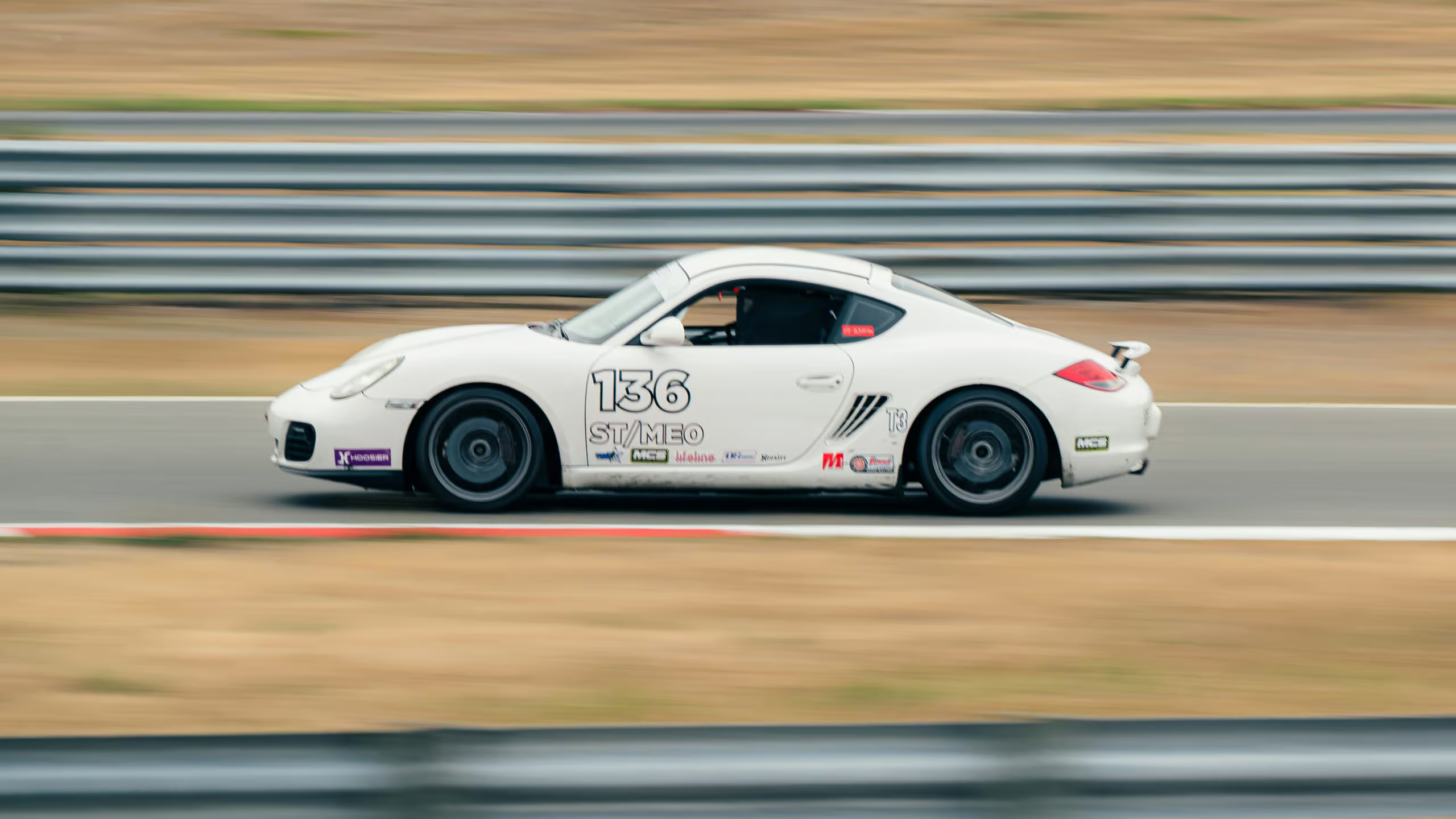
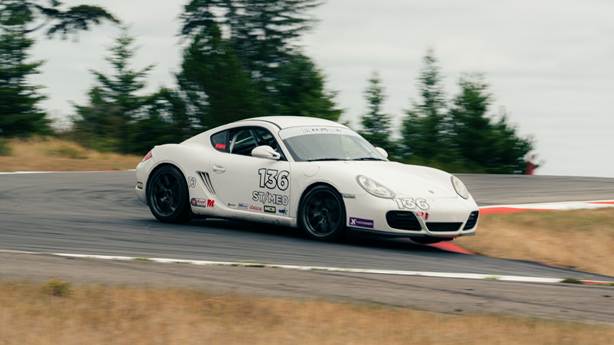
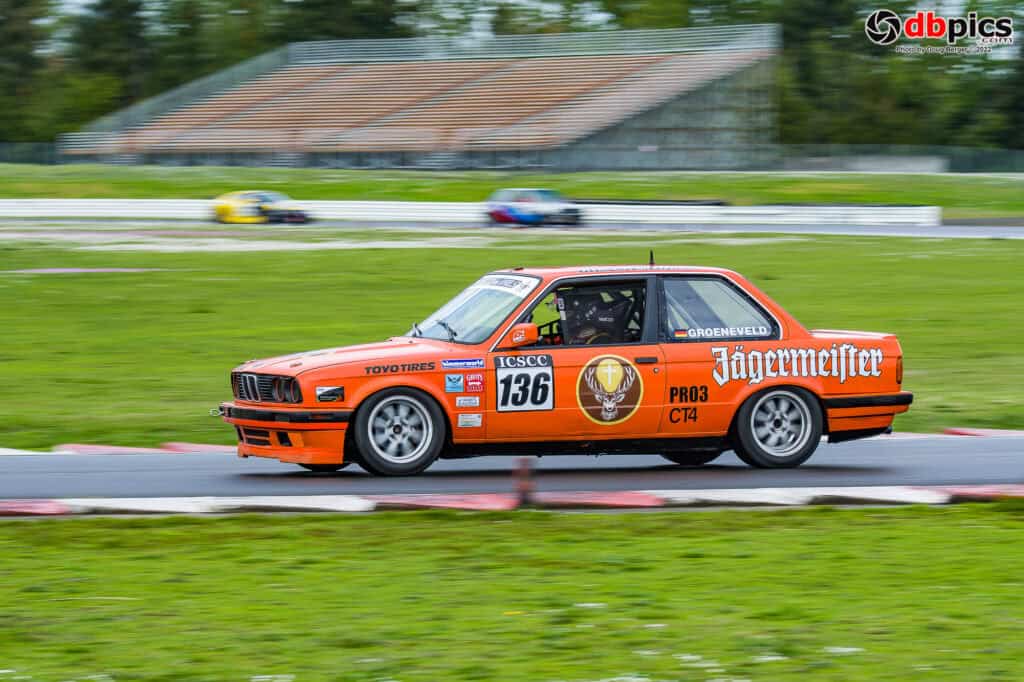
Dirk Groeneveld driving the white #136 2010 Porsche Cayman Base Touring 3 race car at The Ridge Motorsports Park.

IRDC’s Tribute to the Volunteers at The Ridge August 2026

A weekend of new baselines, mechanical problem-solving, family racing, an almost-first win, a new T3 Cayman coming alive, and one final lap we didn’t know was a goodbye.

IRDC Tribute to the Volunteers at The Ridge Motorsports Park, August 15–16, 2026.

First, a tribute where it belongs

Before the drivers, the lap times, the setup changes, or the mechanical drama, this weekend belongs to the volunteers.

IRDC’s Tribute to the Volunteers weekend at The Ridge Motorsports Park is named for the people who make club racing possible: corner workers, grid, timing and scoring, tech, registration, safety crews, stewards, and everyone else who gives up a weekend so the rest of us can go racing. There is no green flag without them, and there are no stories like the ones below without them either. Thank you!!

The weekend also had a little extra energy this year. The Conference calendar is different enough that this wasn’t quite the usual end-of-season punctuation mark, and IRDC used the weekend to debut a new Porsche & Ginetta Cup concept. More than a dozen Porsches and Ginettas took the green on Sunday, which made for a pretty remarkable first outing for something that had come together on a very short runway.

For Racer on Rails, though, the biggest theme of the weekend was something we talk about constantly: development does not look the same for every driver. Sometimes progress is a faster lap. Sometimes it is doing the same lap over and over. Sometimes it is learning to race at the front. Sometimes it is keeping a difficult weekend from unraveling. Sometimes it is simply remembering why you love driving the car in the first place.

We got a little bit of all of it.

Matt Apeland: first make it repeatable

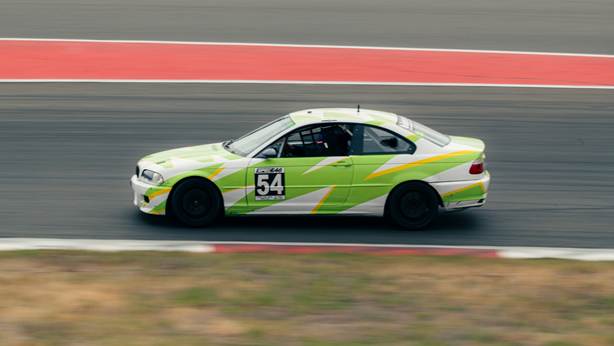
Matt Apeland’s #54 Spec E46 at The Ridge.

Matt Apeland’s #54 Spec E46 at The Ridge.

Matt came into the weekend still early in his racing journey and excited after a strong previous outing with us. He now has a properly developed Spec E46 underneath him, which means the biggest opportunity is increasingly the same one every driver eventually confronts: turning isolated good moments into a repeatable process.

Friday gave us the baseline. Matt could produce a good lap, but the spread between laps was still too wide. So the assignment for Saturday was deliberately boring: consistency.

Before we can ask a driver to change one braking point, one turn-in, or one throttle application, we need confidence that the rest of the lap will stay reasonably constant. Otherwise you are changing five variables at once and trying to learn from static.

We went deep on that idea with Matt, including one of the exercises Gama used when he was first learning: sit in the race car, watch onboard video from a faster driver, and physically mimic the steering, shifts, brake release, and throttle application. Not because the motions need to be copied robotically, but because repetition starts teaching the body what a lap is supposed to feel like.

Matt committed to it. By Sunday, the stopwatch started reflecting the change. He got into the 1:57s, including an official 1:57.820, and more importantly began backing the pace up with a string of laps in the 1:58s rather than one lonely hero lap surrounded by much larger swings.

When he climbed out and saw what he had done, his summary was better than anything we could write for him: “I’m a believer. The process works.”

That was the win.

Montey Mathison: earn the pace twice

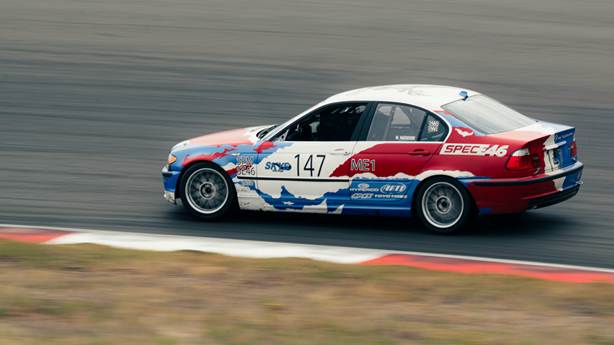
Montey Mathison’s #147 Spec E46.

Montey is 18 and has been building real momentum this season. Over the previous couple of weekends he had started closing the gap to some of our quickest Spec E46 drivers, so he arrived at The Ridge with confidence and, naturally, expectations.
Then Friday handed him a car that simply would not make the power it should.

We worked through the usual suspects until the trail finally led to the ECU connection, where we found corrosion. Swapping in our spare ECU brought the car back to life. It cost Montey track time, but once the problem was solved he did exactly what we wanted to see: he reset, got back to work, and returned to pace.

Sunday qualifying produced a 1:52.565, and he finished third in Spec E46 with a 1:52.975 best race lap. Those numbers put him right back in the conversation with the front half of our group after spending a meaningful chunk of the weekend troubleshooting instead of driving.

That is a different kind of development. The fast lap matters. So does the ability to have the weekend go sideways, get the car back, and immediately resume the work.

Ron Tanemura: the weekend kept trying to stop him

Ron Tanemura’s #63 Spec E46.

Ron was quick essentially from the moment the weekend started. On Friday we could see that he had the pace to run near the front of the Spec E46 field.

Naturally, that is when the shifter selector rod decided to leave the chat.

The CAE shifter’s selector rod came apart late in the test day and left Ron without a way to select gears. We overnighted a replacement. It arrived too short. So on Saturday morning René made the run back to the shop for Silver Bullet, our E36, so Ron could keep racing.

Then Silver Bullet developed an electrical problem and shut off late in Saturday’s race.

Race cars have timing.

The good news was that by then we had sourced the correct selector rod for Ron’s own Spec E46. Sunday he was back in the #63, qualified fourth in class, and raced his way to second place, finishing just 0.641 seconds behind the winner. There were still learning moments, including an ambitious move that cost him momentum, but that is exactly the point. He was racing in the part of the field where those decisions matter.

The part that stuck with us most did not come from the timing sheet. Multiple people independently came up during the weekend to tell us how impressed they were with Ron’s development. They have watched him try different cars, put in the work, take coaching seriously, and keep showing up. Now they are watching the pace and racecraft arrive with it.

Respect in a paddock is difficult to shortcut. Ron has earned his.

Anthony Lo: the result hurt. The driving didn’t.

We were not providing Anthony’s trackside support this weekend, but he is absolutely a Racer on Rails driver, and we need to pause here for a massive shoutout.

Anthony qualified second in Spec E46 with a 1:52.098. In the race he ran a 1:51.459, the fastest Spec E46 lap of the race, and put himself in position to take his first class win.

Then, on the final corner of the final lap, contact sent him around and the result disappeared.

That part is brutal. Racing can be brutally literal about where you cross the line, even when that line does a terrible job of describing how you drove.

Anthony’s result was disappointing. His performance was anything but.

He showed that he now has the pace to race at the very front, the composure to stay there, and the speed to win. The first victory will matter when it comes, but this weekend showed that the capability has already arrived.

Dirk Groeneveld: the T3 Cayman comes alive

Dirk Groeneveld’s 2010 Porsche Cayman Base, now developed as an SCCA Touring 3 car.

Dirk’s weekend was a milestone for both driver and car: the first official race weekend for his 2010 Porsche Cayman Base that we have been developing into an SCCA Touring 3 car.

The previous test days had been productive but each uncovered another small issue to solve. The biggest lingering problem was an intermittent power cut that appeared to be torque limiting when the car moved outside the operating assumptions Porsche built into a street car. Before this weekend we updated the tune, put fresh tires on the car, and moved to a staggered tire setup.

Friday was the first time everything simply worked.

Dirk initially came back describing the car as if he were still wrestling with it. Then we asked the obvious question: what are the lap times?

Low 1:50s. Then the 1:49s.

That changed the conversation. The Cayman was already seriously quick, and Dirk was doing it on Hoosier R7s rather than a qualifying-style A7. Over the rest of the weekend he continued learning what the car wanted and where the next limits lived. By Sunday, the questions were less about whether the concept worked and more about tire capacity, brake thermal management, and how much more performance is still buried in the chassis.

Dirk won ST both days, but this weekend was never really about collecting class wins. It was a shakedown, and it gave us a new performance baseline for a car we have only begun to optimize.

There was also a much more important layer to the weekend. Dirk’s dad was visiting from Germany and was able to be there to see the car, experience the paddock, and watch his son properly lean on it. Dirk has not had a huge amount of seat time over the last year and admitted that his physical race fitness still needs rebuilding, but the driving itself was at a very high level.

Fast car. Fast driver. Dad there to see it. That one felt special.

Matt Dawson: Assignment -> Maximum Fun

Matt Dawson stretching the legs of his BMW Z4 M Coupe.

Not every weekend needs to be a crusade for the last tenth.

Matt Dawson brought his BMW Z4 M Coupe with a beautifully straightforward objective: drive the thing, enjoy it, and have fun.

We did have to earn some of that fun. A power-steering fitting began leaking on the test day and cost him some track time while we repaired it. Then Matt introduced an unexpected coaching exercise of his own by showing up with a set of Toyo R888s he wanted to use up.

Those tires offered dramatically less lateral grip than the Hoosiers he normally drives, which meant the technique had to change. We talked about approaching it almost like a wet track: do more of the braking and acceleration with the car straight, reduce the demand for combined grip, and square off corners where appropriate.

It became a useful experiment in adapting the driver to the grip available rather than waiting for the car to feel the way you want it to feel.

Then he bolted the Hoosiers back on and went back to enjoying the Z4. On Sunday he finished third in SPM with a 1:50.921 best lap.

There are worse ways to spend a weekend than learning something useful and repeatedly revving an S54 toward the top of the tach. Man that car sounds good!!!

John and Mat Hennessy: the part you remember

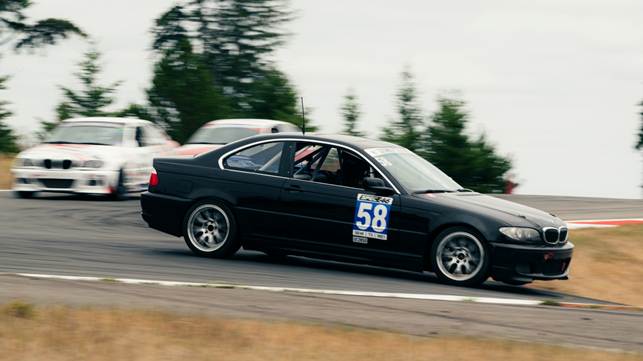
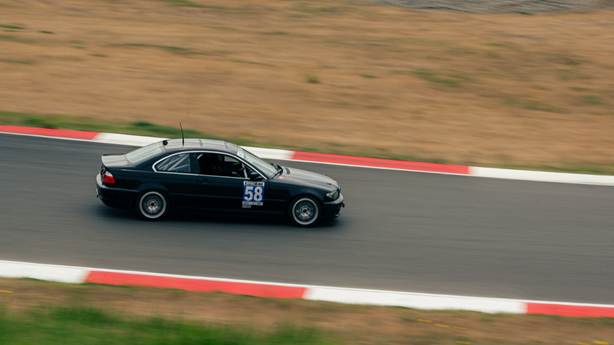
The Hennessys’ #58 Spec E46.

John and Mat Hennessy have been racing with us for years, sharing their #58 Spec E46 across different groups and coming together for the mini enduro.

The car itself has lived a full race-car life and has a list of service work waiting for it, but it kept doing its job this weekend. John had some excellent battles, including time near the front of the Spec E46 fight and exchanges with Ron. Matt ran around his usual pace and got his own share of good racing. The #58 also came home second in ME1 in Saturday’s mini enduro.

The lap times and positions are nice. They are not the reason this story matters.

Watching a father and son share a race car, split sessions, debrief together, and keep coming back to do this year after year is one of those things that quietly reminds you what the sport can be. Gama told them as much over the weekend: he hopes that when his own kids are older, he gets to share some version of this with them.

A race result lasts until the next race. Getting to do something you love with your kid can become part of a family’s language.

Harry and Lola Hollander: an unexpected addition to the tent

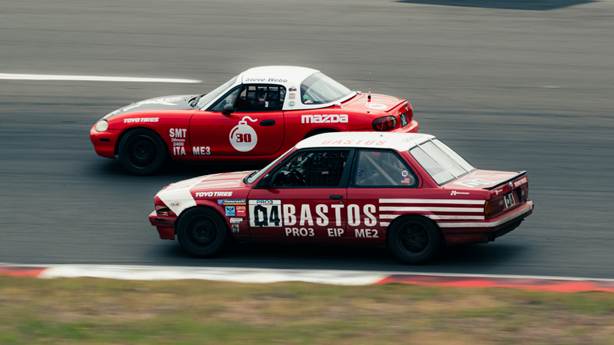
The Hollanders’ Bastos-liveried #04 PRO3 BMW in traffic.

Harry and Lola Hollander were not originally part of our weekend plan.

We had met them previously while they were finishing novice licensing and exploring where they wanted to race. They ultimately went the PRO3 route and bought the familiar Bastos-liveried #04 BMW. At The Ridge they found themselves needing some last-minute trackside support and asked if we could help.

We were clear about the deal: we had not seen the car before, we did not know its condition, and our technician resource would be shared. But we had capacity to help, so we would tackle one problem at a time and do everything we could to keep them driving.

The car made sure we had problems to tackle.

Despite that, Harry and Lola made essentially the whole weekend, missing only one session, and more importantly they were able to focus enough on their driving to make real progress. Both improved their personal bests by multiple seconds.

Lola’s Sunday race included a 1:59.453, putting her under the two-minute mark at The Ridge. Harry’s PRO3 best that day was 2:01.236.

Which means the official family leaderboard now says Lola beat Dad by 1.783 seconds.

We will allow her to decide how frequently that fact needs to be mentioned.

For us, this was a good reminder of what track support is supposed to accomplish. The goal is not simply to make a broken thing unbroken. It is to create enough stability around the driver that the weekend can still become productive, enjoyable, and worth remembering.

One last run in the Cayman

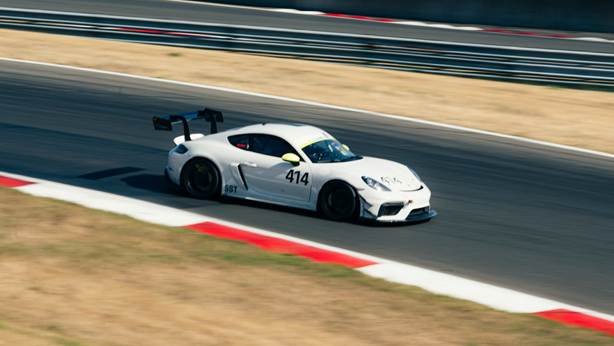
The #414 Cayman during what unexpectedly became its final race weekend with Racer on Rails.

Gama’s assignment for the weekend was supposed to be straightforward: prepare for the upcoming Gridlife GLGT race at Laguna Seca.

We could not get the required series tires in time, so the Cayman went to The Ridge on old Yokohama A052s, both sets date-stamped in 2023 and already carrying plenty of heat cycles. The plan was to re-establish a driver baseline, work on setup, then return the following weekend with reduced power and the correct tires for a much more representative Laguna test.

Friday went well. On the first set of old tires the car felt good and ran in the 1:44 to 1:45 range while we worked through setup changes.

Saturday was stranger. We installed the set that visually looked healthier because it had more tread, only to discover that it was actually even older. The car developed enormous front-end push, especially in the left-hand corners that make up so much of The Ridge. At first we went hunting for setup or mechanical problems. By the end of the day the answer was wonderfully unglamorous: the tires were simply done.

Sunday we went back to the less-dead set, and the car came back underneath Gama immediately.

That afternoon brought the inaugural Porsche & Ginetta Cup race. The Cayman was in an awkward performance island: not quick enough on those tires to fight the 991.2 and 992 Cup cars, but significantly faster than much of the rest of the field. So instead of racing another car, Gama spent the stint racing the lap.

He qualified at 1:45.183. Through the race, he kept finding small pieces, convinced there were still a few tenths scattered around the circuit. On lap eight, the final lap, he put together a 1:45.502, his fastest lap of the race.

He climbed out excited about coming back the following weekend with fresh tires and the next round of changes.

The Cayman sold the next day.

We thought we were establishing a baseline for what came next. It turned out we were putting a period on the end of the Cayman’s chapter with Racer on Rails.

There are worse ways for a race car to say goodbye than setting its best lap of the race on the final lap.

Development is bigger than a result

Looking back, that is what we will remember about Tribute to the Volunteers.

Matt Apeland learned that speed becomes useful when it is repeatable. Montey Mathison lost track time and then immediately found his pace again. Ron Tanemura fought through two different cars trying to strand him and still finished second. Anthony Lo showed race-winning speed even though the result did not survive the final corner. Dirk Groeneveld and the T3 Cayman established an entirely new performance baseline. Matt Dawson used a low-grip tire experiment as an excuse to learn and then went back to having fun. John and Matt Hennessy reminded us why sharing this sport with family matters. Harry and Lola Hollander turned a last-minute support request into personal bests and a little father-daughter scoreboard drama. And the #414 Cayman gave us one final great lap before moving on to its next chapter.

That is driver development to us.

It is not just making the stopwatch smaller. It is engineering, preparation, coaching, racecraft, physical readiness, problem-solving, repetition, reflection, and knowing when the objective for the day is simply to enjoy the machine.

And none of it happens without a community willing to make racing possible.

So one more time: thank you to IRDC, Conference, The Ridge, and especially every volunteer who worked the weekend. We got to do the fun part because you were there.

See you at the track.

— Racer on Rails

If you are building a track or racing program around your own goals, reach us at gofaster@raceronrails.com.

Posted on

Confidence, Consistency and Podiums at Watkins Glen – Porsche Club of America (PCA) July 2026

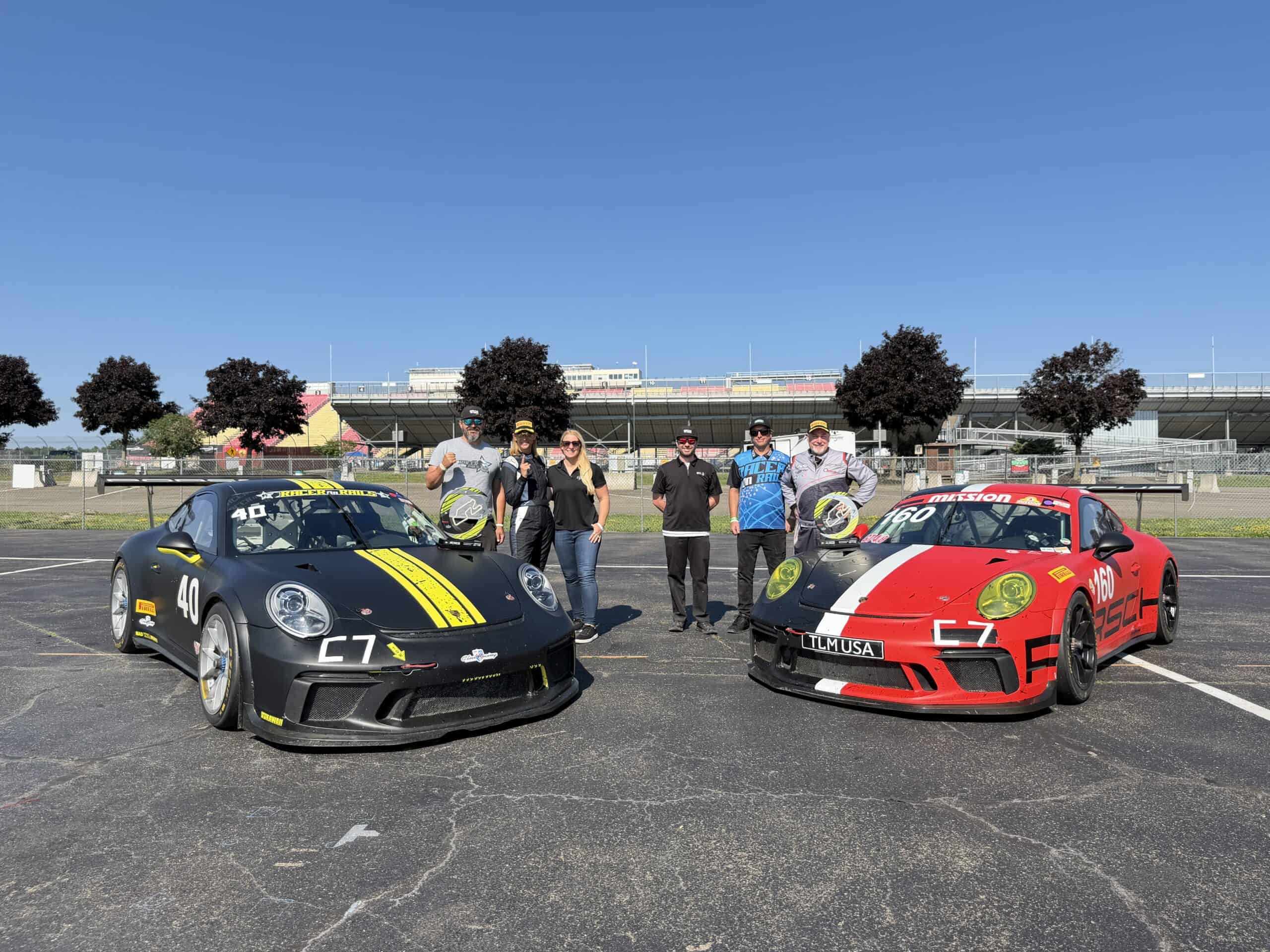
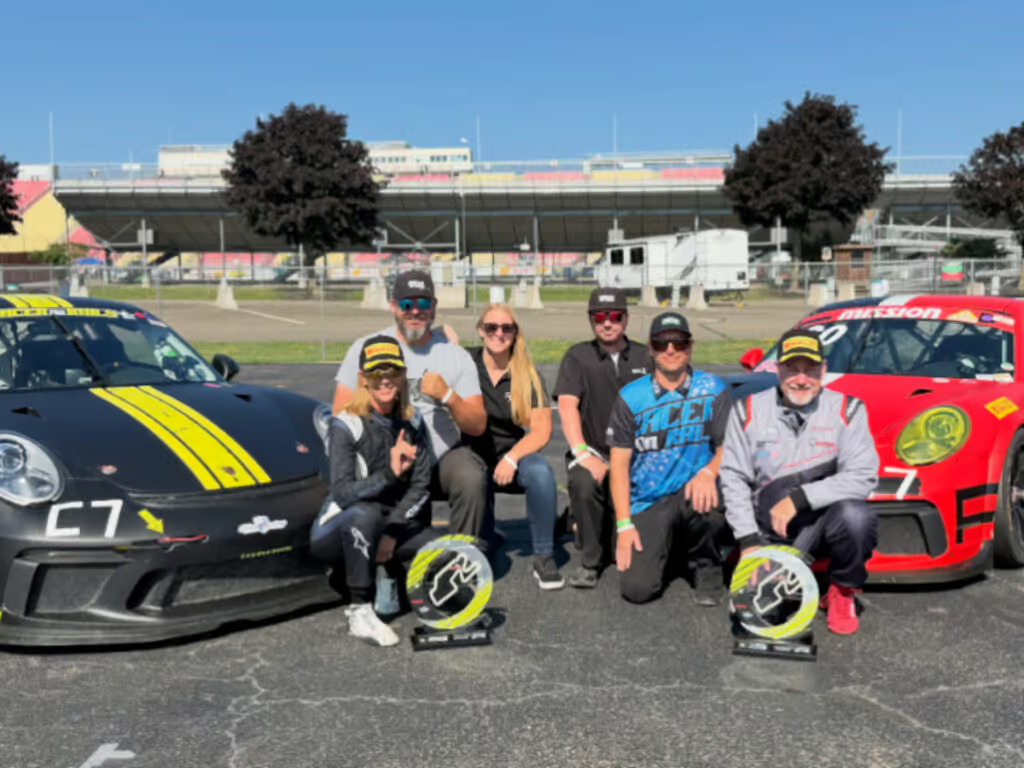
Racer on Rails team with Ann Doherty’s black Porsche race car, Thad Berger’s red Porsche and their podium trophies at Watkins Glen.

Watkins Glen International is a circuit that demands confidence.

Across its 3.45-mile Grand Prix layout, the speed is high, the consequences of hesitation are real and the car is almost always being asked to do more than one thing at a time. Braking zones arrive while the chassis is still loaded, elevation changes alter the balance beneath the driver and many of the most important corners require commitment well before the exit comes into view.

It is also one of North America’s most historic racing venues. Competition around Watkins Glen dates back to the first postwar road race through the village in 1948, and the circuit has remained one of the country’s defining motorsport destinations ever since.

For Racer on Rails, the Porsche Club of America Club Racing weekend presented two very different driver-development stories.

Longtime friend and client Thad Berger was returning to competition after a hiatus caused by a major rebuild of his car. Alongside him was Ann Doherty, whom we have supported throughout the season and who arrived at The Glen with momentum already building.

Ann’s program also included support from professional driver and coach Pippa Mann. The Racer on Rails crew consisted of Jordan Allen, serving as car chief for Ann’s 991.2-generation Porsche 911 GT3 Cup car; Ian Anderson, serving as car chief for Thad; and Tyler Campbell, working as race engineer and driver coach across both programs.

Tyler supported both drivers directly while collaborating with Pippa throughout Ann’s weekend.

The drivers arrived from different starting points, but the objective was the same: build trust in the car, sharpen the communication between driver and crew and turn that confidence into repeatable performance.

Carrying Momentum into the Weekend

Ann arrived at the PCA weekend with valuable recent experience at Watkins Glen.

Only a couple of weeks earlier, Racer on Rails had supported her during the SCCA race weekend at the same circuit. A combination of simulator work, preparation and focused coaching allowed her to arrive ready to perform, ultimately producing a third-place finish in Sunday’s race.

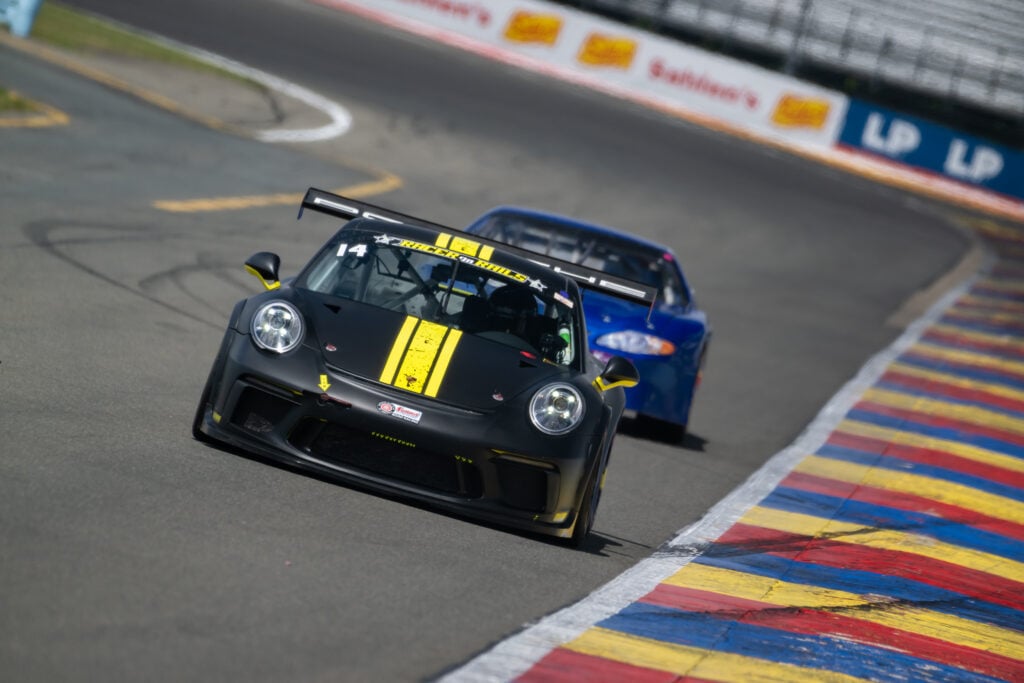
Ann Doherty drives the black-and-yellow Racer on Rails Porsche race car through a corner at Watkins Glen International.
Ann Doherty attacks Watkins Glen International in her black-and-yellow Racer on Rails Porsche during the SCCA Hoosier Super Tour weekend. Photo Credit: Trey Coleman

That recent experience meant the PCA weekend did not begin with Ann needing to relearn the circuit. Instead, she could immediately begin refining her driving, exploring the limits of the car and building on the progress already made.

Ann Doherty celebrates a third-place finish on the SCCA Hoosier Super Tour podium at Watkins Glen International.
Ann Doherty celebrates a third-place finish at the SCCA Hoosier Super Tour weekend at Watkins Glen International.

Friday opened with two practice sessions before the field moved into qualifying and the weekend’s first race.

Ann quickly showed that the earlier preparation had carried over. She set a new personal-best lap and qualified second in GTC7 for the non-points race.

GTC7 is PCA Club Racing’s class for 2017 through 2021 Porsche 991.2-generation Cup cars. With the machinery tightly controlled by the regulations, performance comes down heavily to preparation, setup, execution and the driver’s ability to consistently extract speed from the platform.

When an issue struck the initial race leader, Ann was in position to capitalize.

She stayed composed, managed the race and brought the car home for the victory. Along the way, she continued lowering her personal best, eventually producing a 1:55.2 lap time before the end of Friday.

The victory was the visible result, but the larger story was the progression behind it.

Ann was becoming increasingly comfortable asking more from the car, and increasingly precise when describing what she needed from it.

Developing the Car as the Pace Increased

As Ann became faster, the setup needed to evolve with her.

The car that helps a driver build confidence early in their development is not always the same car they need once the pace begins to increase. As Ann carried more speed, committed earlier and asked more from the front axle, her feedback began to change.

Throughout Friday and Saturday, the team worked through a series of adjustments designed to preserve the confidence she had built while giving her the response she needed at a higher level of commitment.

She wanted more authority from the front of the car. At the same time, the increase in her pace meant she no longer needed the same level of aerodynamic stability she had previously relied upon.

Jordan and Tyler continued adjusting the platform around that feedback, while Tyler and Pippa worked together to maintain a consistent coaching framework.

Racer on Rails team member works beside Ann Doherty’s Porsche as Thad Berger’s Porsche sits nearby in the Watkins Glen paddock.
The Racer on Rails crew prepares Ann Doherty’s and Thad Berger’s Porsche race cars between sessions in the Watkins Glen paddock.

The goal was not simply to make the car faster on paper.

It was to give Ann a car she understood, trusted and could use.

By the end of the process, the car was responding in a way that allowed her to drive with greater confidence. The lap times followed, but more importantly, so did the consistency.

Fighting Forward in the Heat

Saturday presented a different challenge.

Temperatures climbed, the points-race fields grew larger and Ann found herself racing in the middle of a group that included several newer 992-generation Cup cars.

Traffic became more difficult. The heat changed the car. The racing became more physical.

Despite those conditions, and some light contact from another competitor, Ann stayed in the fight. She managed the car, remained composed and finished second in GTC7 in the first points race.

The second points race was equally demanding.

The conditions continued to test both driver and car, and Ann did not feel as comfortable as she had earlier in the weekend. Even so, she continued working through the difficulty rather than allowing it to dictate the race.

The result was another second-place class finish.

Across the three sprint races, Ann earned:

  • One GTC7 victory
  • Two GTC7 second-place finishes
  • A new 1:55.2 personal-best lap

More importantly, the weekend showed that the speed developed through simulator work, preparation, engineering and coaching could be carried into changing conditions and converted into repeatable race results.

Rebuilding Rhythm with Thad

While Ann entered the weekend carrying recent Watkins Glen momentum, Thad’s program began from a very different position.

Thad has considerable experience at The Glen, but his return followed an extended break while his car underwent a fresh rebuild. That rebuild followed a major incident at Road Atlanta in 2024, when another car lost control on the back straight and collected Thad’s Porsche, causing significant damage to the passenger side.

Thad Berger drives his No. 60 Porsche through the Bus Stop chicane at Watkins Glen International.
Thad Berger drives the No. 60 Porsche through Watkins Glen’s high-speed Bus Stop chicane during the PCA Club Racing weekend.

Before arriving at Watkins Glen with Racer on Rails, he had completed only one shakedown weekend with another team.

The familiarity with the circuit was still there.

The immediate trust in the rebuilt car was not.

We began the weekend with a baseline setup and then worked methodically through a series of changes intended to give Thad a car that responded the way he expected.

That process became an important driver-development exercise.

Thad is an experienced racer with significant seat time, but much of that experience had been instinctive. He had not previously spent as much time developing the language needed to describe the car’s behavior, identify what he wanted changed and anticipate how a particular adjustment should affect the platform.

After every session, we separated the conversation into two connected areas.

First, we reviewed the driving itself: lap strategy, execution, traffic management and the places where Thad could make better use of the car.

Then, we discussed the car.

We worked to identify what he was feeling, what he was asking the chassis to do and which adjustments could help the platform better support those instincts.

Before making each change, we talked through the expected effect. When Thad returned from the next session, he could confirm whether he felt what we had anticipated.

That feedback loop allowed him to connect a mechanical adjustment to the sensation behind the wheel.

It also gave the team increasingly precise information to work with.

Building Pace Through Understanding

With each session, Thad’s understanding of the car improved.

As his confidence in the platform grew, so did his confidence in his own feedback. He became more decisive when describing the car, more deliberate in his requests and more comfortable pushing once the setup began responding as expected.

The progress accelerated quickly.

By the later sessions, Thad was not simply setting personal-best laps. He was doing it while managing traffic, racing other cars and completing passes.

That combination of improving pace, racecraft and consistency became especially valuable in the two points races.

Despite qualifying several positions behind where he would eventually finish, Thad raced his way forward to third in class in both races.

Across the two contests, he completed a combined six in-class passes, earning two hard-fought podium finishes.

For a driver returning after a long interruption and adapting to a freshly rebuilt car, those results represented much more than two trophies.

They demonstrated what can happen when experience, engineering feedback and a structured development process begin working together.

Finding the Limit

The confidence built throughout the weekend carried directly into Sunday’s enduro.

As Thad became increasingly comfortable with the car, he began pushing harder than he had at any earlier point in the weekend.

While attacking Turn 8, he found the limit and spun the car.

After the spin, the Porsche would not restart, bringing the enduro to an early conclusion. It was not the ending anyone planned, but it was also not a reason to discount the progress that came before it.

Ian immediately began investigating the no-start condition and identified the cause within a couple of hours. With replacement parts on the way, the car should be repaired and ready for its upcoming International GT and Trans Am weekend.

Thad Berger races his No. 60 Porsche through the Watkins Glen Bus Stop between other competitors.
Thad Berger navigates the Watkins Glen Bus Stop in traffic during the PCA Club Racing weekend.

The spin was another piece of information.

Thad had started the weekend rebuilding trust in a freshly rebuilt car. By Sunday, he had become comfortable enough to push beyond where he had previously been willing to go.

Finding the limit is part of racing.

Sometimes that lesson arrives through a faster lap. Sometimes it arrives through a moment that creates a new problem for the crew to solve. Either way, it establishes the next step in the development process.

Thad returned from a lengthy hiatus, improved with every session, developed a stronger understanding of both the car and his own feedback, completed six in-class passes and earned podium finishes in both points races.

By Sunday, he was no longer searching for confidence.

He was using it.

Two Drivers, One Development Process

Ann and Thad arrived at Watkins Glen from very different starting points.

Ann carried momentum from her recent SCCA podium and used it to attack the weekend immediately. She set new personal bests, won Friday’s race and added two second-place finishes in the points races.

Thad arrived needing to rebuild rhythm and trust after time away from the car. Through a methodical process of setup changes, feedback and coaching, he rediscovered his pace and converted that progress into two podium finishes of his own.

Racer on Rails team with Ann Doherty, Thad Berger, their Porsche race cars and podium trophies at Watkins Glen.
From left: Ann Doherty, Jordan Allen, Pippa Mann, Tyler Campbell, Ian Anderson and Thad Berger with Ann’s and Thad’s Porsche race cars and their Watkins Glen podium trophies.

Between them, the Racer on Rails drivers earned:

  • One GTC7 victory
  • Two GTC7 second-place finishes
  • Two class third-place finishes
  • Six in-class passes for Thad
  • A new 1:55.2 personal best for Ann

Jordan Allen and Ian Anderson kept both cars supported through a demanding weekend, while the combined engineering and coaching effort from Tyler Campbell and Pippa Mann helped turn driver feedback into measurable progress.

There were trophies, personal-best laps and plenty of close racing.

But the most important result was the confidence built across both programs.

At a place as fast and demanding as Watkins Glen, confidence is not simply a feeling.

It is performance.

Posted on

2024 Hoosier Super Tour Race 1 – Sebring International Raceways

After a very short “off-season” coming off the 2023 SCCA Runoffs held at Virginia International Raceways for the second year in a row, the team regrouped, got cars turned and headed to Sebring, FL for the first race of the year.

With a new racing year, we have some changes on the team. For the first race, we brought down Simon Asselin in his 991.1 Porsche GT3 Cup Car, racing in the GT2 class for a second year in a row. Dave Orem has moved from a BMW Spec E46 in Touring 3 class, to the 2023 Touring 3 National Championship winning BMW Z4 M. Gama Aguilar returned in his freshly rebuilt Nissan Nismo 370Z, also competing in Touring 3 class.

Ann Doherty is in the middle of transitioning into a new car and new class for 2024 – stay tuned for updates! Thad Berger will be focusing on his Porsche Cayman GT4 MR in Touring 1 class but will miss the first couple of races and join the tour at Road Atlanta in March.

Simon Asselin Porsche 911 GT3 Cup Car in GT2 Class

Simon took official delivery and got his first laps in his Cup Car at this race last year. Since last year, Simon has had several solid race weekends, upgraded suspension with Motion Control Suspension (MCS) 3-ways, experimented with different tires, and iterated on both dry and wet setups. With a stronger foundational knowledge of the car and seat time, the goal for the weekend was to build on that and maximize competitiveness.

With the changing conditions throughout the weekend, it was a challenge to iterate on the dry setup but Simon made the most of the conditions for qualifying on Saturday AM with a P5 in full wet conditions and only 1 second separating him from P2.

At the start of the race, Simon lost a couple of positions but quickly got on his horse to recapture the positions and before a full course yellow came out that ended the race, Simon secured P5 and most importantly, improved on his PB at Sebring by 2 seconds!

Simon Asselin in his Porsche 991.1 GT3 Cup Car, racing in the GT2 class.
Simon Asselin piloting his Porsche 991.1 GT3 Cup Car at Sebring International Raceways at the SCCA Hoosier Super Tour.

On Sunday, the forecast was for cloudy skies but dry pavement. Well, the forecast didn’t pan out that way, and not at all. We awoke to passing showers and rain started properly falling before lunch. By race time, it was a full wet race and the first race group after lunch would be the GT2 race.

Right as the cars came around Turn 17 (Sunset) for the green flag, many cars moved into pit lane to change onto wet tires which shuffled the starting grid and created some confusion. A car on the second row lost control of the car at the green flag, tried to keep it together but unfortunately the car hooked right and ultimately making contact with several cars, including Simon who properly collected the other car. Simon had nowhere to go and thanks to all the safety equipment and design of the Porsche GT3 Cup Car, the energy was disbursed, eliminating major physical harm to Simon. He walked away from the incident and has been recovering well. The car took a significant hit to the front end and a more minor hit to the rear. That was the end of the race and we are actively getting the car evaluated and on a path to repair.

Dave Orem BMW Z4 M-Coupe in Touring 3 Class

Building off another solid year of driver development in the Spec E46, wanting to continue developing as a driver but also wanting to have a material chance to podium at our events, Dave couldn’t pass up on the opportunity to purchase the 2023 SCCA Touring 3 National Championship winning car.

The BMW Z4 M-Coupe is essentially an E46 M3 but with a smaller body that can punch through the air more effectively and a much lower center of gravity. At tracks like Road America where the Runoffs will be run over the next two years, where we spend a material amount of time over 100mph, this car is one of the favorites to continue competing for the top steps.

Dave Orem getting used to his new-to-him BMW Z4 M-Coupe in the SCCA Touring 3 Class at Sebring International Raceways

Dave only had limited testing before the trip and in cold/wet conditions so the goals for the weekend were simple: learn the car, build confidence and drive it into the trailer at the end.

During the Thursday Test day, Dave started building confidence in the car and getting used to the taller gearing compared to the Spec E46 but in the last session, he lost what would end up being an axle shaft (no drive), which left the team sourcing parts and getting the car fixed on Friday, thus missing practice on Friday. Saturday he qualified P7 in his first competitive wet session, while dropping time each lap. In the race, he lost a few positions in the start battling with T2, SMX and T3 cars, got himself settled in and started picking away at the cars one at a time. By the time a black flag came out that would eventually end the race, Dave had hit his best lap time in the car and feeling/seeing where the big chunks of time were left.

On Sunday, the Touring 3 race was the race right after Simon’s GT2 race, with full wet conditions. Dave started P16 overall, lost a few spots in the first few laps due to the visibility but after a full course yellow to move Gama’s 370Z that lost electronics due to the wet weather, Dave got moving and got back all but one position.

Overall given the inconsistent conditions throughout the weekend and battling through a lost day of running on Friday, Dave had an excellent first race weekend in his new-to-him race car.

Gama Aguilar Nissan 370Z Nismo Touring 3 Class

Gama debuted his 370Z at the 2023 Runoffs but unfortunately suffered from a catastrophic “Ice Mode” situation at Oak Tree corner where the car suffered significant front end damage, along with injuries that took 2.5 months to mostly recover. In that recovery time, Gama, Tyler Mayer and the team dug deep and got the car fixed and tested in time to make the Sebring race weekend.

Similar tone to Dave’s goal for the weekend, we only had a couple of goals for the weekend: first was to experiment, document, and share results on different potential solutions to better understand and mitigate the risk to “Ice Mode” and second, establish a baseline pace and characteristics to truly start leaning on the car.

Gama shaking down and testing things to figure out the brakes in his 2011 Nissan Nismo 370Z in SCCA Touring 3 Class

One of the leading theories behind Ice Mode is that the brake booster in the 370Z is WAY over-powered. That means that for every pound of pressure/pedal effort the driver makes on the brake pedal, the power assisted brake booster, magnifies that force into the braking system. This is normal in power boosted and ABS based braking systems and it makes sense for normal street driving where the cars are not being subjected to the G-forces that are seen in racing conditions and with extremely sticky tires. Normal drivers don’t need to hit the brakes very hard to get to maximum braking and they are usually on street tires with much less grip.

In our conditions, what we’ve found is that this overly powerful brake booster contributes to the ABS system freaking out and potentially locking the driver out of the braking system. Not good! So to test this theory, we installed an AIM Brake Pressure sensor and a Sakebomb Garage Variable Brake Booster Vaccum Controller. This device in installed in-line between the engine and the brake booster and can adjust the amount of vacuum fed to the brake booster and thus adjusting the maximum about of brake boosting, the booster can provide.

Learnings

After installing the vacuum controller, we turned it all the way “off” in that it didn’t apply any adjustment to the vacuum levels, we hit the brakes (with ending running) with a 10/10 brake pedal effort hit and saw the impact to the brake pressure sensor —> 2,000psi! Holy moly! That is insane. Now granted, that took a massive pedal effort that frankly isn’t realistic in any conditions but our normal pedal effort braking still resulted in ~1,800psi of brake pressure. That is still insane – not even Motorsport ABS systems can handle those levels of brake pressure in a system. We then modulated the pedal effort to see what it took to keep brake pressure below 1,000psi (generally accepted as about the max range most braking systems can handle *and* slow the car down – anything above these levels will not only make the ABS system overwork but it won’t effectively further slow the car down). The result was that it was dang near impossible to repeatedly be that gentle with the brake pedal and the modulation window from 600-900psi was even more difficult.

We don’t know 100% that this is the root of the issue behind Ice Mode but this sure as heck isn’t helping things. So we found the adjustment level where the max brake pressure we could possibly hit was ~1,000psi.

We also tested 2-piece rotors from Paragon, which have a more Motorsport focus hat design for better heat consistency across the rings and hats and we experimented with different brake pads, with all of them being in a direction of less aggressive pads.

Catching the overall theme here? All experiments were around making it harder for the OEM ABS system to freak out from sudden spikes in brake pressure and/or changes in wheel speeds.

The results? We’re going in the right direction. Prior to adjusting the controller to max ~1,000psi brake pressure, we didn’t hit ice mode but were able to get the wheels to consistently lockup in “heavier” brake application. Interesting that a functional ant-lock braking (ABS) system, still allowed tires to lock up. Hhhhmmm….

After making the adjustment and going straight into a race due to the transmission failing during the last test day session, the brake pedal was MUCH better and finally allowed me (Gama) to start building confidence in the brakes.

I started at the very back of the Touring field (split start) in P24. By the end of the race, I’d moved up 13 positions total, finished in P8, right on the tail of the next few cars in class and ending with the 3rd fastest lap of the race! Starting to cook with some real fire!

For Sunday’s race, we’d start closer to the front but in full wet conditions. The start was okay, picking up a position but not able to be more aggressive because how bad the spray was in front – literally couldn’t see more than 10-15 feet in front. Once the cars started stringing out, made up some more positions and mid-way through second lap was in P2 in class. Then suddenly the electronic controls inside the car went dead but the car was still running – clearly water had gotten in somewhere and started causing shorts.

Gama Aguilar moving to P2 before an eventual DNF due to water in electronics.

Going into T17, I broke early and soft but with the amount of water on the track and how bumpy the track is, I ended up spinning along with several other cars and thankfully, came to a stop before making contact with anything. With no functioning electronic controls in the car, I wasn’t able to get it running again and had to DNF.

Making Lemonade out of Lemons

To top things off, a fellow competitor in Touring 3 decided to protest me in the 370Z for running an illegal part, even though we had been openly discussing and sharing the testing plan, as the goal was to figure out how to make these cars safe, not to achieve a performance advantage. We were prepared and okay with this potential scenario but it was still disappointing for someone to protest the car when the focus was on safety *and* that competitor finished ahead of me on both races – e.g. no impact to his or anyone in the podium position places.

Despite that, we leave Sebring optimistic about what we’ve learned to make these cars safe for people to race in Touring 3 class. We are not only going to make a rules change proposal to allow this non-in-car adjustable controller for the Nissan 370Z and we are looking at ways in which we can still limit the vacuum to the booster, without the addition of a controller in case that proposal doesn’t go through.

What’s next? Round 2 at NOLA Motorsports Park!

The next round in the 2024 SCCA Hoosier Super Tour is at NOLA Motorsports Park in New Orleans, LA in February. Dave and Gama will be there for sure. Simon is TBD based on the outcomes of repairing the Cup Car and Ann is targeting to join at NOLA. This will be a new track for everyone so lots of time in the simulator is in store for all of us between now and the weekend of February 18th!

Big shout out to the whole Racer on Rails crew who made getting the cars ready and transported across the country, happen!

Posted on

Race Report 2: Circuit of the Americas SCCA Hoosier Super Tour

For the third year in a row, we headed back to Austin, Texas for the second round of the Hoosier Super Tour at the beautiful and challenging, Circuit of the Americas. Thankfully, we avoided the annual winter freeze that hits southern Texas and while it was dry all weekend, it wasn’t “warm” except for on load-in day (Thursday) and Sunday afternoon. Perfect! (Insert thick amounts of sarcasm)

Prior to the race weekend Jordan, Memo, Bryce and Mark flew into Houston, TX where we had the cars and trucks stored to whip the cars into shape. Can’t say enough how grateful we are to have friends across the country that have helped us with space to park and work on the cars. Thank you Todd Joseph Farley (TMJ Bimmers) and James Walker Jr!

Jordan taking a big swig of Green Redbull to do a full engine swap on the 81 SE46 that decided it just didn’t want to run anymore, at Sebring.

For this race report, we’re going to do something a little different. Driving at these bucket list tracks, we regularly get asked which track is our favorite, most unique, most scary and/or most challenging? So for this report, we’re going to focus a little more on what makes COTA such an awesome and challenging track to tackle.

1. COTA is Big!

At 3.426 Miles and 20 corners (using the Grand Prix layout), COTA is a long track with at least 20 opportunities to make a mistake and decent distances after a corner, so that you have ample time to relive and think about the mistake(s) you just made. All the while, watching your predictive lap timer reinforce, with math, that you made a mistake. 🙂

The volume of corners in terms of learning the track is a challenge but to be perfectly honest, in the three years that we’ve come to the SCCA Hoosier Super Tour with now seven different drivers, not once have we had a discussion about “what corner comes next” or “the line” in terms of just getting around the track.

Each driver puts in the preparation work before the race weekend with time in a simulator, watching race videos and track walks – our drivers come to compete!

So “learning the track” isn’t a thing but another aspect of COTA that is a challenge is how wide the track is. This is a blessing and a curse. The track in general is wide enough to go three wide in multiple segments, which results in multiple lines that can be taken through a corner or sequence of corners. This gives us flexibility in racing conditions but it gives the same flexibility to competitors.

Ann Doherty in the #4 Porsche Cayman GT4 Clubsport trying to run away from a Touring 1 Camaro in the run to Turn 12

From the approach of turn 1 through the entry to the esses (turn 3) , it’s not just feasible but it’s common to see cars going 2 and 3 wide with only a marginal drop off in lap time.

Turn 6 is wide enough that it’s possible to attack another car from the outside, which then turns into the inside for Turn 7.

The entry into Turn 11 is like turn 1, almost an open runway with a lot of space to dive bomb into the corner but with the longest straight away on the tracking coming next, going two or three wide into turn 11, will punish your straight line speed down to turn 12. There are even lines to overtake someone on the outside in Turn 1, especially at the start of the races.

Turn 12 also is wide enough for at least two cars to go side by side and while not particularly fast, it’s possible and common throughout the weekend to see cars going side by side all the way until Turn 19.

Finally, Turn 20 can also easily allow two cars to go side by side but it will impact the exit speed and thus the time that runs all the way to turn 1.

2. COTA is technical. Really Technical.

Many tracks have some kind of bias due to the natural outcome of being “lap based” – e.g. at some point, the track will return back to start/finish. If a track has a clock-wise orientation, there will usually have more right hand corners than left hand corners. If a track is counter-clockwise (like COTA), vice-versa will be true.

So while COTA has a counter-clockwise orientation, it has exactly 10 left-hand corners and you guessed it, 10 right hand corners.

And yes, the three longest straight aways are setup by left-hand corners, which would normally make a team want to setup a car to be biased for left-hand corners BUT there are 6 different corners that are either high-commitment or high-duration (you spend a good amount of time in them), so it really pushes a team and driver to have a well balanced setup for both corner types, unlike what we’d for say Portland International Raceways or Lime Rock Park – pretty much all right hand corners.

COTA also has a wide variety of corners:

  • Short duration, slow speed and sharp angled corners: Slow corners make it really easy for drivers to over-slow on entry and if you don’t have the car pointed just right and at full throttle at the apex, the exit and the proceeding straight away suffer. Think the exit of Turn 1, Turn 11 and Turn 20 where the minimum speeds are in the mid to high 30’s depending on the car. Teams and drivers may be tempted to setup a car nice and loose on slow speed corners to get through these as quickly as possible but…
  • Medium/High-Speed Corners: Turn 3 (the entry into the esses), you enter near the top of 4th gear in the Spec E46’s (~105mph) and then need a well balanced car to carve through them.
  • Long duration medium speed corners: Turns 6 and the Carousel (turns 16 – 18) are both right hand corners where you are in them for longer than most corners. So how do you setup a car to both be awesome on slow quick corners but not too skaty through carousel type corners?
  • COTA beats up cars: Remember in 2019 when Sebastian Vettel had a suspension arm break on the exit of a corner? That’s from the bumps that form and change all the time from the ground/earth under the pavement. The dirt on which COTA sits isn’t super stable to begin with due to how dry the area typically is but then when it rains, it RAINS – think flash flooding. COTA has been repaved multiple times and it was repaved in time for the 2022 season (we were there) but in that one single year, the track has gone from a pretty smooth pavement, to having bumps all over the track.
  • Some notable bumps exist in the braking for Turn 1, throughout Turn 6, the exit of Turn 9, breaking for Turn 11 and right as you confidently exit the carousel of Turn 18, there is a healthy sized bumped waiting to knock you off your high horse, when you get too confident.
    • Finally, COTA has lots of FIA curbs, of which in the dry are awesome and to be used as much as possible but the repercussion is that the vibrations from curb usage travel all through the suspension and chassis, leading to increase amounts of brake pad knock-back and as I personally found in 2021, damaged suspension components. Expect to do a deep inspection of your wheel bearings, control arms, shocks and a full nut and bolt.
Thad Berger in his Spec E46, looking where he wants to go and hitting those apexes as hard as he can.

3. COTA is ROUGH!

Remember in 2019 when Sebastian Vettel had a suspension arm break on the exit of a corner? That’s from the bumps that form and change all the time from the ground/earth under the pavement. The dirt on which COTA sits isn’t super stable to begin with due to how dry the area typically is but then when it rains, it RAINS – think flash flooding. COTA has been repaved multiple times and it was repaved in time for the 2022 season (we were there) but in that one single year, the track has gone from a pretty smooth pavement, to having bumps all over the track.

Some notable bumps exist in the braking for Turn 1, throughout Turn 6, the exit of Turn 9, breaking for Turn 11 and right as you confidently exit the carousel of Turn 18, there is a healthy sized bumped waiting to knock you off your high horse, when you get too confident.

Finally, COTA has lots of FIA curbs, of which in the dry are awesome and to be used as much as possible but the repercussion is that the vibrations from curb usage travel all through the suspension and chassis, leading to increase amounts of brake pad knock-back and as I personally found in 2021, damaged suspension components. Expect to do a deep inspection of your wheel bearings, control arms, shocks and a full nut and bolt.

So, how did we do?

Ann Doherty was at COTA for the second time, having done the Hoosier Super Tour in 2022 as well and not only did she improve on her personal best lap times from a year ago, despite the track being in worst shape but she continued her streak of finishing right behind some experienced and very accomplished drivers! The raw pace is there, she’s getting faster and now we shift our focus to a little more on race craft as on the Sunday race, she lost positions on the start and got stuck behind a group of slower cars (in and out of class) and with a couple laps left in the race, she turned it up and got past them all.

Ann also showed serious grit as she got hit decently hard in race 1, lap 1 and turn 1! With a car that had a bent suspension and rear bumper falling off, she finished the race. We got the car put back together the best we could and she finished P5 but with lap times towards the end that would have been in contention for P2 and P3. Awesome job!

Thad Berger not just raced but drove COTA for the very first time at this race weekend! He made solid progress throughout the weekend, improving on just about every session and by the end of the day on Sunday, he was solidly in the mid-pack (P8 out of 13) and battling with MX-5 Global Cup cars and 350Z’s!

Simon Asselin had another busy weekend, doing double duty in his Touring 3 Spec E46 and GT2 Porsche GT3 Cup Car. In Touring 3, he finished P4 in race 1 and P3 in race 2 with AMAZING battles the entirety of both races. Check out his race video below!

YouTube player

In GT2, Simon was busy as well! He started from the back in Race 1 as a cone ended up destroying one of his front tires on the outlap but made his way through to P8 and in race 2, he continued his march forward and ended up P3 for two podiums throughout the weekend. Great job, Simon!

Dave Orem had to last minute pull out of the race weekend due to a family situation but we ran his car during the test day and it was a ripper! Dave will be back for Road Atlanta!

Thank you to the entire team who is behind the scenes and making it all happen! Memo Calderon, Bryce Allen, Jordan Allen, Reid Morris, Tyer Mayer, Tyler Campbell, Mark Farmer, Harry Mineer and our amazing coaches, Seth Thomas and Ray Phillips!

Posted on

Race Report 5 & 6: Portland International Raceways – Finally!

And we’re back from the winter 2022 trip with four race weekends under our belt, at new tracks for most of us and ready to come back to familiar ground where nothing would be easier but instead the challenges would be different.

This is post will cover two race weekends as we were at Portland International Raceways April 29 – May 1 for the ICSCC season opening race (Rose City Opener, hosted by Cascade Sports Car Club) and then back again two weeks later, for the SCCA Hoosier Super Tour stop, a part of the US Majors Tour.

Home track advantage

Wait, aren’t most of the people who race at these events, also from the region? For the ICSCC race – absolutely. A little less for the Hoosier Super Tour but that’s not exactly what we mean here. One of the many challenges of each of the stops on the winter trip was that even though we spent countless hours on the simulator training for each track, and it made a massive impact – we were still driving the tracks either for the first time or the first time in the specific race car each of us were driving.

That’s not a BMW or Porsche?!?!? Gama taking the EK Honda Civic with a K24 swap out for it’s maiden race weekend at a known and comfortable space – Portland International Raceways. Photo credit: Doug Berger

That means that at minimum, some material amount of our mental capacity was still being allocated for learning the track. That also means less mental capacity to think about improving on a specific corner or to focus on race craft.

So what happens when you get to a track that you’ve driven hundreds, if not thousands of laps on in real life, simulator and in a variety of conditions and cars? All that occupied mental capacity (and some), comes back and becomes available to be used on another area of improvement. That could be anything from fine tuning a specific setup component for given conditions, exploring different lines/entry speeds into a corner or working on race craft.

It could be anything but the bottom line is that the ability to learn and improve is simply easier because there is one big important thing to think about much less.

So what happened? New Personal Bests All Around!

The ICSCC weekend was held using the non-chicane configuration which further simplifies the course and results in really only ~7 corners total.

Ann in the Porsche Cayman GT4 Clubsport – Finally!!!

Ann in the Porsche Cayman GT4 Clubsport had never driven PIR without a chicane but we had a sense of what her pace would have been from her lap times at Portland last August (2021) with a chicane.

This would also be Ann’s first time driving on Hoosier A7 tires. Results? Ann immediately jumped into the 1:13’s early in the weekend and while she was able to sustain that pace, it looked like there was more low hanging fruit.

One of these is not like the others. Ann Doherty in her Porsche Cayman GT4 Clubsport crashing the GT1 class party.

In the Group 4 race, where she was in the middle of GT1 class cars — You read that correctly, while she was competing in the GT2 class (there were only 2 cars in class that weekend), she was in the front half of the GT1 cars! She put her head down to defend and get as far up the grid as possible and she dropped into the 1:12’s with a scorching 1:12.842. In that race, she would have finished in P3 overall and P3 amongst the GT1 class cars.

And the prior days Group 1 race, when the race started in wet conditions and transitioned to somewhat dry conditions, she was P1 overall and lapped almost every single car except the EK Honda Civic (driven by Gama and more on that below)… twice!

Mega, mega, mega drive by Ann.

Cascade Sports Car Club – Rose City Opener XXX at Portland International Raceway | Ann (#4) and Gama (#309) lapping every single car in the field one time and lapped almost every car a second time before finishing P1 and P2 overall and in SPM class. Photo credit: Doug Berger

When we returned two weeks later for the Hoosier Super Tour event May 13 – 15, the goal was to build on the gains from the first PIR weekend to put it all to work against a stacked GT2 field featuring a Dodge Viper, TA2 Chevy Camaro, a few additional stock cars, nearly tube-frame chassis E46 M3 and even a Porsche 997 Carrera Cup car!

Results? Even more gains and finally, finally – Ann’s 1st SCCA Hoosier Super Tour podium (P2) came on Sunday afternoon’s final race in complete downpour conditions. In dry conditions? Ann improved her personal best lap time by 4.5 seconds from the prior August – incredible progress! In clear air, Ann was competitive for podium contention but in the race, the straight line advantage for the more powerful cars was simply too much for her to keep them behind her for the entire race distance.

So many close podiums in the first 4 races of the year but it finally all came together for Ann in Portland and in the rain.

Simon in the BMW 330ci Spec E46 running in SE46, Touring 3 and SPM

For Simon, we had done 8 Hour Enduro in his car last October and he had done mid-1:19’s here and there and average fast pace was in the high 1:19’s/1:20’s.

Similar to Ann, Simon was immediately on the pace, consistently in the 1:19’s, along with a few other Spec E46 cars but by the end of the weekend, Simon was one of only two Spec E46’s to drop into the 1:18’s and separating himself from the pack of Spec E46’s and closing the gap to Chris Hart, who is an incredibly fast, consistent and national caliber driver. Chris placed P3 in the 2021 SCCA Runoffs in Touring 3 class, past PRO3 champion and spent many years driving stock cars professionally – this guy can wheel!

Simon in the hunt, looking for a way around a turbocharged Subaru WRX STI in the Group 1, SPM race. Photo credit: Doug Berger

During the SCCA Hoosier Super Tour stop, Simon similarly built on his gains from the first weekend and was immediately doing 1:26 lap times – improving his past personal best but on Hoosier Tires versus Toyo Proxes prior. About mid-day on the test day, we did a lead follow session with Simon and I (Gama) with first Simon leading and Gama following – doing mid to low 1:26 lap times and then we switched. Simon was able to follow closely and we both consistently did mid to high 1:25’s – BOOM! New personal bests and now having done lap times that are at the very pointy edge of the Touring 3 and Spec E46 field.

Saturday, Simon qualified on pole for his first Hoosier Super Tour pole position and in wet conditions! During the race, we had dry conditions so at the start Gama got in front of Simon and Chris Hart. About 4-5 laps into the race, Chris had an overheating issue and DNF’ed while Chris, Gama and Simon were running almost nose to tail.

After Chris pulled off track, Simon stuck to the rear of Gama’s bumper and finished P2 for another Hoosier Super Tour podium finish!

Simon’s 4th podium of the year and currently leading the Hoosier Super Tour points standing in Touring 3 (with Dave in 2nd place)

Unfortunately a failing lower ball joint was found in Simon’s car post-race and due to not having press tools at the track, that ended his weekend.

Simon leading a pack of ground pounders through Turn 12 at Portland International Raceways. Photo credit: Doug Berger

Dave skipped the first ICSCC Portland race and drove at Pacific Raceways during our second stop at PIR.

But wait – there were a lot more cars in the Racer on Rails Paddock(s)!

Now that we’re in the thick of the PNW racing season, the SCCA US Majors and Hoosier Super Tour races start to die down (races are still held but mostly out of our region) and we start to dial up the races from our local sanctioning body, the International Conference of Sports Car Clubs (ICSCC).

For the Rose City Opener, we had our group of PRO3 drivers out for their first race of the year and I (Gama) brought out a personal passion project for it’s second race weekend but it’s first with the current power plant – a JDM K24A swap with a JDM Honda Integra Type R transmission and a pretty heavy duty Limited Slip Differential from MFactory.

At a familiar place, the goal with the Honda was to simply get some race mileage on the new chassis, make sure it was running properly, figure out what likes to shake loose and see if we could put down some consistent competitive laps at 80-90% effort. And boy did the Honda deliver!

That little K24A Honda Civic, leading the pack (aside from Ann who had checked out in her Porsche Cayman) to Turn 1 at the start of the SPM Sunday afternoon race. Photo credit: Doug Berger

We worked through some gremlins but with absolutely zero focus on speed, the Honda was consistently doing extremely fast Spec E46 lap times and on Yokohama A052 tires (a really sticky street tire but nothing like a Hoosier tire). There is some serious potential in this car and we’re excited to further develop it over the season. It will be mid June before we see the Honda out again and it should have some new upgrades that will help with reliability and maybe a bit more speed.
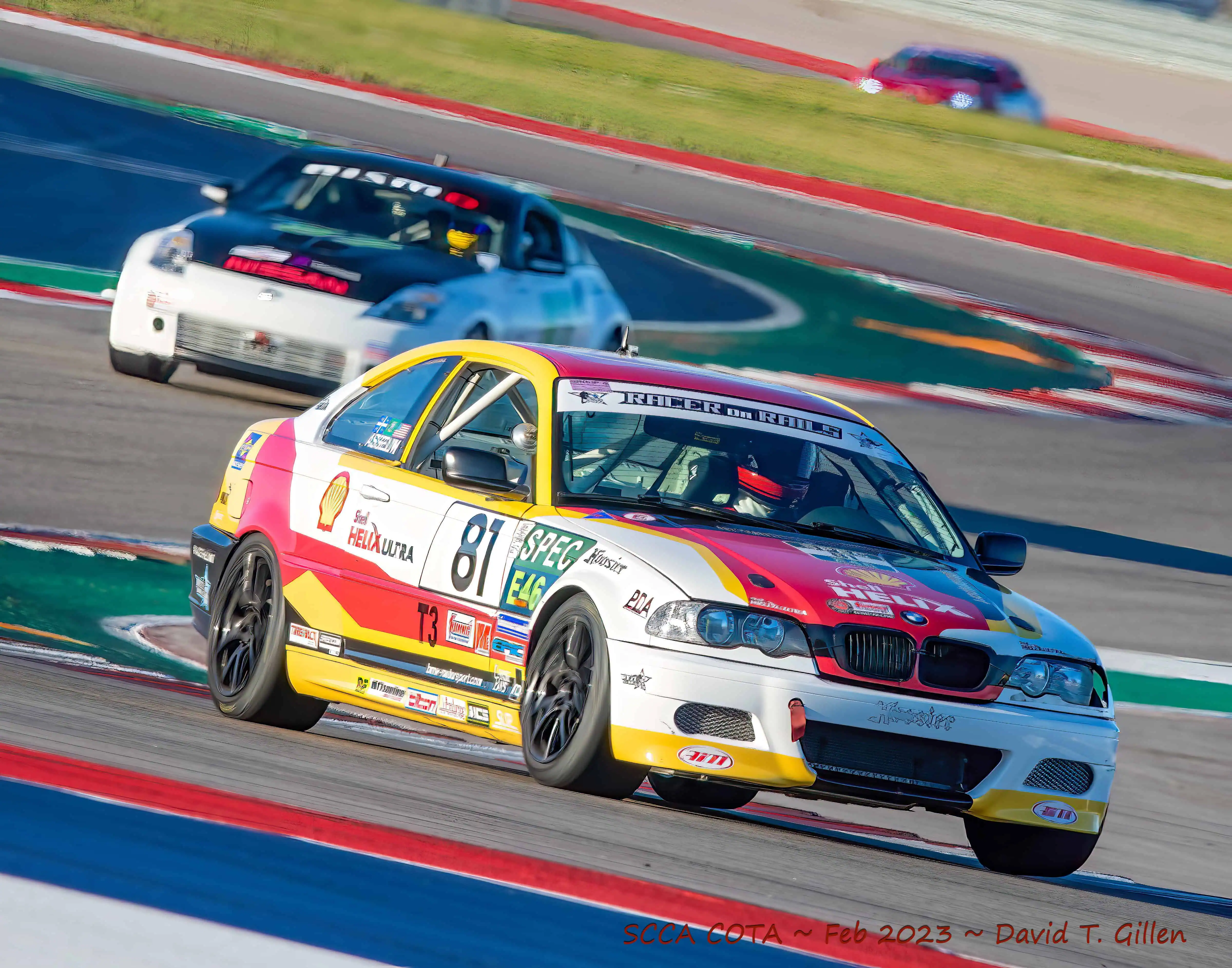
Across the rest of the team, every driver improved their personal best lap times with no Chicane at Portland in a 20+ car field and pushing towards the front in PRO3 and a 10+ car field in Spec E46.

What better way to end this race report than with some in-car video of what a very angry Honda 4 cylinder engine based Civic sounds like, bombing around Portland International Raceways at the same speeds that a front running Spec E46 does?

Turn those headphones down a tiny bit and enjoy!

YouTube player
Gama in the #309 K24A Honda Civic Hatchback doing a low 1:18 lap time during Sunday AM qualifying.
Posted on

Race Report 4: Virginia International Raceways SCCA Hoosier Super Tour 2022

The 4th and final stop of the 2022 Southeast Winter trip for the team was historic Virginia International Raceways, located just north of the Virginia/North Carolina border, in Alton, VA.

Before dive into the weekend, below is the map we took from January – April and covered nearly 7k miles and through the winter season across most of the country which resulted in catching the cold and wet weather at nearly each stop. Wow!

4 stops and ~7k miles over 4 months. Hats off to Jordan and Memo who drove our trucks, trailers and cars for every single mile.

Preparing for VIR

Road Atlanta ended up being a primer for VIR for the team. VIR is almost like a bigger Road Atlanta in that it is made up of mostly medium and high speed corners. Proper technique and equally proper commitment are critical to get into a groove and start attacking the lap times.

Just as before, each driver logged multiple hours in the simulator so that we all knew the track by heart and could dive into the test day with a focus on establishing a baseline performance and chipping away at the times.

On average, each driver (and crew member) had nearly 100 laps at VIR on Assetto Corsa with similar or the exact same cars as we were driving in real life.

Thursday Test Day – More Inclement Weather (Massive Thunderstorm Edition)

We all arrived and were fully setup on Wednesday night for the weekend and Thursday morning we awoke to some dew on the grass, dry track and chance of a shower here or there throughout the day. The first session was dry and we all got out and started familiarizing ourselves with the track in real life. Conclusion? The simulator model was pretty spot on!

A few minutes after our session ended, a thunder storm rolled in and another, and another, and another. We had 2, maybe 3 cells roll through and the middle two sessions were shot. Not just because it was raining but torrential downpour and the poor souls who decided to go out (and survived) ended up getting black flags in each session as the conditions were just horrible. Further, the forecast didn’t call for rain during the weekend so using up new rain tires under those circumstances wasn’t a good use of the tires.

Completely unedited and it only took a few minutes of rain before we had water running on the ground.

By the afternoon, the cells had passed and the track started drying. We all went out and while times were slower (transitioning to dry conditions), it was valuable time to further familiarize ourselves with the track.

Learning, Improving and Delivering Results!

The weekend had a similar progression as we’ve had at the other stops but we arguable started off at the highest point to start the weekend. All three drivers came out strong out of the gate and were within striking distance of podium positions, just needed to put our heads down and keep chipping away at the times.

Every session was an opportunity to learn and while unseasonably cold air rolled through on Friday night, everyone steadily chipped away at the times and at worst, were in a mid-pack battle but still within striking distance for a podium.

BMW Spec E46 Touring 3 SCCA
Simon in his Touring 3 Spec E46 managing transitioning conditions.

Below is a look at three of the corners we focused on across most drivers.

Sweet track map of VIR full course with a clear plexiglass on top that makes for great white board discussions about lines, markers and passing zones.

VIR Corner Focus 1: NASCAR Bend (Turn 3)

NASCAR Bend is the first left-hand corner/complex of the lap where it’s a bit of an awkward, somewhat off-camber corner where there isn’t a ton of time to be gained but very easy to over-slow and lose time. It feels a lot like Turn 6 at Portland International where it’s key to maintain minimum speeds and spend as little time as possible in the complex.

None of us really felt like we consistently hit the corner right but we aimed at being on-throttle at the apex, ascending to full throttle and carrying enough speed that the car had no choice but to use all of the exit curbing on the right. Getting out on that curbing then gave us a wider arch for the next left hand corner, which then left us track left to setup the run through the esses.

BMW M240iR in Touring 2 class at VIR NASCAR Bend
Gama in the Racer on Rails #110 BMW M240iR using all the exit curbing coming out of NASCAR Bend at the start of the Sunday race.

VIR Corner Focus 2: Southbend (exit of the Uphill Esses)

Before there is any controversy, yes – the Uphill Esses (Climbing Esses) are a pretty unique experience. There are few tracks in the world where you are flat out in 5th gear (or 6th gear) and you enter a corner section… without lifting. Thanks to the hours each driver spent in the simulator, after the first few laps in dry conditions, we were all able to take them flat but once you have the right line and rhythm, there’s not much more to them. HOWEVER! What you do on the exit of the Esses is something else.

Check out the Sunday Race 3 video in the M240iR and specifically this video is placed on a flying lap where the car gets light at 129mph and while being flat full throttle. (Note – rewind to start to watch the climb from P5 to P3 in Touring 2 class)

YouTube player

First, yes – it is possible to stay flat through the entire uphill essess complex but doing so compromises the entry into Southbend, of which is a high-speed left hand corner where you’re trying to keep your minimum speed above 90mph.

We found in the simulator that under most conditions, that was the trade-off and instead focused on having the car balanced and turned correctly to brush off minimal speed at Southbend and then carrying that speed into Oak Tree.

VIR Corner Focus 3: Oak Tree

Very much wish we could have been here when Oak Tree had the actual tree still standing. It’s an interesting and challenging corner to begin with but having the tree creating a arch across the corner, would have been majestic. But that’s life and we still enjoyed the scenery and challenge of the corner.

Open wheelers/formula cars showing the line through Oak Tree.

While it’s referred to as a single corner, it’s more like two corners in one and it is *not* a slow speed corner. The entry is best when you can brake into the corner and in a straight line. You can also brake less than you initially think, because the entry is uphill so the grip increases, the further into the corner you go. There is a moment of releasing the brake about mid corner, a focus on getting wide to the left to open up the radius of the corner and then attack the apex with full throttle application right at or before the apex.

In recent years, VIR has added extra pavement beyond the traditional FIA exit curbs which means more track and thus the ability (and requirement) to use all of that extra track on exit. Oak Tree leads to the longest straight away, which makes it the most important corner to hit well and consistently. In the BMW M240iR, we were hitting in the low 140-142mph without a draft and up to 145mph with a draft. The Porsche Cayman GT4 Clubsport was consistently hitting 150mph+ before braking for “Rollercoaster”, which was indeed, a roller coaster!

Race Results: Gains and Podiums

Saturday was a tough day for everyone – full course yellows (not caused by any of our drivers) were rampant, despite dry conditions. There were no gains on personal bests and we all found ourselves battling below the pace we each had demonstrated but struggling to get past cars with better straight line speed.

Dave looking for a way past a T3 Mustang at VIR

Sunday, we all hit the reset button and focused on getting solid starts, creating our own track position/space and getting after it.

Touring 3 Race: Dave and Simon both pounced on mistakes by other drivers and picked up a spot individually, putting Simon in P3 and Dave in P7 before a full course yellow came out that eventually ended the race due to an STU car that had gone deep into the tire wall at the end of the back straight away. Driver and car were all okay. Both ended up with their personal best lap times right before the FCY and were it not for the FCY, each felt like they had the rhythm and pace to further improve.

GT2 Race: Ann started in P5 with a mega qualifying effort and quickly jumped into P3 on the first lap with some assertive moves. With a gang of TA2 cars, tube-frame chassis RX7’s and many other ground pounders, her nimble and incredibly impressive under braking, Cayman GT4 Clubsport was under constant attack on the long back and front straight aways but she was able to create distance in the handling sections of the track.

Unfortunately there was a 3 lap long Full Course Yellow which took away the entire gap that she had built up and as soon as the green flag was thrown for the restart, she was back under attack and sitting duck for cars that had nearly a 10mph speed trap advantage.

Ann defended hard but ended up losing two positions by the end to finish in P6 BUT she fired in her fastest lap of the weekend on the final lap of the race.

Touring 2 Race: Gama was once again behind the #110 BMW M240iR for this race and faced similar challenges to the previous races – great under braking, handling but lacking 8-10mph to other BMW’s and 10-14mph to the Porsche’s. It became very clear on the Saturday race that if he wasn’t able to keep them behind them before the end of the back straight (coming off of Oak Tree), he’d be stuck behind them for the rest of the race.

The goal was simple – get a solid start (tough with a turbo car), get positions and keep them behind before T13 (Rollercoaster) and then create a gap in the handling sections.

The start was above average but still nothing compared to the naturally aspirated cars. Fortunately, they left a giant gap going into braking for T1 and was able to recover a lost position under braking. The next two laps (switching to first person mode) I was looking for a gap and specifically coming out of the uphill essess because I had noticed the Porsche’s were struggling to carry speed and get a good exit out of Southbend.

In lap 3 of the race, it happened – 997 Porsche got too sideways on the exit and I pounced, getting by him before braking for Oak Tree.

I was getting better exits out of Oak Tree than the Porsche but by about the middle of the straight away, I was a sitting duck so for one lap, I defended like a lion. Right after exiting the corner, I signaled to the Porsche that he’d have to pass me somewhere else on this one lap as I slowly moved from one side of the track to the other so that I could break a draft he might get (not that the Porsche needed it). He got the message and stayed behind.
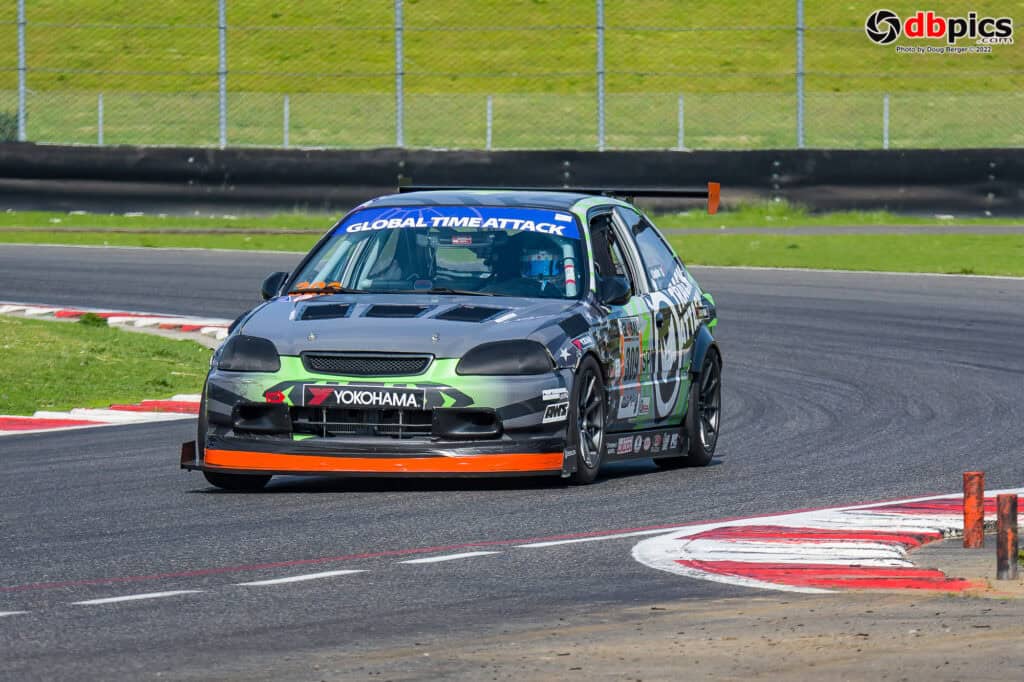
From then on, I put my head down and carried as much speed as I could through Hog Pen (final corner sequence of the lap) and onto the front straight. I had created just enough of a gap that I didn’t think he could make a credible move into turn 1, so last second, I moved back to the left to brake at normal spot and line. The Porsche ducked in to out-brake me into Turn 1 but the line was WAY too shallow for braking that late and with the additional speed the Porsche’s carry, so he easily washed out and off-track.

From then on, I put my head down and hammered out two new personal best lap times (in the 2:04’s) and was chipping away and making my way through traffic. Aside from a big mistake, I simply didn’t have the straight line speed to compete for better than P3.

Full course yellow came and my gap had been erased. The following 10-12 minutes were some of the most nerve racking of my life – I was sitting duck on the restart so I’d have to pull some magic out again but luckily, the race ended under FCY and for the first time in my life, I was beyond grateful for that result. P3 in Touring 2 class at Virginia International Raceways and against a fleet of Fall Line Porsche’s and BMW’s – what a weekend!

What’s Next?

We’re a little late in publishing this report but after this we make our way back to the Pacific Northwest to start the regional racing season with races at Portland International Raceways, Pacific Raceways and Spokane County Raceway in May.

VIR was an amazing experience overall and great practice and data gathering for when we return in September for the 2022 SCCA Runoffs.