Posted on

Confidence, Consistency and Podiums at Watkins Glen – Porsche Club of America (PCA) July 2026

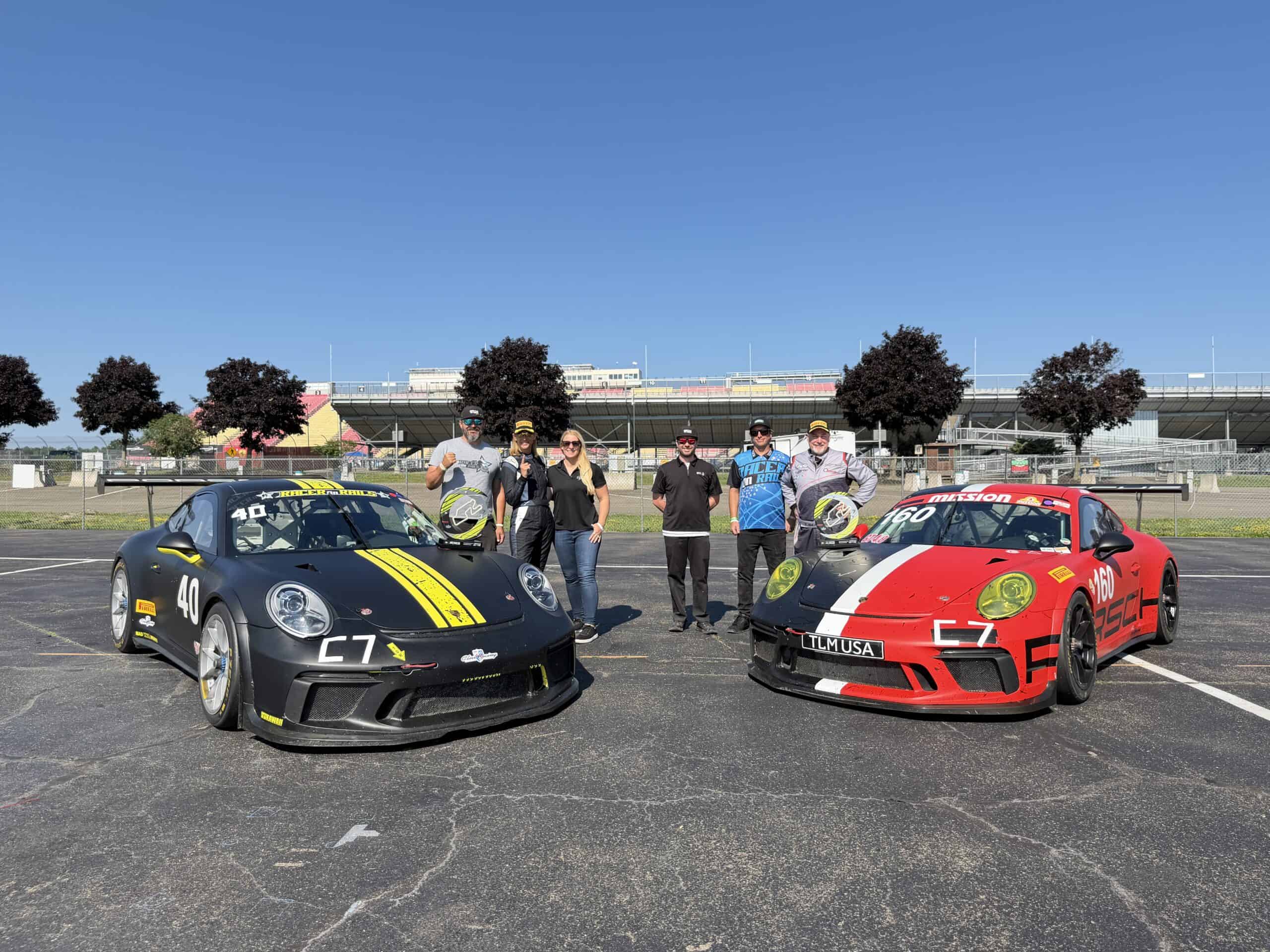
Racer on Rails team with Ann Doherty’s black Porsche race car, Thad Berger’s red Porsche and their podium trophies at Watkins Glen.

Watkins Glen International is a circuit that demands confidence.

Across its 3.45-mile Grand Prix layout, the speed is high, the consequences of hesitation are real and the car is almost always being asked to do more than one thing at a time. Braking zones arrive while the chassis is still loaded, elevation changes alter the balance beneath the driver and many of the most important corners require commitment well before the exit comes into view.

It is also one of North America’s most historic racing venues. Competition around Watkins Glen dates back to the first postwar road race through the village in 1948, and the circuit has remained one of the country’s defining motorsport destinations ever since.

For Racer on Rails, the Porsche Club of America Club Racing weekend presented two very different driver-development stories.

Longtime friend and client Thad Berger was returning to competition after a hiatus caused by a major rebuild of his car. Alongside him was Ann Doherty, whom we have supported throughout the season and who arrived at The Glen with momentum already building.

Ann’s program also included support from professional driver and coach Pippa Mann. The Racer on Rails crew consisted of Jordan Allen, serving as car chief for Ann’s 991.2-generation Porsche 911 GT3 Cup car; Ian Anderson, serving as car chief for Thad; and Tyler Campbell, working as race engineer and driver coach across both programs.

Tyler supported both drivers directly while collaborating with Pippa throughout Ann’s weekend.

The drivers arrived from different starting points, but the objective was the same: build trust in the car, sharpen the communication between driver and crew and turn that confidence into repeatable performance.

Carrying Momentum into the Weekend

Ann arrived at the PCA weekend with valuable recent experience at Watkins Glen.

Only a couple of weeks earlier, Racer on Rails had supported her during the SCCA race weekend at the same circuit. A combination of simulator work, preparation and focused coaching allowed her to arrive ready to perform, ultimately producing a third-place finish in Sunday’s race.
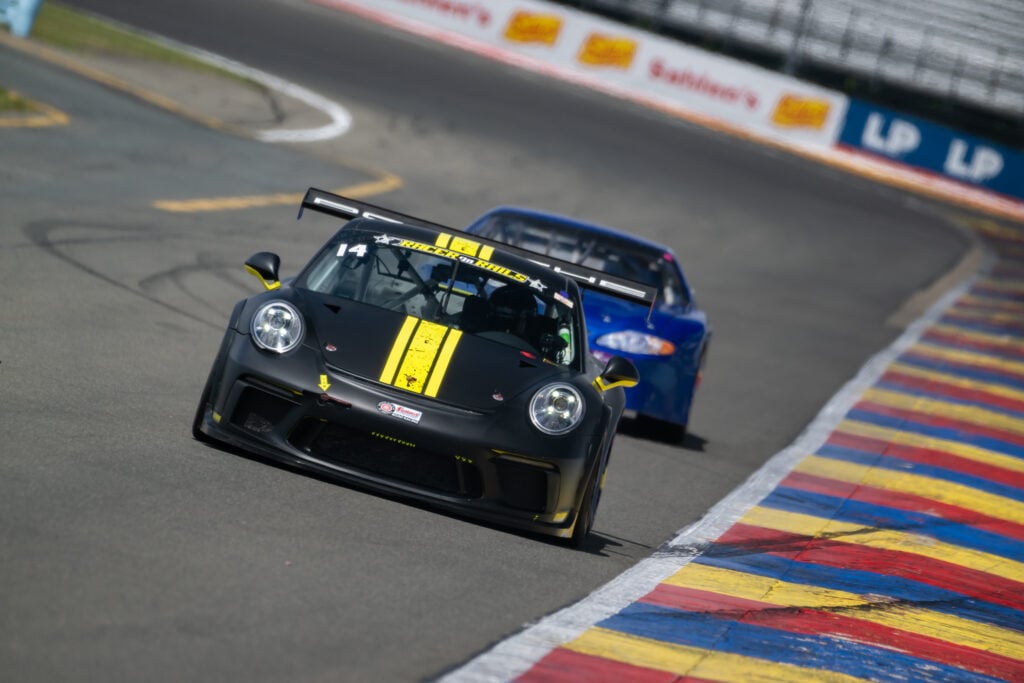
Ann Doherty drives the black-and-yellow Racer on Rails Porsche race car through a corner at Watkins Glen International.
Ann Doherty attacks Watkins Glen International in her black-and-yellow Racer on Rails Porsche during the SCCA Hoosier Super Tour weekend. Photo Credit: Trey Coleman

That recent experience meant the PCA weekend did not begin with Ann needing to relearn the circuit. Instead, she could immediately begin refining her driving, exploring the limits of the car and building on the progress already made.
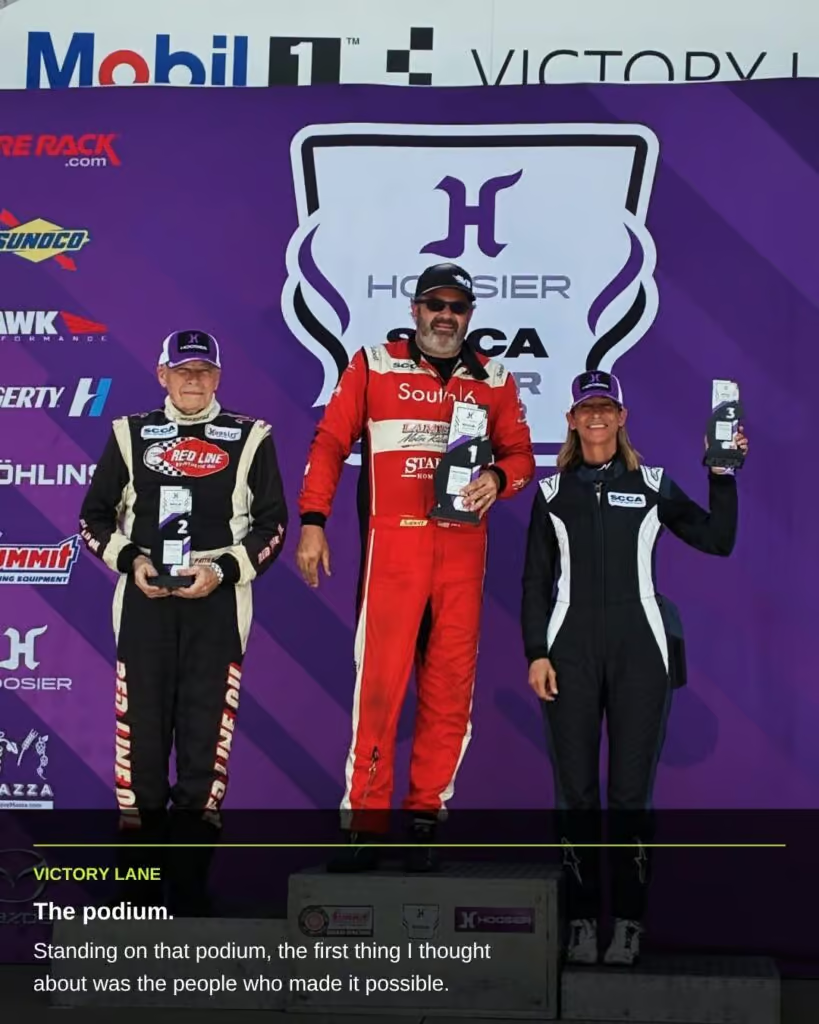
Ann Doherty celebrates a third-place finish on the SCCA Hoosier Super Tour podium at Watkins Glen International.
Ann Doherty celebrates a third-place finish at the SCCA Hoosier Super Tour weekend at Watkins Glen International.

Friday opened with two practice sessions before the field moved into qualifying and the weekend’s first race.

Ann quickly showed that the earlier preparation had carried over. She set a new personal-best lap and qualified second in GTC7 for the non-points race.

GTC7 is PCA Club Racing’s class for 2017 through 2021 Porsche 991.2-generation Cup cars. With the machinery tightly controlled by the regulations, performance comes down heavily to preparation, setup, execution and the driver’s ability to consistently extract speed from the platform.

When an issue struck the initial race leader, Ann was in position to capitalize.

She stayed composed, managed the race and brought the car home for the victory. Along the way, she continued lowering her personal best, eventually producing a 1:55.2 lap time before the end of Friday.

The victory was the visible result, but the larger story was the progression behind it.

Ann was becoming increasingly comfortable asking more from the car, and increasingly precise when describing what she needed from it.

Developing the Car as the Pace Increased

As Ann became faster, the setup needed to evolve with her.

The car that helps a driver build confidence early in their development is not always the same car they need once the pace begins to increase. As Ann carried more speed, committed earlier and asked more from the front axle, her feedback began to change.

Throughout Friday and Saturday, the team worked through a series of adjustments designed to preserve the confidence she had built while giving her the response she needed at a higher level of commitment.

She wanted more authority from the front of the car. At the same time, the increase in her pace meant she no longer needed the same level of aerodynamic stability she had previously relied upon.

Jordan and Tyler continued adjusting the platform around that feedback, while Tyler and Pippa worked together to maintain a consistent coaching framework.
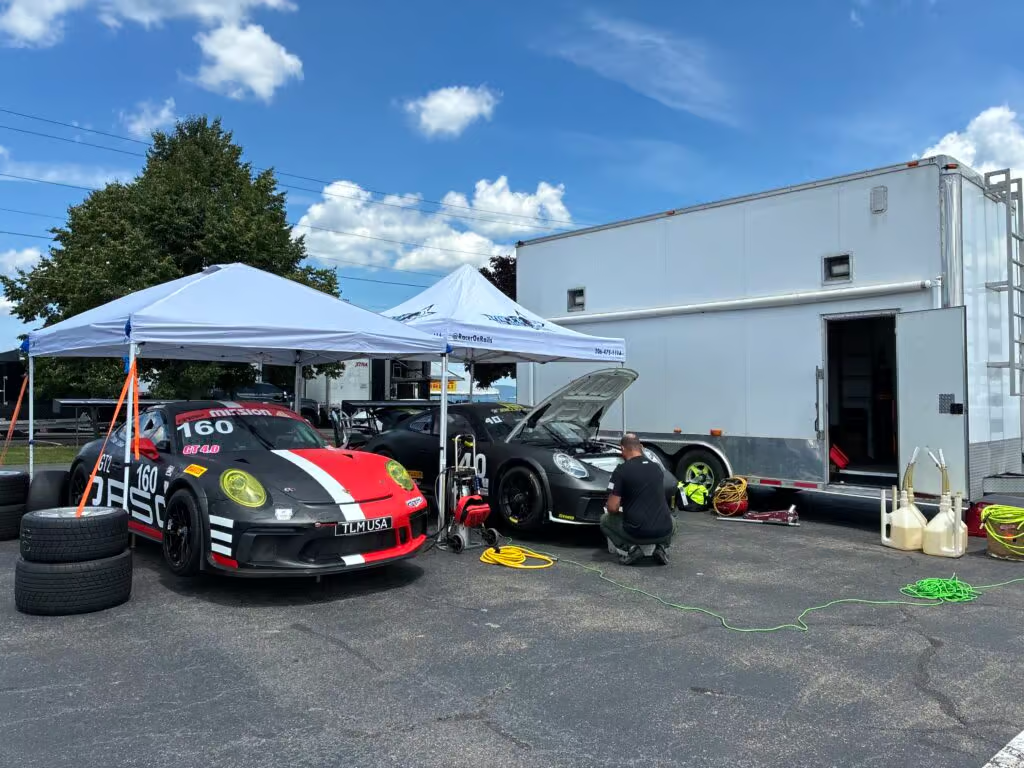
Racer on Rails team member works beside Ann Doherty’s Porsche as Thad Berger’s Porsche sits nearby in the Watkins Glen paddock.
The Racer on Rails crew prepares Ann Doherty’s and Thad Berger’s Porsche race cars between sessions in the Watkins Glen paddock.

The goal was not simply to make the car faster on paper.

It was to give Ann a car she understood, trusted and could use.

By the end of the process, the car was responding in a way that allowed her to drive with greater confidence. The lap times followed, but more importantly, so did the consistency.

Fighting Forward in the Heat

Saturday presented a different challenge.

Temperatures climbed, the points-race fields grew larger and Ann found herself racing in the middle of a group that included several newer 992-generation Cup cars.

Traffic became more difficult. The heat changed the car. The racing became more physical.

Despite those conditions, and some light contact from another competitor, Ann stayed in the fight. She managed the car, remained composed and finished second in GTC7 in the first points race.

The second points race was equally demanding.

The conditions continued to test both driver and car, and Ann did not feel as comfortable as she had earlier in the weekend. Even so, she continued working through the difficulty rather than allowing it to dictate the race.

The result was another second-place class finish.

Across the three sprint races, Ann earned:

  • One GTC7 victory
  • Two GTC7 second-place finishes
  • A new 1:55.2 personal-best lap

More importantly, the weekend showed that the speed developed through simulator work, preparation, engineering and coaching could be carried into changing conditions and converted into repeatable race results.

Rebuilding Rhythm with Thad

While Ann entered the weekend carrying recent Watkins Glen momentum, Thad’s program began from a very different position.

Thad has considerable experience at The Glen, but his return followed an extended break while his car underwent a fresh rebuild. That rebuild followed a major incident at Road Atlanta in 2024, when another car lost control on the back straight and collected Thad’s Porsche, causing significant damage to the passenger side.
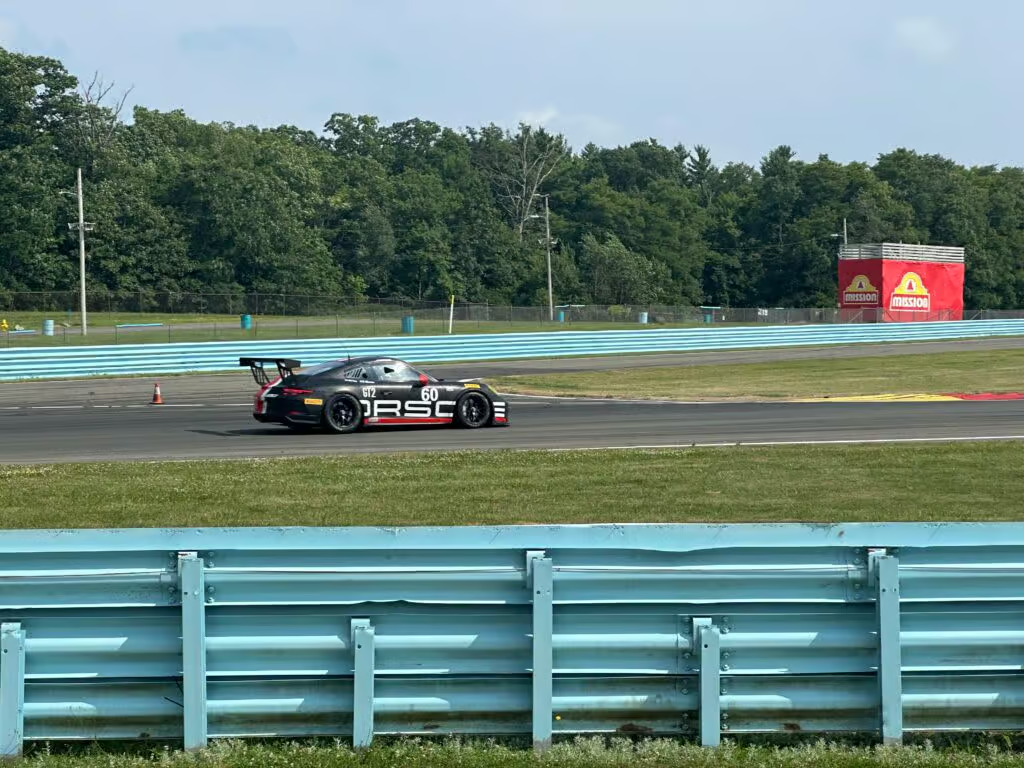
Thad Berger drives his No. 60 Porsche through the Bus Stop chicane at Watkins Glen International.
Thad Berger drives the No. 60 Porsche through Watkins Glen’s high-speed Bus Stop chicane during the PCA Club Racing weekend.

Before arriving at Watkins Glen with Racer on Rails, he had completed only one shakedown weekend with another team.

The familiarity with the circuit was still there.

The immediate trust in the rebuilt car was not.

We began the weekend with a baseline setup and then worked methodically through a series of changes intended to give Thad a car that responded the way he expected.

That process became an important driver-development exercise.

Thad is an experienced racer with significant seat time, but much of that experience had been instinctive. He had not previously spent as much time developing the language needed to describe the car’s behavior, identify what he wanted changed and anticipate how a particular adjustment should affect the platform.

After every session, we separated the conversation into two connected areas.

First, we reviewed the driving itself: lap strategy, execution, traffic management and the places where Thad could make better use of the car.

Then, we discussed the car.

We worked to identify what he was feeling, what he was asking the chassis to do and which adjustments could help the platform better support those instincts.

Before making each change, we talked through the expected effect. When Thad returned from the next session, he could confirm whether he felt what we had anticipated.

That feedback loop allowed him to connect a mechanical adjustment to the sensation behind the wheel.

It also gave the team increasingly precise information to work with.

Building Pace Through Understanding

With each session, Thad’s understanding of the car improved.

As his confidence in the platform grew, so did his confidence in his own feedback. He became more decisive when describing the car, more deliberate in his requests and more comfortable pushing once the setup began responding as expected.

The progress accelerated quickly.

By the later sessions, Thad was not simply setting personal-best laps. He was doing it while managing traffic, racing other cars and completing passes.

That combination of improving pace, racecraft and consistency became especially valuable in the two points races.

Despite qualifying several positions behind where he would eventually finish, Thad raced his way forward to third in class in both races.

Across the two contests, he completed a combined six in-class passes, earning two hard-fought podium finishes.

For a driver returning after a long interruption and adapting to a freshly rebuilt car, those results represented much more than two trophies.

They demonstrated what can happen when experience, engineering feedback and a structured development process begin working together.

Finding the Limit

The confidence built throughout the weekend carried directly into Sunday’s enduro.

As Thad became increasingly comfortable with the car, he began pushing harder than he had at any earlier point in the weekend.

While attacking Turn 8, he found the limit and spun the car.

After the spin, the Porsche would not restart, bringing the enduro to an early conclusion. It was not the ending anyone planned, but it was also not a reason to discount the progress that came before it.

Ian immediately began investigating the no-start condition and identified the cause within a couple of hours. With replacement parts on the way, the car should be repaired and ready for its upcoming International GT and Trans Am weekend.
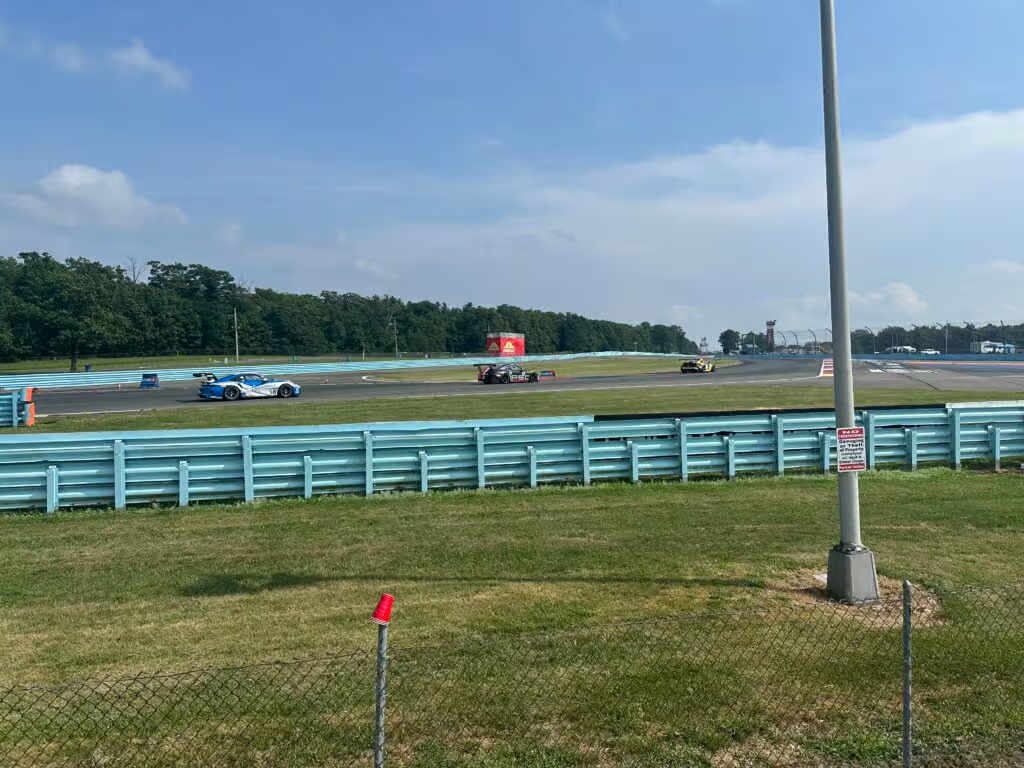
Thad Berger races his No. 60 Porsche through the Watkins Glen Bus Stop between other competitors.
Thad Berger navigates the Watkins Glen Bus Stop in traffic during the PCA Club Racing weekend.

The spin was another piece of information.

Thad had started the weekend rebuilding trust in a freshly rebuilt car. By Sunday, he had become comfortable enough to push beyond where he had previously been willing to go.

Finding the limit is part of racing.

Sometimes that lesson arrives through a faster lap. Sometimes it arrives through a moment that creates a new problem for the crew to solve. Either way, it establishes the next step in the development process.

Thad returned from a lengthy hiatus, improved with every session, developed a stronger understanding of both the car and his own feedback, completed six in-class passes and earned podium finishes in both points races.

By Sunday, he was no longer searching for confidence.

He was using it.

Two Drivers, One Development Process

Ann and Thad arrived at Watkins Glen from very different starting points.

Ann carried momentum from her recent SCCA podium and used it to attack the weekend immediately. She set new personal bests, won Friday’s race and added two second-place finishes in the points races.

Thad arrived needing to rebuild rhythm and trust after time away from the car. Through a methodical process of setup changes, feedback and coaching, he rediscovered his pace and converted that progress into two podium finishes of his own.
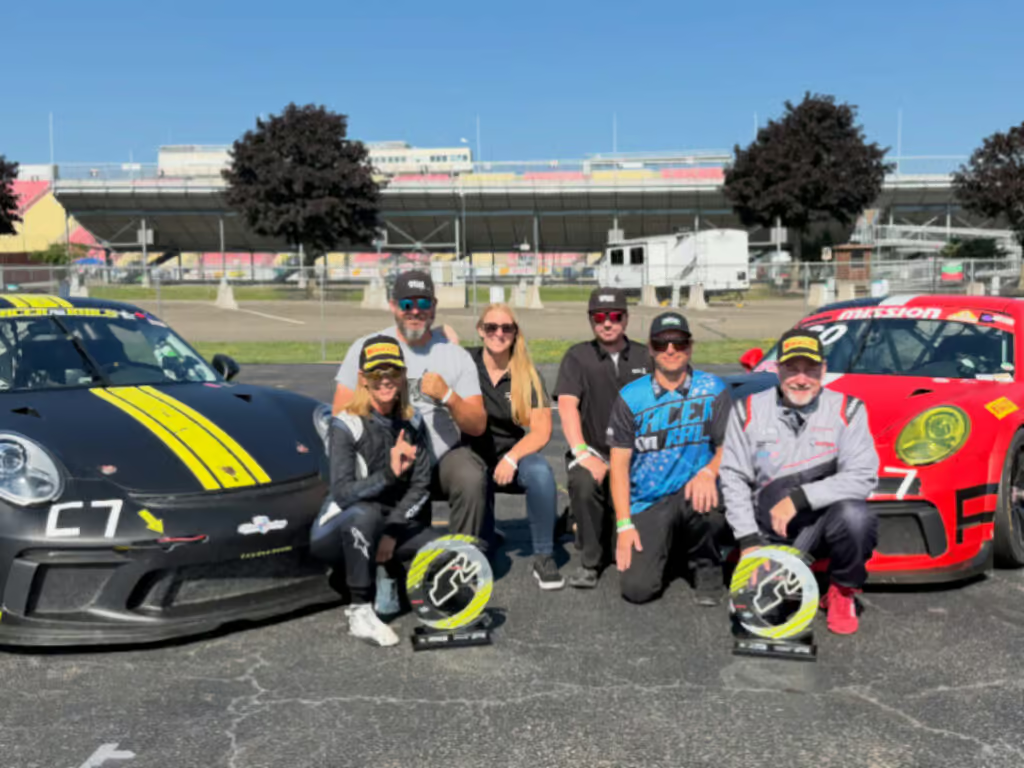
Racer on Rails team with Ann Doherty, Thad Berger, their Porsche race cars and podium trophies at Watkins Glen.
From left: Ann Doherty, Jordan Allen, Pippa Mann, Tyler Campbell, Ian Anderson and Thad Berger with Ann’s and Thad’s Porsche race cars and their Watkins Glen podium trophies.

Between them, the Racer on Rails drivers earned:

  • One GTC7 victory
  • Two GTC7 second-place finishes
  • Two class third-place finishes
  • Six in-class passes for Thad
  • A new 1:55.2 personal best for Ann

Jordan Allen and Ian Anderson kept both cars supported through a demanding weekend, while the combined engineering and coaching effort from Tyler Campbell and Pippa Mann helped turn driver feedback into measurable progress.

There were trophies, personal-best laps and plenty of close racing.

But the most important result was the confidence built across both programs.

At a place as fast and demanding as Watkins Glen, confidence is not simply a feeling.

It is performance.
Posted on

New Track, New Car, Who Dis?

The second stop in the 2024 SCCA Hoosier Super Tour schedule for the team was NOLA Motorsports Park – a new track for all the drivers and most of the team. Relatively flat, built on a swamp and host of SRO GT Americas race events the past few years, NOLA ended up being a decently technical track and the Louisiana weather initially welcomed us with 70F, sunny and with a breeze weather. But once the test day came, the cold air from up north and a weather system from down south decided to join the party and aside from Sunday, we had low 40F temps, rain, and wind. Why do we even leave the PNW to go racing???

Thoughts on NOLA

Flat, minor (but critical) banking in some corners, no point-n-shoot corners and not a lot of time above 120mph meant that balancing the car in the cornering bits was going to be a premium.

NOLA has 16 corners with 10-11 of them (depending on how you count the corners) are right hand corners and there are two sections of the track where you have consecutive right hand-corners, which makes those left-side tires important. From Turn 4, you are only making right hand turns until Turn 10! Turn 4 is a slower speed corner which requires a good amount of mechanical grip. Turns 5, 6 and 7 are higher speed corners where you are trying really hard to not over-slow for turns 5 and 6 but as you try to carry the speed into those corners, the left rear tire is taking a beating from the slight high-speed yaw action when trying to rotate the car and then accelerating through the corner.

The esses complex is relatively straight forward but carrying speed into Turn 9 (the first ess) is critical and sets up the rhythm through the rest of the complex.

Finally, the left side tires only get a mini-break before needing to turn hard at Turn 13 and then suffer through a long duration compound section of Turns 13-14, which leads onto the main straightaway.

If you’d like a more detailed walkthrough of the track, check out this video that came in super handy from ASM and Tom O’Gorman.

YouTube player
Credit: ASM + TOMO Coaching

Ann’s new baby shark! 991.2 Porsche GT3 Cup Car

As some of you may have read in past posts, Ann has been developing at a rapid pace the past couple of years and driven the wheels off a Porsche Cayman GT4 Clubsport, mostly in SCCA GT2 and T1 classes. At the end of the 2023 season, with the repairs needed on the car from a failed tire during the runoffs, Ann made the decision to move on from the Cayman and jump into a GT3 Cup Car. So she spent the off-season looking for options and just in time for the NOLA race, we took delivery of her new steed on the Wednesday before the race weekend. Exciting but yikes!

With her car being new to the team and her and limited information of the running state, we set low expectations for the weekend: get the car on track, have it circulate consistently and have Ann start to build confidence in the car. Any specific result was not a consideration at all for the weekend.

Look at the butt on that! Yeah – it must work out. Ann’s new 991.2 Porsche GT3 Cup Car!

Jordan got to work on the car and after completing a full inspection, we were in decent shape! There were a couple of suspension bits to monitor, some to proactively replace but aside from that, it was just work to get the car personalized to Ann’s preferences and get the car out on the track so we could know more confidently, what we had on our hands. The car was ready to test on Friday but straight up gross, wet, and cold conditions, we made the team decision we’d wait until Saturday where there was a window of potential dry weather.

Saturday started off wet but the rain started slowing around 9-10am, just in time for qualifying. Ann went out on wet tires in case it started raining again (it didn’t) for her maiden voyage and by the end of the session, we had a clean bill of health! By the afternoon race, we fitted a set of the used tires the car came with and sent her out to get more laps, see what breaks and build confidence! After race 1, she moved up several positions, finished P6, nothing broke and ended the race with the last 2-3 laps at a decent enough pace where we could actually start looking at performance.

On Sunday, we finally got a break in the weather with the system that ended up delaying the Daytona 500, moving south of us, leaving us with clear skies but COLD winds. Beggars can’t be choosers! Ann continued to take time off her lap times during qualifying and exchanged places to finish P6 out of 13 in her first race! In race 2, Ann picked right back up where she left off, took another 2 seconds off her fastest lap time to finish with 4 laps in the low 1:50’s. All again on 2 year old used tires with unknown number of heat cycles. Safe to say that Ann is loving her new Porsche GT3 Cup Car and is ready to build on this for the next race at Road Atlanta!

One last thing on Ann to put things in perspective. Just a few years ago, she had never been on a race track, let alone raced wheel to wheel. ~3 years in and developing at a very high rate in a Cayman GT4 Clubsport which is mega fast but has a lot of driver aides, she decided to move onto a monster of a platform. She not only jumped in with full confidence to drive, but she truly slayed this beast on her first outings in it. Incredible job, Ann!!!

Ann driving back into the pits from her first on-track session in her new Porsche 911 GT3 Cup Car!

Dave continues building on his BMW Z4 M Coupe

Dave took his new-to-him BMW Z4 M-Coupe out at Sebring for the first race weekend and made solid progress on the new platform but NOLA brought a whole new set of challenges with the weather and the gearing. The Z4M has won the SCCA Runoffs the last 2 years in a row, in large part due to the M3 based gearing. Nice and tall gears to let it stretch it’s legs out on the long straight aways. NOLA doesn’t have any long straight aways, so we knew going into the weekend that the gearing wouldn’t be optimal for the car but we’d still make the most of it.

Dave took part in all of the test day sessions but as covered previously, the conditions were horrible so they were good for getting a sense of the track from simulator preparations but gave next to no representative data for what ended up being dry the rest of the weekend.

Dave (and Gama) qualified on Saturday AM on wet tires (along with the rest of the field) but it ended up being damp to drying track surface. In race 1 Dave got out to a good start, avoided spinning on the oil left by a T4 car that dropped oil around the final corners leading to the main straight away and finished P6, one spot behind Gama who spun on that oil and had to battle his way back from last place.

On Sunday, Dave worked committing to throttle in one smooth motion during qualifying and dropped another almost 2 seconds from his personal best! In the race, which finally brought some track temperature with the sun appearing, he built on those learnings, took advantage of mistakes from other drivers and came in P5, chipping away at the gap to P4! Road Atlanta should be better suited for the powerhouse BMW Z4M with that long back straight away, two uphill sections where torque pays off big time and it being Dave’s 3rd time back to the track!

NISMO 370Z Starts to Deliver on it’s Potential

At Sebring, we saw signs that the 370z could compete for podium positions but rain in the wiring and dealing with the ice mode issue held us back from being able to truly show the car’s potential. Fast forward to NOLA where the brake vacuum controller that was requested to be allowed, was approved (yay!!) but not legal until March 1st, we had to figure out how to make due with an ABS System that could freak out at any point. We tried a few different things and while not perfect, they were good enough for us to feel comfortable running the car for the weekend.

On the morning of the test day, we decided to switch to wet tires due to the rain that had started but a wheel stud failed when trying to remove the wheel. Ugh! Memo jumped on the problem and 3-4 hours later, the car was ready to go, only to make the last test session of the day, just to make sure everything stayed together. Hats off to Memo’s effort and problem solving – as we chatted on the sidelines through the repair, had this type of an issue occurred while any of us drivers would have been there on our own – game over. Someone help me push this thing into the trailer but with Memo and or team on-hand, dang near anything can come up and as long as it’s safe, they’ll get the car back on the grid.

In the Saturday AM qualifying, we went out on wet tires like everyone else and finished P4, believing we had more pace in the car and on the second row, so all the things to play for. In the Saturday afternoon race, towards the end of lap 2, someone lost an engine, dropped oil all around the last couple corners. In the heat of the battle and with wet spots all around, I didn’t spot the oil (though the team had radio’ed it in) and got caught out when the rear tires hit the oil.

It took me a bit to get the car re-fired and out of the completely soaked grass but got going again, put my head down, worked my way back to P5 and was catching the leading group at 1-2 seconds per lap (of which I didn’t realize at the time and was somewhat frustrated with my pace).

The next day for the Sunday AM qualifying, we swapped on some lower heat cycle tires (specifically, the tires that I used during the VIR Runoffs in the installation laps/sessions) and a new tire on the front left corner. Better tires but still not a full on sticker run. First flying lap was good but I wasn’t pushing 100% and tires weren’t fully into the working window. The 3rd flying lap I let it all out and found myself a very fast Danny Stein in his Mazda STL car which provided a nice tow around the track, which resulted in a 1:55.2XX and pole for T3! On the next lap, I was slightly up on that 1:55.2XX lap time and I was going for another flyer to try and improve. I braked at the same point for Turn 1, did my downshift, turned in and then full front end lock up – sigh. This would end up being a telling sign of the rest of the day.

For the race, we decided to raise the car all around to help with compliance around the bumpy track. Thanks to fellow Nissan racers Rick Kulach and Richard Baldwin, we were able to get our hands on some taller front springs and made the change in time for the race.

YouTube player
Watch the Sunday Touring 3 Race where Gama Aguilar starts in P1 and leads from flag to flag.

When the race started, I focused on getting a good start and ideally not be competing for the corner going into Turn 1. Luckily that happened and after the first lap, decided to pump out the fastest laps I can could muster so that I could build a healthy gap to P2. All was going to plan until I locked up going into T13 and had to take the escape road. Lesson learned that even though I thought the tires were still fresh, it was simply too much speed for this *awesome* (sarcasm) brake system to handle. From then on, I focused on braking a little earlier and softer in all braking zones, knowing I’d be leaving some time on the table but that would be better than locking up and flying off the track.

My plan was to steadily build the gap so that by the time we hit lapped traffic, I could use that pull away. Unfortunately, the rest of the competitors were not aware of my plan. haha

Sometime about mid-way through the race, someone lost a big lip spoiler or some strip of something that was 4-5′ long and right at the exit of Turn 8 of which I didn’t see until it was too late to do anything but run right over it. There was some loud banging as it went under the car and I had to slow to figure out if anything had impacted the handling/safety of the car. No issues but I lost a solid 1-2 seconds.

The next couple of laps, I had to take Turn 8 more cautiously so that I could see where that object was and not run over it again. Perfect. 🙁

Some laps later, Richard’s 350Z had a tire failure and he pulled off to the right of the essess, causing a local yellow. I ran up on a lapped T3 Mustang right in that spot and there went my entire gap to P2. From then on, it was a battle to steadily build up that gap.

2011 Nissan NISMO 370Z SCCA Touring 3 Spec at night with lights on.
Clearly bias but look at this thing!

Another thing that I have been struggling with is the shifter and specifically, the 5th to 4th shift where the shifter doesn’t self-center and will easily drop into 6th gear, not 4th gear. That shift is critical for Turn 8 and I had to over slow to make sure I got the shift done right and even then, I screwed it up a couple of times – another .5-.75 seconds lost on each screw up.

With a few laps left in the race, started coming up fast on a T4 car going into the essess and made the judgement call to make the pass before we got perpendicular to the standing yellow flag – barely made it!

Finally, going into the last lap, I was focused on matching or improving my personal best, knowing the left side tires were struggling. Half way through the lap, I was almost matching my fastest lap but knew I was vulnerable in the essess due to the 5th to 4th shift but still had a decent run through the section. P2 car was on my rear bumper so going into Turn 13, I ran a more defensive line, braked earlier and softer, go the downshift done and when I started turning, the front end locked up again.

My only choices were to continue plowing forward and straight into the grass, of which when that happens, I would have likely lost control of the car until it hit the asphalt again OR come of the brake and straighten the wheel so I could take the escape road. I did the second path as I had earlier in the race, then focused on making sure I didn’t make contact with anyone while rejoining the course. Coasted through the escape road, looked to my right, saw no cars and then rejoined with a primary concern of not causing a wreck.

Ended the race in P1 but post-race, the stewards felt like I gained an unfair advantage by taking the escape road and while that wasn’t my intent at all, I had no argument against it. Minor disappointment but in the grand scheme of things, very pleased with the results.

We made it through a weekend without the brake vacuum regulator and no damage to the car or other cars, learned more about the car and finally got consecutive on-track sessions to build base level confidence in the car. This car is finally showing the potential we know it has!

Mega thanks to the whole Racer on Rails team that made the NOLA SCCA Hoosier Super Tour weekend a massive success! Next up is Road Atlanta in March where the team is looking to build on success and momentum in 2023. Let’s go!!!