Posted on

Porsche 718 Cayman GT4 Clubsport MR: When Motorsport Comes First

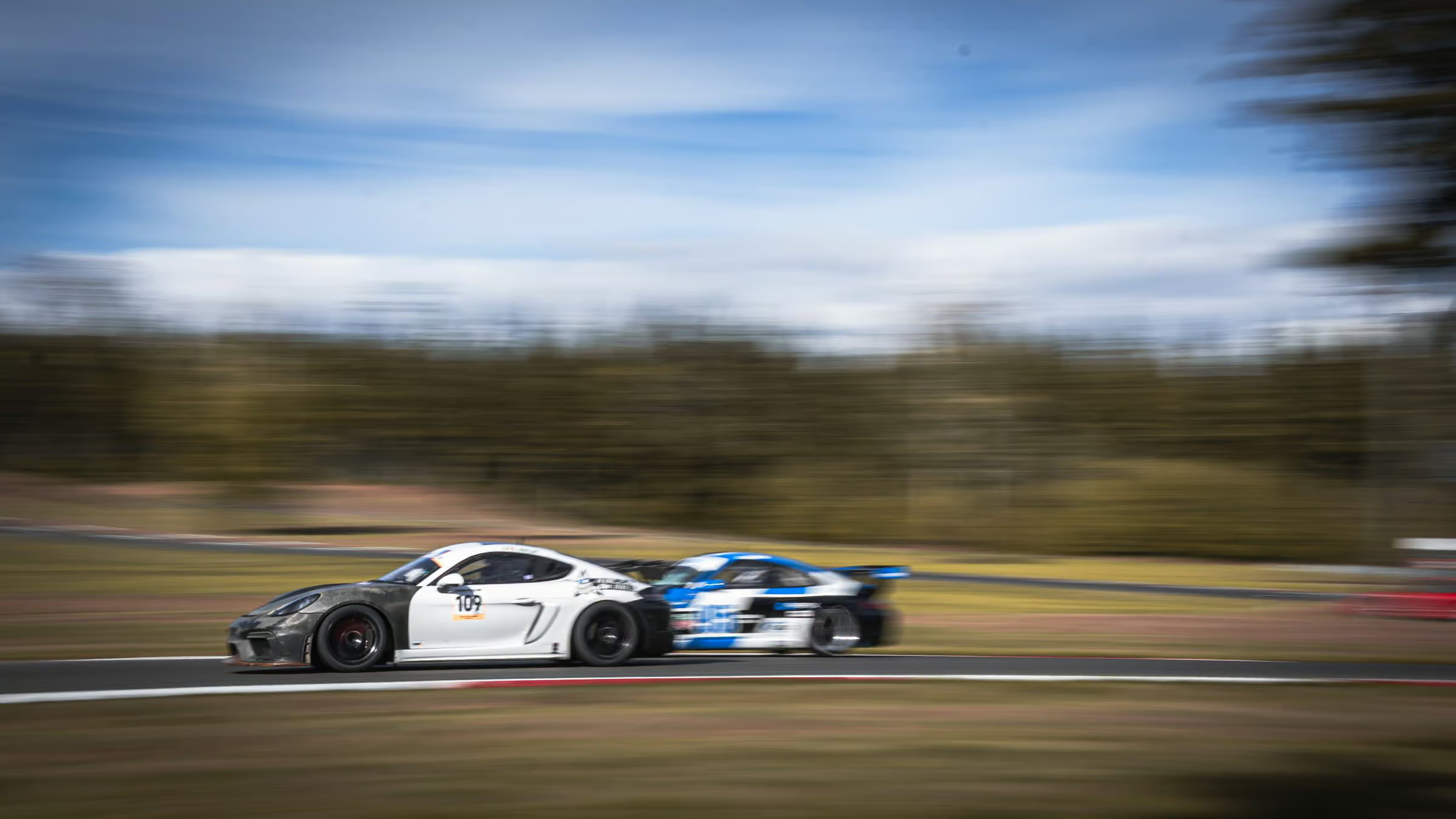
Porsche 718 Cayman GT4 Clubsport MR #109 on track at the Ridge

We bought a wrecked GT4 race car.

Not a GT4 race car with a story. Not a GT4 race car with “some assembly required.” A 2020 Porsche 718 Cayman GT4 Clubsport MR that had been hit hard enough at Road Atlanta to end its day, its season, and — as far as most people were concerned — its career.

The previous owner, Thad Berger, did what serious racers do. He assessed the damage, made the economic call, and moved on to a GT3 Cup car.

We made a different call.

This is the story of that car: what a Clubsport MR actually is, what it takes to bring one back from the dead properly, and why this specific car has become the standard our whole shop is measured against.
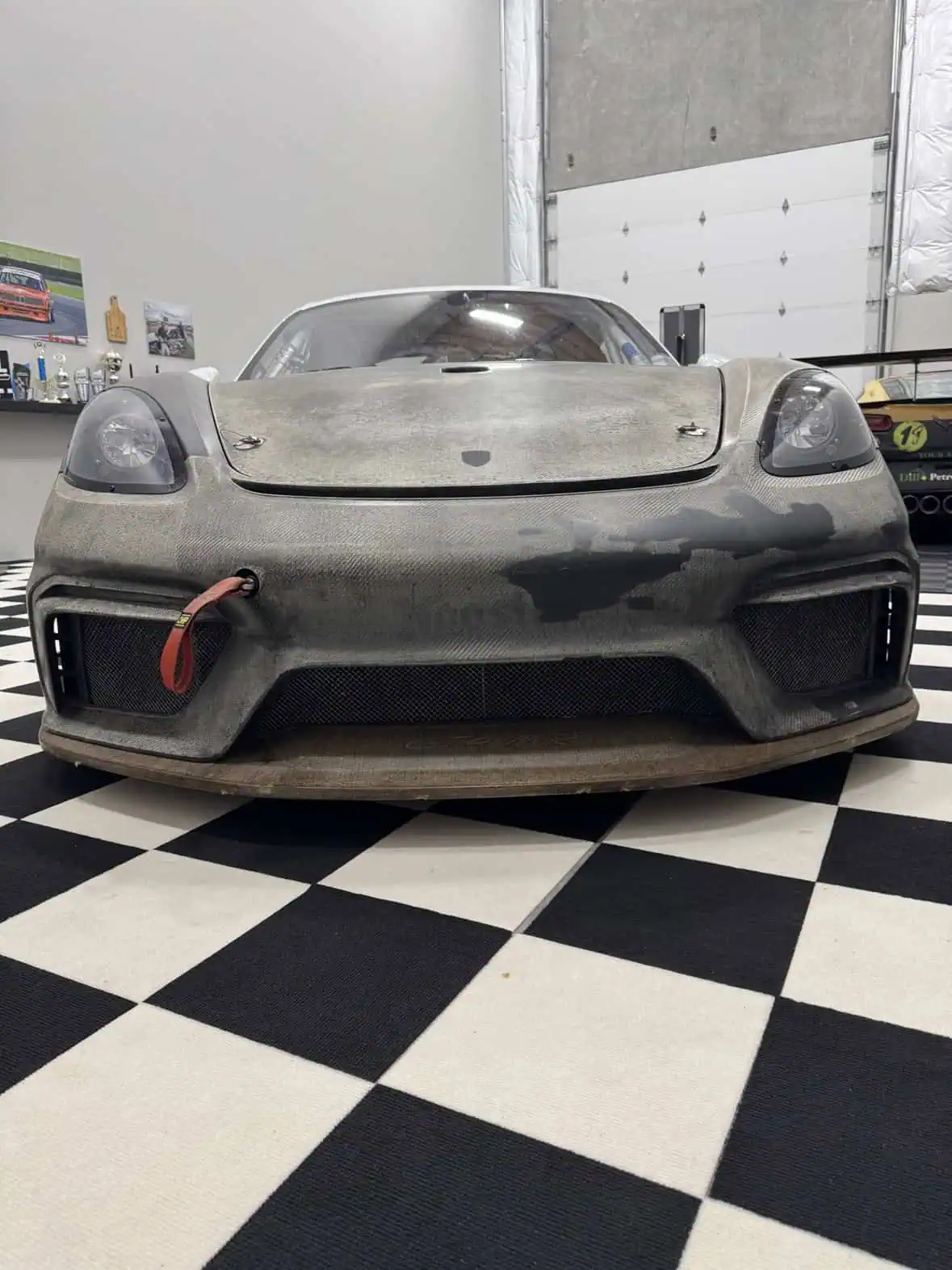
718 Cayman GT4 Clubsport MR with raw unpainted carbon front clip
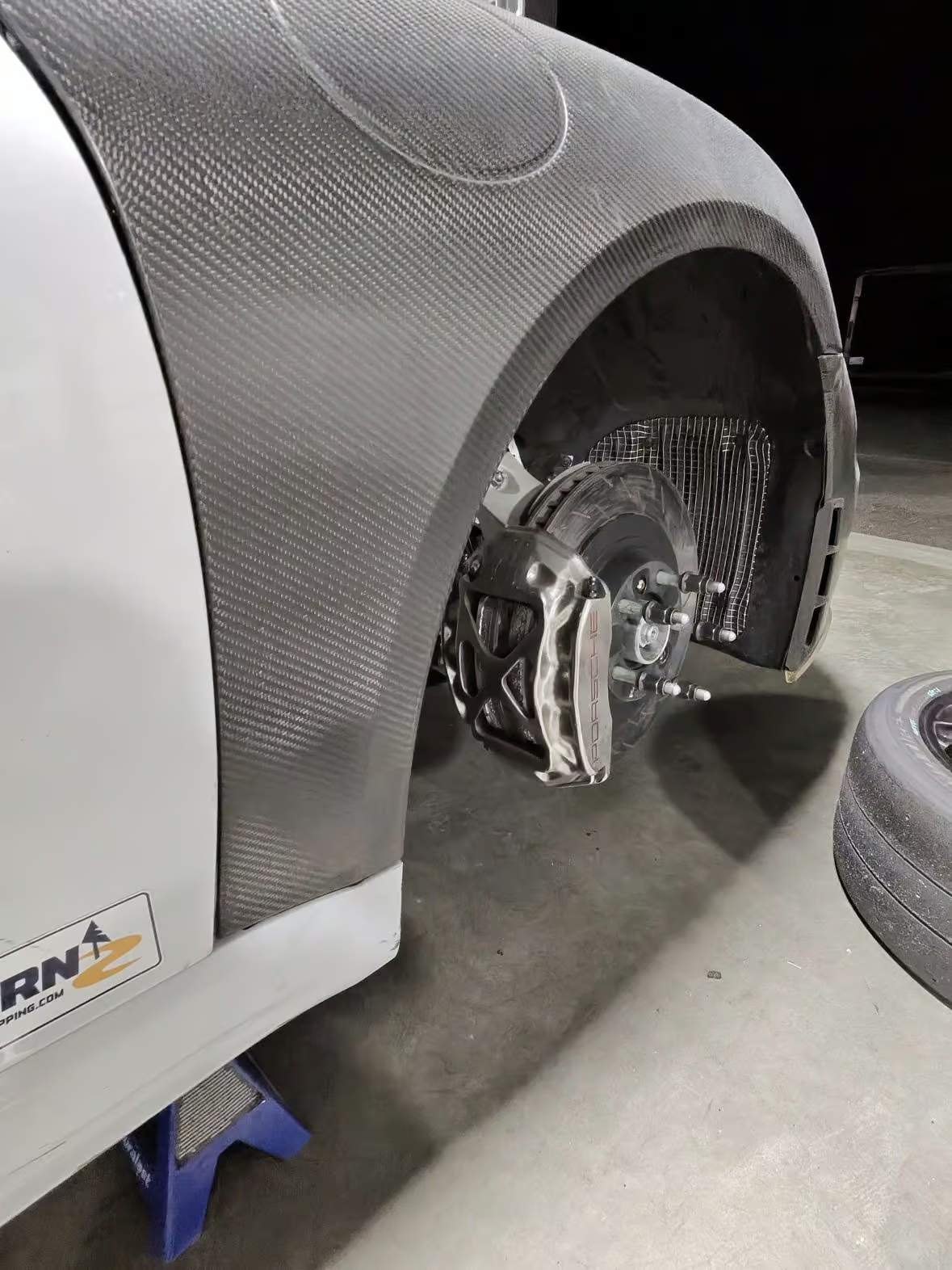
The front clip is raw, unpainted carbon fiber. That is not a style choice. It is a receipt.

First, What Is a Clubsport MR?

Some context first, because “Clubsport” gets used loosely. A Clubsport is a customer race car built by Porsche Motorsport itself — designed, assembled and supported as a race car from day one, in the same factory ecosystem that produces the 911 GT3 Cup. The GT4 part of the name is the category: SRO’s GT4 class, the global formula for production-based GT racing that sits one step below GT3. When you buy a Clubsport, you are not buying a car and a pile of parts. You are buying into a factory program — documentation, parts supply, software and support included.

For this generation, Porsche offered the 718 GT4 Clubsport in three trim levels. The Trackday was built for track days and club events — factory race car underneath, but specified for running hard without a rulebook: simpler, more forgiving, and not homologated for competition (we know this one well; our previous GT4 Clubsport was a Trackday). The Competition is the full racing version — homologated for GT4 series around the world, with the adjustable motorsport electronics, equipment and setup range that real competition demands. And at the top sits the MR: the Competition car, developed further by Manthey-Racing with carbon-fiber bodywork and refined aerodynamics. Three flavors of the same idea, sharpened for three different jobs. Ours is the sharp one.

The 718 Cayman GT4 Clubsport is Porsche Motorsport’s factory-built race car based on the GT4 road car — and “factory-built” is doing real work in that sentence. This is not a street car we converted. It was assembled as a race car: welded-in roll cage, racing safety cell, fire system, air jacks, a motorsport wiring loom, and a 3.8-liter flat-six that shares its architecture with the road car’s engine but lives an entirely different life.

The MR takes that car one step further. MR stands for Manthey-Racing — the Nürburgring-based outfit that runs Porsche’s factory GT programs — and the MR package is their development of the Clubsport: extensive carbon-fiber bodywork including the front clip, fenders, doors and rear wing, developed aerodynamics, and a chassis setup refined by the same people who set up cars for Le Mans.

When people in our shop talk about “the standard,” this is what they mean. Porsche Motorsport North America plus Manthey-Racing is the combination that built this car. Every other car we touch gets measured against how this one was done.
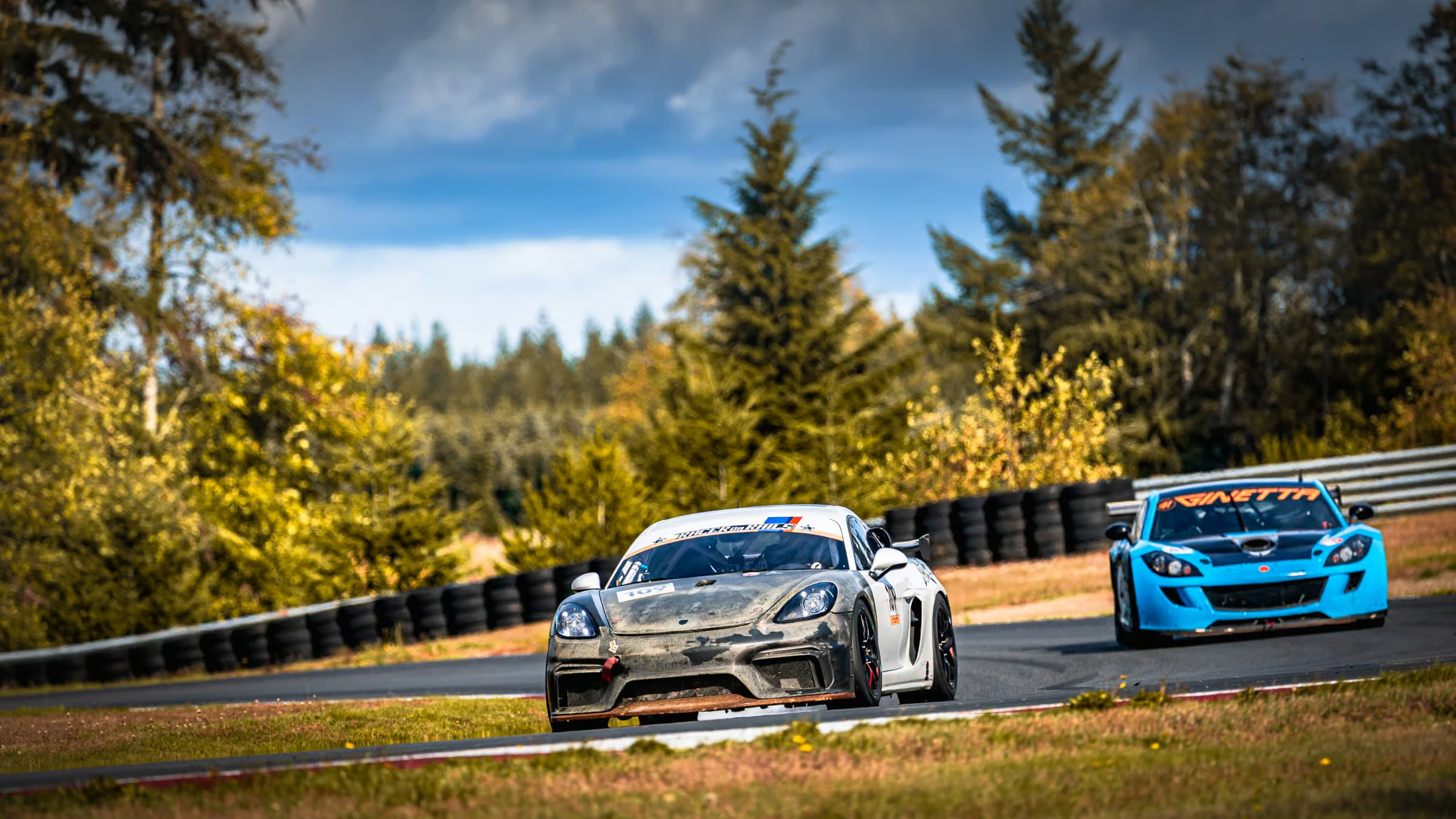
Porsche 718 Cayman GT4 Clubsport MR with raw carbon front clip on track
The MR package is Manthey-Racing’s development of the Clubsport — carbon bodywork, serious aero, and a chassis tuned by the people who run Porsche’s factory GT program. Photo: Karl Noakes

The Car, By the Numbers

  • Car: 2020 Porsche 718 Cayman GT4 Clubsport MR (Typ 982)
  • Engine: 3.8-liter flat-six, water-cooled, 425 hp at 7,500 rpm, 425 Nm at 6,600 rpm
  • Transmission: 7-speed PDK, motorsport calibration
  • Chassis: Factory welded roll cage, Recaro racing seat, Schroth harness, fire suppression system, air jack system
  • Brakes & suspension: Fully homologated Clubsport specification
  • Body: Manthey-Racing carbon-fiber front clip, fenders, doors and rear wing
  • Electronics: Cosworth ICD display and motorsport data logging, PMNA-supported PIWIS diagnostics

Numbers only tell part of it. A Clubsport is a system — every part of the car assumes every other part will be maintained to factory motorsport standards, on factory motorsport intervals, with factory documentation. That assumption drives everything that follows in this story.
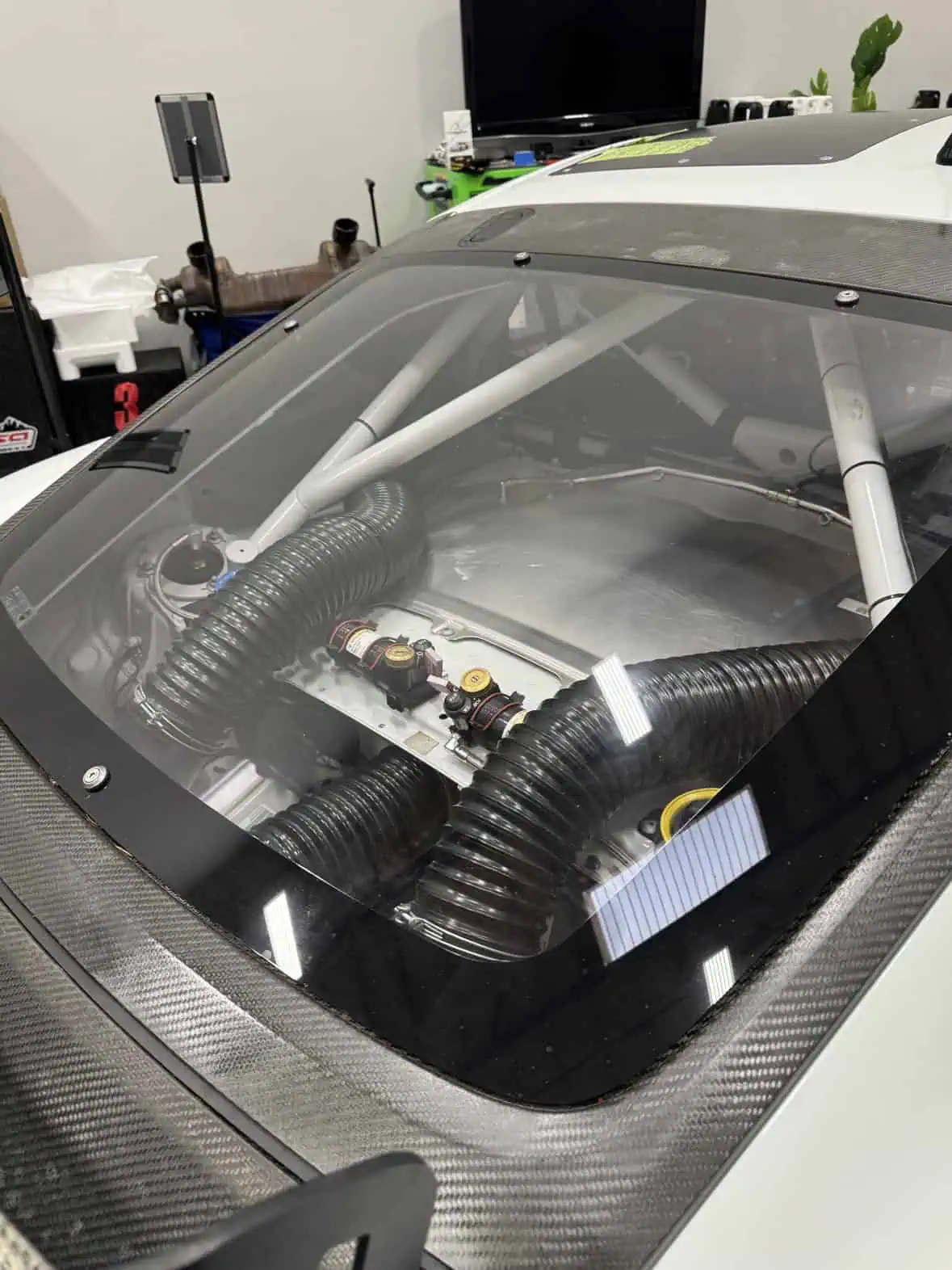
GT4 Clubsport MR engine cover detail
Under the cover: a 3.8-liter flat-six making 425 hp — and an entire factory support ecosystem behind it.
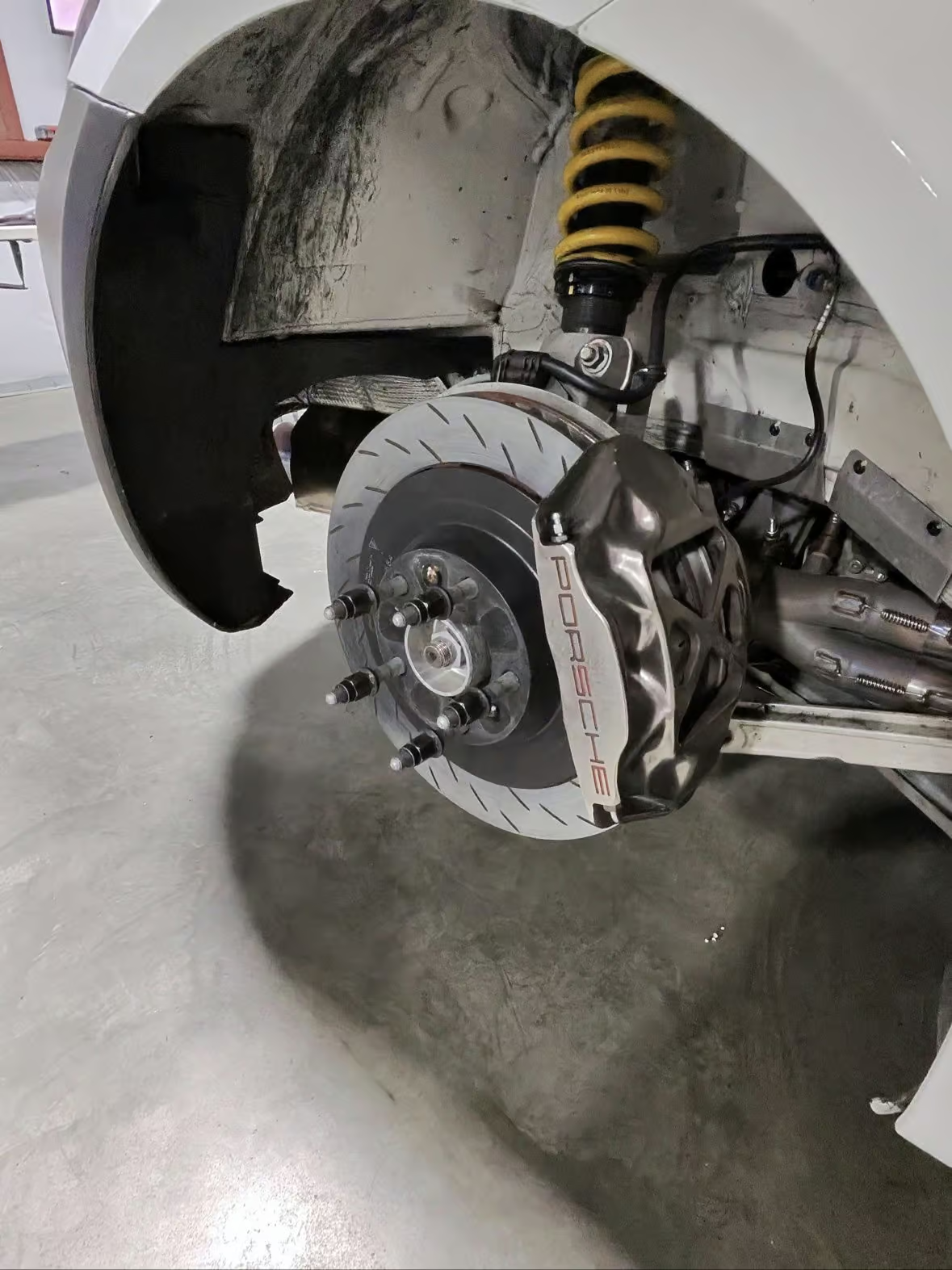
Porsche 718 Cayman GT4 Clubsport MR brake rotor, caliper and damper with wheel removed
Fully homologated, exactly as the rulebook specifies — the Clubsport brake package and damper, wheel off.
Porsche 718 Cayman GT4 Clubsport MR front brake and carbon fender with wheel removed
The front corner: carbon fender, motorsport caliper, and cooling for days.

The Wreck, and the Bet

At a Hoosier Super Tour weekend at Michelin Raceway Road Atlanta, another car spun in oil and collected the GT4 in the passenger door. That is the kind of hit that bends more than bodywork. It is the kind of hit that makes a car a “mechanic’s special” — sold as-is, worth a fraction of a running car, with the difference made up entirely of unknowns.

Most people looked at those unknowns and saw risk. We looked at them and saw the actual business we are in.

Racer on Rails exists to run factory-built race cars at a national level. If we could not take a bent Clubsport and return it to factory standard — documented, verified, every system gone through — then the rest of our claims about expertise were just marketing. This car was a chance to prove, not posture.

So we bought it.

What Actually Showed Up

Honesty matters here, because this is where resurrection stories usually get romanticized.

The car came to us through Race Cars for You, and their team was straightforward about it from the start: the car had been collected from the previous shop in pieces — a ton of pieces, in their words — with all kinds of things missing. Not just the crash-damaged parts. Small things. Hardware. Trim. The thousand details that separate a race car from a pile of very expensive components.

That is the reality of a mechanic’s special. The purchase price is the beginning of the invoice, not the end of it. Anyone who tells you different has not done one.
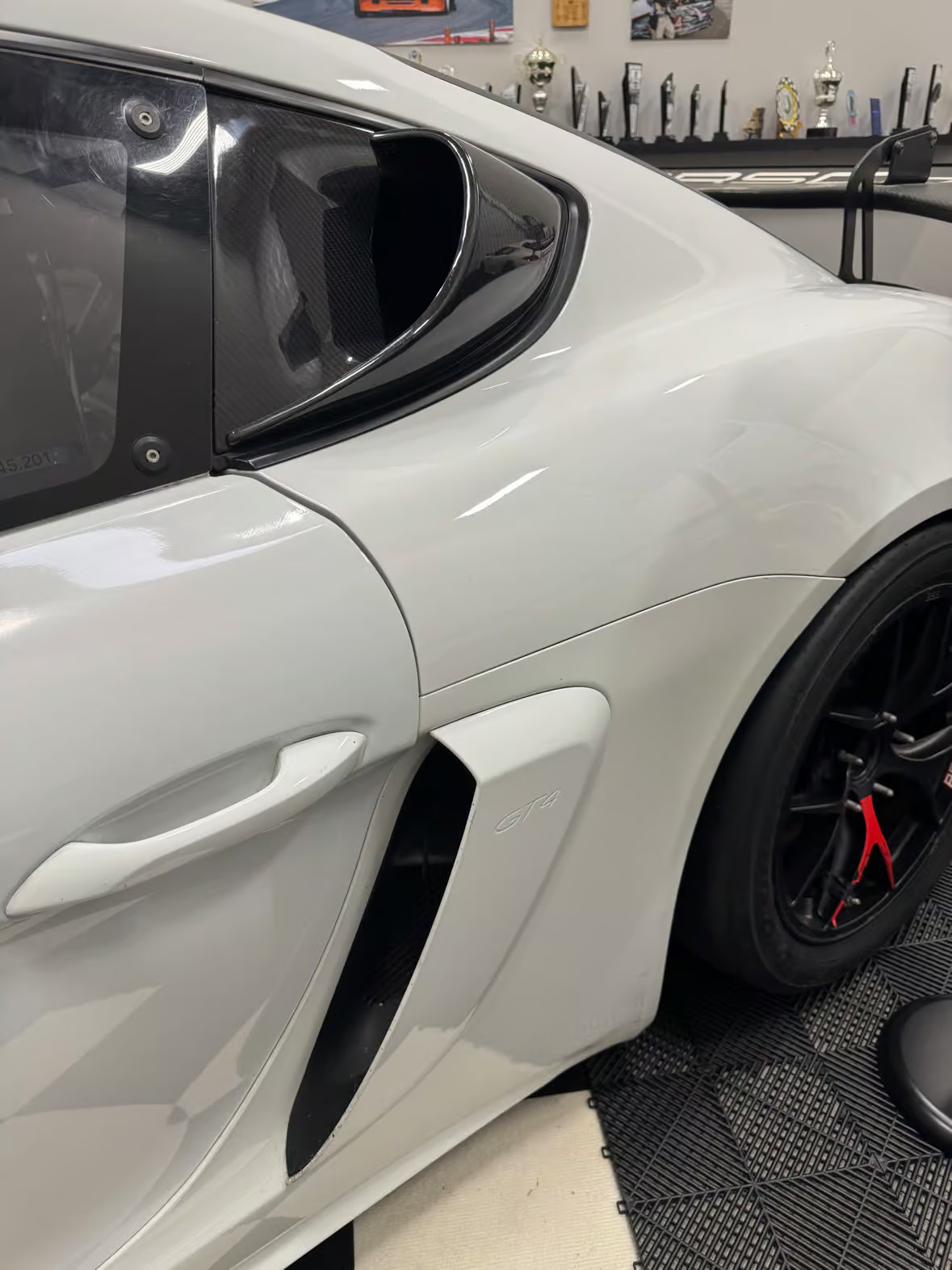
GT4 Clubsport MR front three-quarter in the showroom
White bodywork, raw carbon nose. The car wears its history honestly — we would not have it any other way.

The Rebuild: No Shortcuts, Because Shortcuts Are Expensive

The rebuild followed one rule: return the car to factory specification, using factory information, and document everything. Where a part was damaged, it was replaced with the correct part. Where a part was missing, we found the correct part — not a substitute that “should work.”

The front end is the obvious example. The MR’s carbon front clip is a Manthey-Racing component set, and the rebuild panels went on in raw, unpainted carbon. We have left them that way. Partly because paint adds nothing to how the car works, and partly because the raw carbon tells the truth about what this car is: a working race car that was rebuilt properly, not a showpiece pretending it was never hurt.

Underneath, the work was less photogenic and more important. The cage was inspected. Safety systems were gone through end to end — harness, seat, fire system. Cooling, brakes, suspension pickup points, steering: every system that a door hit can silently reach was checked against the factory manual, torqued to factory specification, and recorded.

One upgrade we made without hesitation: the exhaust. The car now runs Dundon’s full race exhaust system, and it sounds amazing — a 3.8-liter flat-six with its voice fully uncorked. Factory specification got this car right in almost every way. The soundtrack was the exception.

A Steering Wheel, and What It Taught Us

One detail deserves its own section, because it captures the whole philosophy.

The steering wheel that arrived with the car was not the factory wheel. It was a replacement from another builder, and it was missing functions the factory wheel carries — including the radio and acknowledge buttons the driver uses constantly in a race. The cord was frayed. For a street car, that is an annoyance. For a race car, it is a systems problem: the wheel is an interface, and the interface was wrong.

So the hunt began — for an original wheel, through every channel we have. In parallel, we traced the factory repair path, which runs through bf1systems in the UK, the electronics firm behind these wheels, under a Porsche Motorsport service bulletin. Two tracks, one standard: the car ends up with a correct, fully functional factory wheel.

That is the difference between fixing a car and finishing a car. A missing radio button will never show up in a photograph. It shows up at 140 mph when your driver needs to answer the pits.
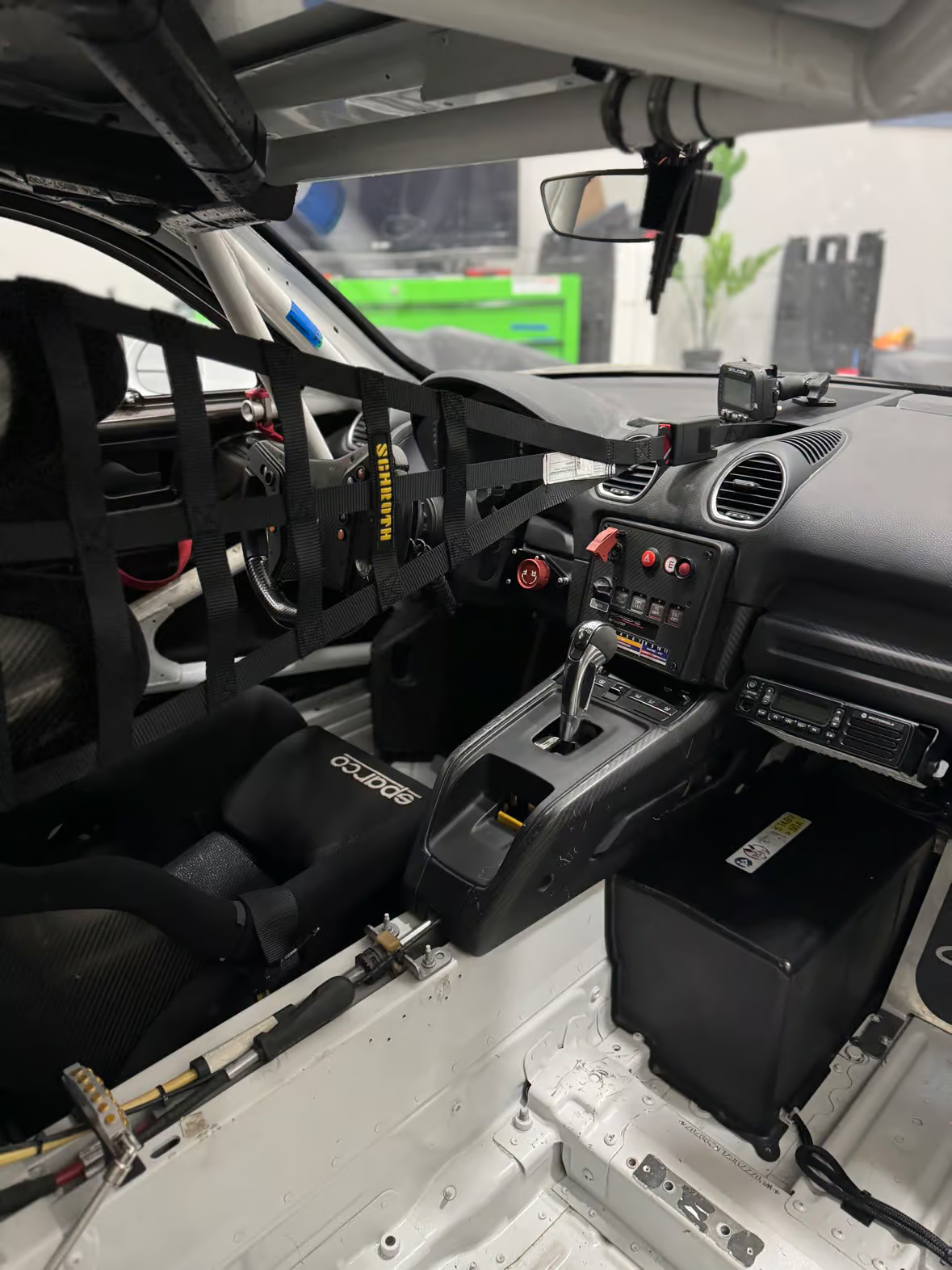
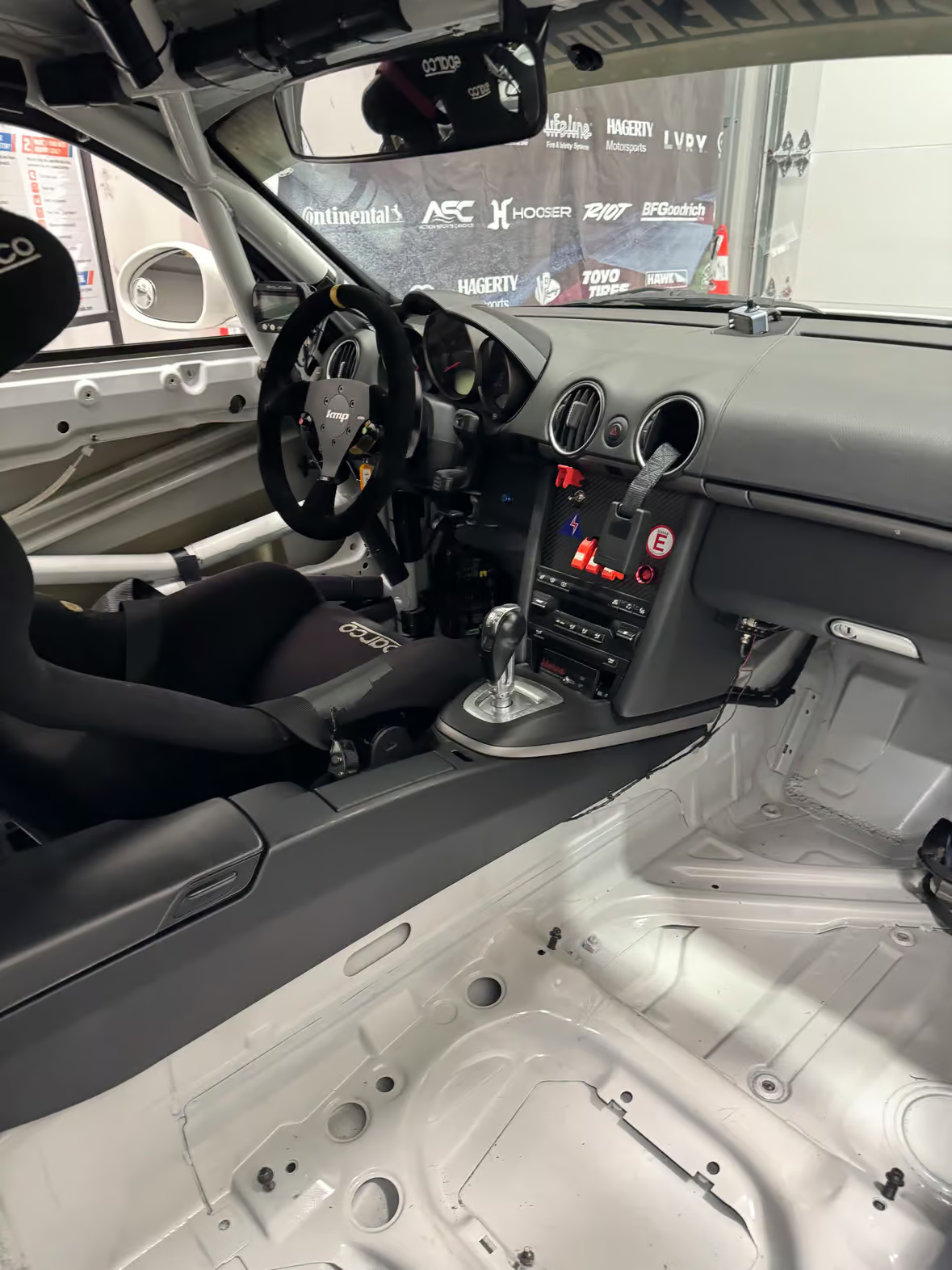
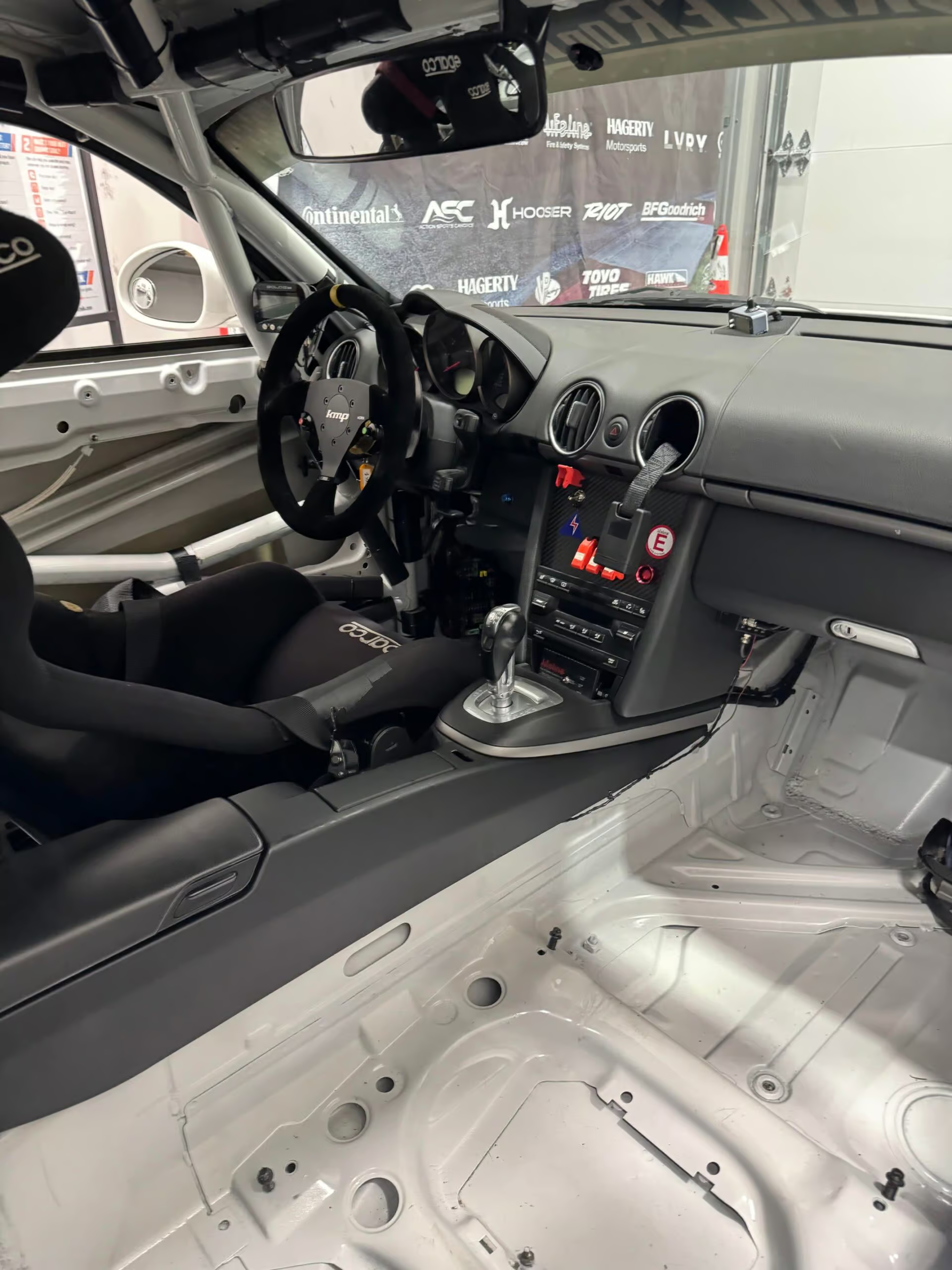
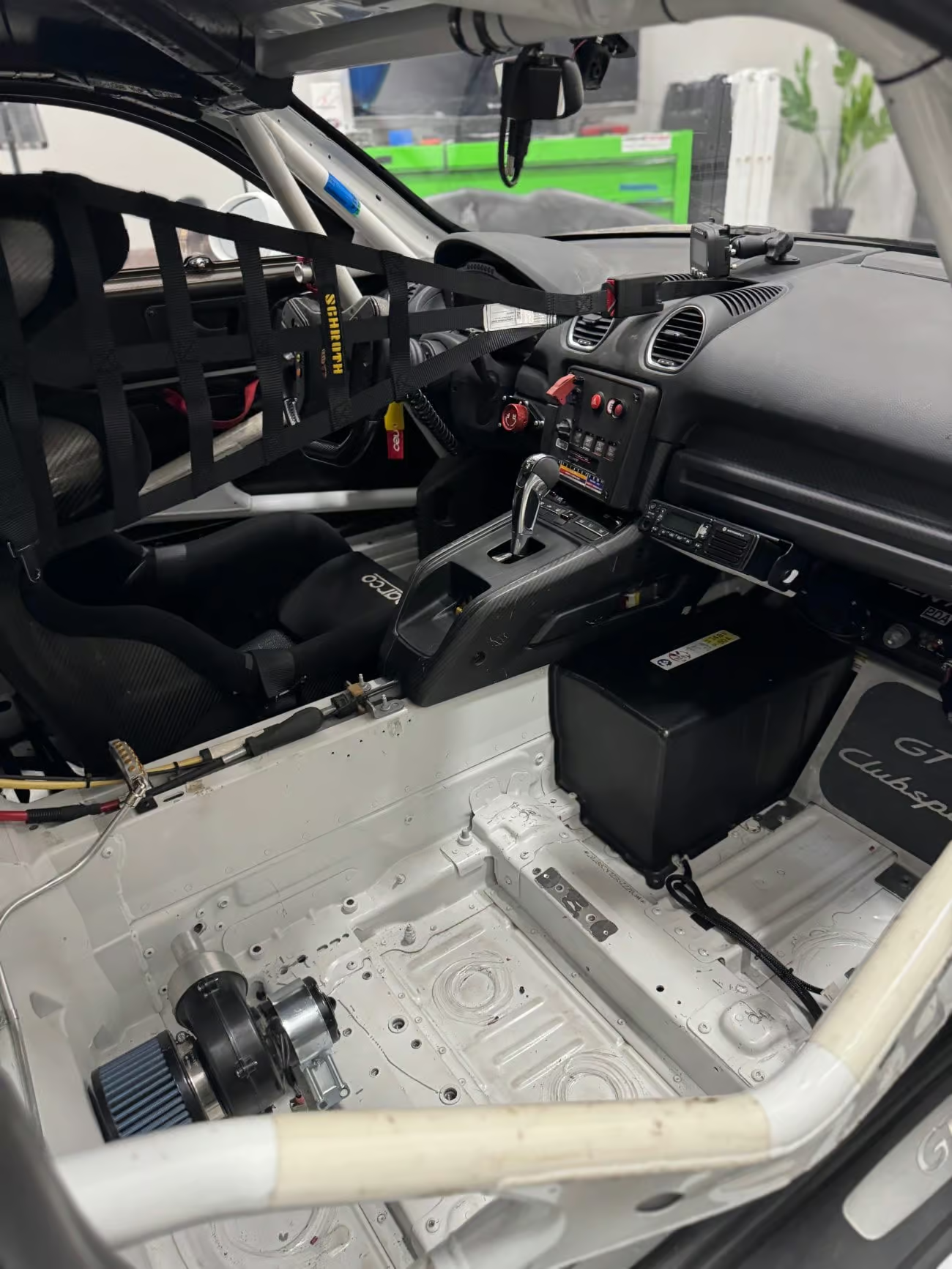
GT4 Clubsport MR cockpit with PDK controls and Schroth harness
The office. Every control in here is an interface the driver trusts at speed — including the ones on the wheel.

The Factory Ecosystem Behind the Car

Here is the part of Clubsport ownership that does not appear on a spec sheet.

A factory race car comes with a factory information ecosystem: the technical manual, the parts catalog, a running library of service bulletins and updates issued by Porsche Motorsport, software for the Cosworth dash and data systems, and a support structure at Porsche Motorsport North America behind all of it. Registered owners get access. The access is not automatic, and it is not casual — it is a professional system, run for professional programs.

We did the work to get this car registered properly and to bring its full factory documentation into our team’s library, organized the same way we now organize documentation for every car we manage: per-car, complete, and available to the technicians actually turning the wrenches. When a bulletin exists for this car, we know. When a component has a factory service life, we know that too.

This is what “done right” looks like when nobody is watching. Not the photograph. The file cabinet.
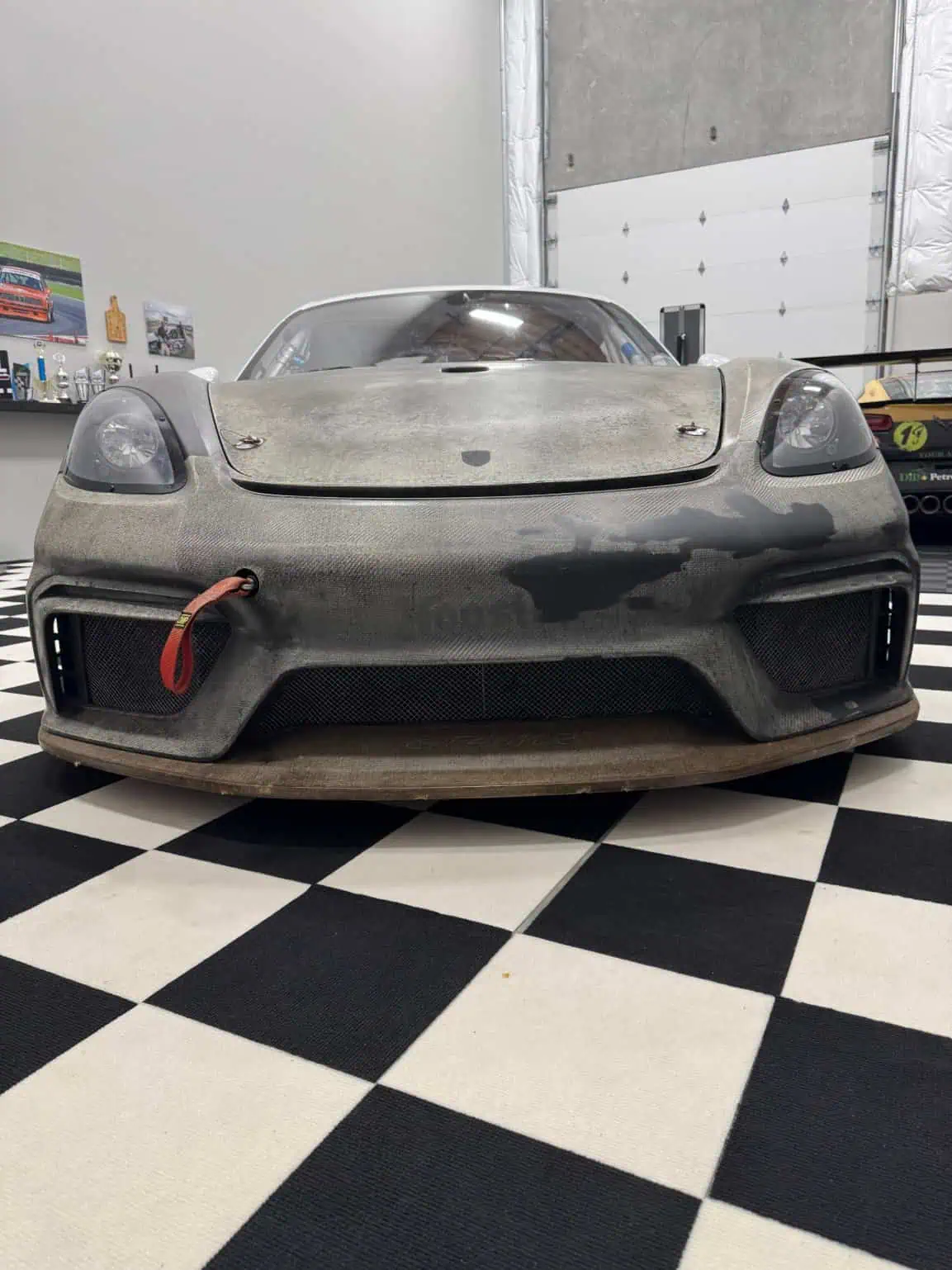
Carbon front detail with tow strap on the GT4 Clubsport MR
Details are the program. Correct parts, correct torque, documented — every time.

First Dance: Back on Track

A rebuild is a theory until the car turns a lap in anger.

The GT4’s first full weekend came at the Ridge Motorsports Park in October, at the IRDC weekend — and racing, as it does, improvised. When Dirk’s T3 Cayman developed an issue, the GT4 went out wearing number 109 and did double duty. It ran. It raced. It came home confirmed as a healthy, working competition car.
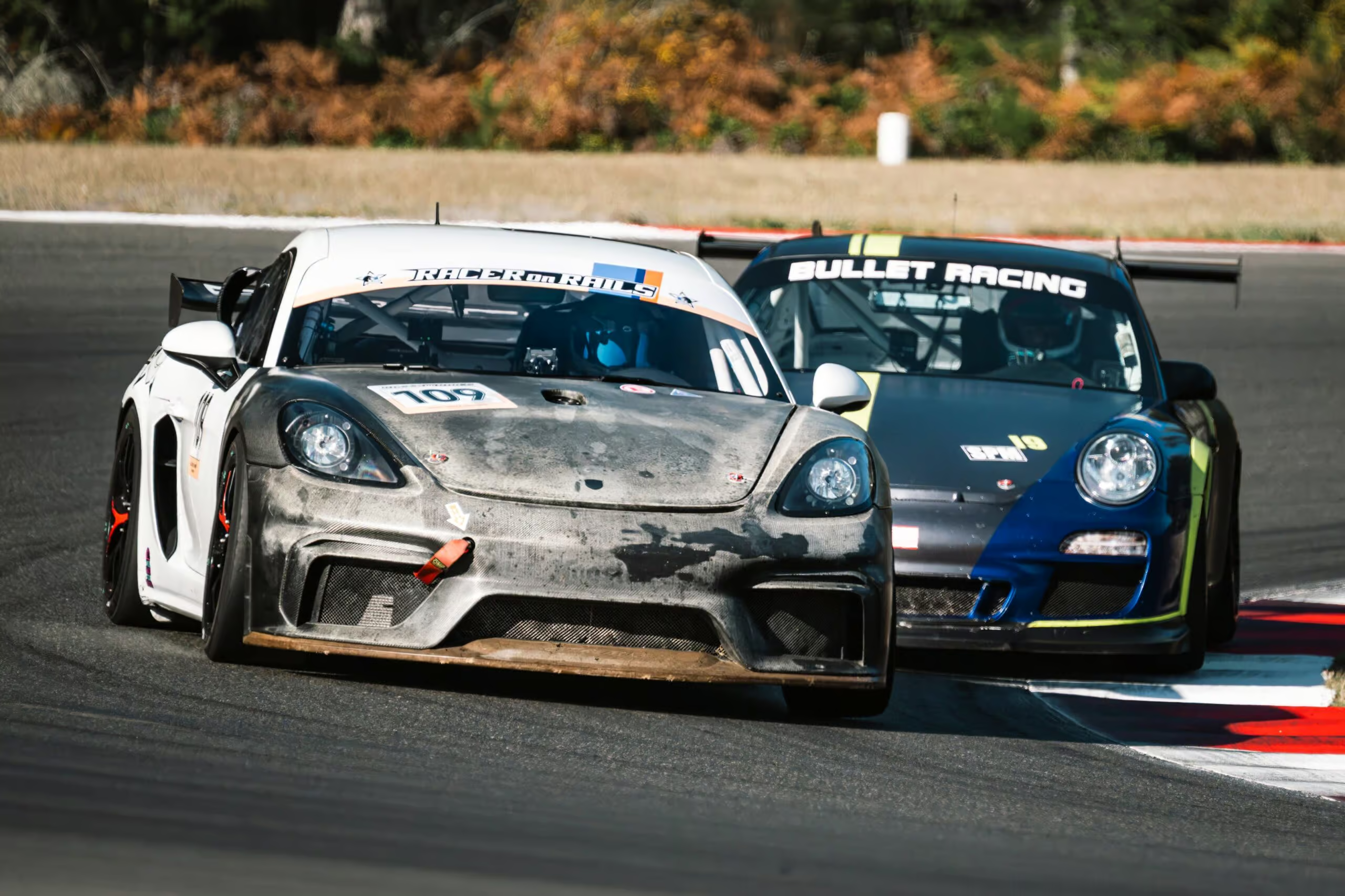
Porsche 718 Cayman GT4 Clubsport MR carbon front clip covered in rubber marks on track
Run hard in real competition — the carbon clip wears the weekend proudly. Photo: Peng Du

That weekend mattered more than any dyno sheet could. A car that has been hit, stripped, rebuilt and then run hard in real competition — wheel to wheel, session after session — has answered the only question that ever really mattered:

Is it right?

It is right.
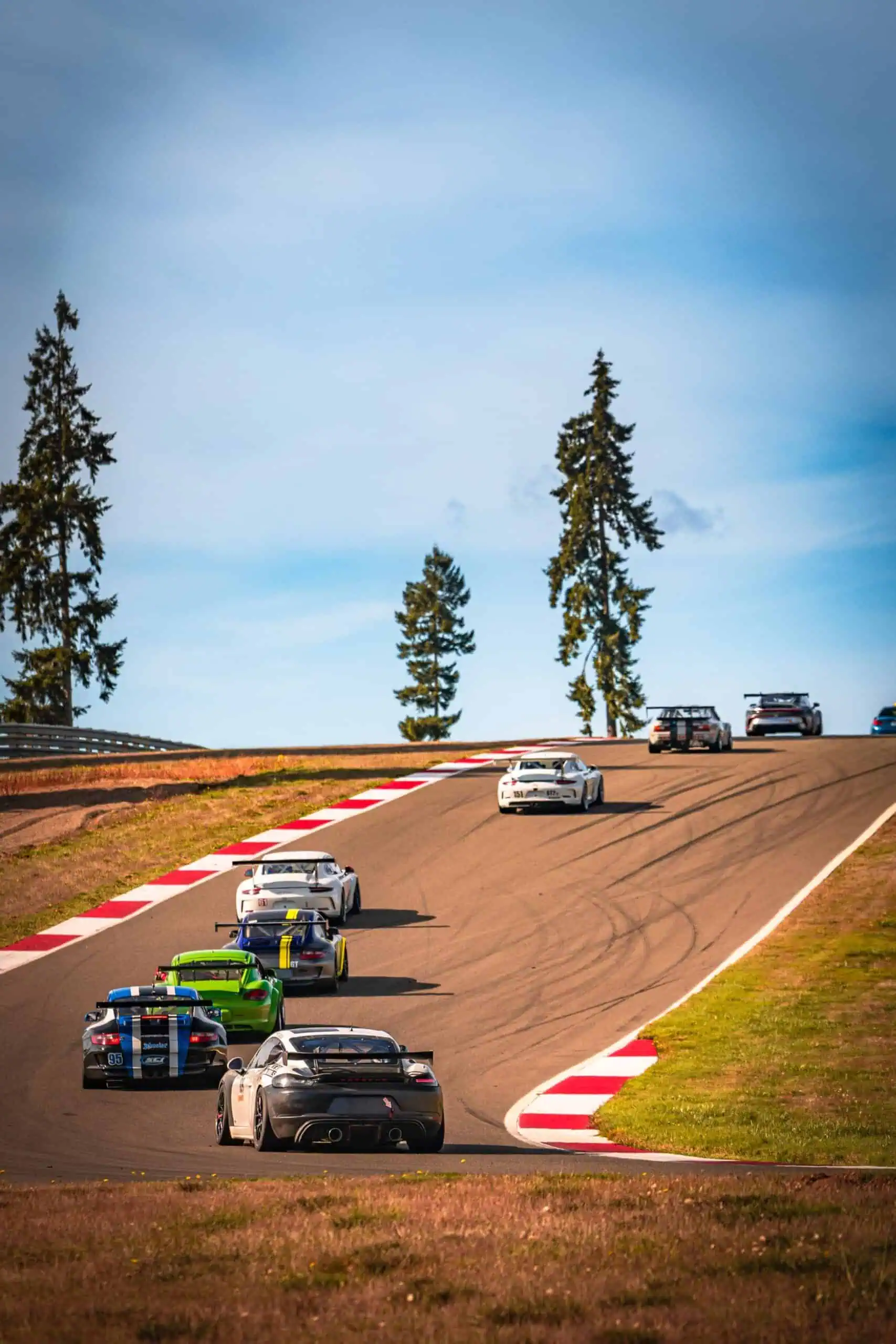
Porsche 718 Cayman GT4 Clubsport MR on track at the Ridge leading a pack of cars uphill
Leading them up the hill at the Ridge. Photo: Peng Du

What This Car Does for Racer on Rails

The GT4 MR now anchors our Porsche program. It is the car our GT customers’ cars get compared to, the benchmark our technicians train against, and — because it is ours — a car we can offer for arrive-and-drive and rental programs with total confidence in what is underneath the driver.

It is also, quietly, our credential. Any shop can say it understands factory race cars. We bought a wrecked one, in pieces, with parts missing — and returned it to factory standard, documented end to end. That is a different sentence.
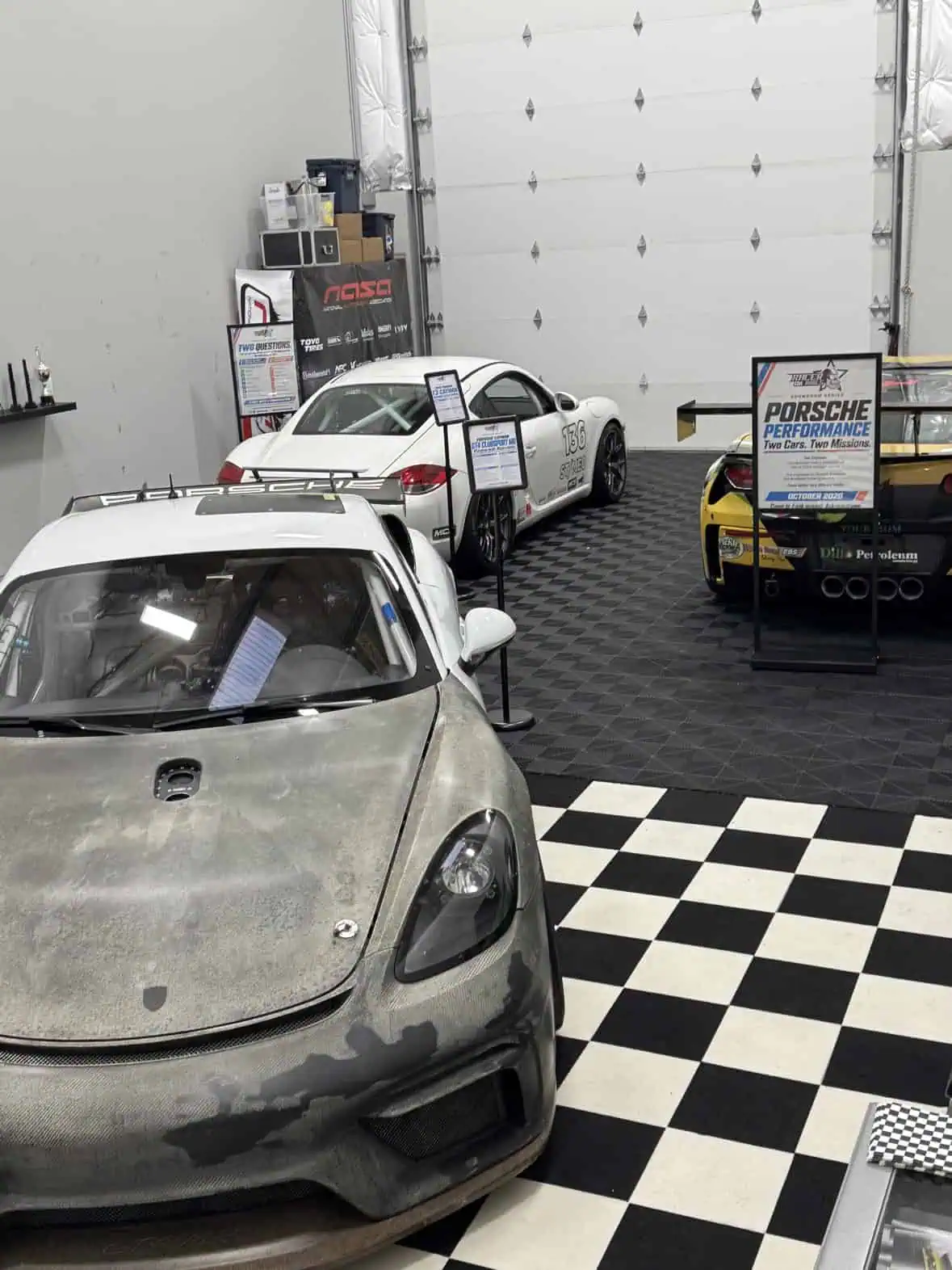
GT4 Clubsport MR in the Racer on Rails showroom
October’s Showroom Series: the GT4 MR alongside Dirk’s T3 Cayman — the car Porsche built for motorsport, and the car we developed for it.

Where It Goes From Here

The car’s 2027 season is already taking shape, and there is a symmetry we cannot help but aim at. Road Atlanta — the track where this car’s story nearly ended — hosts both the SCCA Super Tour in March and the Runoffs in October of 2027. Bringing this car back to that track, at that level, is the penciled-in homecoming.

The development list is already written. The brakes and dampers stay on the fully homologated Clubsport specification for now — that is the baseline this car was built to — but the dampers will not stay stock forever: a set of 3-way adjustable MCS shocks is planned, the same setup we run on most of the cars we campaign. And the aero gets the full treatment as well: Dundon’s Valkyrie aero kit, the same package we ran on our previous GT4 Clubsport Trackday car, is going on this one.

Between now and then: seat time, development, and the unglamorous factory maintenance rhythm that keeps a Clubsport a Clubsport. Software current. Safety systems in date. Everything documented.

We bought a wrecked GT4 race car.

We would do it again.
Posted on

Building the T3 Cayman: Developing a Production Porsche for Competition

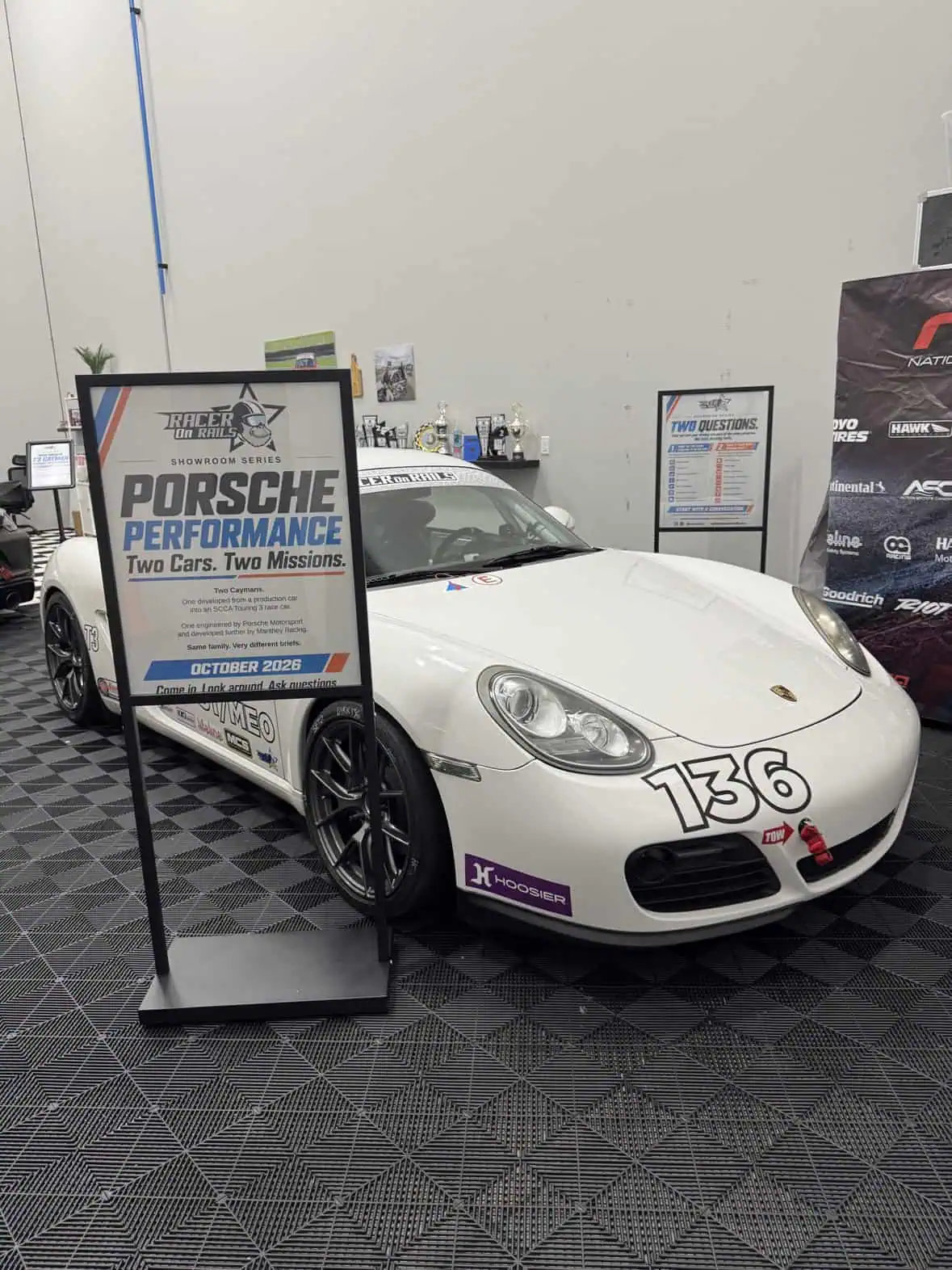
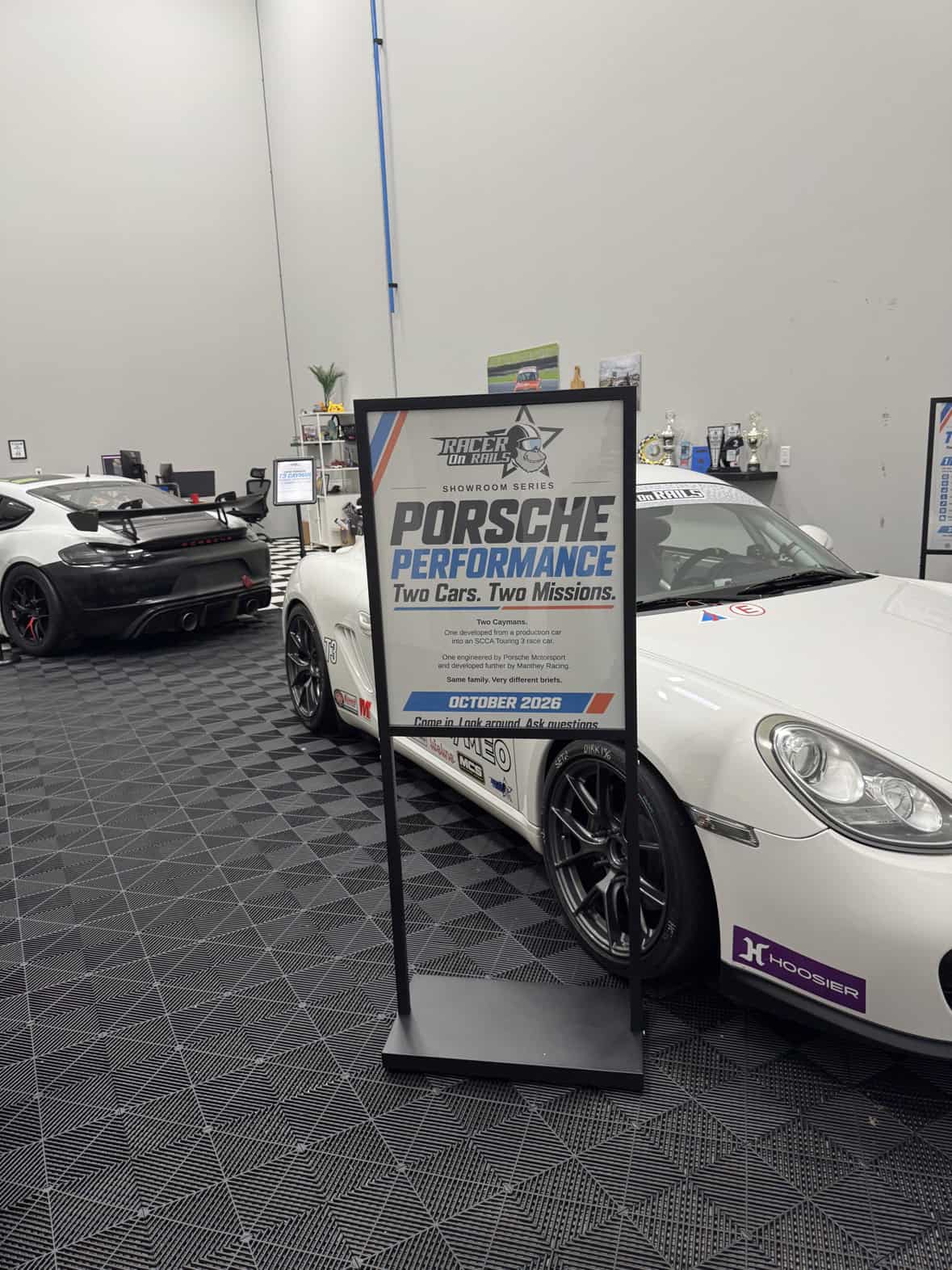
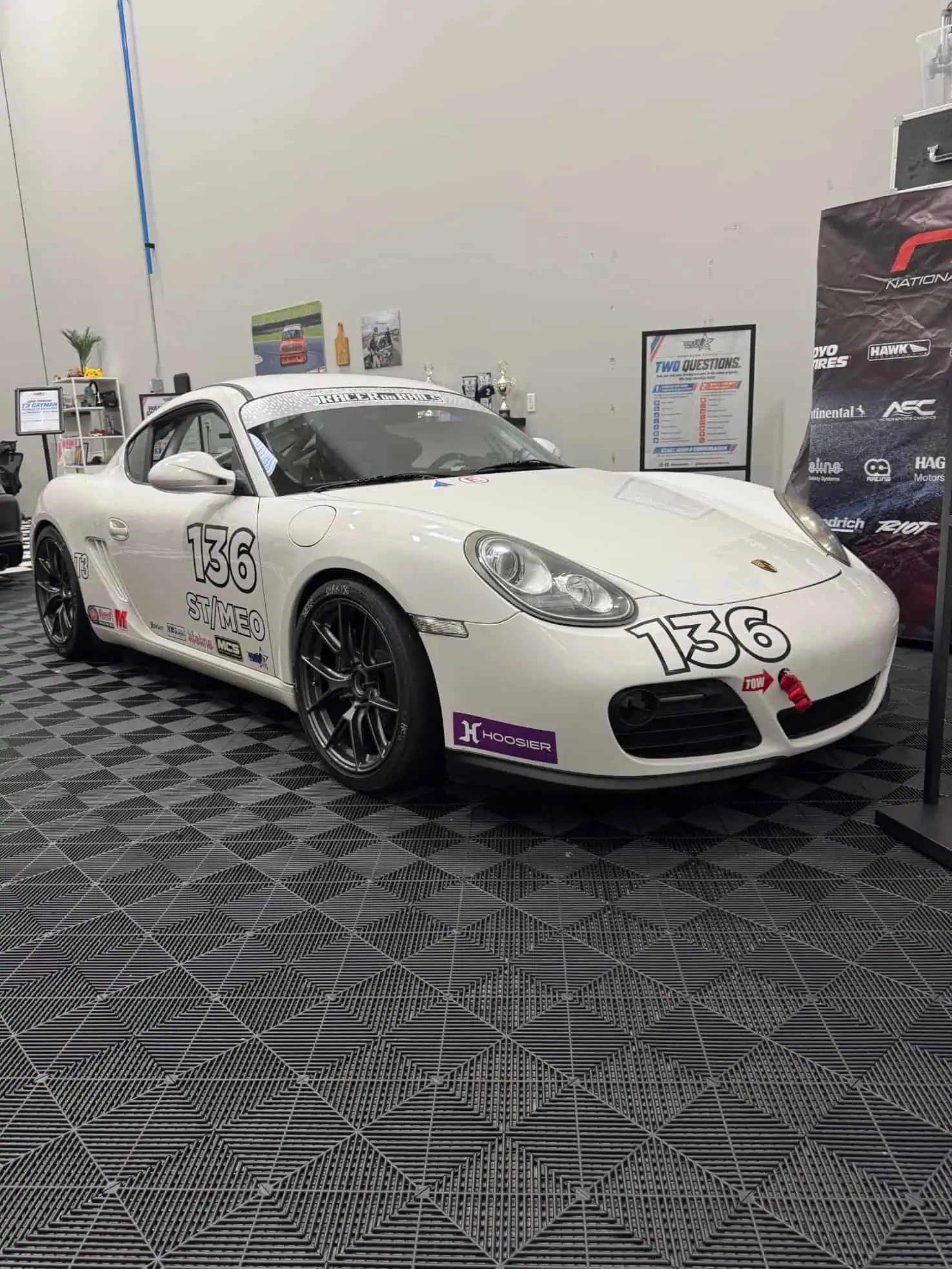
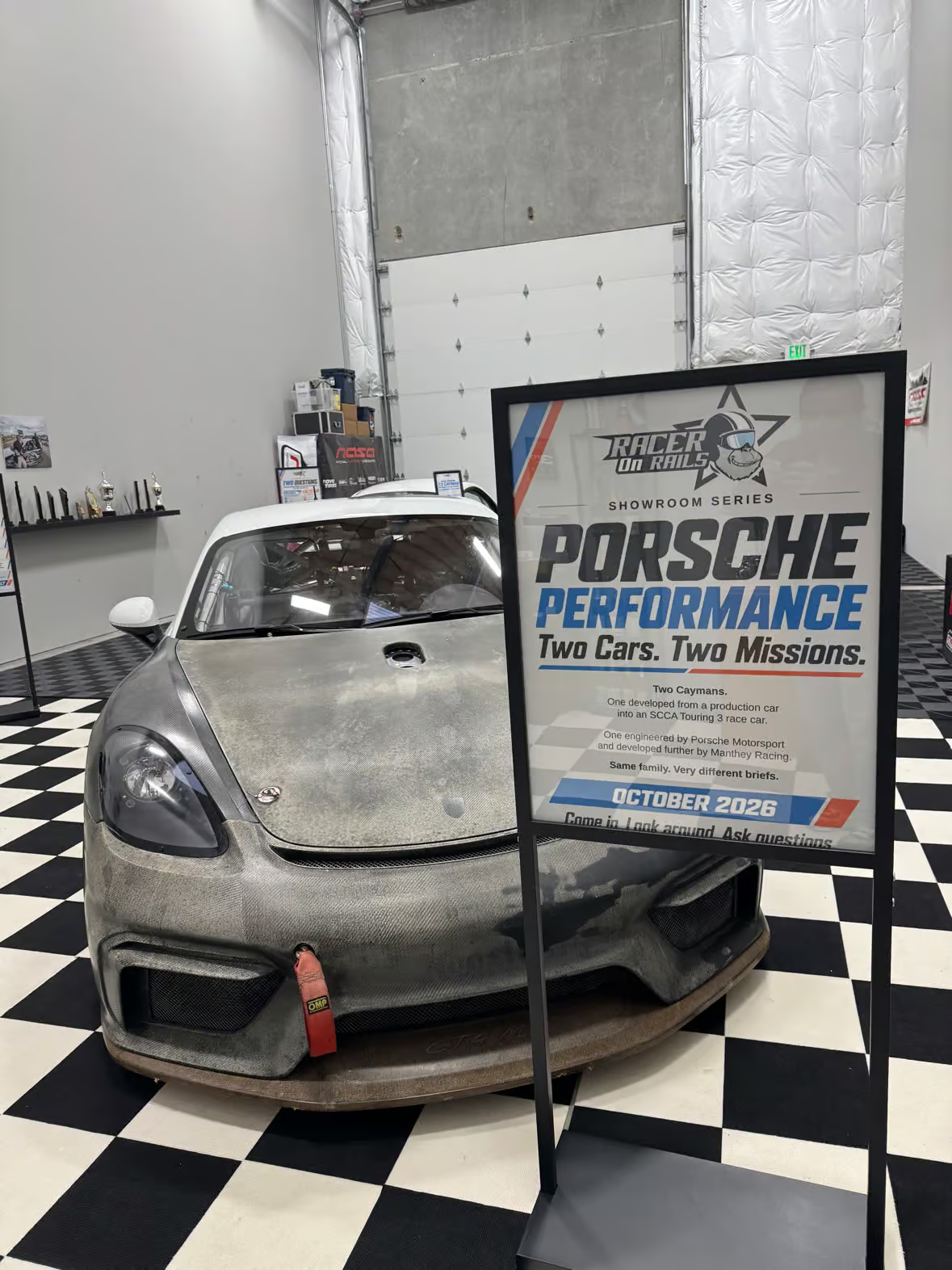
Dirk's T3 Cayman with Porsche Performance showroom signage
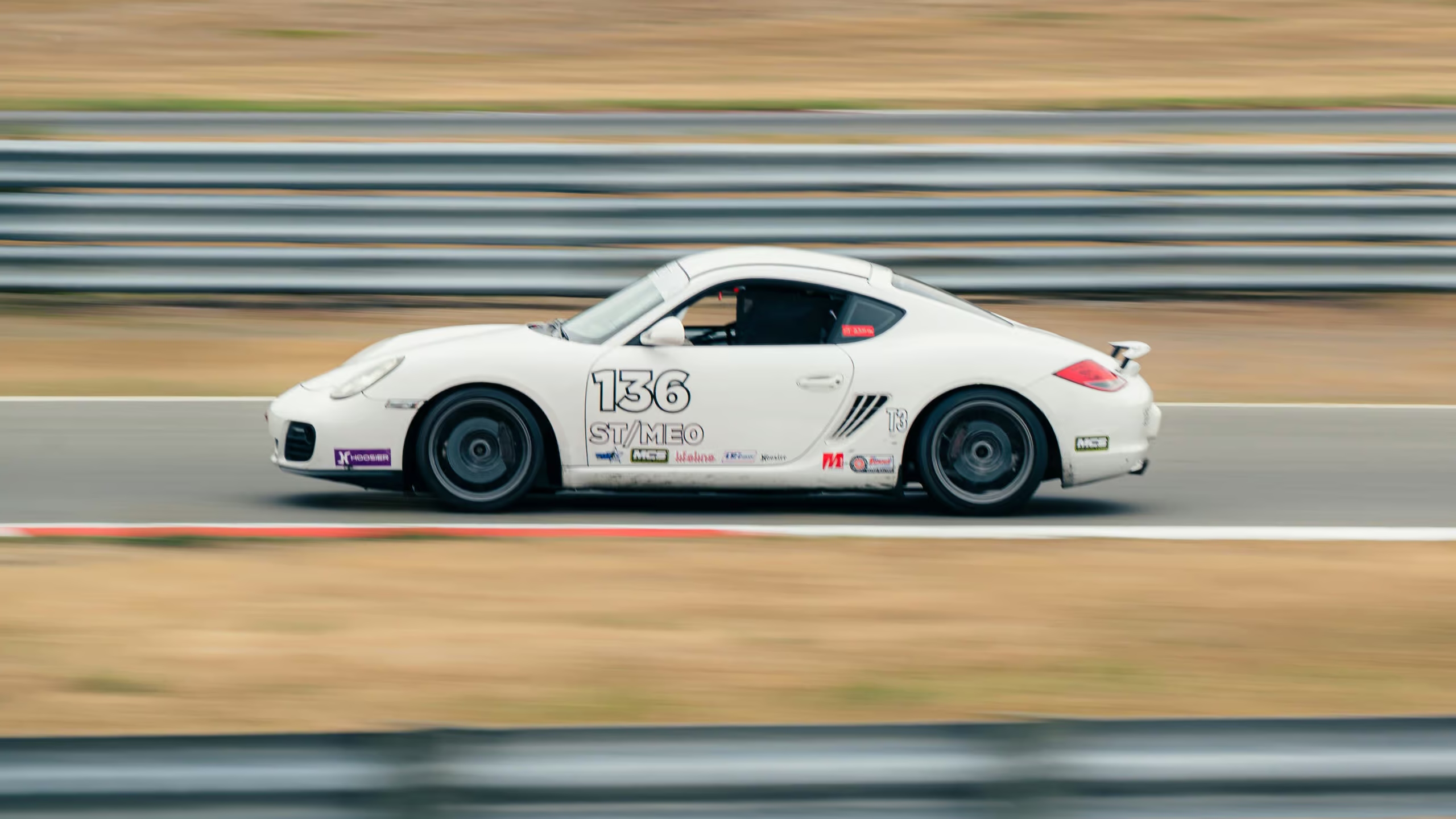
Dirk’s #136 under the Porsche Performance banner — October’s Showroom Series car.

There is a particular kind of satisfaction in developing a race car that was never designed solely to be a race car. You begin with something already good, then start asking increasingly inconvenient questions about what happens when you operate it near the limit, lap after lap.

That has been the story of Dirk’s Cayman.

It began as a 2010 Porsche Cayman Base, a 987.2-generation street car with a naturally aspirated 2.9-liter flat-six and PDK transmission. Today, it is being developed as a serious SCCA Touring 3 competition car.

The goal was never simply installing race parts. It was developing a coherent competition car — chassis, brakes, cooling, drivetrain, data, safety and driver all working together.

The Cayman is a contender.

Now the fun part is figuring out how good we can make it.

Part of the RoR Showroom Series

Dirk’s Cayman is one of the first two cars featured in the new Racer on Rails Showroom Series, our monthly program built around bringing interesting cars out of the background and into the conversation.

October’s theme is Porsche Performance, and we’re putting this production-derived T3 Cayman alongside our Porsche Cayman GT4 Clubsport MR.

They arrive at racing from opposite directions.

Dirk’s car started as a street Cayman, developed inside a production-based rule set. The GT4 Clubsport starts much closer to the destination, engineered for motorsport by Porsche Motorsport and Manthey Racing.

Put them next to each other and they create a useful question:

What changes when the mission changes?

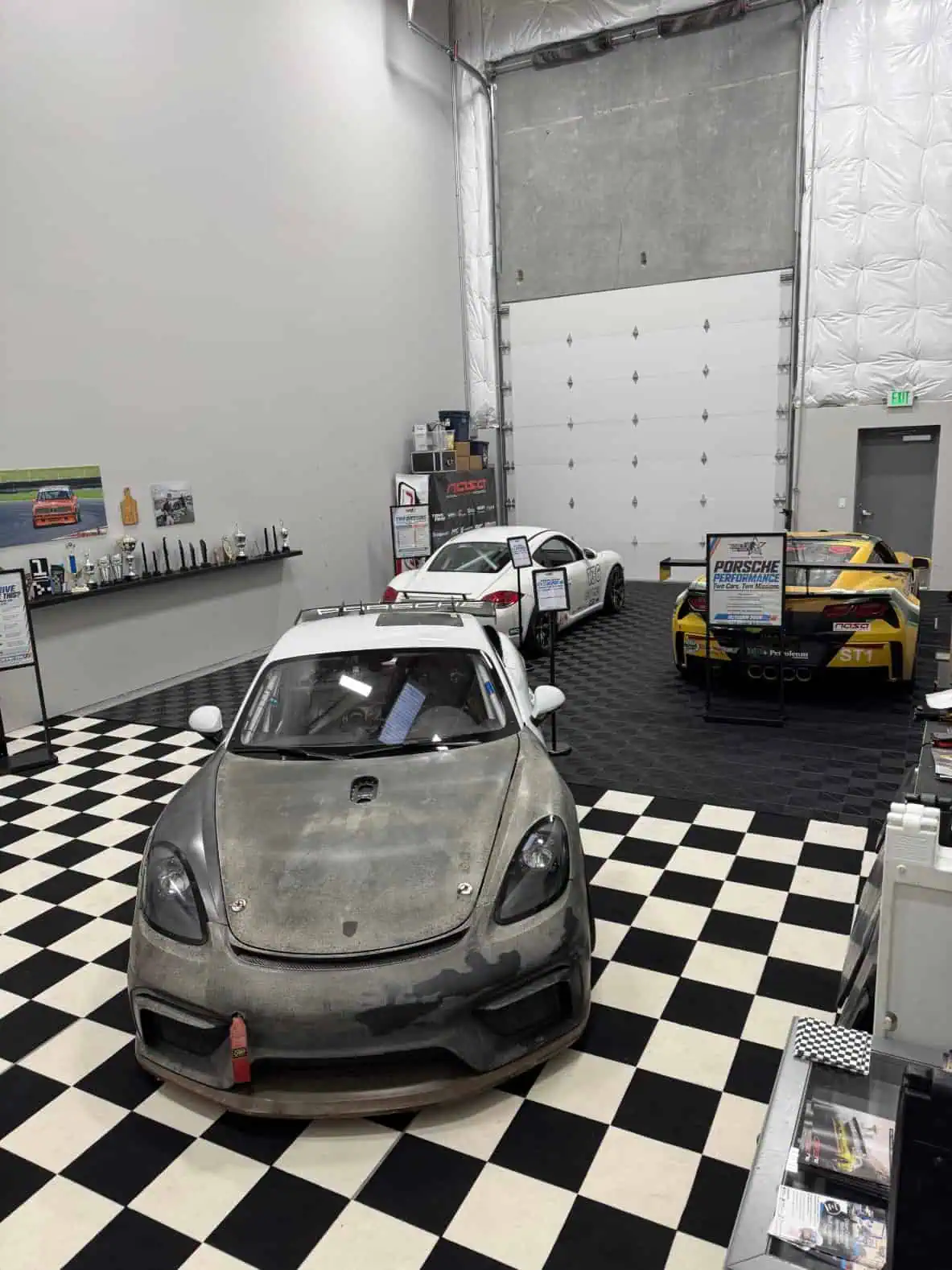
T3 Cayman and GT4 MR together in the RoR showroom

Two Caymans, two very different approaches to building a competition car.

Why We Love Touring 3

Part of the reason this car exists is that we genuinely love Touring 3.

T3 occupies a fun part of the racing universe: relatively modern, reasonably powerful cars, substantial enough to feel like serious machinery. Properly fast, without the speeds, budgets or complexity of a GT2 program.

In the grand scheme of racing, the performance remains manageable.

And the smiles-per-dollar equation can be very good.

What makes the class particularly interesting is the variety. The cars do not all solve the lap-time problem the same way: more power, less weight, better braking, better power-down, aero, wheelbase, transmission, tire usage, chassis balance. Different strengths, different weaknesses.

That means there is not one universal Touring 3 recipe.

You have to understand what your car already does well, identify where it is vulnerable, and develop around those characteristics.

That is exactly the kind of racing and engineering problem we enjoy.

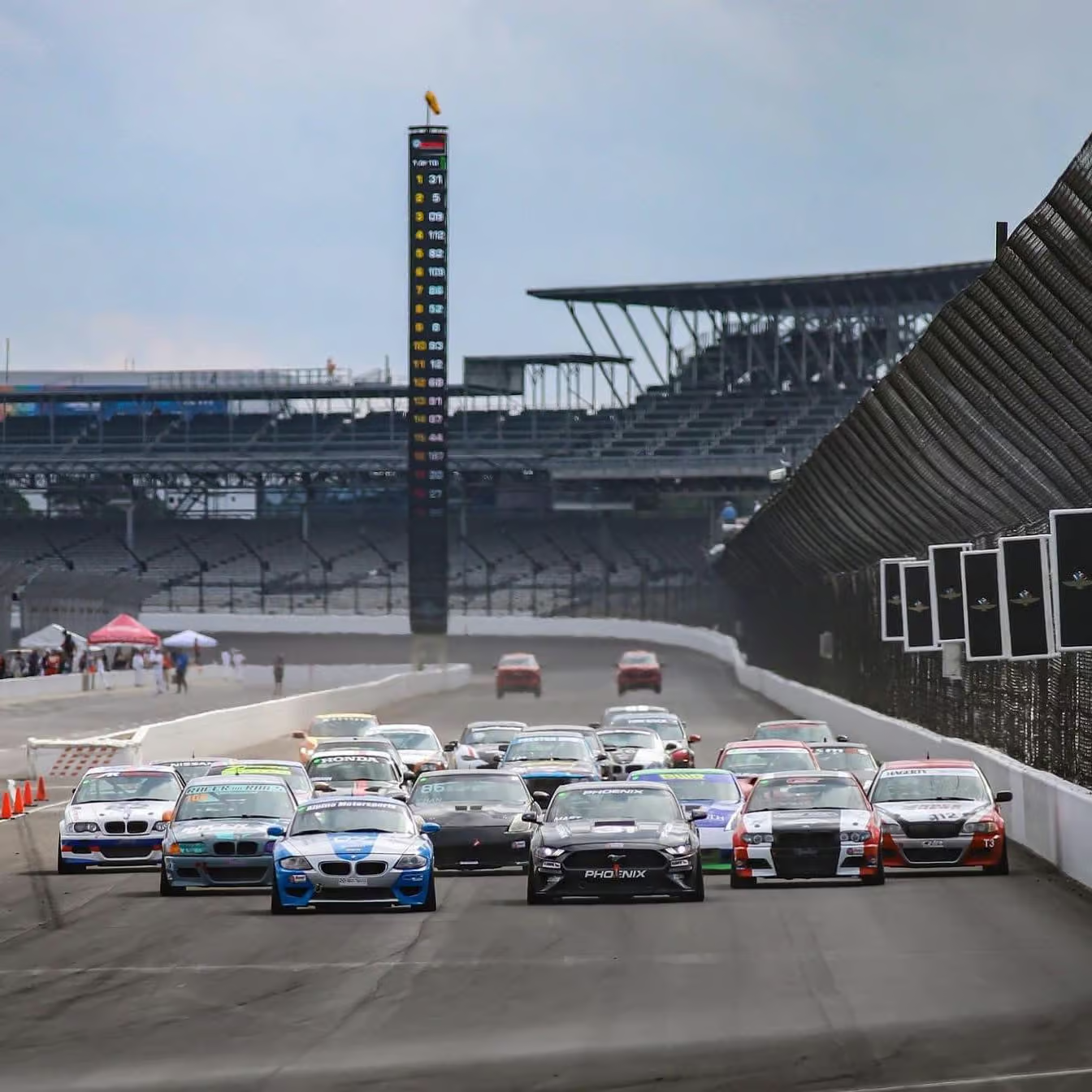
Touring 3 national championship race start at Indianapolis Motor Speedway — the variety of T3 machinery

The Touring 3 field at Indianapolis — production-based cars, national-level racing.

Why the Cayman?

When we started looking seriously at T3 options, the base Cayman kept checking boxes. Porsches rarely win on one enormous spec-sheet number — they arrive with enough power, then make the rest of the package work exceptionally well around it. That was exactly the attraction.

Enough Power

The 2.9-liter flat-six was never going to be the biggest hammer in the T3 toolbox, and that was fine. The question was whether it had enough power when combined with the rest of the chassis.

Our bet was yes.

A Strong Braking Foundation

Porsche’s production braking systems give us an excellent place to start.

We begin with thoughtful factory hardware, good pedal behavior and a platform that was designed from the outset to be driven hard.

That matters enormously in a production-based class, because braking is not simply about one stopping-distance number. It is about repeatability, temperature, confidence, pedal communication and what the car does as the driver starts releasing the brake and turning in.

Weight

The Cayman was one of the relatively lighter choices among the larger, more powerful production-based cars we were considering.

Less mass helps almost everywhere. The tires have less work to do, the brakes have less energy to dissipate, and the suspension has less mass to control every time the car accelerates, stops or changes direction.

The Shape

Then there is the shape.

The Cayman has a compact, clean aerodynamic profile that moves efficiently without enormous wings and splitters. We believed it would be one of the stronger T3 options both in clean air and in a draft.

On a class car that still needs to make good speed down long straights, that matters.

PDK

And then there was PDK.

For this car, we viewed the transmission as an advantage.

Every task we can simplify gives the driver a little more mental capacity for something else. There is no clutch operation on every shift, no heel-toe downshift to execute while threshold braking, and both hands can spend more time on the wheel. Left-foot braking is available naturally.

None of that makes racing easy.

It simply removes one mechanical task from a driver who is already processing cars, mirrors, flags, brake points, corner placement, grip, strategy and whatever unexpected thing just happened six feet in front of the windshield.

That matters.

The Cayman That Clinched It

There was also one experience that stuck with me.

At a February Hoosier Super Tour a few years ago, there was a newer-generation base Cayman racing in Touring 3. From watching the car, it looked like there was still meaningful lap time available through some of the more technical sections.

Then the road straightened out.

The thing was devastatingly effective.

That got my attention.

If the platform could give away time in parts of the lap and still be that difficult to deal with once everything opened up, there was clearly something there.

That was the clincher.

On paper, the 2010 Cayman Base seemed to have the right ingredients: enough power, good brakes, relatively low weight, an efficient shape, a mid-engine chassis and PDK.

So we bought one and decided to find out.

After its first race weekend and a handful of test and shakedown sessions, it has already shown that the idea works.

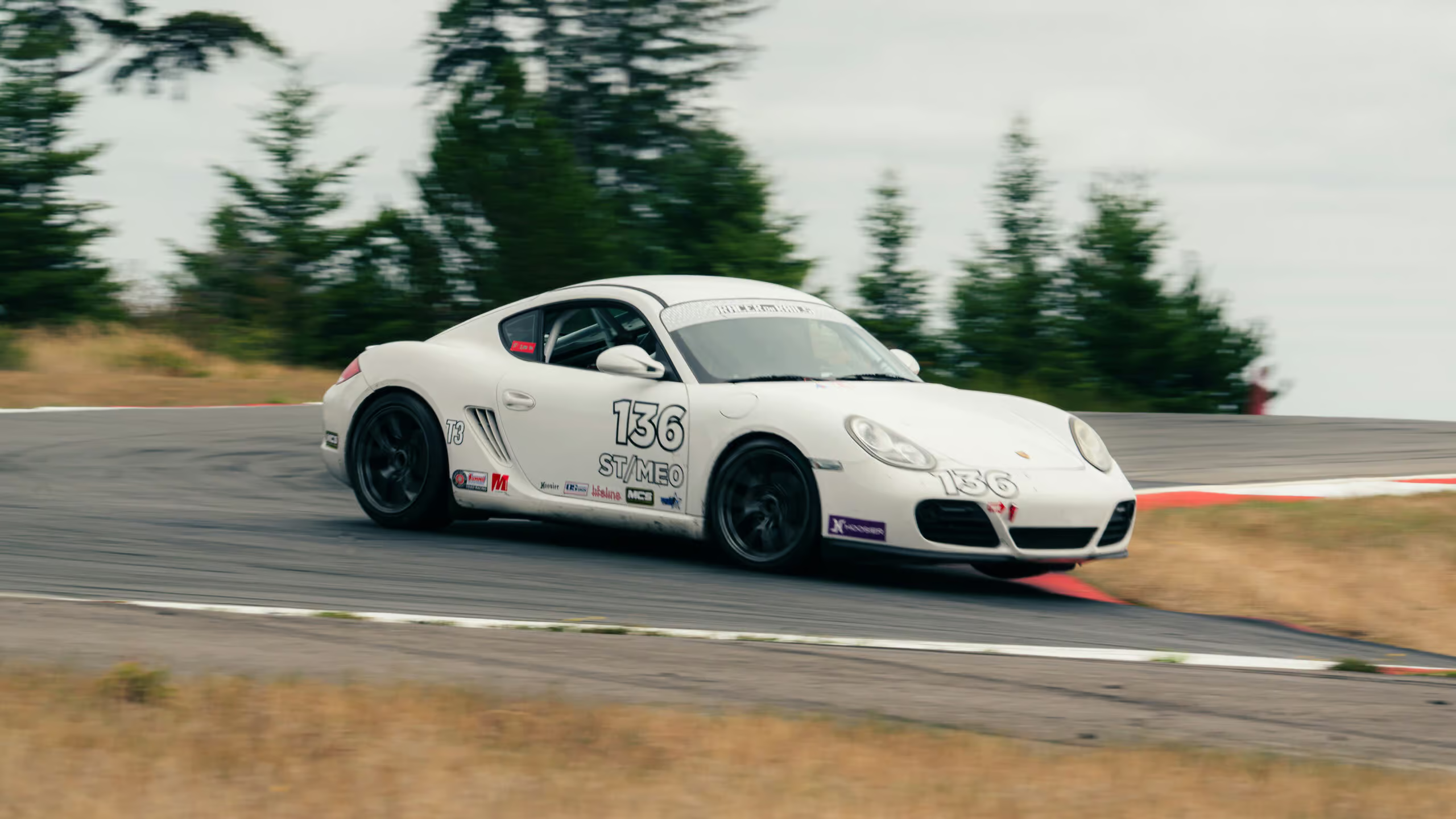
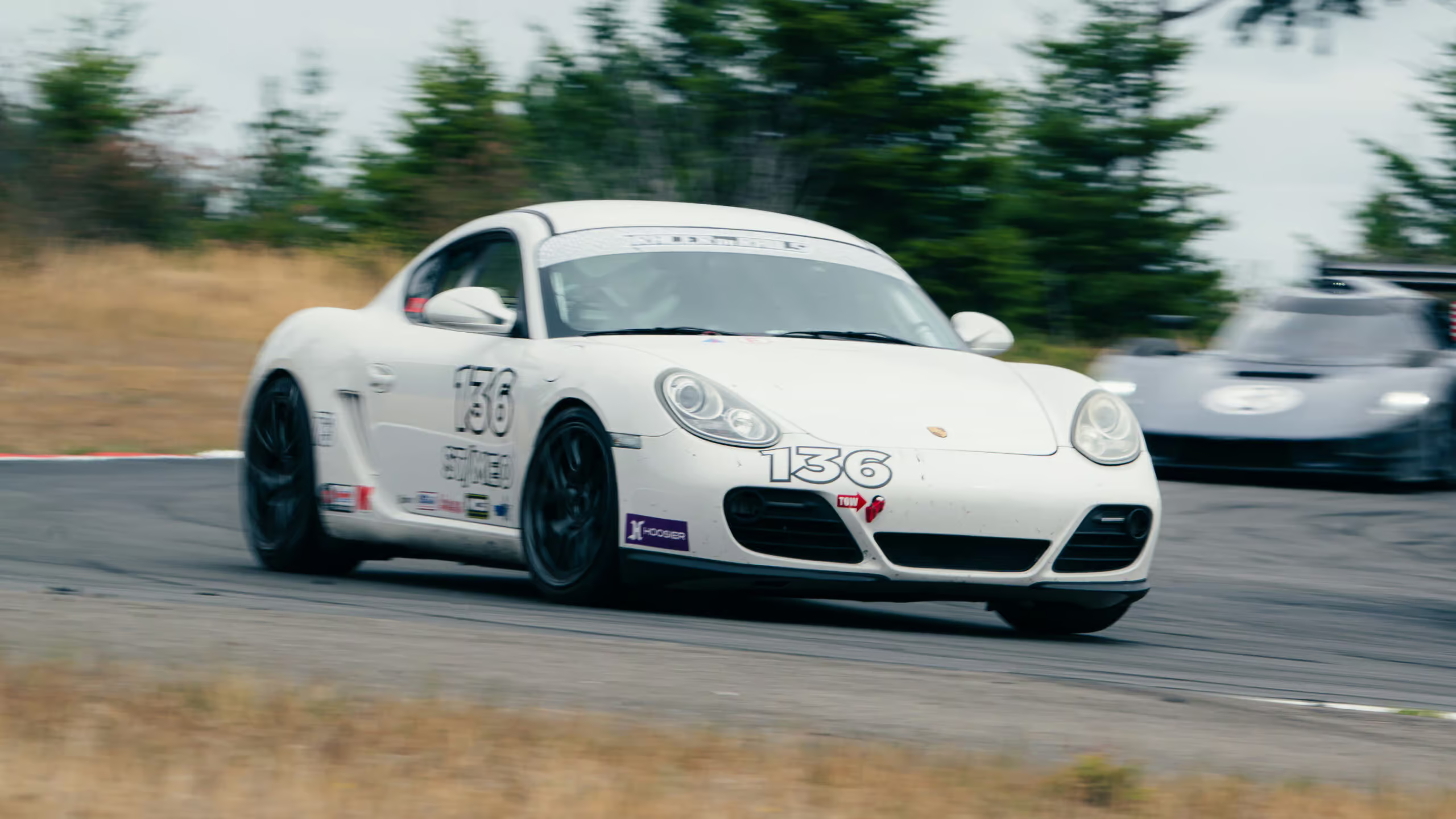
The #136 T3 Cayman at speed — compact profile doing its thing

The #136 at speed — early shakedown laps confirmed the concept works.

The Rulebook Is Part of the Engineering

Touring-class development is interesting because the solution cannot simply be “replace everything.” The rulebook creates a box, and that box becomes part of the engineering problem: enough freedom to meaningfully improve the car, but not enough to erase the production platform’s character.

Where should we spend weight?

How much spring rate does the tire really want?

How much braking hardware do we actually need?

Which weaknesses need hardware, and which ones need setup?

The rulebook is not just a restriction.

It is part of the design brief.

Current State of the Car

We used a similar format documenting our T3 Nissan 370Z: less a parts list, more a snapshot of where the development program stands today.

Chassis

The foundation is a 2010 Porsche Cayman Base, 987.2, converted from a street car into a wheel-to-wheel competition platform.

Current chassis highlights:

  • 2010 Porsche Cayman Base, 987.2
  • Mid-engine, rear-wheel drive
  • SCCA Touring 3 competition build
  • Full competition roll cage
  • Modified and reinstalled factory dashboard
  • Fabricated carbon-fiber block-off panels
  • Fabricated driver floorplate
  • Fender liners and undertray retained
  • MCS 3-Way Coilover and Shock Package
  • Fabricated rear trunk-release system
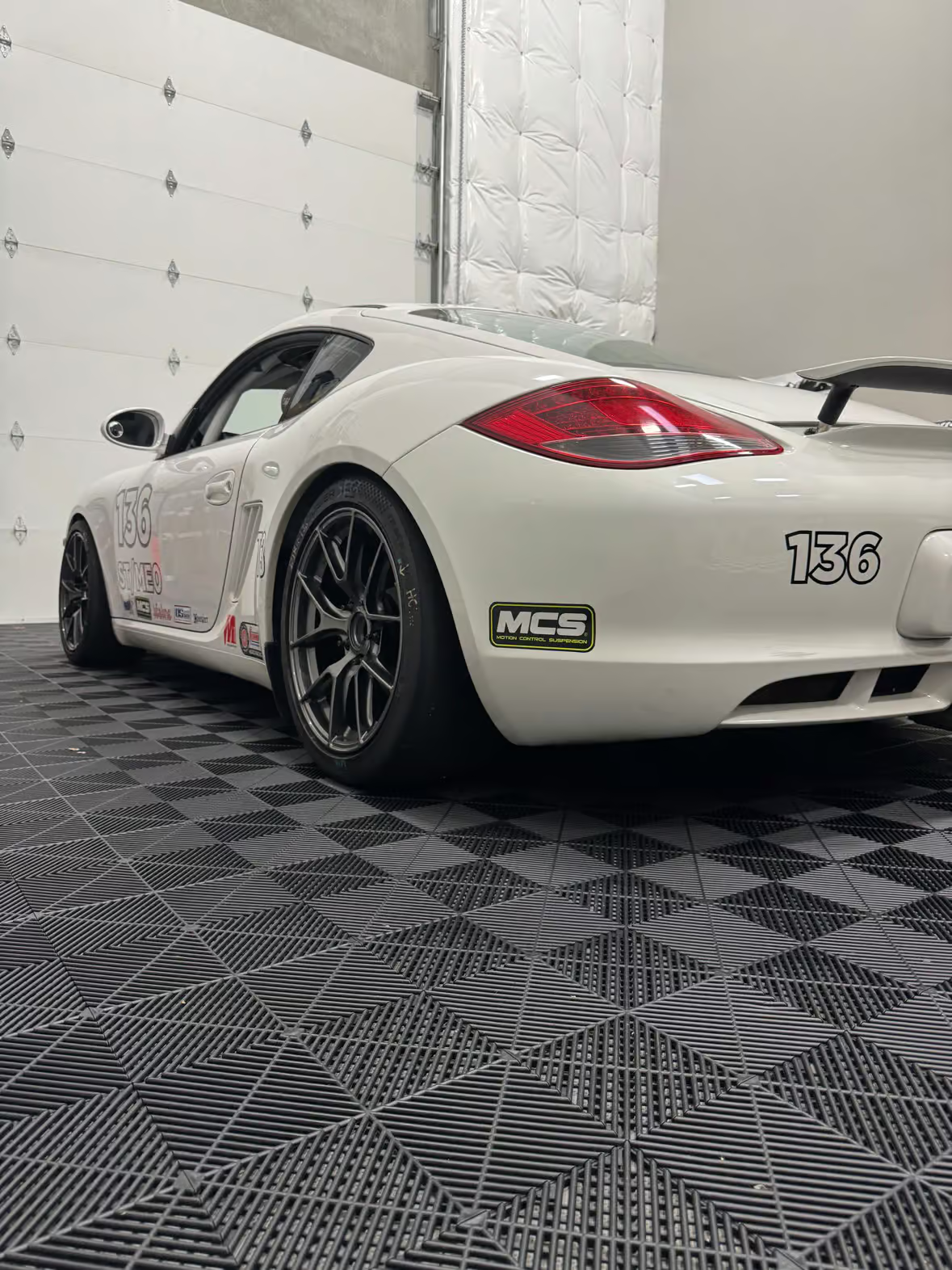
T3 Cayman clean exterior rear three-quarter

The #136 as it sits today — a production Cayman developed for competition.

Interior & Safety

The cockpit was built for wheel-to-wheel use, and for the way we believe a race car should feel when you sit in it.

Our reference point is not the improvised club-racing interior where everything technically works but looks added one weekend at a time. We take more inspiration from factory-built TCR, GT4, GT3 and single-make cars.

That means clean, tidy, functional and clearly organized. Wiring routed intentionally. Controls where they make sense. Labels clear. Safety equipment integrated rather than appended. The finished cockpit should feel like an evolution of the original road car, not a collection of unrelated race parts.

For us, that is not cosmetic. A well-organized race car is easier to operate, easier to inspect, easier to diagnose and easier to service. Good presentation and good engineering often reinforce each other.

The Cayman currently includes:

  • Full competition roll cage
  • Fixed-back competition driver seat with custom bracket and slider installation
  • Driver harnesses
  • Driver nets
  • KMP steering wheel
  • Integrated fire-suppression system
  • Low-profile SFI roll-bar padding
  • Rennline rear tow hook
  • Main power relay / cutoff provisions
  • Flagtronics in-car flagging system
  • Lifeline FIA rain light
  • Custom dashboard modification and wiring integration
  • Heater-core lines deleted and rerouted
  • Competition-oriented interior block-off panels and driver floorplate

One detail we particularly like: achieving the lowest practical seating position while retaining a slider took real fabrication, not just a bolt-in bracket.

That small detail reflects the larger theme of the build: the car should fit the driver and the mission, not simply the parts catalog.

T3 Cayman full cockpit

The office — built around the driver, not the parts catalog.
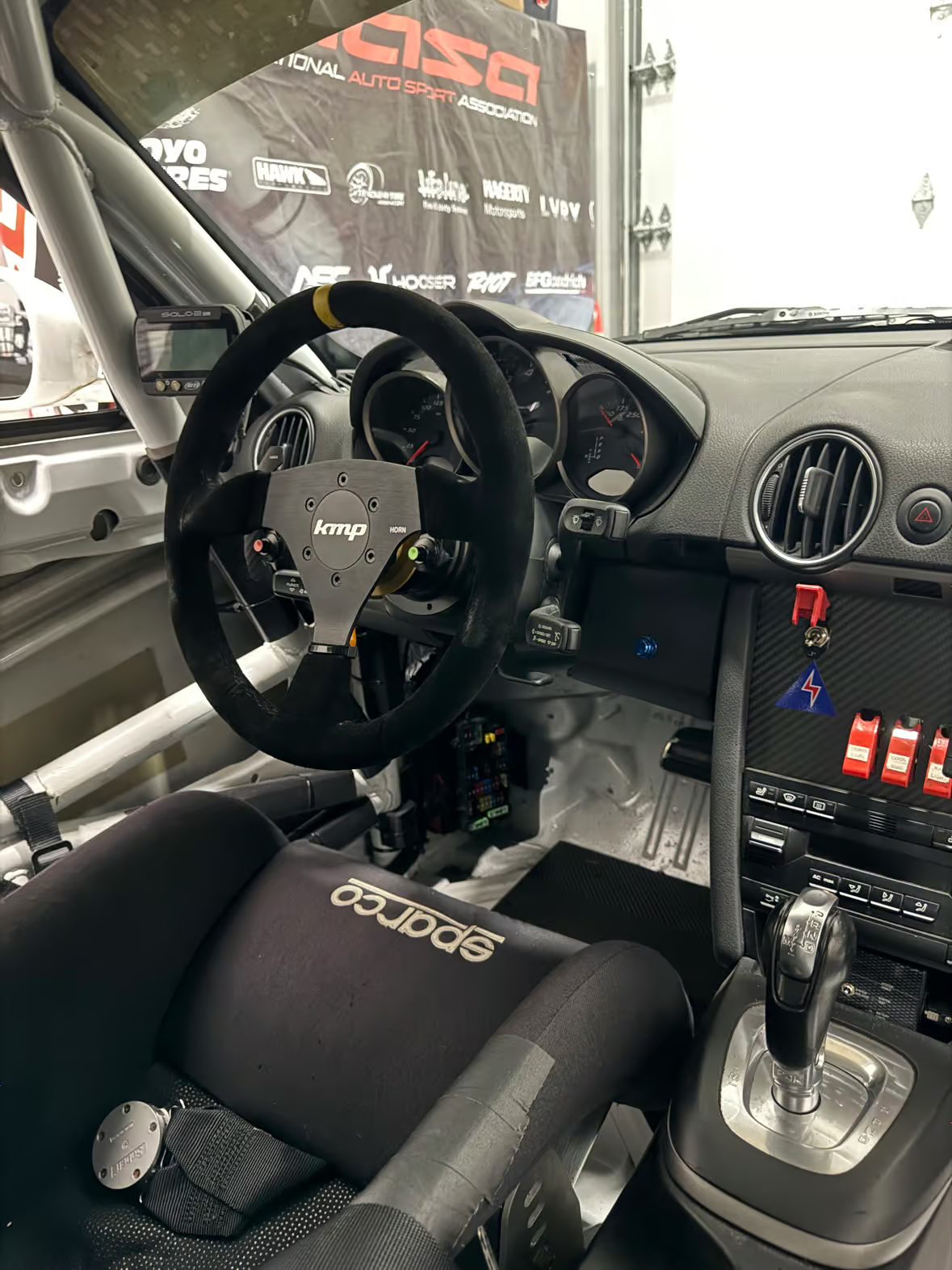
KMP steering wheel and driver controls

KMP wheel and driver controls — everything within reach, nothing extra.

Brakes

Brakes are one of the most active development areas on the Cayman.

The existing system has already received a proper baseline: rebuilt front and rear calipers, stainless-steel brake lines, fresh pads and rotors, and a flush with Endless RF-650 racing brake fluid.

That gives us a known starting point.

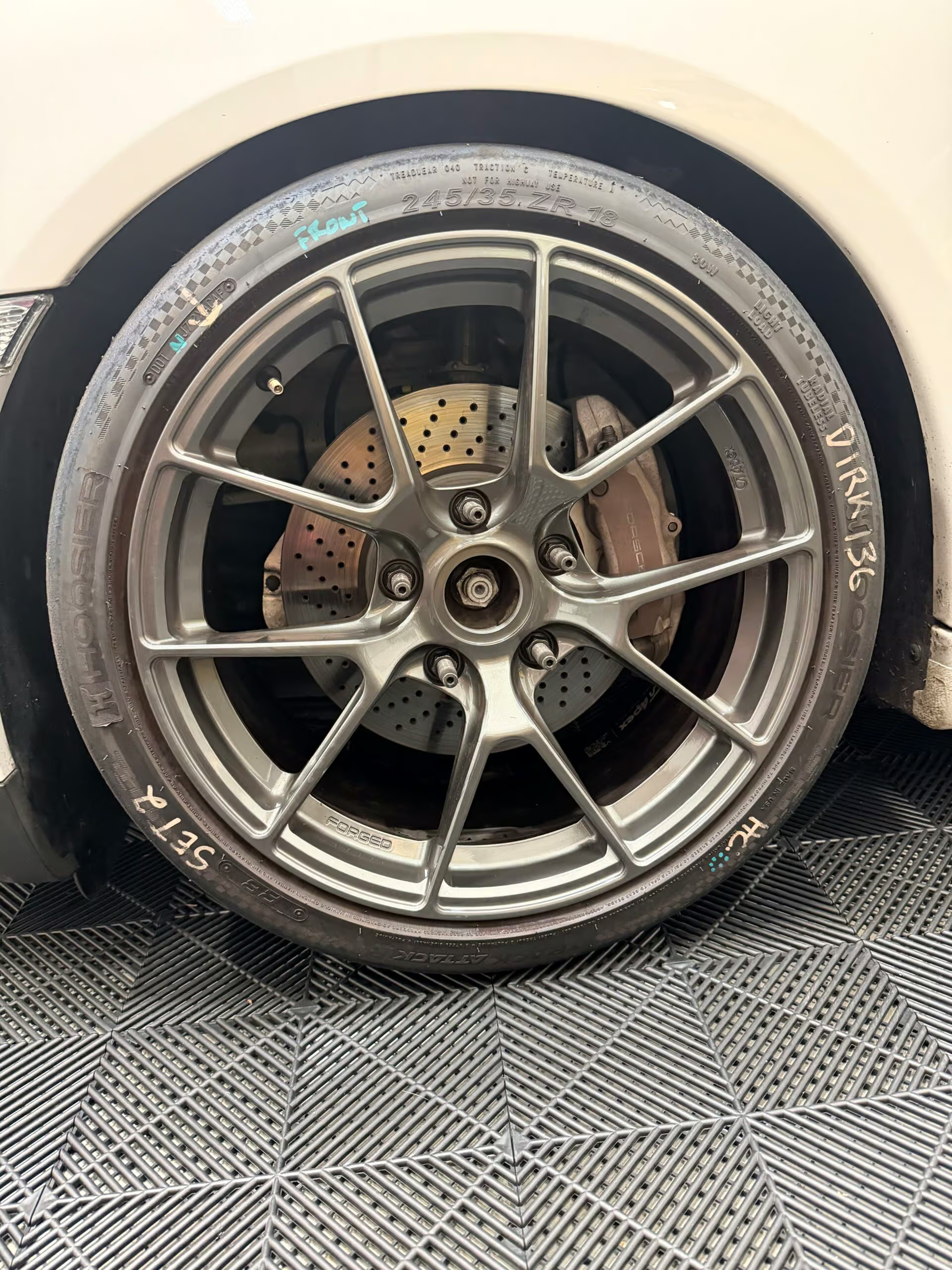
Apex forged wheel with drilled brake disc and bronze Porsche caliper on the #136 T3 Cayman
The #136’s front corner: Apex forged wheel, drilled disc, bronze Porsche caliper — the current brake baseline.

Now the interesting question becomes what, if anything, the car actually needs next.

Current brake configuration and development work includes:

  • Rebuilt OEM front and rear Porsche calipers
  • Stainless-steel brake lines
  • Competition pads and rotors
  • Endless RF-650 brake fluid
  • Brake-temperature and wear evaluation
  • Alternative rotor options under evaluation

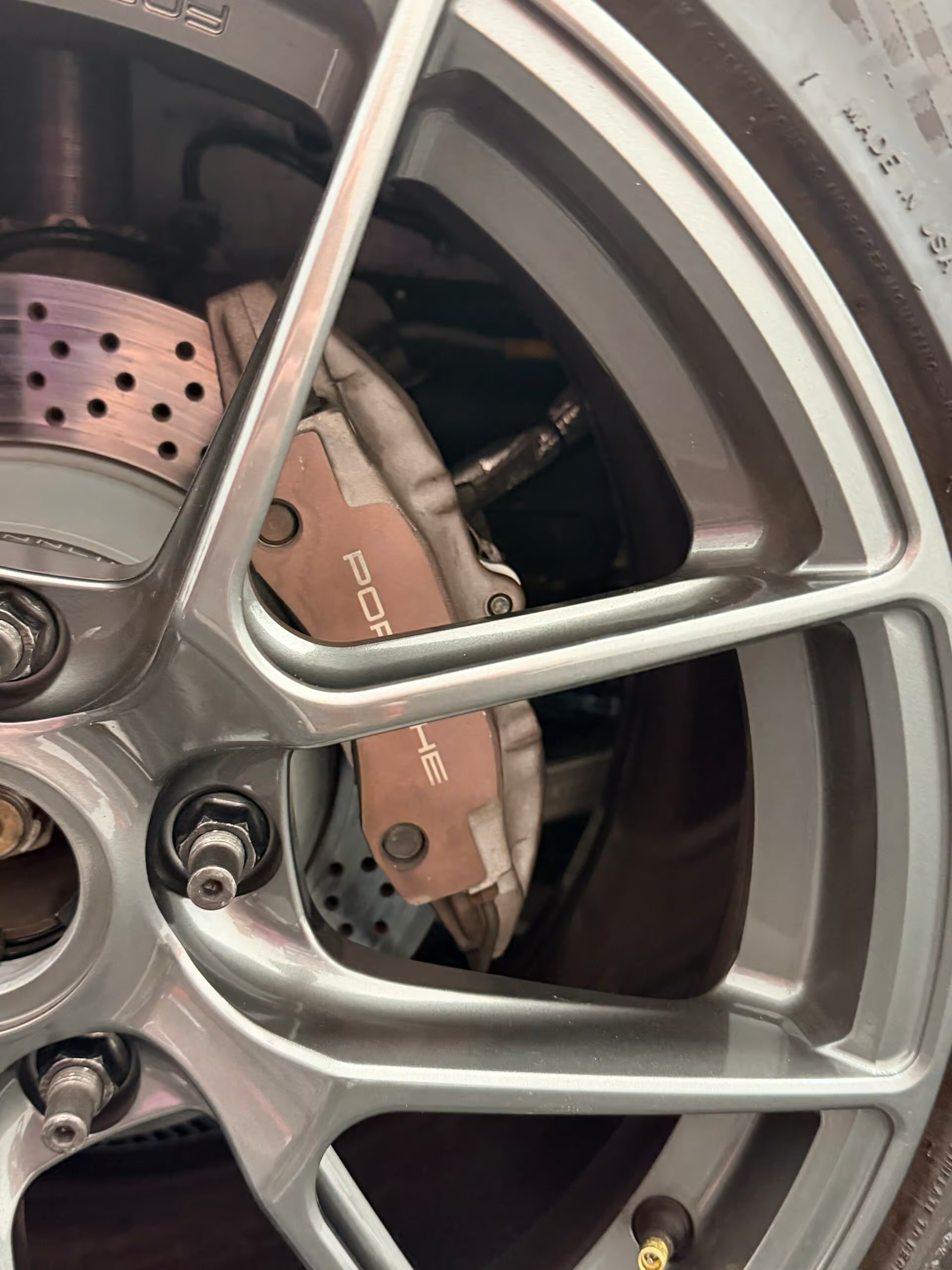
Close-up of the bronze Porsche brake caliper and drilled disc through the wheel spokes
Porsche caliper and drilled disc, up close. Evaluation continues — the right answer is the simplest one that solves the problem.

Engineering is not choosing the biggest thing the rulebook allows. It is finding the simplest solution that actually solves the problem.

Suspension

The current suspension package gives us meaningful setup authority while keeping the Cayman’s fundamental character.

The car uses Motion Control Suspension (MCS) 3-way adjustable dampers, upgraded camber plates and an upgraded front sway bar. The front shock towers were also modified to create the necessary camber clearance. Alignment and corner balancing have been part of the setup process from the beginning.

Current suspension highlights include:

  • MCS 3-way adjustable dampers
  • Upgraded camber plates
  • Upgraded front sway bar
  • Front shock-tower modification for camber clearance
  • Competition alignment and corner balancing

We choose hardware based on what makes sense for the car and the program. MCS has earned its place on our serious competition builds because the engineering relationship matters as much as the hardware.

Suspension development gets complicated quickly — spring rate, damping, motion ratio, tire construction, aero load, roll stiffness, track surface and driver preference all interact — and a damper is only useful if the team understands how to use its adjustment range.

That relationship makes it a two-way development process: we bring them what the car is doing, what the driver is feeling and what the data is showing, then work through what the platform actually needs rather than treating the damper as a black box.

A three-way damper gives us significant control, but more adjustment is only useful if every click has a purpose. The objective is not maximum stiffness. It is controlling the platform, supporting the tire and giving the driver predictable behavior through braking, turn-in, mid-corner and exit.

A setup sheet full of dramatic numbers does not automatically create a fast car.

The tire does not care how impressive the alignment sheet looks, and the stopwatch definitely does not care what logo is printed on the shock.

The value comes from understanding the system and having the right tools to improve it.

MCS damper detail at the rear
MCS 3-way dampers give us substantial setup authority, but the real value is the engineering relationship that helps us use that adjustment intelligently.

Wheels & Tires

The dry package uses APEX VS-5RS forged wheels in 18×9 ET46 with Hoosier R8 tires — a shorter 245/35R18 front, 245/40R18 rear.

That staggered diameter is the result of testing rather than aesthetics.

Earlier running showed too much front-to-rear wheel-speed difference with the previous tire configuration. After reviewing the data and consulting Porsche specialists, we moved to the shorter front tire while retaining the same section width.

That is exactly the sort of thing we enjoy about development work.

The specification sheet gives us a starting point. The car tells us what happens in reality.

Hoosier rubber on the #136's rear quarter

Hoosier rubber — where the specification sheet meets reality.

Engine

The engine remains fundamentally Porsche’s naturally aspirated 2.9-liter flat-six, but preparing a production engine for sustained competition requires much more than changing the oil and sending it.

The build has included a complete tune-up, spark plugs, cam and crank sensors, water pump replacement, seals and gaskets, engine mounts, exhaust development, dyno verification and Softronic 987.2 performance software tune.

The exhaust work is a good example of the thought process behind this build.

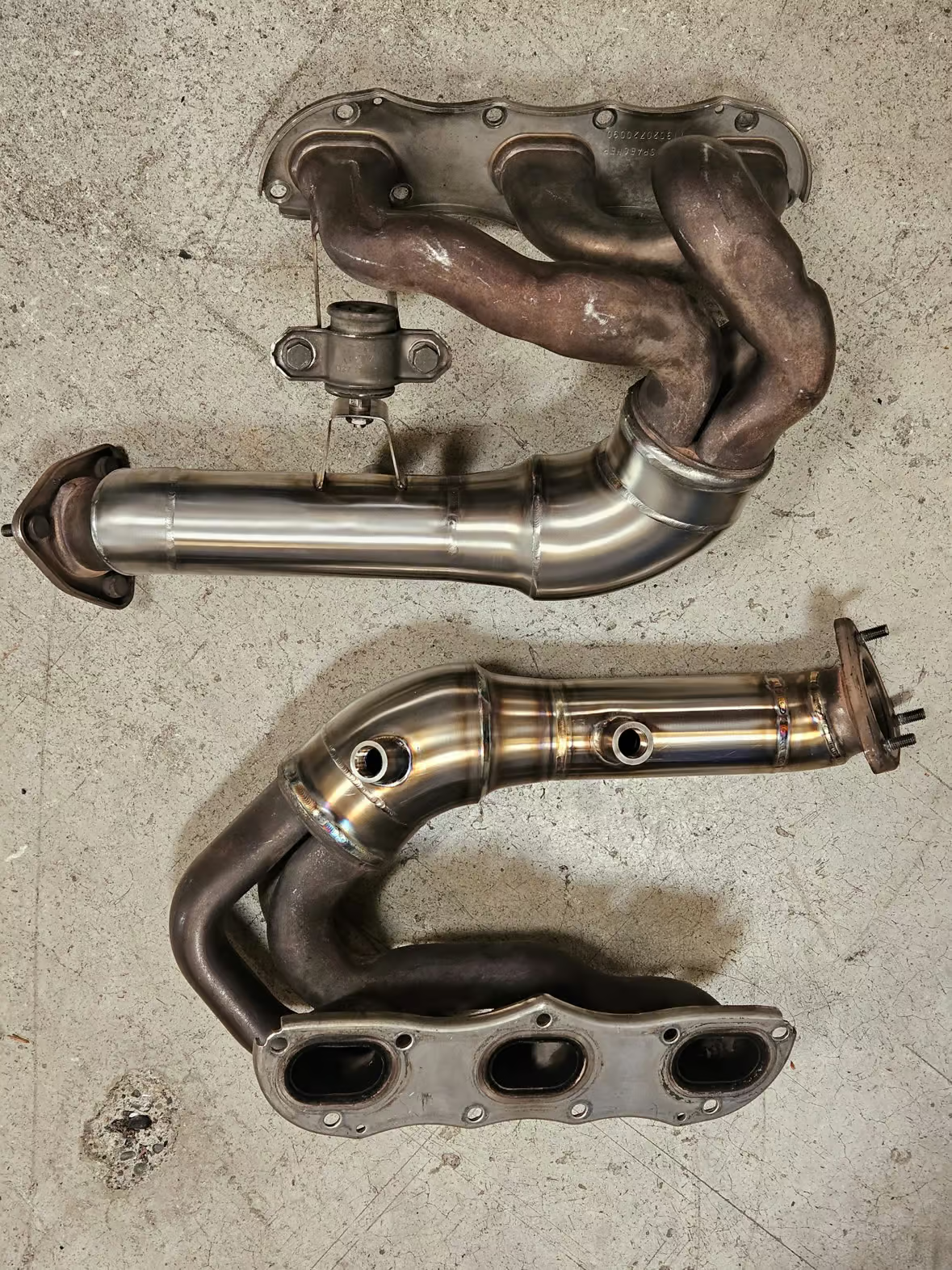
The rules allowed removing the catalyst material, but simply hollowing the factory housings would leave a large empty expansion volume in the exhaust path. Instead, we fabricated a properly sized straight section through the catalyst area, keeping a cleaner flow path and preserving exhaust-gas velocity.

Again, the question was not simply, “What are we allowed to do?”

It was, “Which legal solution best serves the engine?”

Up next: a larger-diameter race exhaust, which should unlock a few more ponies.

Custom-fabricated headers for the #136 — TIG work done in-house

Custom-fabricated headers, TIG-welded in-house — the kind of work the rulebook rewards.

Engine Cooling & Thermal Management

Cooling became a priority almost immediately.

Engine coolant temperatures were already a concern in early testing despite favorable conditions, so rather than waiting for summer heat, the car received a substantial cooling-system upgrade.

That includes:

  • CSF upgraded left radiator
  • CSF upgraded center radiator
  • CSF upgraded right radiator
  • 160°F low-temperature thermostat
  • Center-radiator installation hardware
  • Front-bumper mesh protection
  • Racing coolant strategy
  • Cooling-system service and vacuum-fill equipment included with the track spares

Thermal management is not merely a reliability subject.

It is performance.

The drivetrain gets the same treatment. PDK is one of the reasons we chose the Cayman, but asking a dual-clutch gearbox to operate continuously at race pace creates a very different thermal environment than normal road use. The car now uses a BRS 987.2 PDK transmission oil-cooler system, with an active pump circulating fluid through a dedicated oil-to-water cooler, and an AiM temperature sensor so transmission temperature becomes something we can actually measure instead of speculate about.

Cold is not automatically better.

Controlled is better.

Electronics & Data

The development car needs to tell us what it is doing.

The current data system is built around an AiM Solo 2 DL with CAN, paired with an AiM eight-channel expansion hub, a 150 PSI pressure sensor and an additional oil/coolant temperature sensor. Custom mounting and sensor integration were completed as part of the build. We’re monitoring all the driver and car vitals including but not limited to brake pressure, steering angle, throttle position, engine RPM, wheel speeds, Yaw, coolant temp, coolant pressure, oil temp, oil pressure, diff fluid temp, and transmission fluid temp.

No SmartyCam yet — Dirk still happily triggers video manually before each session, so the data/video system has room to evolve.

For now, the important part is that the AiM system is not simply being used as an expensive lap timer.

We want data because we have specific questions to answer.

What happens to drivetrain temperature over a full session?

Did a setup change help one corner while hurting another?

Are we changing the car because we know what is happening, or because we think we know?

That distinction matters.

Drivetrain

The drivetrain is one of the pieces that made the Cayman especially attractive in the first place.

At the center is Porsche’s 7-speed PDK, now paired with an OS Giken Super Lock 1.5-way limited-slip differential.

Current drivetrain configuration includes:

  • Porsche 7-speed PDK
  • OS Giken Super Lock LSD, 1.5-way
  • OS Giken differential fluid
  • PDK service
  • Replacement inner and outer PDK carrier bearings
  • ARP differential-cover bolts
  • BRS PDK transmission cooler
  • Active cooling pump
  • Dedicated oil-to-water cooler
  • AiM transmission-fluid temperature monitoring

The 1.5-way gives us meaningful locking under acceleration without making the car as aggressive on deceleration as a full 2-way.

That suits a car we value for its willingness to rotate cleanly and communicate what the rear axle is doing.

The Tire Has to Do the Work

The tire rules are another reason this development is interesting: we cannot solve every handling issue with enormous rubber, so geometry, damping, roll control and extracting the most from the available contact patch matter more.

Camber, toe, ride height, spring behavior, damping, sway-bar balance and bump travel all affect what happens to that relatively small area of rubber touching the racetrack.

And none of those adjustments exists in isolation.

A change that improves front response can hurt braking stability. A geometry tweak that helps mid-corner can hurt brake release. A setup that produces one phenomenal qualifying lap may not give us consistency over a full race.

The goal is not to maximize any individual setting.

It is to make the entire chassis work together.

Front tire loaded up in the corner — sidewall doing work

Loaded up — the whole chassis working as one.

The Driver Is Inside the Development Loop

Development works better when the driver is treated as part of the system, not just the person holding the steering wheel.

Driver feedback matters.

Data matters.

Inspection matters.

Lap time matters.

Tire condition matters.

None should be used by itself.

If the driver reports instability during brake release, we want to understand why. If the data shows something unexpected, we correlate it with what the driver felt. If the tire disagrees with both, we investigate instead of deciding which source must be wrong.

The objective is not to prove the driver right or the data right.

It is to understand the car.

That relationship works both ways. As the car becomes more predictable, the driver can become more precise about what they feel, and the engineering team receives better information.

The driver develops the car.

The car also develops the driver.

Production-Based Development Has Its Own Appeal

Next to the GT4 Clubsport MR, the T3 Cayman remains visibly connected to the road car underneath it.

There is something deeply satisfying about asking how much more capable a very good production sports car can become inside a defined rule set.

You are not throwing away Porsche’s original idea.

You are evolving it for a new job.

That also makes the lessons unusually transferable.

What we learn about braking, geometry, thermal management, tires and chassis balance here transfers directly to a customer’s street Cayman, HPDE car or another production-based race build.

The T3 car becomes a laboratory.

T3 Cayman side profile

The #136 is a laboratory — what we learn here goes straight into customer builds.

What We’ve Learned So Far

The biggest lesson so far is that the basic platform appears to be every bit as promising as it looked on paper.

It does not need enormous horsepower to be effective. The combination of low mass, aerodynamic efficiency, strong braking fundamentals, PDK and a communicative mid-engine chassis gives us a lot to work with.

We have also learned that the interesting gains are unlikely to come from one magic component.

Brake thermal capacity needs measuring and managing. The tire needs using well. Drivetrain temperatures need controlling. Alignment and damping need to complement the driver, not just look aggressive on a setup sheet.

The real opportunity is getting all of those things working together.

And after its first race weekend and early testing, the Cayman has already shown that it belongs in the fight.

#136 with company — race weekend action

In the fight — the Cayman holding its own on a race weekend.

Where We Go Next

The next phase is about widening the car’s usable performance window, not reinventing it.

We want to keep establishing brake-temperature baselines and determine whether the next step is better one-piece rotors, two-piece rotors, more airflow, different cooling geometry or a larger package.

We will keep developing the thermostatic transmission and differential cooling strategy, suspension geometry, alignment and tire utilization — validating reliability over longer races and using the AiM system to connect what the driver feels with what the car is actually doing.

The goal is not one heroic lap.

The goal is a car that is fast, predictable and repeatable enough that the driver can access that performance over and over again.
Posted on

Runoffs 2026: Chasing the Podium at Road America

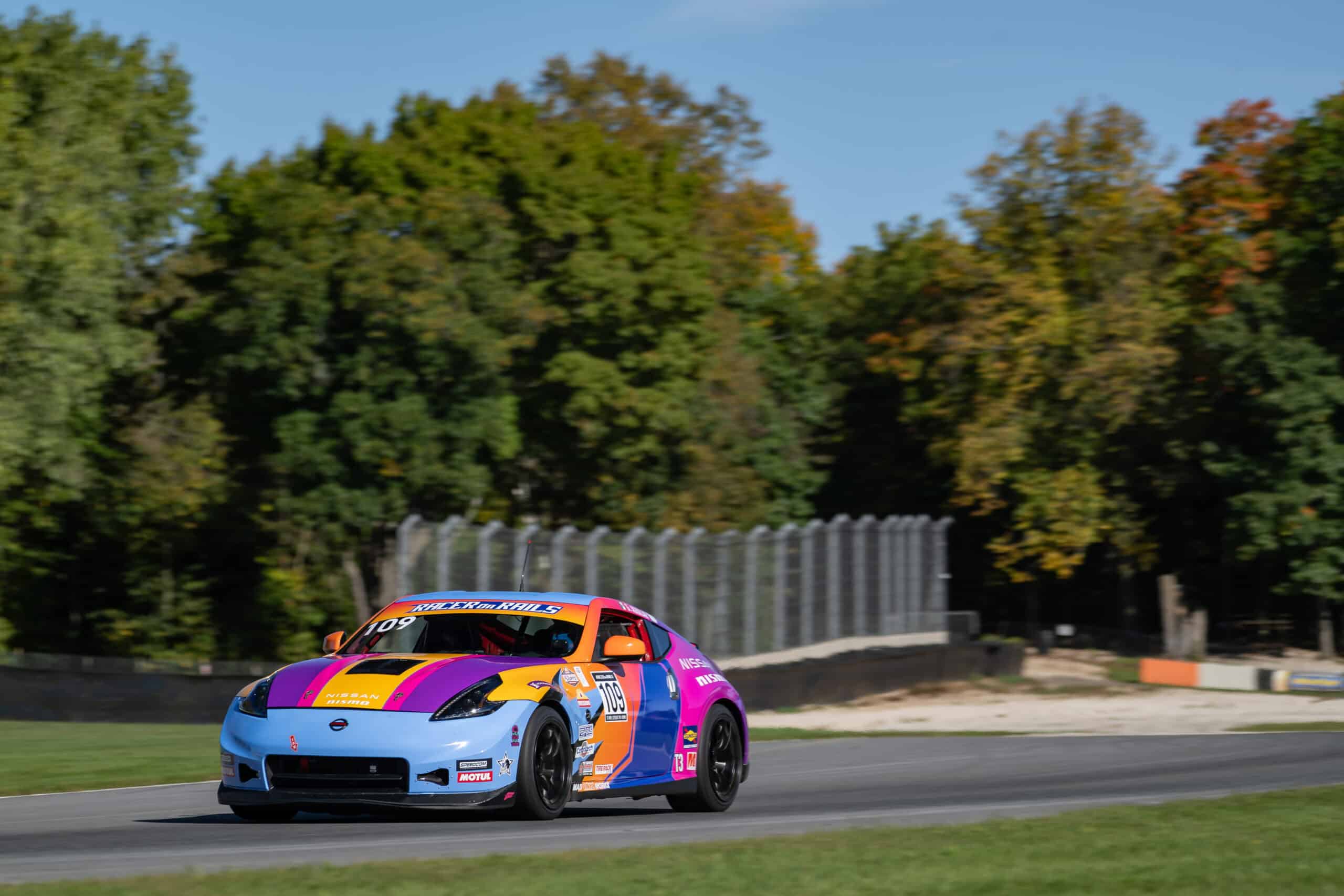
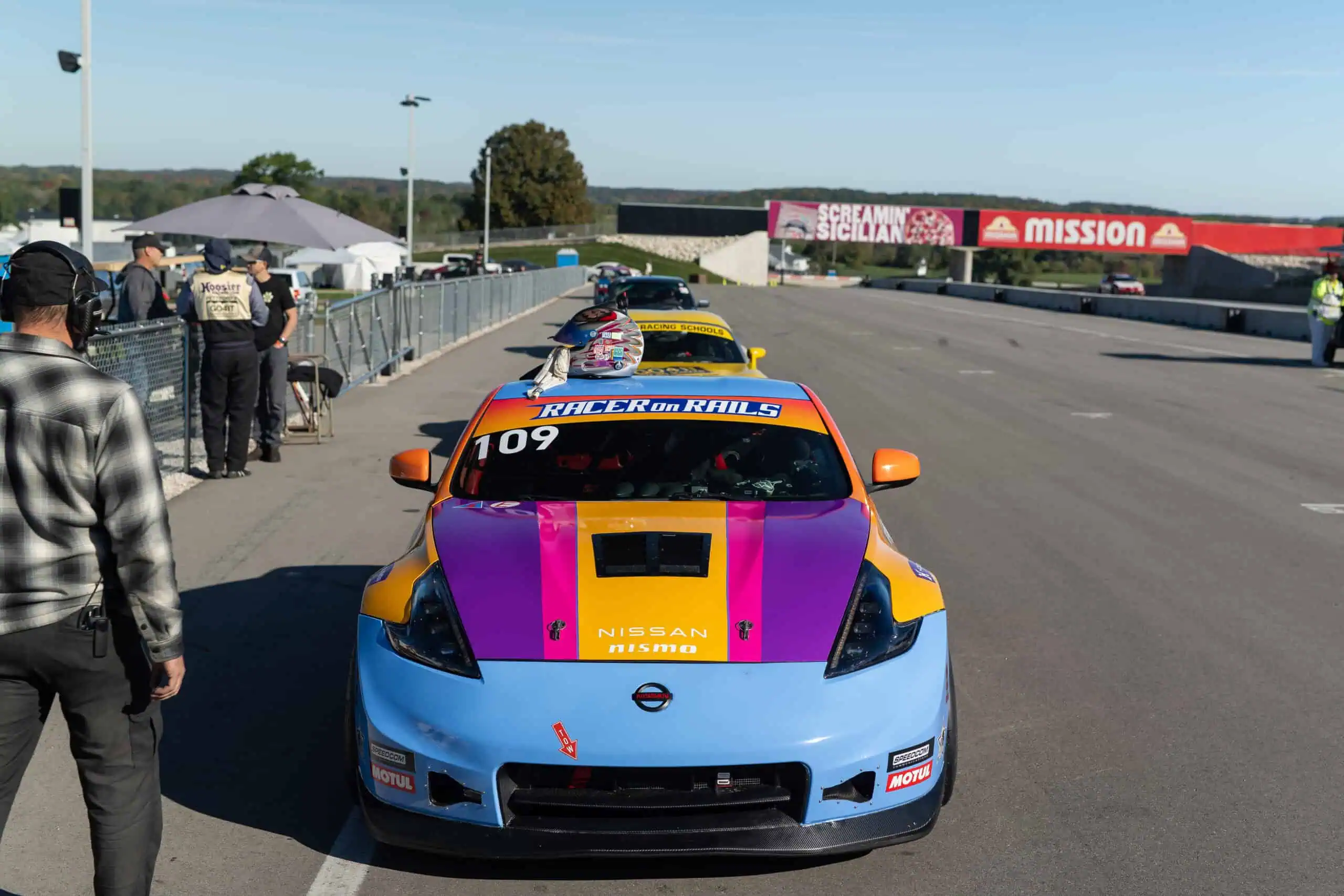
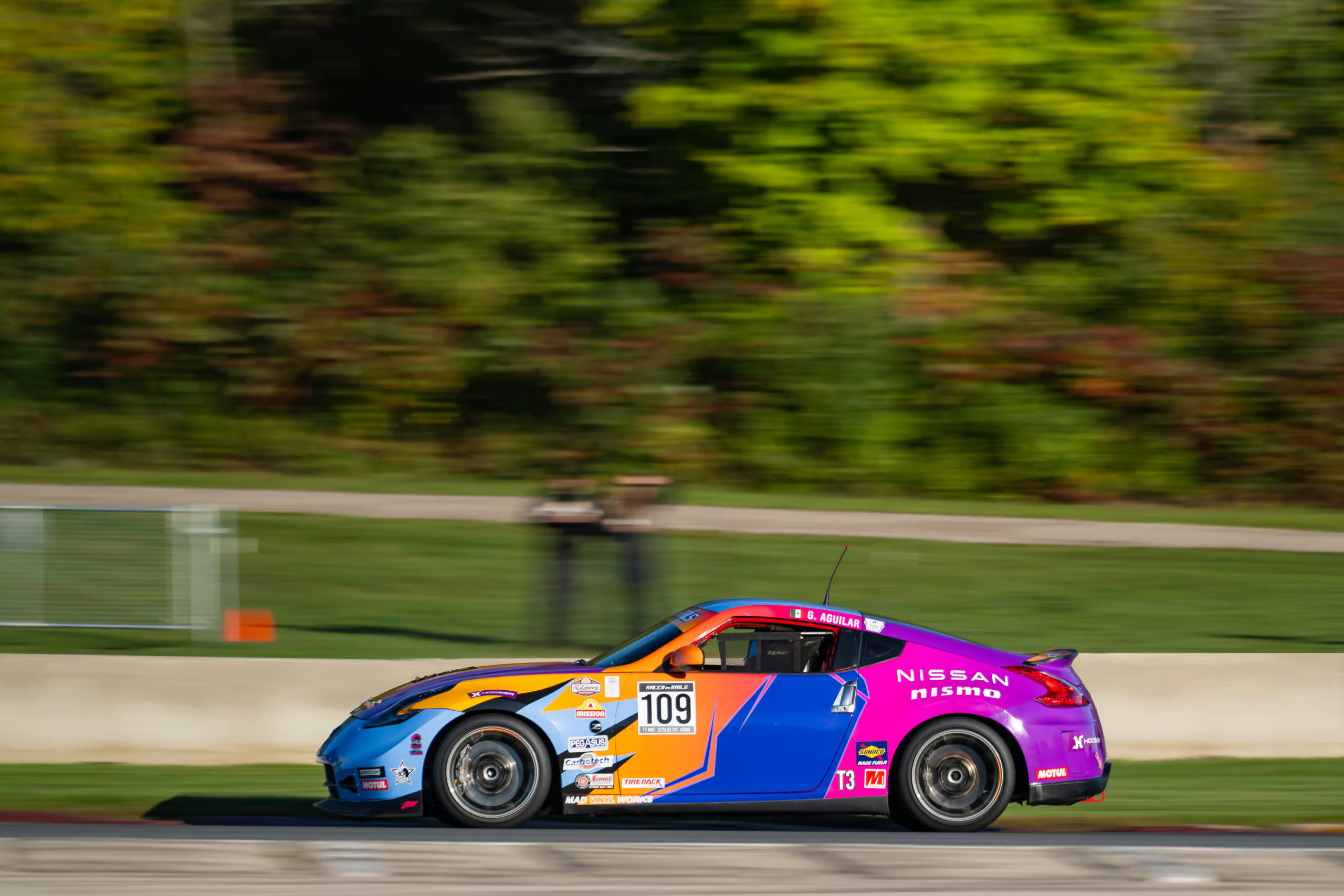
The #109 Racer on Rails 370Z on track at Road America during the 2026 SCCA Runoffs

The Runoffs. Road America. The big one.

If you’ve followed this team for a while, you know this race has been living rent-free in my head for three years now. Three years of hauling across the country, breaking things, learning things the hard way, and coming home with our tails between our legs. This year felt different walking in. The car was the best it’s ever been. We finally understood what it wanted.

And then Turn 5 happened. But I’m getting ahead of myself.

#109 370Z dicing with the #73 Mustang at Road America
The #109 going door-to-door with the #73 Mustang. This is what we came for.

How we got here (the short version of a long story)

Three years ago we ran our first two Runoffs in a row in the Spec E46. The first one was 2021 at Indianapolis Motor Speedway, and honestly we did pretty well. I qualified fifth. Then I got taken out on lap 1, turn 3 and that was basically the end of our weekend. Sigh.

The next year we went to VIR, and that’s where we learned the hard truth: the Spec E46 just wasn’t the right weapon for the Runoffs. Not enough power, not enough gear, especially at a track like VIR. Great car. Wrong tool for the job.

So we went car shopping. And I mean really shopping. We looked at everything that was winning in T3. The EcoBoost Mustang. The newer V6 Mustangs (though we didn’t know much about Mustangs, if I’m being honest). The BMW Z4M Coupe, because those things had done well and actually won the Runoffs at VIR. The Nissan 370Z, a few Z’s were campaigning regularly and finishing top five at national races, so there had to be something in the chassis.

And then I was reading the spec lines and saw the Porsche Cayman base, and that one stopped me cold. Good power, the best braking system of the bunch, good gearing, and it’s a Porsche with a fantastic dynamic profile. I actually bought one. That’s the car that’s now Dirk’s T3 Cayman, sitting in our showroom. That was my lead contender.

But when it came time to actually build a car for the next Runoffs, I went with the 370Z. Here’s why: Chris Hart had bought one of those well performing 370Z’s and was doing really well with it, with continued development behind it. My thinking was simple. Maybe too simple. Copy and paste Chris’s chassis and setup into my car, accelerate through the learning curve, go fast immediately.

Welp, that plan didn’t pan out too well. haha!

We went to VIR that year and basically finished building the car during the test days. Second or third session, just shaking the thing down, and I got ice mode going into the braking zone for Oak Tree. Straight into the tire wall at 65 mph. First significant damage to the car. It really, really hurt.

We came home, fixed the car, and campaigned it properly the next year — fighting the brakes all season, because the ABS system in these cars simply isn’t as good compared to BMW, Porsche, Ford, all of them. We managed it well enough to get to the Runoffs at Road America feeling okay. Qualified around sixth, got a great start… and the engine blew up before we even got to Turn 3. On the start. I ended that year crying at the side of the track while the race drove away without us.

What followed was the engine saga. A fresh engine over the offseason, then a head gasket showing up on the dyno before the season even started — pulled it before it could blow, and I missed the whole beginning of the year. Then a used engine that broke the Portland track record in the morning session and blew up in the afternoon. Turns out we’d left metal debris in the old oil cooler and lines, just waiting to kill the next motor. My fault. Expensive lesson.

Done rolling the dice on used engines, I bought a certified remanufactured VQ37 straight from Nissan. As close to brand new as you can get. Dropped it in, fought through the electrical gremlins, and finally got the car running right. Went back to Road America that July for a Majors weekend — podium on Monday, won the race on Tuesday. The car was really, really good.

Catching the overall theme here? Every time this car got good, something broke. Every time something broke, we learned something.

The tire lesson (2025 Runoffs)

We went back to Road America for the 2025 Runoffs feeling like we knew how to go fast. Problem was, we weren’t going fast enough. I was risking my life in basically every corner and just could not keep a tire underneath the car.

We qualified somewhere around sixth or seventh, had a good start, and I think I was running fourth or battling for fourth by the end. But the tires were just gone. We were burning them off, and we didn’t understand why.

Over the offseason we finally stopped guessing and started engineering. Full suspension analysis, and what we found wasn’t pretty — the geometry was working against the tires in ways we couldn’t feel from the driver’s seat.

So we made two big changes. We raised the car to get the suspension working in a happier window, and we got serious about the tire program — nitrogen only, with a proper procedure to keep moisture out and temperatures under control. For the first time, we actually understood what the tires were doing.

We went to Portland and Pacific Raceways with those changes and the car was fast. Like, really, really fast. We finally felt like we’d solved it.

Then we spent about a month and a half prepping for this year’s Runoffs. Full refresh. Brand new wrap. Every detail. It was the best prepared this car has ever been, and it looked amazing.

#109 370Z head-on in the paddock with its fresh wrap
Best it’s ever looked. Best it’s ever been. We were ready.

The week

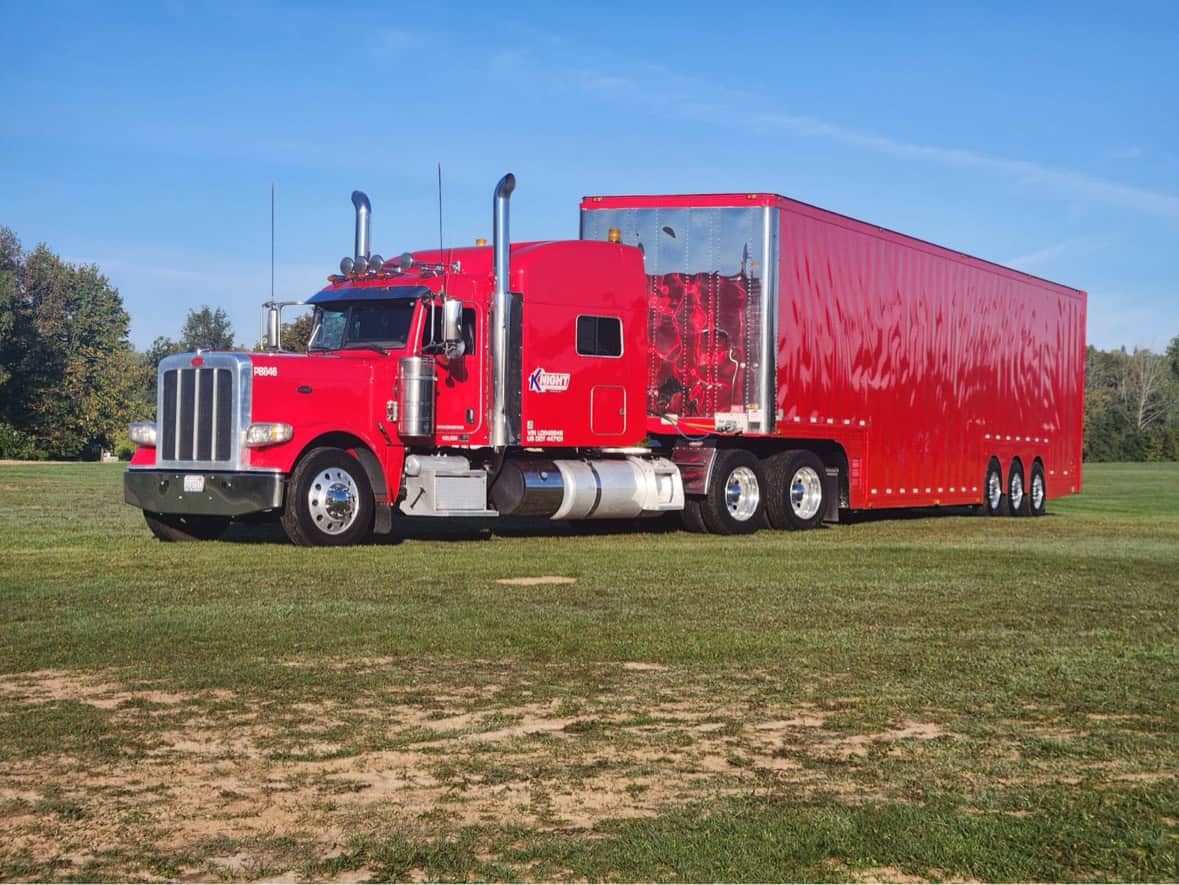
One big change this year: instead of hauling everything ourselves, we partnered with Scotty B White and Knight Transportation to transport the car and paddocked with his operation. Just me going from our team, which kept things simple. And I have to say, it was a great call. Scotty runs a really well-oiled operation, and we’re super grateful. There’s a real chance we work together again in 2027, which I’m excited about.

The red Knight Transport truck and trailer at Road America
The big red Knight Transport rig — Rob’s office for the week.

We showed up with a full test plan. Monday and Tuesday for testing, which would set up our qualifying plan for Thursday and Friday. Simple on paper.

Monday was clear and awesome all day long. Four sessions, full dry, lots of track space. We ended the day feeling good about our race pace on older tires — and expecting to go quicker on Tuesday with fresh rubber.

Tuesday gave us three practice sessions, and every single one got black-flagged after a couple of laps. Limited running, and the fresh rubber never got a proper chance to show us anything. Not the feeling we wanted.

Wednesday: two sessions, rained all day. Thursday: two qualifying sessions, rained all day.

With Friday morning’s third qualifying session forecast full dry — just our class on track, plenty of space — and Saturday’s race forecast dry, there was no point risking the car in the wet. We sat out the rain days and kept working.

The crew with the #109 in the paddock at Road America
The crew with the #109 in the paddock.
During those wet days we found a simulator center about an hour from the track in West Bend, Wisconsin. Place called the Racing House. Really cool spot. They had proper non-motion rigs with all the right components for real driver training, and then they had this 6-degree-of-freedom motion rig with the most insane brake pedal I’ve ever felt. Hydraulic, with real ABS feel. Like two grand just for the pedal, and worth every penny if you’re serious about training.

Tyler and I went over there in the evening and I put in work on that rig, training for Friday’s qualifying. Anything to show up prepared, right?

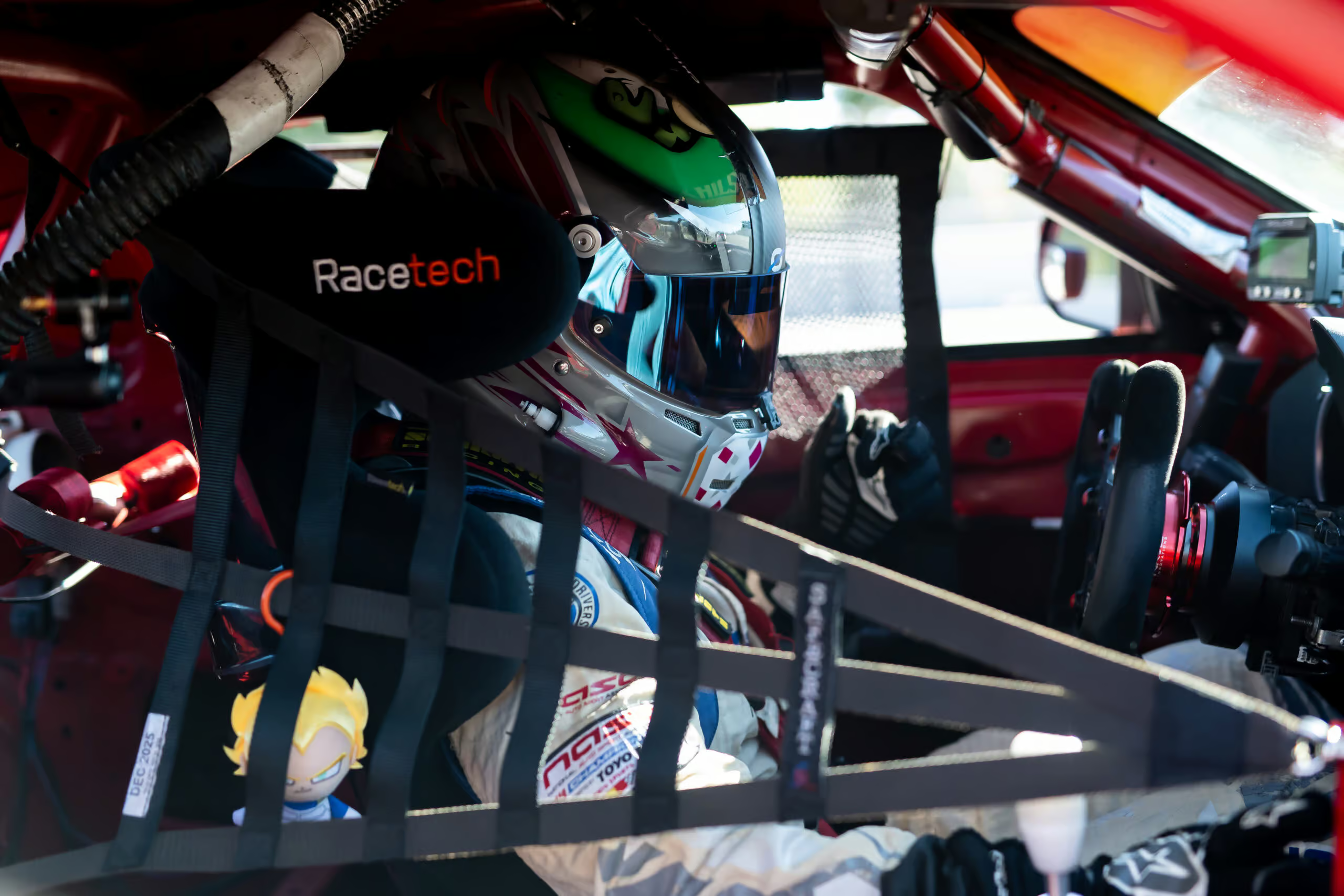
Gama strapped into the #109 cockpit
Strapped in and ready. The office for the week.

Friday: one shot

Friday morning was it. Our first and last real chance to qualify. Around 9 o’clock, dry track, sticker tires on, best possible shot.

First flying lap: okay. Not great, but okay. Second lap: time’s coming down, tires are coming in, but not fast enough. Third lap: I put down something like a 1:31.8, and man, I was risking stuff to get that. It didn’t feel like enough. We should have been faster.

I came around for another lap and watched the predictive timer start going the wrong way. Slower and slower. Part of it was losing the draft I’d had on the fast lap, but going through the handling sections I was losing time in every single braking zone. Something was off.

Maybe I’d overheated the tires? We’d run pressures a little higher than normal to get them to come in faster. So I pitted, Jordan checked the pressures and let them down, and I went back out for another attack.

Didn’t even need to complete the lap. I could feel it immediately. The tires were cooked. Late in corner exit, almost to full straight on the steering wheel, using all the exit curb, and I’m still counter-steering because the rear just won’t hold. Specifically the left rear, on all the right-hand corners. It kept giving up.

I’m on the radio to Tyler going, I don’t understand why the left rear feels like it’s giving up, it’s 60 degrees out and we’ve done four or five laps, this doesn’t add up. Tyler went over and hand-checked the tires. His words: holy crap, this thing is on fire. Compared to the others, something was definitely wrong. We were still just overheating tires.

After qualifying, standing there in impound, one thing was clear: we were near maxed out in our current development direction. Don’t get me wrong — 2:31s at Road America is fast. Just not fast enough. Not for this field.

We needed to explore a fundamentally different approach. So overnight, we changed everything we could with what we had: tire pressures, shock damping, sway bars. Jordan put the car back on the setup pad and made sure the setup was exactly as we wanted it from the setup sheet.

Tyler and Jordan both told me later they slept like crap that night. Just lying there second-guessing every change. Were we about to ruin a good car? We had no idea if any of it would work.

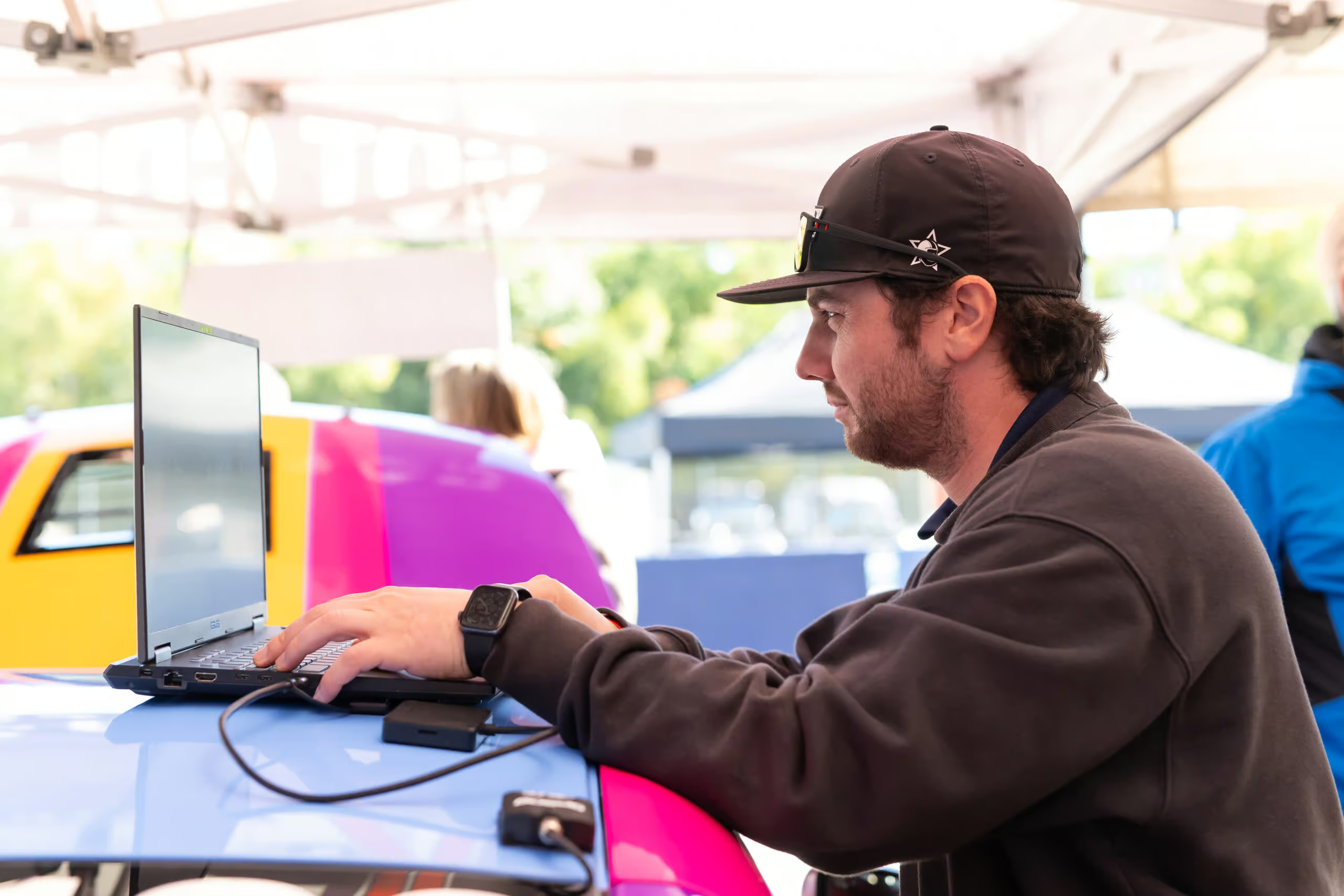
Crew working through data on a laptop in the paddock
The engineering never stops. Data, changes, second-guessing, repeat.

The race

Race morning. Formation lap. And I could tell immediately. Even on pre-grid, the car was driving straight. Felt planted. Felt confident. Warming up the tires on the formation lap, cleaning them off, and the thing was just carving. Beautiful.

I got a really good start, but then got bottled up behind a GR86. No room on the right for the inside, checked left, nothing there either. Probably cost me a couple positions before Turn 1, but I wasn’t going to force contact. Not on lap one. Not at the Runoffs.

My mindset was simple. I didn’t think I had anything for Hammann or White based on their pace. But John LoGiudice, who I’d raced hard and clean with before? I should be able to give John a run for his money. Get to P3, and I’d be thrilled. So: get through the first couple laps clean, work through the field, get to John, and then… whatever happens, happens.

And the car was amazing. After the first lap or so, every lap just kept coming down. Faster, faster, faster. The car was responding to me, and it kept getting better as the fuel burned off and I found the new limits. I was right on John’s bumper after a few laps from the start, in his draft, pressuring him for that last podium spot. Five laps of it. Exactly where I wanted to be.

Then came lap 6. Going into Turn 1, he didn’t protect. I’m right on him through 2 and 3. Coming up to Turn 5, he starts moving left to cover the inside, and I’m thinking: perfect. I’ll go right. Set up wide, and I’ve got options. Maybe an over-under into 6. At minimum, a mega run out of 5 and I’ll be on his bumper all the way through the kink, and I can get him at Canada Corner. Or worst case, next lap at Turn 5. My kind of corners were coming. The carousel, the kink, that’s where I pull away from people.

I set up wider than normal going in. About 8 feet wider than usual, according to the data later. Fifth gear, on the brakes, everything’s good. Down to fourth, still on the brakes, and then I feel the right-side tires touch the curb on the right. While I’m still in the first phase of braking.

And they locked up.

I can only describe what happened next as this horrible cocktail of your heart dropping, fear, disbelief, and sadness, all at the exact same time. Like, what’s happening!?!?!?!?!? No. No no no!!!

John’s car is right there in front of me. I don’t want to hit him, so I move a little more right. Now I’m on the dusty concrete on the outside of the curb. I think I scraped the wall a little. The car’s slowing, I’m trying to turn it, and then the grass is just there in front of me.

Dewy grass. It had rained the day before, overnight dew, and the moment the tires touched it, it was game over. Straight into the tire wall. Honestly the impact wasn’t that bad. I drove the car out of it. But something broke in the steering. We lost all the steering fluid, no power steering, and the car went into limp mode. Wouldn’t go more than 5 mph.

Lap 6. Done. Five laps completed, running P4 the whole way, and the official results list me as DNF, handing fourth to Piekarczyk.

I limped it back to the paddock. Got there before the race was even over. Sat there and watched the end on the screens. And what an end it was: Hammann and White dueling to the final lap, contact at Turn 14, Hammann in the wall under the bridge, White first across the line but relegated to last after the stewards’ review. John, the rookie, the winner. A 37-second margin of victory that tells you everything about how chaotic those last laps were.

Panning shot of the #109 at speed at Road America
Before Turn 5. The car was the best it’s ever been.

The feeling

I wasn’t angry. I was just sad.

I sat there in the car and cried. Later I cried with John too. He’d just won the whole thing, his first Runoffs win, after all kinds of last-lap drama. And I was genuinely so happy for and with him. We’d battled so hard and so clean over the years. There’s nobody I’d rather share a track with.

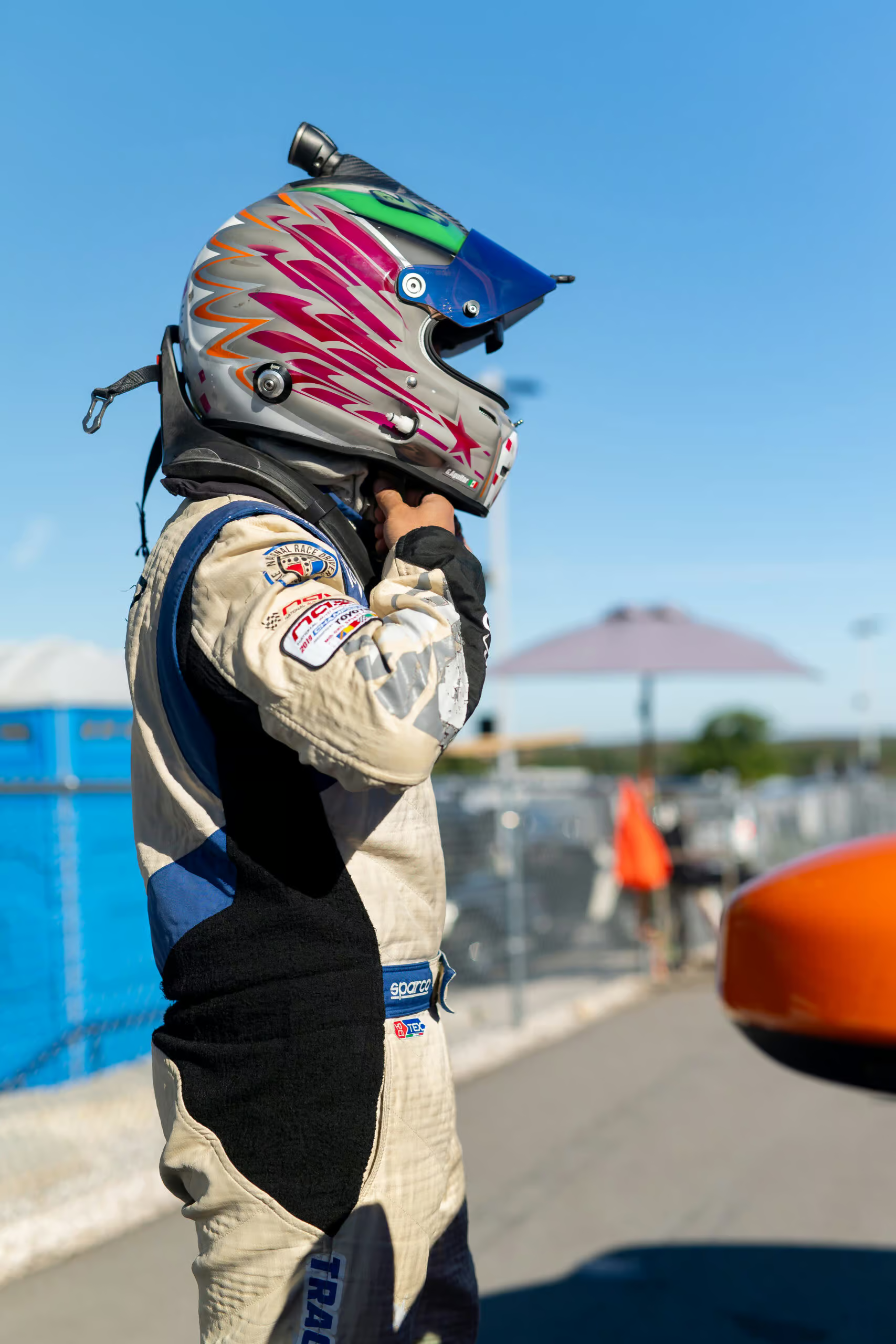
Gama in helmet and race suit at Road America
Not the hardware we came for. The heart’s still full.

The crew

None of this happens without the people, and I need to say that properly.

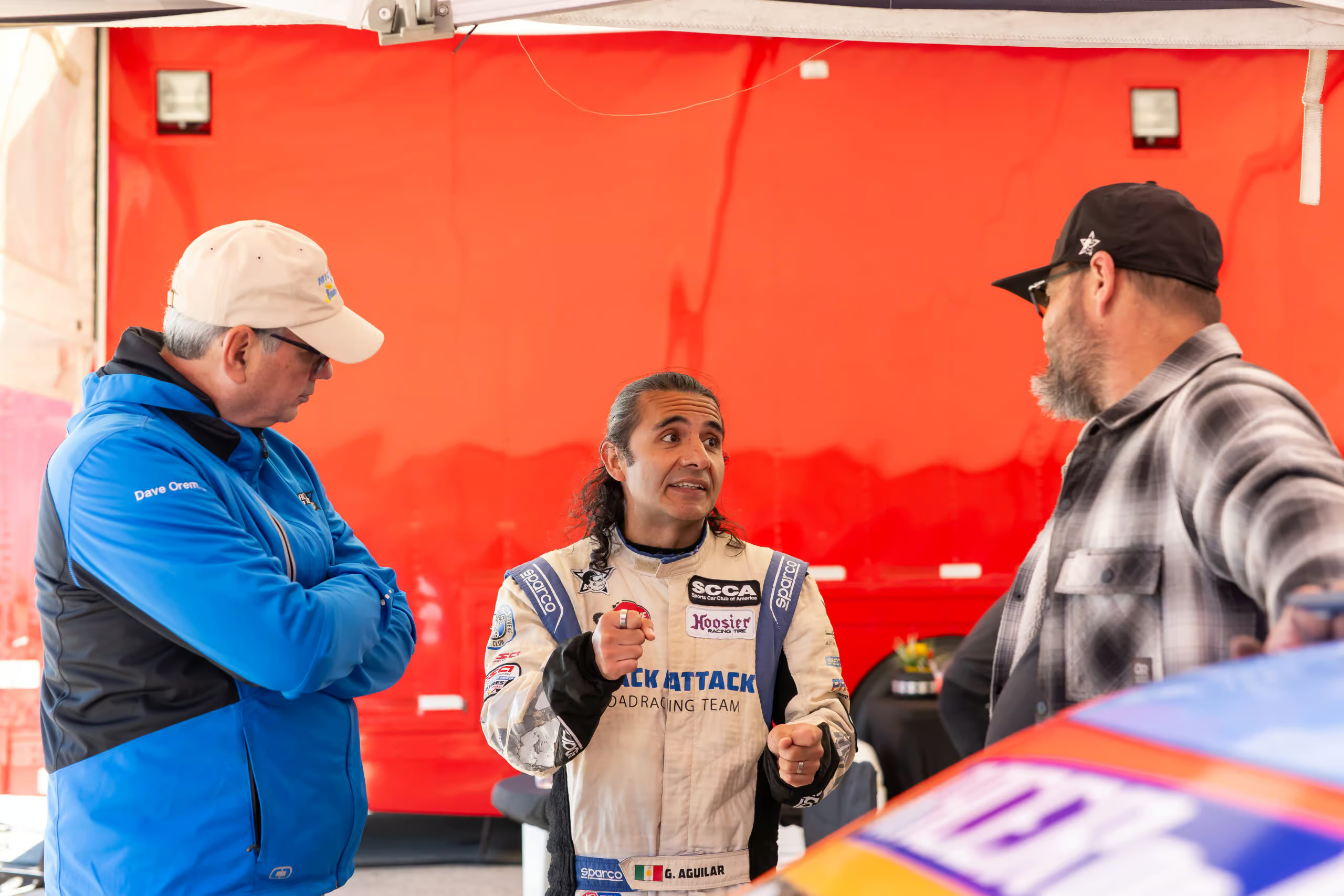
Jordan and Tyler. These two basically lived at the setup pad all week, second-guessing themselves at 2 AM, then showing up and nailing it anyway. The overnight compliance changes, the toe fix, the steering wheel, all of it. They never stopped working the problem.

Jack Doherty came out with us to learn wrenching on the 370Z, and the kid was genuinely helpful. Extra hands, good attitude, soaked up everything. That’s what this is supposed to be about.

Jordan and Jack in front of the #109
Jordan and Jack in front of the #109.

Scotty B White’s crew gave us their whole weekend. Marshall Mast, Rob Scholl, Todd. Having that operation around us made the whole week better.

And I need to stop here and talk about Rob and Christine Scholl properly, because they were a huge part of why this trip worked.

Rob is a retired police officer who got into the racing world several years ago. He was actually our first commercial truck driver at Racer on Rails. Then he started doing commercial transport driving in racing, and got the opportunity to work with Scotty B White. And look, I would never stand in the way of someone’s economic opportunity, so off he went. He’s been working with Scotty for the last couple years now.

This week, the transport operation was excellent largely because Rob was the one running it. I could trust the entire operation because I knew Rob was handling it. That’s what trust looks like after years of working together. You just know. Honestly, Rob and Christine were critical to the whole week being as positive as it was — working alongside Scotty’s team with people you trust in the middle of it changes everything.

And Christine? Christine is an absolute gem and a joy. Always. She’s there helping with the transport stuff, but also the hospitality, the cooking, the project management, keeping everything and everyone together. And she took amazing pictures for us all weekend long. The woman does it all, and she does it smiling.

Christine Scholl photographing the paddock
Christine doing what she does — capturing the weekend.

I got to do the Runoffs with them because of Rob and Christine. I don’t take that lightly. So grateful.

David Orem came out just to watch and hang out. Didn’t have to. That’s family.

And Ann Doherty came out too, not even racing this year, and brought her son Jack for the experience. Watching a kid fall in love with the work, the engineering, the craft of it? That’s the good stuff.

Gama, Jack and Tyler selfie under the Knight Transport tent
The crew — Gama, Jack and Tyler under the Knight tent.
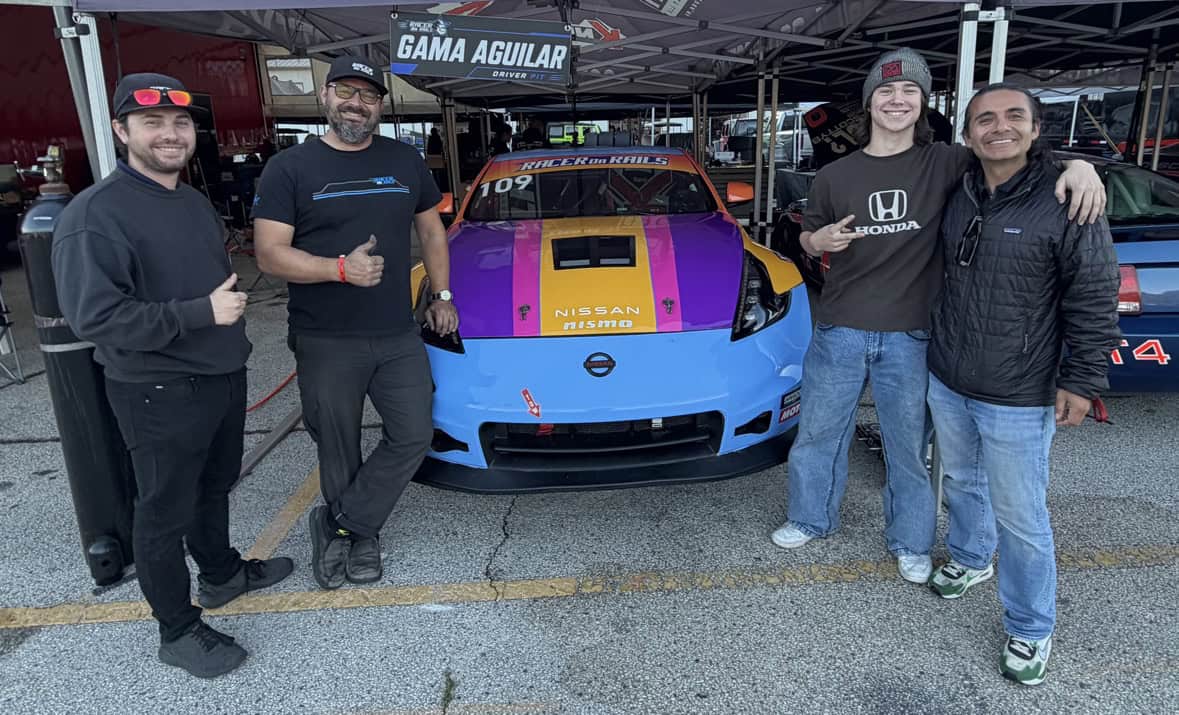
The RoR team gathered around the #109
The team around the car. This is the whole thing, right here.
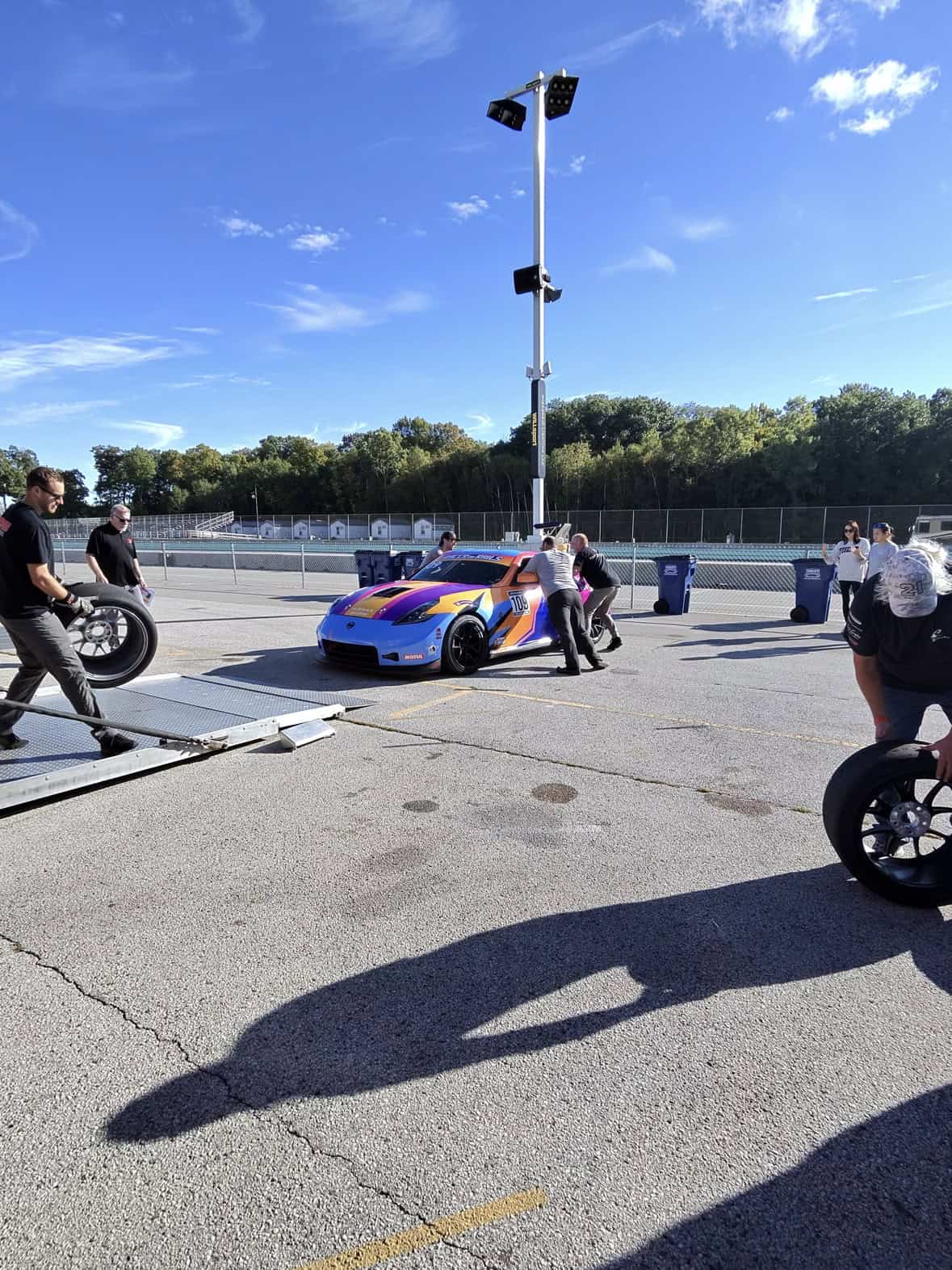
Marshall Mast, Rob Scholl and Todd unloading the #109 370Z at Road America
The operation behind the operation — Marshall, Rob, and Todd getting the car unloaded.

What it meant

Here’s what I keep coming back to. I’m super bummed about the result. Of course I am. In some other universe there’s a timeline where I don’t hit that curb, I get past John, things shake out, and I’m standing on the top step of a national championship.

But that’s not how I think about things.

That trip was incredibly successful and necessary. We were never going to win at this level without learning what we learned. The compliance breakthrough, the tire program, the roll center work, understanding what a truly national-level setup looks like when you see it sitting in impound next to you. You don’t learn that from a forum. You learn it by getting your butt kicked by the best and being humble enough to look at their car and go… oh. Oh.

This sport is about trophies, sure. But the Runoffs aren’t just about us. It’s where all the fastest drivers in the country end up in the same place. I got to catch up with Ryon from the 4048 Racing team. Ryland Hazelton came over from California with his cars. Will Bolt was paddocked with us, great getting to know him and his team, and he drove a hell of a race to P2 in T2 right behind Scotty. Robert Wellington, our “Beef Wellington,” was there racing up and down the East Coast all year in the Racer on Rails-backed M235iR. His race ended before it really started, car’s hurt but he’s fine, and we got to be there for him. And Asad, car 144, a local kid we’ve worked with on sim training and real-world coaching, was out there in Spec Racer Ford running third when a racing incident ended his day. That’s racing. Proud of him for being there. Scotty went out and won T2. Not second. Won. Pole, led all 13 laps, new track record. After everything that happened in the T3 race, he put his head down and drove the wheels off that Mustang. I was genuinely happy for him. Jason Fiorito, who owns Pacific Raceways, was out there in his wild GT1 car and finished second as well. And Michael McAleenan, a friend of the show who was paddocked with us, was running the Lowe Group Racing Lamborghini Huracan in GT1 and had a podium in his hands until the fuel ran short in the closing laps. Gutting. He deserved that spot.

Our partners showed up too. The SCCA national staff who put these events on. The Hoosier Midwest folks who keep us in tires. Mike and Greg from Carbotech, our brake pad people out of North Carolina. This whole paddock is a community, and getting to be in the middle of it for a week is a privilege.

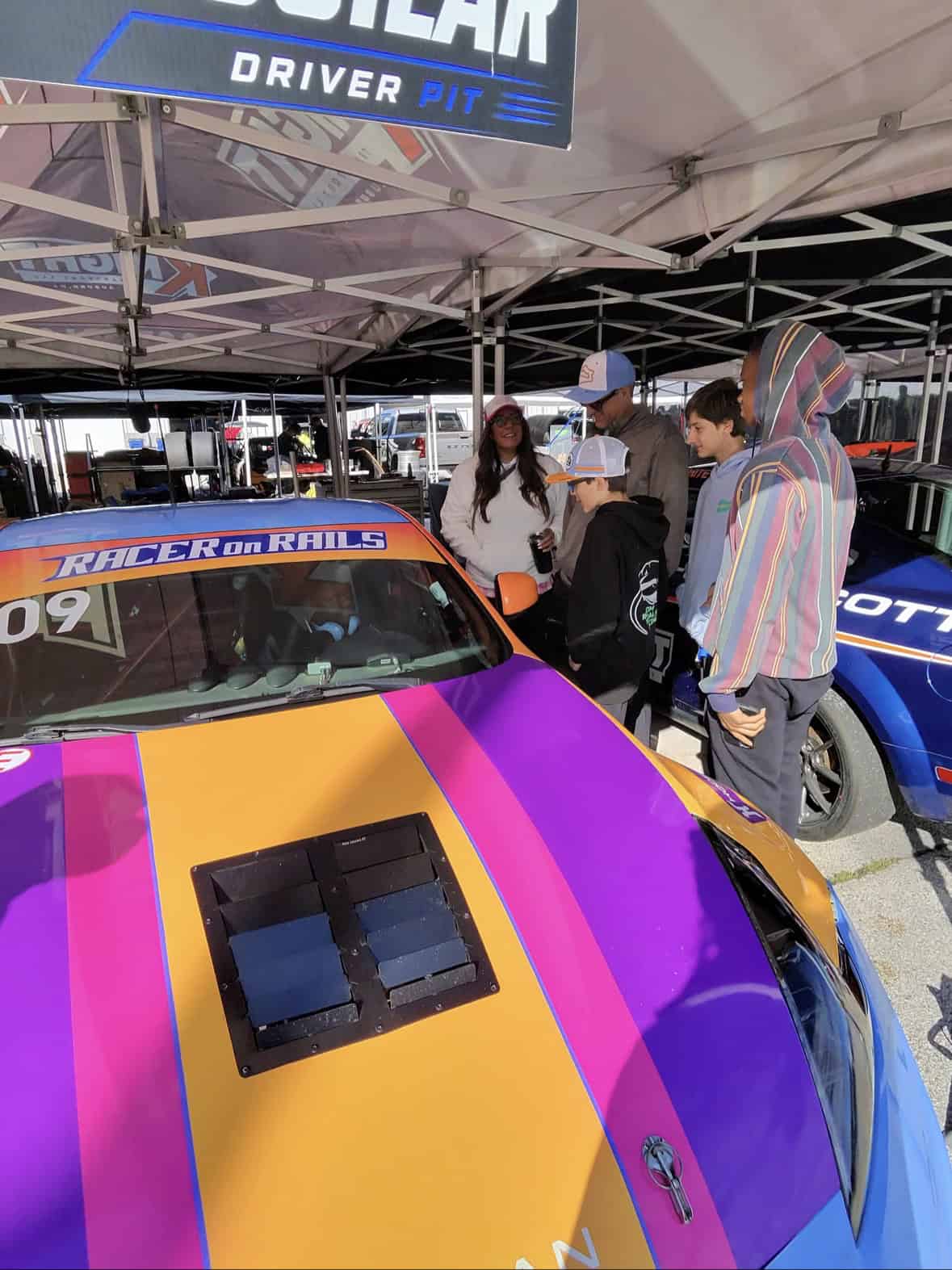
Fans checking out the #109 in the paddock after the race
They didn’t care we DNF’ed — they just loved the car and the racing.
Candid of Gama with the crew at Road America
Full heart. That’s the whole report, really.

What’s next

We go again.
2027 is already taking shape in my head. Road Atlanta, twice. The Super Tour in March, which feels like a homecoming for the Cayman program, and then the Runoffs back at Road Atlanta in October. One track, three programs — the 370Z’s T3 podium chase, our GT3 Cup customers, and the Spec E46 Silver Bullet — and a full season to build toward it.

The 370Z is the best it’s ever been. We finally understand what it wants. And now we know what the next level looks like, because we saw it in impound with our own eyes.

Different cars. Different goals. Same stopwatch. We’ll be ready.

Mega thanks to Jordan, Tyler, and Jack. To Scotty and his whole crew. To everyone who came out, everyone who helped, everyone who believes in what we’re building here.

Goals. Smiles. Memories. Let’s go!!!

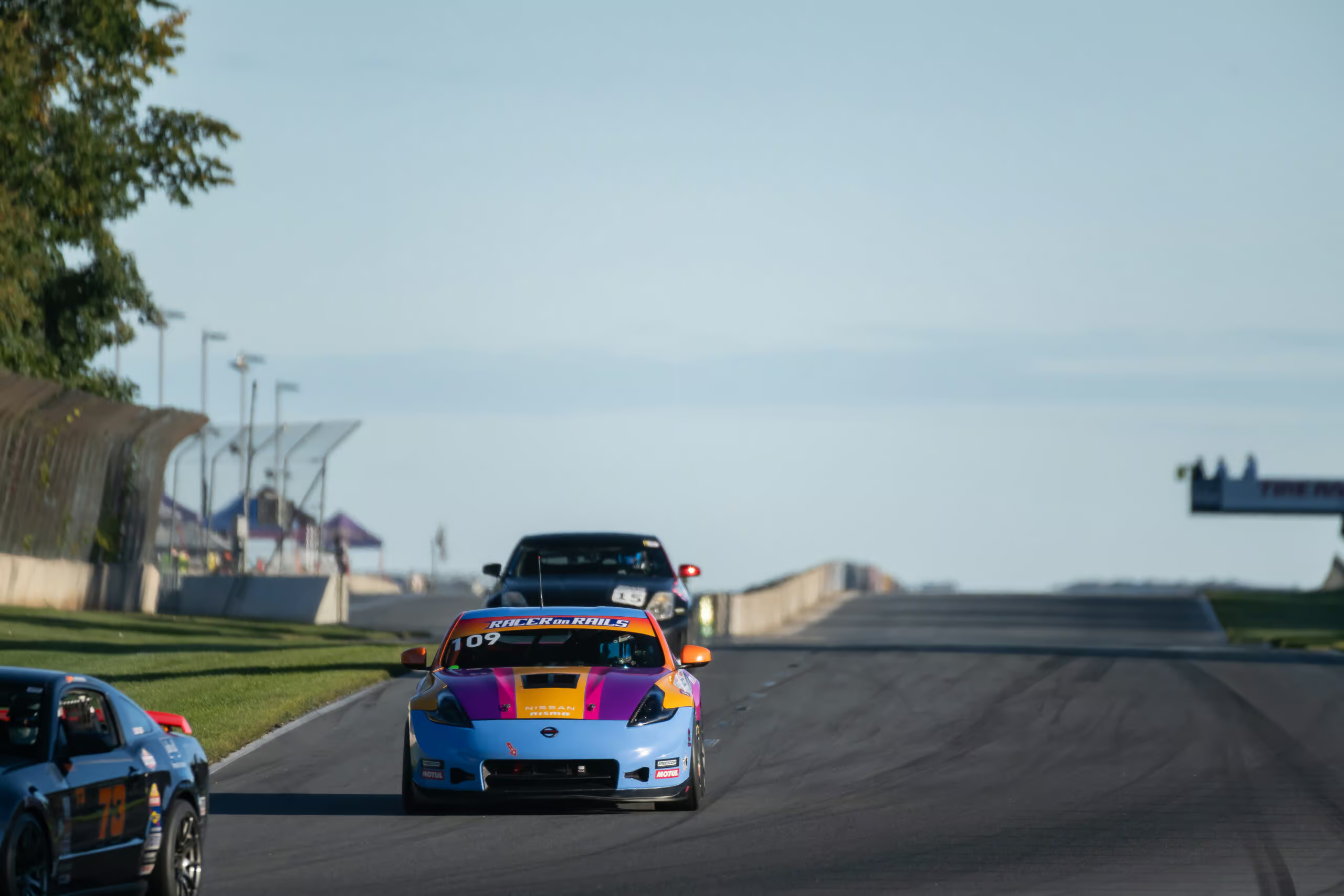
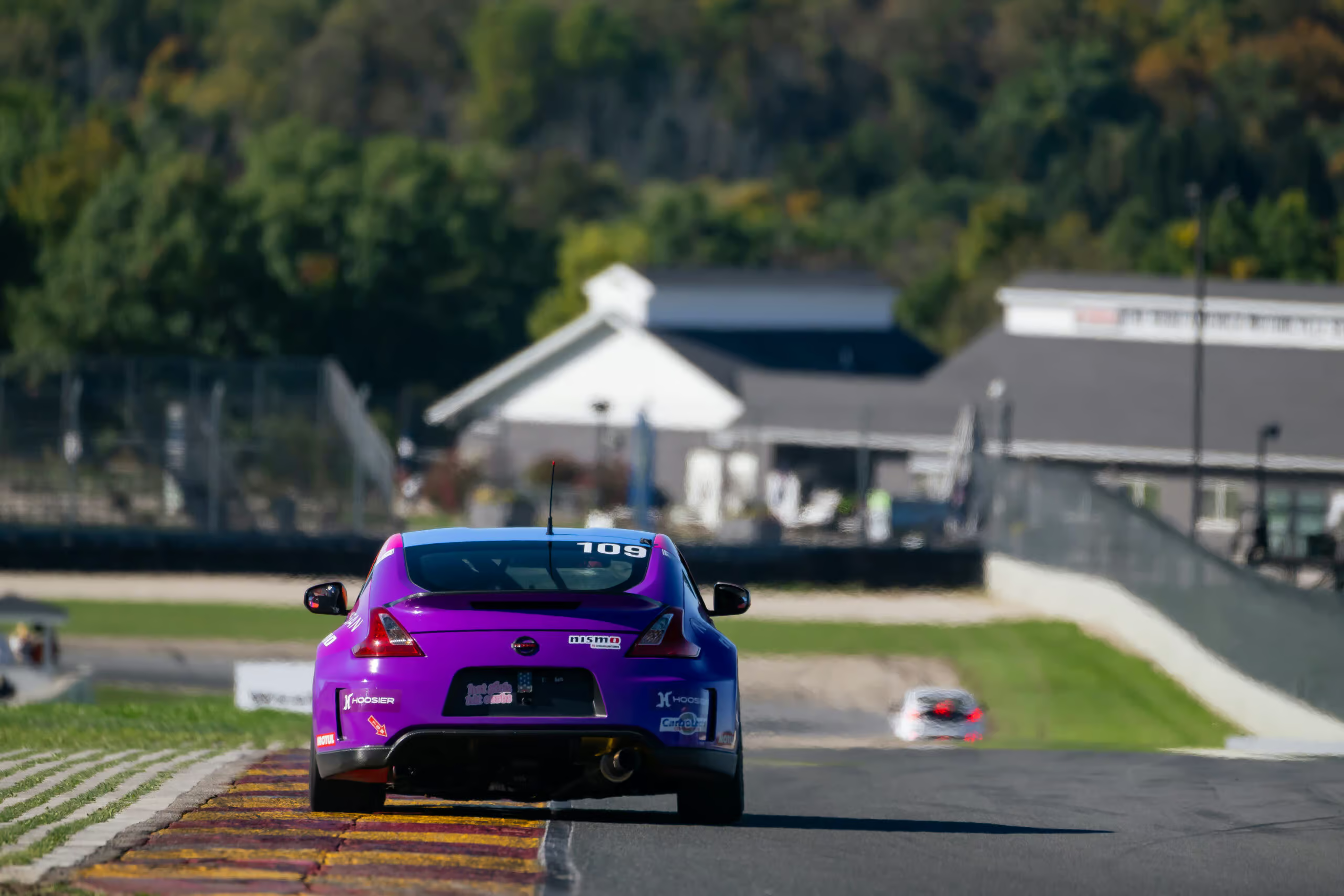
Rear chase view of the #109 on track at Road America
Chasing. Always chasing. See you in 2027.
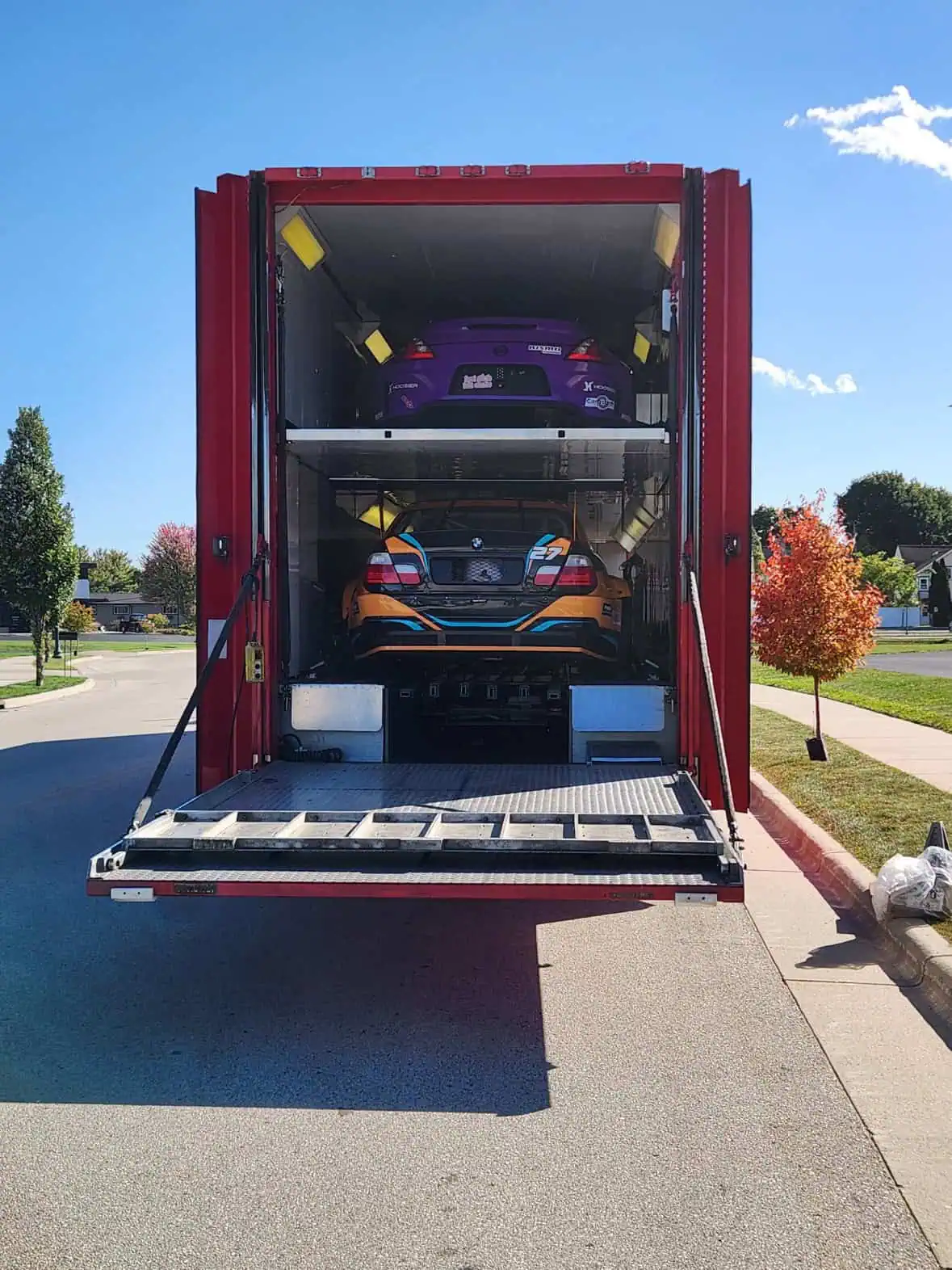
The #109 370Z loaded in the Knight Transport trailer heading home
Loaded up and heading home.
Posted on

Two Porsche’s, One Mission – Introducing the Racer on Rails Showroom Series – October 2026

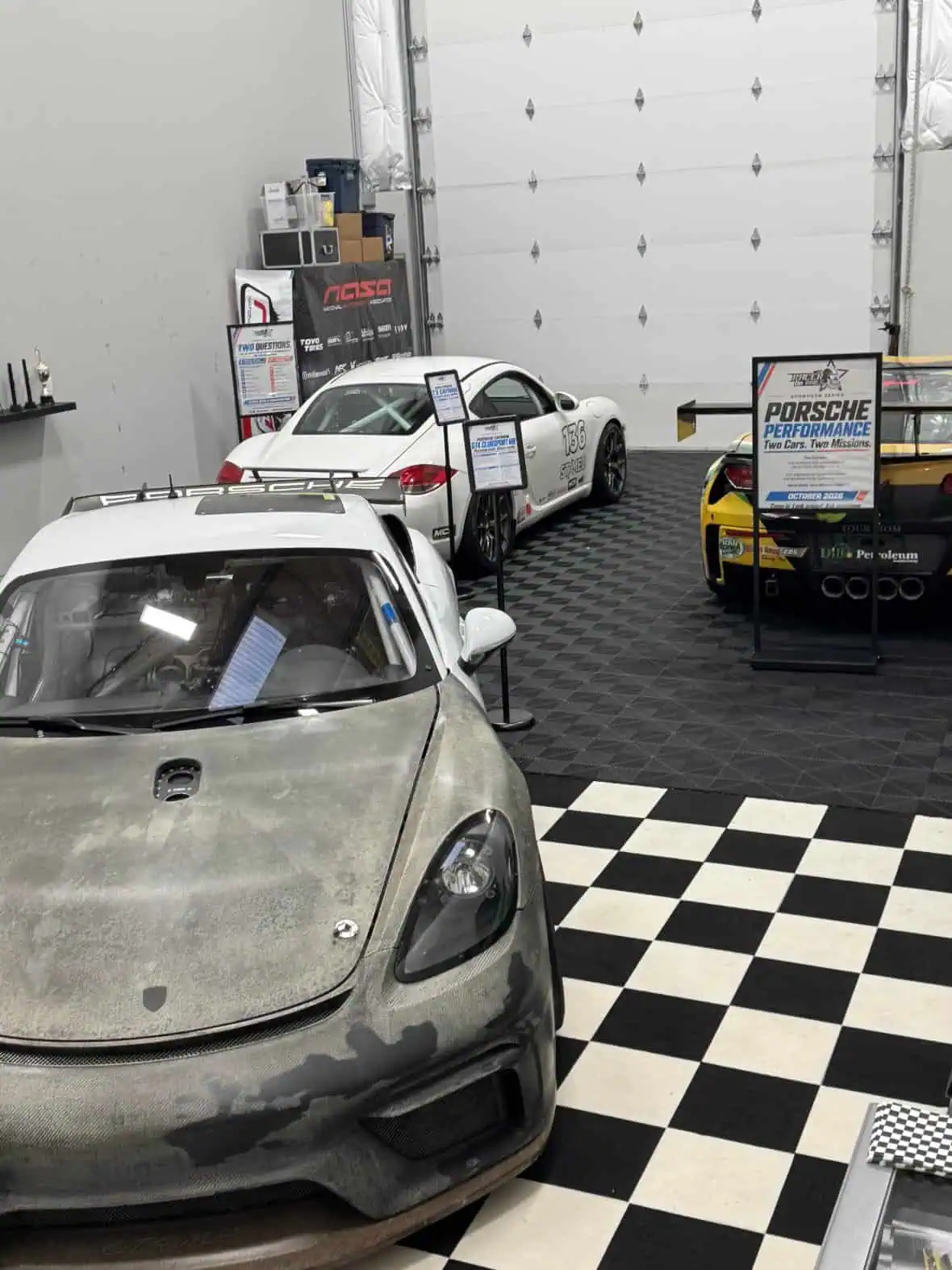
Porsche Cayman GT4 Clubsport MR and Dirk's #136 T3 Cayman side by side in the Racer on Rails showroom

Two Caymans. Same manufacturer. Very different briefs.

For October, we’re kicking off the Racer on Rails Showroom Series with Dirk’s SCCA Touring 3 2010 Porsche Cayman Base and our Porsche Cayman GT4 Clubsport MR. Park them next to each other and the family resemblance is obvious. Spend a little more time with them and the differences become much more interesting.

One started life as a production Porsche and has been developed into a serious competition car within the boundaries of a rule set. The other also traces its roots back to a production Cayman, but Porsche Motorsport and Manthey Racing take that architecture through a much more radical transformation.

Neither approach is inherently better. They simply solve different problems.

Before getting into those differences, though, there are two useful questions to answer: why Porsche, and why are we putting these cars in a showroom in the first place?

Introducing the RoR Showroom Series

We have a lot of interesting cars move through Racer on Rails. Some are ours, some belong to customers, and some exist as part of larger driver-development and competition programs. Too often, though, the cars come into the shop, get worked on, go racing, and disappear again without creating much opportunity for people outside the immediate program to see them closely or understand why they were built the way they were.

The RoR Showroom Series is our attempt to change that. Each month, we’ll feature a couple of interesting cars in our Bay 114 showroom and use them as the starting point for stories, technical deep dives, conversations and community events.

The goal is not to turn the shop into a museum. It is to make the cars, the thinking behind them and the pathways into motorsport easier to access.

We want someone walking through the door to be able to look at a car and ask, “Why did you do that?” We want another person to ask, “How would I get into something like this?” And we want somebody else to tell us, “My car does this weird thing under braking. Can you help me understand it?”

October’s theme is Porsche Performance, and these two Caymans give us a particularly good place to start.

October's Porsche Performance edition of the RoR Showroom Series puts two very different Caymans side by side.
October’s Porsche Performance edition of the RoR Showroom Series puts two very different Caymans side by side.

Why Porsche?

There is a reason Porsche occupies such an outsized place in enthusiast and motorsport culture. The company has spent generations building road cars and competition cars alongside one another, and you can feel that relationship in the products. The steering, braking, chassis, controls and packaging tend to feel like parts of the same idea rather than a collection of impressive specifications.

For me, admitting that took a little resistance.

The first time I was handed a glass of Dom Pérignon (fancy champagne), I remember hoping I wouldn’t like it. If it tasted more or less like everything else, I could confidently walk away thinking, See? I knew it wasn’t worth all that money.

Unfortunately, it was wonderful. It felt like pouring gold silk across my tongue and down my throat. Dang it!

I had almost exactly the same experience the first time I really drove a Porsche. I wanted to discover that some of the mythology was just mythology. That would have been much cheaper.

Instead, I found myself thinking, Dang it. They really are that good.

Everything seemed considered and correctly packaged, but the thing that struck me most was how directly the car responded to what I asked of it. The steering in particular changed my frame of reference. Turn the wheel in a Cayman and the car just carves.

The Porsche that really drove that lesson home for me was actually Dirk’s Cayman, before it became the T3 race car sitting in our showroom today. Driving it helped me recognize something I had spent years accepting as normal in the front-engine, rear-wheel-drive cars we love, particularly BMWs: that inherent tendency toward understeer was suddenly much easier to feel.

The Cayman wasn’t exempt from physics. It simply gave me another reference point. Once you experience another way of placing the mass, loading the tires and communicating through the steering, your internal calibration changes.

That makes Dirk’s car an especially appropriate place for us to begin this series. It helped change the way I understood cars before we ever started turning it into a race car.

Dirk's 2010 Porsche Cayman T3 race car #136 in the Racer on Rails showroom
Before becoming an SCCA T3 race car, Dirk’s Cayman was the road car that helped recalibrate how we thought about steering and chassis balance.

Porsche Gives Drivers Somewhere to Go

There is another reason Porsche matters to us beyond the quality of the cars themselves. There is an unusually deep ecosystem around actually using them.

A Porsche can be an extraordinary street car. It can become an HPDE or track-day car. It can become a production-based competition car like Dirk’s T3 Cayman. Or a driver can step into purpose-built Porsche Motorsport machinery such as a Cayman GT4 Clubsport or GT3 Cup car.

Even inside the Clubsport world, Porsche recognizes that not every serious driver needs the exact same thing.

A driver who wants to spend a lot of time at the track, drive hard and use real motorsport hardware does not necessarily need every system required for campaigning the car in a formal competition series. That is where the GT4 Clubsport Trackday concept becomes interesting.

Porsche starts with the GT4 street-car architecture and turns it into a real race-bred track machine, but some competition-specific systems can be left out if the owner is not planning to campaign the car in a series. Things like air jacks, a larger fuel cell and a fully integrated competition fire system become much more important when you are supporting pit stops, endurance operation or formal competition than they are for someone whose primary goal is serious non-competitive track use.

That gives the owner a machine built to tolerate the punishment and workload of track driving without necessarily paying for every piece of hardware required by a full race program.

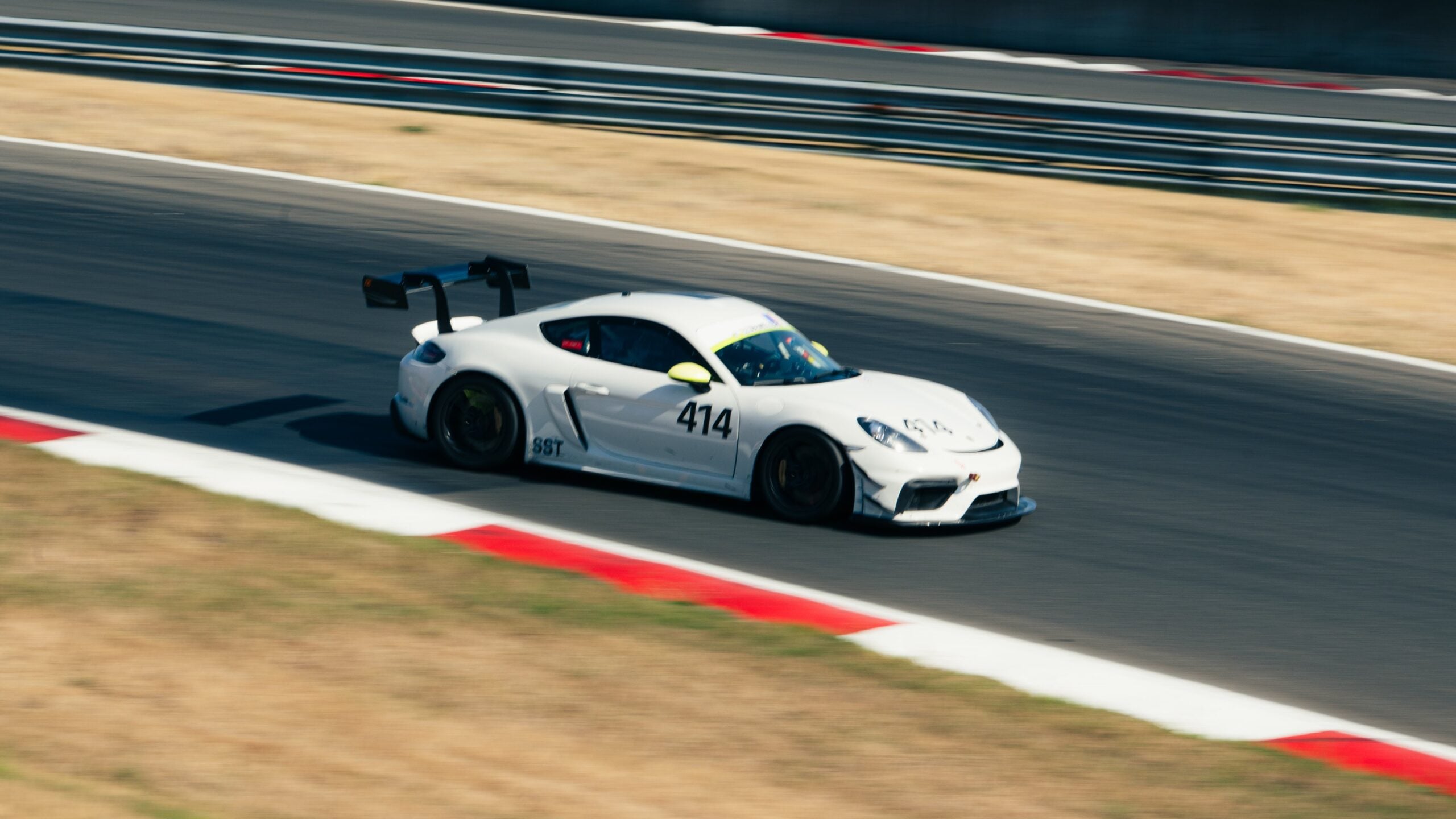
We know that version well because our previous GT4 Clubsport was the Trackday edition.

Previous GT4 Clubsport Trackday Edition #414 on track
Our previous GT4 Clubsport was the Trackday Edition, built for serious track use without every system required for a full pro-level competition program.

Our current car goes a couple more steps beyond that. It is a full GT4 Clubsport MR, equipped with the complete Manthey Racing MR package and the SRO power package. By the time you reach this level, you are no longer talking about a very serious track-day car. You are talking about machinery configured around actual GT competition.

That progression is part of what makes the Porsche ecosystem so interesting. The equipment can evolve as the mission and the driver’s goals evolve.

GT4 Clubsport MR front view with raw unpainted carbon front clip
The current car: a full GT4 Clubsport MR with the complete Manthey Racing package and SRO power package — configured around serious GT competition.

Porsche Ginetta Cup – Racing the Cars Without Destroying Them

Locally, we’re also working to help create places where owners can actually enjoy cars at the more serious end of that spectrum.

One example is the Porsche Ginetta Cup, a new racing series whose priorities line up closely with how we think motorsport should work: the racing should be competitive, but it should also be fun, sustainable and respectful of the machinery people have invested in.

A defining principle of the group is no-contact racing. These are extraordinary and expensive cars, and the point is to give their owners a place to race them without treating body contact as an unavoidable cost of participation.

The group’s approach is intentionally simple. If contact happens, the drivers involved are black-flagged from the session. The emphasis is not on turning every incident into a courtroom argument about fault. The emphasis is on creating a culture in which avoiding contact is everybody’s responsibility.

That changes the character of the racing. You can compete, develop as a driver and enjoy real wheel-to-wheel action while understanding that respecting the other driver and their equipment is part of the job.

For us, that connects directly to the larger Racer on Rails goal of helping people get the right return on their motorsport investment, both in money and in time. The objective is not simply to own interesting machinery. It is to build a program around it that lets you use it, learn from it and enjoy it.

Porsche Ginetta Cup starting grid at the inaugural race
The Porsche Ginetta Cup grid at its inaugural race — competitive, no-contact racing for serious Porsche machinery.

Start With the Mission

That brings us back to the two Caymans sitting next to each other in the showroom.

A great road car has to do a staggering number of things well. It needs to start every morning, deal with traffic, survive potholes and temperature swings, handle long drives and short trips, remain serviceable and provide some degree of comfort. Somewhere inside that enormous list of requirements, it also needs to be fun.

A race car receives a much narrower job description. Lap time, consistency, safety, durability within its operating environment, serviceability between sessions and feedback that helps the driver use the car at its limit all become dominant priorities.

That narrower mission changes nearly every engineering decision.

The fascinating part about the two Caymans in our showroom is that they reach competition from opposite directions.

The T3 Cayman: Develop What You Have

Dirk’s Cayman started as a production car, which means its development process begins with an architecture that was never designed solely around racing.

That is not necessarily a weakness. In many ways, it is what makes the project interesting.

The challenge is understanding the original platform deeply enough to know what needs to change, what should be left alone and where the rules allow meaningful development. The work becomes a series of interconnected questions. For example, how much brake capacity does the car actually need? Where are we generating heat? How does the chassis behave under braking? What does the driver feel during brake release and turn-in? How does a geometry change affect the tire several laps later? Can we solve one performance problem without creating a durability problem somewhere else?

That process is iterative. We change something, drive the car, look at data, listen to what the driver reports, inspect the car and decide what the next problem really is.

That is development. It is rarely one enormous breakthrough. More often, it is dozens of smaller decisions that gradually make the entire system work better together.

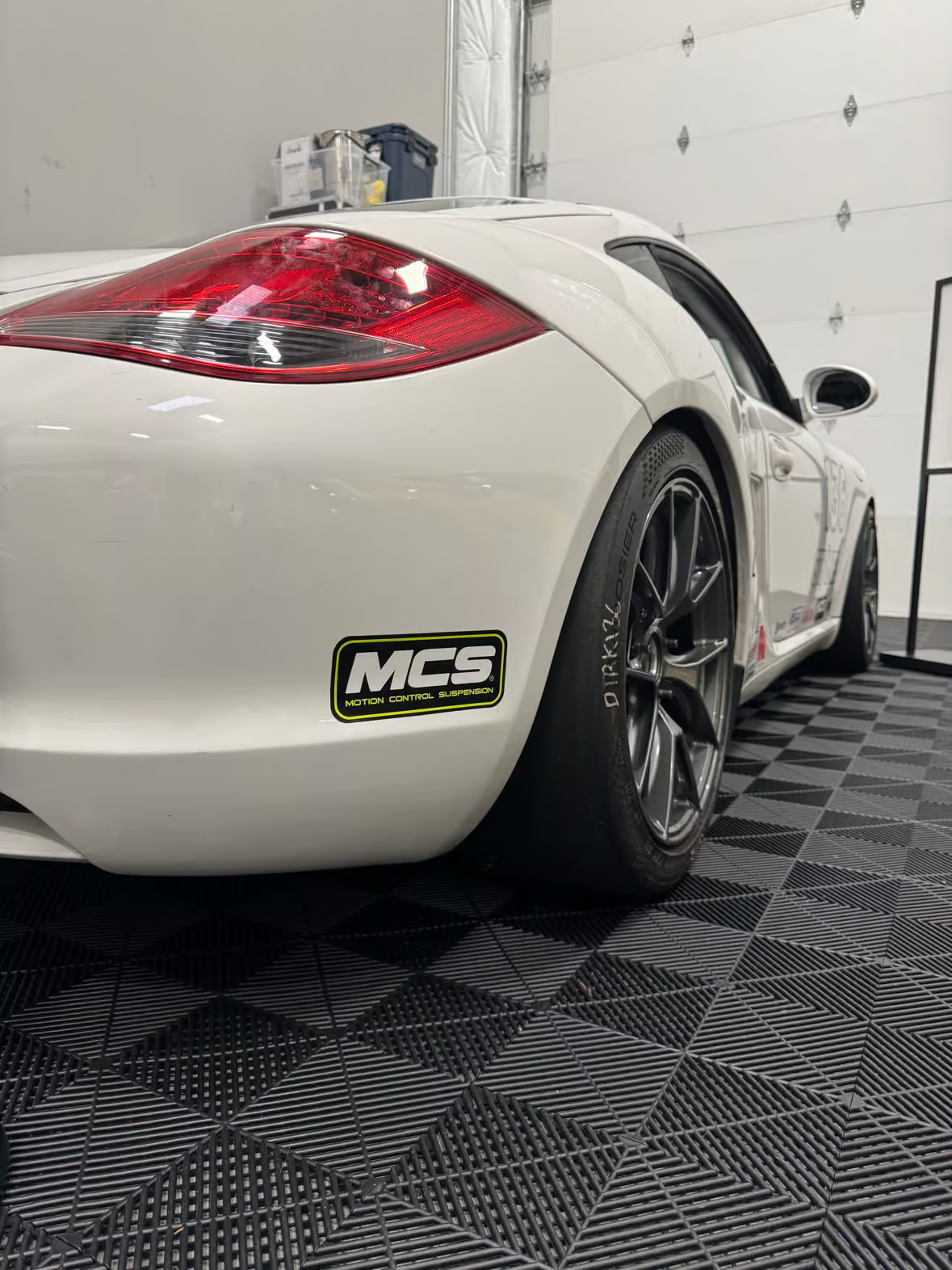
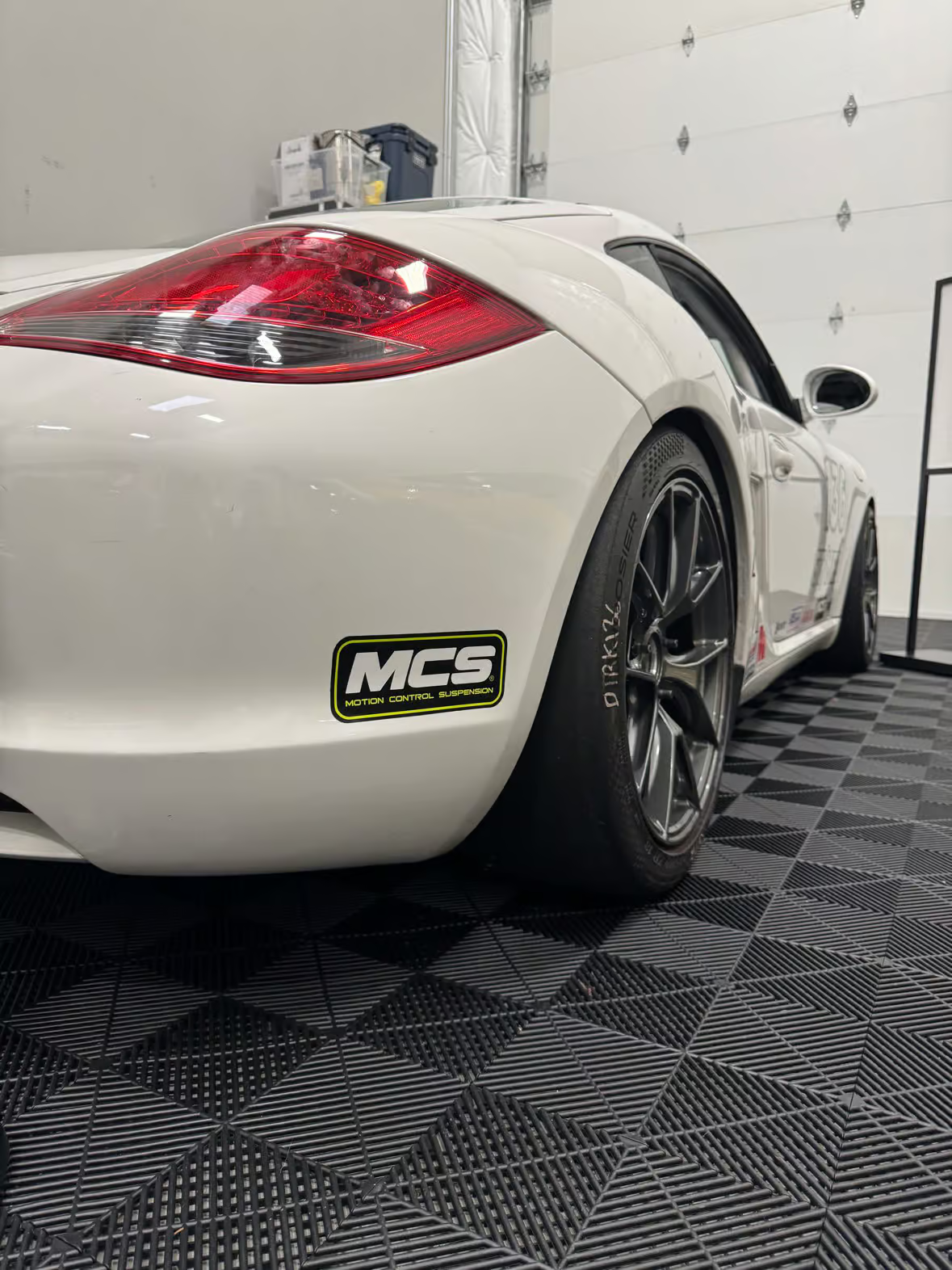
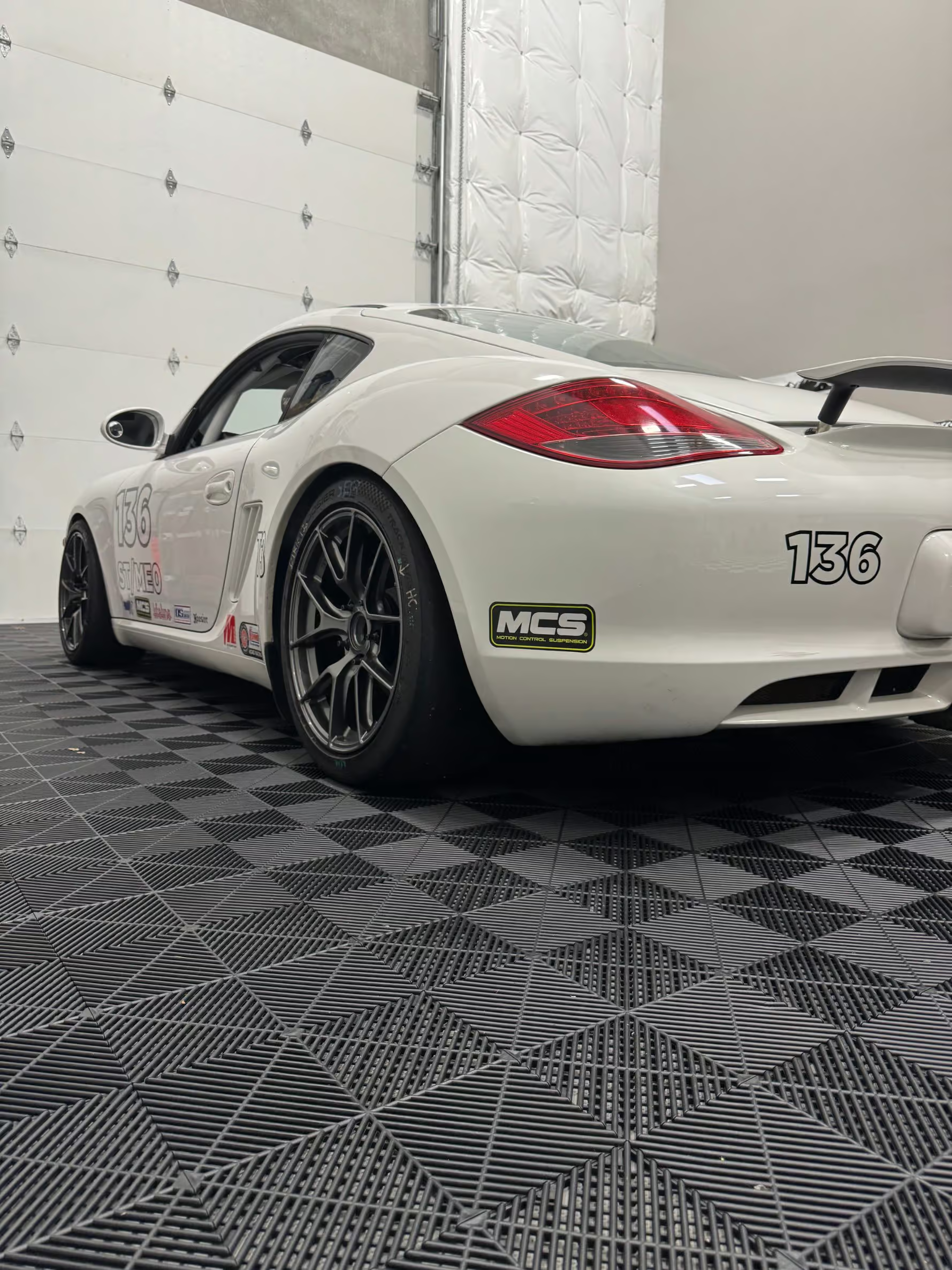
T3 Cayman rear quarter showing MCS suspension branding and race wheel
Dirk’s T3 Cayman: developed, not just modified — every change answers to a rule book and a lap timer.

The GT4 MR: Start Much Closer to the Destination

The GT4 Clubsport MR reaches the same broad world of competition from a very different starting point.

At the foundation is Porsche’s Cayman GT4 street car. Porsche Motorsport then takes that architecture and transforms it into the GT4 Clubsport, replacing the road-car mission with a much narrower motorsport brief.

The Trackday edition shows how deliberate that transformation is. It gives a serious driver most of what they need to repeatedly beat on the car at the track without requiring every piece of competition hardware necessary for a formal race program.

Our car goes beyond that. It is a full GT4 Clubsport MR with the complete MR package and SRO power package, so the mission is no longer simply sustained track use. The car is configured around serious GT competition.

By this point, the safety structure, cockpit, suspension, braking, cooling, serviceability, fuel system and other systems are being considered through the lens of motorsport rather than road-car compromise.

Purpose-built still does not mean effortless, though. A car at this level needs preparation, maintenance, setup, alignment, tire management, brake management and disciplined operating procedures. It also needs a driver capable of accessing what the chassis is offering.

The problems change. They do not disappear.

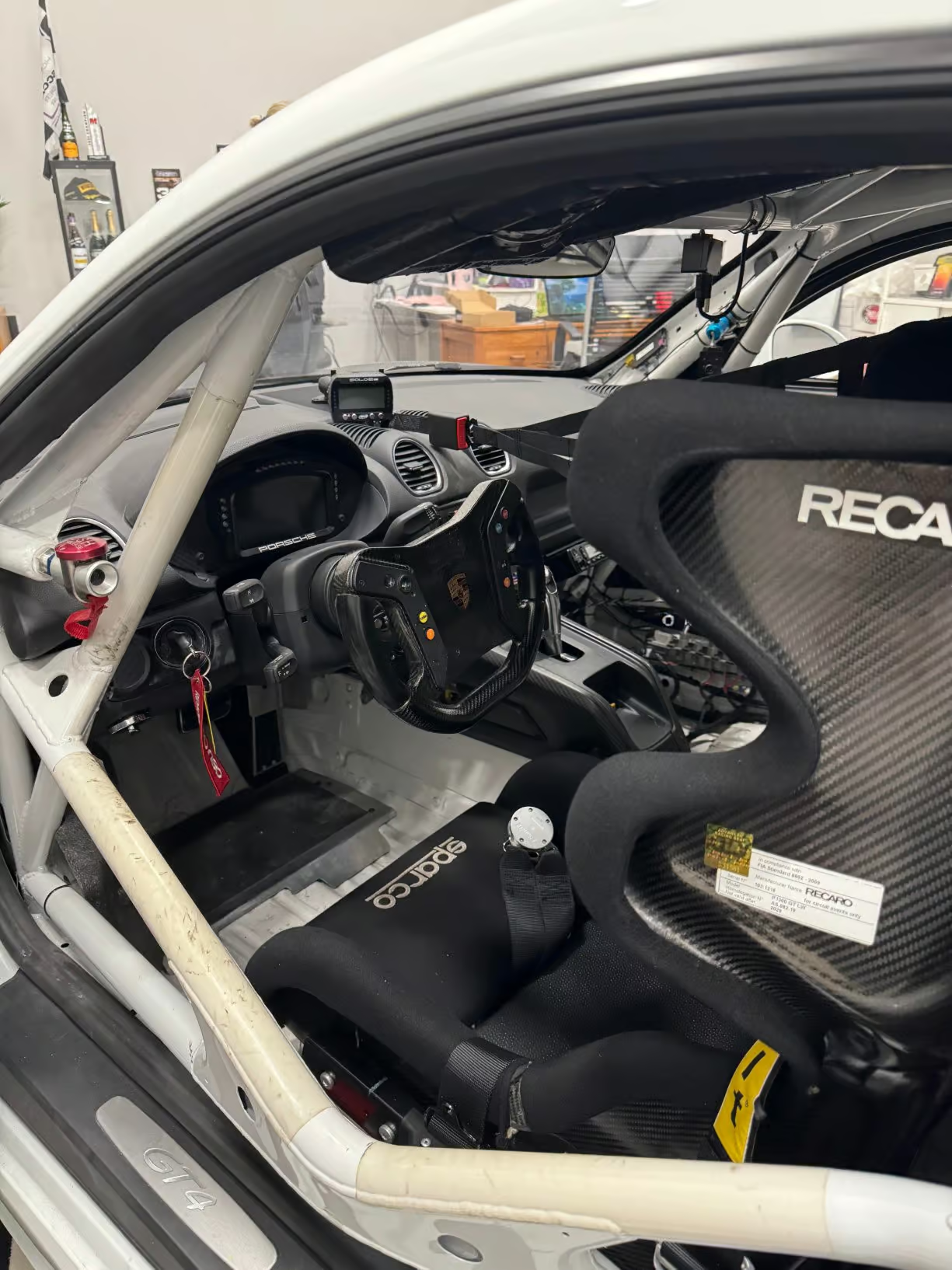
GT4 Clubsport MR cockpit with carbon steering wheel, Recaro seat and roll cage
The GT4 MR cockpit: Porsche Motorsport’s answer, starting much closer to the destination.

Two Cars, Two Different Kinds of Engineering

This is why we wanted these cars together for the first RoR Showroom Series.

The T3 Cayman asks: How far can we develop a production platform for a specific competitive mission?

The GT4 MR asks: What changes when Porsche Motorsport and Manthey Racing start much closer to the final destination?

Look at the brakes, suspension, cockpit, cooling, safety systems and serviceability. Each difference exists because somebody was solving a different problem.

And that is the lesson that matters far beyond these two Porsches.

T3 Cayman cockpit with KMP steering wheel and roll cage
GT4 Clubsport MR cockpit with PDK shifter and Schroth window net
Same mission, different starting points: the T3 cockpit and the GT4 MR cockpit.

The Same Question Applies to Your Car

Most of our drivers are not deciding between building an SCCA Touring car and buying a GT4 race car. The same thinking still applies to a street Porsche, BMW, Nissan, Toyota, Subaru, Honda, Mazda, Ford, etc….

Before choosing parts, we want to understand what bothers you about the car, what you already love about it, where you drive it, what you want to preserve and what you are willing to compromise.

Sometimes “better” means faster. Sometimes it means better brake feel or more predictable rotation. Sometimes it means correcting a car that has accumulated modifications without a coherent plan. Sometimes it means making a great sports car feel factory-fresh again.
The solution should follow the mission, not the other way around.
Throughout October, both cars will be part of the RoR Showroom Series: Porsche Performance at Bay 114 at Pacific Raceways. We’ll also publish deeper build overviews of each car and use them throughout the month to dig into the engineering decisions that separate them.

If you’re at the track and see the Showroom Open sign, come in, look around and ask questions. Want to schedule a specific time to check out the cars and make sure we’re around to chat and ask questions – shoot us an email or call.

Then tell us:

What do you want your car to do better?

And if the answer is really about you rather than the machine:

What’s your next driving goal?

Looking forward to seeing you all swing by the showroom!