Posted on

SCCA US Majors Tour – Thunderhill 2026 – The Last Stop South

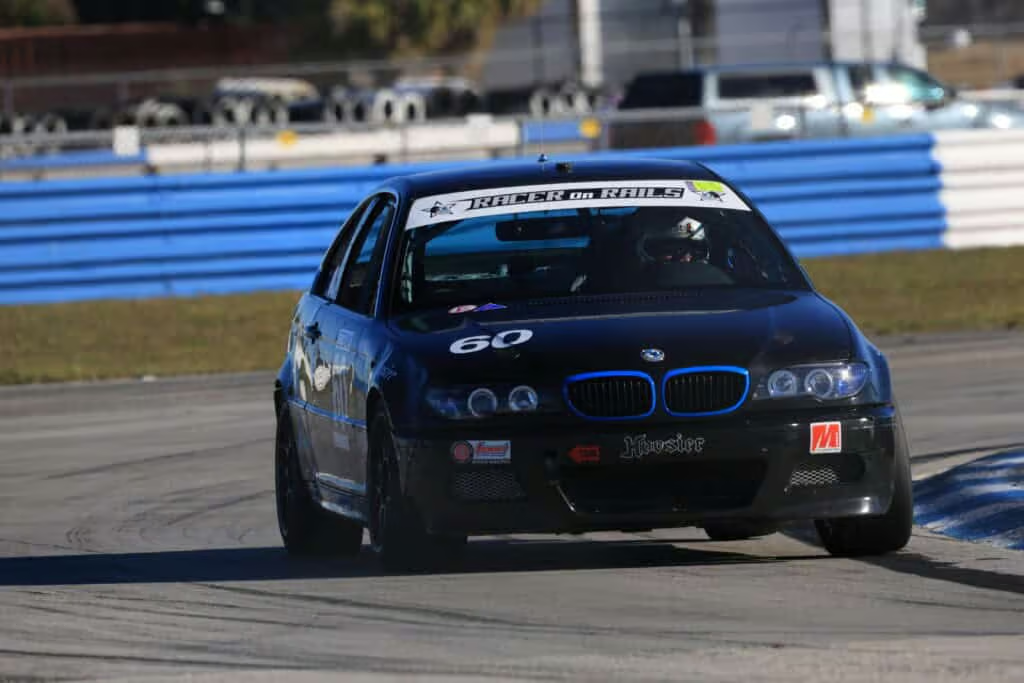
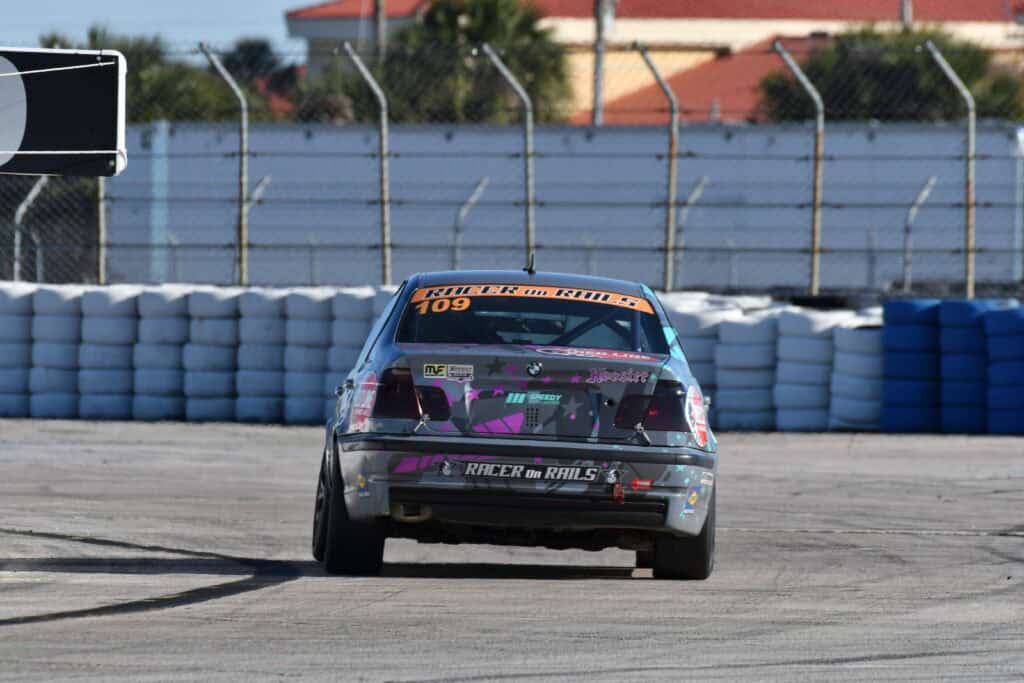
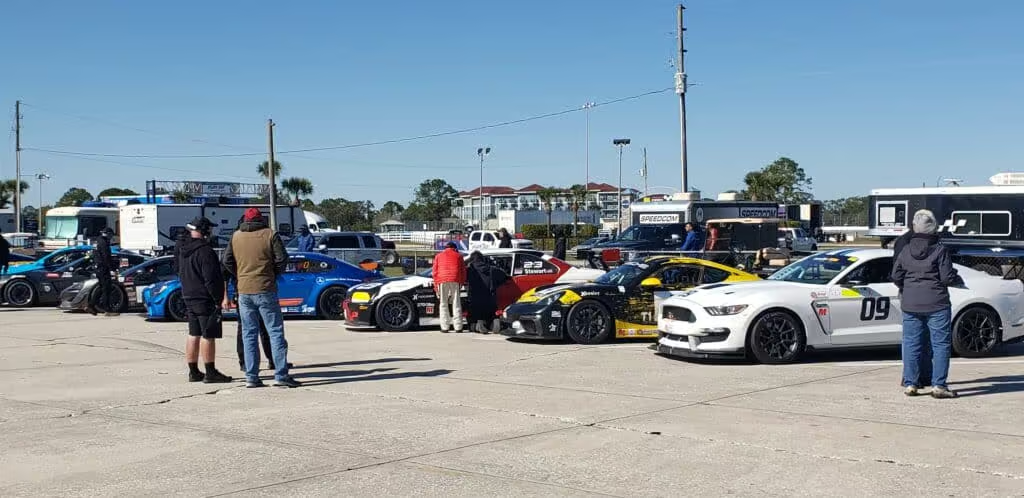
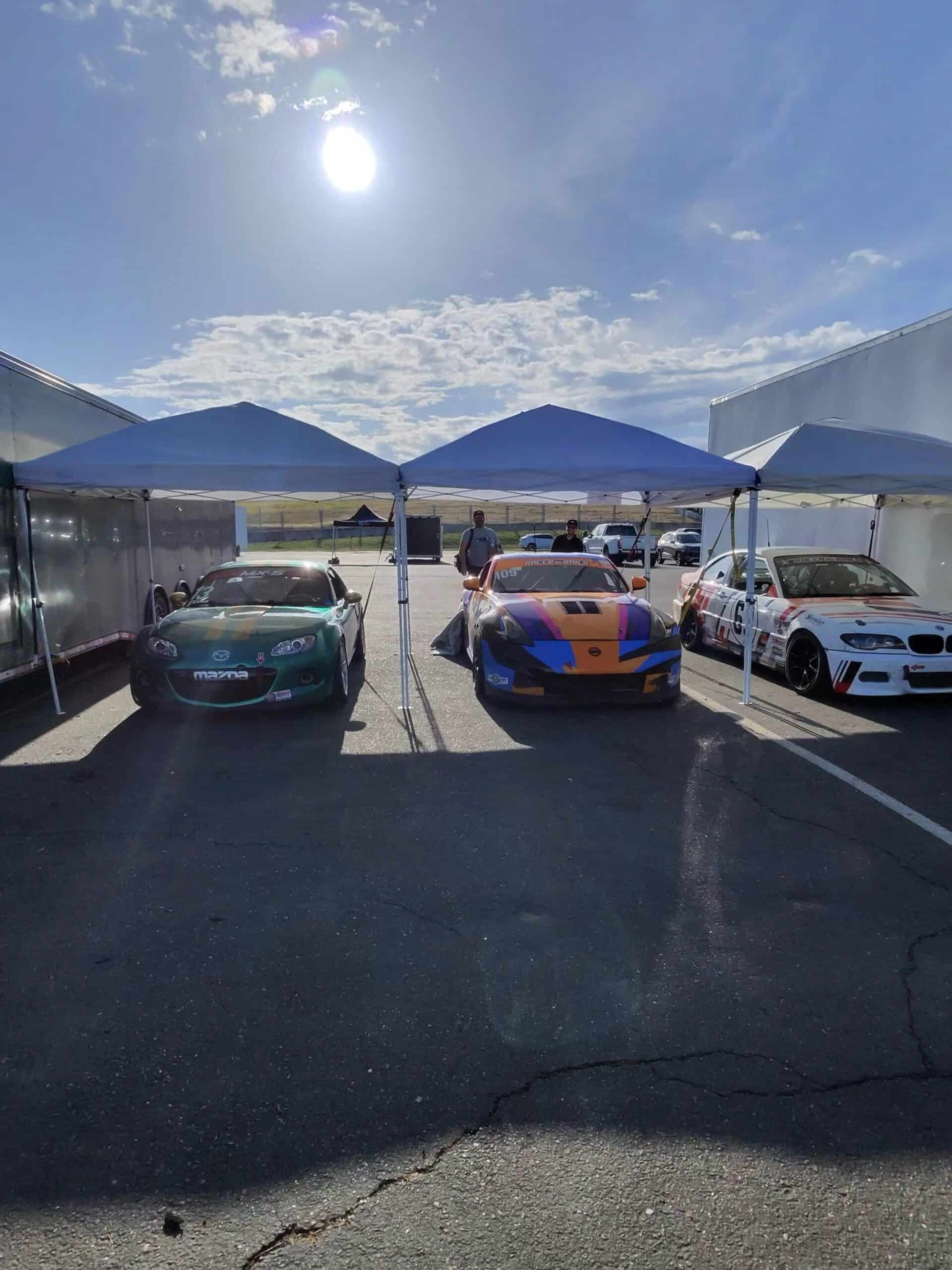
Racer on Rails paddock'ed at Thunderhill Raceway Park

In late April, we wrapped up the final stop of our early-season West Coast racing trip with the 2026 SCCA U.S. Majors Tour at Thunderhill Raceway Park.

This trip started in February at Buttonwillowโ€™s new โ€œThe Circuitโ€ layout, continued through a NASA NorCal weekend at Sonoma Raceway, and finished at Thunderhill before the cars, hauler, and team made the long drive back to the Pacific Northwest.

For anyone newer to club racing, the SCCA U.S. Majors Tour is one of the national-level competition paths within the Sports Car Club of America. It brings together strong regional and national drivers, gives racers a chance to measure themselves against deeper fields, and, for many drivers, forms part of the path toward the SCCA National Championship Runoffs.

Thunderhill is always a fun place to end a trip like this. It has elevation, fast commitment corners, technical braking zones, and enough rhythm changes to keep a driver honest. For this event, we ran the Crows Nest configuration, which adds its own personality to the lap and rewards drivers who can stay patient, committed, and precise.

For Racer on Rails, this weekend had two main drivers:

Gama Aguilar-Gamez in the No. 109 Nissan 370Z, competing in Touring 3

Ron Tanemura in his BMW Spec E46, competing in Touring 3 and STU

On paper, it was another race weekend. In reality, it was exactly the kind of weekend that shows why we love this sport so much. There were clear goals, real progress, hard-earned smiles, and a few memories that will probably get retold in the paddock for a long time.

Why We Were There

Every driver came into Thunderhill with a different mission.

For Gama, the weekend was an important step in the 2026 Runoffs journey. To qualify for the SCCA National Championship Runoffs, drivers need to complete the required number of race weekends and race finishes. After completing two races earlier in the season, Thunderhill became a critical opportunity to add two more finishes and move much closer to locking in the qualification path.
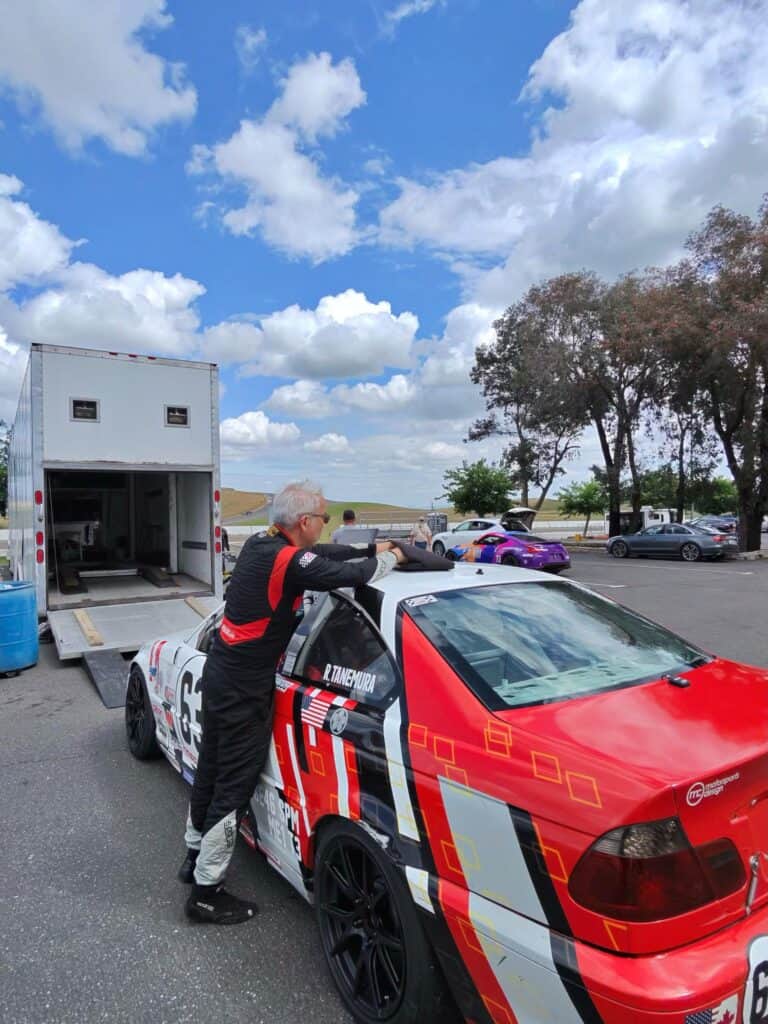
Ron Tanemura never stops looking for opportunity!

But the weekend was not just about checking a box.

The 370Z is still a car we are actively developing. It has shown strong pace, but like most serious race cars, especially one being pushed toward national competitiveness, the work is never really finished. Reliability, braking behavior, tire temperature, chassis balance, setup range, and driver confidence all remain part of the larger development puzzle.

For Ron, the goal was different but just as important.

Ronโ€™s bigger mission this year is driver development. Not just getting faster in one car, at one track, in one situation, but becoming more adaptable, more trusted, and more complete as a driver.

A big part of that is variety. Different tracks. Different race groups. Different cars around him. Different levels of pressure. The long-term target is for him to be the kind of driver who can step into different racing environments, learn quickly, run cleanly, stay close enough on pace, and be trusted by the people around him.

That does not happen by accident.

It happens by putting yourself in new situations, then doing the work to understand them. It happens by learning how to drive a car when it moves around underneath you. It happens by getting comfortable being uncomfortable.

Thunderhill gave Ron exactly that kind of opportunity.

Ronโ€™s Weekend: Raising the Baseline

Ron came into Thunderhill with a very clear goal: build on last year, get more comfortable with the car moving underneath him, and leave with a higher baseline as a driver.

That is one of the things we love about working with Ron. He is not just chasing a result. He is actively working on his craft. He pays attention to what the car is doing, what he is doing, and where the next layer of performance might be hiding.

Thunderhill gave him a perfect environment for that.

Last year, Ronโ€™s best lap at Thunderhill was a 2:06.24. This year, he came close with a 2:06.46. On paper, that means he did not beat his previous personal best. But the timing sheet does not tell the full story.

The bigger win was consistency.

Last year, Ron had one lap in the 2:06 range, one lap in the low 2:07 range, and a handful of laps in the 2:08s. This year, he had five laps in the 2:06s, eight laps in the 2:07s, and seventeen laps in the 2:08s.

That matters.

A single fast lap is fun. A higher baseline is progress.

Ronโ€™s own takeaway from the weekend was that he did not feel quite as โ€œon itโ€ as he did at Sonoma, but he was close enough to feel like his pace is becoming more real and more repeatable. That is exactly the kind of step we want to see from a developing driver.

The biggest learning was around car control.
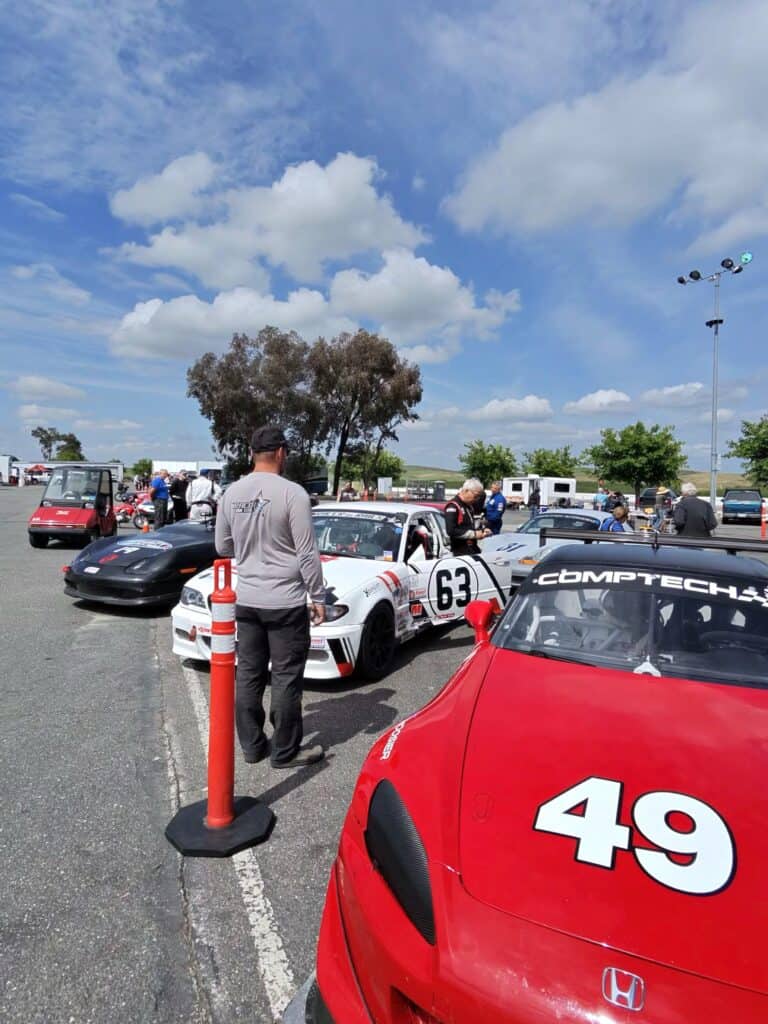
Post session – getting that Chequered flag for Ron!

When Ron was faster, the car was moving. It was rotating. He was catching it, correcting it, and working with it instead of waiting for the car to feel perfectly settled. During Friday testing, especially in the later sessions, he started getting more comfortable with that feeling. The next challenge is learning how to access that level of commitment earlier in a session, instead of needing several laps to build into it.

That became one of his biggest themes from the weekend: push earlier, trust the car sooner, and learn to drive closer to the limit on demand.

Saturday showed that progress.

In his first Touring 3 qualifying session, Ron was quick and consistent, including a run of laps in the 2:06s before the session ended. Later, in his second qualifying session, he was fast immediately after the restart, showing that the pace was starting to become easier to access.

The races gave him a different kind of experience.

In Touring 3, Ron finished second in class. It was a solid result, but he did not have as much direct class competition around him as he would have liked. At Sonoma, he had more sustained battles, and Thunderhill was a little quieter in that regard.

But the weekend still gave him valuable race craft notes.

He worked on starts. He worked on positioning. He got reminders about following closer before the green, not over-defending Turn 1 when there is an opportunity to open the gap, and using commitment through fast corners to set up passing opportunities later in the lap.

Then Sunday threw the team a curveball.

During Touring 3 qualifying, Ron quickly realized he had lost fourth gear. The transmission needed to be replaced, and the clock was not exactly being generous.

Thankfully, we had a spare transmission available.

The team looked at the schedule and knew it was going to be tight, but there was still a chance to get Ron back out for the STU race later that afternoon.

There was also something special waiting at the end.

At SCCA Majors events, class winners often receive more than a trophy. This event was hosted by the San Francisco Region, and the class-win flags were a cool keepsake from the weekend.

So we made the call: letโ€™s get Ron that flag.

The team jumped on the transmission swap, got the car buttoned up, warmed up, checked over, and ready. Ron made it to the race.

And he delivered.

He finished third overall in Group 2, won STU, and brought home the flag.

But the real story was not just the flag. It was the full arc of the weekend: clear goals, honest self-assessment, measurable progress, a mechanical setback, a team thrash, and one more chance to go race.

That is the kind of weekend that builds a driver.

Gamaโ€™s Weekend: Runoffs Progress and More 370Z Development

For Gama, Thunderhill was about two things: continuing the Runoffs qualification path and continuing to develop the No. 109 Nissan 370Z into a nationally competitive Touring 3 car.

This was only the second full race weekend of the season for the Z, and we came in with some important new learning.

Before the event, Tyler spent time with our partners at Motion Control Suspension to better understand the internal behavior, adjustment range, and service considerations of our three-way dampers with external reservoirs. The details matter, and we came away with more tools in our toolbelt that have helped us start fine tuning the carโ€™s behavior.

For a car like the 370Z, which has shown both pace and some sensitivity around braking behavior and tire temperature management, that kind of learning matters. We have been trying to understand how to make the car more compliant, more consistent, and easier to extract speed from over a full race distance.
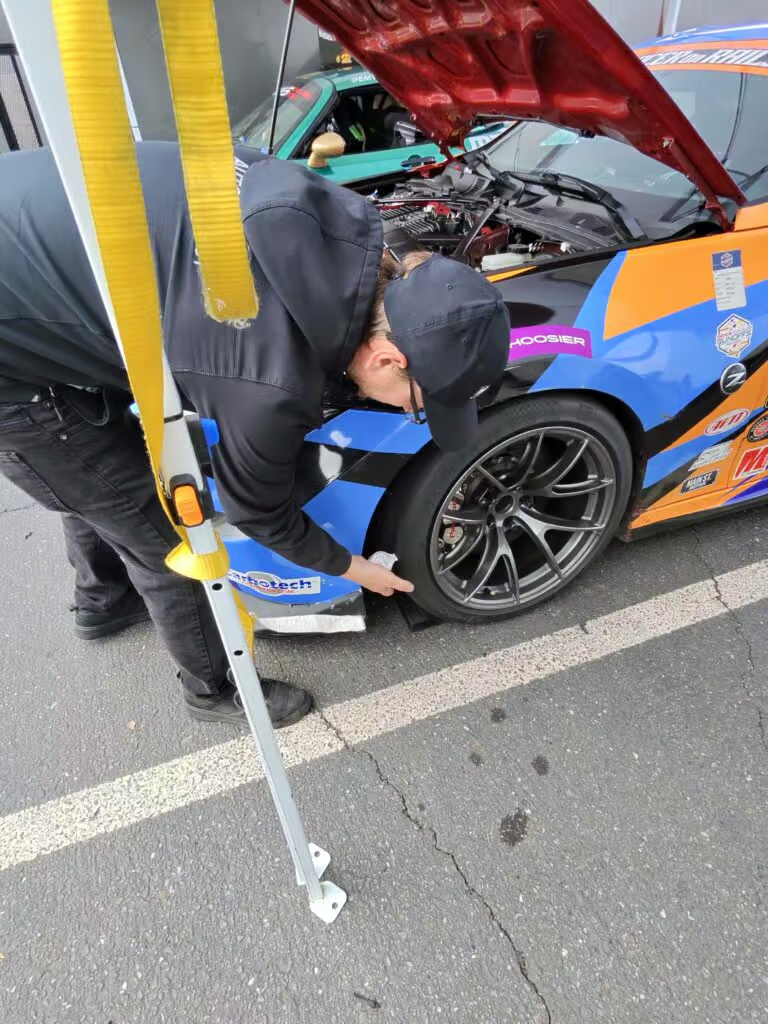
Ian Anderson getting the tire pressures dialed in before a session

The goal was not to find one magic adjustment. Race cars rarely work that way.

The goal was to understand the platform better, continue chipping away at reliability concerns, give the driver a car that communicates more clearly, and keep moving the program forward with discipline.

That is the unglamorous part of race car development. It is not always fireworks. Sometimes it is pressure checks, damper notes, tire readings, brake feel, driver feedback, and the quiet little decisions that add up to real progress.

Thunderhill gave us more of that.

On Saturday, Gama finished fifth overall in Group 1 and first in Touring 3, with a best lap of 2:02.789. That result mattered for the points and the Runoffs path, but it also showed that the 370Z had real speed in the class.

On Sunday, the priority was clear: finish the race, keep stacking Runoffs qualification progress, and bring the car home. Gama finished fourth overall and again first in Touring 3, adding another strong finish to the season.
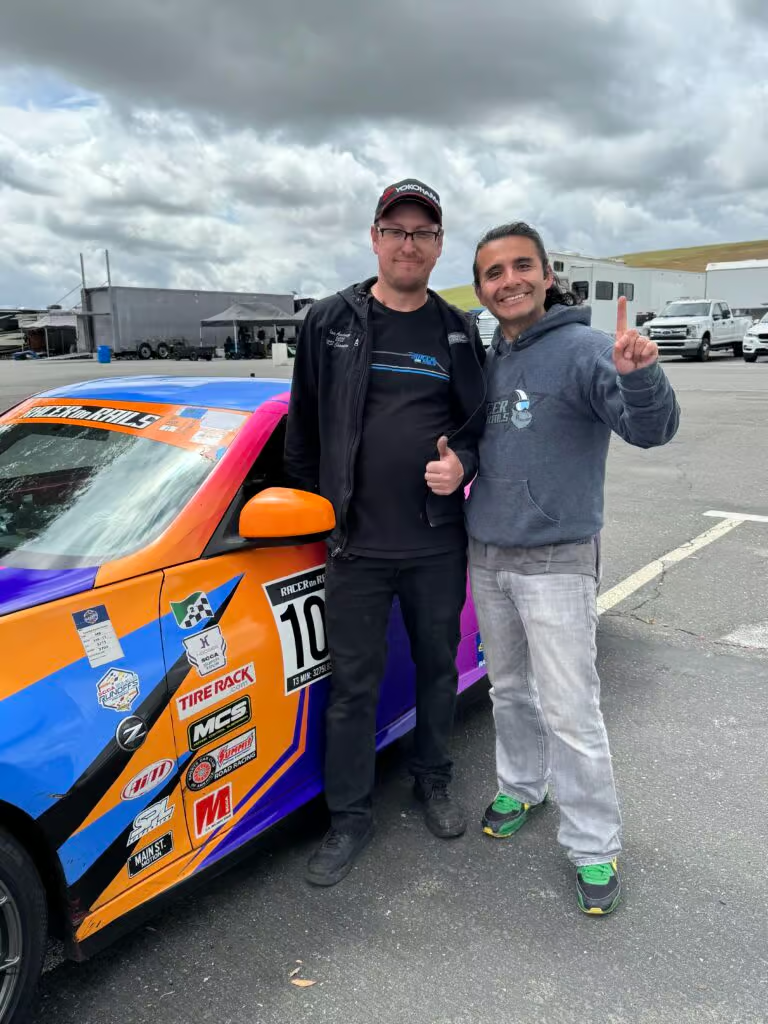
That's another P1 sweep of a race weekend for Ian, Gama, and the Nissan 370z in SCCA Touring 3
That’s another P1 sweep of a race weekend for Ian, Gama, and the Nissan 370z in SCCA Touring 3

Just as importantly, the weekend helped validate some of the direction we are taking with the chassis. The car became easier to work with, more predictable, and more useful as a development platform.

For Gamaโ€™s season, the biggest objective was to continue stacking the race finishes needed for Runoffs qualification. In that sense, the weekend did exactly what it needed to do.

For the car, it gave us more data.
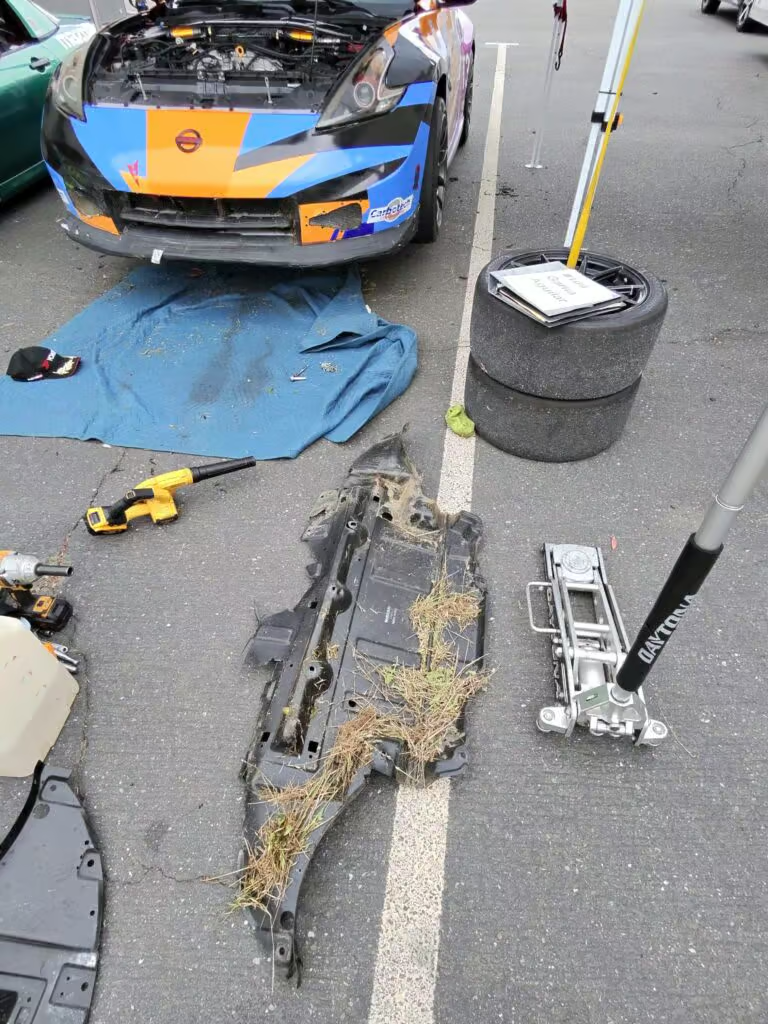
It’s not all roses and daisies when chasing speed. Sometimes you find yourself in the grass…

For the driver, it gave more confidence.

For the team, it gave another reminder that the path to national-level competitiveness is built one weekend, one session, and one decision at a time.

The Bigger Picture

The easy version of a race recap is to talk about qualifying positions, lap times, race results, and trophies.

Those things matter. We care about them. We work hard for them.

But the best weekends usually have another layer.

Ronโ€™s weekend was a perfect example. He hit the goals he came in with, but still left wanting more. That is a good place to be. He raised his baseline, got more comfortable with the car moving, built more race craft notes, identified where the next step is, and still came home with a class win flag after the team thrashed to get him back on track.

Gamaโ€™s weekend was different, but connected. The 370Z program took another step forward, the Runoffs path became more achievable, and we continued learning how to get more out of the platform without losing sight of reliability and drivability.

That is the heart of what Racer on Rails is becoming.

Yes, we prepare race cars. Yes, we support race weekends. Yes, we care deeply about setup, reliability, data, execution, and all the thousand little details that make a race car work.

But ultimately, we are here to help drivers become better drivers.

Sometimes that means building a faster car. Sometimes that means making a car easier to trust. Sometimes that means helping a driver understand what they are feeling. Sometimes that means creating the right environment for a driver to stretch, learn, and come back wanting more.

We want to help people set goals that matter to them, whether that is winning a national championship, earning a Runoffs invite, becoming more comfortable with car control, developing race craft, or simply leaving the track knowing they took a real step forward.

That is why weekends like Thunderhill matter.
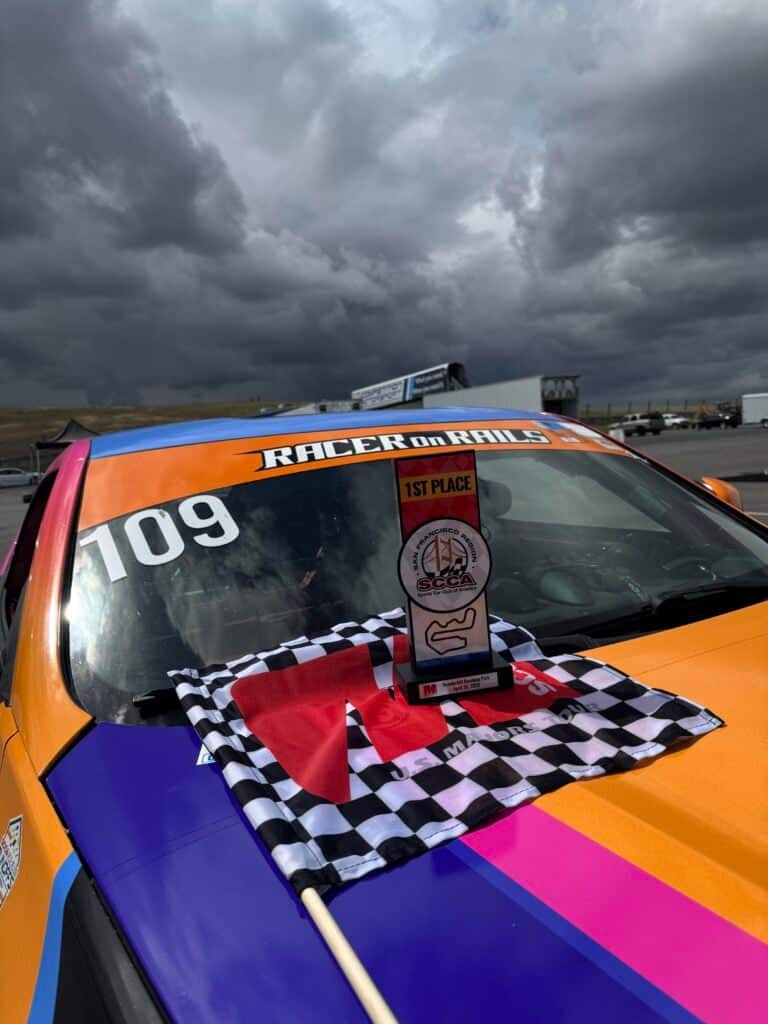
P1 both races in SCCA Touring 3 and collecting some hardware before the weather rolled in!

The cars came back north to the Pacific Northwest with more miles on them, more notes in the book, and a few more stories for the paddock. For us, it felt like the right ending to the first chapter of the season.

And for our drivers, it was another reminder that progress in racing rarely arrives as one giant leap.

Most of the time, it shows up as one better corner, one cleaner race, one smarter adjustment, one hard-earned finish, and one flag you almost did not make it back on track to win.

Posted on

SCCA Touring 3 Nissan Nismo 370Z #109 โ€” Build Overview

Introduction

Every race car has a story, and our goal with these build overviews is to pull back the curtain a bit and share the why behind each one. Not just the spec list or the shiny parts bolted on, but the decisions that shaped the build, the lessons we learned the hard way, how the car performs today, and where weโ€™re taking it next. Think of this as a guided walk through the full journey โ€” the good, the bad, the breakthroughs โ€” so that whether youโ€™re dreaming up your first build, refining a current project, or planning something wild for the future, youโ€™ve got real-world insight to draw from. And hey, if any of this sparks ideas or youโ€™re curious about building a similar car, weโ€™re always happy to talk shop and help you get pointed in the right direction.

Gama shaking down and testing things to figure out the brakes in his 2011 Nissan Nismo 370Z in SCCA Touring 3 Class

How We Ended Up in a Nissan 370Z for Touring 3

Our path to campaigning a Nismo Nissan 370Z in SCCA Touring 3 didnโ€™t start with a Z-car at all โ€” it started with a fleet of BMW Spec E46s and a once-in-a-lifetime opportunity.

Back in 2021, the SCCA Runoffs were being held at the Indianapolis Motor Speedway. Thatโ€™s bucket-list territory. There was absolutely no way we were going to miss the chance to race at Indy, so we brought our Spec E46 drivers and cars and dove into T3 with both feet.

That first year was awesome. The SE46 was decently competitive and, with a 2,950-lb minimum weight in Touring 3 (vs. 2,850 in the spec class), we still felt like the platform had room to grow. We were optimistic.

Even a hurricane couldn’t slow down the field enough to make a Spec E46 competitive at big tracks like VIR

But 2022 at VIR changed everything.

VIR is the polar opposite of Indy when what matters most is top-end speed. And in T3, you simply cannot hide from that reality. While the front-running cars were consistently touching 138โ€“140 mph top speeds, our Spec E46s were essentially tapped at 136 mph, and in reality at VIR, we were barely seeing 132 mph with a draft.

So even if the chassis could somehow theoretically match the lap times, the racing wasnโ€™t viable. It was a harsh reality check, but a necessary one.

Time for a Change

After the 2022 Runoffs, we evaluated realistic alternatives:

  • BMW Z4 M Coupe
  • Nissan 370Z

We also had a 2010 Porsche Cayman PDK ready to build, but the timeline and development curve didnโ€™t match our Runoffs schedule.

The turning point came when a proven, nationally competitive T3 370Z changed hands and landed with our friend Chris Hart. Suddenly, we had access to race-winning data and real experience. Combined with the 370Zโ€™s double-wishbone geometry โ€” perfect under T3โ€™s 3.5-degree camber limit โ€” the choice became clear.


Buying the Car โ€” A True Nismo

In mid-2023, we bought a 2011 Nissan 370Z Nismo โ€” a true, original-owner Nismo.

Because the shop was at max capacity, the entire initial teardown happened in the driveway. Full interior strip, seam sealer removal, weight reduction โ€” everything. We delivered a perfect rolling chassis to Fabtek for a cage that matched Chris’s championship-proven design.

Cage & Safety Fabrication

Once Fabtek completed the cage, we resprayed the interior in OEM Nismo red and began the race against time to assemble the car before the 2023 Runoffs at VIR.


2023 Runoffs โ€” The ABS Reality Check

We made it to VIRโ€ฆ but the first test day exposed the 370Zโ€™s biggest flaw: its factory ABS logic.

We experienced full-on ICE mode, where the ABS system dramatically reduces braking pressure unpredictably. It ended our Runoffs before the weekend truly began โ€” but thank God, the car and driver were safe.

Post-Runoffs: Fixing the Brakes

That failure changed everything. We went deep into:

  • pad compounds
  • rotor configurations
  • wheel-speed ratios
  • heat management
  • master cylinder behavior
  • ABS trigger logic

We broke things. Tested everything. Logged everything. Even pushed for rule adjustments when needed.

And now? The brakes are one of the absolute strengths of the car.


Current State of the Car

Chassis

  • 2011 Nissan 370Z Nismo
  • SCCA-compliant Fabtek cage
  • OEM interior respray (red)
  • OEM front strut bar
  • No additional chassis stiffening (per T3 rules)

Interior & Safety

  • Racetech 119 seat
  • Schroth 6-point
  • Safecraft nets
  • Lifeline fire system
  • OMP wheel
  • Helmet blower + cool shirt
  • Lots of heat shielding at the transmission tunnel to protect driver’s feet

Brakes

  • Paragon PA015 calipers
  • Paragon 2-piece rotors
  • Carbotech XP12 front pads / 1521 rear pads
  • Motul RBF660
  • Goodridge stainless lines
  • Racer on Rails custom brake ducts
  • Fully optimized ABS strategy

Suspension

  • MCS 3-way coilovers
  • Eibach T3-compliant springs
  • SPL adjustable arms & endlinks
  • AFE sway bars
  • Urethane diff mount

Engine

  • Nissan reman VQ37HR
  • Z1 baffled oil pan
  • OEM intakes (required)
  • 42mm restrictor
  • Motordyne test pipes
  • Z1 single-exit exhaust
  • ECUTek tuned on 100 octane
  • Comprehensive cooling upgrades
It's a Z battle at the 2025 SCCA Runoffs!
It’s a Z battle at the 2025 SCCA Runoffs!

Aero

  • OEM Nismo V1/V2 aero
  • Race Louvers center hood louver
  • OEM body panel constraint for T3

Electronics

  • AIM MXS v2 + SmartyCam 3 dual
  • Switch-Pro control system
  • Full auxiliary sensor package
  • Motorola long-track radio

Drivetrain

  • CAE shifter (350Z variant custom-adapted)
  • Tomei 1.5-way LSD
  • OEM mounts (urethane where allowed)
  • Diff & trans coolers
  • Enkei RFP1 18×10.5 + Hoosier A7s

Racing & Driving Highlights

???? 2024 Hoosier Super Tour Win โ€” NOLA Motorsports Park

The carโ€™s first national-level win (but technically a P2 due to post-race adjustment). New track, technical course, colder weather and still figuring out the brakes.

Video:

???? 2025 CAT Majors Win โ€” Road America

90ยฐF, extreme humidity, and the car delivered a dominant run once we were in clear air.

Video:

???? Global Time Attack โ€” The Ridge Motorsports Park

Unrestricted laps on Yokohama A052s showed the Zโ€™s true potential.

Video:


What Weโ€™ve Learned

  • The car loves mechanical grip.
  • Weight distribution & stiffness tuning are critical.
  • The ABS and braking system is both the biggest weakness and the biggest opportunity.
  • Heat management is everything in longer races/sessions and when air temps get above 80F.
  • The Z rewards smooth inputs and stability.
  • Parts availability is excellent with the right partners.

Future Direction โ€” Where #109 Is Headed

  • More engine & cooling refinement
  • Testing Paragon PA015 big-brake upgrade
  • Further alignment/tire data development
  • Weight management improvements
  • Full prep for 2026 Hoosier Super Tour + Runoffs

Thinking About Building a Production-Based Race or Track Car?

If this build sparks any questions, ideas, or โ€œshould I do this with my car?โ€ thoughts, reach out. Whether you’re dreaming up a production-based track car, considering something in the SCCA Touring 3 or Touring 2 world, or want to explore a power-to-weight package similar to this build, we’re always happy to help you think through the right path.

From full builds to setup refinement, from brake and cooling solutions to driver development, we love partnering with drivers to create fast, reliable, confidence-inspiring cars. If something here resonated with you โ€” letโ€™s talk.

Posted on

Race Report 1: Sebring International Raceways

We made it! Last year (2022) we had Sebring as our first race of the year and first stop on the SCCA Hoosier Super Tour but epic levels of snow across the mountain passes had us locked in the Pacific Northwest but this year, the snow hit earlier in December and by the first week in January, the passes were clear!

The January 12 – 15 race weekend which included a test day on Thursday, qualifying on Friday/Saturday AM and two feature races on Saturday and Sunday, would not only be the first race of the year for the team, organizing body and the drivers! We came prepared with patience, positive attitudes and a singular goal: improvement.

Each of our drivers put in serious hours of training on the simulator, studying historical race videos and watching track walk videos from the likes of Ross Bentley, so that when they got on the track for the first time, they could focus on getting comfortable leaning on the car and not worrying about where to turn next!

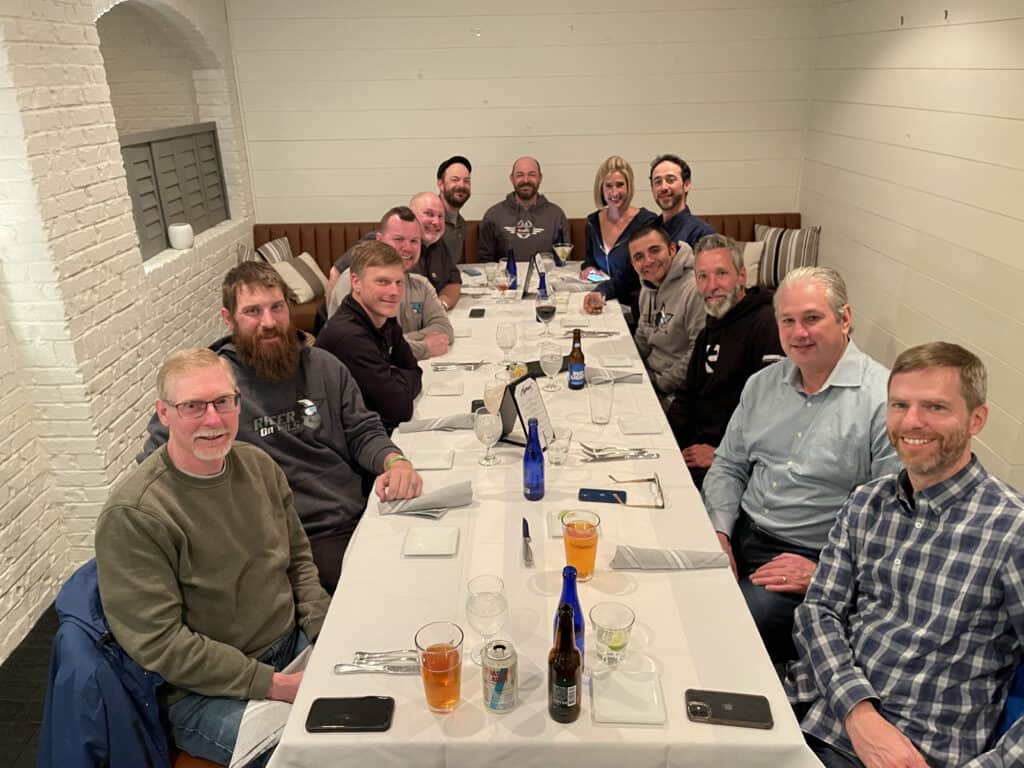
Let’s just be honest; racing is just an excuse to get together with friends and have several meals in an empty parking lot/temporary village and an occasional restaurant like Chicane’s in Sebring, FL!

2023 Driver Lineup and a new addition!

For the 2023 tour, we continued with the same driver team from 2022 with Ann Doherty in her Porsche Cayman GT4 Clubsport but now competing in Touring 1 class (versus GT2). Starting in 2023, the Touring 1 SCCA class has changed to allow the GT4 race cars that are currently competing in SRO and IMSA series, a place to race in SCCA Club Racing. You might ask, but why? They are professional level race cars – shouldn’t SCCA club racing be about non-professionally built race cars?

Historically, that has been true and most would agree but a couple things are happening that have forced the hand of SCCA and we are in full support. First, for many years as Pro level cars have aged out of the pro series (new cars have shown up and the “old” cars are no longer allowed to compete in the pro leagues) they have been sold to amateur drivers and teams, who then drive them at track days and increasingly, club racing leagues. For example, many of the old IMSA/Grand Am Continental Tire Series Grand Sport (GS) cars that were retired from pro racing, trickled down into SCCA Touring 1. IMSA Michelin Pilot Challenge GS class is the new version of the old Conti Challenge and the top class (GS) is made up exclusively of FIA homologated GT4 race cars.

Second, and the biggest variable, is that newer street cars come with advanced electronics that need to balance performance with emissions and safety regulations. These systems are so advanced that it has become increasingly difficult, cost prohibitive and in some cases, impossible to tweak the OEM controllers so that the car can run reliably in race conditions.

The net result is it is equally as expensive to build a Touring 1 level car from a street car and less reliable than simply buying a factory built race car, like the GT4 race cars. So in an effort to save the Touring 1 class, SCCA has moved to allow these cars in T1. Not only do we fully support the shift to the future for the class but specifically for the Porsche Cayman GT4 Clubsport, it’s inline with the spirit of Touring class cars (race on Sunday, sell on Monday) and it has a much better chance to compete at the front, compared to GT2 cars that have thrown most connections to the street cars, out the window (along with the windows!).

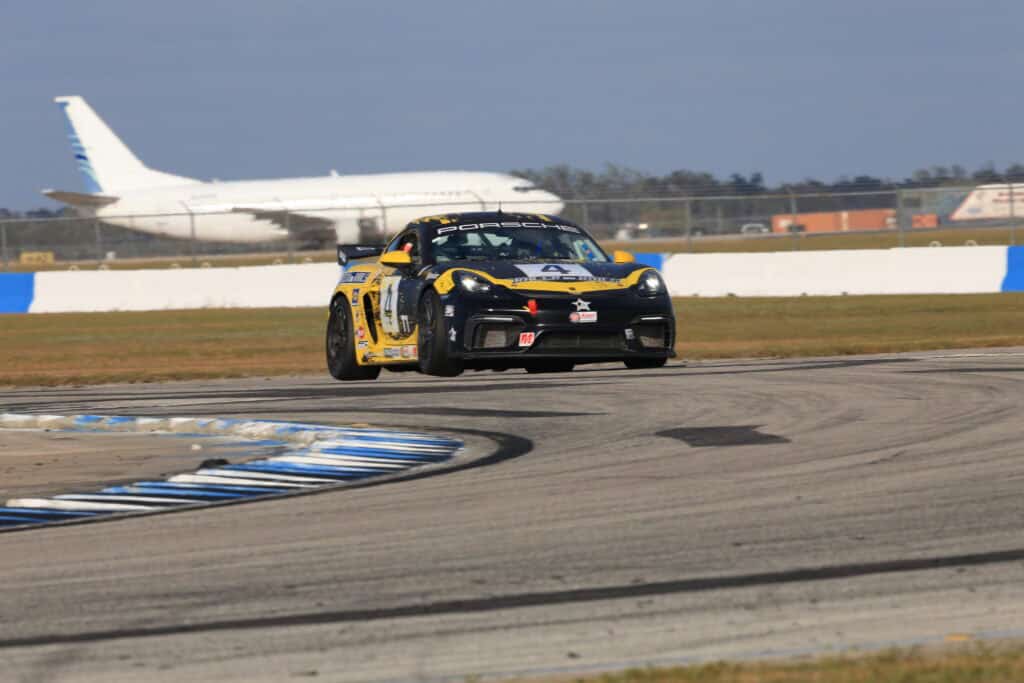
Ann Doherty piloting her Porsche Cayman GT4 Clubsport in the SCCA Touring 1 Class

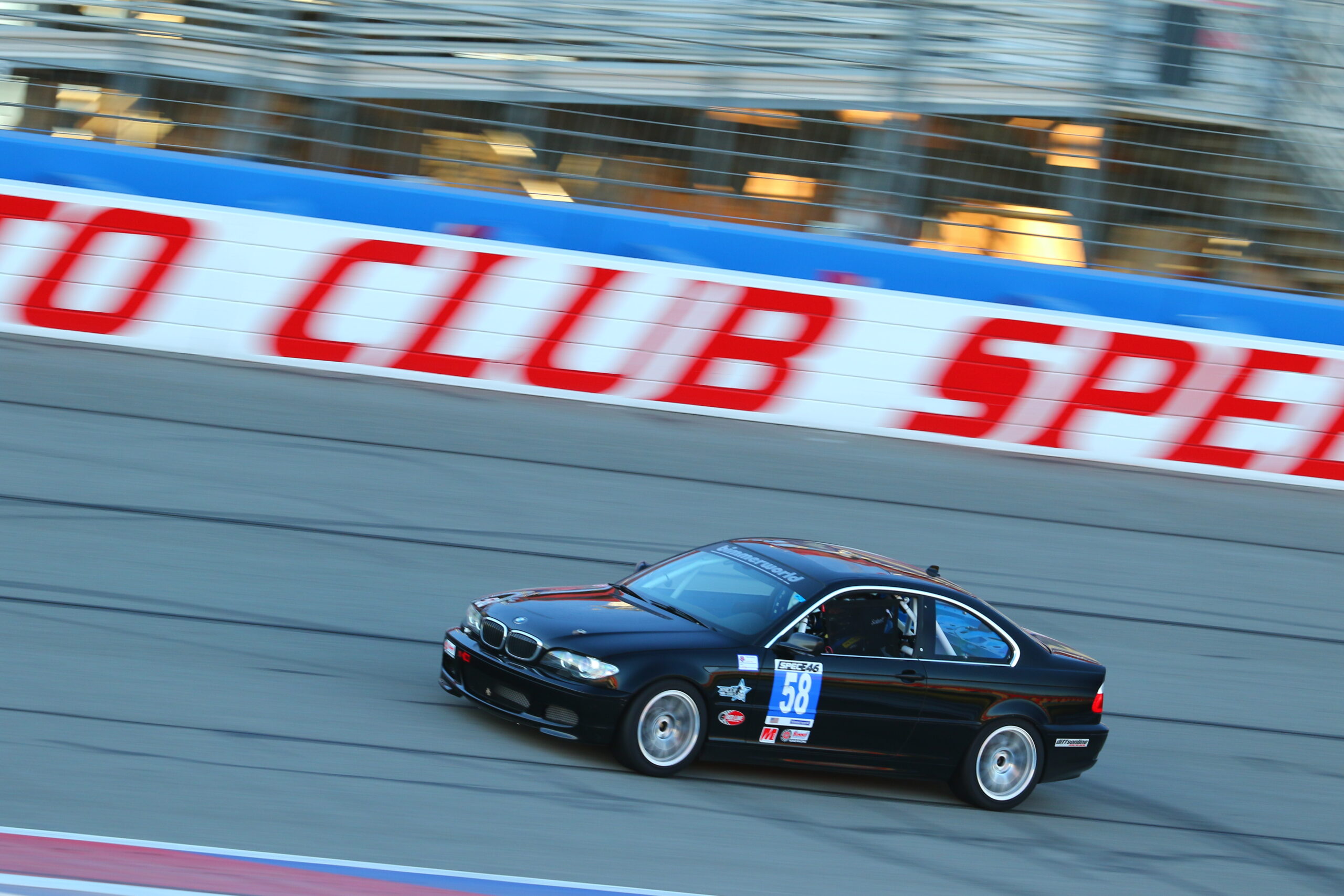
In the Touring 3 class, we had Dave Orem returning in his #44 2001 BMW 330ci in Spec E46 trim, Simon Asselin in his #81 Spec E46, Gama Aguilar in his #109 Spec E46 and joining the group is Thad Berger in his #60 Spec E46! As you can probably tell, we love them BMW Spec E46’s at Racer on Rails!

Unfortunately for Simon, his engine developed an issue on the very first test day session which sounded like an engine throwing the white flag so he jumped into Gama’s #109 to finish the weekend. Gama would end up sitting out the weekend and focused on coaching.

Speaking of coaching, we welcomed back Ray Phillips from Precision Driving Analytics and Seth Thomas, who coached the 2022 team to significant improvements, multiple podiums, some race wins and personal bests that simply couldn’t have been possible for drivers coming to the bucket list tracks we drove at in 2022.

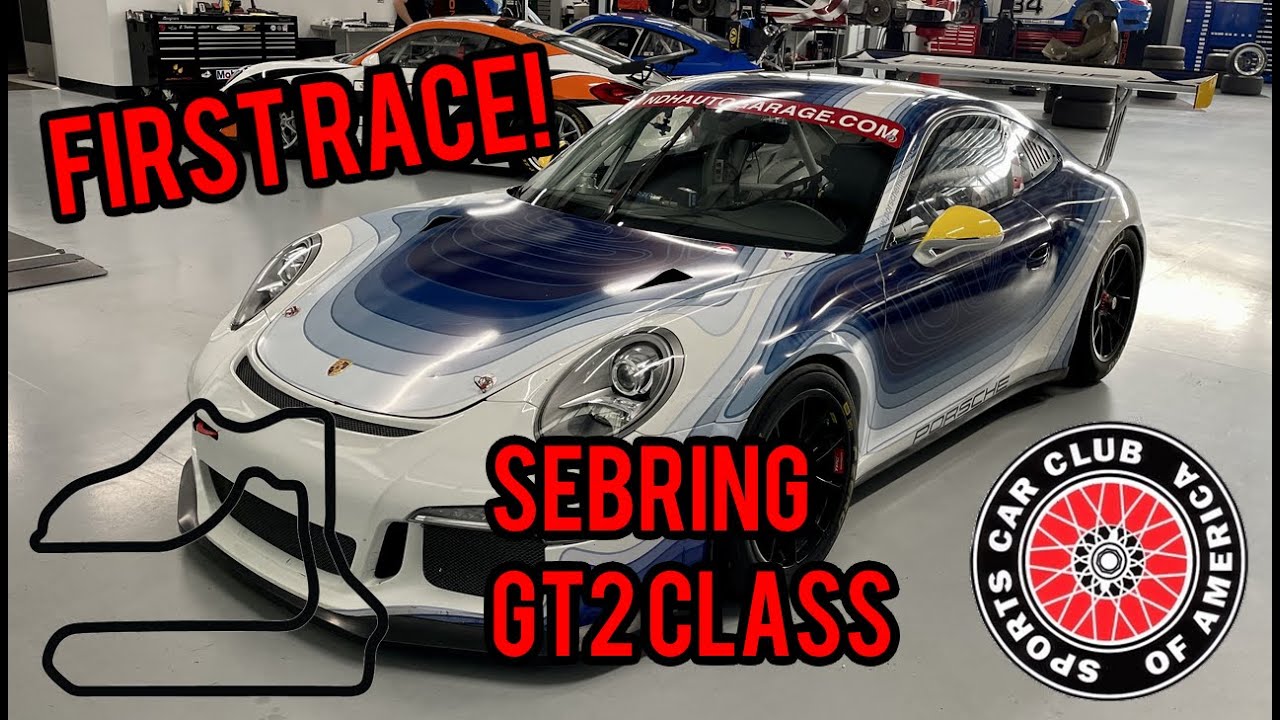
Finally, Simon Asselin was not just piloting a Spec E46 but on the way to Sebring, we made a detour stop to pickup his new (to him) 991.1 Porsche 911 GT3 Cup car that races in the GT2 class! While we normally would not advise anyone to pickup a race car on the way to running said race car in a competition weekend, we worked with Autometrics Motorsports out of Summerville, SC (who was the previous custodian of the car) to get it as prepared as possible for competition in SCCA GT2 class. A big thank you to Adam, Gordon and the Autometrics team for helping it a smooth transition process for Simon and our team!

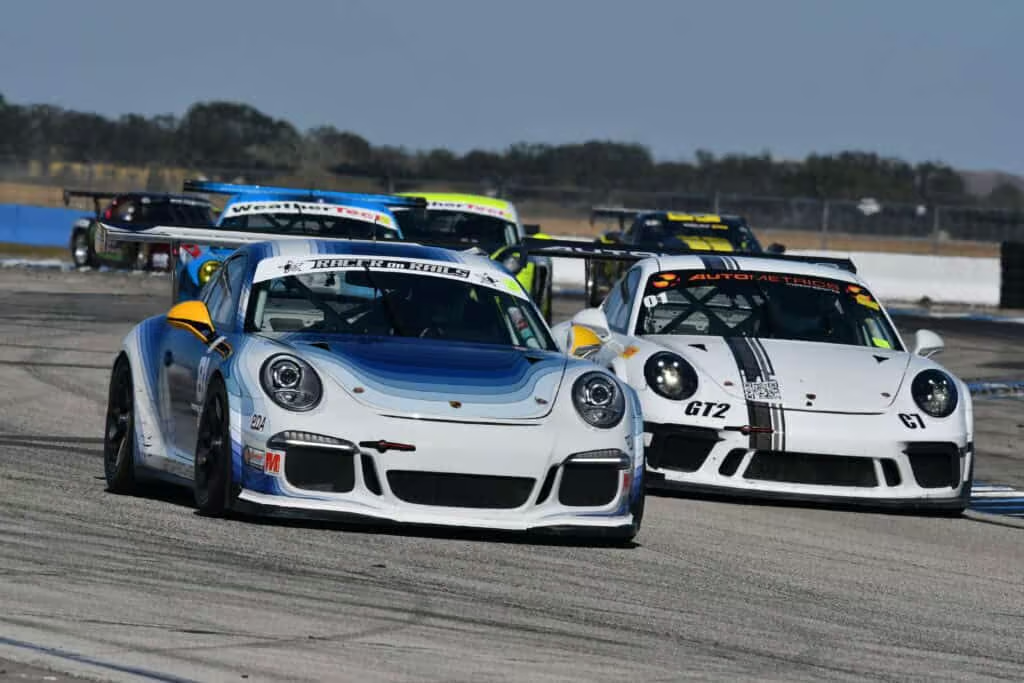
Simon Asselin in a heated battle in GT2 with another Porsche GT3 Cup Car

Ramping up on new tracks fast and competing at the front

One of the biggest challenges of going on the Hoosier Super Tour, being based out of Seattle, WA and generally, the Pacific Northwest, is that these are all new or relatively new tracks for each driver. Drivers can’t lean on their thousands of laps at local tracks like Pacific Raceways (that is literally our back or front yard now!). The competition tough, the fields are big and track time is limited. Even with a test day.

So the drivers and we as a team have to figure out how to get up to a respectable pace fast and improve every session. As mentioned above, each driver put in 10+ hours on the simulator before the race weekend and little by little, each driver progressed, chipping away at lap times and every once in a while, taking large chunks.

The grid had a lot of HRSRS in the GT2 and T1 group!

Over time what has happened, especially for the drivers that were part of this tour in 2022, is that they got a lot of experience learning new tracks and they got better throughout each weekend. Over the races, they started developing not a library of tracks that they reference, but instead a library of corners. So a new track isn’t a completely new thing they haven’t driven before, but instead a track that is a collection of corners that some they have driven before. So for example, turn 1 at Sebring is a lot like turn 1 at the Ridge (high speed left hand corner where you float as much speed as possible into the corner). Turn 7 (Hairpin) is similar to Turn 11 at COTA – slow speed corner where there are multiple lines that can be taken and the exit is paramount due to the straight away that follows. The bumps at Sebring, especially the exit of Sunset Bend (respect the bumps!) is similar to the exit of Turn 9 at Pacific Raceways (respect the bumps!).

We find (and found!) that when drivers start thinking about new tracks in that way, they are able to anchor themselves to a familiar feeling of what the car should feel like and a sensation for the speed. It doesn’t mean that you treat the corners the same but it’s a high informed starting point to begin really leaning on the car and the tires. Because until a driver really starts leaning on the car and tires, the lap times won’t drop materially.

Touring 3

With a solid day’s worth of practice, Thad, Dave and Simon were set to go after a solid qualifying position to start the races. Qualifying 1 was rained out and with no further rain expected the rest of the weekend, most of the grid didn’t quality for T3 including Dave and Thad. In qualifying 2, Simon locked up P3, Dave had a time good enough for P4 but his transponder decided to quit on us so he would start race 1 from the back and need to make his way through the field. Thad started P6 and knew exactly what he needed to to gain positions and lap time.

Race 1 was close battling from start to finish! Simon lost some positions on the start but jumped back in, regained positions and while simultaneously battling T3, T4 and T2 cars, mustered out a P2! Dave let the lap 1, turn 1 mayhem happen and then got to work, moving his way through almost the entire T4 field, five T3 cars and came home in P3, on top of improving on his personal best time of the weekend!

Thad was in the thick of the front T4 battle but he took no prisoners, held his ground and took out 2.6 seconds off his qualifying 2 lap time. Let the big dog eat!

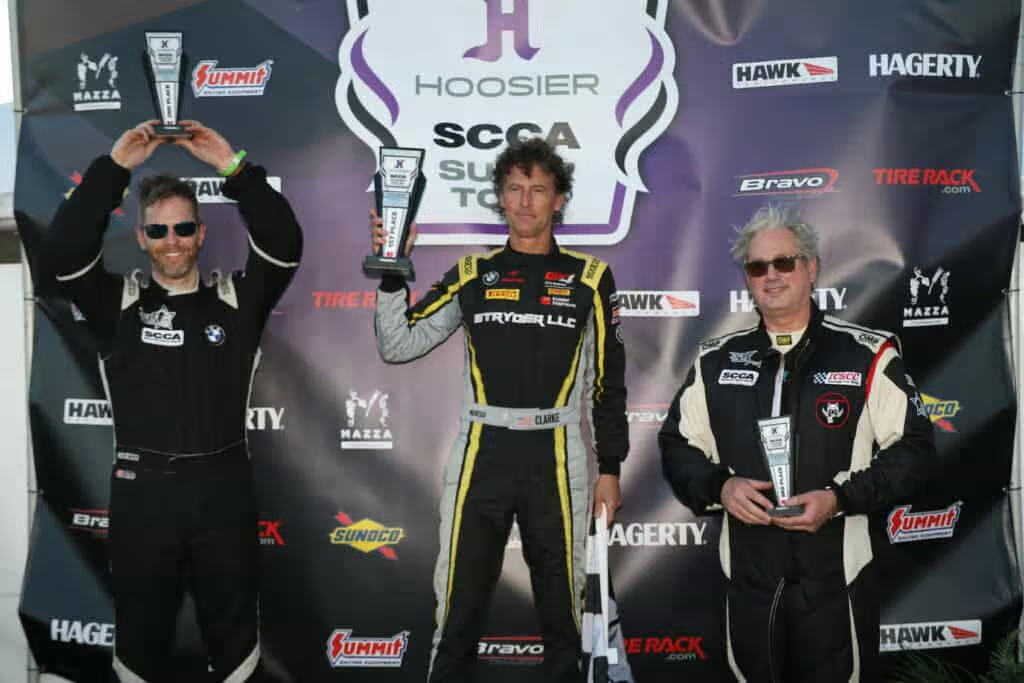
Simon (P2) and Dave (P3) sharing the podium at Sebring AND special bonus, Todd Clarke, also a PNW driver in P1. A full PNW podium in T3, in Florida!

For race 2, everyone started in better positions and the themes were similar. Hard racing the entire race for each driver, further improvements in personal bests and not a moment to catch your breath! Thad dropped a further .9 seconds off his personal best to a 2:32.7 and finished P4 in his second ever Hoosier Super Tour.

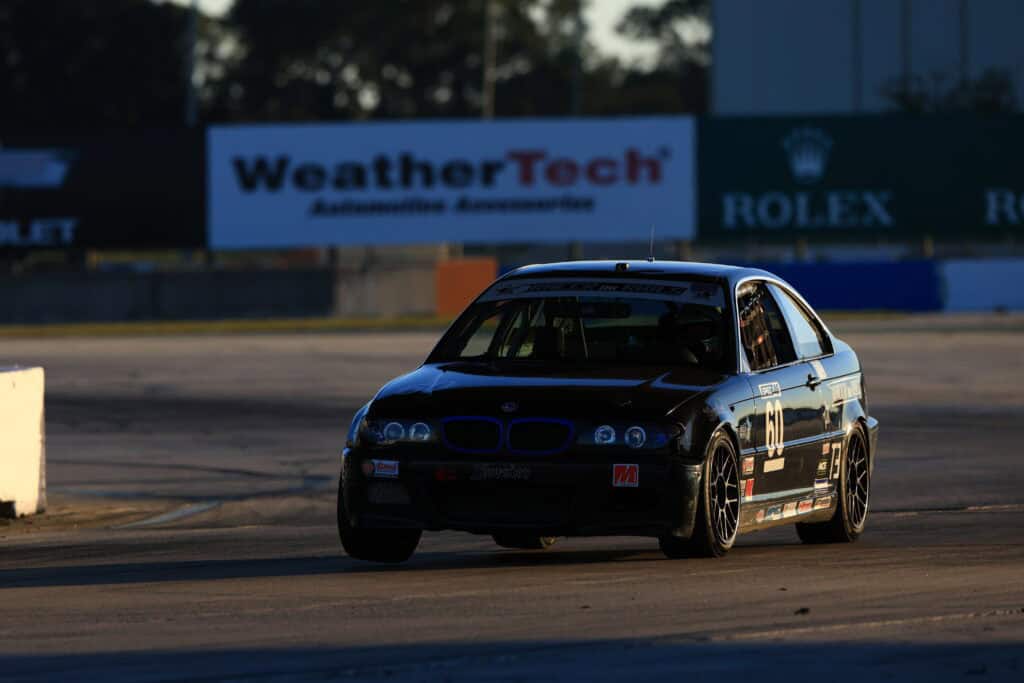
Thad Berger, riding into the sunset after an amazing first stop of the Hoosier Super Tour at Sebring International Raceways.


Want to pause here and emphasize what Thad did. Thad has been wheel to wheel racing for less than 1 year. He jumped into the deep end of the pool, competing against experienced/fast drivers, at the Hoosier Super Tour and at a bucket list track that he had never driven. On top of all of that – in qualifying 2, on the first flying lap, he had a real big moment at Sunset Bend (Turn 17) where legitimately almost put the car into the wall. But he didn’t. He gathered the car up, drove through pit lane for a quick visual check on the car – everything looked good and he immediately got back at it. That is something he and we all, will never forget. Great job, Thad!

Dave continued his progress through the field after losing a couple positions on the start, focused on consistency and dropped another .5 seconds off his fastest time of the weekend for a 2:31.4 and with Simon’s DNF, a P3 and a double podium weekend!

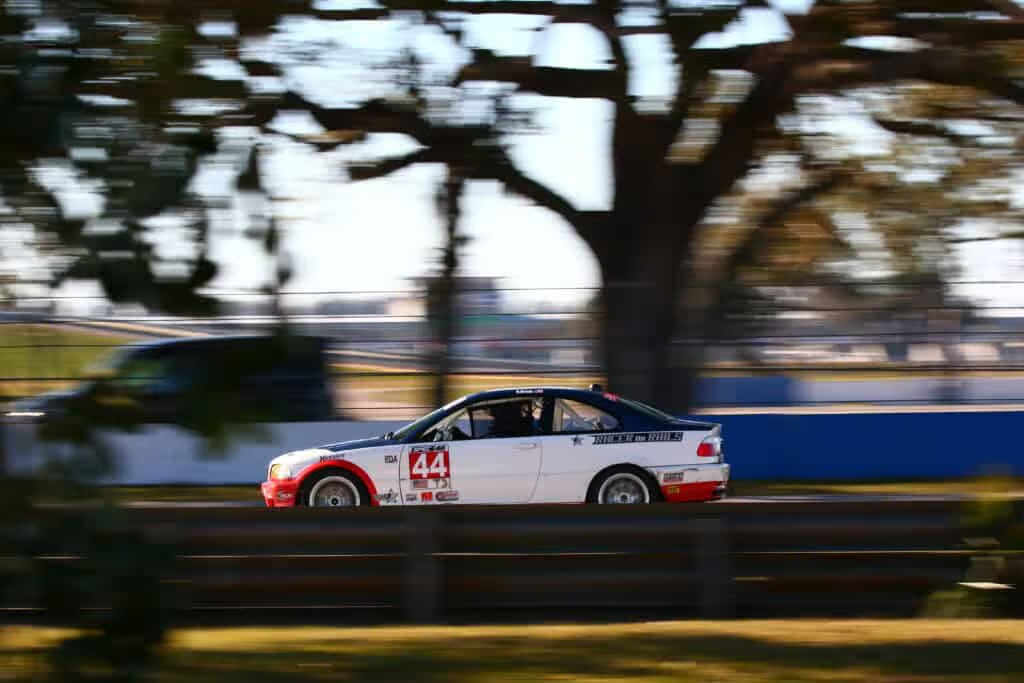
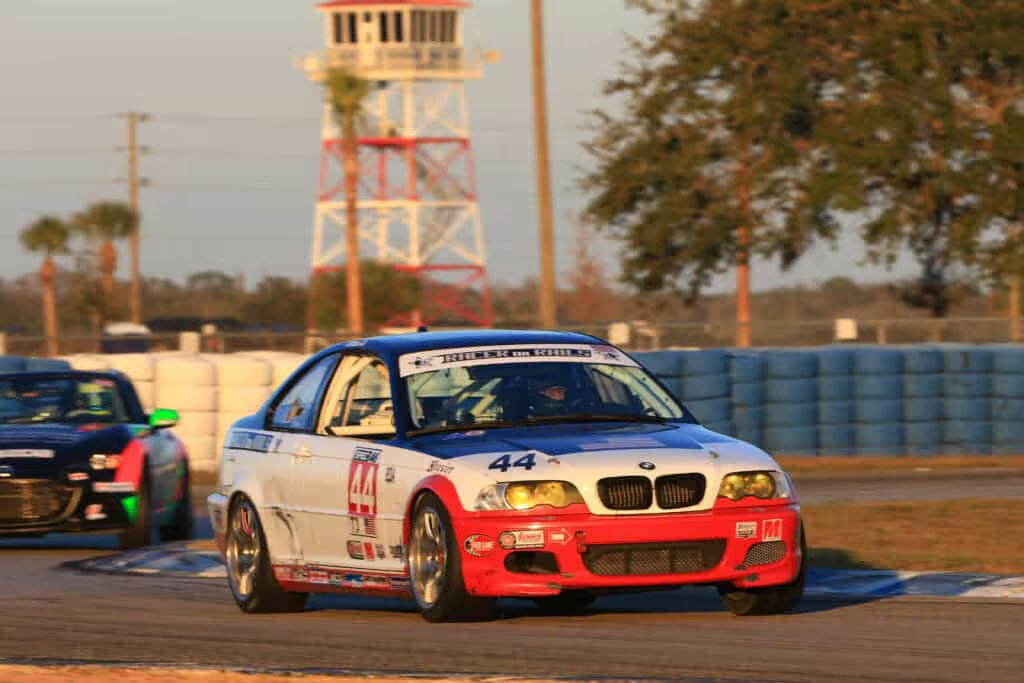
Dave Orem holding off a Global MX5 Cup Car in Touring 3 class.

Finally, Simon had one of the most intense races ever, battling T2, T3 and T4 cars again! And while he also took almost a full second out of his fastest time of the weekend for a 2:30.1 lap time, with a lap to go, he went a little hot into a corner, got the car sideways and was unfortunately collected by a really competitive out of class car. That unfortunately ended the race for him but he sustained no issues and the 109 has already been repaired – the incident did not detract from the weekend as a whole. Watch Simon’s race below (with picture in picture of the SCCA broadcast!)

YouTube player
Race 2 of the SCCA Hoosier Super Tour for Simon Asselin in the RoR #109 in Touring 3 class

Touring 1 and GT2

Lucky for us, both Ann and Simon race in the same group but in two different classes so we got lots to follow during their group race!

While Ann hadn’t been to Sebring, she has developed a reputation for ramping up quickly at each new track and by the end of the race weekend, competing towards the front of the grid or the front of the mid-pack and that was last year, in GT2! Well she did not disappoint! After missing qualy 1 as it was also a wet session and no forecasted wet sessions for the rest of the weekend, she qualified P6 out of 10. And while she finished P6 in both races, she finished only about 1.5 seconds off the race pace of the podium finishers and the five drivers in front of her were ex-professional IMSA drivers, current SRO drivers, multi-national champions and seasoned (and fast) Touring 1 cars/drivers. Lots of work left to get close to the top 5 type of drivers but her performance coming out of the gates and through the weekend were amazing!

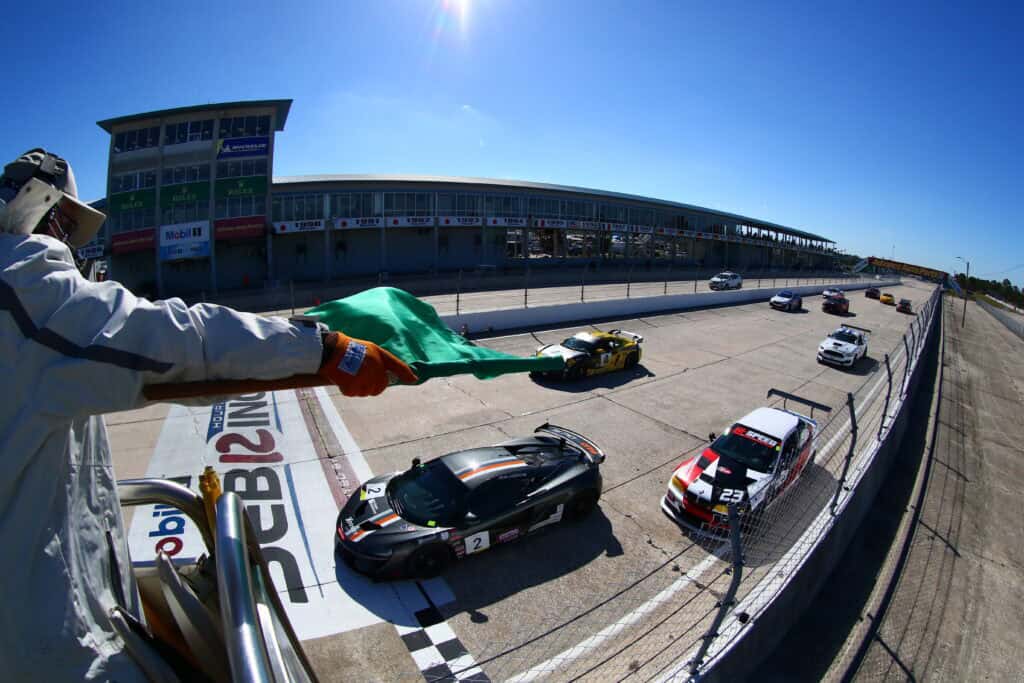
Ann takes the green flag for the Touring 1 race and in the mix with a combination of new GT4 and historical Touring 1 race cars.

This was Simon’s first weekend with the Porsche GT3 Cup Car and we all came into the weekend with specific expectations: learn the car, get quality laps, and have fun! With a new car to the team and no testing beforehand, we had really no gauge for how the car and Simon could perform. However, we were all extremely pleased to get the car running by mid-morning of the test day. Seth Thomas drove it on it’s maiden track session under the Racer on Rails umbrella, to provide a baseline for how the car simply ran and once confidence built up, a gauge for the pace of the car.

The verdict? It’s a great GT3 Cup Car! While it wasn’t fully compliant to GT2 rules at the time (hadn’t added the full ballast required), the lap times Seth put down were well within the front of GT2 class range that we saw throughout the weekend and it gave Simon a rabbit to chase throughout the weekend. You might be asking – how can you figure that after a single person driving the car in one session/5 laps? First, the team has worked on factory built Porsche’s throughout the years so we had a solid foundation of what to expect re the machinery itself and setups. Second, Seth has driven a wide variety of race cars and including several Porsche GT3 Cup Cars (along with being somewhat of a Porsche nut himself) and he’s driven/raced at Sebring dozens of times, with likely thousands of laps at Sebring. So after he had 3-4 laps underneath him and the tires were finally in a working range, he was able to start really leaning into the car.

The results? Simon finished P5 in race 1 after a hard fought battle with another 991 GT3 Cup car and P6 in race 2 where his tires started to show signs of aging after taking a couple of qualifying sessions and a full race 1. All in all, Simon ended up ~2 seconds off the race winner but only ~1 second off the leading Porsche GT3 Cup car in the field. Awesome first outing and race weekend for Simon in the Porsche GT3 Cup Car.

Check out the in-car and live broadcast from Simon’s first race below!

Catch the next race report that recaps our stop at Circuit of the Americas!

YouTube player
Posted on

Andy Porterfield Memorial SCCA U.S. Majors @ Auto Club Speedway

Not even a couple weeks into 2021, we kicked off the racing season with a trip to Southern California for our very first SCCA race weekend and a U.S. Majors Tour event at that!

We love the Spec E46 class and series because it’s a national class where these cars can be raced all over the country in a variety of series. In 2019 we did a NASA National Championship run, racing in California at Sonoma and Thunderhill to qualify for the National Championship at Mid-Ohio Sports Car Course. We were all set for a similar campaign and with more cars and the national championships at Utah Motorsports Park but COVID threw a wrench into those plans (and everything else in the world).

With the 2021 NASA National Championships to be held at Daytona International Speedway, we decided to instead participate in the SCCA Run Offs (SCCA’s National Championship) which is set to be held at Indianapolis Motor Speedway. To be able to compete in the Run Offs, you have to qualify by competing in a minimum number of US Majors/Hoosier Super Tour events (minimum 3 weekends and finish minimum of 3 races in the same class) or participate in 4 Divisional race weekends and finish in the top 3 of the divisional points race in that same class.

This race weekend would be the first of our “winter” Southwest road trip, followed by a Hoosier Super Tour event at Circuit of the Americas in February, Buttonwillow in late February and Thunderhill in March. With this “trip” we should have all the races taken cared of to qualify for the Runoffs before the PNW racing season gets going.

New track, trailer and tires

By the time the cars hit the track on Friday mid-day, we had gotten through three new firsts:

  1. New track: This would be a new track for everyone on the team but being able to get some simulator time on iRacing in the Mazda Global MX-5 Cup Car helped us get up to speed on the track and some sense for braking points and a rough setup direction.
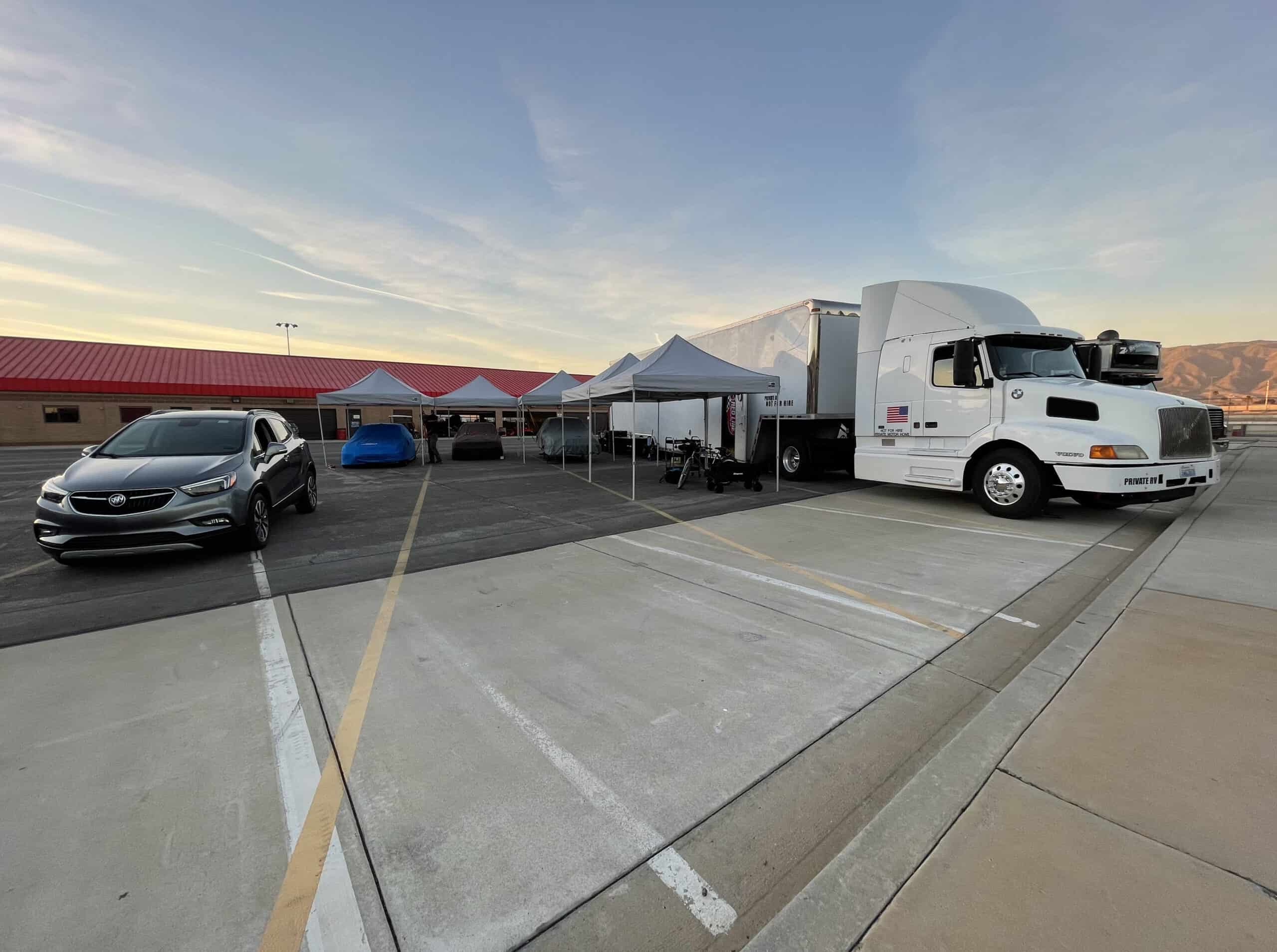
  2. New trailer: With a few cars to transport and what is looking like a packed racing year, it was time for us to invest into the shop and buy a larger trailer. This was our inaugural outing in the new truck and trailer. We’ll still be seeing our trusty individual trailers for other weekends but the new trailer made this trip much easier to manage.
  3. New tires: This also was the first time we strapped on Hoosier tires for T3 competition on any of the SE46’s in our fleet. While the Hoosier’s are technically more narrow in diameter 225/45/17 versus the 255/40/17 spec for the Toyo RR’s. We measured them and the Hoosier is still wider than the Toyo RR. ????

Learning a new track and an roval

Having some time on the simulator really helped out and after a couple sessions, each of the three drivers started developing a rhythm and we were able to start focusing on specific sections of the track. While a decent sized track, it ended up being relatively simple. Kind of like Portland International Raceways, it felt like figuring out how to get the first 85-90% came relatively easy but that last 10-15% took a good amount of discipline and intestinal fortitude.

The track is made up of a two chicanes which are similar to the PIR chicane, one very tricky decreasing radius right hander, a deceivingly simple final sector that leads to oval section and longest full throttle sequence and a turn 1 and 2 on the oval that requires a good amount of commitment to stay full throttle the entire time. It wasn’t until after Saturday’s qualifying and race sessions that we were convinced it was possible to stay 100% full throttle through the whole oval and bets were laid out to see who the first one was to stay flat on Sunday AM’s qualifying.

Gama Aguilar in the #209 Full Throttle in the Oval Section

Saturday Podiums and Progress

The story of the day on Saturday was to keep learning and bring back some hardware. With a limited field in T3, podium spots were almost guaranteed but there were other cars from other classes that qualified amongst the T3 runners, which were made up of our fleet of 3 BMW E46’s and the #12 BMW SpecE46 of Brian Ghidinelli.

Racer on Rails customers John Hennessy and Russell Seewald had an incredible battle the entire race where Russell was able to hold off a late race charge from John to hold on for P3 in T3.

Gama Aguilar (person writing this article ????) got behind Brian Ghidinelli, who qualified on pole and stuck behind him for the majority of the race, waiting for an opening to make a pass. About 3/4 of the way through the race there was an opening going into the last chicane of the track. I came out of his draft right before going to brakes, moved into the inside and got side by side. As I started trailing to turn in, I looked at the body language of Brian’s car and it looked like he didn’t see me so I started backing out of the move but he turned in too quickly and we ended up making contact with Brian spinning out.

I made sure the car was still working (it was) and while I thought it was a clean move, I didn’t want any questions or discussions with stewards so I backed off and waited for Brian to catch up. Once he did, I waived him through to give the position back and resume racing. The goal is to qualify for the Runoffs. Winning every race is a goal and would be awesome but that’s not the ultimate goal.

Saturday Race Results: 1. Brian Ghidinelli, 2. Gama Aguilar, 3. Russell Seewald, 4. John Hennessy

Sunday AM Qualifying and Final Race

After getting the bets on the table for who would got flat through the oval first and John Hennessy strapping on some sticker tires, we went out for qualifying. Gama and Russell both went out on scrubbed but still fresh Hoosier A7’s and with qualifying time of 8am PST, the track conditions were going to be near perfect.

Everybody improved across the board, dropping at minimum 1.5 seconds. John Hennessy put in a MEGA lap of 1:52.106, less than 1 tenth of second behind Brian Ghidinelli with a 1:52.048 – both of which broke the previous T3 track record. Gama came in with a 1:52.652 and Russell came in with a 1:54.655.

With the starting grid for Sunday’s race based on fastest lap from all officially timed sessions on Saturday and Sunday so far, we ended up being gridded across multiple cars from other classes.

The start of the race was a bit faster than of us expected as the overall pole setter had us well into 4th gear before the green flag flew. John got caught off guard a bit with that start and missed opportunities to tuck into the inside lane and lost some spots by the time we were braking for the chicane.

Russell took advantage of that and stuck behind John but on the second lap going into braking for the first chicane, he had a spicy downshift into 3rd gear which locked up the rears and sent him on a ride. Fortunately, no walls or bumpers were hurt during the spin. Russell got back on the track, finished the race and made the most of some flat spotted rear tires.

John got into a rhythm but the lost positions at the start created a gap to the P1 and P2 battle that was unfolding.

Gama (err… I) got a couple of positions on the start of the race and was behind Brian by mid-way through lap 1 but an out of class Corvette was getting around me on the big straight aways and getting in the way for the braking zones. It took a couple of laps but eventually created enough space to not have to worry about it.

I started putting my head down to eat away at the gap Brian had created (probably around 3-5 second gap) and around lap 4, a spun out Mazda Rx7 GT2 car almost took me out in the first chicane. Was able to put down some fast laps and eventually, the Rx7 got around me and while it slowed me down a little, it eventually went out of sight and caught up to Brian.

About half-way through the race, the RX7, Brian and I were all bunched up and it became apparent that the RX7 didn’t have the braking or handling performance to hang with us in the corners and while it would motor away on the straights, the lap time gap wasn’t big enough to create separation. It would turn into who would be the last person to have a lap or a sector screwed up by the RX7 and giving the opportunity to the other driver. We both benefited and took hits from managing the RX7 but unfortunately for me, it ended up being on the second to last lap (as I was leading) that the RX7 parked it on the sequence that leads on to the main start/finish straight. I had to lift and adjust my line to not take us both out and by the time I was back on throttle and had cleared the RX7, I looked to my left to take the inside line (and thus make Brian go around me on the outside to overtake), he was already tucked in with some overlap.
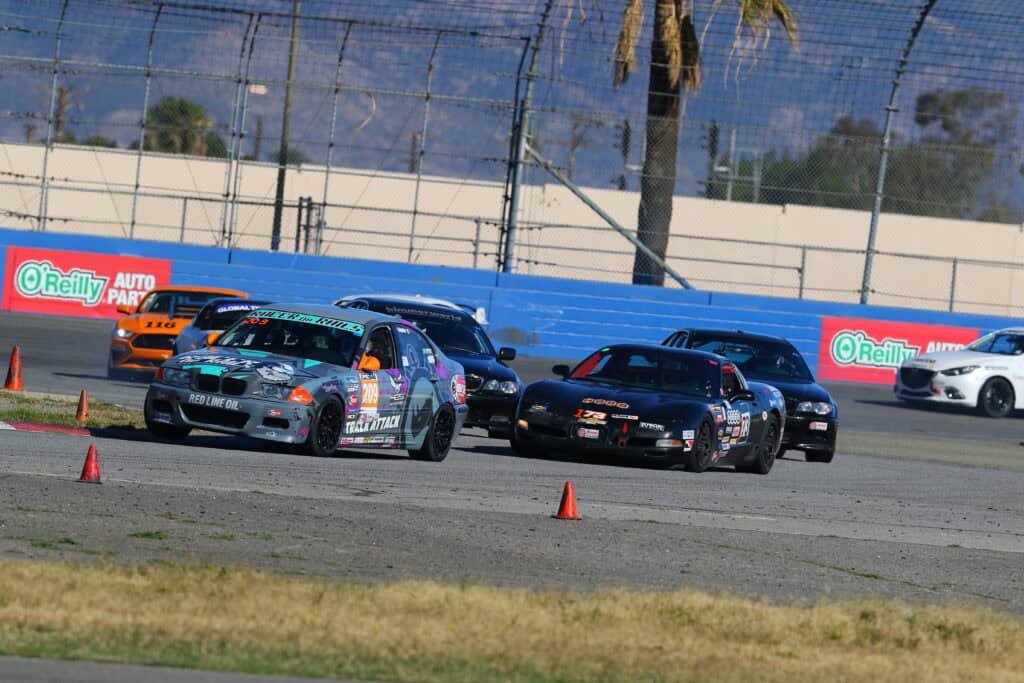
This turned into the most exciting sector of the weekend where we went side by side through the entire oval sector for the last lap and I stayed flat for as long as possible to try to keep the position but Brian had the inside line for the chicane and unless he completely over slowed, it would have been near impossible to keep the position by going around him on the outside.

#12 pulling away on the final lap as the RX7 refuses to go away.

From then on, the RX7 hassled me on another two corners which sealed the deal for Brian. Overall, was a great race and incredible time at our first time as a Racer on Rails team, going to a super speedway and roval course.

Sunday Race Results: 1. Brian Ghidinelli, 2. Gama Aguilar, 3. John Hennessy, 4. Russell Seewald

Thank you to everyone at the SCCA Cal Club, Hoosier Tires and all the volunteers who made this race weekend happen without a single issue and in the middle of a pandemic. THANK YOU!

YouTube player

Speed Nerd Bonus Content: What changed over 1 day?

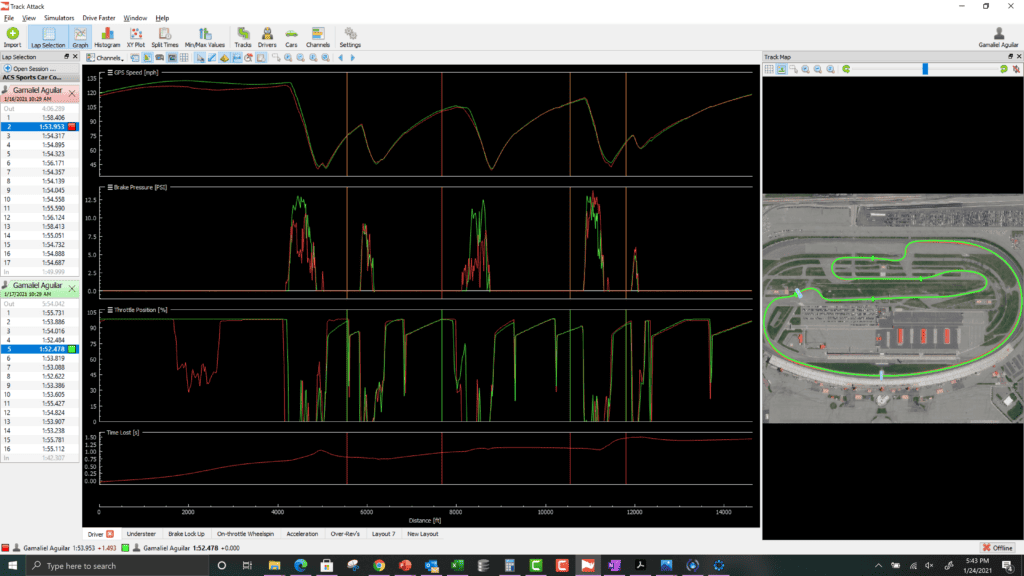
From Saturday to Sunday, the qualifying laps, average race laps and fastest race laps all came down by at least 1.5 seconds. So what happened? Below is a comparison of the fastest race lap time on Saturday versus Sunday. Here’s what we think happened:

  1. More seat time: Saturday was only the third or fifth time any of the RoR drivers had ever driven on the track in real life. Each session would help find more speed.
  2. Staying flat on the oval: Every little bit counts and as we got comfortable with the track, it became clear that you could take it flat every lap and while a little sketchy, it was possible. Just had to believe and trust that it was possible and it appears to have resulted in almost .75 seconds gained before hitting the brakes for the chicane.
  3. Patience on the exit of corners: This is likely tied to #1 but as I understood the track more and more, I started focusing on corner exits – do anything possible to not need to lift or hesitate too much when ascending to full throttle. Still not perfect at all but I think it got much better.
  4. Use that purple crack: The additional grip of these Hoosier A7’s relative to the Toyo RR’s is significant. For example, on sticker tires in the Toyo’s, coming out the hot pits I can drop it into 1st or 2nd gear and light up the rear tires. That was near impossible with the Hoosier tires. I think we got more comfortable with the tires and what they could take under all aspects of a corner. I think we still left grip on the table but that just gives us something to look forward to.
#209 Gama Aguilar Fast Laps from Saturday and Sunday Races

Next up: Circuit of the Americas February 6-7, 2021