Posted on

Portland Hoosier Super Tour Recap: Setup Windows, Mental Unlocks, and a T3 Weekend Sweep

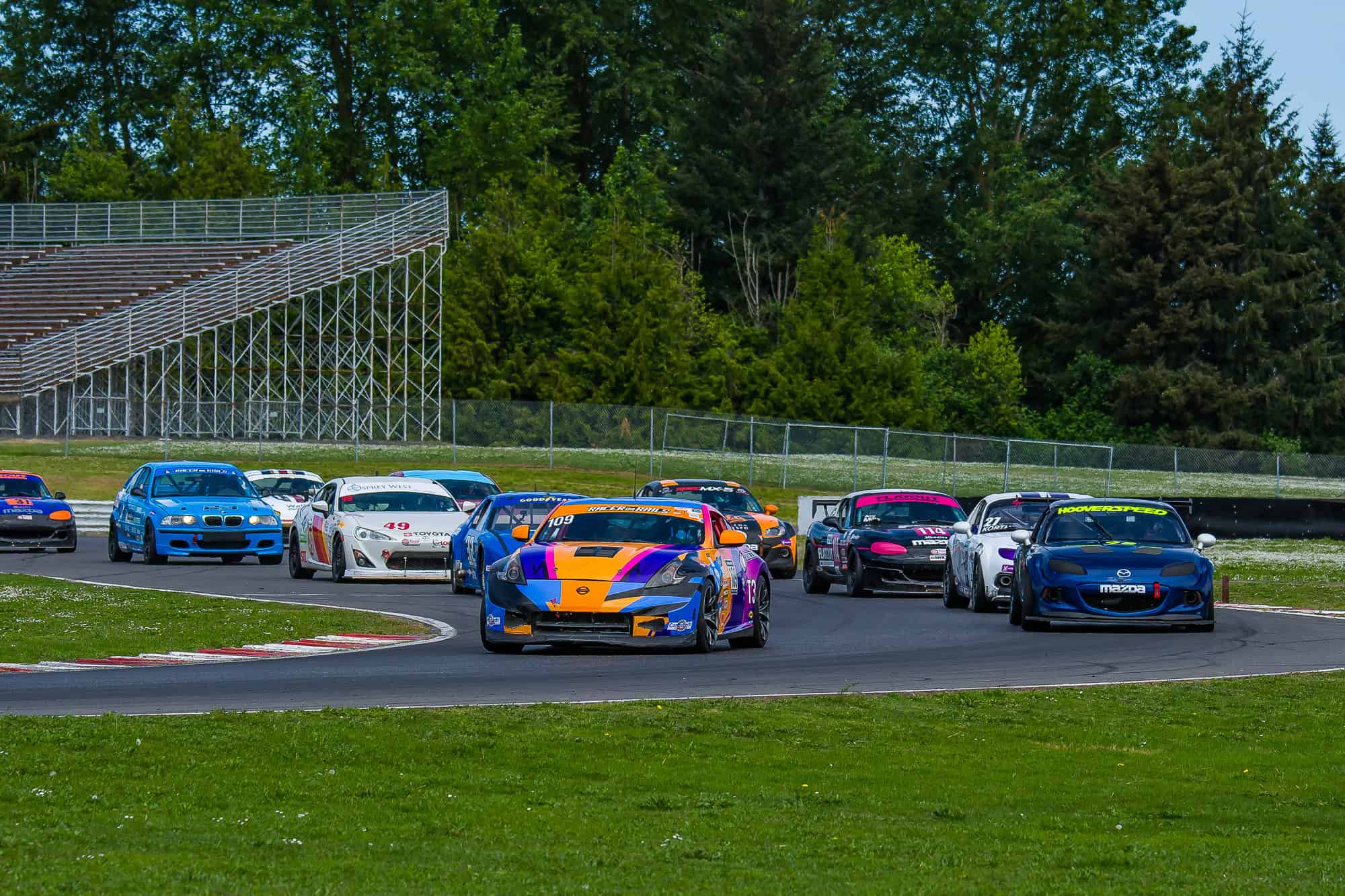
Racer on Rails Nissan 370Z leading a mixed Touring 3 race group through Portland International Raceway during the Oregon SCCA Hoosier Super Tour.
Gama Aguilar-Gamez leads the Touring 3 field in the Racer on Rails Nissan 370Z during the Oregon SCCA Hoosier Super Tour at Portland International Raceway.

The SCCA Hoosier Super Tour is one of the biggest stages in amateur road racing. It is where regional racers, national contenders, Runoffs hopefuls, longtime club racers, and professionally prepared teams all end up in the same paddock, chasing the same thing: speed that holds up when the stopwatch and the field both get serious.

For Racer on Rails, weekends like this matter because they are more than another race on the calendar. They are measuring sticks. They show where the cars are, where the drivers are, where the team is operating well, and where the next layer of performance is hiding.

This round brought us back to Portland International Raceway for the Oregon SCCA Hoosier Super Tour. PIR is a uniquely Northwest kind of racetrack. It sits inside a major city, close to the Columbia River, built on land with real history, surrounded by trees, planes, cyclists, and the strange calm of a public park that also happens to host serious race cars. It is one of those places that feels easy until you try to be fast there.

On paper, Portland looks simple. It is flat, relatively short, and does not have the obvious “monster corner” personality of a place like Road America, Thunderhill, or Sonoma. But that is exactly the trap. PIR asks for precision everywhere. The lap is full of medium-speed commitment, heavy braking moments, curb usage, track-out discipline, and small setup decisions that either build confidence or quietly steal time every lap. If the car is not underneath you, the track exposes it. If the driver is not fully committed, the stopwatch tattles immediately.
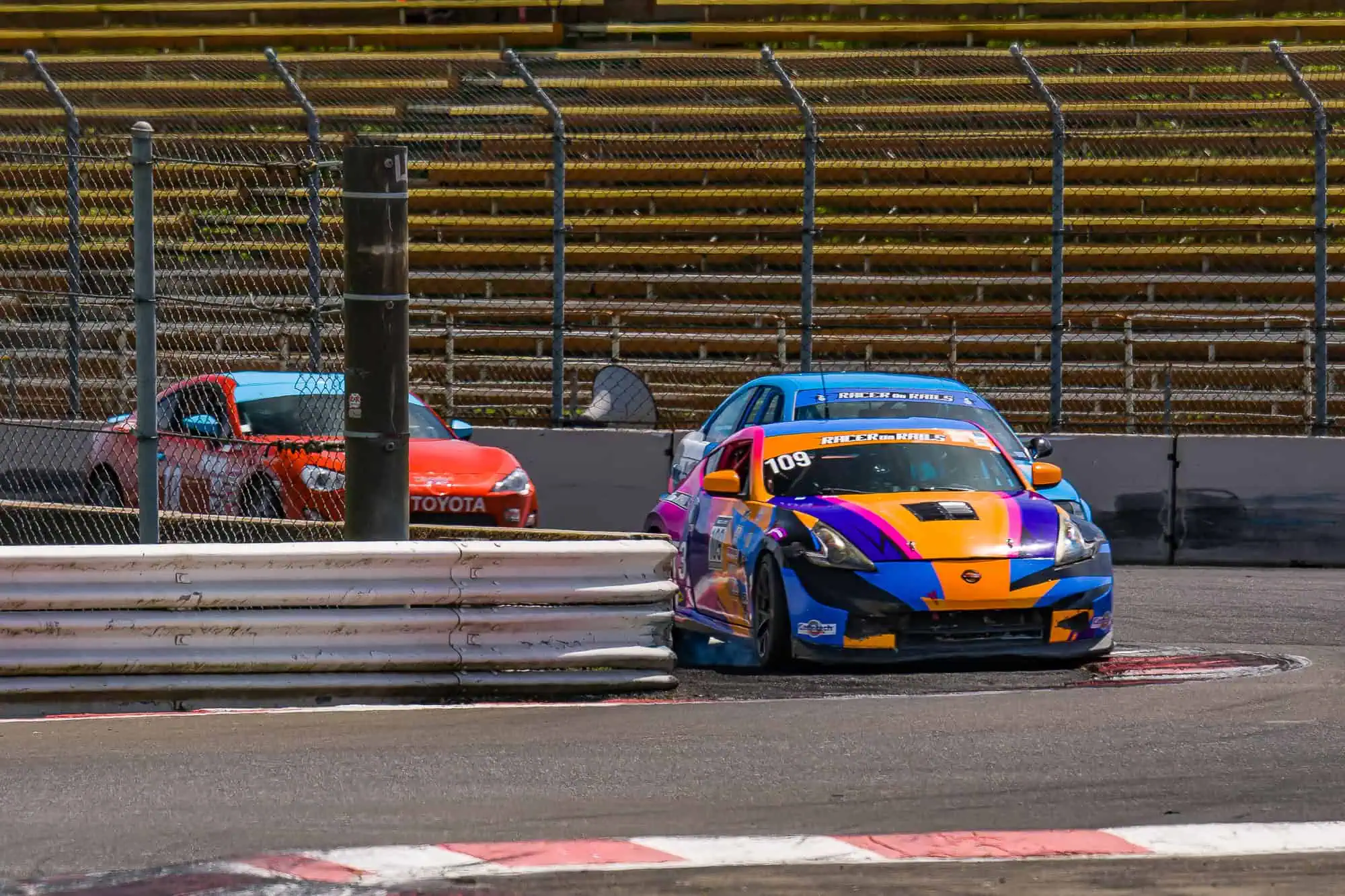
Racer on Rails Nissan 370Z Touring 3 race car driving over the curbing at Portland International Raceway with race traffic behind.  | (C) 2025 Doug Berger | DBPics
The Portland chicane rewards commitment, curb confidence, and a car that stays predictable under braking and turn-in. (C) 2025 Doug Berger | DBPics

Our weekend lineup had a little bit of everything.

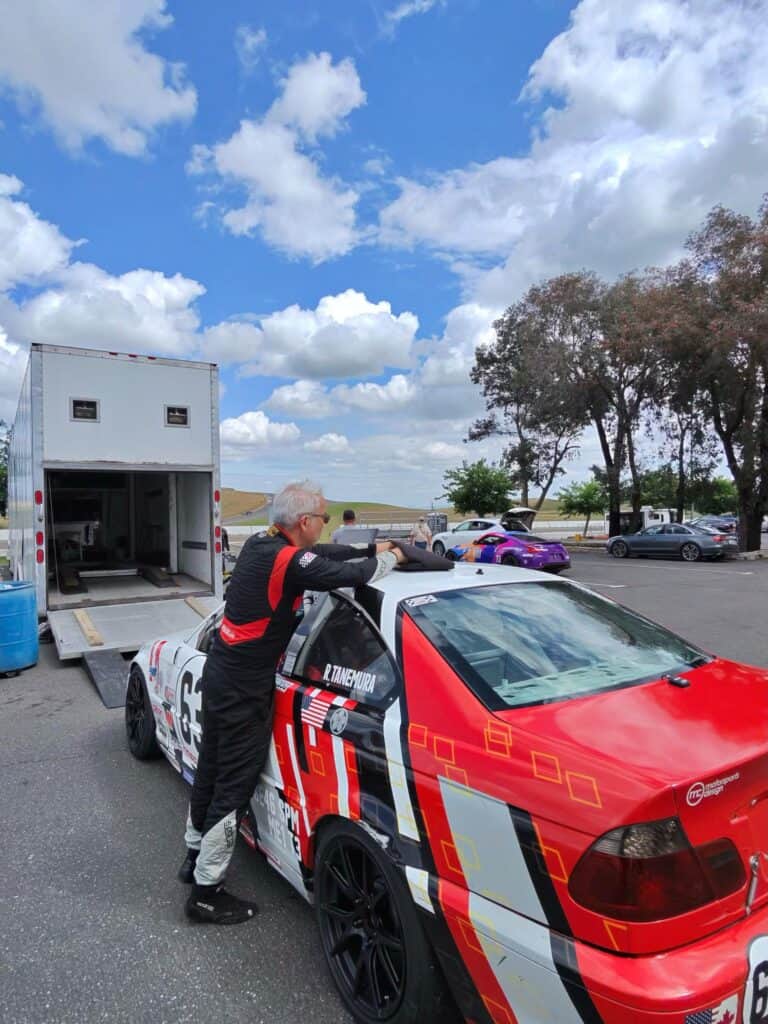
Chris Johnson was back in his Spec E46 in Touring 3 for the first time since last July. Gama Aguilar was in the Nissan 370Z, also in Touring 3, continuing the development push from Thunderhill. Beef Wellington brought out his Touring 2 BMW M240iR. And while Ron Tanemura was not technically in one of our cars, he was still part of the broader Racer on Rails driver development program, racing a Spec Racer Ford Gen3 with Flat Out Racing and continuing to work with Tyler through our coaching services.

Different cars. Different goals. Same weekend. Same stopwatch.

Chris Johnson: Back in the Saddle, Then Fully Lit

Chris started the weekend exactly where you might expect after nearly a year away from the car: knocking the dust off.

The Spec E46 was on older tires, Chris was rebuilding rhythm, and the first part of the test day was about getting reconnected with the car. Braking points. Corner entries. Trust. References. The little internal checklist every driver has to rebuild after time away.
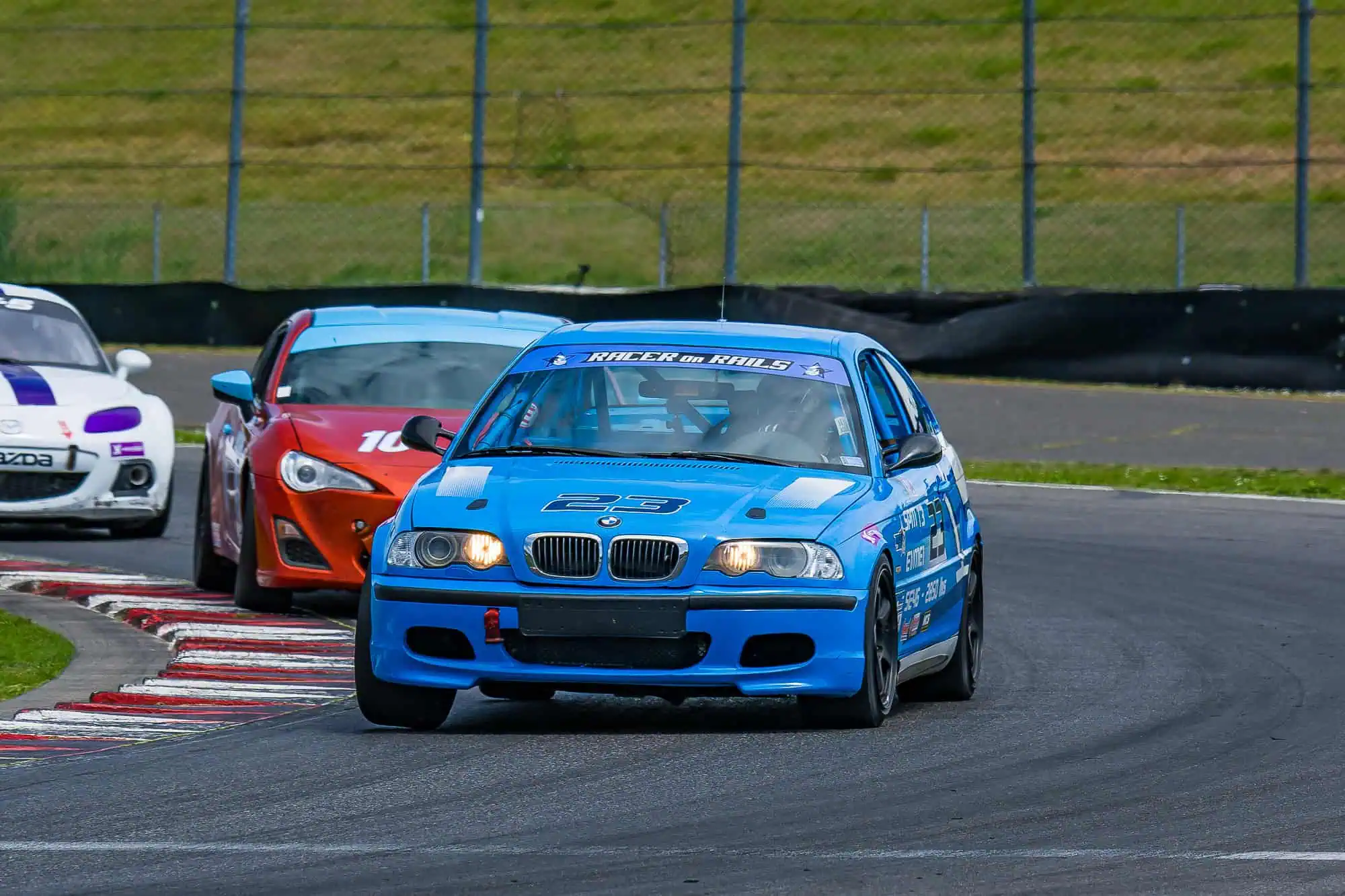
Chris Johnson driving the blue Racer on Rails BMW Spec E46 Touring 3 race car through Portland International Raceway with race traffic close behind.
Chris Johnson returned to the seat of his Spec E46 in Touring 3 and spent the weekend rebuilding rhythm, confidence, and pace. (C) 2025 Doug Berger | DBPics

By the end of the first test day, though, the fog was clearing. Even as the track got hotter and conditions worsened, Chris started closing back in on his personal best lap times. That was the first sign that the speed had not gone anywhere. It was still there, sitting under the surface, waiting for him to believe it was available again.

The next day, we had one of those conversations that matters more than a shock adjustment or tire pressure change.

Chris was talking through what he was feeling in the car, but underneath the words were a few limiting thoughts. Not excuses. Not weakness. Just the normal stuff drivers tell themselves when confidence is still a lap or two behind capability.

The conversation was about the things we tell ourselves. What we accept as true. What we assume is possible. What we decide is “about where we are” before the car and the data have actually said that.

Something clicked.

In Saturday’s race, Chris came alive. He got pulled into a tight battle with a few out-of-class cars that were absolutely flying, and that extra competitive energy did exactly what a good race battle should do. It sharpened him. It pulled his eyes forward. It made him stop driving the idea of the lap and start racing the car in front of him.

The result was a major unlock. Chris knocked roughly a second from his previous bests and started driving with the kind of intent we knew was still there.

Sunday morning, he was determined to prove Saturday was not a one-off. He wanted to build on the confidence instead of simply enjoy the memory of it.

He did.
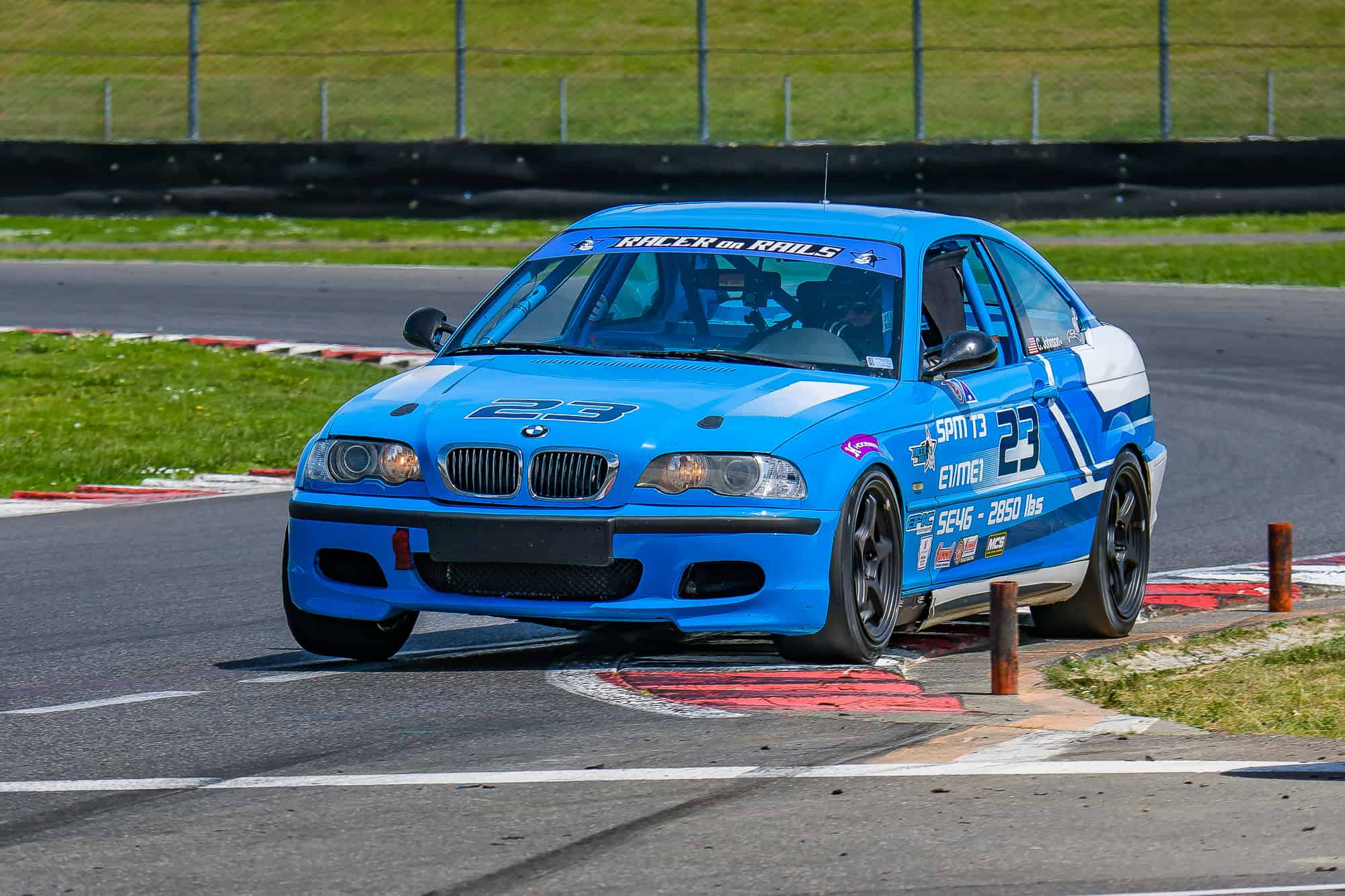
Blue Racer on Rails BMW Spec E46 Touring 3 race car using the curbing at Portland International Raceway during the Oregon SCCA Hoosier Super Tour.
By Sunday, Chris was driving with more commitment and using the confidence from Saturday’s race to unlock another step forward. (C) 2025 Doug Berger | DBPics

In Race 2, Chris carried the lessons forward. He cleared the cars he had been battling with on Saturday and found himself racing farther up the field, with new competition and a new target. That is always one of the best signs in driver development: yesterday’s mountain becomes today’s baseline.

The wild part? He did all of this while nursing an engine that had given us a scare on Friday. Chris had an over-rev, followed by white smoke out the tailpipe. Jordan kept a close eye on the car for the rest of the weekend, and thankfully it made it through without getting worse.

So yes, Chris had a big weekend on the stopwatch. But the bigger unlock was mental. This was a driver remembering that confidence is not something you wait around to receive. Sometimes you have to go take a bite out of the lap and let the confidence catch up.
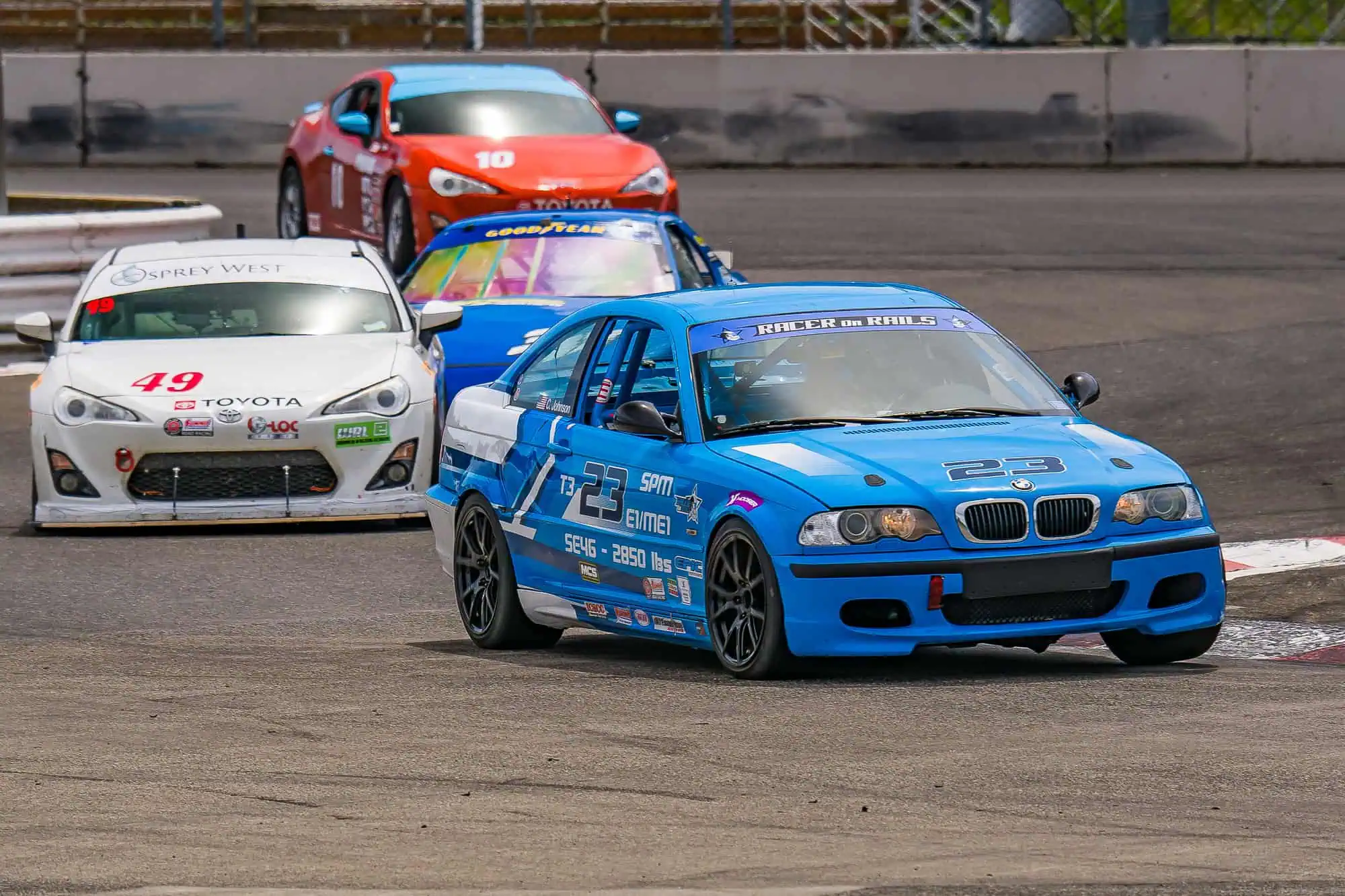
Chris Johnson driving the blue Racer on Rails BMW Spec E46 Touring 3 race car ahead of race traffic at Portland International Raceway.
Chris found himself racing harder, cleaner, and farther up the field as the weekend progressed. (C) 2025 Doug Berger | DBPics

Beef Wellington: A Short Weekend, But the Right Call

Beef’s weekend ended earlier than anyone wanted.

The BMW M240iR had a solid shakedown at Pacific Raceways the week before, so we came into Portland expecting to continue learning the car and building momentum. Instead, the car started overheating after only four or five flying laps.

At first, it looked like the usual race-car mystery novel: temperatures okay, then suddenly not okay. The car would run fine, then start building too much coolant pressure and blow through the expansion tank valve.

The team worked through the problem methodically. Cooling system. Pressure behavior. Failure pattern. Repeatability. The ugly little clues all started pointing in the same direction.

Head gasket.

Mega bummer.

That is never the way we want a weekend to end, especially with a new-to-him but still used/junkyard engine. But there is a version of this story that is much worse. We caught it before destroying the whole engine, avoided turning a repair into a full-scale catastrophe, and got the car pointed toward the work needed before June Sprints at Road America later in the month.

Sometimes race weekends are about trophies. Sometimes they are about knowing when to stop digging.

This was the right call. Not fun. Not glamorous. But right.

Ron Tanemura: Expanding the Driving Toolbox

Ron’s Portland weekend had a different purpose.

He was in a Spec Racer Ford Gen3 rental with Flat Out Racing, while continuing to work with Tyler as part of the Racer on Rails coaching program. The goal was not simply to jump in a new car and chase a number. The goal was to expand his driving range.

That matters.

Ron has been intentionally building a broader driving education. Different platforms. Different sensations. Different demands. The SRF3 is a very different animal from a BMW sedan. It is lighter, more direct, more exposed, and less forgiving of half-commitment. It wants clearer inputs. It rewards decisiveness. It asks the driver to be comfortable with the car moving underneath them.
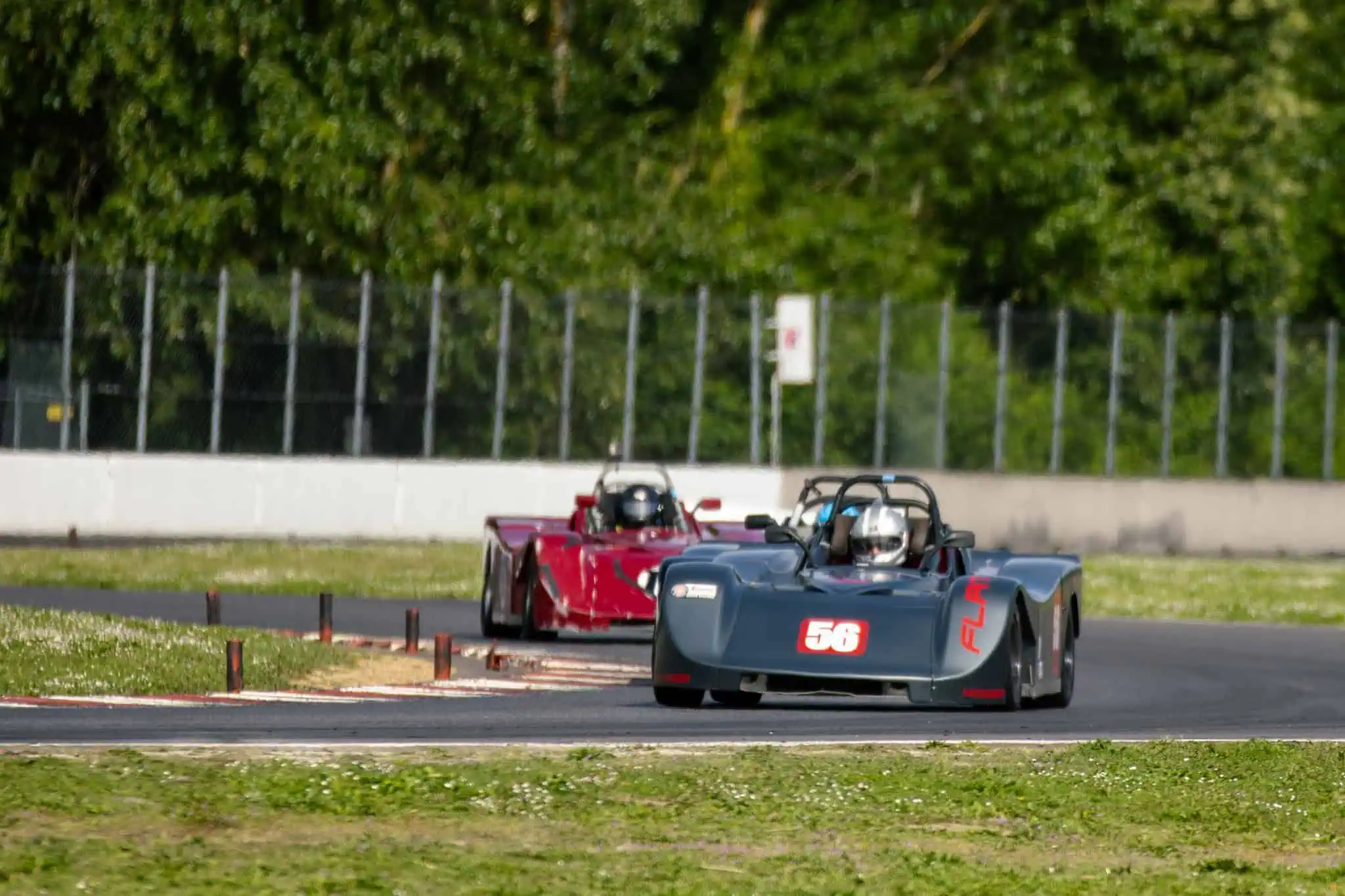
Ron Tanemura driving a black Spec Racer Ford Gen3 through Portland International Raceway during an SCCA race weekend.
Ron Tanemura used the Spec Racer Ford Gen3 weekend to expand his driving range and build a new real-car baseline. (C) 2025 Doug Berger | DBPics

For Ron, the weekend established something important: racing the SRF3 is viable for him. He handled the starts well, showed good awareness, avoided major self-inflicted issues, and built a baseline he can come back to.

The next layer is not secret. It is also not simple.

It is about closing the gap between understanding and execution. Ron has done real work in the sim. He knows a lot of the “recipe” for the car and track. But the real car adds sensation, consequence, tire feel, traffic, imperfect references, and the pressure of being around other drivers. That gap between knowing and doing is where driver development actually lives.

The coaching takeaway was clear: more commitment, more decisive brake release, clearer throttle discipline, more willingness to let the car rotate, and more assertive racecraft once the race settles in.

That is exactly why this was a valuable weekend. Ron did not just collect laps. He collected a sharper understanding of what the next phase of work needs to be.
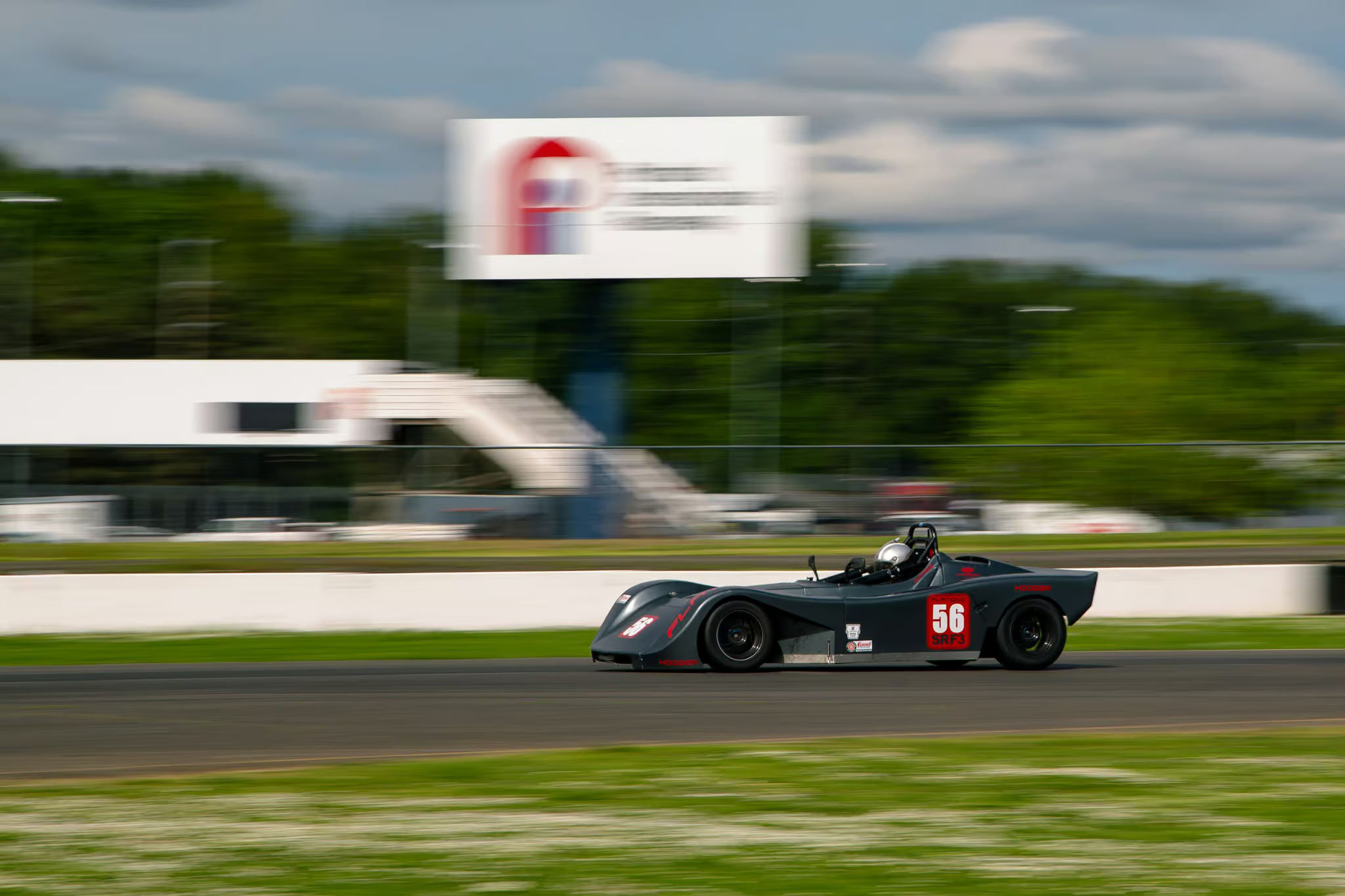
Black Spec Racer Ford Gen3 race car speeding past the Portland International Raceway front straight during an SCCA race weekend.
A new car, a new rhythm, and another layer in Ron’s broader driver development plan. (C) 2025 Doug Berger | DBPics

And that is the whole point of a driver development plan. Not every weekend is supposed to be a finished product. Some weekends are supposed to reveal the next door.

Gama Aguilar: Engineering the Window

For Gama and the Nissan 370Z, Portland was about building on the lessons from Thunderhill.

At Thunderhill, we had speed, but we were still fighting the car. The Z had pace in flashes, but it was not yet living in a consistent, repeatable window. Under braking and turn-in, the car still had moments where it felt like it was asking for trust without giving enough trust back.

Before Portland, Ian spent a full week digging into the chassis, working through an engineering workbook, checking assumptions, and giving the car the kind of measured attention that separates guessing from development. We are not going to give away every detail of what we found, but the big picture was clear: there was systemic pace hiding in the car.

That was the unlock.

This was not about finding one magic adjustment or chasing a one-lap setup. It was about understanding the car at a deeper level, getting it into a healthier operating window, and creating a foundation we could actually build on across a full weekend.

From there, we reset the approach. The chassis setup moved in a better direction. The car became more predictable. We switched to nitrogen in the tires, including multiple purge cycles to reduce the influence of air and moisture. Then we started fresh on understanding pressure build, temperature behavior, and how to keep the tire in a usable window from the first hard lap to the last.

That became the real work of the weekend.

Not “what makes one fast lap?” but “what makes the car fast, repeatable, and trustworthy every time we lean on it?”

By Friday, the difference was obvious. For the first time ever in the 370Z, we could push the car hard every session and have it respond the same way. The car was no longer giving us a narrow little keyhole of performance. It gave us a window. And once we had a window, we could finally start doing real race-car work.
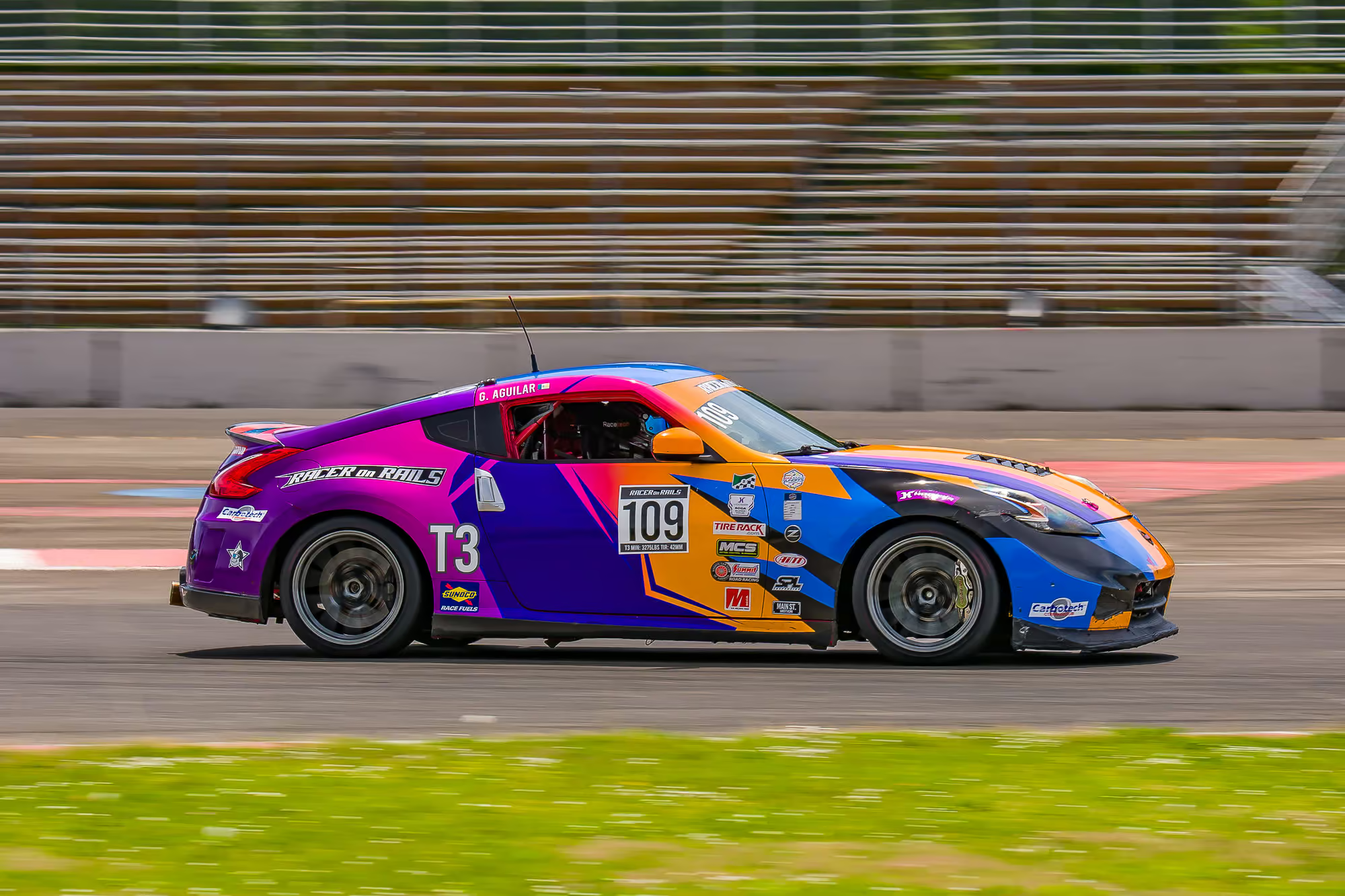
Side profile of the Racer on Rails Nissan 370Z Touring 3 race car at speed on the front straight at Portland International Raceway.
After ride height, suspension geometry, nitrogen, and tire pressure work, the 370Z finally delivered a repeatable setup window. (C) 2025 Doug Berger | DBPics

That is a big deal.

The official Race 1 time cards showed the progress starting to show up on paper, with the #109 370Z quickly moving from a 1:26.946 opening lap into a 1:24.759, then a 1:24.526, then a 1:24.701. More important than the single lap was the shape of the run. The car stayed in the window. The laps stayed usable. The team finally had a platform we could tune instead of survive.

By the race weekend, we were fine-tuning instead of firefighting.

The result was an easy Touring 3 pole, a Saturday T3 win, and then another T3 win on Sunday to complete the weekend sweep.

Saturday was not without drama. At the start, there was unnecessary contact with the STU pole sitter that could have ended the race before it properly got going. Thankfully, the Apex forged wheel took an absurd hit and somehow held on. The car survived, the tire held, and we were able to finish.
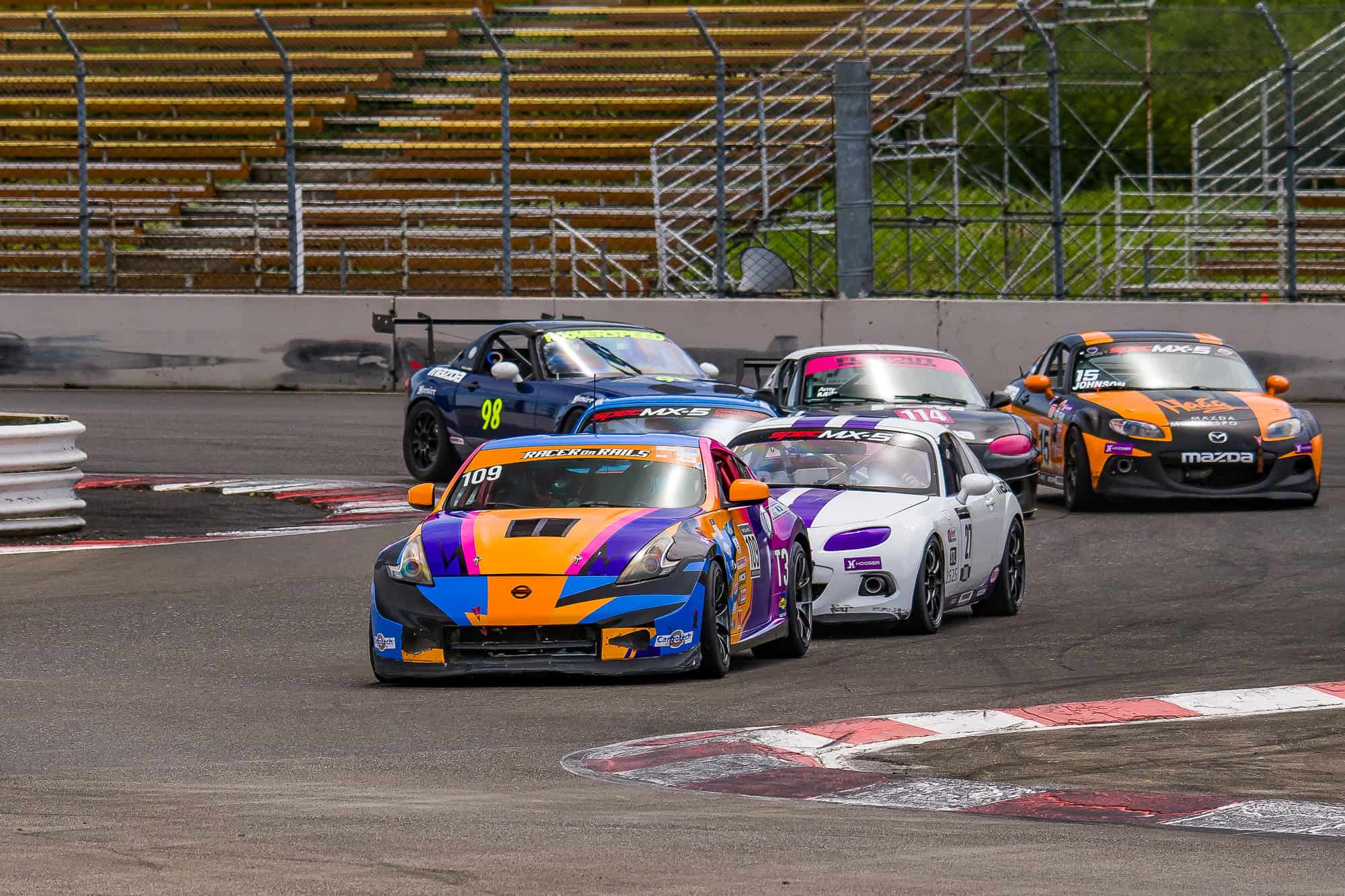
Racer on Rails Nissan 370Z leading a tight pack of race cars through the Portland International Raceway chicane during the SCCA Hoosier Super Tour.
Saturday’s race had contact, traffic, and plenty of chicane chaos, but the 370Z stayed together and brought home the Touring 3 win. (C) 2025 Doug Berger | DBPics

On Sunday, we replaced the damaged wheel and tire, put our heads down, and went for a maximum race-pace push.

That was the most encouraging part of the weekend. Not just winning. Not just getting through the races. But seeing that the car had pace in conditions that were not perfect. The overcast morning cloud cover had burned off by the time our Sunday race started, the track was warmer, and the car still had the ability to push toward the kind of pace we have seen from some of the strongest Touring 3 drivers at this event in prior years.
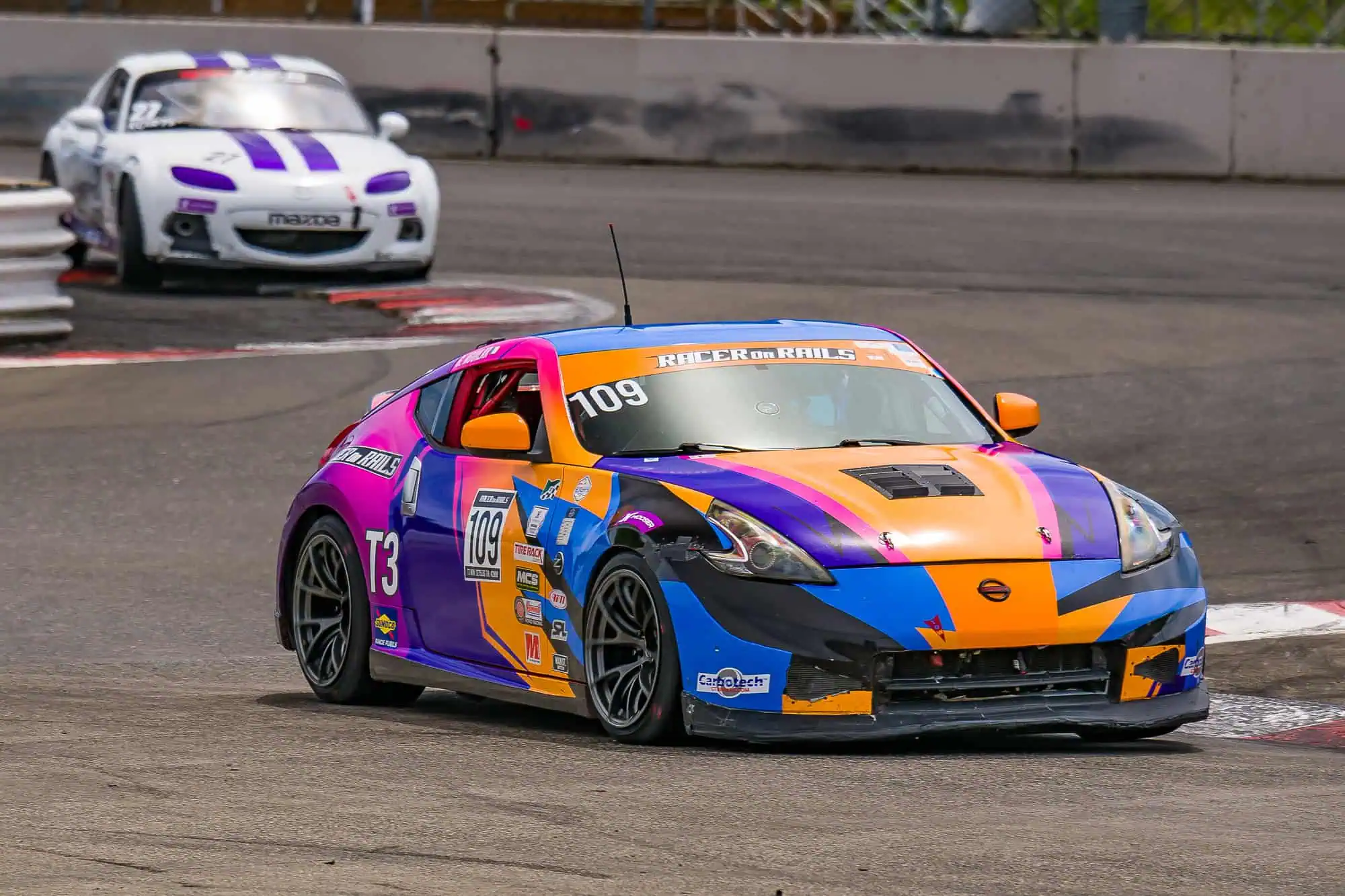
Gama Aguilar-Gamez driving the Racer on Rails Nissan 370Z Touring 3 race car through Portland International Raceway with a Spec MX-5 behind.
The weekend’s biggest win was not just the result. It was finally having a 370Z that could be leaned on lap after lap. (C) 2025 Doug Berger | DBPics

That is the good stuff.

The kind of weekend where the notebook matters as much as the trophy.

The Team Behind the Weekend

Like most race weekends, Portland had its share of curveballs.

Jordan’s personal car broke down on the way to Portland. Beef’s M240iR tried to turn Friday into a cooling system crime scene. Chris’s Spec E46 had to be monitored all weekend after an over-rev and smoke. The Z needed continued tuning and then a wheel/tire change after race contact.

None of that is unusual in racing. That is the job.

What mattered was how the team responded.

Ian’s engineering work before the event gave the Z a new foundation. Jordan kept Chris’s car alive and monitored. Tyler continued guiding drivers through both technical and mental development. The crew absorbed the chaos, kept working the problems, and moved the weekend forward.

That is what we want Racer on Rails to be.

Not just a shop that brings cars to the track. A team that develops cars, develops drivers, solves problems, and helps people leave the weekend with better tools than they arrived with.

Portland gave us a lot.

A Touring 3 weekend sweep for the 370Z. A major mental unlock for Chris. A hard but smart diagnostic call on Beef’s BMW. A valuable SRF3 baseline for Ron. A stronger engineering process for the team. And a reminder that race weekends are rarely clean, but they can still be deeply productive.

We left Portland feeling like the whole program moved forward.

Goals. Smiles. Memories. LFG.
Posted on

SCCA US Majors Tour – Thunderhill 2026 – The Last Stop South

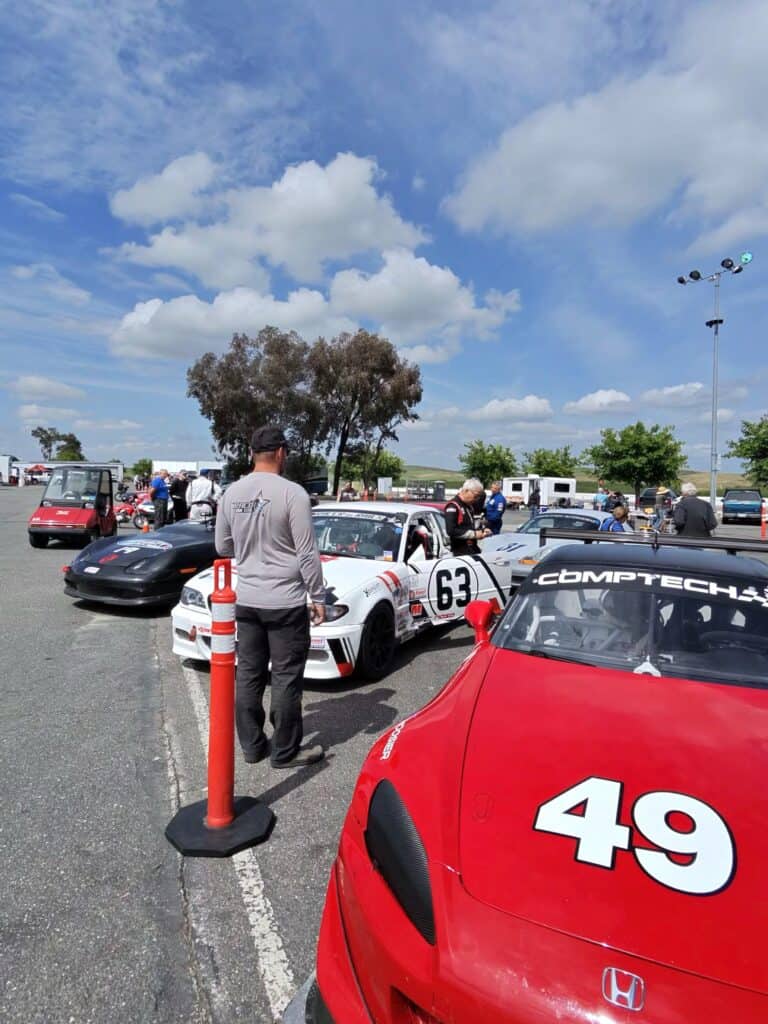
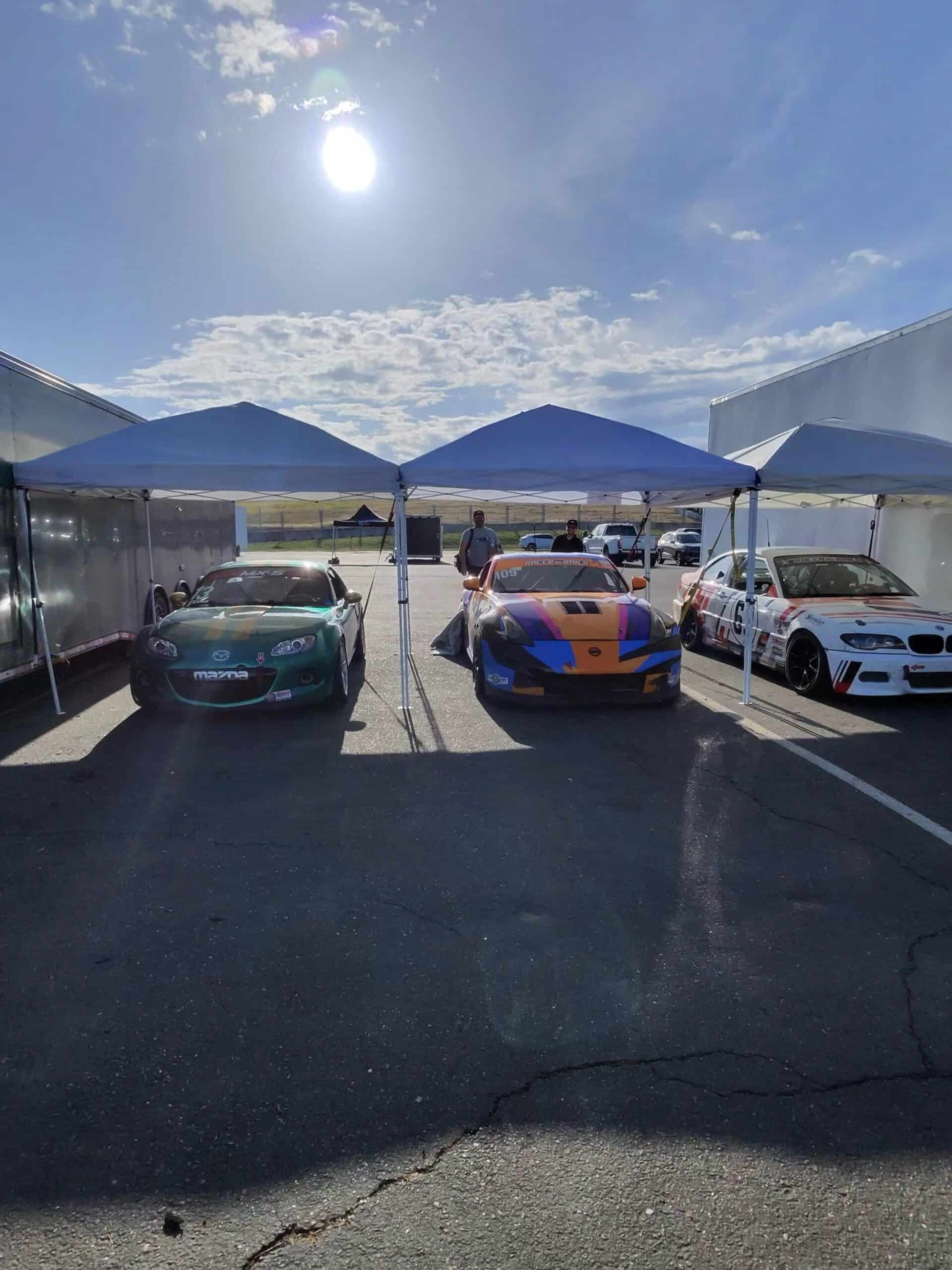
Racer on Rails paddock'ed at Thunderhill Raceway Park

In late April, we wrapped up the final stop of our early-season West Coast racing trip with the 2026 SCCA U.S. Majors Tour at Thunderhill Raceway Park.

This trip started in February at Buttonwillow’s new “The Circuit” layout, continued through a NASA NorCal weekend at Sonoma Raceway, and finished at Thunderhill before the cars, hauler, and team made the long drive back to the Pacific Northwest.

For anyone newer to club racing, the SCCA U.S. Majors Tour is one of the national-level competition paths within the Sports Car Club of America. It brings together strong regional and national drivers, gives racers a chance to measure themselves against deeper fields, and, for many drivers, forms part of the path toward the SCCA National Championship Runoffs.

Thunderhill is always a fun place to end a trip like this. It has elevation, fast commitment corners, technical braking zones, and enough rhythm changes to keep a driver honest. For this event, we ran the Crows Nest configuration, which adds its own personality to the lap and rewards drivers who can stay patient, committed, and precise.

For Racer on Rails, this weekend had two main drivers:

Gama Aguilar-Gamez in the No. 109 Nissan 370Z, competing in Touring 3

Ron Tanemura in his BMW Spec E46, competing in Touring 3 and STU

On paper, it was another race weekend. In reality, it was exactly the kind of weekend that shows why we love this sport so much. There were clear goals, real progress, hard-earned smiles, and a few memories that will probably get retold in the paddock for a long time.

Why We Were There

Every driver came into Thunderhill with a different mission.

For Gama, the weekend was an important step in the 2026 Runoffs journey. To qualify for the SCCA National Championship Runoffs, drivers need to complete the required number of race weekends and race finishes. After completing two races earlier in the season, Thunderhill became a critical opportunity to add two more finishes and move much closer to locking in the qualification path.

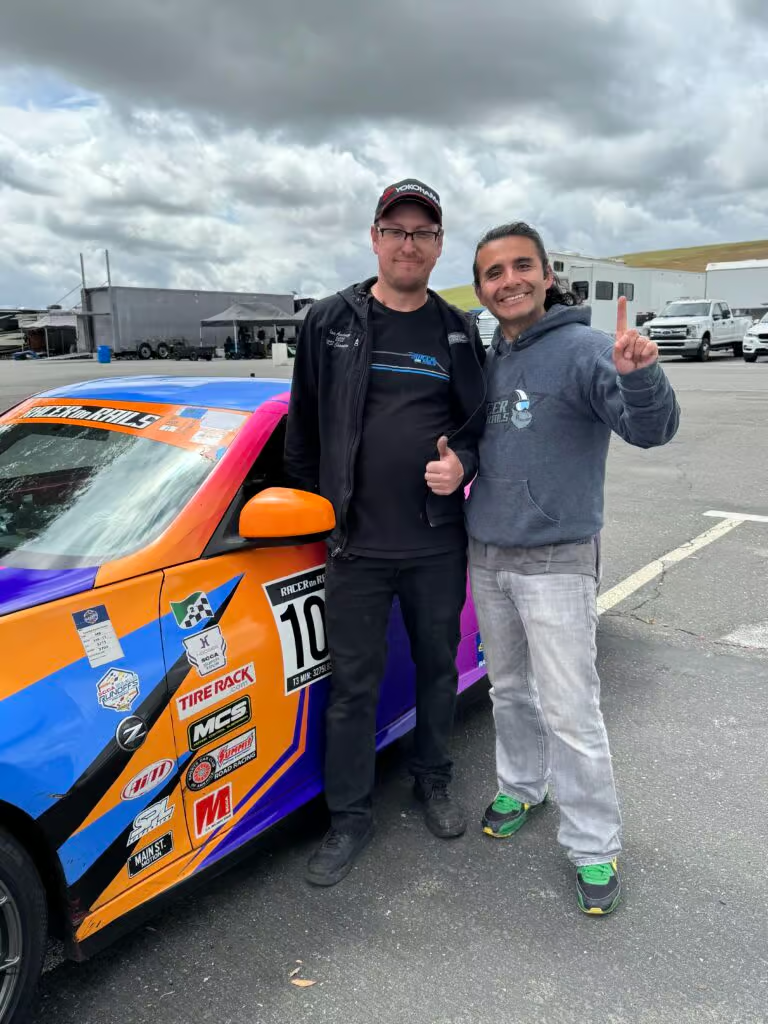
Ron Tanemura never stops looking for opportunity!

But the weekend was not just about checking a box.

The 370Z is still a car we are actively developing. It has shown strong pace, but like most serious race cars, especially one being pushed toward national competitiveness, the work is never really finished. Reliability, braking behavior, tire temperature, chassis balance, setup range, and driver confidence all remain part of the larger development puzzle.

For Ron, the goal was different but just as important.

Ron’s bigger mission this year is driver development. Not just getting faster in one car, at one track, in one situation, but becoming more adaptable, more trusted, and more complete as a driver.

A big part of that is variety. Different tracks. Different race groups. Different cars around him. Different levels of pressure. The long-term target is for him to be the kind of driver who can step into different racing environments, learn quickly, run cleanly, stay close enough on pace, and be trusted by the people around him.

That does not happen by accident.

It happens by putting yourself in new situations, then doing the work to understand them. It happens by learning how to drive a car when it moves around underneath you. It happens by getting comfortable being uncomfortable.

Thunderhill gave Ron exactly that kind of opportunity.

Ron’s Weekend: Raising the Baseline

Ron came into Thunderhill with a very clear goal: build on last year, get more comfortable with the car moving underneath him, and leave with a higher baseline as a driver.

That is one of the things we love about working with Ron. He is not just chasing a result. He is actively working on his craft. He pays attention to what the car is doing, what he is doing, and where the next layer of performance might be hiding.

Thunderhill gave him a perfect environment for that.

Last year, Ron’s best lap at Thunderhill was a 2:06.24. This year, he came close with a 2:06.46. On paper, that means he did not beat his previous personal best. But the timing sheet does not tell the full story.

The bigger win was consistency.

Last year, Ron had one lap in the 2:06 range, one lap in the low 2:07 range, and a handful of laps in the 2:08s. This year, he had five laps in the 2:06s, eight laps in the 2:07s, and seventeen laps in the 2:08s.

That matters.

A single fast lap is fun. A higher baseline is progress.

Ron’s own takeaway from the weekend was that he did not feel quite as “on it” as he did at Sonoma, but he was close enough to feel like his pace is becoming more real and more repeatable. That is exactly the kind of step we want to see from a developing driver.

The biggest learning was around car control.

Post session – getting that Chequered flag for Ron!

When Ron was faster, the car was moving. It was rotating. He was catching it, correcting it, and working with it instead of waiting for the car to feel perfectly settled. During Friday testing, especially in the later sessions, he started getting more comfortable with that feeling. The next challenge is learning how to access that level of commitment earlier in a session, instead of needing several laps to build into it.

That became one of his biggest themes from the weekend: push earlier, trust the car sooner, and learn to drive closer to the limit on demand.

Saturday showed that progress.

In his first Touring 3 qualifying session, Ron was quick and consistent, including a run of laps in the 2:06s before the session ended. Later, in his second qualifying session, he was fast immediately after the restart, showing that the pace was starting to become easier to access.

The races gave him a different kind of experience.

In Touring 3, Ron finished second in class. It was a solid result, but he did not have as much direct class competition around him as he would have liked. At Sonoma, he had more sustained battles, and Thunderhill was a little quieter in that regard.

But the weekend still gave him valuable race craft notes.

He worked on starts. He worked on positioning. He got reminders about following closer before the green, not over-defending Turn 1 when there is an opportunity to open the gap, and using commitment through fast corners to set up passing opportunities later in the lap.

Then Sunday threw the team a curveball.

During Touring 3 qualifying, Ron quickly realized he had lost fourth gear. The transmission needed to be replaced, and the clock was not exactly being generous.

Thankfully, we had a spare transmission available.

The team looked at the schedule and knew it was going to be tight, but there was still a chance to get Ron back out for the STU race later that afternoon.

There was also something special waiting at the end.

At SCCA Majors events, class winners often receive more than a trophy. This event was hosted by the San Francisco Region, and the class-win flags were a cool keepsake from the weekend.

So we made the call: let’s get Ron that flag.

The team jumped on the transmission swap, got the car buttoned up, warmed up, checked over, and ready. Ron made it to the race.

And he delivered.

He finished third overall in Group 2, won STU, and brought home the flag.

But the real story was not just the flag. It was the full arc of the weekend: clear goals, honest self-assessment, measurable progress, a mechanical setback, a team thrash, and one more chance to go race.

That is the kind of weekend that builds a driver.

Gama’s Weekend: Runoffs Progress and More 370Z Development

For Gama, Thunderhill was about two things: continuing the Runoffs qualification path and continuing to develop the No. 109 Nissan 370Z into a nationally competitive Touring 3 car.

This was only the second full race weekend of the season for the Z, and we came in with some important new learning.

Before the event, Tyler spent time with our partners at Motion Control Suspension to better understand the internal behavior, adjustment range, and service considerations of our three-way dampers with external reservoirs. The details matter, and we came away with more tools in our toolbelt that have helped us start fine tuning the car’s behavior.

For a car like the 370Z, which has shown both pace and some sensitivity around braking behavior and tire temperature management, that kind of learning matters. We have been trying to understand how to make the car more compliant, more consistent, and easier to extract speed from over a full race distance.

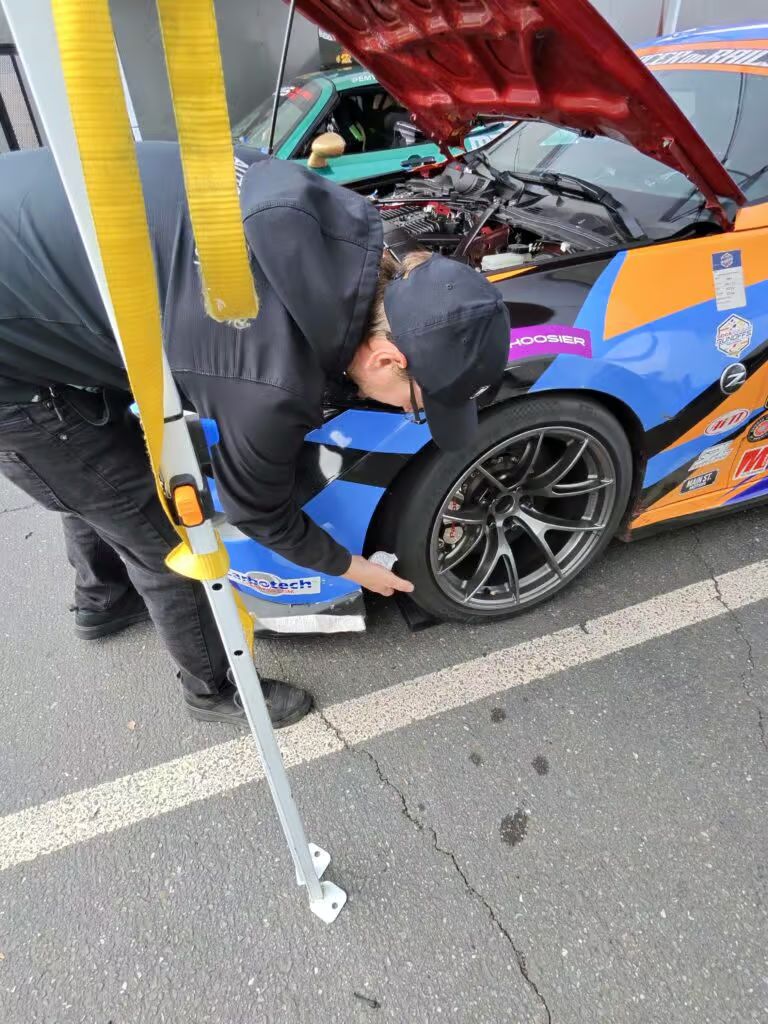
Ian Anderson getting the tire pressures dialed in before a session

The goal was not to find one magic adjustment. Race cars rarely work that way.

The goal was to understand the platform better, continue chipping away at reliability concerns, give the driver a car that communicates more clearly, and keep moving the program forward with discipline.

That is the unglamorous part of race car development. It is not always fireworks. Sometimes it is pressure checks, damper notes, tire readings, brake feel, driver feedback, and the quiet little decisions that add up to real progress.

Thunderhill gave us more of that.

On Saturday, Gama finished fifth overall in Group 1 and first in Touring 3, with a best lap of 2:02.789. That result mattered for the points and the Runoffs path, but it also showed that the 370Z had real speed in the class.

On Sunday, the priority was clear: finish the race, keep stacking Runoffs qualification progress, and bring the car home. Gama finished fourth overall and again first in Touring 3, adding another strong finish to the season.

That's another P1 sweep of a race weekend for Ian, Gama, and the Nissan 370z in SCCA Touring 3
That’s another P1 sweep of a race weekend for Ian, Gama, and the Nissan 370z in SCCA Touring 3

Just as importantly, the weekend helped validate some of the direction we are taking with the chassis. The car became easier to work with, more predictable, and more useful as a development platform.

For Gama’s season, the biggest objective was to continue stacking the race finishes needed for Runoffs qualification. In that sense, the weekend did exactly what it needed to do.

For the car, it gave us more data.

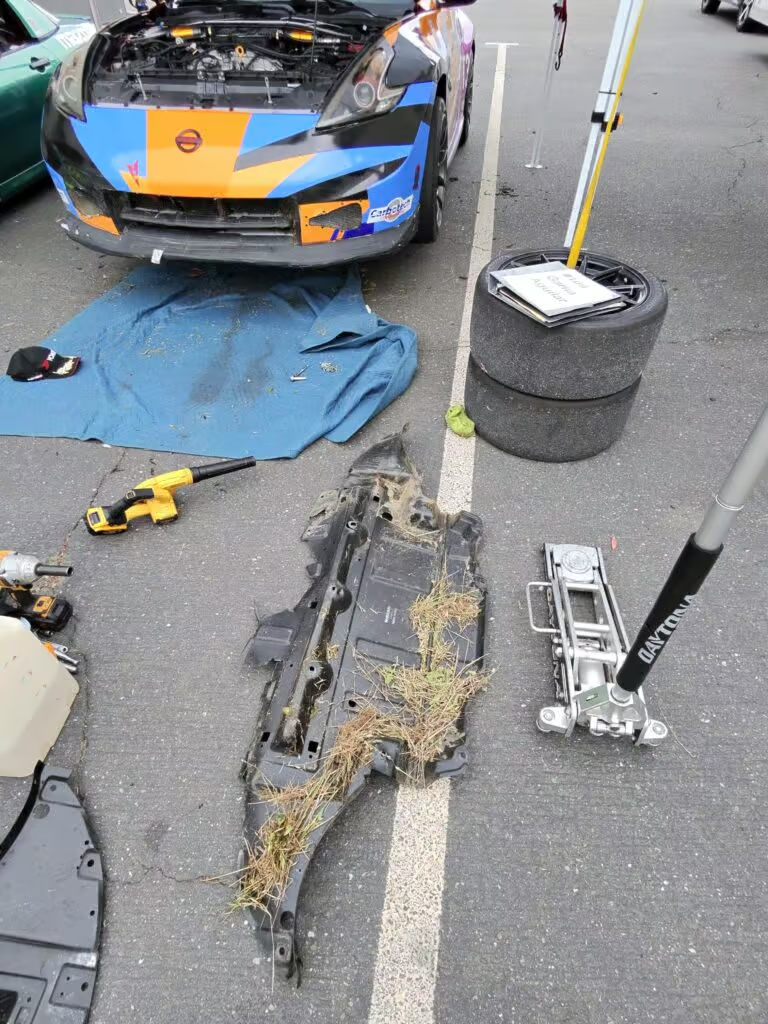
It’s not all roses and daisies when chasing speed. Sometimes you find yourself in the grass…

For the driver, it gave more confidence.

For the team, it gave another reminder that the path to national-level competitiveness is built one weekend, one session, and one decision at a time.

The Bigger Picture

The easy version of a race recap is to talk about qualifying positions, lap times, race results, and trophies.

Those things matter. We care about them. We work hard for them.

But the best weekends usually have another layer.

Ron’s weekend was a perfect example. He hit the goals he came in with, but still left wanting more. That is a good place to be. He raised his baseline, got more comfortable with the car moving, built more race craft notes, identified where the next step is, and still came home with a class win flag after the team thrashed to get him back on track.

Gama’s weekend was different, but connected. The 370Z program took another step forward, the Runoffs path became more achievable, and we continued learning how to get more out of the platform without losing sight of reliability and drivability.

That is the heart of what Racer on Rails is becoming.

Yes, we prepare race cars. Yes, we support race weekends. Yes, we care deeply about setup, reliability, data, execution, and all the thousand little details that make a race car work.

But ultimately, we are here to help drivers become better drivers.

Sometimes that means building a faster car. Sometimes that means making a car easier to trust. Sometimes that means helping a driver understand what they are feeling. Sometimes that means creating the right environment for a driver to stretch, learn, and come back wanting more.

We want to help people set goals that matter to them, whether that is winning a national championship, earning a Runoffs invite, becoming more comfortable with car control, developing race craft, or simply leaving the track knowing they took a real step forward.

That is why weekends like Thunderhill matter.

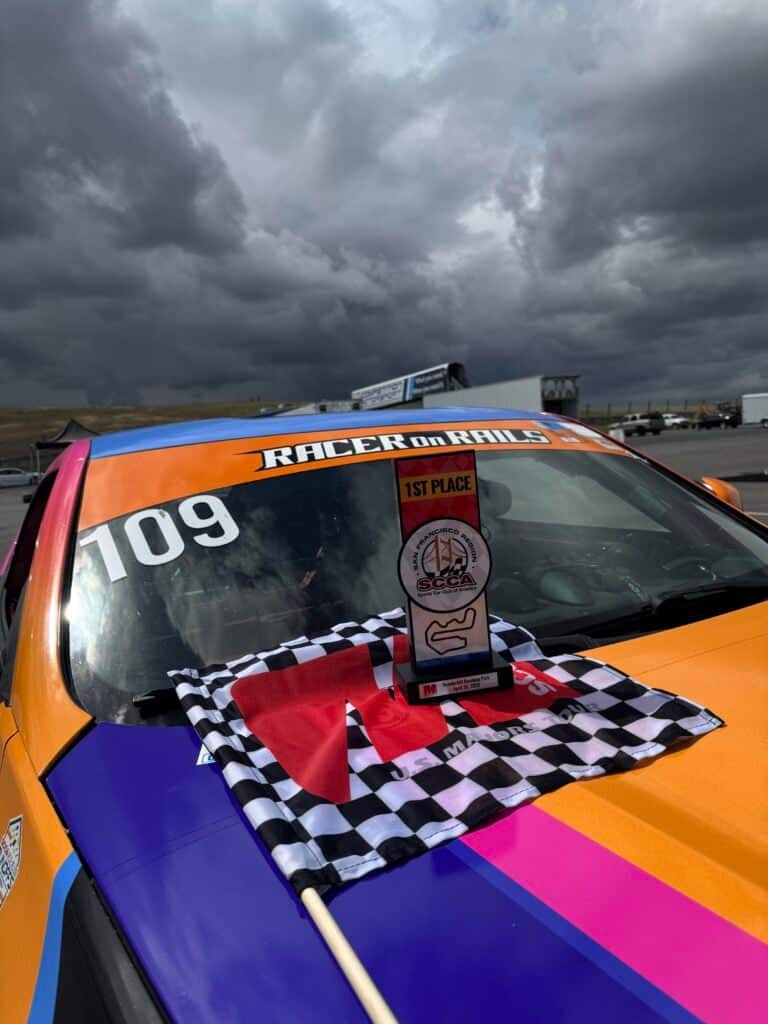
P1 both races in SCCA Touring 3 and collecting some hardware before the weather rolled in!

The cars came back north to the Pacific Northwest with more miles on them, more notes in the book, and a few more stories for the paddock. For us, it felt like the right ending to the first chapter of the season.

And for our drivers, it was another reminder that progress in racing rarely arrives as one giant leap.

Most of the time, it shows up as one better corner, one cleaner race, one smarter adjustment, one hard-earned finish, and one flag you almost did not make it back on track to win.

Posted on

Porsche Cayman GT4 Clubsport Build Overview

(2020 718 GT4 Clubsport – Track Day Edition)

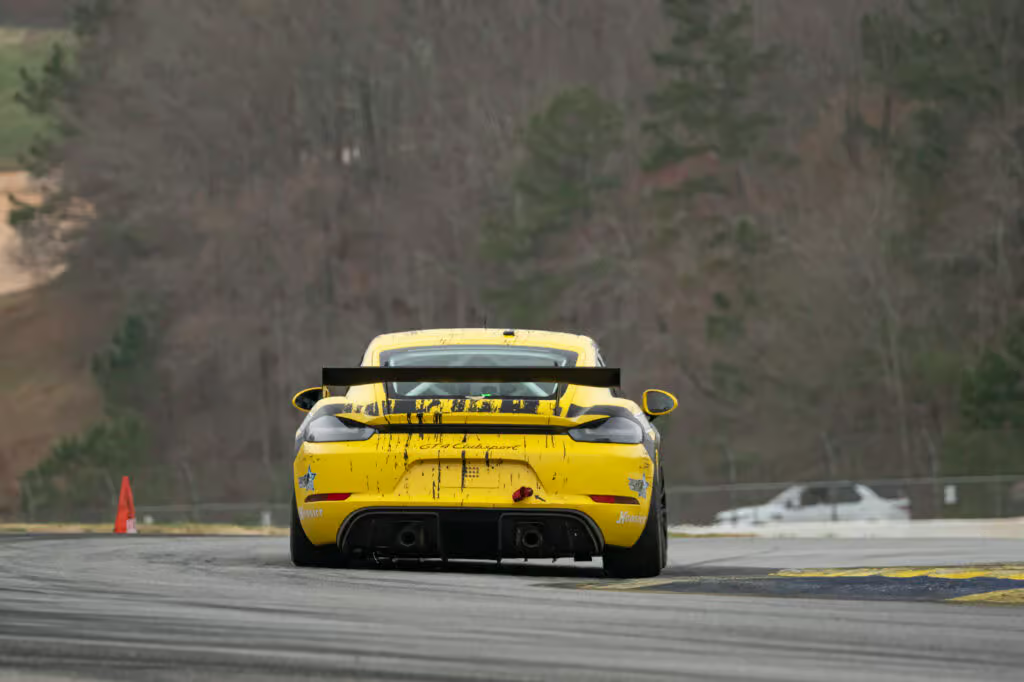
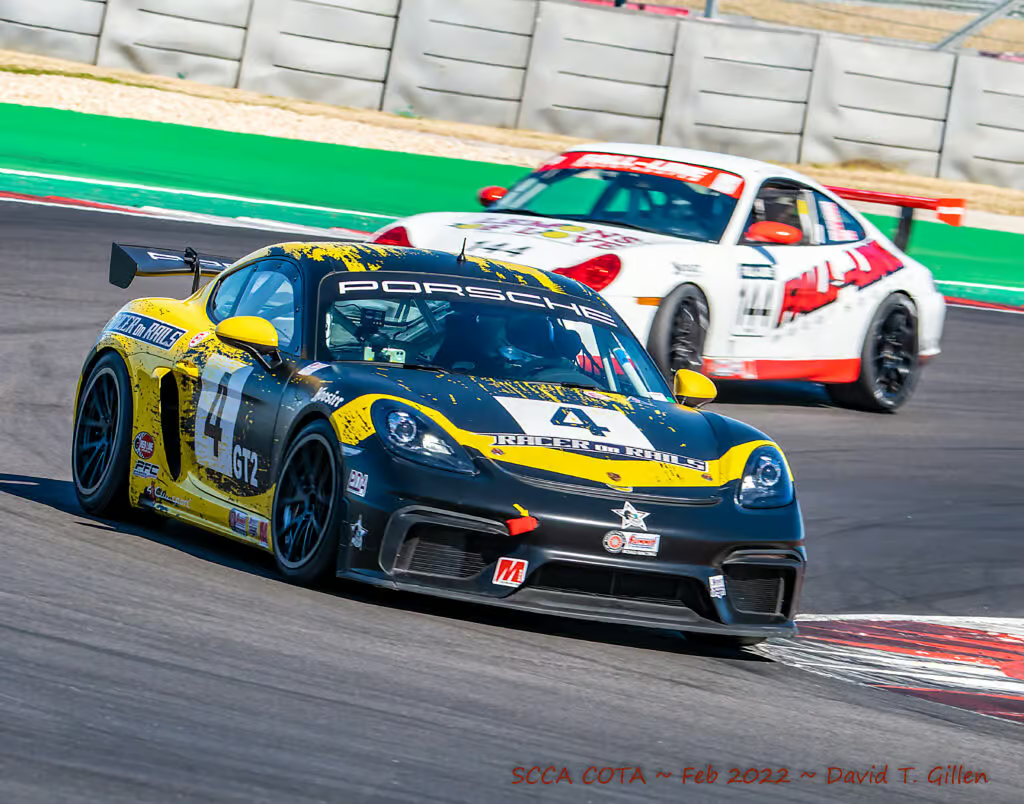
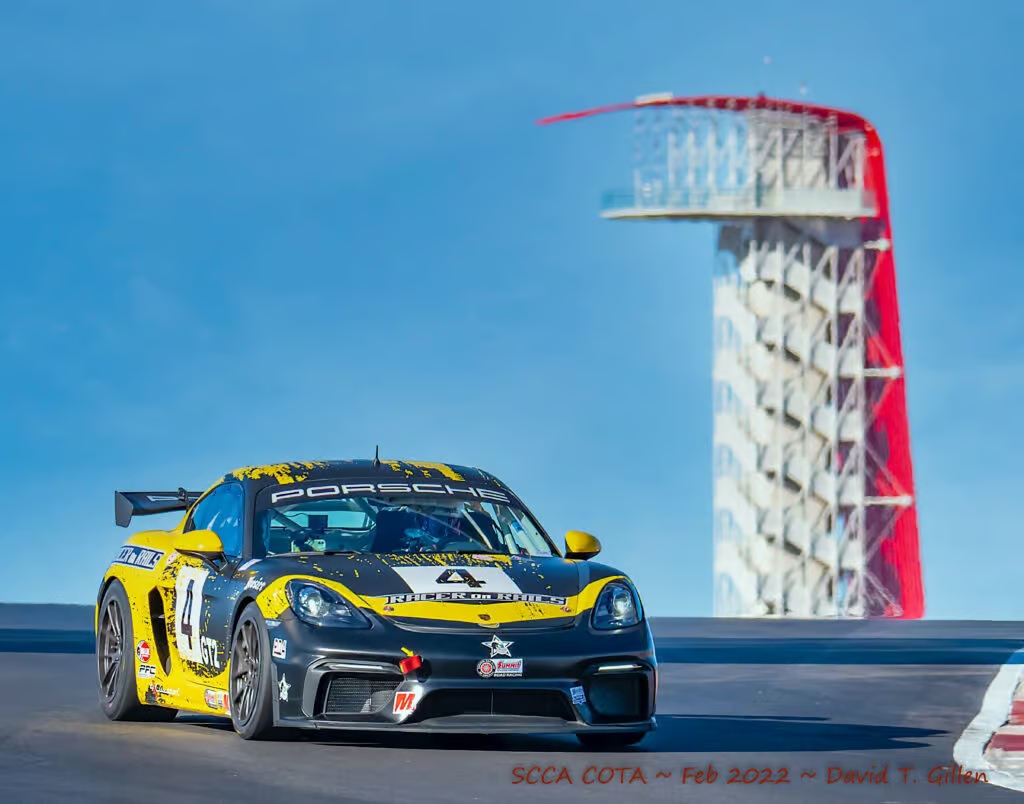
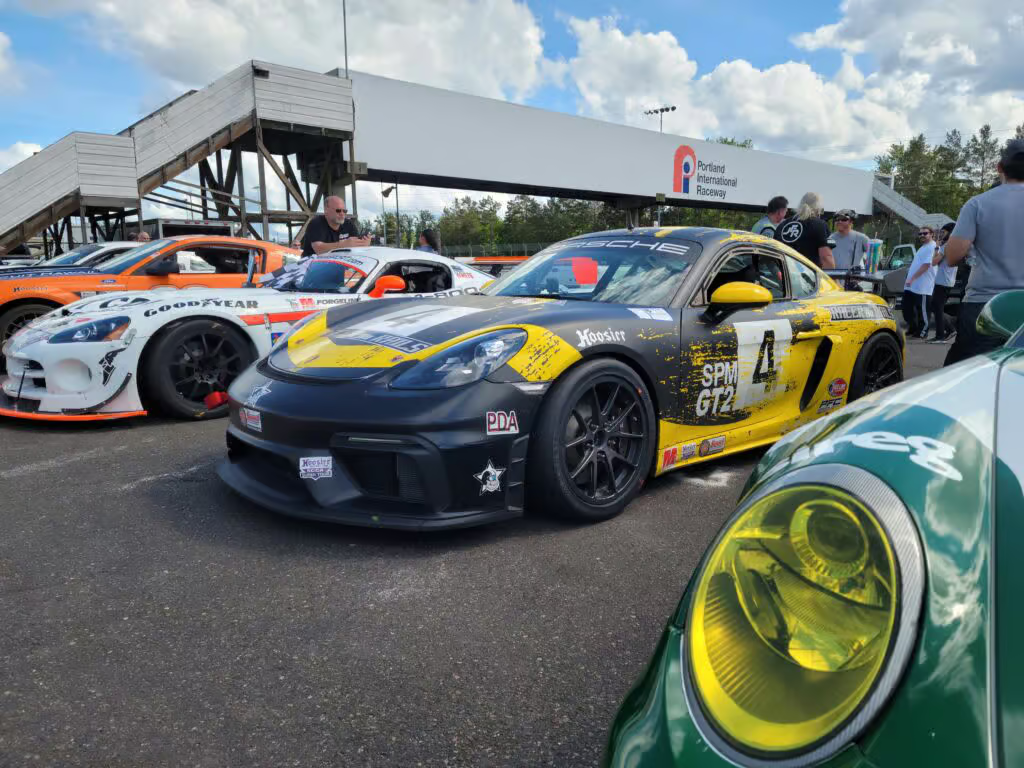
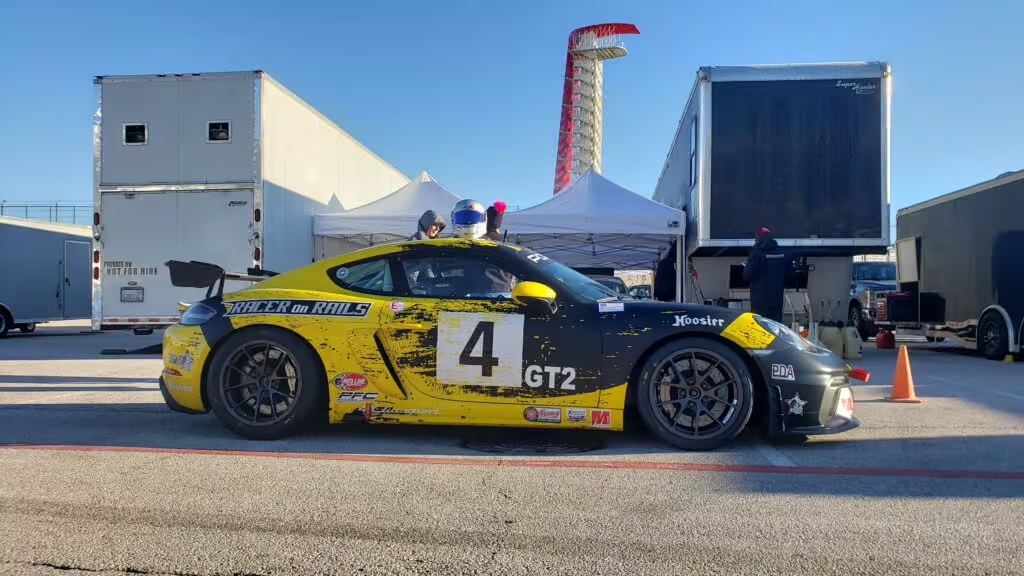
If you’ve followed Racer on Rails for a while, you already know our philosophy: take great cars, make them better, and then drive the hell out of them. This 2020 Porsche Cayman GT4 Clubsport Track Day Edition is the perfect example — a factory-built Porsche Motorsports car with real pedigree and a second life that spans endurance racing, time attack, and driver development.

Before we go deeper, it’s important to understand which Clubsport variant this is, because Porsche built several versions:


718 Cayman GT4 Clubsport Variants

Track Day Edition (This Car)

  • Designed for private owners and track day use
  • Same 425 hp 3.8L flat-six as Comp version
  • Lighter-duty fuel system
  • No air-jack system (but provisions exist)
  • Not homologated for GT4 racing

Competition Version (Not This Car)

  • Fully homologated for GT4 racing
  • Air-jack system included
  • Larger motorsport fuel cell
  • Endurance switches & safety electronics
  • Homologation restricts power/aero changes
  • Carbon and natural fiber material body panels

Newer 718 Cayman GT4 RS Clubsport

  • 4.0L RS-based platform
  • More power, higher RPM ceiling
  • Improved aero and suspension
  • The current model used in IMSA/SRO GT4
  • Much closer to a “mini Cup Car”

Our car — the Track Day Edition — gives us the freedom to pursue more aero, more setup range, and more developmental headroom than the rules-restricted Competition version.


Where This GT4 Clubsport Came From

Photos of the car from its Ann Doherty era after arriving at RoR.

This GT4 Clubsport began its life with Ann Doherty, who ran it competitively in SCCA T1 and GT2 before upgrading to a 991.2 GT3 Cup Car.

Because the car came from Ann, we gained two major benefits:

  1. It had been maintained at a true professional standard.
  2. It had already proven itself at a national competition level.

When she moved to the Cup Car, we took ownership of the GT4 and immediately put it to work.


What We Used It For

1. Endurance Racing (2024)

Bombing down Turn 5 at Road America with World Racing League

The first chapter of this car’s life with us was national-level endurance racing:

  • WRL Road America — April 2024
    Our first outing. Strong pace, great aero learning, and flawless reliability.
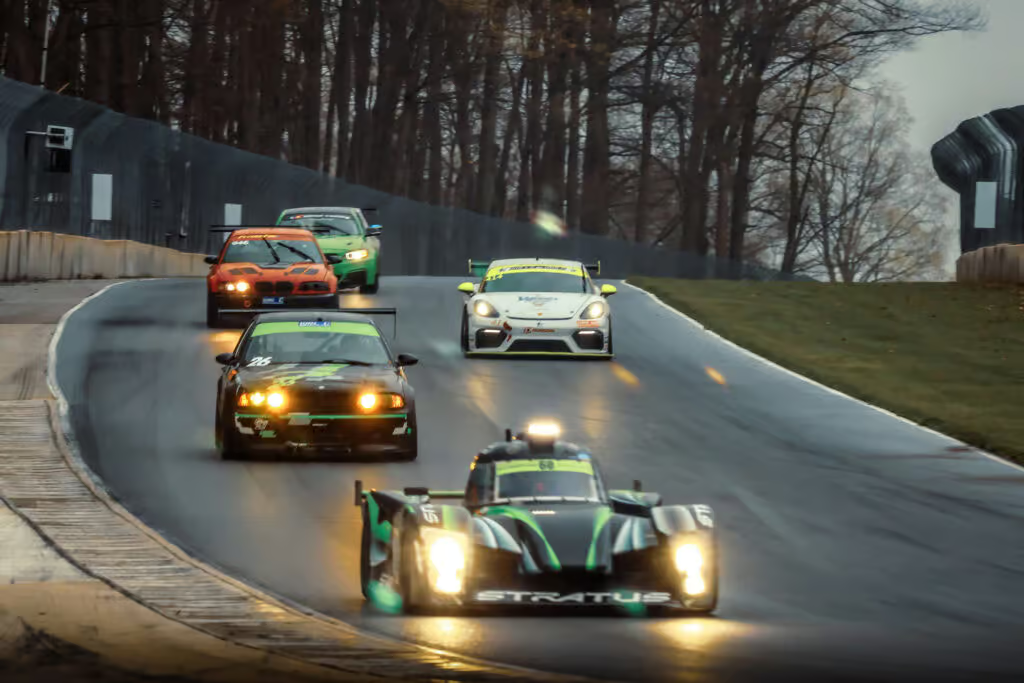
  • ICSCC Cascade 8 Hours of Portland — October 2024
    A full-day grind that gave us massive data on tire wear, pit strategy, and aero balance.

The car was consistent, predictable, and incredibly reliable — exactly what you want in an endurance platform.


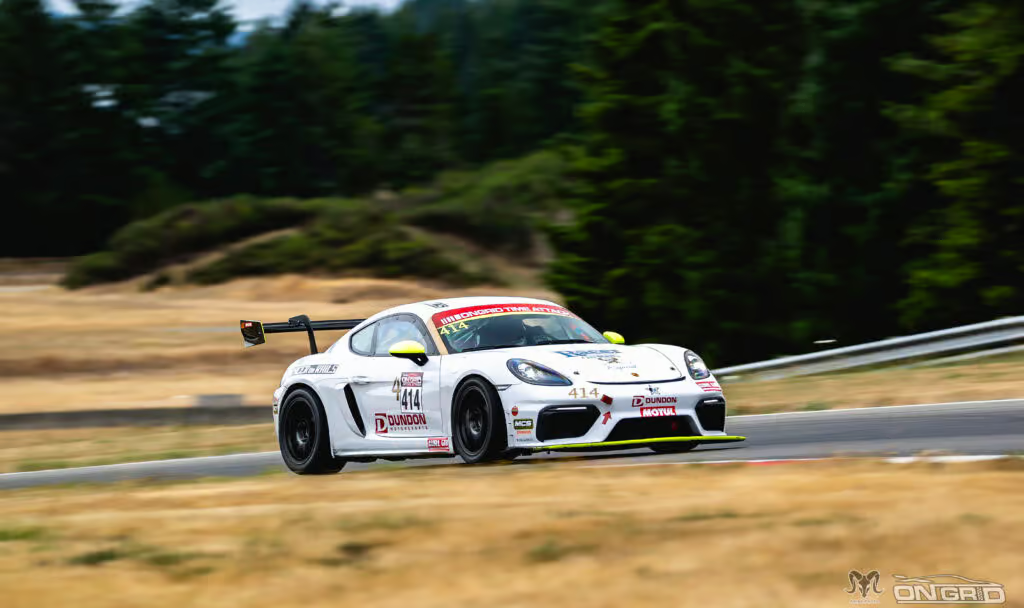
2. OnGrid Time Attack (2025)

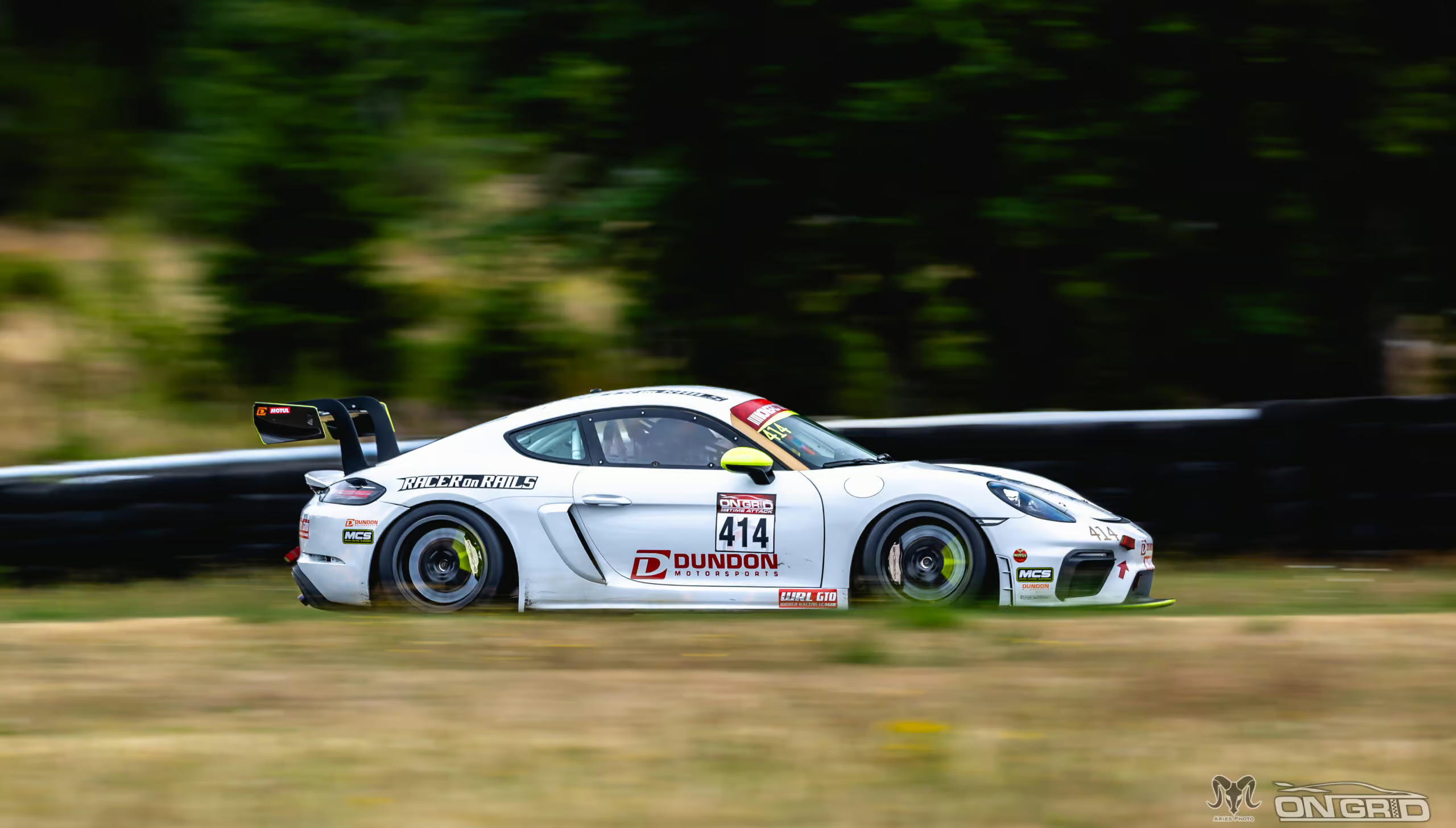
With the Dundon Valkyrie aero package installed, the car moved into OnGrid GT+ and instantly became a serious contender.

Huge downforce. Big mid-corner speed. Better braking stability. It was a transformation.

Check out one of the flying laps from this past summer – matching 992 and 991.2 GT3 Cup car lap times!

YouTube player

3. Driver Development & Testing Tool

This GT4 became one of our strongest tools for:

  • Advanced driver coaching
  • Back-to-back setup testing
  • Tire comparisons
  • Driver development beyond Spec E46, T3, and regional touring classes

Turnkey speed. Zero drama. Endless data.


Factory Specs — 2020 Porsche Cayman GT4 Clubsport (Track Day Edition)

PHOTO SUGGESTION: Interior cockpit photo or engine bay shot.

Engine & Drivetrain

  • 3.8L naturally aspirated flat-six
  • 425 hp @ 7,500 RPM
  • 7-speed PDK w/ motorsport tuning
  • Motorsport cooling system
  • Mechanical LSD

Chassis & Safety

  • FIA welded cage
  • Motorsport wiring harness
  • Composite doors
  • Fire system
  • Air-jack provisions (air jack system not currently installed)
  • Recaro race seat + 6-point harness

Suspension & Brakes

  • 3-way MCS motorsport dampers (upgrade)
  • Fully adjustable alignment
  • Porsche Motorsport ABS
  • Motorsport stability control

Aero

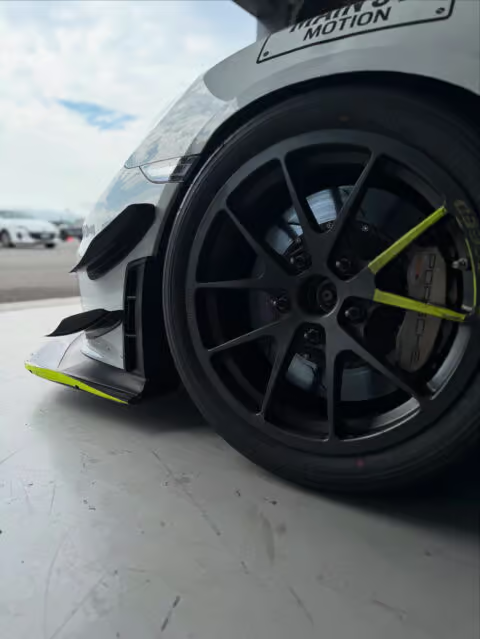
  • GT4-spec splitter but currently running the full Dundon Motorsports Valkyrie Aero package (front splitter, canards, rear wing)
  • Adjustable rear wing
  • Factory Flat floor
  • Factory cooling and airflow optimization

Our Modifications & Upgrades

Dundon Motorsports Valkyrie Aero Package

  • Full-length carbon splitter
  • Functional multi-channel front diffuser
  • Canards
  • Swan-neck rear wing
  • High-efficiency rear diffuser

This fundamentally changes the car’s downforce ceiling and high-speed stability.

Dundon Motorsports Valkyrie Aero front Bumpcer Canards in focus

Data & Electronics

  • AIM data integration
  • Radio/comms upgrades

Race Prep & Setup

  • Multiple alignment profiles
  • Corner balance for sprint, endurance, and time attack
  • Dundon headers/exhaust (optional configuration)
  • Tire mapping across A052, F200, and slicks

Deep Dive: Dundon Valkyrie Aero vs. Porsche Factory vs. Manthey Racing

Porsche Factory GT4 Aero

  • Designed to be predictable and safe
  • Built to meet strict GT4 regs
  • Limited splitter/wing/diffuser scope
  • Great for consistency but capped on downforce

Manthey Racing Aero

  • Refined airflow
  • Cleaner front-end efficiency
  • Slightly more downforce than OEM
  • Still constrained by GT4 rulebook

Dundon Valkyrie Aero

  • Not rule-limited
  • Significant downforce increase
  • Real front-end loading under trail braking
  • Balanced with a serious rear aero package
  • Center of pressure stability improves with speed

At The Ridge, the difference was dramatic: the car stopped washing out in the T3–T4 transition and gained real front-end authority.


Real-World Lap Time Proof

This wasn’t a pure A/B test — different drivers, power levels, tires, and conditions — but the result is hard to ignore.

June 2023 — Homologated GT4 Aero @ Road America

  • Hoosier A7 (sprint tire)
  • Full GT4 power
  • Lap: 2:25.6

April 2024 — Dundon Aero @ Road America

  • Yokohama A052 (endurance tire)
  • WRL power restrictions (¾ intake blocked)
  • Full endurance fuel levels
  • Laps: Low 2:24s — consistent

Less power.
Heavier car.
Slower tire.
Faster laps.

Conclusion:

The aero works. It transforms the platform. Check out this video comparison of the Dundon vs Manthay aero on the faster Cayman RS GT4.

YouTube player


What Types of Racing This Car Excels In

Endurance Racing (WRL, AER, ICSCC Enduros, ChampCar Pro)

  • Ultra-consistent
  • PDK-friendly
  • Great tire life
  • Zero drama across long stints

Time Attack (OnGrid, GTA, SCCA TT)

With Dundon aero?
It’s a legitimate GT+-class weapon.

Sprint Racing (SCCA ST, ICSCC ST/SPO, NASA ST1/ST2)

Great for drivers moving beyond grassroots or regional programs.

Driver Development

One of the best “advanced learning” platforms we’ve ever used.


Interested in Renting or Developing a GT4 Clubsport?

If you’re curious what a Porsche Cayman GT4 Clubsport can do, we’d love to help.

  • Want to rent this GT4 Clubsport for a race weekend or time attack?
    We offer full arrive-and-drive + coaching.
  • Already own a GT4 or Porsche race car?
    We can help you extract more from the car and yourself with setup, aero, maintenance, and coaching.

Reach out anytime. Let’s build something fast together.