Posted on

Building the T3 Cayman: Developing a Production Porsche for Competition

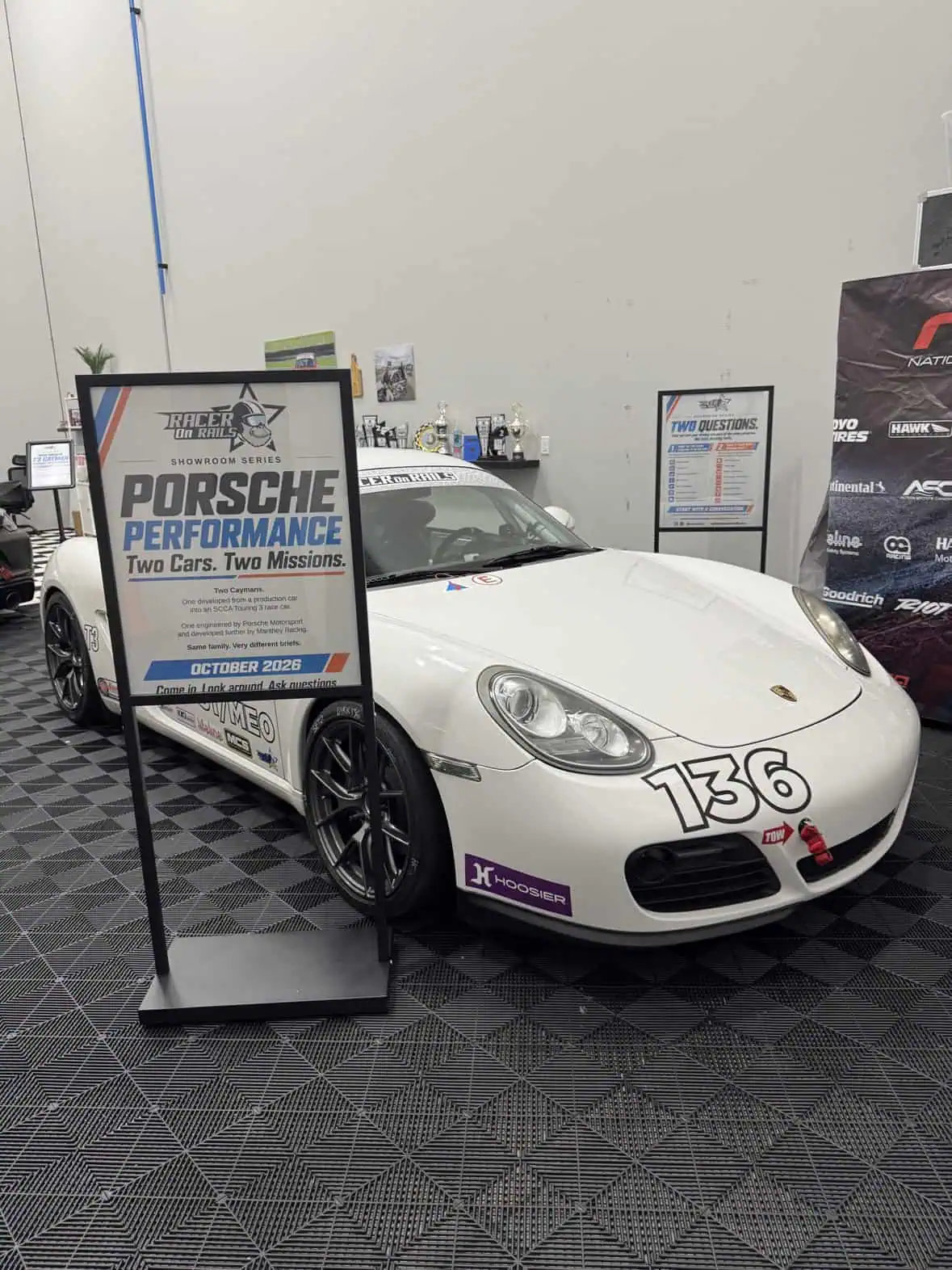
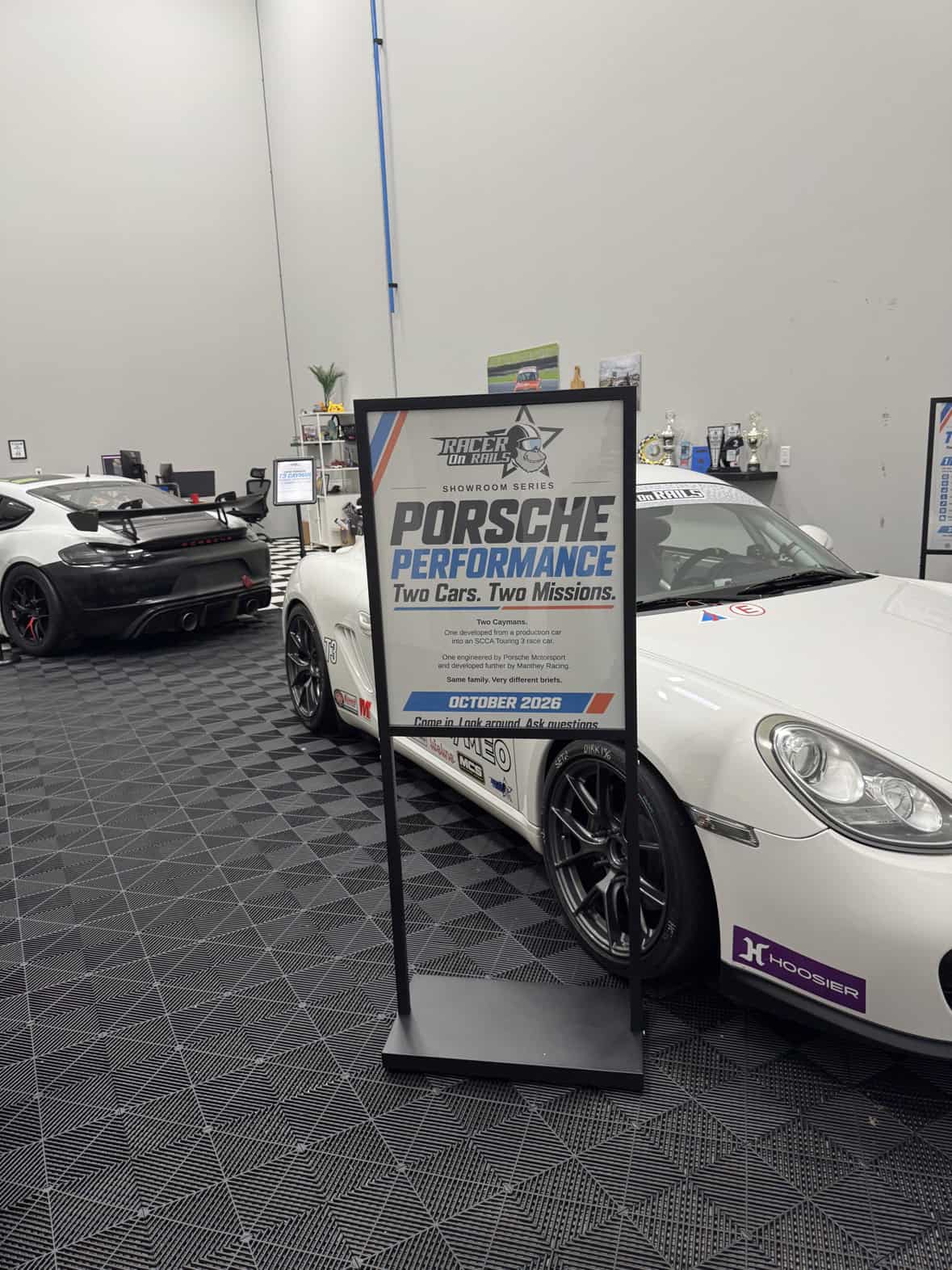
Dirk's T3 Cayman with Porsche Performance showroom signage
Dirk’s #136 under the Porsche Performance banner — October’s Showroom Series car.

There is a particular kind of satisfaction in developing a race car that was never designed solely to be a race car. You begin with something already good, then start asking increasingly inconvenient questions about what happens when you operate it near the limit, lap after lap.

That has been the story of Dirk’s Cayman.

It began as a 2010 Porsche Cayman Base, a 987.2-generation street car with a naturally aspirated 2.9-liter flat-six and PDK transmission. Today, it is being developed as a serious SCCA Touring 3 competition car.

The goal was never simply installing race parts. It was developing a coherent competition car — chassis, brakes, cooling, drivetrain, data, safety and driver all working together.

The Cayman is a contender.

Now the fun part is figuring out how good we can make it.

Part of the RoR Showroom Series

Dirk’s Cayman is one of the first two cars featured in the new Racer on Rails Showroom Series, our monthly program built around bringing interesting cars out of the background and into the conversation.

October’s theme is Porsche Performance, and we’re putting this production-derived T3 Cayman alongside our Porsche Cayman GT4 Clubsport MR.

They arrive at racing from opposite directions.

Dirk’s car started as a street Cayman, developed inside a production-based rule set. The GT4 Clubsport starts much closer to the destination, engineered for motorsport by Porsche Motorsport and Manthey Racing.

Put them next to each other and they create a useful question:

What changes when the mission changes?
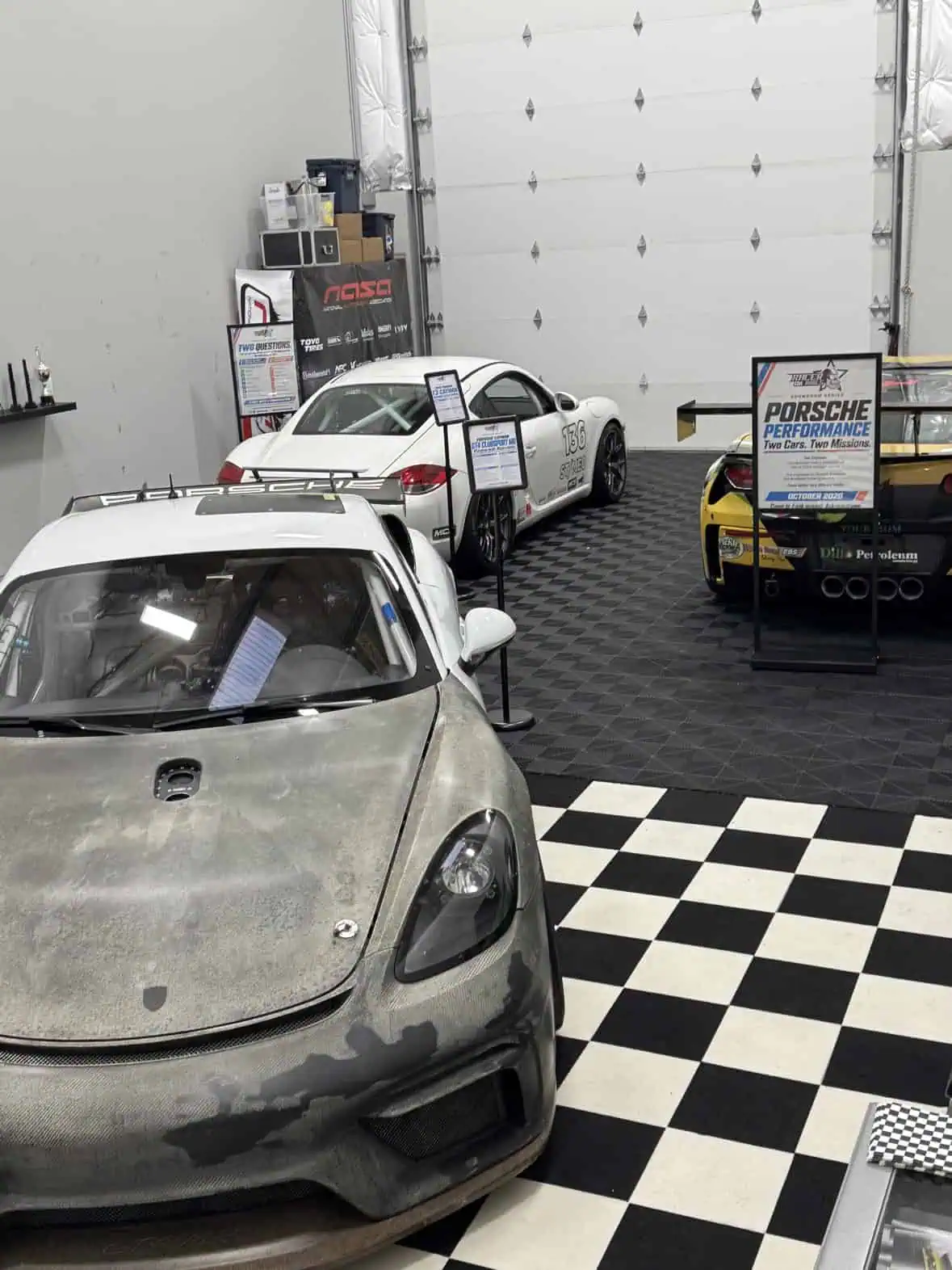
T3 Cayman and GT4 MR together in the RoR showroom

Two Caymans, two very different approaches to building a competition car.

Why We Love Touring 3

Part of the reason this car exists is that we genuinely love Touring 3.

T3 occupies a fun part of the racing universe: relatively modern, reasonably powerful cars, substantial enough to feel like serious machinery. Properly fast, without the speeds, budgets or complexity of a GT2 program.

In the grand scheme of racing, the performance remains manageable.

And the smiles-per-dollar equation can be very good.

What makes the class particularly interesting is the variety. The cars do not all solve the lap-time problem the same way: more power, less weight, better braking, better power-down, aero, wheelbase, transmission, tire usage, chassis balance. Different strengths, different weaknesses.

That means there is not one universal Touring 3 recipe.

You have to understand what your car already does well, identify where it is vulnerable, and develop around those characteristics.

That is exactly the kind of racing and engineering problem we enjoy.
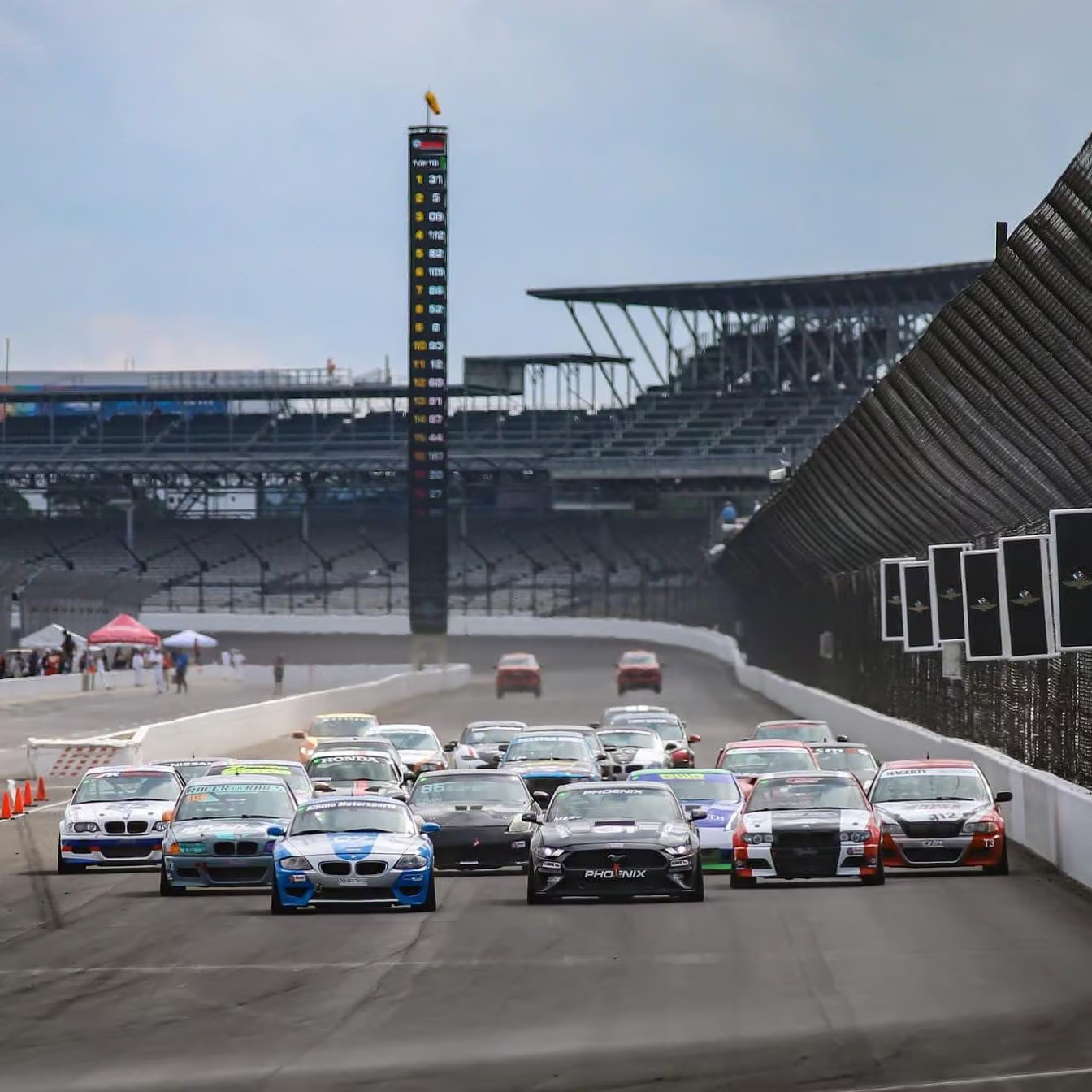
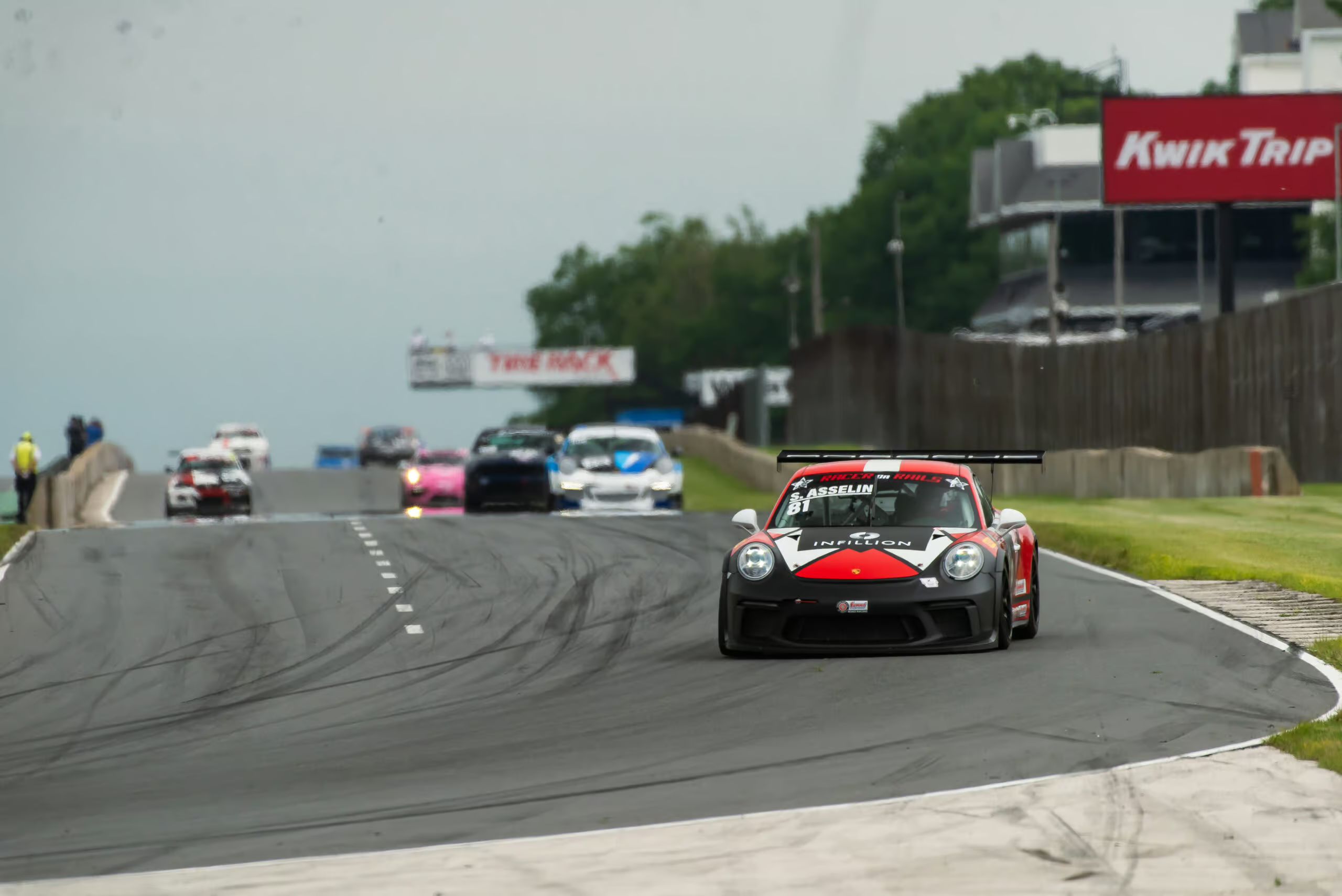
Touring 3 national championship race start at Indianapolis Motor Speedway — the variety of T3 machinery

The Touring 3 field at Indianapolis — production-based cars, national-level racing.

Why the Cayman?

When we started looking seriously at T3 options, the base Cayman kept checking boxes. Porsches rarely win on one enormous spec-sheet number — they arrive with enough power, then make the rest of the package work exceptionally well around it. That was exactly the attraction.

Enough Power

The 2.9-liter flat-six was never going to be the biggest hammer in the T3 toolbox, and that was fine. The question was whether it had enough power when combined with the rest of the chassis.

Our bet was yes.

A Strong Braking Foundation

Porsche’s production braking systems give us an excellent place to start.

We begin with thoughtful factory hardware, good pedal behavior and a platform that was designed from the outset to be driven hard.

That matters enormously in a production-based class, because braking is not simply about one stopping-distance number. It is about repeatability, temperature, confidence, pedal communication and what the car does as the driver starts releasing the brake and turning in.

Weight

The Cayman was one of the relatively lighter choices among the larger, more powerful production-based cars we were considering.

Less mass helps almost everywhere. The tires have less work to do, the brakes have less energy to dissipate, and the suspension has less mass to control every time the car accelerates, stops or changes direction.

The Shape

Then there is the shape.

The Cayman has a compact, clean aerodynamic profile that moves efficiently without enormous wings and splitters. We believed it would be one of the stronger T3 options both in clean air and in a draft.

On a class car that still needs to make good speed down long straights, that matters.

PDK

And then there was PDK.

For this car, we viewed the transmission as an advantage.

Every task we can simplify gives the driver a little more mental capacity for something else. There is no clutch operation on every shift, no heel-toe downshift to execute while threshold braking, and both hands can spend more time on the wheel. Left-foot braking is available naturally.

None of that makes racing easy.

It simply removes one mechanical task from a driver who is already processing cars, mirrors, flags, brake points, corner placement, grip, strategy and whatever unexpected thing just happened six feet in front of the windshield.

That matters.

The Cayman That Clinched It

There was also one experience that stuck with me.

At a February Hoosier Super Tour a few years ago, there was a newer-generation base Cayman racing in Touring 3. From watching the car, it looked like there was still meaningful lap time available through some of the more technical sections.

Then the road straightened out.

The thing was devastatingly effective.

That got my attention.

If the platform could give away time in parts of the lap and still be that difficult to deal with once everything opened up, there was clearly something there.

That was the clincher.

On paper, the 2010 Cayman Base seemed to have the right ingredients: enough power, good brakes, relatively low weight, an efficient shape, a mid-engine chassis and PDK.

So we bought one and decided to find out.

After its first race weekend and a handful of test and shakedown sessions, it has already shown that the idea works.

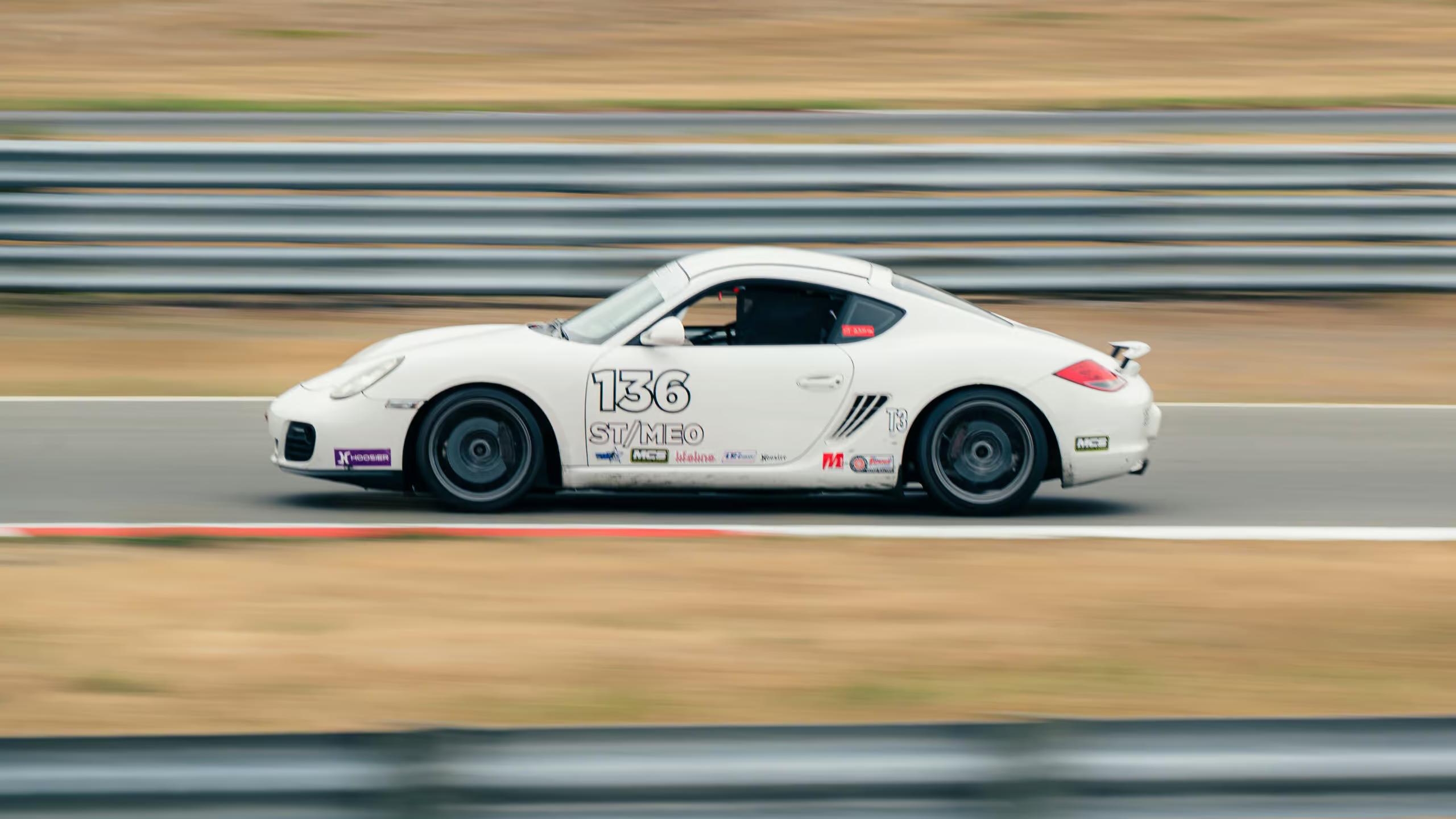
The #136 T3 Cayman at speed — compact profile doing its thing

The #136 at speed — early shakedown laps confirmed the concept works.

The Rulebook Is Part of the Engineering

Touring-class development is interesting because the solution cannot simply be “replace everything.” The rulebook creates a box, and that box becomes part of the engineering problem: enough freedom to meaningfully improve the car, but not enough to erase the production platform’s character.

Where should we spend weight?

How much spring rate does the tire really want?

How much braking hardware do we actually need?

Which weaknesses need hardware, and which ones need setup?

The rulebook is not just a restriction.

It is part of the design brief.

Current State of the Car

We used a similar format documenting our T3 Nissan 370Z: less a parts list, more a snapshot of where the development program stands today.

Chassis

The foundation is a 2010 Porsche Cayman Base, 987.2, converted from a street car into a wheel-to-wheel competition platform.

Current chassis highlights:

  • 2010 Porsche Cayman Base, 987.2
  • Mid-engine, rear-wheel drive
  • SCCA Touring 3 competition build
  • Full competition roll cage
  • Modified and reinstalled factory dashboard
  • Fabricated carbon-fiber block-off panels
  • Fabricated driver floorplate
  • Fender liners and undertray retained
  • MCS 3-Way Coilover and Shock Package
  • Fabricated rear trunk-release system
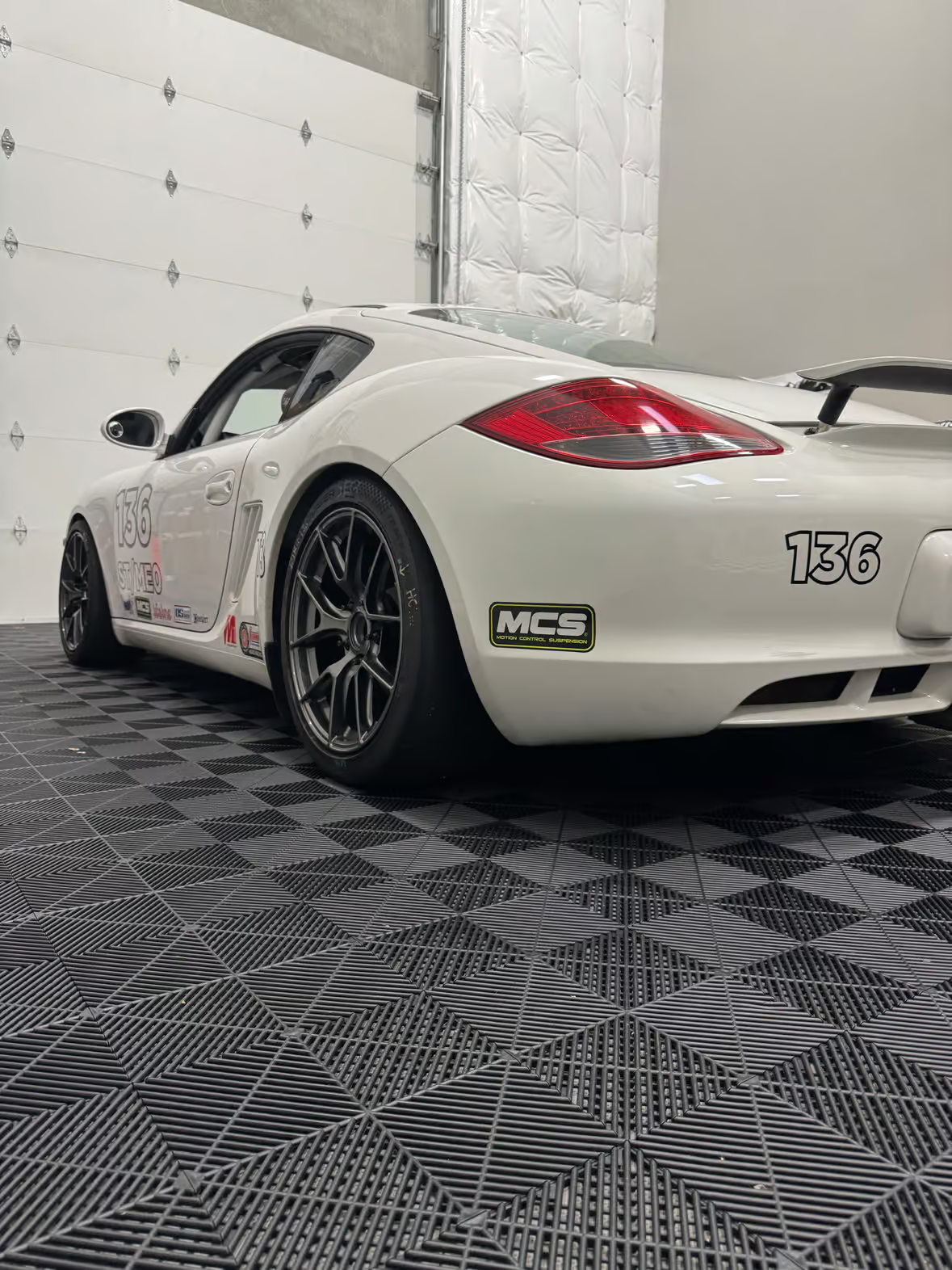
T3 Cayman clean exterior rear three-quarter

The #136 as it sits today — a production Cayman developed for competition.

Interior & Safety

The cockpit was built for wheel-to-wheel use, and for the way we believe a race car should feel when you sit in it.

Our reference point is not the improvised club-racing interior where everything technically works but looks added one weekend at a time. We take more inspiration from factory-built TCR, GT4, GT3 and single-make cars.

That means clean, tidy, functional and clearly organized. Wiring routed intentionally. Controls where they make sense. Labels clear. Safety equipment integrated rather than appended. The finished cockpit should feel like an evolution of the original road car, not a collection of unrelated race parts.

For us, that is not cosmetic. A well-organized race car is easier to operate, easier to inspect, easier to diagnose and easier to service. Good presentation and good engineering often reinforce each other.

The Cayman currently includes:

  • Full competition roll cage
  • Fixed-back competition driver seat with custom bracket and slider installation
  • Driver harnesses
  • Driver nets
  • KMP steering wheel
  • Integrated fire-suppression system
  • Low-profile SFI roll-bar padding
  • Rennline rear tow hook
  • Main power relay / cutoff provisions
  • Flagtronics in-car flagging system
  • Lifeline FIA rain light
  • Custom dashboard modification and wiring integration
  • Heater-core lines deleted and rerouted
  • Competition-oriented interior block-off panels and driver floorplate

One detail we particularly like: achieving the lowest practical seating position while retaining a slider took real fabrication, not just a bolt-in bracket.

That small detail reflects the larger theme of the build: the car should fit the driver and the mission, not simply the parts catalog.
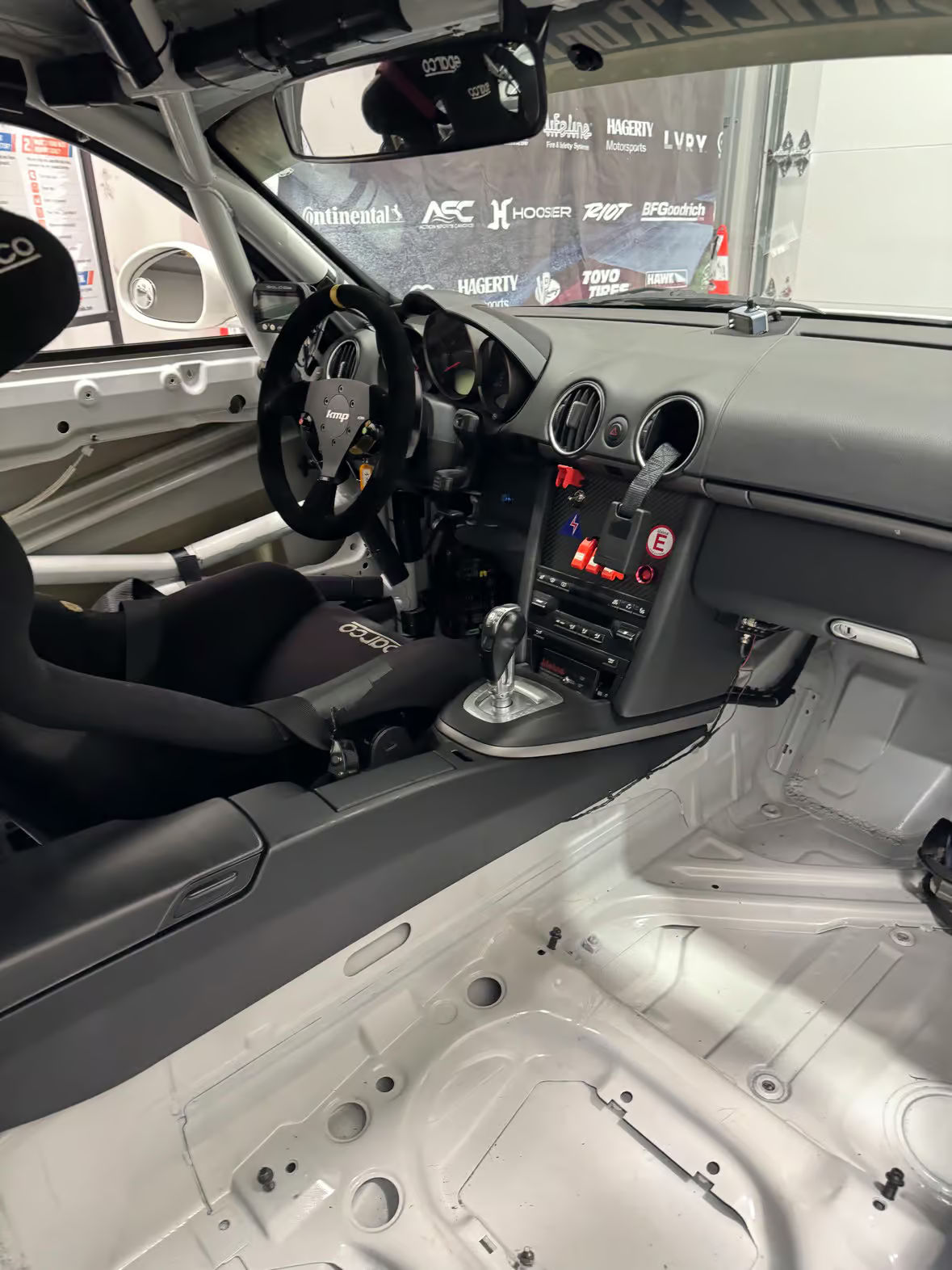
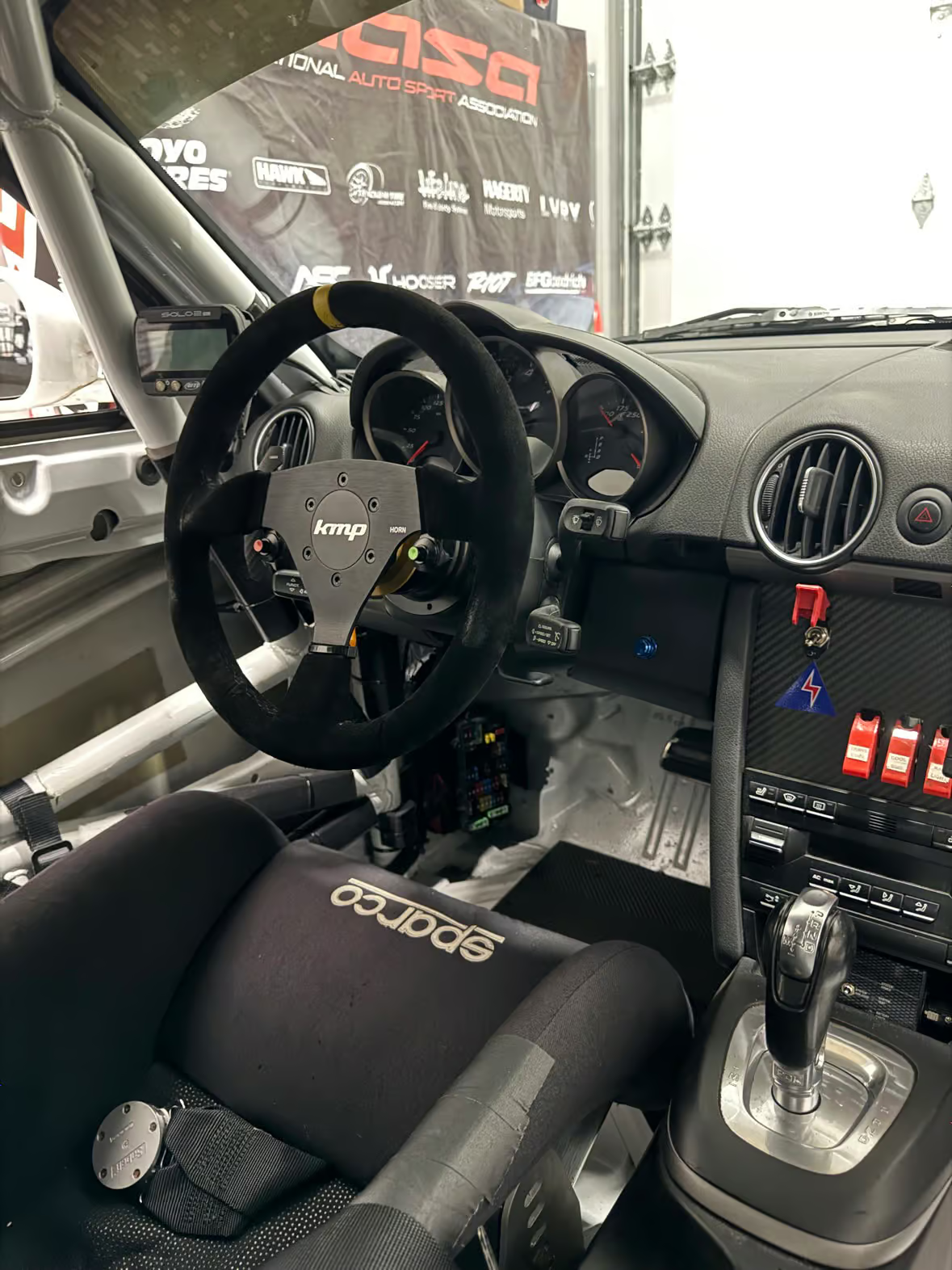
T3 Cayman full cockpit

The office — built around the driver, not the parts catalog.
KMP steering wheel and driver controls

KMP wheel and driver controls — everything within reach, nothing extra.

Brakes

Brakes are one of the most active development areas on the Cayman.

The existing system has already received a proper baseline: rebuilt front and rear calipers, stainless-steel brake lines, fresh pads and rotors, and a flush with Endless RF-650 racing brake fluid.

That gives us a known starting point.
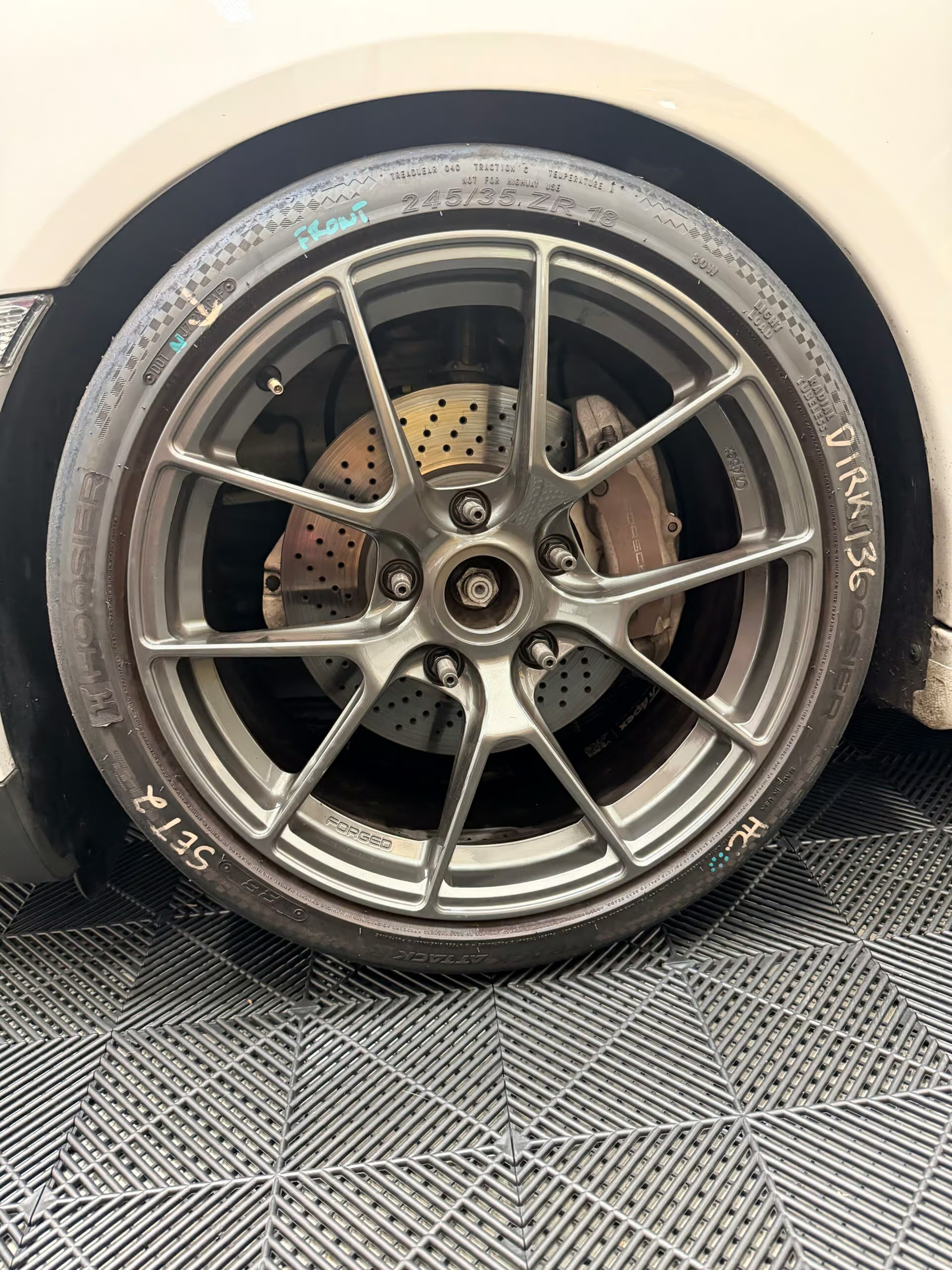
Apex forged wheel with drilled brake disc and bronze Porsche caliper on the #136 T3 Cayman
The #136’s front corner: Apex forged wheel, drilled disc, bronze Porsche caliper — the current brake baseline.

Now the interesting question becomes what, if anything, the car actually needs next.

Current brake configuration and development work includes:

  • Rebuilt OEM front and rear Porsche calipers
  • Stainless-steel brake lines
  • Competition pads and rotors
  • Endless RF-650 brake fluid
  • Brake-temperature and wear evaluation
  • Alternative rotor options under evaluation
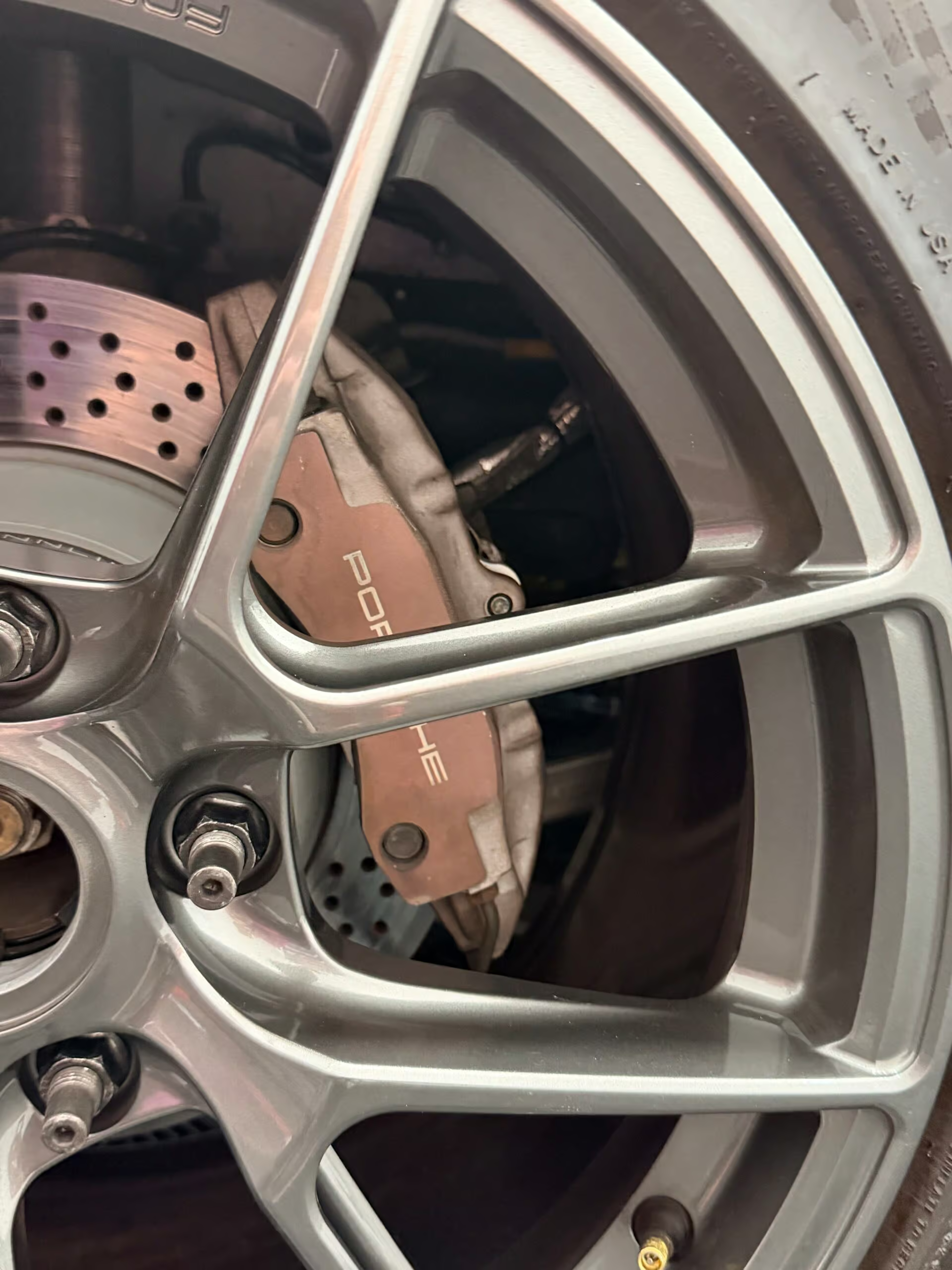
Close-up of the bronze Porsche brake caliper and drilled disc through the wheel spokes
Porsche caliper and drilled disc, up close. Evaluation continues — the right answer is the simplest one that solves the problem.

Engineering is not choosing the biggest thing the rulebook allows. It is finding the simplest solution that actually solves the problem.

Suspension

The current suspension package gives us meaningful setup authority while keeping the Cayman’s fundamental character.

The car uses Motion Control Suspension (MCS) 3-way adjustable dampers, upgraded camber plates and an upgraded front sway bar. The front shock towers were also modified to create the necessary camber clearance. Alignment and corner balancing have been part of the setup process from the beginning.

Current suspension highlights include:

  • MCS 3-way adjustable dampers
  • Upgraded camber plates
  • Upgraded front sway bar
  • Front shock-tower modification for camber clearance
  • Competition alignment and corner balancing

We choose hardware based on what makes sense for the car and the program. MCS has earned its place on our serious competition builds because the engineering relationship matters as much as the hardware.

Suspension development gets complicated quickly — spring rate, damping, motion ratio, tire construction, aero load, roll stiffness, track surface and driver preference all interact — and a damper is only useful if the team understands how to use its adjustment range.

That relationship makes it a two-way development process: we bring them what the car is doing, what the driver is feeling and what the data is showing, then work through what the platform actually needs rather than treating the damper as a black box.

A three-way damper gives us significant control, but more adjustment is only useful if every click has a purpose. The objective is not maximum stiffness. It is controlling the platform, supporting the tire and giving the driver predictable behavior through braking, turn-in, mid-corner and exit.

A setup sheet full of dramatic numbers does not automatically create a fast car.

The tire does not care how impressive the alignment sheet looks, and the stopwatch definitely does not care what logo is printed on the shock.

The value comes from understanding the system and having the right tools to improve it.
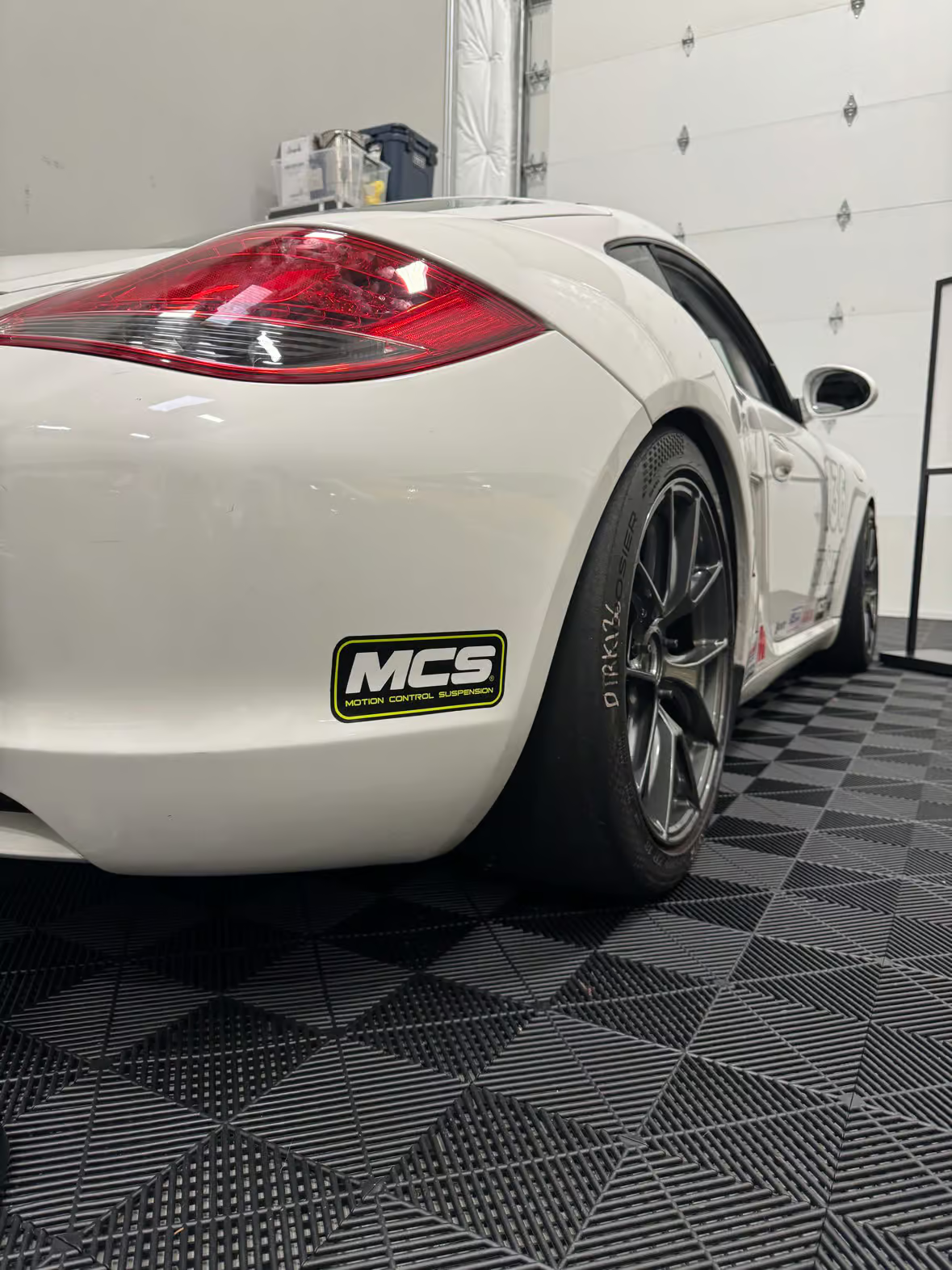
MCS damper detail at the rear
MCS 3-way dampers give us substantial setup authority, but the real value is the engineering relationship that helps us use that adjustment intelligently.

Wheels & Tires

The dry package uses APEX VS-5RS forged wheels in 18×9 ET46 with Hoosier R8 tires — a shorter 245/35R18 front, 245/40R18 rear.

That staggered diameter is the result of testing rather than aesthetics.

Earlier running showed too much front-to-rear wheel-speed difference with the previous tire configuration. After reviewing the data and consulting Porsche specialists, we moved to the shorter front tire while retaining the same section width.

That is exactly the sort of thing we enjoy about development work.

The specification sheet gives us a starting point. The car tells us what happens in reality.
Hoosier rubber on the #136's rear quarter

Hoosier rubber — where the specification sheet meets reality.

Engine

The engine remains fundamentally Porsche’s naturally aspirated 2.9-liter flat-six, but preparing a production engine for sustained competition requires much more than changing the oil and sending it.

The build has included a complete tune-up, spark plugs, cam and crank sensors, water pump replacement, seals and gaskets, engine mounts, exhaust development, dyno verification and Softronic 987.2 performance software tune.

The exhaust work is a good example of the thought process behind this build.

The rules allowed removing the catalyst material, but simply hollowing the factory housings would leave a large empty expansion volume in the exhaust path. Instead, we fabricated a properly sized straight section through the catalyst area, keeping a cleaner flow path and preserving exhaust-gas velocity.

Again, the question was not simply, “What are we allowed to do?”

It was, “Which legal solution best serves the engine?”

Up next: a larger-diameter race exhaust, which should unlock a few more ponies.
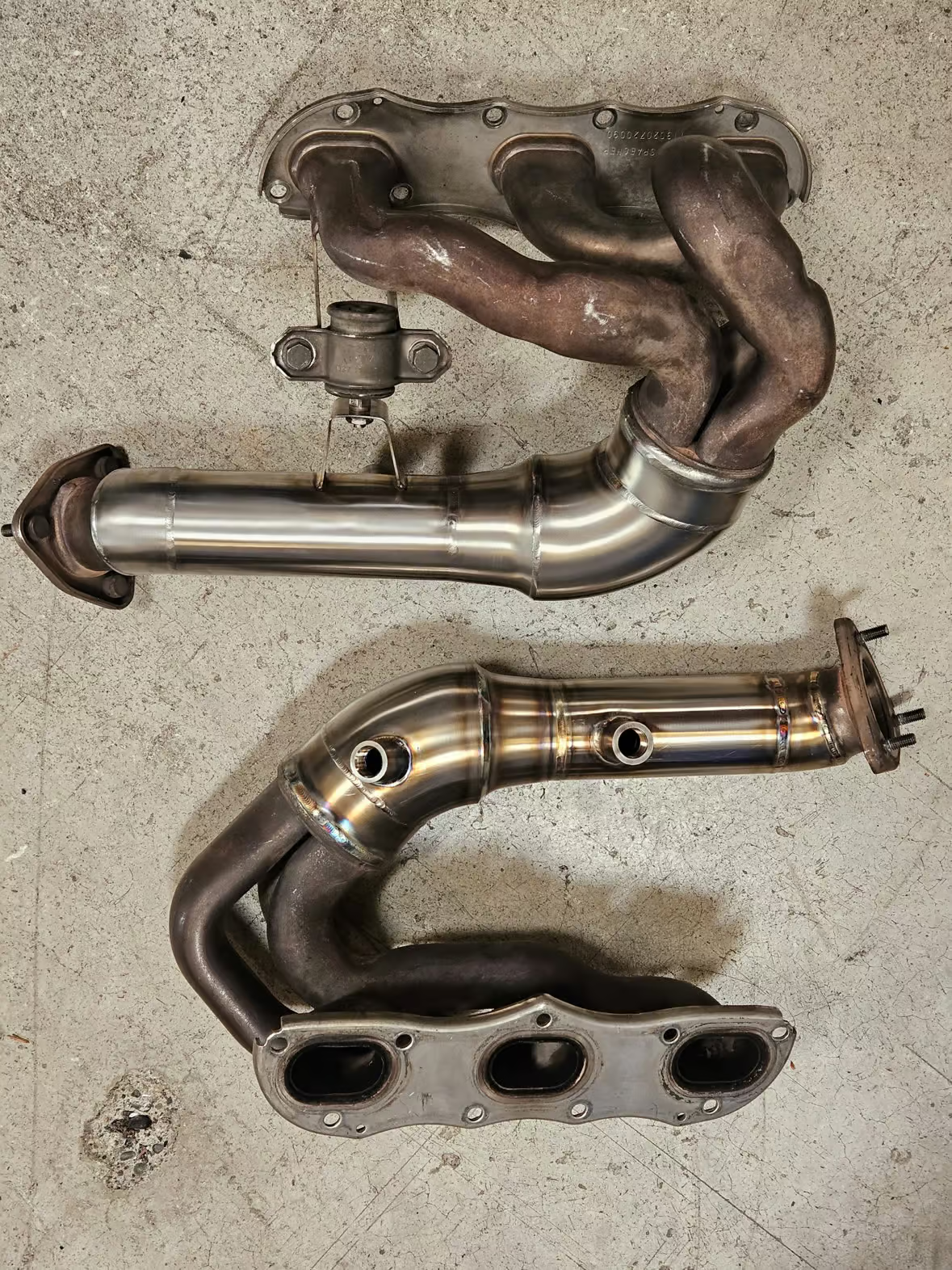
Custom-fabricated headers for the #136 — TIG work done in-house

Custom-fabricated headers, TIG-welded in-house — the kind of work the rulebook rewards.

Engine Cooling & Thermal Management

Cooling became a priority almost immediately.

Engine coolant temperatures were already a concern in early testing despite favorable conditions, so rather than waiting for summer heat, the car received a substantial cooling-system upgrade.

That includes:

  • CSF upgraded left radiator
  • CSF upgraded center radiator
  • CSF upgraded right radiator
  • 160°F low-temperature thermostat
  • Center-radiator installation hardware
  • Front-bumper mesh protection
  • Racing coolant strategy
  • Cooling-system service and vacuum-fill equipment included with the track spares

Thermal management is not merely a reliability subject.

It is performance.

The drivetrain gets the same treatment. PDK is one of the reasons we chose the Cayman, but asking a dual-clutch gearbox to operate continuously at race pace creates a very different thermal environment than normal road use. The car now uses a BRS 987.2 PDK transmission oil-cooler system, with an active pump circulating fluid through a dedicated oil-to-water cooler, and an AiM temperature sensor so transmission temperature becomes something we can actually measure instead of speculate about.

Cold is not automatically better.

Controlled is better.

Electronics & Data

The development car needs to tell us what it is doing.

The current data system is built around an AiM Solo 2 DL with CAN, paired with an AiM eight-channel expansion hub, a 150 PSI pressure sensor and an additional oil/coolant temperature sensor. Custom mounting and sensor integration were completed as part of the build. We’re monitoring all the driver and car vitals including but not limited to brake pressure, steering angle, throttle position, engine RPM, wheel speeds, Yaw, coolant temp, coolant pressure, oil temp, oil pressure, diff fluid temp, and transmission fluid temp.

No SmartyCam yet — Dirk still happily triggers video manually before each session, so the data/video system has room to evolve.

For now, the important part is that the AiM system is not simply being used as an expensive lap timer.

We want data because we have specific questions to answer.

What happens to drivetrain temperature over a full session?

Did a setup change help one corner while hurting another?

Are we changing the car because we know what is happening, or because we think we know?

That distinction matters.

Drivetrain

The drivetrain is one of the pieces that made the Cayman especially attractive in the first place.

At the center is Porsche’s 7-speed PDK, now paired with an OS Giken Super Lock 1.5-way limited-slip differential.

Current drivetrain configuration includes:

  • Porsche 7-speed PDK
  • OS Giken Super Lock LSD, 1.5-way
  • OS Giken differential fluid
  • PDK service
  • Replacement inner and outer PDK carrier bearings
  • ARP differential-cover bolts
  • BRS PDK transmission cooler
  • Active cooling pump
  • Dedicated oil-to-water cooler
  • AiM transmission-fluid temperature monitoring

The 1.5-way gives us meaningful locking under acceleration without making the car as aggressive on deceleration as a full 2-way.

That suits a car we value for its willingness to rotate cleanly and communicate what the rear axle is doing.

The Tire Has to Do the Work

The tire rules are another reason this development is interesting: we cannot solve every handling issue with enormous rubber, so geometry, damping, roll control and extracting the most from the available contact patch matter more.

Camber, toe, ride height, spring behavior, damping, sway-bar balance and bump travel all affect what happens to that relatively small area of rubber touching the racetrack.

And none of those adjustments exists in isolation.

A change that improves front response can hurt braking stability. A geometry tweak that helps mid-corner can hurt brake release. A setup that produces one phenomenal qualifying lap may not give us consistency over a full race.

The goal is not to maximize any individual setting.

It is to make the entire chassis work together.
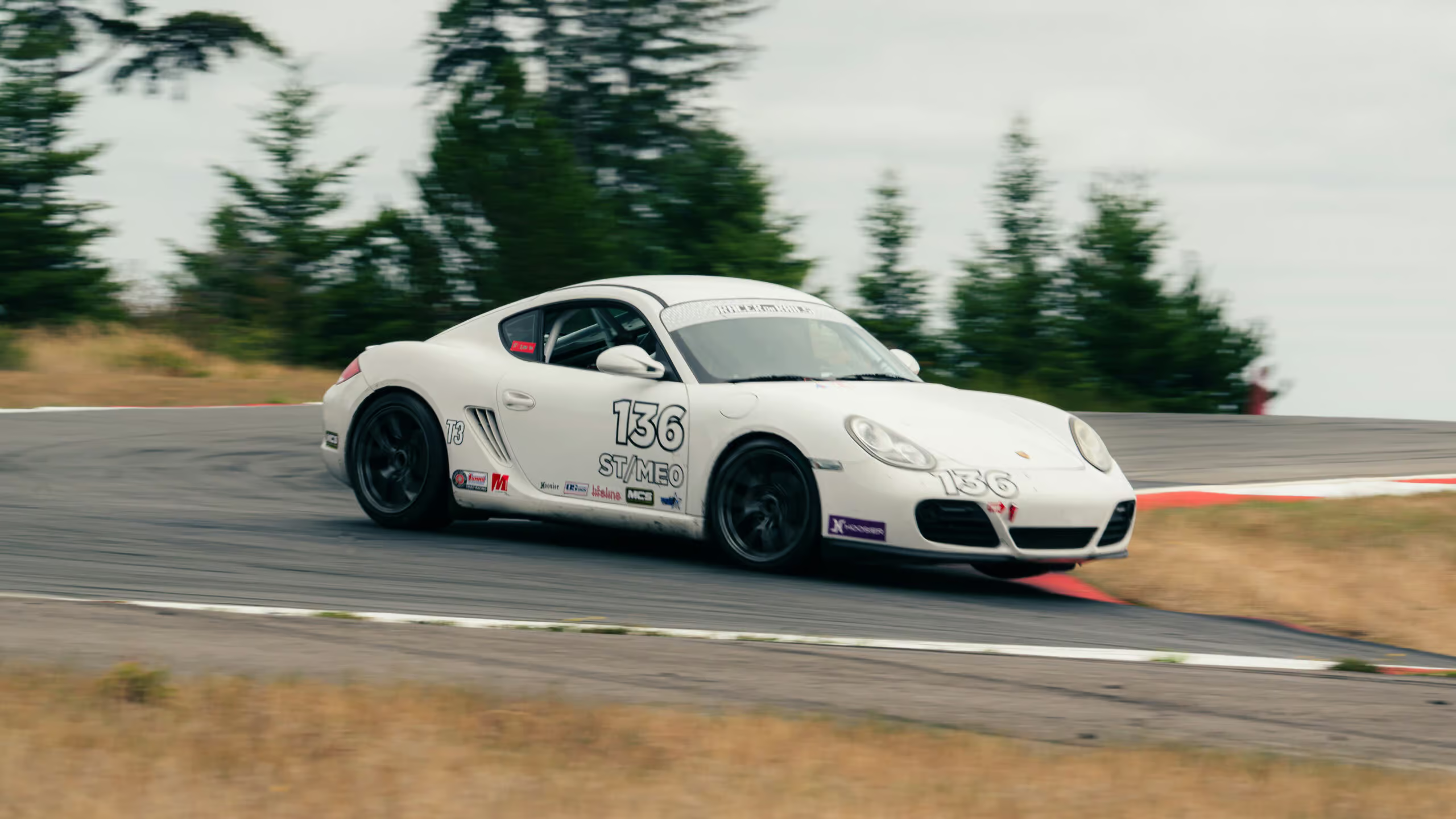
Front tire loaded up in the corner — sidewall doing work

Loaded up — the whole chassis working as one.

The Driver Is Inside the Development Loop

Development works better when the driver is treated as part of the system, not just the person holding the steering wheel.

Driver feedback matters.

Data matters.

Inspection matters.

Lap time matters.

Tire condition matters.

None should be used by itself.

If the driver reports instability during brake release, we want to understand why. If the data shows something unexpected, we correlate it with what the driver felt. If the tire disagrees with both, we investigate instead of deciding which source must be wrong.

The objective is not to prove the driver right or the data right.

It is to understand the car.

That relationship works both ways. As the car becomes more predictable, the driver can become more precise about what they feel, and the engineering team receives better information.

The driver develops the car.

The car also develops the driver.

Production-Based Development Has Its Own Appeal

Next to the GT4 Clubsport MR, the T3 Cayman remains visibly connected to the road car underneath it.

There is something deeply satisfying about asking how much more capable a very good production sports car can become inside a defined rule set.

You are not throwing away Porsche’s original idea.

You are evolving it for a new job.

That also makes the lessons unusually transferable.

What we learn about braking, geometry, thermal management, tires and chassis balance here transfers directly to a customer’s street Cayman, HPDE car or another production-based race build.

The T3 car becomes a laboratory.
T3 Cayman side profile

The #136 is a laboratory — what we learn here goes straight into customer builds.

What We’ve Learned So Far

The biggest lesson so far is that the basic platform appears to be every bit as promising as it looked on paper.

It does not need enormous horsepower to be effective. The combination of low mass, aerodynamic efficiency, strong braking fundamentals, PDK and a communicative mid-engine chassis gives us a lot to work with.

We have also learned that the interesting gains are unlikely to come from one magic component.

Brake thermal capacity needs measuring and managing. The tire needs using well. Drivetrain temperatures need controlling. Alignment and damping need to complement the driver, not just look aggressive on a setup sheet.

The real opportunity is getting all of those things working together.

And after its first race weekend and early testing, the Cayman has already shown that it belongs in the fight.
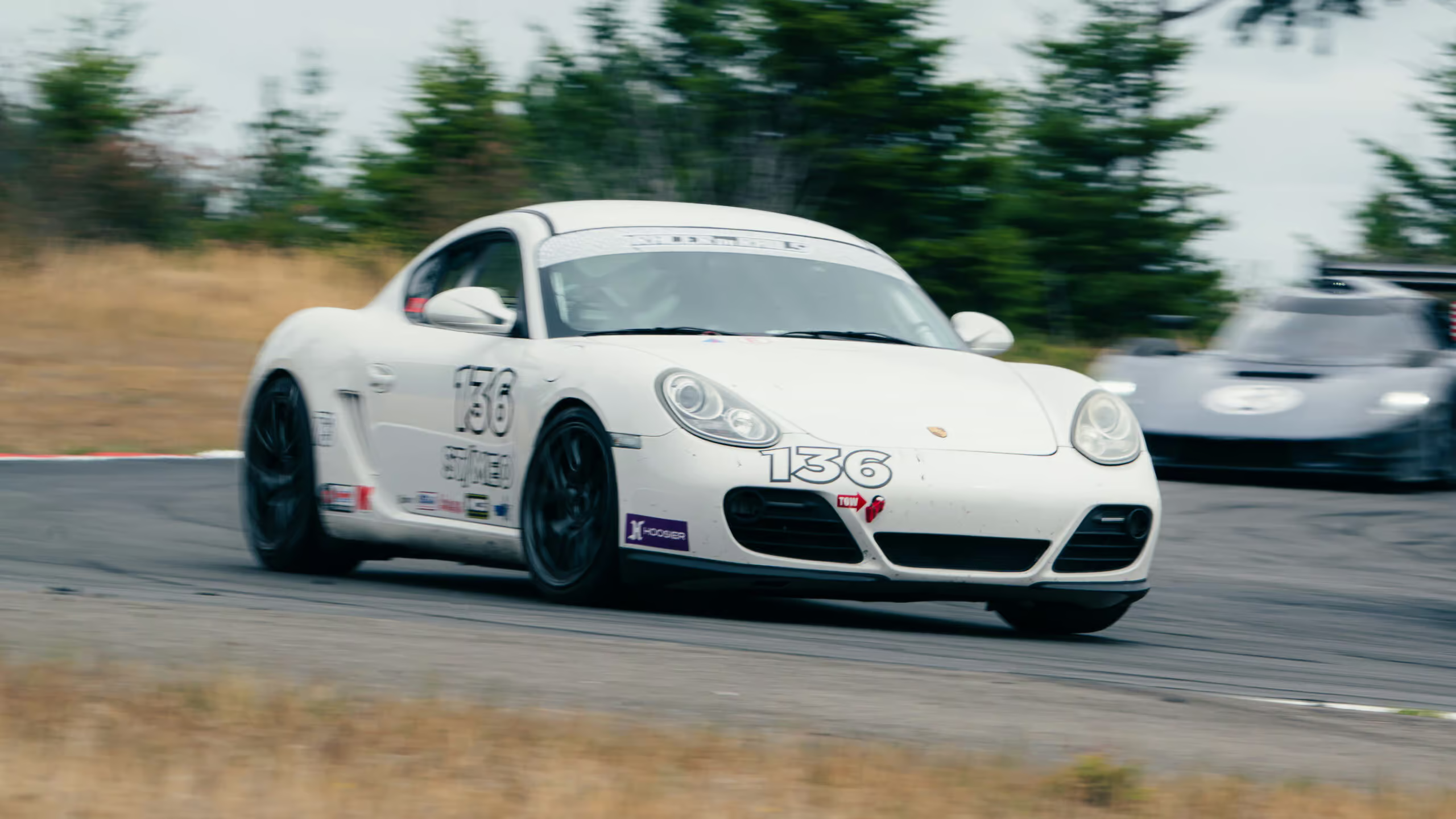
#136 with company — race weekend action

In the fight — the Cayman holding its own on a race weekend.

Where We Go Next

The next phase is about widening the car’s usable performance window, not reinventing it.

We want to keep establishing brake-temperature baselines and determine whether the next step is better one-piece rotors, two-piece rotors, more airflow, different cooling geometry or a larger package.

We will keep developing the thermostatic transmission and differential cooling strategy, suspension geometry, alignment and tire utilization — validating reliability over longer races and using the AiM system to connect what the driver feels with what the car is actually doing.

The goal is not one heroic lap.

The goal is a car that is fast, predictable and repeatable enough that the driver can access that performance over and over again.
Posted on

More Than a Race Weekend: Competition, Development and Community at the 2026 IRDC Summer Classic

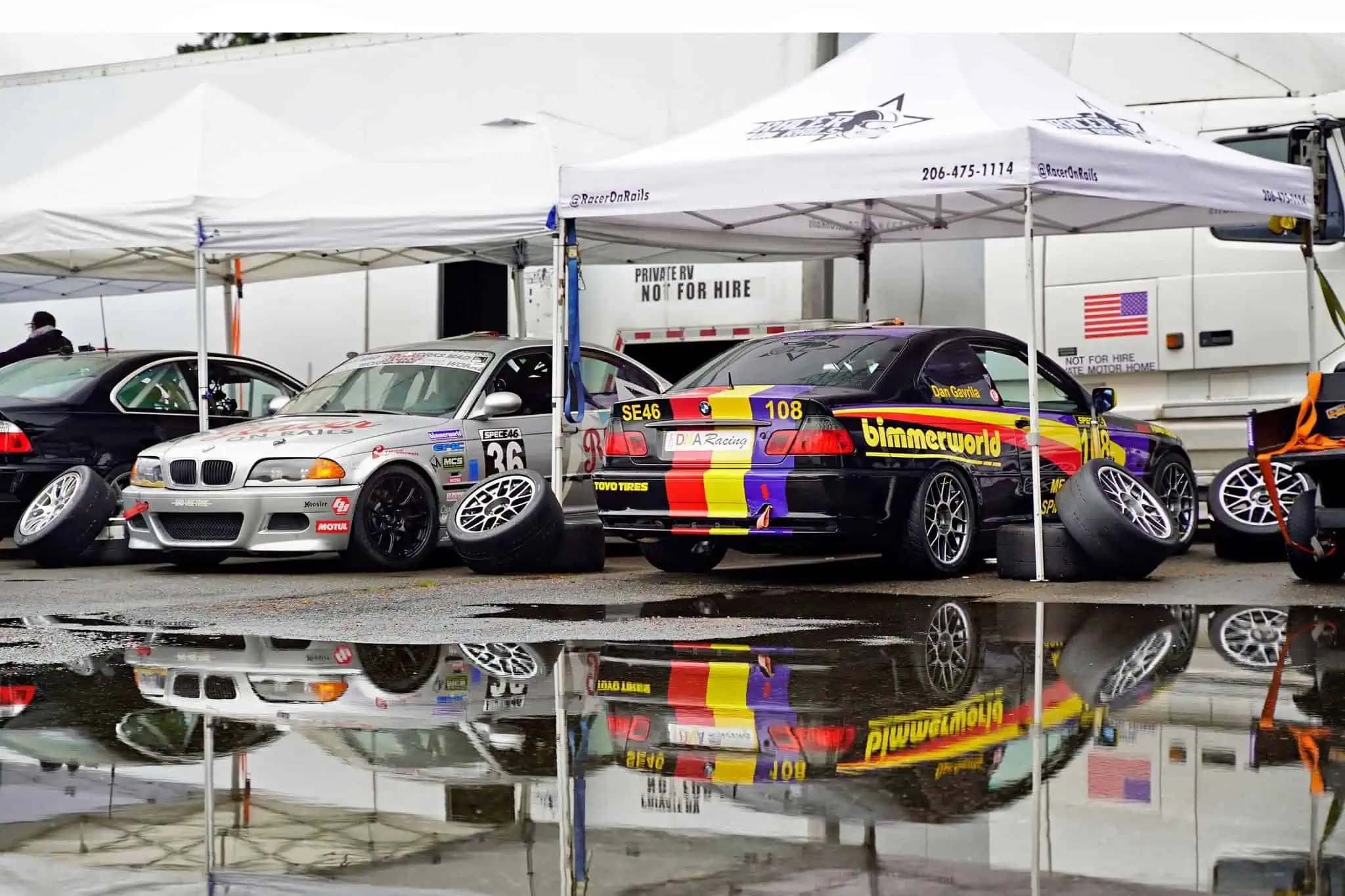
Racer on Rails-supported Spec E46 BMW race cars beneath paddock tents, reflected in rainwater at Pacific Raceways.

The IRDC Summer Classic is not just another race weekend at Pacific Raceways.

IRDC’s May event can produce excellent racing, but spring in the Pacific Northwest always arrives with an asterisk. Cold temperatures and rain can thin the entry list, scramble preparation plans and turn the weekend into an exercise in weather-radar interpretation.

The Summer Classic, traditionally held in late June or July, carries a different energy.

Good weather is never truly guaranteed around here, but the odds are much better. The fields grow, the paddock fills and the competition becomes stronger. It is one of the cornerstone events on the International Race Drivers Club calendar and, in many ways, the weekend when the local racing community is most fully assembled.

The 2026 Summer Classic took place June 26 through 28, with Friday testing leading into two days of qualifying, championship races and a one-hour mini-enduro on Pacific Raceways’ 2.25-mile road course. The event was held under the umbrella of the International Conference of Sports Car Clubs, the Pacific Northwest sanctioning body commonly known throughout the paddock as Conference.

For Racer on Rails, the weekend became a concentrated example of nearly everything we are trying to build.

We supported drivers fighting at the front of Spec E46. We helped another driver make systemic progress through coaching. We introduced a new novice to wheel-to-wheel competition. We kept Stefan Tomalik race-sharp while his own car was being prepared for GRIDLIFE GT competition. We welcomed NASA Northwest’s Jay Perry to Pacific Raceways for the first time and watched him progress from learning the circuit to winning on it. We helped Ellen Porter and Mathieu Martin fit racing into the realities of careers and parenthood. We supported more than half of the Spec E46 field in one form or another.

Then, after the engines went quiet, we partnered with Racecentric to bring racers, volunteers, tuners, time-attack competitors and automotive enthusiasts together at the Racer on Rails facility.

It was more than a race weekend.

It was competition, development and community sharing the same piece of pavement.

A Difficult Start to the Weekend

Saturday morning’s qualifying session provided an immediate reminder that even the Summer Classic can retain a little Pacific Northwest unpredictability.

The track was mixed and drying.

Everyone faced the same decision: wait for the surface to improve, choose wet-weather tires that might quickly overheat, or go onto the circuit with dry tires and accept that parts of the lap were not ready for them.

Most of the field chose dry tires.

The front half of the track was beginning to develop a usable line, but the back side remained damp in places. That mattered because the moisture was concentrated around the part of Pacific Raceways where drivers least want uncertainty: Turns 5A through 6.

That sequence is fast, committed and unforgiving. The car becomes light as the road falls away, the walls feel increasingly close and a driver must trust that the grip waiting on corner entry will still be there when the car reaches the apex.

Damp patches in that section are not merely inconvenient. They change the entire risk calculation.

Everyone had to balance the same questions. How quickly was the track improving? Where was the remaining water? How much commitment was justified when conditions could change from one corner to the next?

No risk, no reward.

Stefan Tomalik navigated the conditions with a 1:38.551, taking the top Spec E46 qualifying position. Dan Gavrila followed with a 1:38.645.

After an entire lap of changing grip, the difference between them was only 0.094 seconds.

It was an early indication that the two of them were going to spend the weekend operating in the same narrow window.

Keeping Stefan Race-Sharp

Stefan has spent much of the season rebuilding his BMW M3 for GRIDLIFE GT competition at WeatherTech Raceway Laguna Seca in September.

Preparing the car is only one part of that project.

The driver also needs preparation.

GLGT will place Stefan in a fast and varied field, surrounded by cars that generate lap time in very different ways. He will need to manage traffic, adapt to changing situations and make good decisions while racing against unfamiliar competitors.

That cannot be recreated through casual track time alone.

The best preparation for racing is racing, especially against people who demand your best.

For the Summer Classic, Stefan returned to the Racer on Rails Silver Bullet in Spec E46. The goal was to keep him competing, keep the decision-making muscles active and measure him against some of the strongest club racers in the region.

Dan Gavrila provided exactly that benchmark.

Dan is exceptionally fast at Pacific Raceways. He knows the circuit intimately and is capable of extracting pace from the car almost immediately. Stefan’s ability to qualify within a tenth of him in difficult conditions was impressive, but Saturday’s race would require something different.

Qualifying rewards the fastest individual lap.

Racing rewards the driver who can keep doing the work while managing traffic, pressure, tires and the changing behavior of the car.

Stefan converted the mixed-condition pole into a Spec E46 victory.

According to the official Saturday race results, he completed 17 laps with a best time of 1:31.346. Anthony Lo finished second, Dan third and Matt Dawson fourth, putting four Racer on Rails-supported or managed cars into the first four positions in class.

The strength of Stefan’s race was not limited to one lap.

The Saturday lap chart showed him repeatedly operating in the low 1:31s, 1:32s and 1:33s, continuing to apply pressure without allowing the quality of his driving to unravel.

That ability to repeat pace is essential.

A driver preparing for a larger, more unpredictable competition environment does not need a single firework of a lap. He needs an entire box of matches.

Sunday morning shifted the order.

With a dry circuit, Dan qualified on the Spec E46 pole with a 1:31.239. Stefan followed at 1:31.574, just 0.335 seconds behind.

Charles Beach qualified third at 1:32.197, while Anthony’s 1:32.199 left him only two thousandths of a second from the second row. Matt followed at 1:32.923, according to the official Sunday qualifying results.

The stage was set for another battle between Dan and Stefan.

Unfortunately, a mechanical concern that had been following Dan’s car throughout the season finally caught up with it.

The engine had regularly produced blue smoke on startup, suggesting that something inside was no longer entirely happy. Dan remained fast despite the warning signs, but the problem ultimately developed into a head-gasket failure and engine damage.

Even with the car deteriorating, Dan recorded a 1:32.031 during Sunday’s race. The speed remained, but the machinery could not carry him through to the finish at the front.

Stefan could.

The Sunday race results showed Stefan completing 17 laps and earning his second Spec E46 victory of the weekend, finishing 15.341 seconds ahead of Charles Beach.

Anthony placed third, Matt fourth and Wes Griffith seventh. Dan was classified eighth after completing 15 laps.

Stefan left the Summer Classic with two victories against serious competition.

More importantly, he had spent the weekend practicing exactly the kind of driving he will need at Laguna Seca: adapting to changing conditions, operating under pressure and delivering pace repeatedly rather than occasionally.

Anthony Lo’s Quiet Level-Up

Anthony Lo’s weekend deserves more attention than a pair of podium finishes alone might suggest.

Although we were not providing Anthony’s full trackside support program at the Summer Classic, Racer on Rails manages and maintains his car. That has given us a close view of the work he has put into his driving and the progress he has made over the past year.

The difference is visible from outside the car.

It is also visible in the timing sheets.

At the 2025 Summer Classic, Anthony qualified third in Spec E46 on both days. His Saturday qualifying time was a 1:32.751, followed by a best race lap of 1:33.002 and a second-place finish in the Saturday race.

On Sunday, he qualified with a nearly identical 1:32.752. His race ended after 13 laps, leaving him classified sixth, with a best lap of 1:33.018. The full progression can be seen in the 2025 Sunday qualifying, race results and lap-time report.

One year later, Anthony returned and delivered a more complete weekend in a nine-car Spec E46 field.

Saturday’s damp qualifying session does not provide a meaningful year-over-year comparison, but once the circuit dried, Anthony recorded a 1:32.637 during the race.

That was more than three-tenths quicker than his best race lap from the same event in 2025, and it helped carry him to another second-place finish.

Sunday provided the clearest measurement.

Anthony qualified with a 1:32.199, improving on his 2025 Sunday qualifying time by 0.553 seconds. That placed him only 0.002 seconds behind Charles Beach and less than one second from Dan’s class pole.

He followed qualifying with a third-place finish and a best race lap of 1:32.677, completing all 17 laps.

At this point in a driver’s development, progress is rarely measured in enormous chunks of lap time.

It lives in tenths.

It appears in consistency, confidence and the ability to execute across an entire weekend. It shows up when the driver is no longer searching for a fundamentally different technique, but refining braking points, releases, minimum speeds and the quality of every transition.

Anthony has put in the work, and he has genuinely leveled up.

Last year, the pace of drivers like Stefan and Dan represented something Anthony was chasing.

Now he is close enough that they need to keep checking their mirrors.

Systemic Progress for Wes Griffith

The Summer Classic was our first weekend working directly with Wes Griffith as a coaching client.

The objective was not to manufacture one spectacular lap. It was to understand the underlying behaviors limiting his performance and help him build a process that could produce repeatable improvement.

There is an important distinction between finding speed and learning how to become faster.

A driver can stumble into a personal best through favorable traffic, fresh tires, a particularly brave moment or a lap where several variables happen to align. That lap may be real, but it is not always transferable.

Systemic progress appears when the driver understands what changed, why it worked and how to reproduce it.

That was the work with Wes.

We focused on giving him clearer references and a more structured approach to the lap. Rather than trying to attack every corner at once, the goal was to reduce ambiguity, identify the largest opportunities and make deliberate changes that could be evaluated through data and driver feedback.

The results began appearing immediately.

Wes recorded a 1:36.135 during Saturday’s race, breaking through his previous personal-best territory. On Sunday, he lowered the mark again with a 1:35.927.

The lap times were exciting, but the more meaningful development was the process behind them.

Wes was not simply trying harder. He was becoming more precise about where and how he applied that effort.

He began improving his understanding of what the car needed, how the corner phases connected and where commitment would produce speed rather than merely additional risk.

He did not beat his personal best once and spend the rest of the weekend admiring it.

He reset it, learned from it and moved it again.

That is the kind of progress that can continue long after the weekend is over.

Matt Dawson and the Joy of 8,500 RPM

Matt Dawson arrived at the Summer Classic with two very different BMWs and two very different assignments.

In Spec E46, he continued developing within one of the weekend’s most competitive classes. Matt finished fourth on both Saturday and Sunday, recording best race laps of 1:33.069 and 1:33.645.

Then there was the Z4 M Coupe.

Matt purchased the car earlier this year, adding a machine with an SCCA National Championship-winning history to his collection.

It is a wonderfully distinctive race car, powered by an engine that rewards commitment all the way to its 8,500-rpm redline.

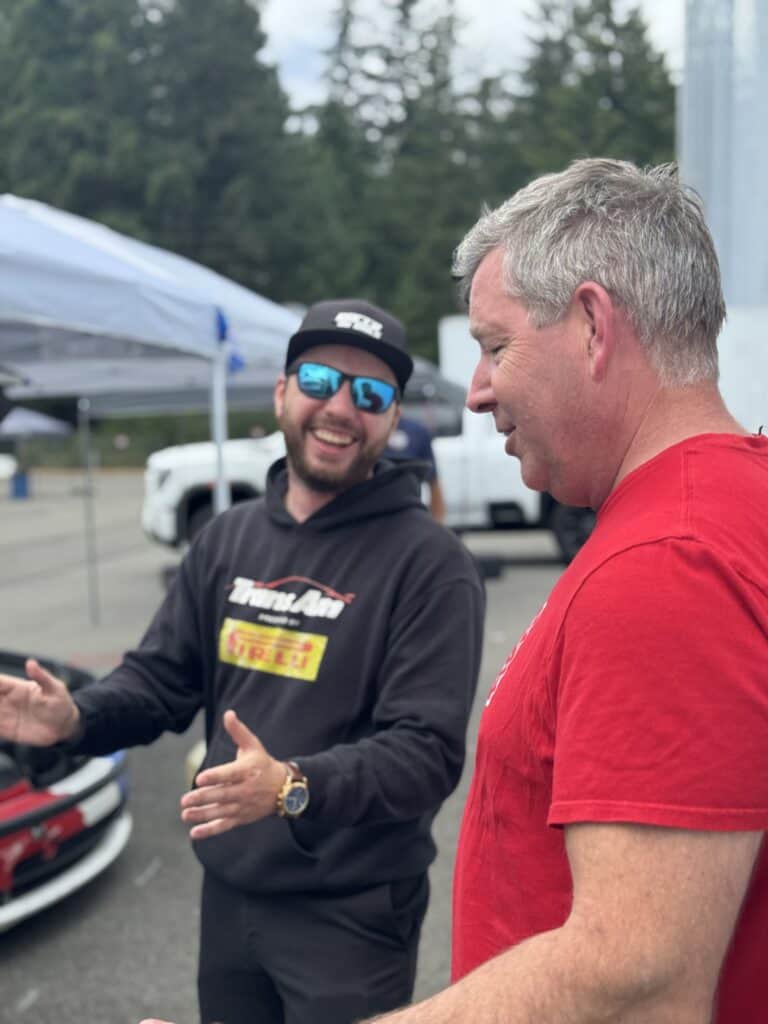
Tyler Campbell and Matt Dawson talk beside a race car in the Pacific Raceways paddock.
Tyler Campbell and Matt Dawson catch up in the paddock during a busy weekend of Spec E46 racing and seat time in Matt’s BMW Z4 M Coupe.

Matt was more than happy to explore the entire tachometer.

He entered the Z4 in the one-hour mini-enduro, completing 36 laps and finishing fourth in the MEO class. His best lap was a 1:30.689.

Learning a new race car is serious work.

The driver must recalibrate nearly everything: braking references, control effort, visibility, gearing, tire behavior and the subtle signals that indicate whether the car has more to give.

It can also be enormous fun.

Every time Matt climbed out of the Z4, he was grinning from ear to ear. Some cars make their case through engineering diagrams and trophy cabinets. Others make it every time the engine reaches the top of the rev range.

The Z4 managed all three.

Jay Perry’s First Visit to Pacific Raceways

The Summer Classic also welcomed Jay Perry from NASA Northwest for his first opportunity to race at Pacific Raceways.

Jay arrived with his C7 Corvette and a substantial learning assignment ahead of him.

Pacific Raceways is not a circuit that reveals all of its secrets immediately.

Its elevation changes obscure sightlines, several important corners are connected in ways that are not obvious from behind the wheel, and the fastest sections require a driver to build trust gradually.

Learning the track is one challenge.

Learning it while racing a powerful Corvette against experienced local competitors adds several more layers.

Jay embraced all of it.

He became quicker and more comfortable throughout the weekend, gradually piecing together the circuit while learning where the Corvette’s power, braking capability and balance could be used most effectively.

By Saturday’s race, Jay was already battling Dan Rogers in his BMW M3 GTR at the front of the SPO class.

Dan won, but only barely.

After 14 laps, the two cars were separated by just 0.347 seconds, with Jay recording a best lap of 1:27.930 in his first race at the circuit.

Jay returned Sunday with another day of knowledge stored away and immediately put it to use.

He lowered his best lap to a 1:25.046 and beat Dan to the finish by 1.894 seconds, splitting the weekend’s two races with a driver who brought both serious pace and extensive Pacific Raceways experience.

That is a serious achievement.

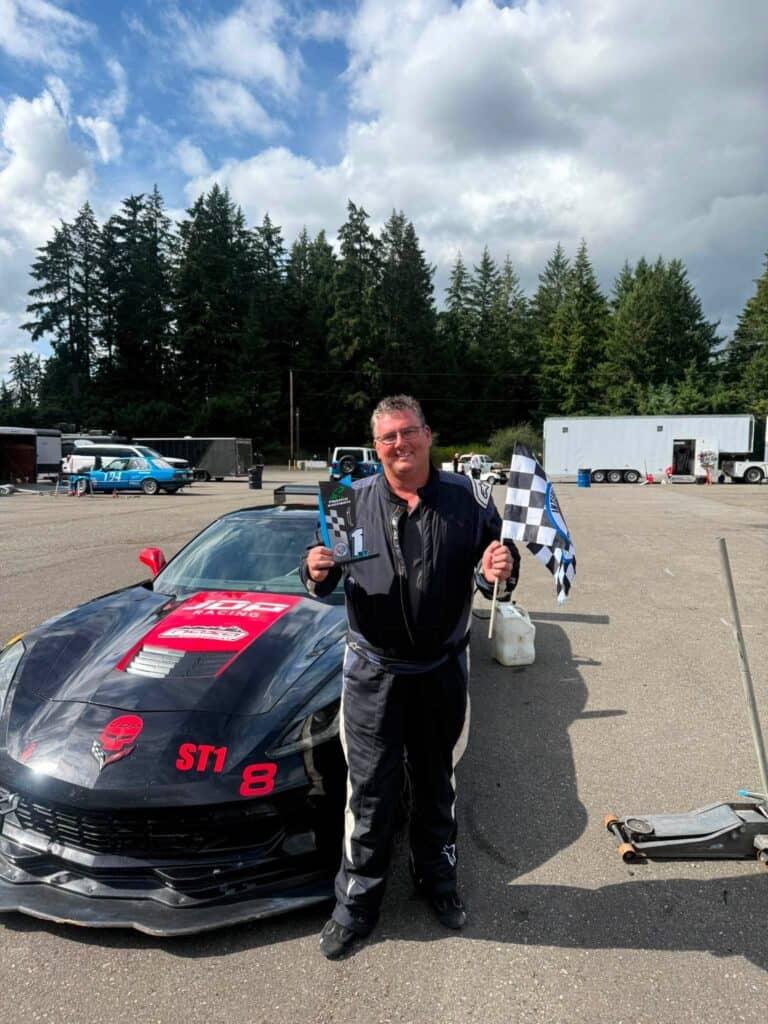
Jay Perry holds a first-place trophy and checkered flag beside his black C7 Corvette at Pacific Raceways.
NASA Northwest’s Jay Perry celebrates an SPO victory beside his C7 Corvette after learning Pacific Raceways and splitting the weekend’s races with Dan Rogers.

Jay did not simply visit a new track, collect some laps and head home. He learned quickly enough to challenge an established local front-runner, race him closely on Saturday and then find the additional performance needed to reverse the order on Sunday.

It was also exactly the kind of crossover we want to see more often.

Organizations such as NASA Northwest, IRDC and Conference may operate their own events and championships, but they are all part of the same regional motorsport community.

Drivers moving between them bring new cars, different experiences and fresh competition into each paddock.

Jay arrived to experience Pacific Raceways for the first time.

He left with a victory, a rapidly expanding notebook and a very good reason to come back.

Federico Mira Picone’s First Novice Weekend

Federico Mira Picone arrived at Pacific Raceways for his first novice race weekend in the Racer on Rails Jägermeister-liveried PRO3 car.

A first wheel-to-wheel event asks a great deal from a driver.

There are race starts, flags, traffic, passing decisions and procedures that cannot be fully recreated during a track day. The driver must learn to allocate attention across the entire environment while still operating the car quickly and accurately.

The objective is not simply to go faster.

It is to build awareness, judgment and capacity without allowing enthusiasm to outrun experience.

Federico’s first qualifying session took place on the same mixed and damp circuit that complicated the Spec E46 session.

He recorded a 1:55.205, but the time was much more representative of the conditions than his actual dry-weather potential.

Once the circuit dried and Federico became more comfortable, the stopwatch began shedding seconds in large handfuls.

During Saturday’s race, he recorded a 1:40.098, completed all 16 laps and won the novice class.

The roughly 15-second difference from qualifying was not the result of a magical transformation. It reflected the enormous contrast between a damp, mixed-condition session and a dry race, combined with Federico’s growing understanding of the car and the environment around him.

He returned Sunday and continued moving forward.

Federico qualified with a 1:40.674. In the race, he lowered his best to a 1:39.219 and earned his second novice-class victory, finishing only 0.952 seconds ahead of Kevin Sun after 13 laps.

Federico’s family and friends were present throughout the weekend, turning the occasion into more than a licensing exercise.

They were able to see the work, the nerves, the progress and the satisfaction that came with completing his first races successfully.

The car’s reliability also played an important role.

During earlier weekends with Ron Tanemura, we had worked through the transmission issues that previously affected the PRO3 car. That work meant Federico could focus on learning how to race rather than wondering which gear the car might choose to surrender next.

He is scheduled to complete his remaining two novice weekends with Racer on Rails this year, earn his full competition license and then decide what the next stage of his racing journey should become.

The first chapter was a strong one.

Ellen Porter and Mathieu Martin Make Space for Racing

Motorsport has a habit of consuming every available hour.

That makes participation especially challenging for Ellen Porter and Mathieu Martin, who are balancing demanding professional careers with raising two young daughters.

Getting both of them to the racetrack required its own exercise in scheduling, logistics and teamwork.

At the Summer Classic, they split the championship races. Mathieu competed in the large PRO3 field, while Ellen raced in CT4.

Ellen completed 15 laps in Saturday’s race, finishing 12th in CT4 with a best time of 1:39.887.

They then combined their efforts for the one-hour mini-enduro.

Mathieu and Ellen shared the No. 26 car, completing 32 laps and finishing third in the ME2 class. Their best lap was a 1:39.874.

Couples who race together may not eliminate every disagreement, but at least they can arrive at the discussion with timing data.

More importantly, Ellen and Mathieu demonstrate that motorsport does not need to be an all-or-nothing pursuit.

With the right equipment, planning and support system, racing can remain a meaningful part of a busy life.

Sometimes that means competing in separate classes. Sometimes it means sharing a car. Sometimes it means handing the steering wheel to your partner and trusting them to bring it back in one piece.

They made the space, shared the work and left with a podium.

Supporting More Than Half of the Spec E46 Field

The Spec E46 results also illustrated how deeply Racer on Rails has become connected to the local class.

We were providing trackside support for Stefan, Dan, Montey Mathison and Matt. Wes was working with us through coaching, and Anthony’s car remained under our management and maintenance program.

In one form or another, Racer on Rails was connected to six of the nine cars in the Spec E46 field.

The purpose is not to create a protected island inside the paddock.

It is the opposite.

When more drivers have access to strong preparation, dependable trackside support, engineering and coaching, the entire class improves.

Cars become more reliable. Drivers become more capable. The racing grows closer, and everyone is required to continue raising their level.

Saturday’s first four Spec E46 finishers were Stefan, Anthony, Dan and Matt.

On Sunday, Stefan won again, Anthony finished third and Matt fourth. Wes lowered his personal best multiple times, while Dan demonstrated race-winning pace before the engine problem ended his challenge.

That is the kind of environment we want to help create.

Competitive on the racetrack.

Collaborative in the paddock.

Relentlessly focused on improving both the drivers and the machinery.

Connecting the Motorsport Ecosystem

The weekend’s most important activity may not have appeared on a timing sheet.

Racer on Rails partnered with Racecentric to host a club and volunteer dinner and mini car show at our facility.

There was barbecue, cold soda, race cars, beautifully prepared show cars and people from several different corners of the automotive world.

Racers and volunteers spent the evening alongside tuners, builders, enthusiasts and time-attack competitors who might not ordinarily occupy the same paddock.

That mixture was intentional.

Motorsport is often presented as a pyramid, with professional racing at the top and every other form of participation stacked somewhere beneath it.

In practice, it behaves much more like an ecosystem.

Club racers need mechanics, engineers, fabricators, photographers, organizers and volunteers. Tuners benefit from lessons developed through competition. Time-attack drivers may eventually become wheel-to-wheel racers. Show-car owners can become track-day participants. Young enthusiasts can discover careers they did not know existed. Volunteers can build relationships with teams, and teams can become stronger members of the clubs that make their racing possible.

Every part feeds another.

The goal of the evening was to celebrate the club, thank the volunteers and create more opportunities for those different communities to rub shoulders.

Not through a formal conference or a carefully scheduled networking exercise, but over food, cars and the shared language of people who care deeply about machines.

For one evening, the Racer on Rails facility became more than a place where race cars are stored, prepared and repaired.

It became a gathering point for the broader automotive community.

That matters because the long-term health of racing will not be determined solely by what happens between the green and checkered flags.

It will also depend on whether there is an inviting, connected world surrounding the competition.

Progress in Every Direction

The 2026 IRDC Summer Classic produced strong results for Racer on Rails, but no single trophy or finishing position captures the weekend.

Stefan Tomalik won both Spec E46 races while sharpening the skills he will need for GRIDLIFE at Laguna Seca.

Dan Gavrila demonstrated front-running speed before a known mechanical concern developed into an engine failure.

Anthony Lo turned the promise of his 2025 Summer Classic into a more complete 2026 performance, improving his dry-weather pace and earning podium finishes on both days.

Matt Dawson raced hard in Spec E46, then spent the mini-enduro exploring the upper reaches of the Z4 M Coupe’s tachometer.

Jay Perry learned Pacific Raceways at remarkable speed, battling Dan Rogers throughout the weekend and leaving his first visit with an SPO victory.

Wes Griffith broke through previous limitations and lowered his personal best multiple times during our first coaching weekend together.

Federico Mira Picone completed his first novice event, won his class twice and took a major step toward earning his full competition license.

Ellen Porter and Mathieu Martin found a way to balance careers, parenthood and competition, then shared a podium finish in the mini-enduro.

Around them was a Racer on Rails operation preparing cars, coaching drivers, solving problems and supporting more than half of the Spec E46 field.

Then, when racing finished for the day, we opened the doors and brought the wider community together.

That was the real story of the Summer Classic.

Competition, driver development, vehicle preparation and community building do not need to exist as separate activities.

When they are connected intentionally, each one makes the others stronger.

That is the ecosystem we believe in.

And that is exactly what we are trying to build.

Posted on

Portland Hoosier Super Tour Recap: Setup Windows, Mental Unlocks, and a T3 Weekend Sweep

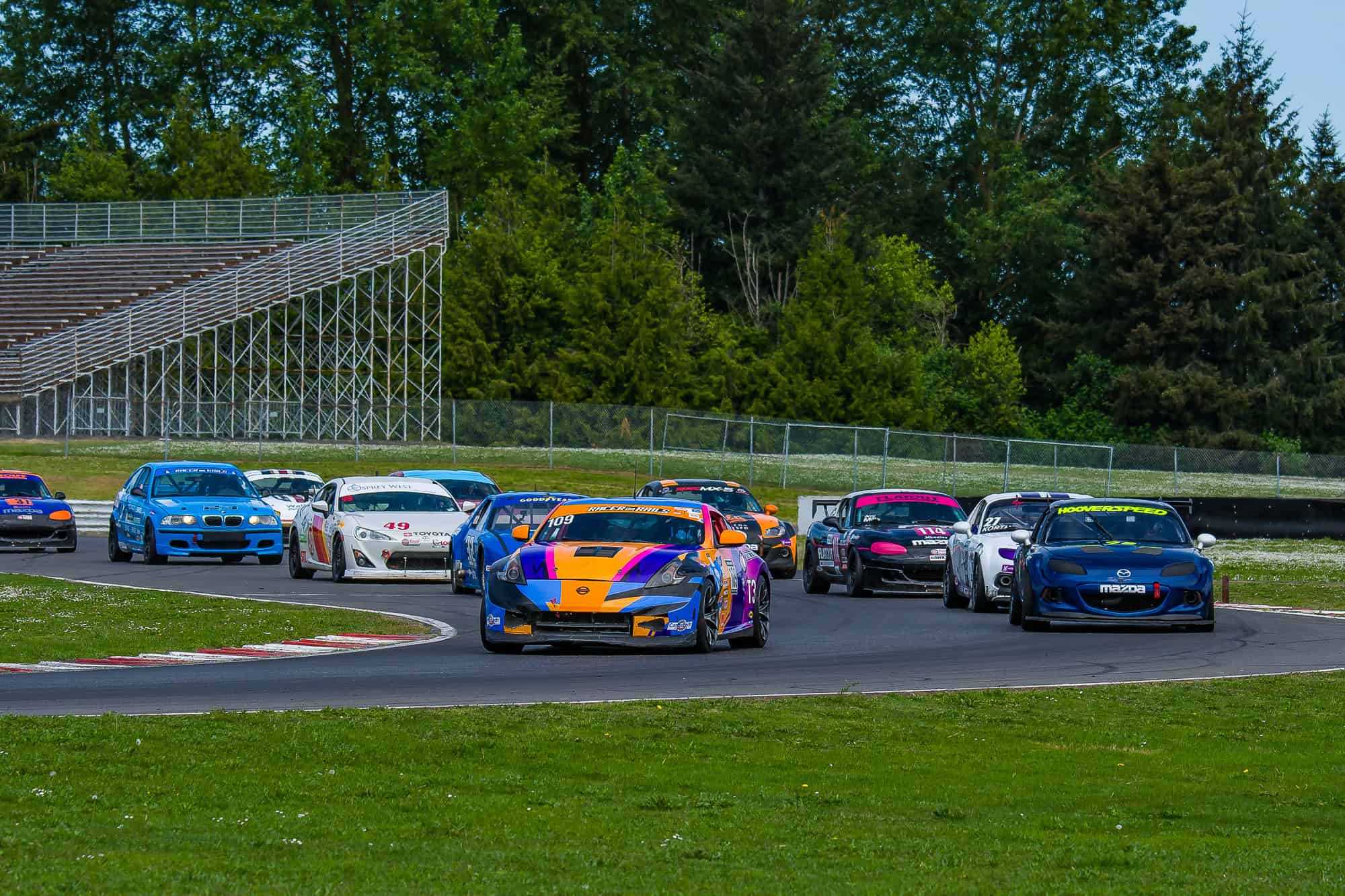
Racer on Rails Nissan 370Z leading a mixed Touring 3 race group through Portland International Raceway during the Oregon SCCA Hoosier Super Tour.
Gama Aguilar-Gamez leads the Touring 3 field in the Racer on Rails Nissan 370Z during the Oregon SCCA Hoosier Super Tour at Portland International Raceway.

The SCCA Hoosier Super Tour is one of the biggest stages in amateur road racing. It is where regional racers, national contenders, Runoffs hopefuls, longtime club racers, and professionally prepared teams all end up in the same paddock, chasing the same thing: speed that holds up when the stopwatch and the field both get serious.

For Racer on Rails, weekends like this matter because they are more than another race on the calendar. They are measuring sticks. They show where the cars are, where the drivers are, where the team is operating well, and where the next layer of performance is hiding.

This round brought us back to Portland International Raceway for the Oregon SCCA Hoosier Super Tour. PIR is a uniquely Northwest kind of racetrack. It sits inside a major city, close to the Columbia River, built on land with real history, surrounded by trees, planes, cyclists, and the strange calm of a public park that also happens to host serious race cars. It is one of those places that feels easy until you try to be fast there.

On paper, Portland looks simple. It is flat, relatively short, and does not have the obvious “monster corner” personality of a place like Road America, Thunderhill, or Sonoma. But that is exactly the trap. PIR asks for precision everywhere. The lap is full of medium-speed commitment, heavy braking moments, curb usage, track-out discipline, and small setup decisions that either build confidence or quietly steal time every lap. If the car is not underneath you, the track exposes it. If the driver is not fully committed, the stopwatch tattles immediately.

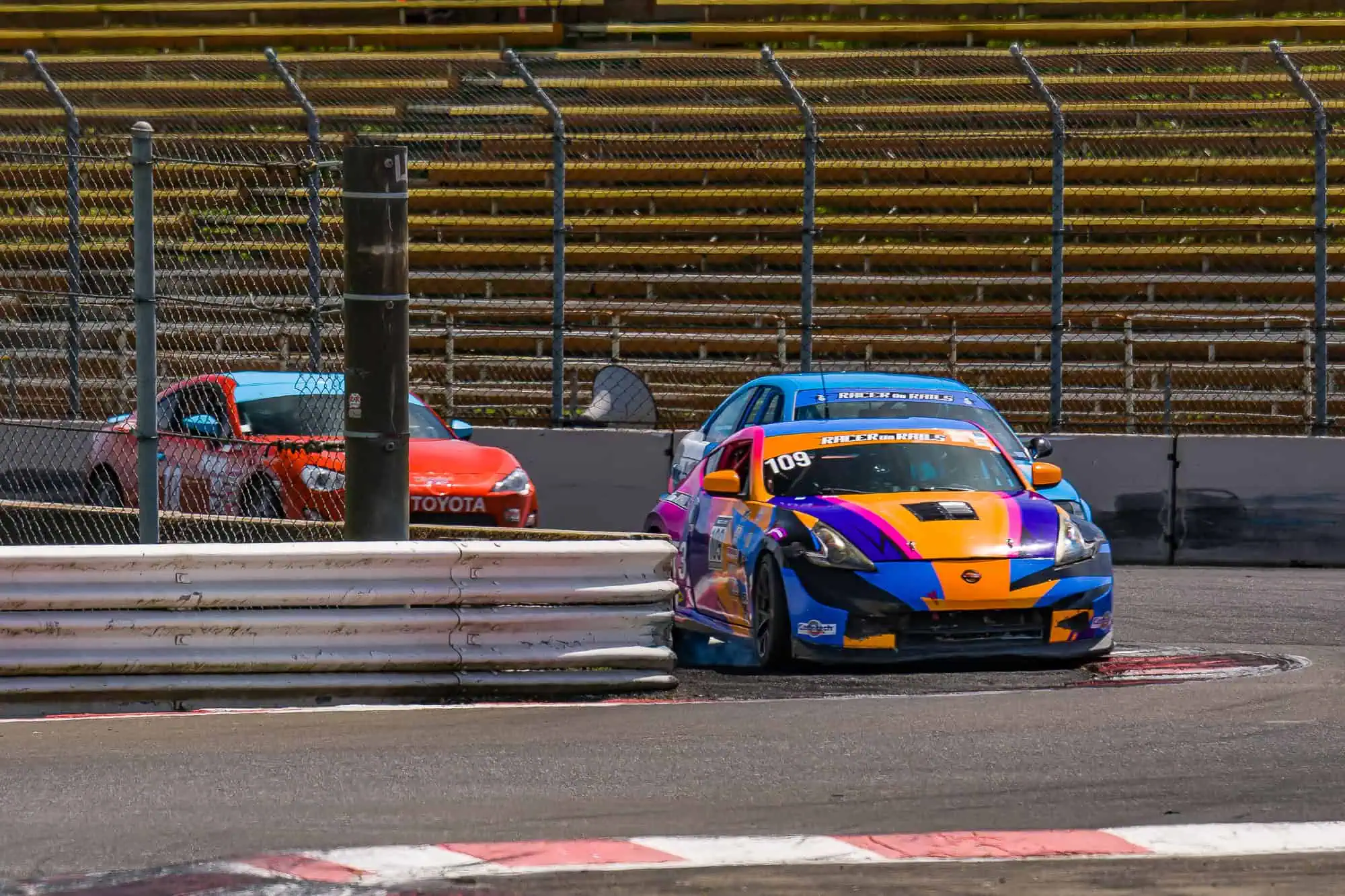
Racer on Rails Nissan 370Z Touring 3 race car driving over the curbing at Portland International Raceway with race traffic behind.  | (C) 2025 Doug Berger | DBPics
The Portland chicane rewards commitment, curb confidence, and a car that stays predictable under braking and turn-in. (C) 2025 Doug Berger | DBPics

Our weekend lineup had a little bit of everything.

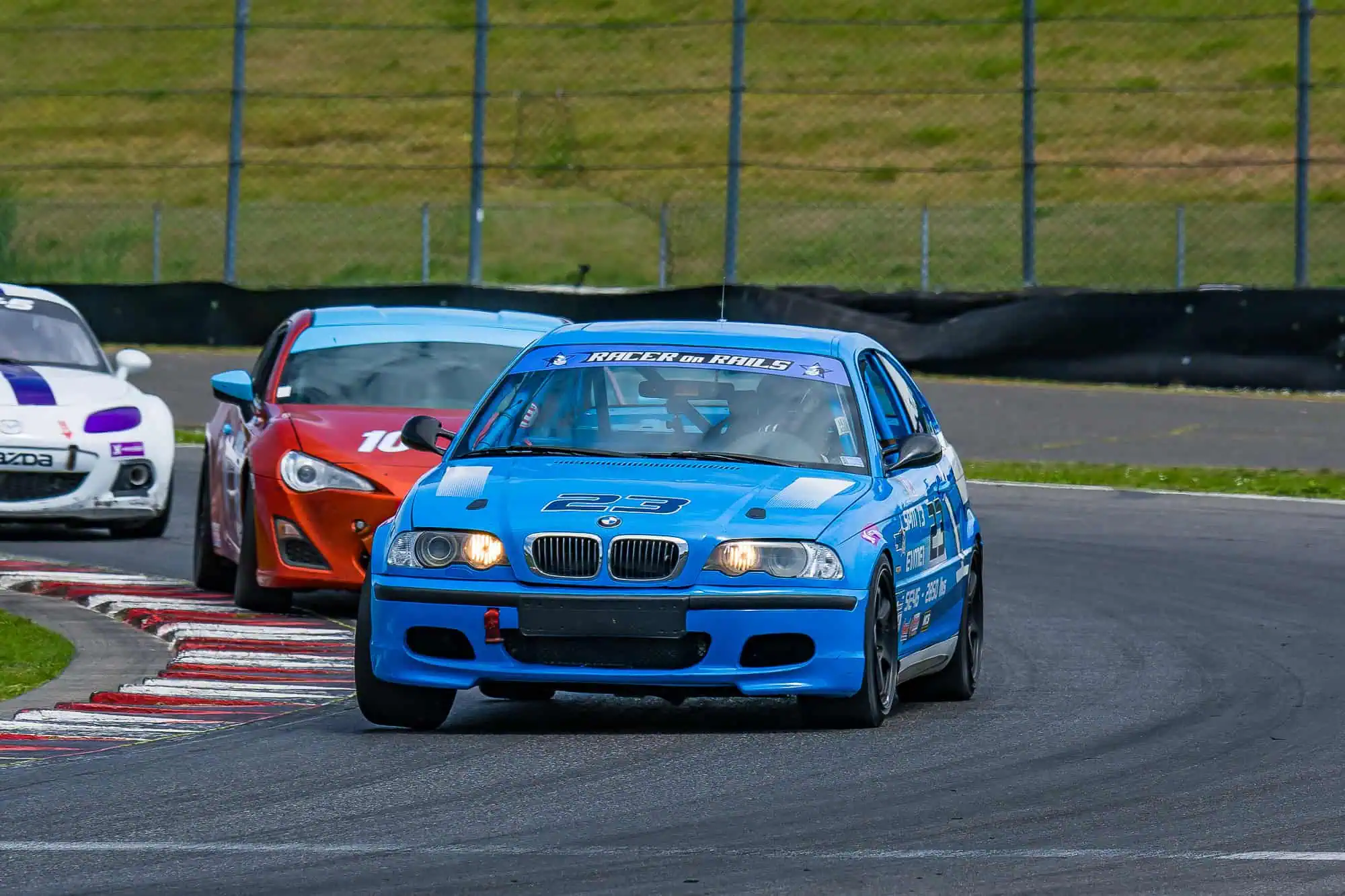
Chris Johnson was back in his Spec E46 in Touring 3 for the first time since last July. Gama Aguilar was in the Nissan 370Z, also in Touring 3, continuing the development push from Thunderhill. Beef Wellington brought out his Touring 2 BMW M240iR. And while Ron Tanemura was not technically in one of our cars, he was still part of the broader Racer on Rails driver development program, racing a Spec Racer Ford Gen3 with Flat Out Racing and continuing to work with Tyler through our coaching services.

Different cars. Different goals. Same weekend. Same stopwatch.

Chris Johnson: Back in the Saddle, Then Fully Lit

Chris started the weekend exactly where you might expect after nearly a year away from the car: knocking the dust off.

The Spec E46 was on older tires, Chris was rebuilding rhythm, and the first part of the test day was about getting reconnected with the car. Braking points. Corner entries. Trust. References. The little internal checklist every driver has to rebuild after time away.

Chris Johnson driving the blue Racer on Rails BMW Spec E46 Touring 3 race car through Portland International Raceway with race traffic close behind.
Chris Johnson returned to the seat of his Spec E46 in Touring 3 and spent the weekend rebuilding rhythm, confidence, and pace. (C) 2025 Doug Berger | DBPics

By the end of the first test day, though, the fog was clearing. Even as the track got hotter and conditions worsened, Chris started closing back in on his personal best lap times. That was the first sign that the speed had not gone anywhere. It was still there, sitting under the surface, waiting for him to believe it was available again.

The next day, we had one of those conversations that matters more than a shock adjustment or tire pressure change.

Chris was talking through what he was feeling in the car, but underneath the words were a few limiting thoughts. Not excuses. Not weakness. Just the normal stuff drivers tell themselves when confidence is still a lap or two behind capability.

The conversation was about the things we tell ourselves. What we accept as true. What we assume is possible. What we decide is “about where we are” before the car and the data have actually said that.

Something clicked.

In Saturday’s race, Chris came alive. He got pulled into a tight battle with a few out-of-class cars that were absolutely flying, and that extra competitive energy did exactly what a good race battle should do. It sharpened him. It pulled his eyes forward. It made him stop driving the idea of the lap and start racing the car in front of him.

The result was a major unlock. Chris knocked roughly a second from his previous bests and started driving with the kind of intent we knew was still there.

Sunday morning, he was determined to prove Saturday was not a one-off. He wanted to build on the confidence instead of simply enjoy the memory of it.

He did.

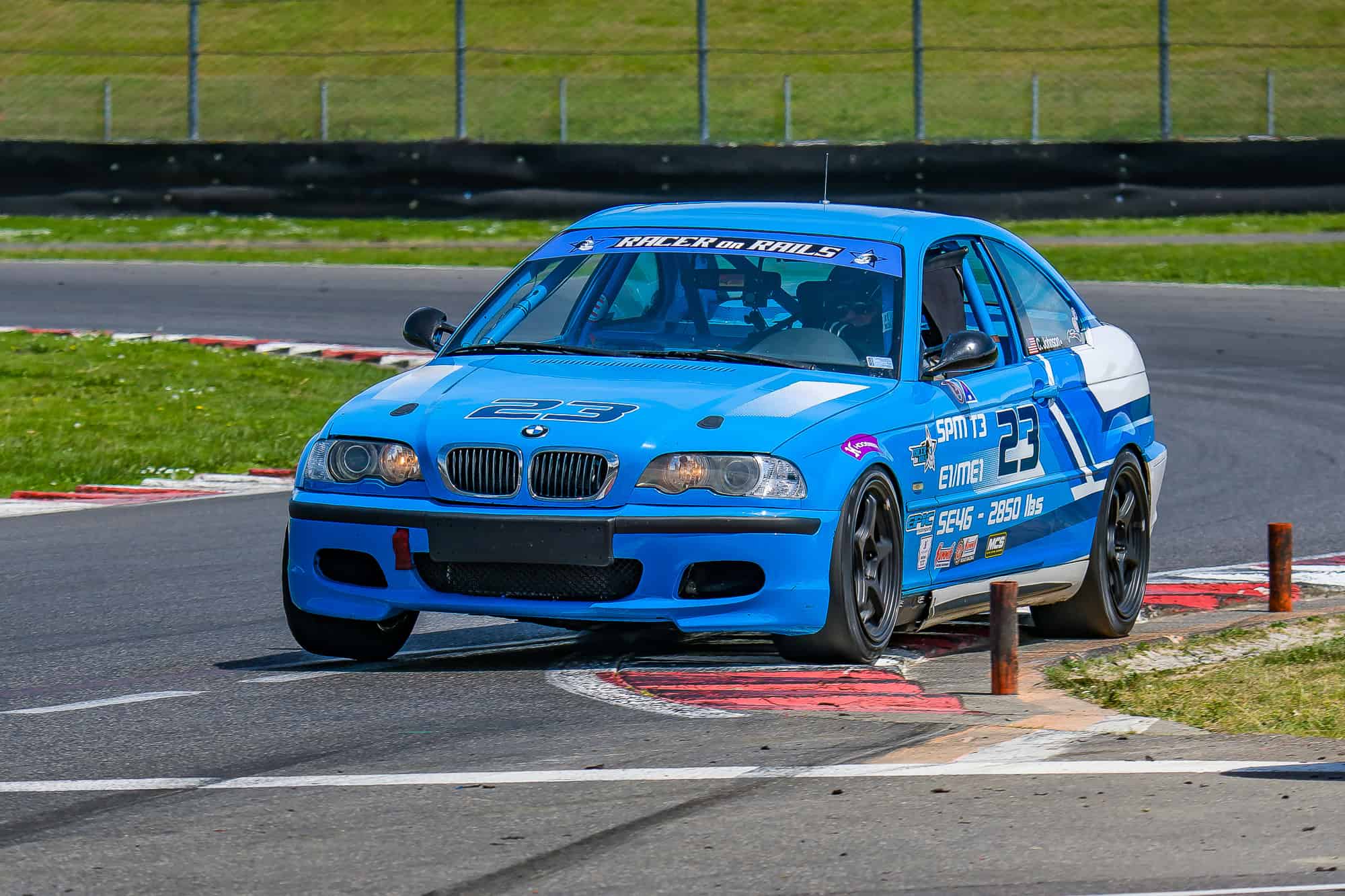
Blue Racer on Rails BMW Spec E46 Touring 3 race car using the curbing at Portland International Raceway during the Oregon SCCA Hoosier Super Tour.
By Sunday, Chris was driving with more commitment and using the confidence from Saturday’s race to unlock another step forward. (C) 2025 Doug Berger | DBPics

In Race 2, Chris carried the lessons forward. He cleared the cars he had been battling with on Saturday and found himself racing farther up the field, with new competition and a new target. That is always one of the best signs in driver development: yesterday’s mountain becomes today’s baseline.

The wild part? He did all of this while nursing an engine that had given us a scare on Friday. Chris had an over-rev, followed by white smoke out the tailpipe. Jordan kept a close eye on the car for the rest of the weekend, and thankfully it made it through without getting worse.

So yes, Chris had a big weekend on the stopwatch. But the bigger unlock was mental. This was a driver remembering that confidence is not something you wait around to receive. Sometimes you have to go take a bite out of the lap and let the confidence catch up.

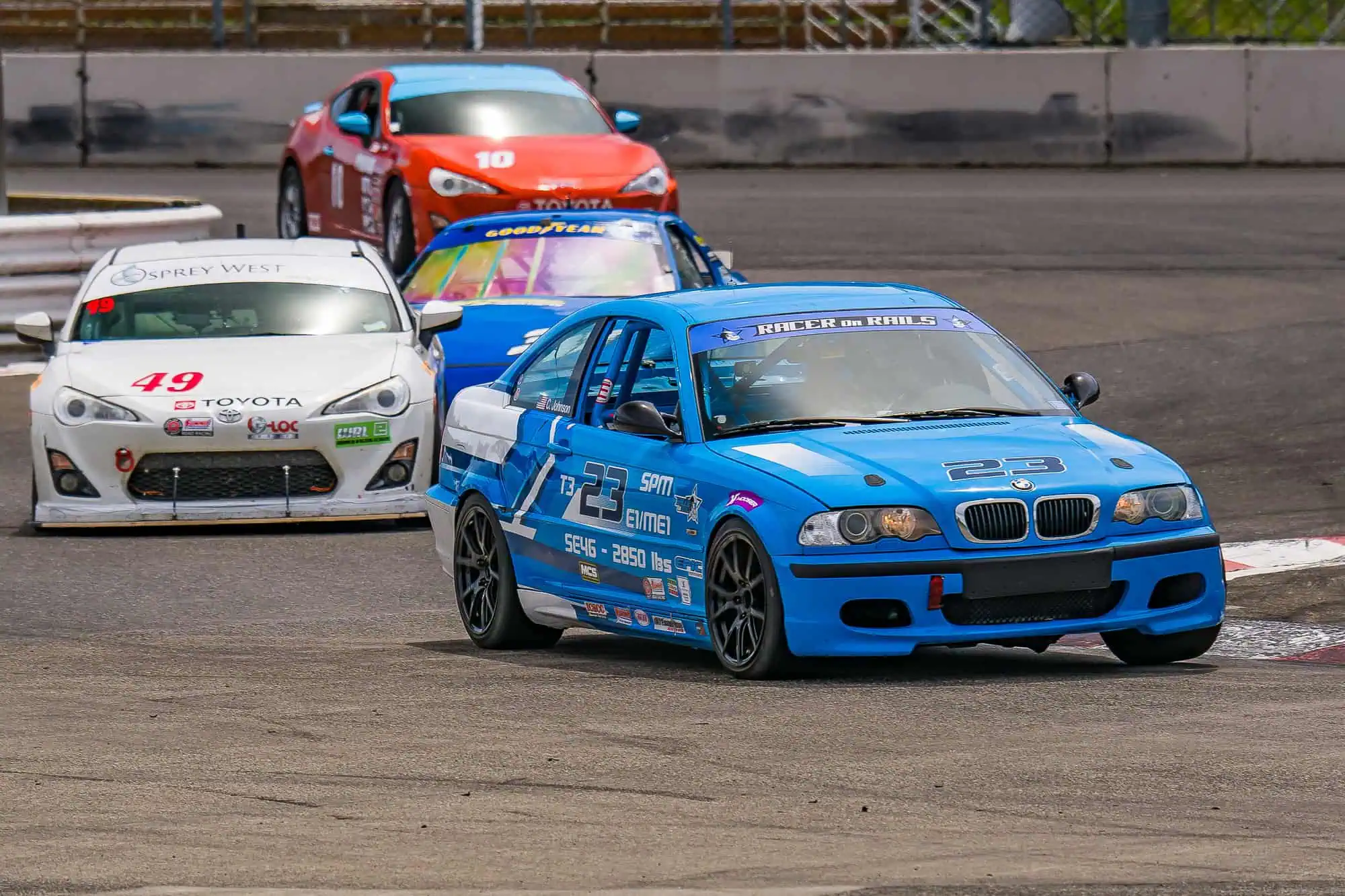
Chris Johnson driving the blue Racer on Rails BMW Spec E46 Touring 3 race car ahead of race traffic at Portland International Raceway.
Chris found himself racing harder, cleaner, and farther up the field as the weekend progressed. (C) 2025 Doug Berger | DBPics

Beef Wellington: A Short Weekend, But the Right Call

Beef’s weekend ended earlier than anyone wanted.

The BMW M240iR had a solid shakedown at Pacific Raceways the week before, so we came into Portland expecting to continue learning the car and building momentum. Instead, the car started overheating after only four or five flying laps.

At first, it looked like the usual race-car mystery novel: temperatures okay, then suddenly not okay. The car would run fine, then start building too much coolant pressure and blow through the expansion tank valve.

The team worked through the problem methodically. Cooling system. Pressure behavior. Failure pattern. Repeatability. The ugly little clues all started pointing in the same direction.

Head gasket.

Mega bummer.

That is never the way we want a weekend to end, especially with a new-to-him but still used/junkyard engine. But there is a version of this story that is much worse. We caught it before destroying the whole engine, avoided turning a repair into a full-scale catastrophe, and got the car pointed toward the work needed before June Sprints at Road America later in the month.

Sometimes race weekends are about trophies. Sometimes they are about knowing when to stop digging.

This was the right call. Not fun. Not glamorous. But right.

Ron Tanemura: Expanding the Driving Toolbox

Ron’s Portland weekend had a different purpose.

He was in a Spec Racer Ford Gen3 rental with Flat Out Racing, while continuing to work with Tyler as part of the Racer on Rails coaching program. The goal was not simply to jump in a new car and chase a number. The goal was to expand his driving range.

That matters.

Ron has been intentionally building a broader driving education. Different platforms. Different sensations. Different demands. The SRF3 is a very different animal from a BMW sedan. It is lighter, more direct, more exposed, and less forgiving of half-commitment. It wants clearer inputs. It rewards decisiveness. It asks the driver to be comfortable with the car moving underneath them.

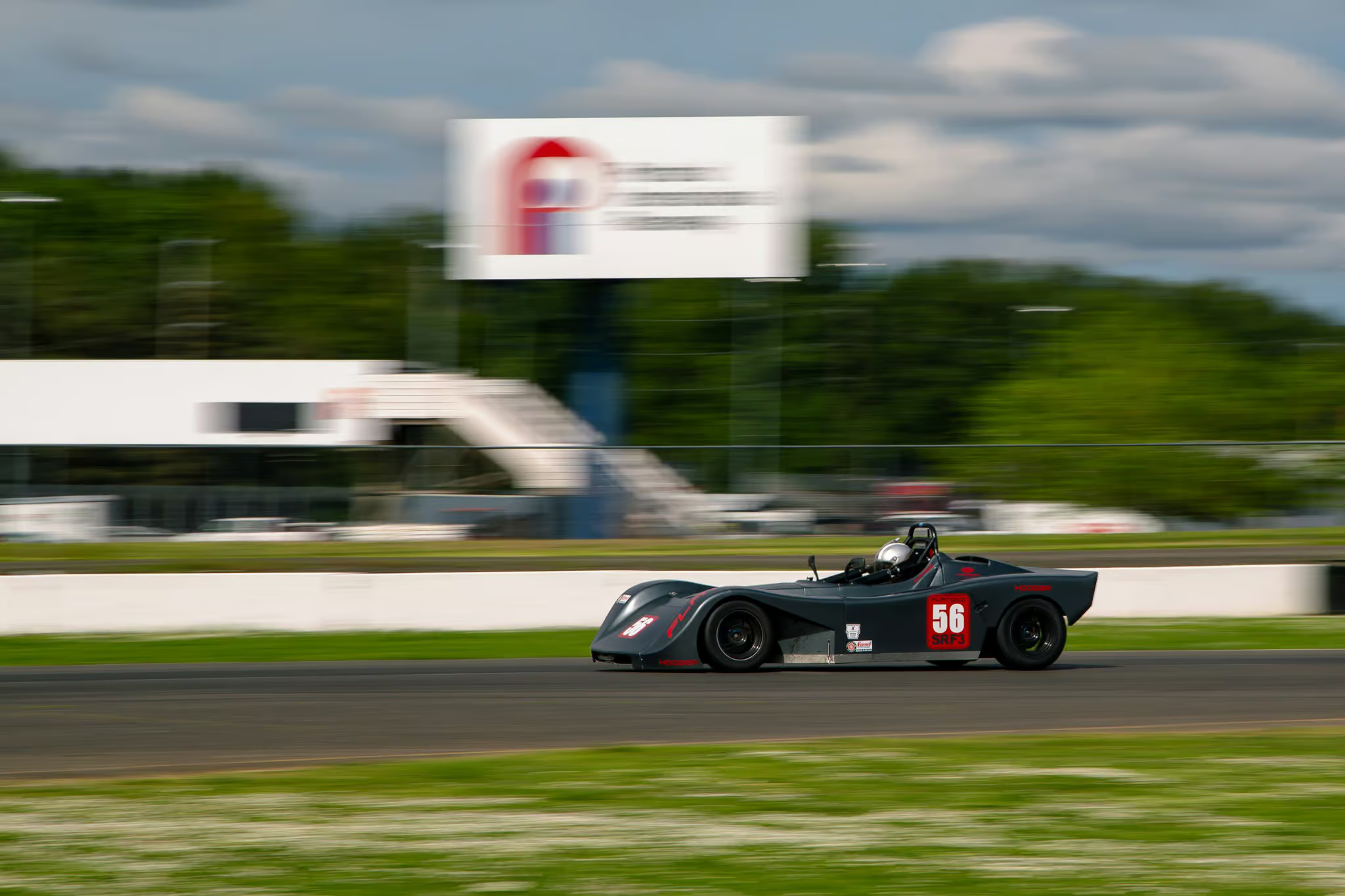
Ron Tanemura driving a black Spec Racer Ford Gen3 through Portland International Raceway during an SCCA race weekend.
Ron Tanemura used the Spec Racer Ford Gen3 weekend to expand his driving range and build a new real-car baseline. (C) 2025 Doug Berger | DBPics

For Ron, the weekend established something important: racing the SRF3 is viable for him. He handled the starts well, showed good awareness, avoided major self-inflicted issues, and built a baseline he can come back to.

The next layer is not secret. It is also not simple.

It is about closing the gap between understanding and execution. Ron has done real work in the sim. He knows a lot of the “recipe” for the car and track. But the real car adds sensation, consequence, tire feel, traffic, imperfect references, and the pressure of being around other drivers. That gap between knowing and doing is where driver development actually lives.

The coaching takeaway was clear: more commitment, more decisive brake release, clearer throttle discipline, more willingness to let the car rotate, and more assertive racecraft once the race settles in.

That is exactly why this was a valuable weekend. Ron did not just collect laps. He collected a sharper understanding of what the next phase of work needs to be.

Black Spec Racer Ford Gen3 race car speeding past the Portland International Raceway front straight during an SCCA race weekend.
A new car, a new rhythm, and another layer in Ron’s broader driver development plan. (C) 2025 Doug Berger | DBPics

And that is the whole point of a driver development plan. Not every weekend is supposed to be a finished product. Some weekends are supposed to reveal the next door.

Gama Aguilar: Engineering the Window

For Gama and the Nissan 370Z, Portland was about building on the lessons from Thunderhill.

At Thunderhill, we had speed, but we were still fighting the car. The Z had pace in flashes, but it was not yet living in a consistent, repeatable window. Under braking and turn-in, the car still had moments where it felt like it was asking for trust without giving enough trust back.

Before Portland, Ian spent a full week digging into the chassis, working through an engineering workbook, checking assumptions, and giving the car the kind of measured attention that separates guessing from development. We are not going to give away every detail of what we found, but the big picture was clear: there was systemic pace hiding in the car.

That was the unlock.

This was not about finding one magic adjustment or chasing a one-lap setup. It was about understanding the car at a deeper level, getting it into a healthier operating window, and creating a foundation we could actually build on across a full weekend.

From there, we reset the approach. The chassis setup moved in a better direction. The car became more predictable. We switched to nitrogen in the tires, including multiple purge cycles to reduce the influence of air and moisture. Then we started fresh on understanding pressure build, temperature behavior, and how to keep the tire in a usable window from the first hard lap to the last.

That became the real work of the weekend.

Not “what makes one fast lap?” but “what makes the car fast, repeatable, and trustworthy every time we lean on it?”

By Friday, the difference was obvious. For the first time ever in the 370Z, we could push the car hard every session and have it respond the same way. The car was no longer giving us a narrow little keyhole of performance. It gave us a window. And once we had a window, we could finally start doing real race-car work.

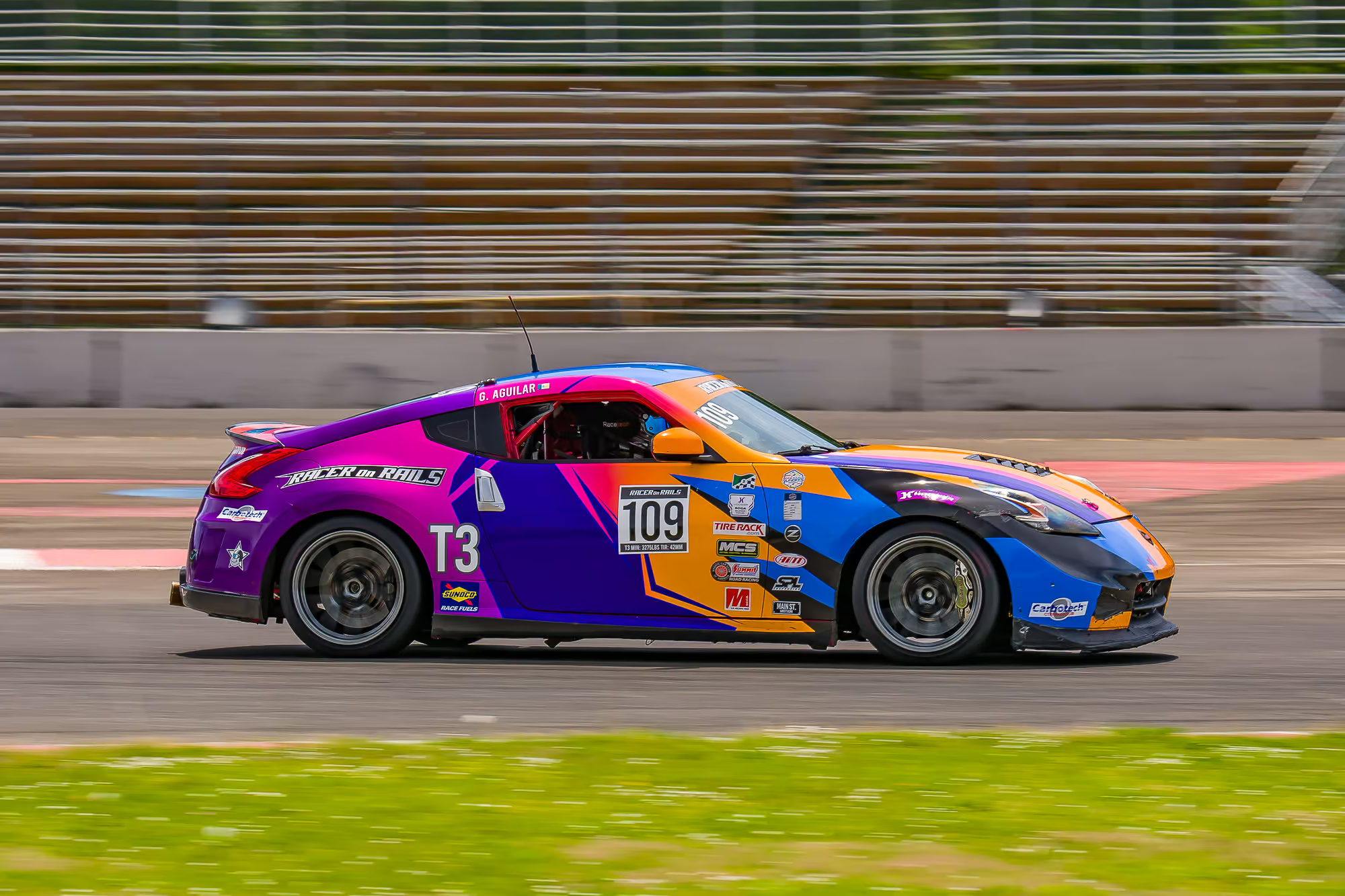
Side profile of the Racer on Rails Nissan 370Z Touring 3 race car at speed on the front straight at Portland International Raceway.
After ride height, suspension geometry, nitrogen, and tire pressure work, the 370Z finally delivered a repeatable setup window. (C) 2025 Doug Berger | DBPics

That is a big deal.

The official Race 1 time cards showed the progress starting to show up on paper, with the #109 370Z quickly moving from a 1:26.946 opening lap into a 1:24.759, then a 1:24.526, then a 1:24.701. More important than the single lap was the shape of the run. The car stayed in the window. The laps stayed usable. The team finally had a platform we could tune instead of survive.

By the race weekend, we were fine-tuning instead of firefighting.

The result was an easy Touring 3 pole, a Saturday T3 win, and then another T3 win on Sunday to complete the weekend sweep.

Saturday was not without drama. At the start, there was unnecessary contact with the STU pole sitter that could have ended the race before it properly got going. Thankfully, the Apex forged wheel took an absurd hit and somehow held on. The car survived, the tire held, and we were able to finish.

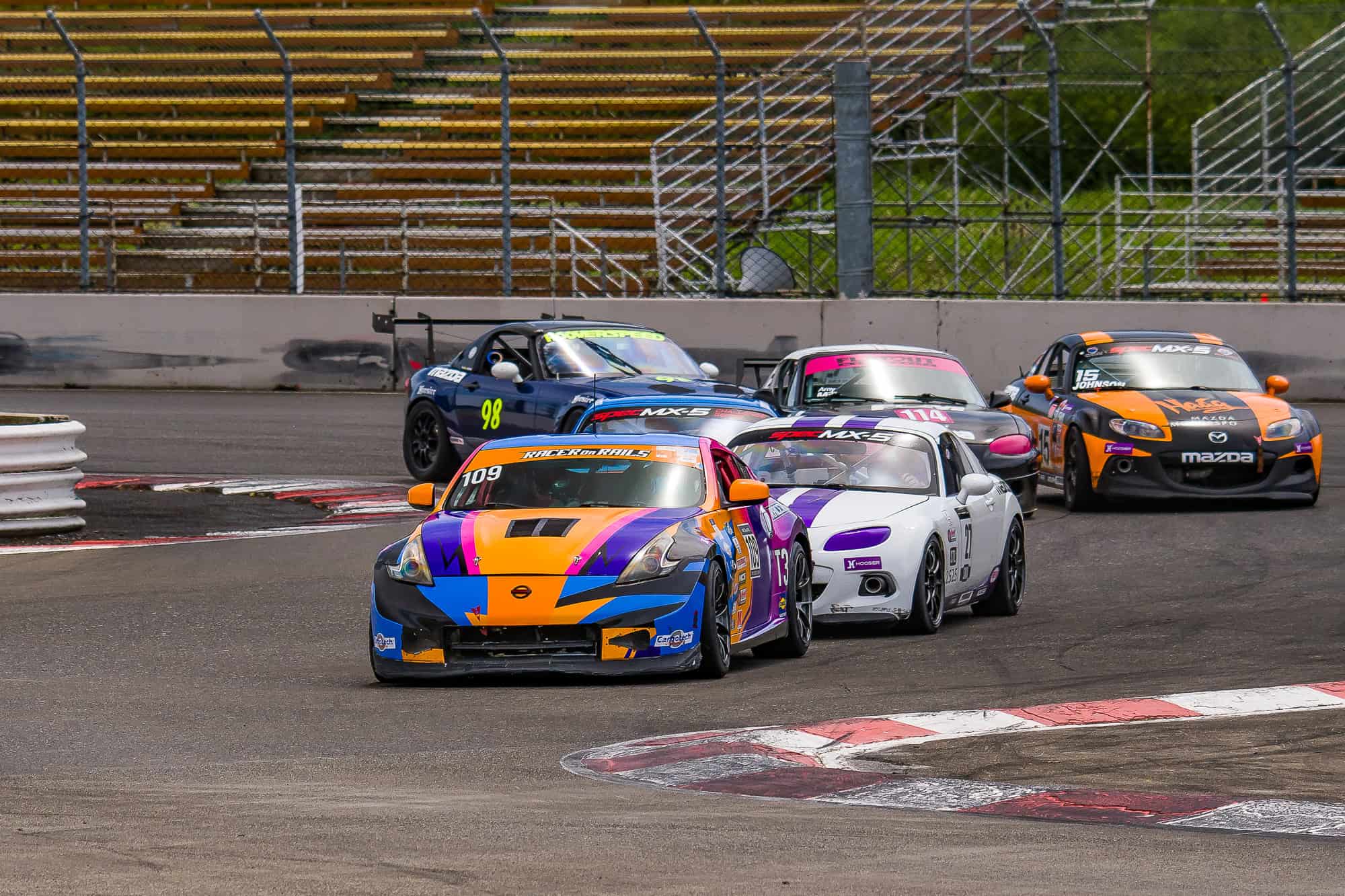
Racer on Rails Nissan 370Z leading a tight pack of race cars through the Portland International Raceway chicane during the SCCA Hoosier Super Tour.
Saturday’s race had contact, traffic, and plenty of chicane chaos, but the 370Z stayed together and brought home the Touring 3 win. (C) 2025 Doug Berger | DBPics

On Sunday, we replaced the damaged wheel and tire, put our heads down, and went for a maximum race-pace push.

That was the most encouraging part of the weekend. Not just winning. Not just getting through the races. But seeing that the car had pace in conditions that were not perfect. The overcast morning cloud cover had burned off by the time our Sunday race started, the track was warmer, and the car still had the ability to push toward the kind of pace we have seen from some of the strongest Touring 3 drivers at this event in prior years.

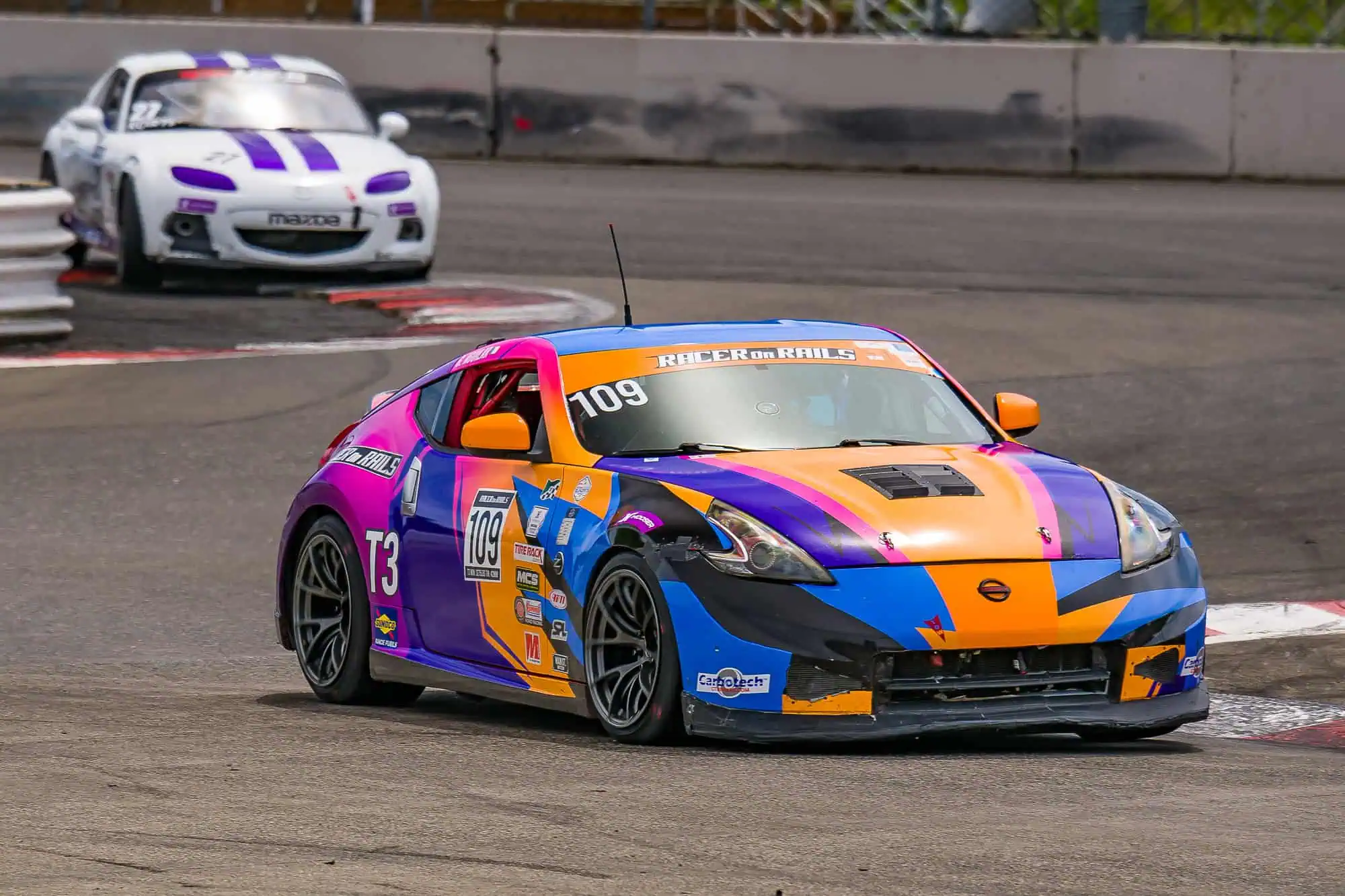
Gama Aguilar-Gamez driving the Racer on Rails Nissan 370Z Touring 3 race car through Portland International Raceway with a Spec MX-5 behind.
The weekend’s biggest win was not just the result. It was finally having a 370Z that could be leaned on lap after lap. (C) 2025 Doug Berger | DBPics

That is the good stuff.

The kind of weekend where the notebook matters as much as the trophy.

The Team Behind the Weekend

Like most race weekends, Portland had its share of curveballs.

Jordan’s personal car broke down on the way to Portland. Beef’s M240iR tried to turn Friday into a cooling system crime scene. Chris’s Spec E46 had to be monitored all weekend after an over-rev and smoke. The Z needed continued tuning and then a wheel/tire change after race contact.

None of that is unusual in racing. That is the job.

What mattered was how the team responded.

Ian’s engineering work before the event gave the Z a new foundation. Jordan kept Chris’s car alive and monitored. Tyler continued guiding drivers through both technical and mental development. The crew absorbed the chaos, kept working the problems, and moved the weekend forward.

That is what we want Racer on Rails to be.

Not just a shop that brings cars to the track. A team that develops cars, develops drivers, solves problems, and helps people leave the weekend with better tools than they arrived with.

Portland gave us a lot.

A Touring 3 weekend sweep for the 370Z. A major mental unlock for Chris. A hard but smart diagnostic call on Beef’s BMW. A valuable SRF3 baseline for Ron. A stronger engineering process for the team. And a reminder that race weekends are rarely clean, but they can still be deeply productive.

We left Portland feeling like the whole program moved forward.

Goals. Smiles. Memories. LFG.

Posted on

2026 Racing Schedule Announcement

Where Racer on Rails Will Be — Come Drive With Us

The 2026 season is officially underway, and our calendar is set. If you’ve been thinking about getting on track, racing more seriously, or stepping into a new program, then right now is the moment to get aligned. Once the season starts stacking, and things are heating up now, prep windows tighten quickly — especially for multi‑event campaigns.

With that in mind, here’s where Racer on Rails will be throughout the 2026 racing season. If any of these events are on your radar, reach out ASAP so we can map out your prep with intention.

SCCA West Coast — Majors, Super Tour & Runoffs

  • Feb 20–22 – Buttonwillow
  • March 27-29 Thunderhill SCCA Regional
  • May 8–10 – Portland SCCA Hoosier Super Tour (Mother’s Day Weekend)
  • May 23–24 – Pacific Raceways SCCA US Majors (Memorial Day Weekend)
  • Sept 25-27 & Oct 2–Oct 4 – Road America SCCA Runoffs

If you’re aiming for a Runoffs qualification campaign or national level competition, this is the ladder.

ICSCC Conference — Pacific Northwest Core Program

  • April 24–26 – Portland
  • May 15–17 – Pacific
  • June 19–21 – Portland
  • June 26–28 – Pacific
  • July 31–Aug 2 – QRP
  • Aug 14–16 – The Ridge
  • Sept 18–20 – Portland
  • Oct 9–11 – Portland (8‑Hour)

For Northwest‑based drivers looking to build racecraft, consistency, and confidence in a tight‑knit paddock, this is home base.

NASA — HPDE, Time Trial & Racing Ladder

  • Mar 6–8 – Sonoma
  • June 19 – 21 Oregon Raceway Park (ORP)
  • Aug 14–16 – Portland
  • Sept 4–6 – Pacific
  • Oct 23–25 – The Ridge

NASA offers one of the clearest progression paths from HPDE to Time Trial to wheel‑to‑wheel racing.

PCA Club Racing

  • Jan 30–Feb 1 – Sebring
  • April 10 – 12 – Road Atlanta
  • July 10–12 – Watkins Glen
  • Sept 4–6 – Road America

If you’re running a Porsche platform and want structured, national‑level competition, this is a strong calendar.

OnGrid Time Attack — Full PNW Calendar

We will be supporting the full OnGrid PNW calendar in 2026.

  • March 27-29 – The Ridge
  • May 22-24 – The Ridge
  • May 29-31 – Thunderhill (GTA)
  • June 19-21 – Pacific
  • July 24-26 – The Ridge

If you’re building a time attack car, refining aero, or sharpening qualifying pace, we’ll be there.

GLTC — Laguna Seca

We will be attending GLTC at Laguna Seca in 2026 as part of our Time Attack and related driving programs.

  • April 17-19 – Carolina Motorsports Park
  • May 8-10 – Road Atlanta
  • June 12-14 – Gingerman Raceway
  • July 24-26 – Watkins Glen
  • Aug 21-23 – Lime Rock Park
  • Sept 18-20 – Laguna Seca – committed to this event only for 2026

If national exposure, high‑energy sprint racing, and a dynamic paddock appeal to you, this is an event to plan early for.

Track Days & Competition License Schools — ProFormance Racing School

For drivers earlier in the journey — or those ready to earn a competition license — we will continue supporting participation in track days and competition school programs with ProFormance Racing School.

ProFormance Racing School Calendar

ProFormance Racing School Accredited Competition Race Licensing Calendar

ProFormance offers:

  • High‑quality foundational instruction
  • Structured HPDE progression
  • Competition license schools
  • A strong on‑ramp into wheel‑to‑wheel racing

If you are:

  • Brand new to the track
  • Looking to build fundamentals
  • Working toward a competition license
  • Or simply wanting more seat time

We can help align your goals, prepare your car, and integrate your track day progression into a broader racing plan.

Track days aren’t separate from racing — they’re often the first step toward it.

What This Means for Your 2026 Season

If you:

  • Want to run even one of these events
  • Need race prep, dyno, setup, or Test Ready certification
  • Want coaching support
  • Are exploring a full‑season campaign
  • Are starting with track days or license school

Our shop capacity, coaching calendar, and trackside support structure are built around this schedule. Aligning early ensures we can support your goals with the time and attention they deserve.

Tell us now.

Goals. Smiles. Memories.                 2026 is here.

Posted on

Welcome Keri and Ian!

Welcome Keri and Ian Anderson to the Racer on Rails Team!

We’re excited to officially welcome Keri and Ian Anderson to the Racer on Rails crew!

If you’ve been around us at the track the last few seasons, you’ve probably already seen them in action — whether it’s wrenching in the paddock, reviewing data late into the night, or debating the finer points of shock tuning, telemetry, tire graining, and simulator setups. We’ve worked alongside Keri and Ian for years as part of our race weekend crew, and before that, we knew each other as friendly competitors and fellow motorsport nerds for over a decade.

Keri joins the team as Service Advisor, Race Car Engineer, and Project Manager, bringing her sharp technical insight and deep experience managing complex race programs from start to finish.

Ian joins as Race Car Technician, Fabricator, and Dyno Operator, where his hands-on expertise, mechanical creativity, and dedication to precision will help keep our cars fast, reliable, and ready to perform.

Together, they bring even more power to our mission: helping drivers reach their goals, create lasting memories, and leave every weekend with a huge smile.

If you’re curious about what it’s like to work with the Racer on Rails team — whether you’re prepping for your first track day, chasing a national championship, or just looking to take your driving to the next level — reach out and connect with us. We’d love to talk about how we can help you go faster, safer, and smarter.

Goals. Smiles. Memories.

That’s what it’s all about.

Posted on

June Sprints at Road America – A Weekend of Grit, Growth, and Podiums

Turn 1 at the start of the Touring 3 race at SCCA Chicago Region June Sprints race!

A few weeks ago, we were at Road America for one of the most iconic events in club racing: the SCCA June Sprints.

There are tracks—and then there’s Road America. Nestled in the rolling hills of Elkhart Lake, Wisconsin, Road America is one of the most iconic and demanding circuits in North America. At 4.048 miles, it’s one of the longest permanent road courses in the country, with 14 turns that blend technical precision with full-send bravery. Corners like the Kink, the Carousel, and Canada Corner don’t just test your car—they test your commitment. Turn 5 is the “slowest” min-speed corner at a target min-speed of 55-60 mph, depending on the car! That is the “slowest” with the rest of the corners having target min-speed of 65, 80, 90 and 110 mph. ????

And then there’s the June Sprints—a race weekend steeped in history. Since 1956, the June Sprints have stood as a cornerstone of American amateur road racing. It’s a proving ground for national champions and future pros, where every lap carries the weight of decades of racing tradition.

But what truly sets this weekend apart is Elkhart Lake itself. This little town breathes motorsport. Historic restaurants like Siebkens and The Osthoff are filled with old racing photos and stories, and the street signs and commemorative plaques around town proudly mark the original road course from the 1950s, when racing took place on public roads. It’s a place where history isn’t just remembered—it’s woven into the landscape.

Just down the road is RealTime Racing HQ, a name familiar to any longtime fan of World Challenge or Honda racing, SO COOL! And everywhere you look during June Sprints weekend, the town is buzzing with performance cars—from vintage Porsches to modern GT4 machines. It’s a car lover’s paradise, and for racers like us, it’s nothing short of heaven.


Big Brains, Big Gains – Engineering First

Before a single lap was turned, Tyler Campbell was already deep in the work: suspension geometry, brake data, tire modeling—he put in the kind of effort that sets great teams apart. We showed up with one of the most dialed-in testing plans we’ve ever run, and it paid off.

We don’t show up to look cool (or at least we think we try to look cool but look like a bunch of racing and track nerds! ????) and bench race. We’re here to science the crap out of our race cars and racing!

Gama and Tyler discussing setup options, data collected and how to move forward.
Gama and Tyler discussing setup options, data collected and how to move forward at June Sprints.

Wednesday & Thursday – Building the Foundation

We rolled in Tuesday night with storms on the radar. Wednesday morning was still wet, but once the track dried, we got to work. We missed the first test session due to the wet track and expected dry conditions through the rest of the race week, but kicked off our structured setup plan with back-to-back sessions focused on testing our hypotheses.

I ran our Spec E46, not because we expected to win overall, but because it gave us a solid, familiar platform to test against elite-level competition (and the Touring 3 Nissan 370Z needed another heart transplant, we’ll get into that more in a future post).

Every change delivered something new—every lap taught us something valuable.

Dave Orem in his BMW Z4M Coupe bombing through Turn 7 at Road America during the 2025 June Sprints
Dave blasting through Turn 7, building speed and confidence lap after lap.

Thursday, we mounted fresh tires and saw a measurable step forward. All signs pointed toward progress, and it gave us confidence heading into the official sessions.


Friday – Contact, Recovery, and Grit

Morning practice started off well… until it didn’t.

Dave Orem got dive-bombed in Turn 1. The hit spun him, left him stalled, and another car—unable to avoid him—collected the Z4M hard.

Bryce and Rene hammer away at fixing a nearly fully destroyed front passenger side corner.
Bryce and Rene hammer away at fixing a nearly fully destroyed front passenger side corner. Within 12 hours of total work time, across a couple days and with overnight delivery of parts, Dave and his Z4M Coupe were online and ready for qualifying session 2 and the race weekend!

Thankfully, Dave was okay. And thanks to an incredible community, we pulled off a minor miracle: sourcing every part needed to get him back on track.

Shoutout to Trevor and Wyatt at Motion Control Suspension for building a replacement MCS shock on short notice and getting it to us overnight.


Friday Qualifying – Almost There

Meanwhile, I was out for qualifying in the E46. Brand new tires. Low Super Tour points meant I was gridded at the back of the T3 field. But we knew we had pace.

Twice, I was on flying laps that would’ve moved me to P2 or P3—both times caught in traffic at the carousel and kink. Absolutely destroyed those laps.

Gama Aguilar in the Racer on Rails silver bullet rental Spec E46,

We finished the day P4. Not ideal, but we knew more was coming.


Saturday – Reset & Rebound

With Dave’s car repaired, he jumped back in for qualifying.

“I didn’t think about the car at all. I was able to focus on finding space and putting down lap times.”

Exactly what you want to hear after an incident. He wasn’t fully back to pace yet but showed strong progress.

Dave building confidence in qualifying after the hit that took him out of Q1.

For me, Saturday qualifying locked in P4. Solid lap. Solid position. Not a perfect lap, but enough to put us in contention for Sunday.


Sunday – Race Day

Dave’s Race

Sunday morning, Dave started deep in mixed-class traffic. Lost a few spots at the start, but once the field spread out, he got to work.

Lap by lap, he found rhythm, overtook competitors, and with just a few laps to go—reset his personal best lap time.

He finished P5 in Touring 3, proud of the recovery but wishing he had the two missed sessions to build more momentum.

Dave making moves through the Sunday main Touring 3 race at the SCCA Chicago Region June Sprints.
Dave making moves through the Sunday main Touring 3 race at the SCCA Chicago Region June Sprints. BMW Z4M Coupe T3 race car.

Gama’s Race

Hot, humid, and with storms on the radar. The goal? Finish to qualify for the Runoffs—and go for a podium if the opportunity was there.

Turn 1 at the start of the Touring 3 race at SCCA Chicago Region June Sprints race!
Gama looking for a way through at the start of the Touring 3 SCCA Chicago Region June Sprints race.

Great start, dicing for P2 and P3 early. Lap 2 brought a jam up into Turn 3 behind a slowing T2 car. Another T3 car got through; I had to wait. That 3–4 second gap to P3 took several laps to close.

Then it happened.

P3 (another Spec E46) dropped a tire into the dirt under braking. Big wiggle. Lost momentum. I got in the draft, faked right, popped left, held side draft as we bent left—and completed the pass into Turn 5 with a wheel in or nibbling at the grass.

Gama looking to grow the gap to P4 during the SCCA Chicago Region June Sprints race at Road America in the Racer on Rails Spec E46 rental race car, the Silver Bullet!

From there? Hit marks. Build gap. Don’t look back.

By the final laps, the lead over P4 was 30+ seconds. P2 and P1 had gotten through the local yellow before me, and that ultimately determined the gap. I brought it home in P3.


???? Watch the Race

Want to see the full race and that battle for the podium?
???? Click here to watch the in-car + SCCA broadcast replay.

YouTube player

What Racing Teaches Us

One of the things I love most about racing is how often we’re proven wrong—and how that’s a good thing. What we “know” is always based on the best data and insight we’ve gathered up to that point. The goal isn’t to be right all the time—it’s to stay curious, stay humble, and keep growing.

And that’s what we did at Road America.


Let’s Build Your Path in Motorsports

If the way we race—the way we prepare, develop, and pursue excellence—resonates with you, let’s talk.

We’re not just about cars. We’re about people, progress, and purpose.
And we’d love to help you chase your motorsport goals.

???? Contact us and let’s get started.

Posted on

Meet Jesse Hasson: New Shop Porter and Apprentice Race Car Technician

We’re thrilled to publicly welcome Jesse Hasson to our team as the new Shop Porter and Apprentice Race Technician. Jesse started back in September and has been getting up to speed and helping the Racer on Rails wheels continue to churn. Jesse’s journey into the world of racing and car mechanics is not just a career choice but a lifelong passion that has been nurtured from a young age.

Jesse’s love for cars and racing sparked early, growing up with a wrench in hand alongside his father. “From the day that I replaced the water pump in our family truck alongside my dad, I knew that working on cars was my lifelong passion and hobby,” Jesse shares. This early experience laid the foundation for his deep-rooted love for all things automotive.

Further honing his skills, Jesse attended Renton Technical College, where he immersed himself in the world of car mechanics. His time at Renton wasn’t just about learning; it was about embracing the complexity and beauty of what makes cars tick. Jesse’s education went beyond textbooks, delving into the practical, hands-on experience that is crucial in our field along with helping on side projects around the shop and working during the race weekends for a while before he officially joined.

But Jesse’s ambitions don’t stop at just fixing and maintaining cars. He dreams of being behind the wheel, competing on the race track. “It is also my lifelong dream to one day competitively drive race cars,” he says with determination. This dream adds an extra layer of enthusiasm and understanding to his role with us.

As our new Shop Porter and Apprentice Race Technician, Jesse brings not just technical skills, but a genuine passion and understanding of the racing world. His role is pivotal in helping the shop operate properly and to help us maintain the high standards of race cars that we manage, ensuring they are in top condition for every race and event.

We believe that Jesse’s passion for racing, combined with his budding technical knowledge, makes him an invaluable addition to our team. His journey is a testament to following one’s passions and turning them into a career. We can’t wait to see the contributions Jesse will make to our team.

Welcome to the team, Jesse! The race track just got a little more exciting with you on board.

Posted on

Dyno Now Available w/Racer’s Annual Benefit!

It may have taken more time than we would have wanted but our dyno is now fully operational and ready to go!

It is a Dyno Dynamics 4WD Dyno that is capable of up to 900whp for a single axle car (FWD or RWD) and 2700whp for AWD platforms!

Check out the Dyno Services page pricing details.

Ready to Schedule?

To book your dyno session, simply reach out and note that Reid Morris will be our full time dyno operator!

Reid Morris Dyno Operator at Racer on Rails
AWD/FWD/RWD Dyno Dynamics Dyno Operator Reid Morris

Licensed Road Race Car Driver Dyno Benefit – Annual Pre/Post Dyno Run

Our purpose, the reason we exist is to help people go racing, achieve their goals, have fun and make memories of a lifetime. The sport isn’t cheap either so as a way to help every racer’s dollar stretch the most it can, we are proud to offer a benefit for all road racers (including Time Attack) where a sanctioned racing license is required.

Pre and Post Season Power Hour for $250 + taxes

If you are a licensed (active and valid license) road racing driver or team, for an extra $55, you get two dyno power hours so that you can head into the season knowing how much power your car is making and at the end of the season, know how much the performance has changed, which can than inform your off-season maintenance, repair, or upgrade plans.

Racer on Rails AWD Dyno Dynamics Dyno
Note: Car on the dyno is in storage mode – making room of every inch of space where we can!

Details

  • Pre-season dyno runs must be scheduled and executed by June 31st of each calendar year
  • Post-season dyno runs must be scheduled between October 1st and December 31st of each calendar year
  • Both Pre and Post-season dyno runs should be scheduled at the same time
  • Post-season dyno run can be rescheduled 1x with at least a 2 week notice
  • No refunds if post-season dyno run is not executed by the end of the calendar year due to a no-show or scheduling issues on the driver side. If due to circumstances on the Racer on Rails side a post-season dyno run needs to be rescheduled more than 1x or past the end of the calendar year, there will be no incremental cost to the driver.
  • Benefit applies to a single unique driver for one race car. e.g. if a licensed race car driver has multiple race cars, this benefit can be used only for one race car per calendar year.
  • Any road racing or time attack/trials license where a driver must demonstrate safe operation of a race car on-track before being licensed and pay an annual due is accepted.
  • Examples of accepted competition licenses: ICSCC, SCCA, NASA, FIA, WRL, SRO, IMSA, AER
Posted on

Welcome, Rene Perez! Race Technician!

Rene came on to our radar last summer where through a friend of the shop, he wanted to come hang out and see what racing was all about during one of our race weekends. He volunteered to work car support just to learn and as the story goes, it was downhill from then!

We’ve continued to grow and Rene joined our team in April as a Race Car Technician and has been having a blast since!

Rene has been a car technician for the past 11 years, initially working for a small mom and pop shop in Southern California, helped maintain/repair city buses for the LA County, worked on high pressure valve blocks in oil refineries, was an air plane technician apprentice and most recently worked at Honda and Maserati dealerships.

His uncle worked for most of his career with Carol Shelby at Shelby of America, so motorsports is in his blood!

When Rene isn’t doing race car things, you’ll find him working on his golf game on the links.

Please join us in welcoming Rene to the team!

Posted on

Welcome, Tyler Campbell – Lead Service Advisor!

Thanks to the support of all our drivers and friends, Racer on Rails has been growing with the big move to our new shop space at Pacific Raceways, an expanded racing calendar (we are currently scheduled to be racing in all but on month in 2023 (December)) and to keep up, we brough on an additional Race Car Technician (Tyler Mayer) and now we’ve landed the second key role – Lead Service Advisor!

ce cTyler Campbell in action as developing data acquisition guy, race car engineer, slideways instigator and all around awesome team member!

Tyler Campbell, Lead Service Advisor

Tyler has been working with the team as an individual contributor and volunteer for the last year on several race weekends. His professional background is as Service Advisor and Project Manager in the automotive sector and will be leveraging those skills in the front end of the shop as our new Lead Service Advisor.

Additionally, he is an avid sim racing driver/coach with national level competitive experience racing GTD Class cars on various simulator platforms (iRacing, Assetto Corsa Competizione, RFactor2) and is a developing race engineer.

Welcome, Tyler! We’re grateful and beyond excited to have you on the team!