The IRDC Summer Classic is not just another race weekend at Pacific Raceways.
IRDC’s May event can produce excellent racing, but spring in the Pacific Northwest always arrives with an asterisk. Cold temperatures and rain can thin the entry list, scramble preparation plans and turn the weekend into an exercise in weather-radar interpretation.
The Summer Classic, traditionally held in late June or July, carries a different energy.
Good weather is never truly guaranteed around here, but the odds are much better. The fields grow, the paddock fills and the competition becomes stronger. It is one of the cornerstone events on the International Race Drivers Club calendar and, in many ways, the weekend when the local racing community is most fully assembled.
The 2026 Summer Classic took place June 26 through 28, with Friday testing leading into two days of qualifying, championship races and a one-hour mini-enduro on Pacific Raceways’ 2.25-mile road course. The event was held under the umbrella of the International Conference of Sports Car Clubs, the Pacific Northwest sanctioning body commonly known throughout the paddock as Conference.
For Racer on Rails, the weekend became a concentrated example of nearly everything we are trying to build.
We supported drivers fighting at the front of Spec E46. We helped another driver make systemic progress through coaching. We introduced a new novice to wheel-to-wheel competition. We kept Stefan Tomalik race-sharp while his own car was being prepared for GRIDLIFE GT competition. We welcomed NASA Northwest’s Jay Perry to Pacific Raceways for the first time and watched him progress from learning the circuit to winning on it. We helped Ellen Porter and Mathieu Martin fit racing into the realities of careers and parenthood. We supported more than half of the Spec E46 field in one form or another.
Then, after the engines went quiet, we partnered with Racecentric to bring racers, volunteers, tuners, time-attack competitors and automotive enthusiasts together at the Racer on Rails facility.
It was more than a race weekend.
It was competition, development and community sharing the same piece of pavement.
A Difficult Start to the Weekend
Saturday morning’s qualifying session provided an immediate reminder that even the Summer Classic can retain a little Pacific Northwest unpredictability.
The track was mixed and drying.
Everyone faced the same decision: wait for the surface to improve, choose wet-weather tires that might quickly overheat, or go onto the circuit with dry tires and accept that parts of the lap were not ready for them.
Most of the field chose dry tires.
The front half of the track was beginning to develop a usable line, but the back side remained damp in places. That mattered because the moisture was concentrated around the part of Pacific Raceways where drivers least want uncertainty: Turns 5A through 6.
That sequence is fast, committed and unforgiving. The car becomes light as the road falls away, the walls feel increasingly close and a driver must trust that the grip waiting on corner entry will still be there when the car reaches the apex.
Damp patches in that section are not merely inconvenient. They change the entire risk calculation.
Everyone had to balance the same questions. How quickly was the track improving? Where was the remaining water? How much commitment was justified when conditions could change from one corner to the next?
No risk, no reward.
Stefan Tomalik navigated the conditions with a 1:38.551, taking the top Spec E46 qualifying position. Dan Gavrila followed with a 1:38.645.
After an entire lap of changing grip, the difference between them was only 0.094 seconds.
It was an early indication that the two of them were going to spend the weekend operating in the same narrow window.
Keeping Stefan Race-Sharp
Stefan has spent much of the season rebuilding his BMW M3 for GRIDLIFE GT competition at WeatherTech Raceway Laguna Seca in September.
Preparing the car is only one part of that project.
The driver also needs preparation.
GLGT will place Stefan in a fast and varied field, surrounded by cars that generate lap time in very different ways. He will need to manage traffic, adapt to changing situations and make good decisions while racing against unfamiliar competitors.
That cannot be recreated through casual track time alone.
The best preparation for racing is racing, especially against people who demand your best.
For the Summer Classic, Stefan returned to the Racer on Rails Silver Bullet in Spec E46. The goal was to keep him competing, keep the decision-making muscles active and measure him against some of the strongest club racers in the region.
Dan Gavrila provided exactly that benchmark.
Dan is exceptionally fast at Pacific Raceways. He knows the circuit intimately and is capable of extracting pace from the car almost immediately. Stefan’s ability to qualify within a tenth of him in difficult conditions was impressive, but Saturday’s race would require something different.
Qualifying rewards the fastest individual lap.
Racing rewards the driver who can keep doing the work while managing traffic, pressure, tires and the changing behavior of the car.
Stefan converted the mixed-condition pole into a Spec E46 victory.
According to the official Saturday race results, he completed 17 laps with a best time of 1:31.346. Anthony Lo finished second, Dan third and Matt Dawson fourth, putting four Racer on Rails-supported or managed cars into the first four positions in class.
The strength of Stefan’s race was not limited to one lap.
The Saturday lap chart showed him repeatedly operating in the low 1:31s, 1:32s and 1:33s, continuing to apply pressure without allowing the quality of his driving to unravel.
That ability to repeat pace is essential.
A driver preparing for a larger, more unpredictable competition environment does not need a single firework of a lap. He needs an entire box of matches.
Sunday morning shifted the order.
With a dry circuit, Dan qualified on the Spec E46 pole with a 1:31.239. Stefan followed at 1:31.574, just 0.335 seconds behind.
Charles Beach qualified third at 1:32.197, while Anthony’s 1:32.199 left him only two thousandths of a second from the second row. Matt followed at 1:32.923, according to the official Sunday qualifying results.
The stage was set for another battle between Dan and Stefan.
Unfortunately, a mechanical concern that had been following Dan’s car throughout the season finally caught up with it.
The engine had regularly produced blue smoke on startup, suggesting that something inside was no longer entirely happy. Dan remained fast despite the warning signs, but the problem ultimately developed into a head-gasket failure and engine damage.
Even with the car deteriorating, Dan recorded a 1:32.031 during Sunday’s race. The speed remained, but the machinery could not carry him through to the finish at the front.
Stefan could.
The Sunday race results showed Stefan completing 17 laps and earning his second Spec E46 victory of the weekend, finishing 15.341 seconds ahead of Charles Beach.
Anthony placed third, Matt fourth and Wes Griffith seventh. Dan was classified eighth after completing 15 laps.
Stefan left the Summer Classic with two victories against serious competition.
More importantly, he had spent the weekend practicing exactly the kind of driving he will need at Laguna Seca: adapting to changing conditions, operating under pressure and delivering pace repeatedly rather than occasionally.
Anthony Lo’s Quiet Level-Up
Anthony Lo’s weekend deserves more attention than a pair of podium finishes alone might suggest.
Although we were not providing Anthony’s full trackside support program at the Summer Classic, Racer on Rails manages and maintains his car. That has given us a close view of the work he has put into his driving and the progress he has made over the past year.
The difference is visible from outside the car.
It is also visible in the timing sheets.
At the 2025 Summer Classic, Anthony qualified third in Spec E46 on both days. His Saturday qualifying time was a 1:32.751, followed by a best race lap of 1:33.002 and a second-place finish in the Saturday race.
On Sunday, he qualified with a nearly identical 1:32.752. His race ended after 13 laps, leaving him classified sixth, with a best lap of 1:33.018. The full progression can be seen in the 2025 Sunday qualifying, race results and lap-time report.
One year later, Anthony returned and delivered a more complete weekend in a nine-car Spec E46 field.
Saturday’s damp qualifying session does not provide a meaningful year-over-year comparison, but once the circuit dried, Anthony recorded a 1:32.637 during the race.
That was more than three-tenths quicker than his best race lap from the same event in 2025, and it helped carry him to another second-place finish.
Sunday provided the clearest measurement.
Anthony qualified with a 1:32.199, improving on his 2025 Sunday qualifying time by 0.553 seconds. That placed him only 0.002 seconds behind Charles Beach and less than one second from Dan’s class pole.
He followed qualifying with a third-place finish and a best race lap of 1:32.677, completing all 17 laps.
At this point in a driver’s development, progress is rarely measured in enormous chunks of lap time.
It lives in tenths.
It appears in consistency, confidence and the ability to execute across an entire weekend. It shows up when the driver is no longer searching for a fundamentally different technique, but refining braking points, releases, minimum speeds and the quality of every transition.
Anthony has put in the work, and he has genuinely leveled up.
Last year, the pace of drivers like Stefan and Dan represented something Anthony was chasing.
Now he is close enough that they need to keep checking their mirrors.
Systemic Progress for Wes Griffith
The Summer Classic was our first weekend working directly with Wes Griffith as a coaching client.
The objective was not to manufacture one spectacular lap. It was to understand the underlying behaviors limiting his performance and help him build a process that could produce repeatable improvement.
There is an important distinction between finding speed and learning how to become faster.
A driver can stumble into a personal best through favorable traffic, fresh tires, a particularly brave moment or a lap where several variables happen to align. That lap may be real, but it is not always transferable.
Systemic progress appears when the driver understands what changed, why it worked and how to reproduce it.
That was the work with Wes.
We focused on giving him clearer references and a more structured approach to the lap. Rather than trying to attack every corner at once, the goal was to reduce ambiguity, identify the largest opportunities and make deliberate changes that could be evaluated through data and driver feedback.
The results began appearing immediately.
Wes recorded a 1:36.135 during Saturday’s race, breaking through his previous personal-best territory. On Sunday, he lowered the mark again with a 1:35.927.
The lap times were exciting, but the more meaningful development was the process behind them.
Wes was not simply trying harder. He was becoming more precise about where and how he applied that effort.
He began improving his understanding of what the car needed, how the corner phases connected and where commitment would produce speed rather than merely additional risk.
He did not beat his personal best once and spend the rest of the weekend admiring it.
He reset it, learned from it and moved it again.
That is the kind of progress that can continue long after the weekend is over.
Matt Dawson and the Joy of 8,500 RPM
Matt Dawson arrived at the Summer Classic with two very different BMWs and two very different assignments.
In Spec E46, he continued developing within one of the weekend’s most competitive classes. Matt finished fourth on both Saturday and Sunday, recording best race laps of 1:33.069 and 1:33.645.
Then there was the Z4 M Coupe.
Matt purchased the car earlier this year, adding a machine with an SCCA National Championship-winning history to his collection.
It is a wonderfully distinctive race car, powered by an engine that rewards commitment all the way to its 8,500-rpm redline.
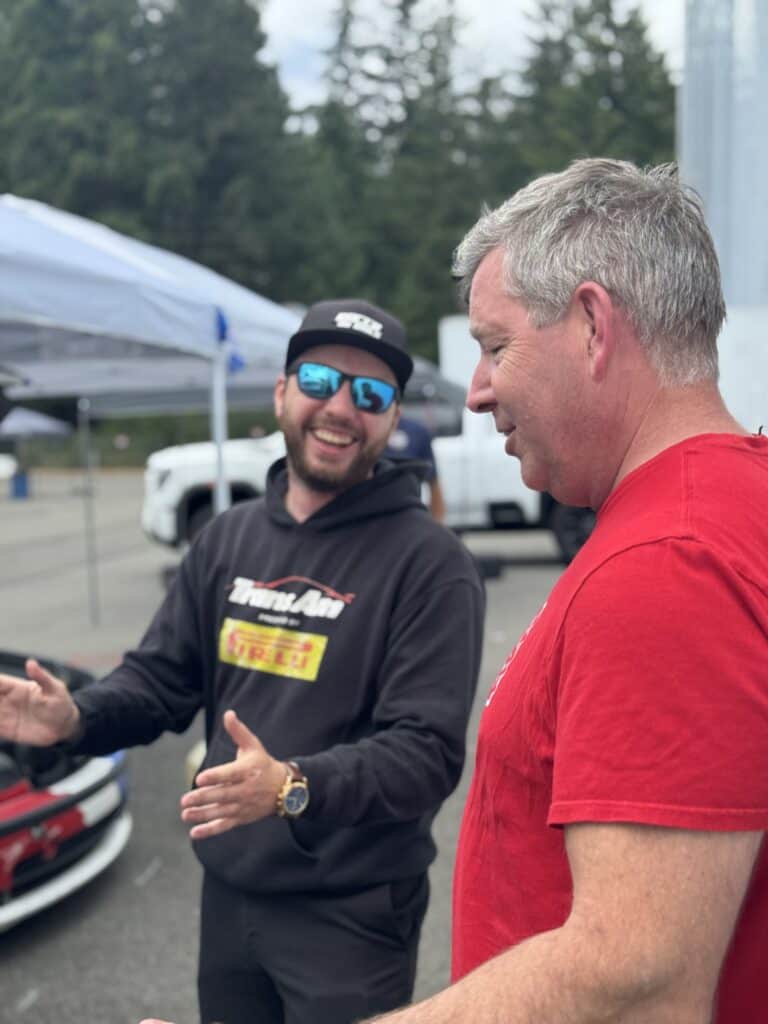
Matt was more than happy to explore the entire tachometer.
He entered the Z4 in the one-hour mini-enduro, completing 36 laps and finishing fourth in the MEO class. His best lap was a 1:30.689.
Learning a new race car is serious work.
The driver must recalibrate nearly everything: braking references, control effort, visibility, gearing, tire behavior and the subtle signals that indicate whether the car has more to give.
It can also be enormous fun.
Every time Matt climbed out of the Z4, he was grinning from ear to ear. Some cars make their case through engineering diagrams and trophy cabinets. Others make it every time the engine reaches the top of the rev range.
The Z4 managed all three.
Jay Perry’s First Visit to Pacific Raceways
The Summer Classic also welcomed Jay Perry from NASA Northwest for his first opportunity to race at Pacific Raceways.
Jay arrived with his C7 Corvette and a substantial learning assignment ahead of him.
Pacific Raceways is not a circuit that reveals all of its secrets immediately.
Its elevation changes obscure sightlines, several important corners are connected in ways that are not obvious from behind the wheel, and the fastest sections require a driver to build trust gradually.
Learning the track is one challenge.
Learning it while racing a powerful Corvette against experienced local competitors adds several more layers.
Jay embraced all of it.
He became quicker and more comfortable throughout the weekend, gradually piecing together the circuit while learning where the Corvette’s power, braking capability and balance could be used most effectively.
By Saturday’s race, Jay was already battling Dan Rogers in his BMW M3 GTR at the front of the SPO class.
Dan won, but only barely.
After 14 laps, the two cars were separated by just 0.347 seconds, with Jay recording a best lap of 1:27.930 in his first race at the circuit.
Jay returned Sunday with another day of knowledge stored away and immediately put it to use.
He lowered his best lap to a 1:25.046 and beat Dan to the finish by 1.894 seconds, splitting the weekend’s two races with a driver who brought both serious pace and extensive Pacific Raceways experience.
That is a serious achievement.
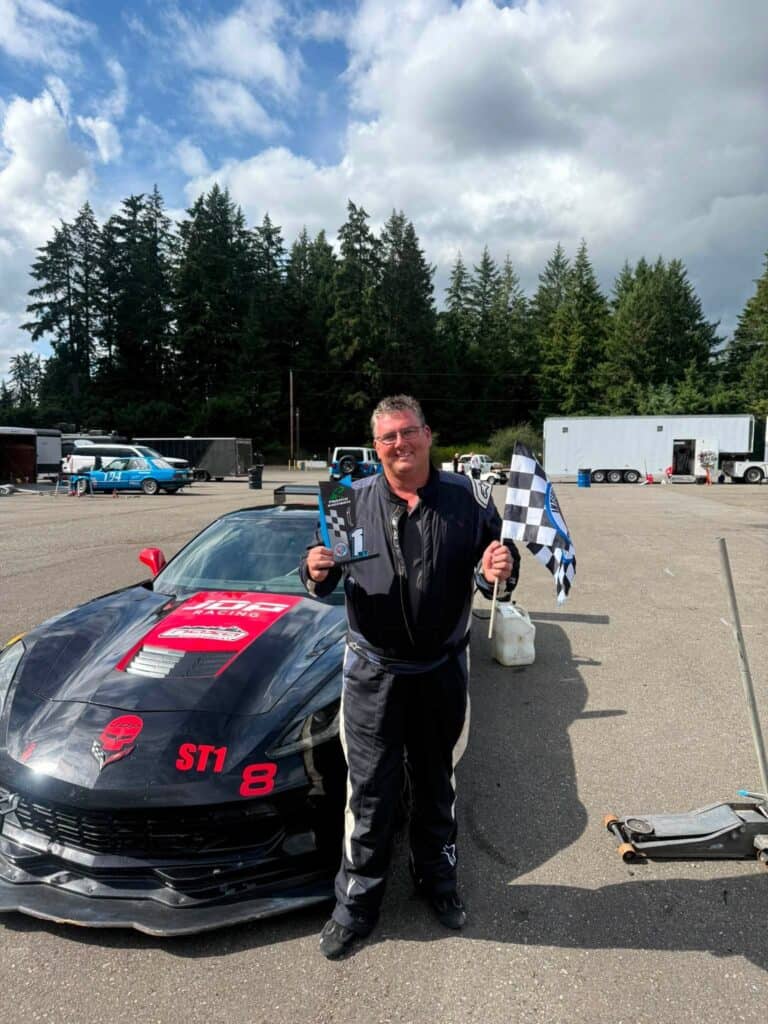
Jay did not simply visit a new track, collect some laps and head home. He learned quickly enough to challenge an established local front-runner, race him closely on Saturday and then find the additional performance needed to reverse the order on Sunday.
It was also exactly the kind of crossover we want to see more often.
Organizations such as NASA Northwest, IRDC and Conference may operate their own events and championships, but they are all part of the same regional motorsport community.
Drivers moving between them bring new cars, different experiences and fresh competition into each paddock.
Jay arrived to experience Pacific Raceways for the first time.
He left with a victory, a rapidly expanding notebook and a very good reason to come back.
Federico Mira Picone’s First Novice Weekend
Federico Mira Picone arrived at Pacific Raceways for his first novice race weekend in the Racer on Rails Jägermeister-liveried PRO3 car.
A first wheel-to-wheel event asks a great deal from a driver.
There are race starts, flags, traffic, passing decisions and procedures that cannot be fully recreated during a track day. The driver must learn to allocate attention across the entire environment while still operating the car quickly and accurately.
The objective is not simply to go faster.
It is to build awareness, judgment and capacity without allowing enthusiasm to outrun experience.
Federico’s first qualifying session took place on the same mixed and damp circuit that complicated the Spec E46 session.
He recorded a 1:55.205, but the time was much more representative of the conditions than his actual dry-weather potential.
Once the circuit dried and Federico became more comfortable, the stopwatch began shedding seconds in large handfuls.
During Saturday’s race, he recorded a 1:40.098, completed all 16 laps and won the novice class.
The roughly 15-second difference from qualifying was not the result of a magical transformation. It reflected the enormous contrast between a damp, mixed-condition session and a dry race, combined with Federico’s growing understanding of the car and the environment around him.
He returned Sunday and continued moving forward.
Federico qualified with a 1:40.674. In the race, he lowered his best to a 1:39.219 and earned his second novice-class victory, finishing only 0.952 seconds ahead of Kevin Sun after 13 laps.
Federico’s family and friends were present throughout the weekend, turning the occasion into more than a licensing exercise.
They were able to see the work, the nerves, the progress and the satisfaction that came with completing his first races successfully.
The car’s reliability also played an important role.
During earlier weekends with Ron Tanemura, we had worked through the transmission issues that previously affected the PRO3 car. That work meant Federico could focus on learning how to race rather than wondering which gear the car might choose to surrender next.
He is scheduled to complete his remaining two novice weekends with Racer on Rails this year, earn his full competition license and then decide what the next stage of his racing journey should become.
The first chapter was a strong one.
Ellen Porter and Mathieu Martin Make Space for Racing
Motorsport has a habit of consuming every available hour.
That makes participation especially challenging for Ellen Porter and Mathieu Martin, who are balancing demanding professional careers with raising two young daughters.
Getting both of them to the racetrack required its own exercise in scheduling, logistics and teamwork.
At the Summer Classic, they split the championship races. Mathieu competed in the large PRO3 field, while Ellen raced in CT4.
Ellen completed 15 laps in Saturday’s race, finishing 12th in CT4 with a best time of 1:39.887.
They then combined their efforts for the one-hour mini-enduro.
Mathieu and Ellen shared the No. 26 car, completing 32 laps and finishing third in the ME2 class. Their best lap was a 1:39.874.
Couples who race together may not eliminate every disagreement, but at least they can arrive at the discussion with timing data.
More importantly, Ellen and Mathieu demonstrate that motorsport does not need to be an all-or-nothing pursuit.
With the right equipment, planning and support system, racing can remain a meaningful part of a busy life.
Sometimes that means competing in separate classes. Sometimes it means sharing a car. Sometimes it means handing the steering wheel to your partner and trusting them to bring it back in one piece.
They made the space, shared the work and left with a podium.
Supporting More Than Half of the Spec E46 Field
The Spec E46 results also illustrated how deeply Racer on Rails has become connected to the local class.
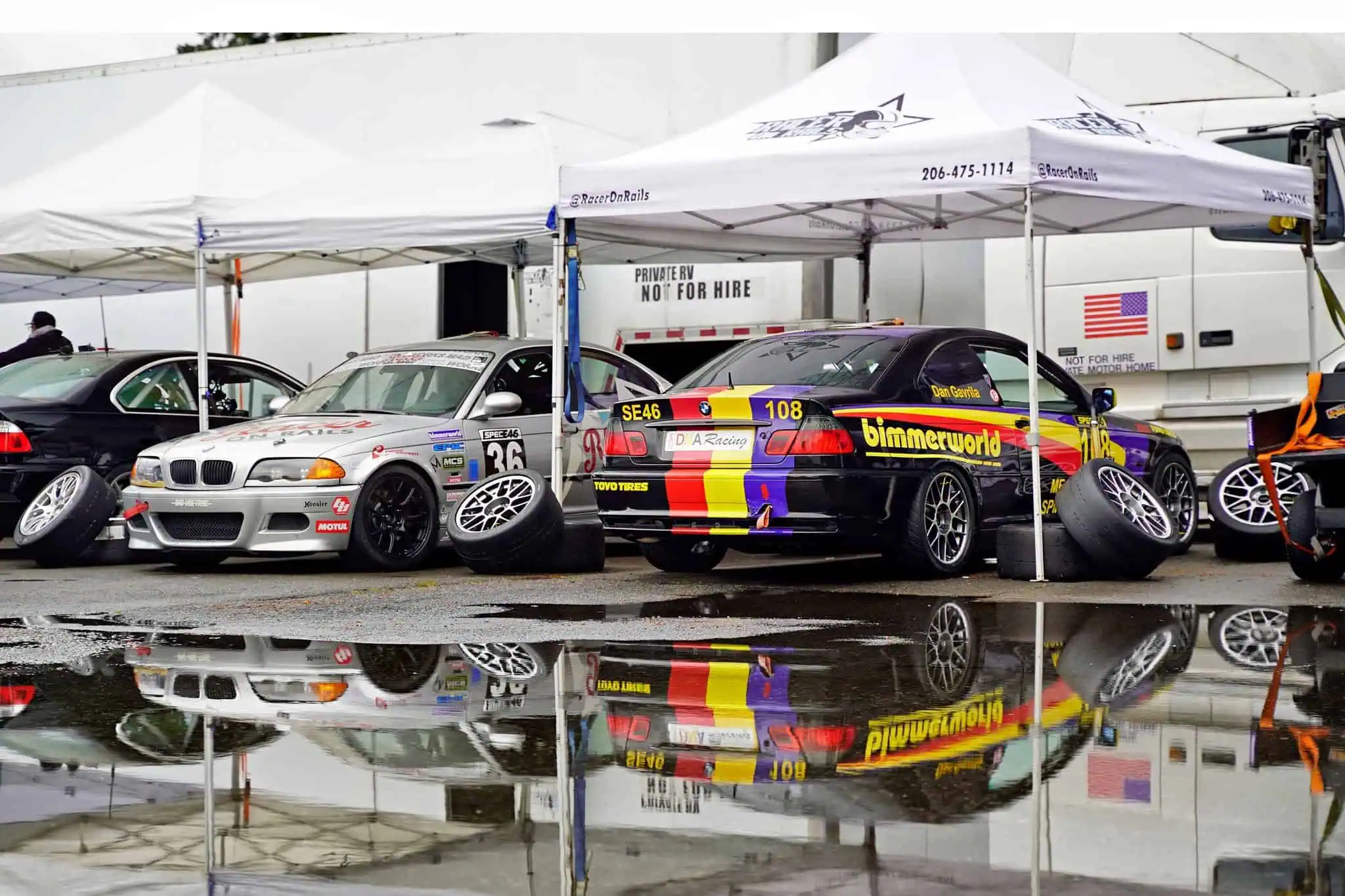
We were providing trackside support for Stefan, Dan, Montey Mathison and Matt. Wes was working with us through coaching, and Anthony’s car remained under our management and maintenance program.
In one form or another, Racer on Rails was connected to six of the nine cars in the Spec E46 field.
The purpose is not to create a protected island inside the paddock.
It is the opposite.
When more drivers have access to strong preparation, dependable trackside support, engineering and coaching, the entire class improves.
Cars become more reliable. Drivers become more capable. The racing grows closer, and everyone is required to continue raising their level.
Saturday’s first four Spec E46 finishers were Stefan, Anthony, Dan and Matt.
On Sunday, Stefan won again, Anthony finished third and Matt fourth. Wes lowered his personal best multiple times, while Dan demonstrated race-winning pace before the engine problem ended his challenge.
That is the kind of environment we want to help create.
Competitive on the racetrack.
Collaborative in the paddock.
Relentlessly focused on improving both the drivers and the machinery.
Connecting the Motorsport Ecosystem
The weekend’s most important activity may not have appeared on a timing sheet.
Racer on Rails partnered with Racecentric to host a club and volunteer dinner and mini car show at our facility.
There was barbecue, cold soda, race cars, beautifully prepared show cars and people from several different corners of the automotive world.
Racers and volunteers spent the evening alongside tuners, builders, enthusiasts and time-attack competitors who might not ordinarily occupy the same paddock.
That mixture was intentional.
Motorsport is often presented as a pyramid, with professional racing at the top and every other form of participation stacked somewhere beneath it.
In practice, it behaves much more like an ecosystem.
Club racers need mechanics, engineers, fabricators, photographers, organizers and volunteers. Tuners benefit from lessons developed through competition. Time-attack drivers may eventually become wheel-to-wheel racers. Show-car owners can become track-day participants. Young enthusiasts can discover careers they did not know existed. Volunteers can build relationships with teams, and teams can become stronger members of the clubs that make their racing possible.
Every part feeds another.
The goal of the evening was to celebrate the club, thank the volunteers and create more opportunities for those different communities to rub shoulders.
Not through a formal conference or a carefully scheduled networking exercise, but over food, cars and the shared language of people who care deeply about machines.
For one evening, the Racer on Rails facility became more than a place where race cars are stored, prepared and repaired.
It became a gathering point for the broader automotive community.
That matters because the long-term health of racing will not be determined solely by what happens between the green and checkered flags.
It will also depend on whether there is an inviting, connected world surrounding the competition.
Progress in Every Direction
The 2026 IRDC Summer Classic produced strong results for Racer on Rails, but no single trophy or finishing position captures the weekend.
Stefan Tomalik won both Spec E46 races while sharpening the skills he will need for GRIDLIFE at Laguna Seca.
Dan Gavrila demonstrated front-running speed before a known mechanical concern developed into an engine failure.
Anthony Lo turned the promise of his 2025 Summer Classic into a more complete 2026 performance, improving his dry-weather pace and earning podium finishes on both days.
Matt Dawson raced hard in Spec E46, then spent the mini-enduro exploring the upper reaches of the Z4 M Coupe’s tachometer.
Jay Perry learned Pacific Raceways at remarkable speed, battling Dan Rogers throughout the weekend and leaving his first visit with an SPO victory.
Wes Griffith broke through previous limitations and lowered his personal best multiple times during our first coaching weekend together.
Federico Mira Picone completed his first novice event, won his class twice and took a major step toward earning his full competition license.
Ellen Porter and Mathieu Martin found a way to balance careers, parenthood and competition, then shared a podium finish in the mini-enduro.
Around them was a Racer on Rails operation preparing cars, coaching drivers, solving problems and supporting more than half of the Spec E46 field.
Then, when racing finished for the day, we opened the doors and brought the wider community together.
That was the real story of the Summer Classic.
Competition, driver development, vehicle preparation and community building do not need to exist as separate activities.
When they are connected intentionally, each one makes the others stronger.
That is the ecosystem we believe in.
And that is exactly what we are trying to build.