Posted on

Racing for Linda: IRDC’s Blackburn Memorial Invitational at the Ridge

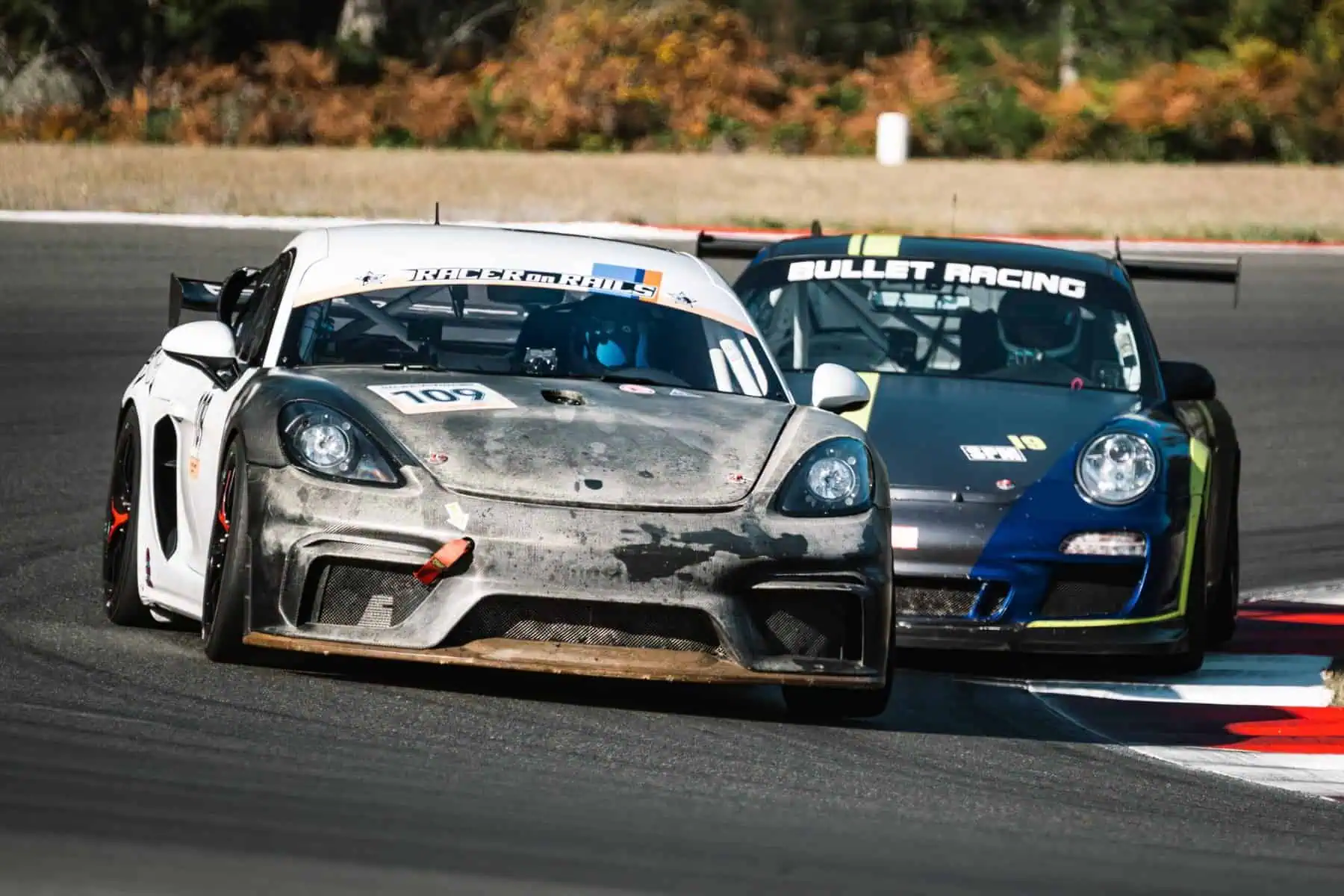
Gama in Racer on Rails' #109 Cayman GT4 MR battling Michael Conatore's #19 Porsche 997 GT3 Cup car at The Ridge.

IRDC’s Linda Blackburn Memorial Invitational | October 17–18, 2026 | The Ridge Motorsports Park
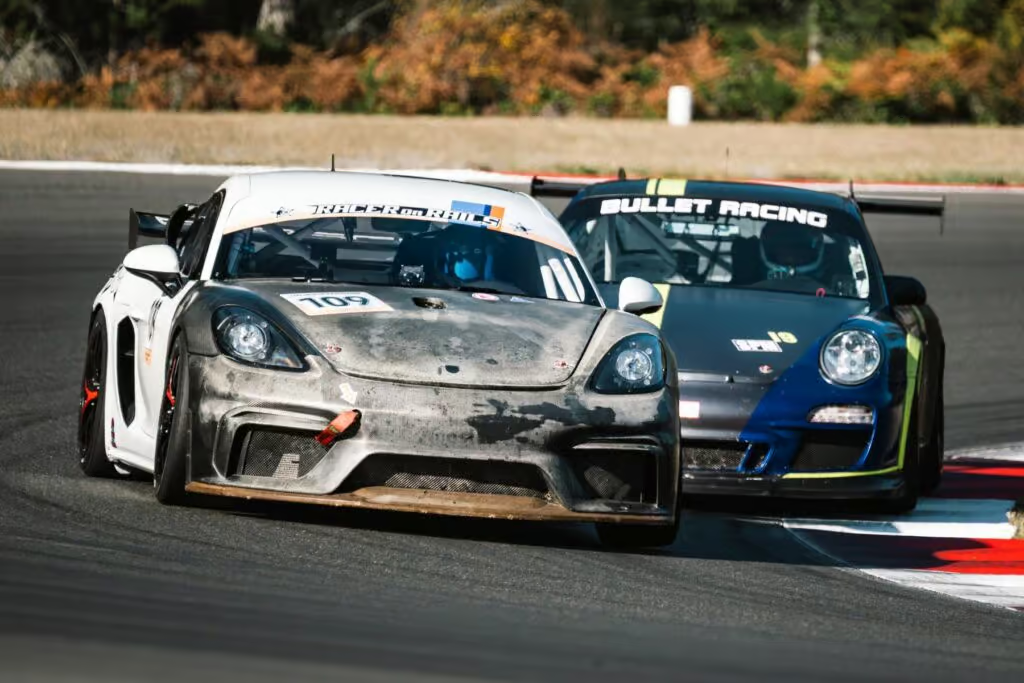
Gama in Racer on Rails' #109 Cayman GT4 MR battling Michael Conatore's #19 Porsche 997 GT3 Cup car at The Ridge.
Gama in Racer on Rails’ #109 Cayman GT4 MR battling Michael Conatore’s #19 Porsche 997 GT3 Cup car at The Ridge. Photo: Peng Du.

October racing in the Pacific Northwest is a gamble.

By the middle of the month, summer is usually a distant memory. Rain becomes increasingly likely, temperatures drop, race cars start getting winterized, and drivers suddenly remember all the things they promised their families they’d do once racing season ended.

So when the International Race Drivers Club (IRDC) decided to add a brand-new October race weekend at The Ridge Motorsports Park, there was some risk involved. But there was also a really good reason to try.

The Linda Blackburn Memorial Invitational, held October 17–18, was a new non-championship event sanctioned by ICSCC, with Friday testing hosted by our friends at Turn 2 Lapping. It gave Northwest racers one more opportunity to get on track, helped build momentum for the newly established Porsche & Ginetta Cup, and brought the club together for something it hadn’t done since before COVID: an IRDC year-end banquet.

And the weather? Well, we got lucky. After a damp start to Saturday, beautiful fall sunshine and cool temperatures gave us plenty of opportunities to make race cars go fast.

For Racer on Rails, we arrived with three cars, some new hardware to test, a new-to-us Porsche Cayman GT4 MR, and a whole bunch of reasons to be excited about what’s ahead.

Remembering Linda Blackburn

Before getting into the racing, we need to talk about the person this weekend was named for. If you’ve been around Conference racing for any meaningful amount of time, you know that the people who make our sport happen aren’t just the people sitting behind steering wheels.

Linda Blackburn was one of those people who helped make everything possible. I’ve been involved in Conference racing for somewhere around 15 years, and for as long as I can remember, Linda was simply always there.

She spent many years volunteering with Cascade Sports Car Club and the broader Conference community, helping with registration, timing and scoring, club administration, and the countless other responsibilities involved in putting on amateur road racing events. Her contributions stretched back many years, including receiving Cascade’s Outstanding Membership award in 2012.

Linda passed away in 2025, leaving behind a remarkable legacy of service to Northwest motorsports. What I particularly appreciate about naming this event after her is that it celebrates the work of somebody who spent so much of her life helping other people enjoy the sport.

We racers tend to measure our weekends in lap times, positions, and trophies. But none of that happens without the people handling registration, waving flags, managing timing and scoring, staffing race control, organizing the paddock, and doing all the work behind the scenes.

Thanks, Linda. And thanks to everyone who continues that tradition.

A New Porsche Chapter for Racer on Rails

One of our biggest objectives for the weekend was to shake down our newest addition to the Racer on Rails fleet: a 2020 Porsche Cayman GT4 Clubsport MR, carrying number 109.

Earlier this year, we sold the Cayman GT4 Clubsport Track Day Edition that had been part of our program for the past few years. We’d purchased that car after it had been damaged, brought it back to life, developed it further, and enjoyed a whole lot of driving and racing with it. The #109 represents the next chapter in that journey.

We’re making a bigger investment in Porsche performance and driver development at Racer on Rails, and part of that means having the right equipment to support the programs we want to build.

For this car, the initial objective was straightforward: complete our post-purchase inspections, bring the maintenance current, address anything requiring attention, and get it onto the racetrack to validate that everything was functioning properly.

Longer term, the #109 is intended to become an important training and development platform for our drivers. We also want to have it on the grid throughout the 2027 Porsche & Ginetta Cup season, helping support the growth of that new series. But before we could start inviting other people to drive it, we needed to make sure we understood the car ourselves.

And, naturally, there was already a small adventure involved.

When we received the GT4, its steering wheel was missing two buttons needed to operate the car properly. Through our friends at Avants, we were connected with Paul, another Cayman GT4 MR owner, who was incredibly gracious in allowing us to borrow his steering wheel so we could validate the car and get it ready for the weekend.

That’s no small favor when you’re talking about specialized Porsche motorsport equipment. Paul, seriously, thank you! We couldn’t have done this weekend without your help, and we’re looking forward to returning the favor with simulator coaching with Tyler and some time together at the track.

It’s another example of something I love about the motorsports community. A shared passion for these machines has a funny way of turning strangers into people who are willing to help each other out.
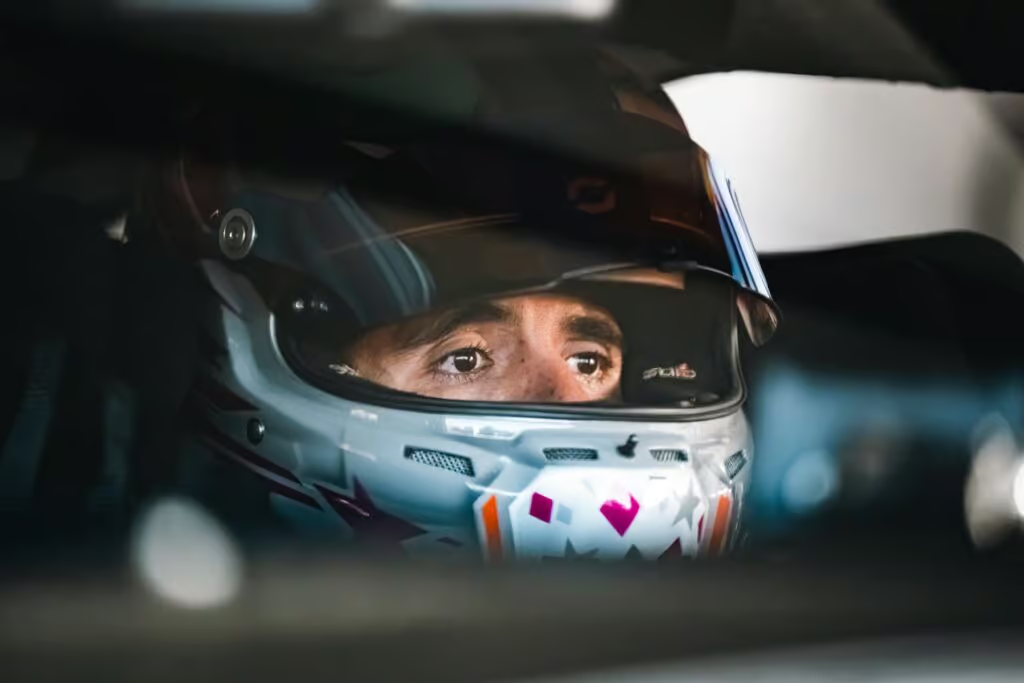
Getting acquainted with the #109 GT4 MR during its first race weekend with Racer on Rails.
Getting acquainted with the #109 GT4 MR during its first race weekend with Racer on Rails. Photo: Peng Du.

Dirk’s Cayman: One Limitation at a Time

Joining us for Friday testing was my good friend and RoR driver Dirk Groeneveld, back in his 2010 Porsche Cayman Base that we’ve been developing for SCCA Touring 3 competition.

We’ve already gotten several test days and a full race weekend under our belts with this car, and it’s become a really fun engineering and driver development project.

One of the principles we’ve been trying to follow is that rather than immediately throwing the entire Porsche performance parts catalog at the car, we want to understand its limitations and address them methodically. Identify the current constraint, make a thoughtful change, validate the result, and then move on to the next opportunity.

At our previous weekend at The Ridge, we’d established that the first major limitation was the braking system, particularly the thermal performance and longevity of the factory rotors.

For this event, we installed DBA one-piece slotted brake rotors and fresh pads. Based on our prior experience with DBA products, we thought they might offer a meaningful improvement without immediately requiring expensive two-piece racing rotors or a complete brake system overhaul.

We also have additional brake cooling and PDK cooling upgrades in the works, but some of those parts didn’t arrive in time. That’s okay. We still had plenty to test.

Friday went really well. Dirk was running on used Hoosier tires and was already back into the low-1:50 range, continuing to build confidence and familiarity with a car that is proving to be seriously quick for its class.
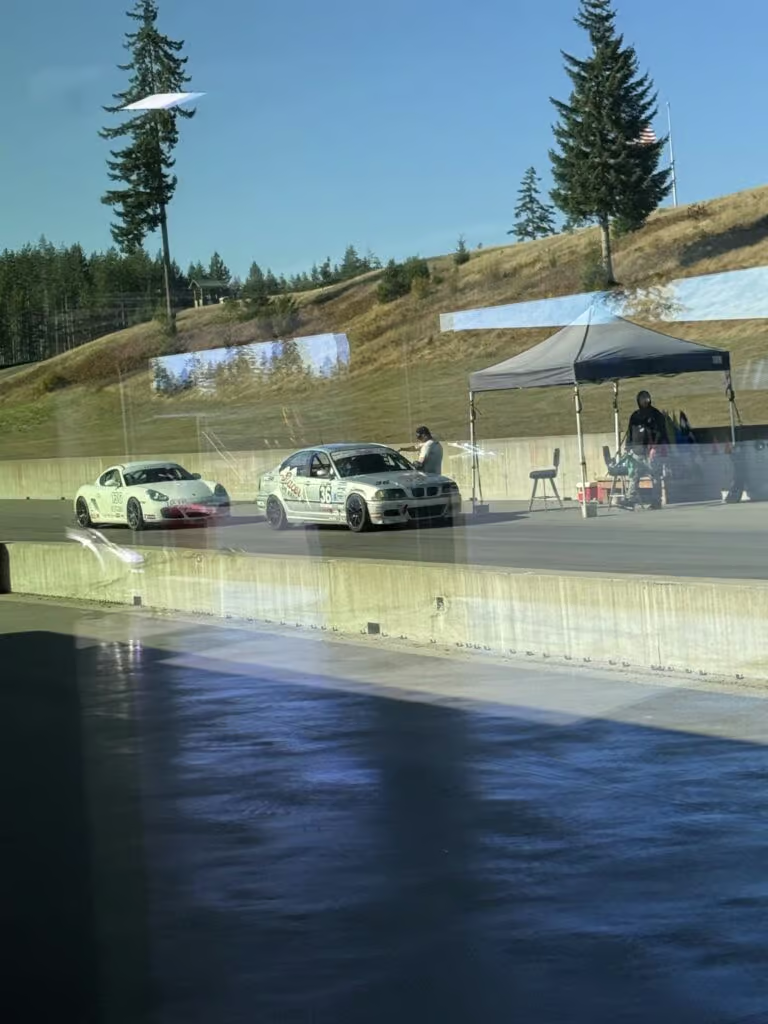
Dirk and Tim lined up for Friday testing. Two drivers, two very different race cars, and another opportunity to work on their craft.
Dirk and Tim lined up for Friday testing. Two drivers, two very different race cars, and another opportunity to work on their craft. Photo: Gama Aguilar / Racer on Rails.

Equally important, Dirk was spending time between sessions reviewing data, evaluating his driving, and helping us understand how the car was responding.
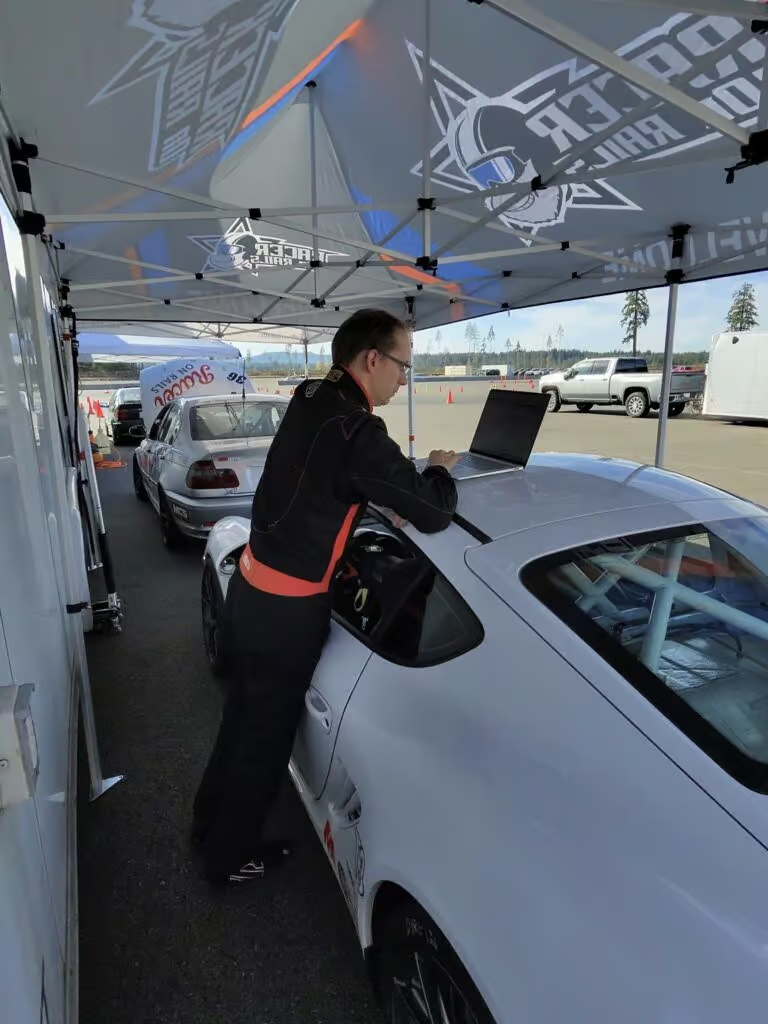
Dirk reviewing session data between runs. Every session is another chance to understand the car, refine the driving, and build speed.
Dirk reviewing session data between runs. Every session is another chance to understand the car, refine the driving, and build speed. Photo: Gama Aguilar / Racer on Rails.

This was exactly the kind of Friday we wanted. Good pace, useful feedback, and more information to guide the next round of development. With Dirk looking toward a national SCCA Touring 3 program in 2027, every weekend like this helps us prepare both the driver and the car for what’s ahead.

Then Saturday morning happened.

A Coolant Line, a Deadline, and a Different Porsche

Saturday began with damp conditions for the first Porsche & Ginetta qualifying session. Dirk went out in his T3 Cayman, but with the track still transitioning from wet to dry, it wasn’t really a session for chasing outright pace.

Later that morning, Dirk completed his other qualifying session with an official best lap of 1:50.617. Unfortunately, when he returned to the paddock, the Cayman was losing coolant.

We traced the problem to a small cut in one of the coolant hoses. Thankfully, he made it back before the car overheated, but we now had a repair to manage and an approaching race start.

René and Bryce jumped on it, and we were able to source a replacement hose. Unfortunately, replacing the failed component is only part of the adventure on a mid-engine Porsche. The engine lives in the back, the radiators live in the front, and coolant travels through lines running nearly the entire length of the car. That’s a lot of opportunity for trapped air, and properly bleeding the system can be frustratingly time-consuming.

We established a deadline: if we couldn’t get the car fully repaired, bled, and confidently ready with enough time before Dirk’s next race, we weren’t going to rush it.

One of my principles when we’re supporting drivers at the track is that our customers aren’t spending all this time and money to watch their cars sit on jack stands. They’re coming to have a driving experience.

Of course, mechanical failures are part of motorsport, and we can’t always prevent them. But when we have an appropriate alternative available, and we’re working with an experienced driver we trust, I’d rather find a way to keep that person driving.

Dirk certainly qualified. He’s also one of my best friends. So when it became clear that his T3 Cayman wasn’t going to make the race, I offered him the keys to our new #109 GT4 MR.

The only wrinkle? Dirk had never driven the car at full throttle. In fact, the very first time he got to experience full throttle in the GT4 MR was when the green flag dropped for his first race.

🤣 Welcome to motorsport!
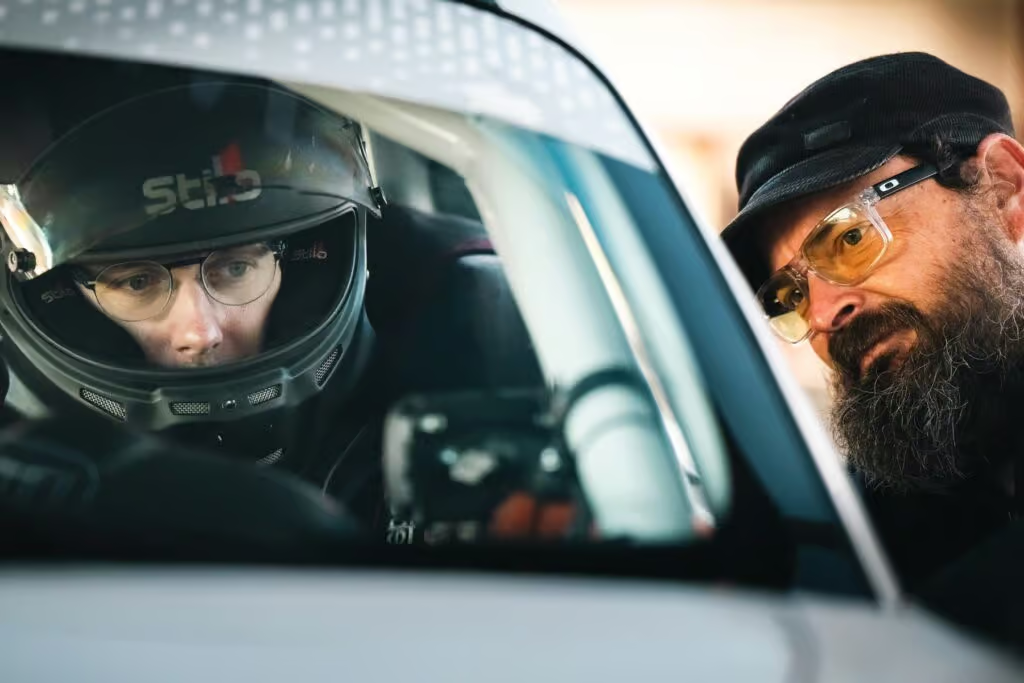
Bryce helping Dirk get situated in the #109 GT4 MR. Sometimes the best way to save a race weekend is to find another car to race.
Bryce helping Dirk get situated in the #109 GT4 MR. Sometimes the best way to save a race weekend is to find another car to race. Photo: Peng Du.

To Dirk’s credit, he approached the whole thing exactly as an experienced driver should. He was conservative initially, spent time understanding the brakes and power delivery, gradually built confidence, and avoided asking more of the car than he understood.

In his first Porsche & Ginetta Cup race, Dirk finished sixth in the Porsche class, recording a best lap of 1:45.772. That’s a pretty respectable introduction to a car he’d never driven at speed!

Then he went out again in Group C, this time competing in the ST class. He brought home the class win and dropped his best lap to 1:45.193. That’s more than half a second faster than his first race, while still learning an unfamiliar race car.

It wasn’t the weekend we’d planned, but Dirk got to race, we collected some excellent shakedown experience with the #109, and we all learned a little more about the car. That’s a pretty good recovery from a failed coolant hose.

Beyond the racing, one of my favorite parts of sharing these weekends with Dirk is simply getting to spend time together. We usually sneak away for dinner, reconnect as friends, and talk about our families, businesses, life, and whatever else is happening outside the paddock.

Those conversations have become an important part of our race weekends together. Dirk had family commitments that kept him away Sunday, but I’m glad we were able to make his Friday and Saturday memorable.

Silver Bullet Returns, and Anthony Raises the Bar

Our other car for the weekend was the #86 Spec E46, affectionately known as Silver Bullet, with longtime friend and RoR driver Tim Wisner behind the wheel.

Silver Bullet had recently received a fresh engine after a failure during our previous race weekend at The Ridge. We’d also taken the opportunity to refresh the car, so this weekend was a chance to validate the work and get it back into competition.

Friday went well, with Tim quickly finding his rhythm and getting down into the high-1:51 to low-1:52 range. Because of family obligations, Tim wasn’t able to participate on Saturday. Under the event’s race format, that meant starting from the back when he returned Sunday.

Tim came back ready to go and put together a pair of excellent Spec E46 races. He worked his way forward, finished third in class in both races, and had some particularly entertaining battles with Pete Bristow, someone he’s raced hard with before.

And the results show just how close those battles were. In Sunday’s first Spec E46 race, Tim finished 0.485 seconds behind Pete. In the afternoon race, the gap was even smaller at 0.430 seconds. Less than half a second separating the two drivers at the finish, twice in one day!

Considering this was only Tim’s second race weekend of 2026, with his previous outing back in June at Oregon Raceway Park, that’s some really excellent driving. He also participated in the SPM race group, adding more racing experience to an already busy Sunday.

But there was somebody else in the Spec E46 field who has been raising the standard all season: Anthony Lo. What a year this guy has had.

We’ve talked about Anthony’s development in previous race reports, and it’s been incredibly rewarding watching him continue to elevate his driving across Pacific Raceways, Portland International Raceway, Spokane, and The Ridge.

At this event, Anthony won both of Sunday’s Spec E46 races, turning fastest laps of 1:50.623 and 1:50.766. Those are seriously quick times for a Spec E46, and the most impressive part is that his performance isn’t confined to a single circuit or one good weekend.

He’s developed into a consistently fast, highly capable racing driver. And now we can officially celebrate something even bigger.

Anthony Lo is the 2026 ICSCC Spec E46 Champion!

He finished the championship with 261 points, having moved from fifth place in 2025 to the top of the standings this season. That also means Racer on Rails drivers have now won the Spec E46 championship two years in a row, following Robin Adrianse’s 2025 title.

That’s what’s up!!! 🏆
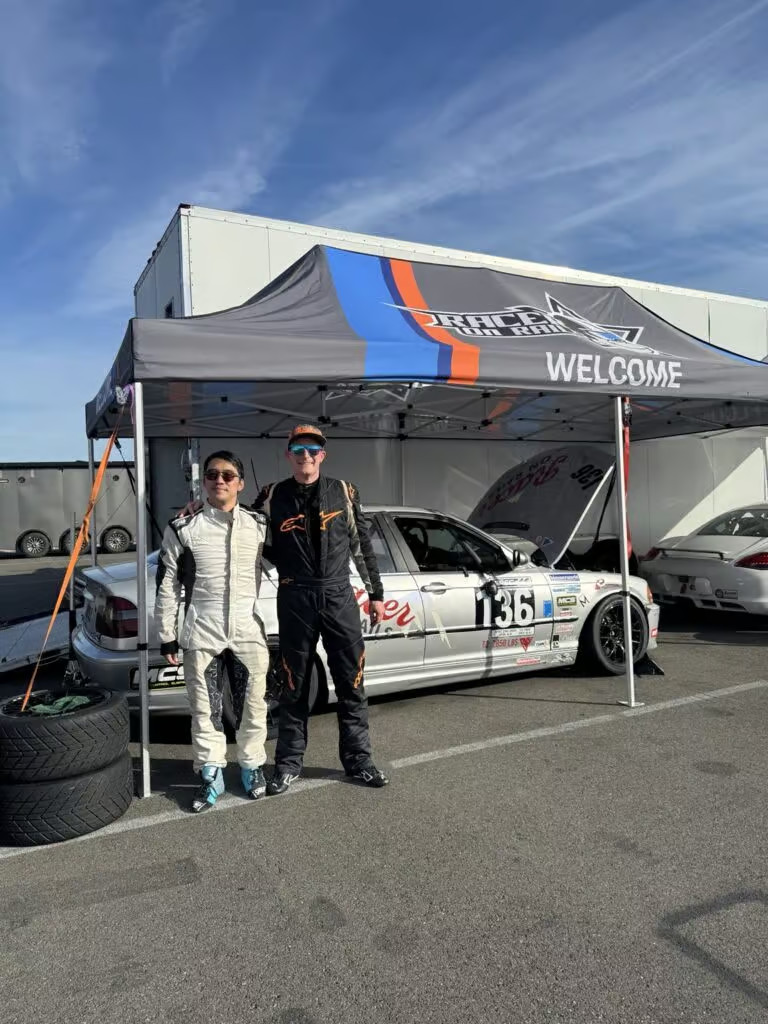
Tim Wisner and Anthony Lo after Sunday's racing. Great performances from both drivers, and a reminder that the relationships are every bit as important as the competition.
Tim Wisner and Anthony Lo after Sunday’s racing. Great performances from both drivers, and a reminder that the relationships are every bit as important as the competition. Photo: Gama Aguilar / Racer on Rails.

We’re incredibly proud of both drivers, and even more excited about what this says about the potential of the Spec E46 community.

The field at this October invitational was relatively small, but that’s not particularly surprising for a late-season non-points weekend. Looking toward 2027, we’re optimistic about the continued growth of Spec E46 in the Northwest, and we think there’s a realistic opportunity to see average grids in the neighborhood of 12 to 15 cars.

That would make for some really excellent racing, especially when you’ve got drivers like Anthony setting the benchmark and motivating everyone else to continue getting better.

The Porsche & Ginetta Cup Is Finding Its Feet

One of the biggest motivations for IRDC to add this October event was to create a second race weekend for the newly established Porsche & Ginetta Cup.

Steve and Rebecca have been championing the concept, with the goal of creating a dedicated place for Porsche and Ginetta owners to enjoy competitive wheel-to-wheel racing in an environment that puts a high priority on safety, respect, and having fun.

The series had only made its debut in August, but here we were two months later with 13 starters in Saturday’s first race, including eight Porsches and five Ginettas. That’s a pretty encouraging start, especially considering the event was being held in October, long after many people have already wrapped up their racing seasons.

I’m particularly excited about the opportunity this creates for owners of factory-built Porsche race cars. There are plenty of Cup cars, GT4s, and other amazing Porsche race cars around the Northwest, and I’d love to see more of them coming out to do what they were designed to do: race! Not just sit in garages, get polished, or show up for the occasional lapping day.

And the philosophy behind the series is one that I strongly support: race hard, give each other room, avoid contact, and have a great time doing it. I got to experience exactly what that kind of racing can look like on Sunday.
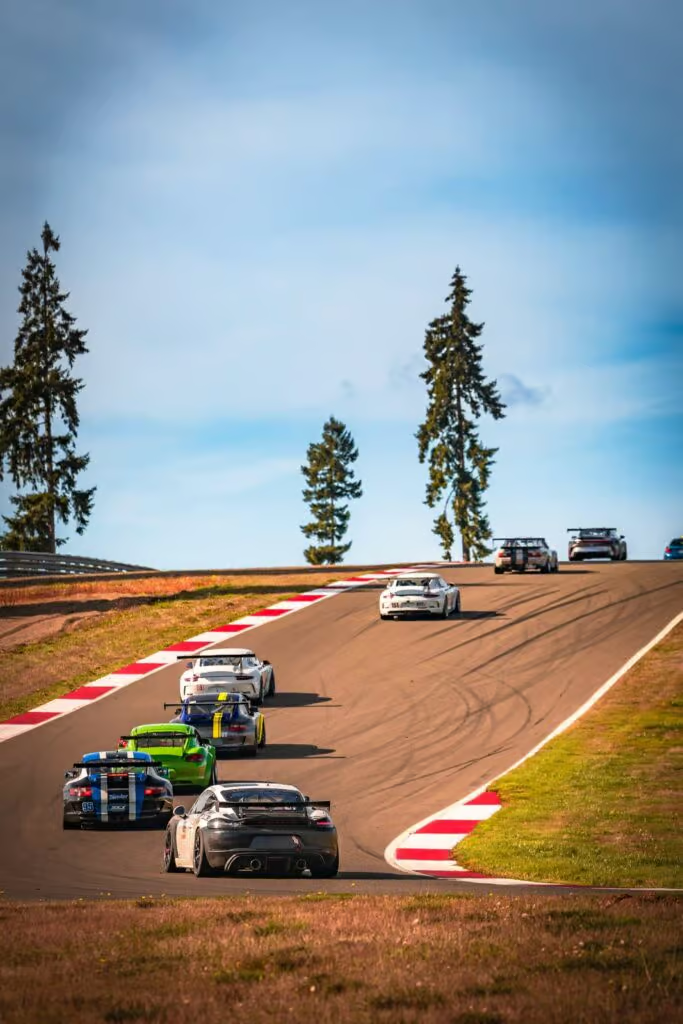
Porsches making their way up the hill at The Ridge during the Linda Blackburn Memorial Invitational.
Porsches making their way up the hill at The Ridge during the Linda Blackburn Memorial Invitational. Photo: Karl Noakes.

An Epic Battle with Michael Conatore

For Sunday’s races I was back in the #109 GT4 MR, and one of the drivers I ended up racing against was Michael Conatore, driving his #19 Porsche 997 GT3 Cup car.

We had a really entertaining mismatch between the two cars. Michael was on full racing Michelin slicks, while I was running Toyo’s new Proxes R tire, its DOT racing tire that replaces the Proxes RR. The Toyo is a perfectly serviceable racing tire, but it certainly isn’t a Michelin slick. And it was fascinating seeing how those differences played out around The Ridge.

Our GT4 MR was excellent through the medium- and high-speed sections, particularly Turns 1 and 2 and the transition toward Turn 3. The car felt composed and capable, and I could create some breathing room in those sections. But once we moved into the slower, more mechanically grip-dependent corners, Michael’s tire advantage really started to show itself.

In our first race, I got a great start and was able to put a few seconds between myself and the cars behind me while they battled among themselves. Eventually, Michael worked his way clear of that group. Then suddenly there he was in my mirrors, and he stayed there.

For lap after lap, I was working to protect the inside when necessary, maximize the GT4’s strengths through the faster sections, and avoid giving him an easy opportunity to use his superior mechanical grip to get alongside me. It was an absolutely fantastic race.

The deciding moment came on the final lap as we approached the Carousel. I’d been protecting the inside, and Michael finally decided to take a shot around the outside. He carried enough momentum to establish overlap, and as we approached the exit, I made sure to leave him room.

That put him on the inside heading toward Turns 8A and 8B. At that point, my tires were pretty well used up and I was struggling to put the power down cleanly. I could have continued fighting for the position, but I decided he’d earned the opportunity and there was no reason to turn an excellent race into an unnecessarily risky one.

Michael completed the pass, and we finished the race. The official timing sheets show Michael finishing fourth in the Porsche class, with me in fifth, just 1.150 seconds behind him after 15 laps. I recorded a best lap of 1:44.423, while Michael’s best was 1:43.456.

But the lap times and finishing positions don’t really capture just how much fun that race was. Afterward, it was handshakes, hugs, high-fives, and big smiles.

That’s exactly the kind of racing we want. We’d pushed each other hard, spent lap after lap trying to find an advantage, and both brought our cars home without contact.
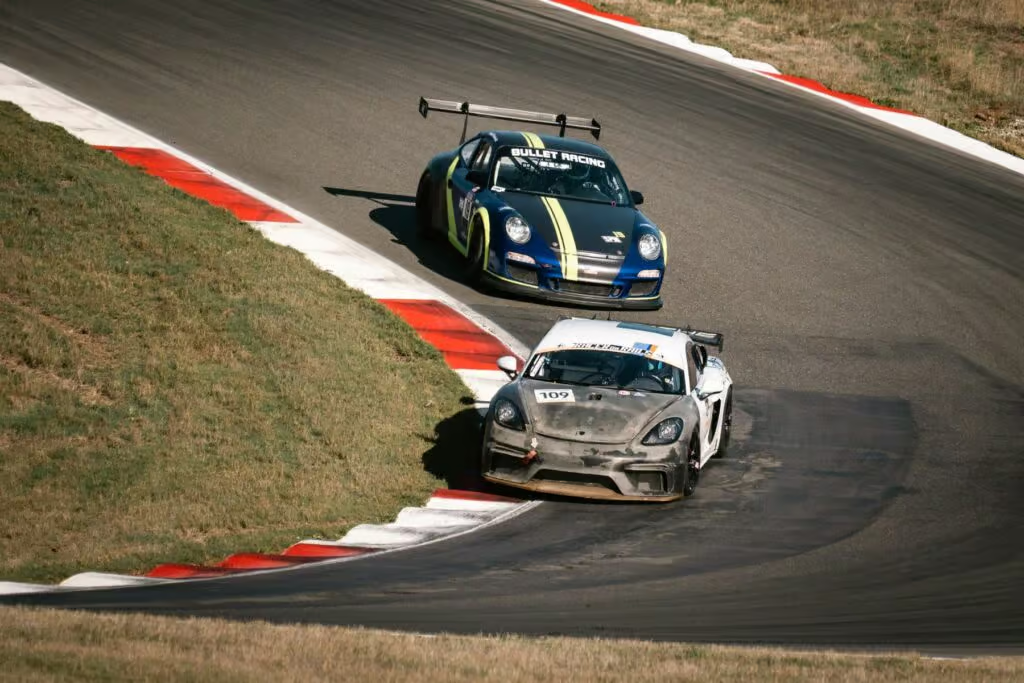
The #109 Cayman GT4 MR leading Michael Conatore's #19 Porsche 997 GT3 Cup car during Sunday's racing.
The #109 Cayman GT4 MR leading Michael Conatore’s #19 Porsche 997 GT3 Cup car during Sunday’s racing. Photo: Peng Du.

In our other Sunday race, the positions were reversed. Michael got ahead early, and I spent most of the race chasing him. I could close the gap through the faster corners and sometimes get right up to him approaching Turns 1 and 2, but by the time we reached the slower sections, he’d use that grip advantage to create just enough separation that I couldn’t put together a clean pass.

We finished fifth and sixth in the Porsche class, respectively, with only 2.749 seconds separating us after 12 laps. Michael’s fastest lap was 1:44.481, compared with my 1:45.072. And I had just as much fun.

We learned a lot about how the GT4 MR behaves, its strengths and limitations, and what we might want to focus on as we continue developing the car for ourselves and our future drivers. Perhaps most importantly, we confirmed that we have a functional, capable Porsche race car that’s ready to become part of the Racer on Rails program.

A Healthy Paddock and a Club Coming Together

The Porsche & Ginetta Cup wasn’t the only part of the weekend that had me excited about the future of Northwest motorsports.

The relatively new Rush SR class was represented by a handful of cars, and it’s been fun to watch that community get established. The cars look like an absolute blast, and hopefully we’ll see more of them on the grid next season.

Meanwhile, PRO3 was doing what PRO3 has been doing exceptionally well for years: bringing a healthy field of cars together for competitive, accessible racing. Even this late in the season, they had a strong turnout and plenty of great battles.

And then there was Spec E46, still growing, developing its drivers, and building toward what we hope will be another exciting season in 2027.

I find it encouraging to see these different racing communities developing alongside each other. There doesn’t need to be one universal answer for what somebody should race. Some people love the simplicity of a lightweight purpose-built race car. Others love the familiarity and accessibility of a production-based BMW. Some want to drive a factory-built Porsche Cup car.

All of those are legitimate paths into the sport, and the more opportunities people have to find the right one for themselves, the healthier our community becomes.

But there was another particularly cool part of the weekend that had absolutely nothing to do with lap times. IRDC held its first club banquet since before COVID.

On Saturday evening, we gathered in the event space at The Ridge, shared a meal, caught up with friends, and celebrated several club members who had made important contributions throughout the year. It was great to see everyone together in a setting where nobody was worrying about their next qualifying session or whether their car would be ready to go back out.

I’ve been involved with IRDC for a long time, including serving as the club’s president for a couple of years, and getting back to these kinds of club gatherings is something I think matters quite a bit.

The relationships we build through this sport extend far beyond the racetrack. Having the opportunity to recognize people for their efforts, reconnect with friends, and simply enjoy being together helps remind us that we’re part of something larger than our own race programs.

It also felt especially appropriate during a weekend dedicated to someone who had spent so much of her life supporting this same community.

One More Weekend

When Steve, Rebecca, and the rest of IRDC decided to add another October race weekend, there was no guarantee that enough people would show up to make it worthwhile. The weather could have been terrible. Drivers could have decided their seasons were finished. Race cars could have stayed parked.

Instead, we got a beautiful October weekend full of great racing, driver development, mechanical challenges, new friendships, old friendships, and some pretty memorable experiences.

For Racer on Rails, we validated our new GT4 MR, continued learning about Dirk’s Touring 3 Cayman, got Silver Bullet back on track with Tim, celebrated Anthony’s championship, and had some fantastic wheel-to-wheel racing.

The Porsche & Ginetta Cup took another step toward becoming an established part of the Northwest racing calendar. PRO3 showed up in force, Rush SR continued building momentum, and Spec E46 gave us plenty to be excited about for next year.

We also had the opportunity to spend time with friends, enjoy the club banquet, and recognize some of the people whose dedication keeps amateur racing alive. And that brings us back to Linda Blackburn, because ultimately, that’s what people like Linda spend so much of their lives making possible.

The cars are the tools. Driving is the craft. But the experiences and the people are the point.

October racing in the Pacific Northwest might be a gamble. I’m really glad IRDC took it, and I’m already looking forward to doing it again next year.

Thank you to IRDC, Turn 2 Lapping, all the volunteers, our customers and friends, and everyone who made the Linda Blackburn Memorial Invitational possible.

See you at the track! 🏁

Photography by Peng Du, Karl Noakes, and Racer on Rails.

Official results and timing

October 17: Qualifying · Race results · Lap times.
October 18: Qualifying · Race results · Lap times.
ICSCC Spec E46 standings: 2026 and 2025.
Posted on

Track Walk: The Ridge Motorsports Park

Welcome to The Ridge!  The Ridge is the newest track in the Pacific Northwest that is generally available to the public (Vancouver Island Motorsports Park opened recently but is a private track).

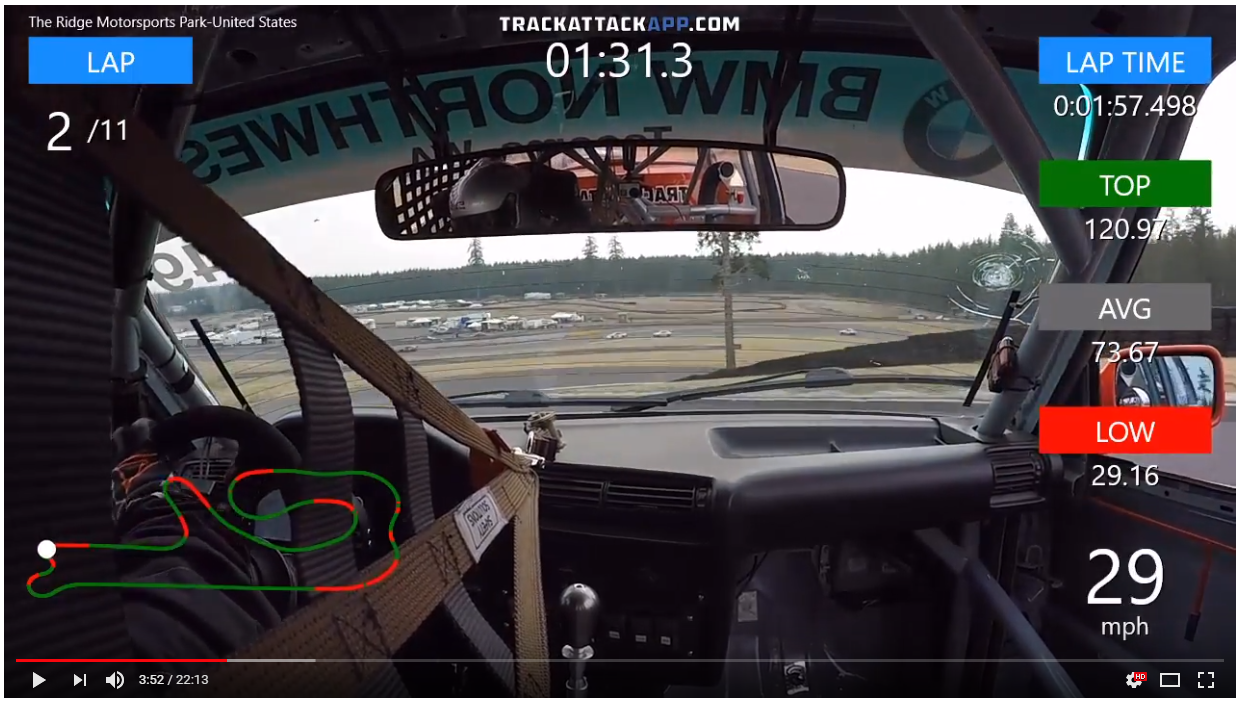
Similar to the Portland International Raceways (with a Chicane) track walk, we’ll use the Track Attack #209 PRO3 race car, a relatively low powered “momentum” car, to illustrate how to get around the track.  The session data we are  using for this is available here on Track Attack – feel free to request it.

We’ve also broken the track down into 6 segments, each segment is defined right before the major major braking/slowing down zones.

Braking a track down into sections, makes it easier for people ‘consume’ it and prioritize where to get focus.

Before you read on, watch this complete lap from a dry race in September of 2017.  Read the article and the re-watch the video.

YouTube player

Segment 1: The Uphill

This segment starts at s/f and goes all the way up to the first major braking zone (not including braking for T2) entering the Carousel.  The first thing here is that this segment is a 76ft climb in elevation.  The equivalent of an 8 story building.  Yeah.  So every single loss of mph as you make your way up the hill, will be penalized with a multiplier as you go uphill – keeping the momentum going is a top priority.

Momentum is important – check!  Turn 1 – get ready for a trouser check.  Turn 1, in some cars, can be taken flat, without lifting.  This is similar to T1 at Spokane but the distance between T1 apex and turn-in for T2 is not as long, so in cars that are faster than a Spec Miata, experiment with caution.  Personally, the most I’ve ever been able to get away with is a ~4/10 braking effort – just a tad more than a brush of the brakes, go back to tad of maintenance throttle and then back on the brakes, about the same amount for the downshift to 4th gear and then going back up the hill.

As you get the car past the apex of T2, it’s really important to get close to the curb of T3 but don’t take too big of a bite off of it, as it will send your car back to track-left, which is not the ideal line for the remainder of the complex.  Once you get to full-throttle, you absolutely cannot lift.  After T3, stay track-right, to setup a wide arch into T5 and then release the car to driver’s-right.  This whole time between T3 through T5, when you’re pinned to full throttle, you will feel the back end wanting to step out.  That’s ok – simple counter steering corrections (small ones), while staying flat, will take care of them.

After this, it’s smooth sailing to The Carousel – find a straight line to follow, that will set you up on track-right, for T6 (The Carousel), which is a long, flat left-hand sweeper.

Segment 2: The Carousel

This segment is just one corner.  Why?  It’s long and hard to get right.  This corner can be taken many ways but here is one that has proven well in racing and qualifying conditions.  Set yourself up track right but not necessarily right on the edge of the track.  Brake a little later than feels comfortable with a solid 6-7/10 effort and after the initial bite, start trailing off and turning into the corner, like if you were trying to double-apex the corner.

The backend may start to come out as you turn-in so get ready to catch the backend with some maintenance throttle.  Try to keep the car tucked in tight to the inside edge of the corner and if it washes out a little mid-corner, that’s ok and that just means you can back on throttle even more aggressively for corner-exit, because you don’t need as much steering input.

Don’t mind what looks like me driving off the course, that’s just a natural occurrence of margin of error of GPS signals and the stitching together of satellite images for maps.

About 35-40% through the corner, you want to be on-throttle and free here on out, you don’t lift.  Start your ascension to full-throttle and as you feel the backend come out, pause the throttle application and give it a steering correction but DO NOT LIFT!  For me, there is a single, tall tree out in the horizon of this corner and the instant I see that tree, I go full-throttle, no matter where I am.

From here, let the car release all the way to track-right, the very edge if needed.  A lot of people don’t get out here because they want to setup far left for the next segment and that’s a trade-off you can decide to make.

Segment 3: The Thumb

This is one of the trickiest parts of the track.  It combines a big compression and low-speed traction event at 8a and 8b but also a super hard, decreasing radius turn at T11 (aka The Thumb).

As you come out of The Carousel, it’s ok to stay driver’s left and then draw a straight line as you go downhill at 8a.  Stay on throttle until right before you feel the ground fall away, lift and synchronize the compression event with your braking.  When you do this right, you don’t need to brake as hard because the compression event gives more bite to front-end.  Downshift (if you have to), wait for the car to rotate a tick and then get back to maintenance throttle.  You want to get on full throttle here as quickly as you can but the sliding plus the acceleration means that it will be really easy to get on-power over-steer, so be aggressive but careful with your throttle application.  After you get to full throttle, it’s a full throttle ride all the way up the hill, which is another 36 foot climb (almost a 4 story building).  Every mph you unnecessarily drop or every split second of having to lift from throttle, will make you pay dearly at the top of the hill.

Where you brake for the thumb will be determined by the car and how fast you’re going.  In a PRO3 car, the engine is spinning at 6,500RPM and ~103mph and we wait to come off throttle just before the curbing on the left and are well into the brakes at those curbs.

You don’t need to track all the way to driver’s right to setup for the thumb, about mid-track is fine in most cars.  Next, is one of the hardest corners to get right – find the late apex and make it your job to hit that curbing with your LF tires.  Getting on those tires, in 3rd gear (in many cars, 2nd gear in Spec Miatas), means you can get on the throttle hard and have plenty of room on the exit of the corner.  Be ready for the car to wash out and go on the exit curbing and maybe even drop a rear tire on the exit of the corner but that’s ok – DO NOT LIFT!

Segment 4 & 5: The Ridge Straight

I’ve broken this segment into two segments because it contains two corners, which are taken very differently and I wanted to leave the last segment being the last corners before the front straight away.

First is the very deceiving Turn 12 right-hander.  It’s deceiving because you can actually car a good amount of speed here and the corner opens up quite a bit on the exit, which means there is a plenty of room for corrections if you maybe got on-throttle too early.

The trick here is to get to the apex and be on full-throttle at the apex.  There is a bump or bulge right at the apex, which will feel like it kicks your car away as you hit but get to full-throttle, stay in it and ride it out.  You’ll almost for sure have the car sliding a little just past exit – a simple steering correction will get it back under you and you can keep going.  Then start making your way over to track-right, to setup for the Ridge complex.

As you approach the corner, you’ll see that the ground starts falling away in the middle of the braking zone – YIKES!!!  This means you have to have your heavy braking done before the ground starts falling away.  Looking at the data, the drop-off is a 7 foot decline in elevation over a 150 foot distance.  150 feet when you’re travelling at 75mph, goes by pretty fast, so this is a split second decision.

As you approach turn-in for the corner, stay on the brakes ever so slightly, so that when you turn in full, the noise is loaded up and will help rotate the car.  It’s ok to bite off a little bit of the curb but don’t get over zealous.

Give it some throttle as soon as you get past the corner, turn for the right hander and stick to track-right as much as you can.  If at all possible, stay off the brakes but you might need to brush the brakes to help the front-end bite.

Segment 6: The Front Straight

The lap is almost over!  You’re barreling down the Ridge Complex, a nearly 80 foot drop and you need to decide what to do for the last corner before the main straight away.  There are couple school’s of thought:

  1. Geometrical fastest line: Swing out wide, carrying more speed because you have a wider arc, a single late apex at Turn 15 and then pin the throttle down until start/finish.
  2. Shortest distance line: Stay a little closer to the inside, use the banking in the corner, travel less distance and hit the apex of Turn 15 at the same spot.

This really depends on what kind of car you have and the track conditions on the outside of Turn 15.  In race weekends, that wide line isn’t used much, so there ends up being a lot of marbles out there.   Great for the rain but not for the dry.

At least in a PRO3 car, we have more grip than power, so as is with many of the other corners, the less distance we have to travel, the better so Option 2 is what you’ll see in the data.

Now, I can totally see an argument even for a PRO3 car to setup for a single flying lap to go super wide, throwing away the lap time for that current lap and setting up for a higher top speed going into Turn 1 or even setting up a competitor for a pass at the end of the straight.

You’ll see in the data that I’m on throttle about mid-corner and full-throttle at about 3/4 of the way of the corner.  After that, it’s about finding the straightest line possible through Turn 16 and the least amount of steering input all the way down the front straight away.

Conclusion: The Ridge is awesome.  Go drive it!

The Ridge is really a fun track.  Newer and well take cared of pavement and plenty of run off room in most corners.  You can get in trouble and it makes you pay but most of the time, it’s dirt and rocks on your car to go along with a bruised ego.

The facilities are constantly improving and with a motocross and a kart track that is a mini version of the big track, there’s few places that can compare.  The downside is that it is located about 30 minutes northwest of Olympia, WA and Shelton has limited hotels but coming out in an RV or camping, is an absolute blast.  Best of all, there are no drag races so every evening, you can do a complete track walk.

Check out the The Ridge Motorsports Park website and Motorsportsreg.com for upcoming events you can sign up for, to drive the Ridge!


Posted on

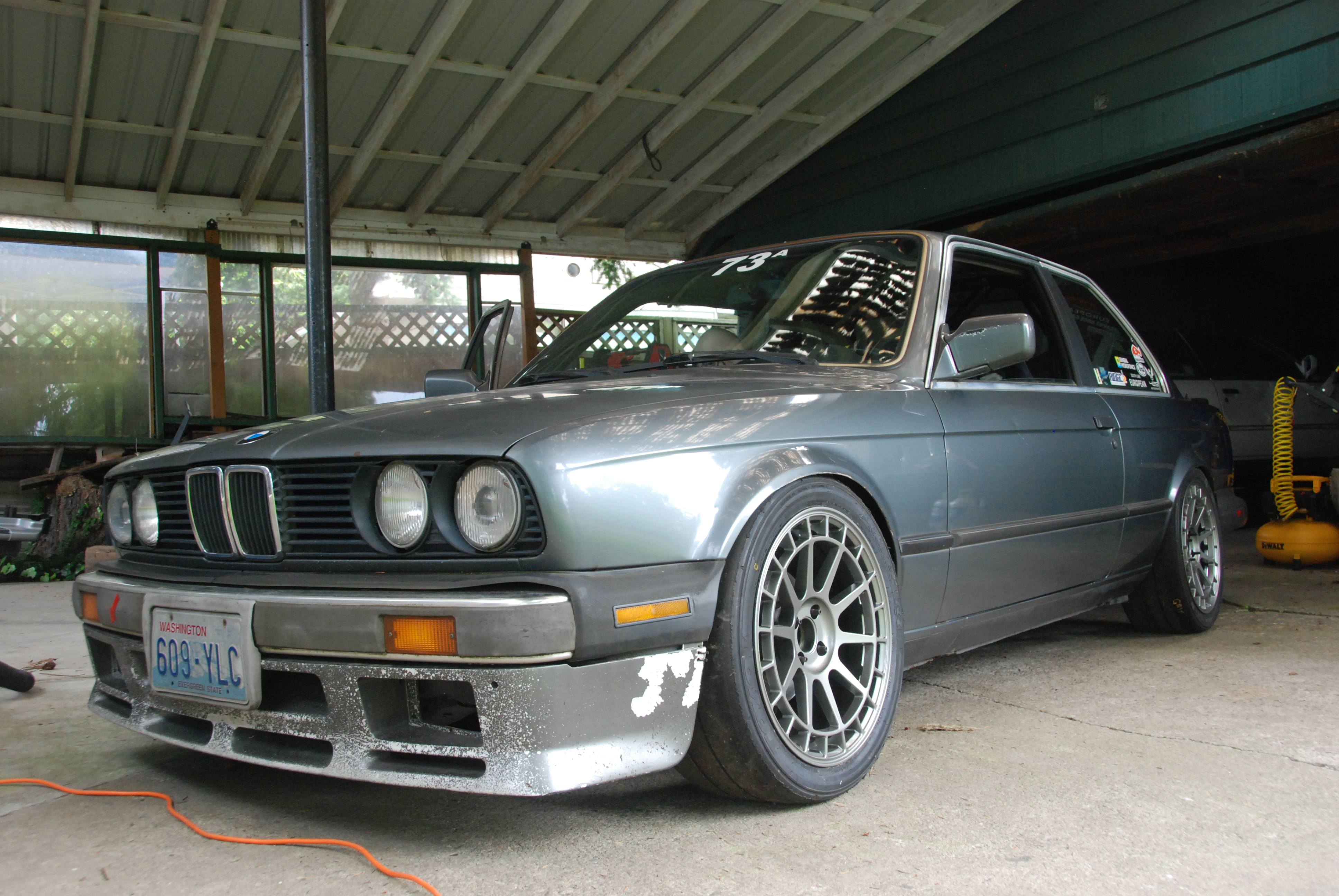
My track car – 1987 BMW 325is

What: My track car – 1987 BMW 325is

If I knew then what I know now:  not a lot… have a larger budget.  My track car has evolved as I feel I have needed at a rate that has been on a equal plain as my skill.  Could use a little more power now……

Check out:  Any of your local track’s and driving schools!


Early days of my track car.

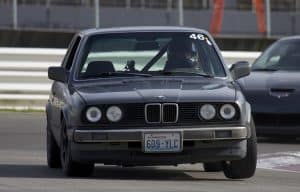
My track weapon of choice is a 1987 BMW 325is. I bought it in 2007 with the idea that it would become my track car. It is what i wanted in a track car, it was in my price range, it was the color I wanted, it was well maintained by the previous owner, and all the work done on the car was at the company/shop I was working for at the time. the only thing it didn’t have was the small plastic late series bumpers. Not to sound snoody but I could look past the bumpers as that was the only bad mark I could come up with when looking at the car. At first i was also going to drive it on the road as well. Well that lasted about two weeks and a car with a bunch of good track race parts that had been wrecked in the guys driveway by a drunk driver became available. This was going to help my rack budget out very much that year. By the time
I had got my parts car home and used what i wanted and parted the rest, I was onto my car pretty cheap. And it had some good stuff at this point. The first parts push ended up with a full Ground Control coilover set, Treehouse Racing front control arm brackets, a set of SSR Comp wheels with Falken rt-215 tires ( in the day one of the top street tires), a new set of stainless brake lines, a low miles E30 M3 4.10 limited slip diff, a set of Powerflex subframe and rear trailing arm bushings, a Momo steering wheel hub adapter, and a new OEM set of euro head lights and grills and a pair of Bride sport seats. I added a set of brake pads, a steering wheel, and a pair of harnesses i had picked up a year or two before on sale. All these ended up costing about $1500. Like I said my track budget looked good that year. others have cost a bit more.

It still had some style at this point.

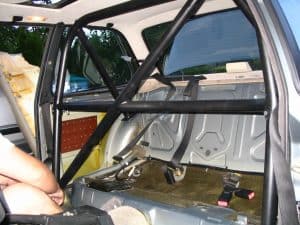
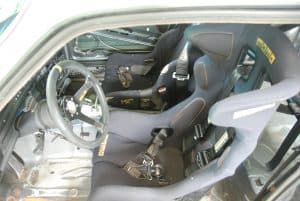
At this point I would say it was still a street car. It still had a back seat and carpet and a radio. I drove it like this for a couple months, but the track bug kept calling. So soon later I found a real race seat. No more reclining. This did now mean I was going to need to look into some sort of roll over protection as I had now defeated that safety measure. I did a lot of shopping and research about fit, style, cost, shipping, availability ect. The one that went in the car was made by a company called VSROne. It had the best clearance and fit in the car. It was not the cheapest option but for sure one I was OK with paying for. Remember I am not a fan of that compromised safety thing. So now the radio has half its speakers, there is no rear carpet or side panels anymore. The seat is in a fixed position. There is scaffolding in the back of the car. but looking forward from the drivers seat it could play the street car part for now……

And out goes the rear seat.

A couple events into the life there was a thirst for more cornering load. Need to find some tires. Lucky for me there is a local race series that runs a similar car to mine and they tend to go through a lot of tires. So after a little hunting I acquired some real track rubber. in this case early on it was Toyo RA1 tires. These are great tires! They last along time, they can take many heat cycles, they made a lot of sizes, they are one of the cheapest track tires around. If they were still in production I would still be on them. Anyway, now I got some rubber and the car is pretty good. Springs in the car are now a little soft, I can feel the car hitting bump stops and floating a little on the grippy tires. The car already had pretty stiff springs. It was a bit stiff for the street, but not to bad. Front springs were rated ant 375 lbs/ in and the rears 475 lbs/in. At this point I had been working on a few Pro3 cars and had learned a few things. I almost doubled the spring rate of the car. Went to 650 lbs/in front and 800 lbs/ in in the rear. This was the next level of feel I was looking for at the track. Man is it stiff. Think of driving a skate board. So in making the suspension on my car up to track use I ruined the street ride quality. Not the best street car anymore.

Gripped up at Portland.

Then there was the day I killed the carpet. Was still daily driving the car at this point when almost home from work the heater core blew a end tank and sprayed the entire left side of the carpet with coolant. For me at this point the decision was easy. Yank that smelly coolant soaked carpet out! All the rear was already gone so why not. The heater core fix itself is pretty easy, but the mess was amazing. couple issues I found with no carpet. The car is super loud, the passengers feet can get a bit warm, and I had no place to rest my foot when not on the clutch. So I built a dead pedal for it and that is all I reinstalled. Screw the passengers feet, and I can deal with a little noise, because racecar. Speaking of noise. I have had at least five different exhausts on the car. I bought it with a Dinan muffler, I killed that one looping turn 6 at Pacific Raceways in the rain. Then the custom Magnaflow cat back, this was great until I smashed it beyond repair at a PGP Time Attack on the rumble strips back when you could do that. Then I scored a IE stainless that was on the car for maybe three days, it was way to quite. I then built a Meghan racing muffler catback out of some spare parts. Didn’t look that cool but it was cheap and it worked. This was on the car until it was no longer driven everyday. It now has a pulse tuned equal length header and a flow matched exhaust built by the now closed Volvo custom shop RSI (R-Sport International) when they were developing a Pro3 race exhaust system. The sound on this is amazing but its is on the very loud side.

This is a street car still?

So now I have been tracking and driving this absurd track car that I have convinced myself is still a street car to the point that it has worn out again. The shocks are all worn and the fronts are dead. DEAD. All the rear suspension bushings, rear wheel bearings, the drive shaft, and a couple other normal maintenance items. So as you should do with any track car i went through and replaced all worn items i found again. I also took this opportunity to think about things I would want to change and the largest one I could come up with was the the shock travel. The car always felt a little held back by the shocks. The valving in them was set for a way softer spring combo, the travel was near the bottom of the shock stroke and they seemed to bottom out a lot because of this. So after much deliberation I got a set of BC Racing coilovers. you can order them valved to specific springs and come with some pretty good hardware. I got a set valved to the springs I had, and because I had springs I had them ship me a softer set (These will be used in another car). I did have to weld the strut tube to my spindle but that is something well in my comfort zone. Once installed and set and tested, I was able to get the result out of the car i was looking for. if felt way better on track, the shock adjustments are now felt, the cat doesn’t bottom on the shocks and they are running in there normal stroke range. I also again made another safety up date at this time. I removed the old race belts and my trusty Sparco race seat and installed a new set of Hans device compliant belts and a Momo head restraint seat. Also upgraded the passenger side belts from 5 pt to 6 pt. Again you can never be to safe.

Wooof!

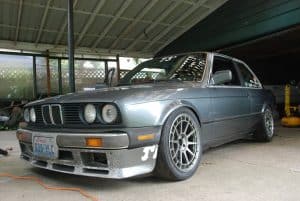
The look of the car was also something that needed a update. Wheels and tires are getting long in the tooth so lets start with that. We are gonna put a little larger tire on it as well. So off come the old trusty 15×7 wheels and 225-50/15 tires and on go the new Roto 17×8 wheels and the same Toyo tire in a larger 235-40/17. This has created a new problem. The slightly larger size is now hitting the bumper trim and stop the tire. Bring on the fender roller. Little work there and they are in! Thats pretty up to date on the car as of this blog. Still on this seasons update list is a set of Massive Brakes big brake kit and a Diff limited slip unit rebuild. then next season the removal of the old roll bar and sunroof and the installation of a roll cage and clean up the interior wiring. Stay tuned in!

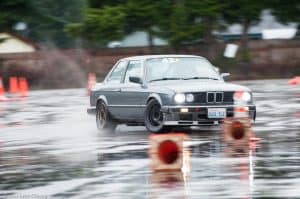
Bonus action shot!

Posted on

6 Hours on the Ridge Spring Enduro – Race Weekend Recap The Ridge Motorsports Park

What: First race of the season, a 6 hour race at the Ridge Motorsports ‘water’ Park.  Non-stop rain, great for driver development but sucked for everything else.  Qualified on pole but finished 2nd in ME2 class.

If I knew then, what I know now: Check all vital systems at least a few days prior to the race weekend.  Not having our radios and GPS receiver working caused us the win and this was all preventable.

Products that you should check out: 

  • Sampson Digital Pro Racing System – this is what we have, paired with an in-helmet speaker system on a Stilo helmet and an IMSA wiring adapter.  When we test it and hook up properly, it works perfectly!

Background

April 30, 2017 marked the first race of the 2017 club racing season, the 6 Hours on the Ridge, held at the Ridge Motorsports Park in Shelton, WA and put on by the International Conference of Sports Car Clubs (ICSCC).  For those of you who are not from the Pacific Northwest, in the United States, this sanctioning body probably doesn’t ring a bell.

The ICSCC operates in Oregon, Washington and British Columbia (Canada) as essentially a Sports Car Club of America (SCCA) but with not as much “politics”.  This is primarily because it’s a smaller organization and thus, rule changes don’t impact as many people and there aren’t as many people lobbying for a change one way or another.  They adopt and support most classes that exist in the SCCA and even NASA, such as Spec Miata, Improved Touring Classes, Spec E46 and so on.

The SCCA does exist in the PNW, it’s just not as strong, though it’s been growing the past couple years.  NASA had a brief stint in 2013-2014.  One series that is unique to the PNW and ICSCC is PRO3.  It’s like Spec E30 but with more modifications allowed, based on an Improved Touring Class formula, has the largest car count in the PNW with over 80 race cars built and fields ranging from 15 – 45 depending on the weather.  It also some of the best drivers, many of which have gone on to the professional ranks in IMSA and Pirelli World Challenge. The PRO3 car qualifies nicely in the E2 and ME2 classes for endurance races.

PRO3 fields are huge and look at the crowd on hand to watch!

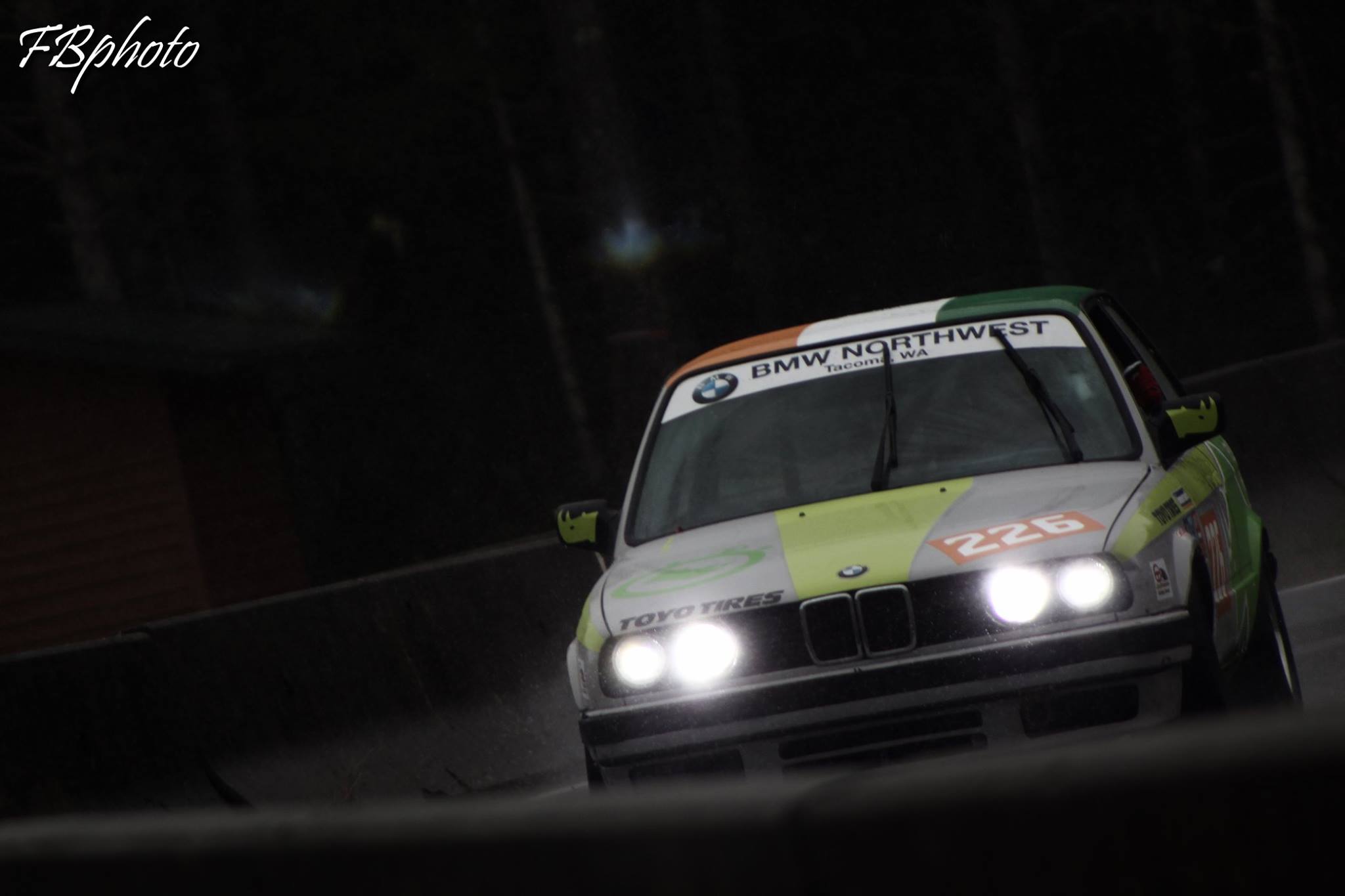
Our car – The Track Attack #226

For this race, we were fortunate to have on our best friends, Manu Yareshimi, run a team for second year in a row and going for repeat wins.  Last year we campaigned his car in the same race and got first place in the E2 class!

Manu about to go in during a pit-stop. We won!

Manu’s PRO3 car is one of the best built PRO3 cars ever, originally built by a previous owner who has moved on to Spec E46 and with the folks at Advanced Auto Fabrications doing all of the work.  And they do top-notch work!  It’s a front running car that has been taken cared.  More on the #226 in a future post when we feature his ride.

The team

Being a 6 hour race and with rain, lots of rain, in the forecast, we felt like as few pit stops as possible and thus probably three, two-hour stints, across three drivers.  That meant Manu, myself (Gama Aguilar) and 2016 PRO3 Champion and new Spec E46 driver, Olivier Henrichot.  There’s one word to describe Olivier: fast.  Just nasty, dirty and unapologetically, fast.  Check out some of his race videos on his YouTube channel.  He has or is close to having just about every PRO3 track record in the local tracks.

YouTube player

This was actually a re-do with Olivier as we were originally going to run the 8 Hour Festival of Endurance in October 2016 at Portland International Raceways but a freak storm that never lived up to it’s hype caused the race to get postponed and most of the drivers and crew weren’t able to make the new date happen.

Bryce, Jordan and friends were there, just as they have been for most of our races, making sure the car was running, we had a strategy and pit-stops were executed well.

Testing, practice, qualifying

We arrived on Saturday for a test-and-tune day, to not only shake down the car but beat the rust off of our driving skills as it was the first time any of use had done anything but sim racing in 2017.  We had originally prepped the car for the 8 hour in October that didn’t happen and then it just sat in the garage.  We drove and made some adjustments to try to dial out some front-end push, that would then be followed by some aggressive over-steer if we tried to coax the front end to bite.  At the end of the day, we made compromises to allow the front end to have more bite, slow the weight transitions but not be too tail happy as not all of us had or have lightening hands, like Olivier.

We woke up Sunday morning to just clouds but then the first drop of rain started around 8:15am and did not let up the WHOLE DAY.  We’re not talking showers or even steady rain, we’re talking downpours transitioning to monsoons and back to downpours.  Aside from being wet and cold when not in the car, it was a blast!

We had a brief practice session where Manu and I split the time and then we put our hot-shoe in for qualifying.  He not only put us on-pole for E2 but 7th overall, splitting half of the Spec E46 field! #winning

We’re on pole for ME2!

The race!

The race started in a steady rain and when the green flag dropped, the spray began and the race was on! The first hour went off with all but two things going as expected.  That first thing, which at the time felt insignificant, ended up being the biggest lesson learned.  The radios didn’t work.  Well, at first it was that we when we did a test connection with Olivier’s helmet and the in-car radio system, the connectors on the system and his helmet weren’t compatible.

Near the front of the grid for the start of the race. Look at the fanfare!

We brushed it off and just assumed that it would work with Manu’s helmet and mine, just like it had the past couple of years, without an issue.  The first sign of this fatal flaw was about 90 minutes into his stint, we gave him a thumbs up as he passed start/finish.  The very next time by, he comes into the pits to see what’s going on?  There goes half of his almost one full lap lead.

20 minutes later, he comes in after going off to check things out and make sure there was no damage to the car.  It all checked out and we decide to do a driver change since it was close enough to the 2 hour planned stint.  Manu goes in, connect radios, turn them on and… nothing. Ok, we’re going off of pit boards only.

Separate story on Manu’s amazing comeback in a separate post but this was Manu’s first time in a race car in exactly one year and after recovering from a life-threatening disease.  So he was working his way to getting back on pace.  Slowly but steadily, his lap times were coming down, even with conditions getting worse but we lost the lead and because our main competition left their fastest driver in the car for about 3 hours (Corey Peters and the KD Motorsports crew), they eventually got two laps up on us.

An extended black flag all due to a car going into the start/finish wall stopped the bleeding and when racing got back underway, Manu had figured out how to drop another 8-10 seconds from his lap times – AWESOME!!

With about 2.5 hours left in the race, it was my turn.  We tried the radios on my headset and nothing.  No sweat – just focus on the goal: drive clean and take big chunks out of the 2 lap lead the competition had on us.  The second hiccup we had was that the GPS receiver on the AIM MXL dash had bitten the dust.  The last few times on track, the receiver was hit and miss but would always eventually get going.  No matter, we strapped in Track Attack on iOS and got going.

Within a few laps, I started clipping away lap times in the mid 2:24-2:25 range on a consistent basis.  The conditions were absolutely horrible.  Fun but horrible.  Aquaplaning on the front straight and the worst was near the top speed area, right before start/finish.  A big puddle of water mid-track and the middle of the transition between T4 and T5. While not super tricky, exploring and searching for traction in the ‘carousal’, a long left-hand sweeper.

Then there was the worst part of the track in the rain, T9.  A slight right hander, that we call ‘the kink’ because right at the corner there is curbing and an immediate uphill climb on the corner exit.  This is great in the dry because you attack it hard, staying flat and using all that grip you get when hitting a steep uphill and on-camber climb.  In the wet though and in these southeast Asia style monsoon conditions, a lake had formed as water collected from all directions and no drains for relief.  It was kind of straight forward: no matter what you did, it was going to feel like hitting a standing water, at-speed, because that is exactly what we were doing and it was going to spit you out the other side and your only goal is minimize how sideways you would be spit out.

Turn 9 – how I hate thee!

After the first 10 or so laps and a few full opposite lock situations, I thought I had it figured out but I would discover that what would work on one lap, had no guarantee of working another lap.  I even resorted to attempting to follow the path of the Spec E46’s, who were placing their right tire on the curbing, claiming it had more grip but if you got it wrong, the penalty would be severe.  I paid a severe penalty, barely being able to keep the car on-track.  Despite all of this, I was making up ground fast, having made up one lap and more than halfway through making up the second lap.  That progress wouldn’t end with what we wanted, over what ended up being the last 30 minutes of my stint, I ended up going off-track (even if it was just 2 wheels off) 4 times.

I eventually got the rolled up black flag, the last warning before being called into the pits and even though I backed off the pace, I still went off again, dropping two wheels on the exit of the kink.  I didn’t know what was going on – almost whatever I tried, it would work one lap but not the other.  I got black flagged for the first time ever.  Had a good conversation with the race steward and promised to back off the pace even more, crawled through the kink on the out-lap.  Made it!  Ok and now early and soft brakes for the ‘thumb’ and… nothing.  No slowing down, no lockup, no turning, no response to brake pedal modulating – just gliding straight off the track.

Embarrassed, confused and disappointed, I kept the car moving so I wouldn’t get stuck on the mud as I had gone a solid 50-75 feet off-track, got back on track and made my way back to the hot pits.  I had the crew checkout the car and while they couldn’t find anything wrong, we saw a big dent in the skid-plate, mud and dirt everywhere and no way to explain what happened.  So we figured we must have been leaking oil and called it a day.

Results

We finished 90%+ of the race laps so we classified in 2nd place.  The 1st place KD Motorsports car would end having to be towed in 4 laps later but still winning overall.  It turns out that they had a slow oil leak and eventually their engine seized – explaining part of why I went off so much; they had been dropping oil across the track for several laps.  While that sure as heck didn’t help our cause, I put all the blame on us.  We should have tested our radio setup the day before and gotten them working, so we could have been in communication with the pit wall and telling the race steward that not only were conditions difficult but that something else was up on the track.

We should have had lap times the entire time, with the crew checking lap times on Race Monitor to tell the drivers that we could slow down a bit and still make progress. This race was lost the day before and even the week before.  We failed to prepare properly – we could have tested radios and GPS a week, a month, several months prior.

Let’s end the article on a good note with this amazing picture from FlyingBye Photo!