The 2026 season is officially underway, and our calendar is set. If you’ve been thinking about getting on track, racing more seriously, or stepping into a new program, then right now is the moment to get aligned. Once the season starts stacking, and things are heating up now, prep windows tighten quickly — especially for multi‑event campaigns.
With that in mind, here’s where Racer on Rails will be throughout the 2026 racing season. If any of these events are on your radar, reach out ASAP so we can map out your prep with intention.
SCCA West Coast — Majors, Super Tour & Runoffs
Feb 20–22 – Buttonwillow
March 27-29 Thunderhill SCCA Regional
May 8–10 – Portland SCCA Hoosier Super Tour (Mother’s Day Weekend)
May 23–24 – Pacific Raceways SCCA US Majors (Memorial Day Weekend)
Sept 25-27 & Oct 2–Oct 4 – Road America SCCA Runoffs
If you’re aiming for a Runoffs qualification campaign or national level competition, this is the ladder.
ICSCC Conference — Pacific Northwest Core Program
April 24–26 – Portland
May 15–17 – Pacific
June 19–21 – Portland
June 26–28 – Pacific
July 31–Aug 2 – QRP
Aug 14–16 – The Ridge
Sept 18–20 – Portland
Oct 9–11 – Portland (8‑Hour)
For Northwest‑based drivers looking to build racecraft, consistency, and confidence in a tight‑knit paddock, this is home base.
NASA — HPDE, Time Trial & Racing Ladder
Mar 6–8 – Sonoma
June 19 – 21 Oregon Raceway Park (ORP)
Aug 14–16 – Portland
Sept 4–6 – Pacific
Oct 23–25 – The Ridge
NASA offers one of the clearest progression paths from HPDE to Time Trial to wheel‑to‑wheel racing.
PCA Club Racing
Jan 30–Feb 1 – Sebring
April 10 – 12 – Road Atlanta
July 10–12 – Watkins Glen
Sept 4–6 – Road America
If you’re running a Porsche platform and want structured, national‑level competition, this is a strong calendar.
OnGrid Time Attack — Full PNW Calendar
We will be supporting the full OnGrid PNW calendar in 2026.
March 27-29 – The Ridge
May 22-24 – The Ridge
May 29-31 – Thunderhill (GTA)
June 19-21 – Pacific
July 24-26 – The Ridge
If you’re building a time attack car, refining aero, or sharpening qualifying pace, we’ll be there.
GLTC — Laguna Seca
We will be attending GLTC at Laguna Seca in 2026 as part of our Time Attack and related driving programs.
April 17-19 – Carolina Motorsports Park
May 8-10 – Road Atlanta
June 12-14 – Gingerman Raceway
July 24-26 – Watkins Glen
Aug 21-23 – Lime Rock Park
Sept 18-20 – Laguna Seca – committed to this event only for 2026
If national exposure, high‑energy sprint racing, and a dynamic paddock appeal to you, this is an event to plan early for.
Track Days & Competition License Schools — ProFormance Racing School
For drivers earlier in the journey — or those ready to earn a competition license — we will continue supporting participation in track days and competition school programs with ProFormance Racing School.
We can help align your goals, prepare your car, and integrate your track day progression into a broader racing plan.
Track days aren’t separate from racing — they’re often the first step toward it.
What This Means for Your 2026 Season
If you:
Want to run even one of these events
Need race prep, dyno, setup, or Test Ready certification
Want coaching support
Are exploring a full‑season campaign
Are starting with track days or license school
Our shop capacity, coaching calendar, and trackside support structure are built around this schedule. Aligning early ensures we can support your goals with the time and attention they deserve.
The 2025 Racer on Rails SCCA racing program kicked off in California at The Circuit, the newly built racecourse at Buttonwillow Raceway Park. This was a weekend of firsts—not just for us, but for the entire everyone, as we took part in the first-ever sanctioned race on the new track!
Everything about The Circuit was new; new track, new tire brand for both slick and wet setups, new coaching program, new competitors, and new adventures. Our drivers and crew had plenty to learn, and we approached the weekend with specific goals and a detailed game plan for each driver. With two days of testing, racing, and strategy calls, the team made incredible strides, achieving personal bests, podiums, and a 1-2 finish in Race 2 on Sunday.
Meet the team
Ron and Reid in impound, post-session
Ron Tanemura & Car Chief Reid Morris
#63 SE46 BMW 330i | SCCA Class – Touring 3 (T3)
2024 ICSCC SPM Class Champion ????
First-ever SCCA U.S. Majors Tour event
Entering Racer on Rails’ SCCA Competition Program
Ron has been racing with Racer on Rails in the Pacific Northwest for a few years, but this was his first-ever SCCA Majors Tour raceand his fist season working full time with Reid. After earning the 2024 ICSCC SPM Class Championship, he stepped up to challenge himself further in national competition. This weekend was a big new challenge —a brand-new track, new competitors, and a stomach bug. But Ron came ready to party, and nothing was stopping him.
Rene getting Dave strapped in for race 1.
David Orem & Car Chief Rene Perez
#6 BMW Z4 M Coupé | SCCA Class – Touring 3 (T3)
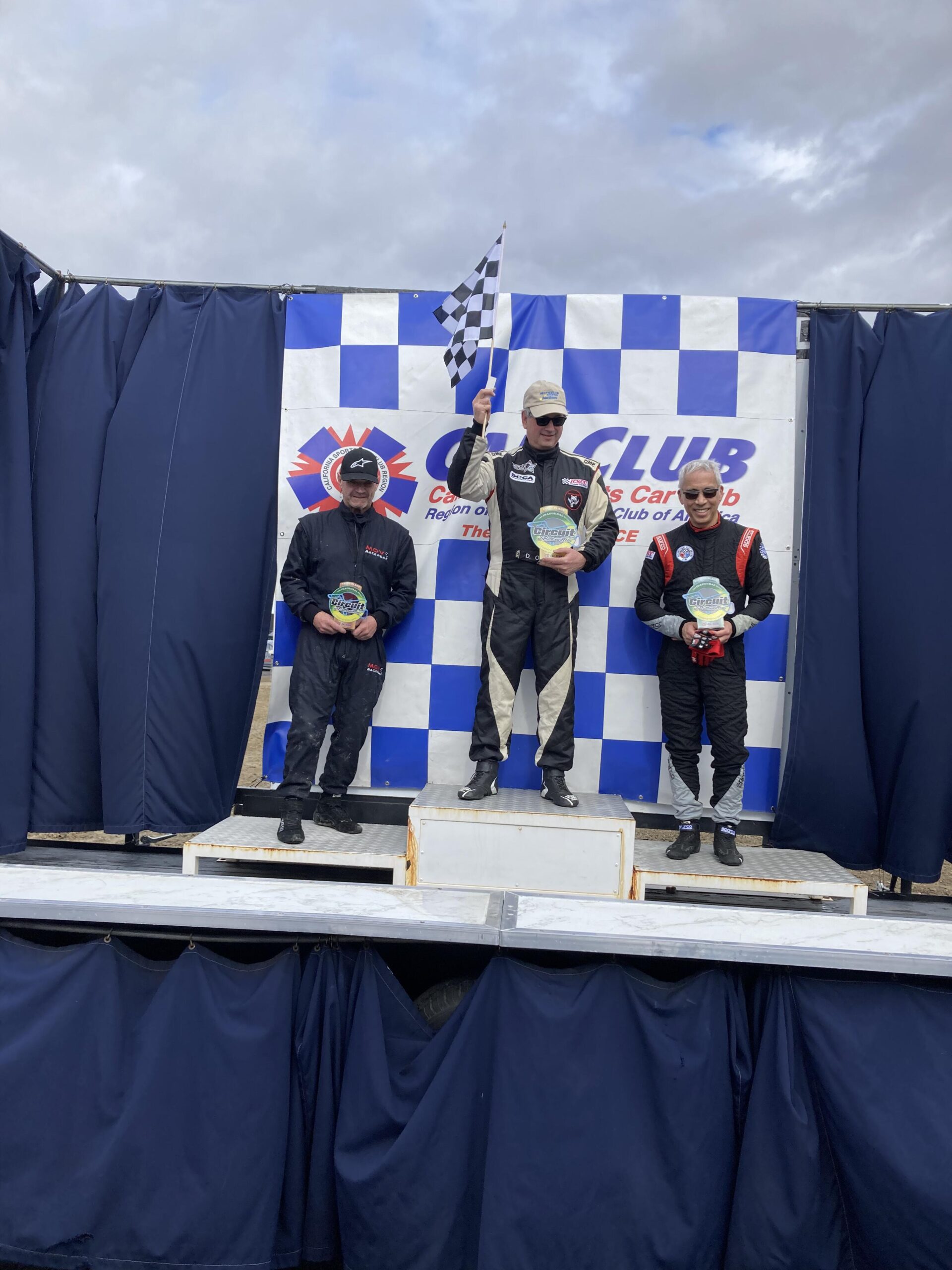
Touring 3 podium finisher
Has mastered Heel-Toe Shifting during the off-season
Goal-Oriented approach
Dave returns to our SCCA program looking toreach the sharp end of the T3 field. With a fresh rebuild on his Z4 M Coupé including a stunning new vinyl wrap, Dave arrives fit, focused and determined. The pairing showed steady progression all weekend, culminating in a checked bag fee on the flight home for a bag containing new hardware.
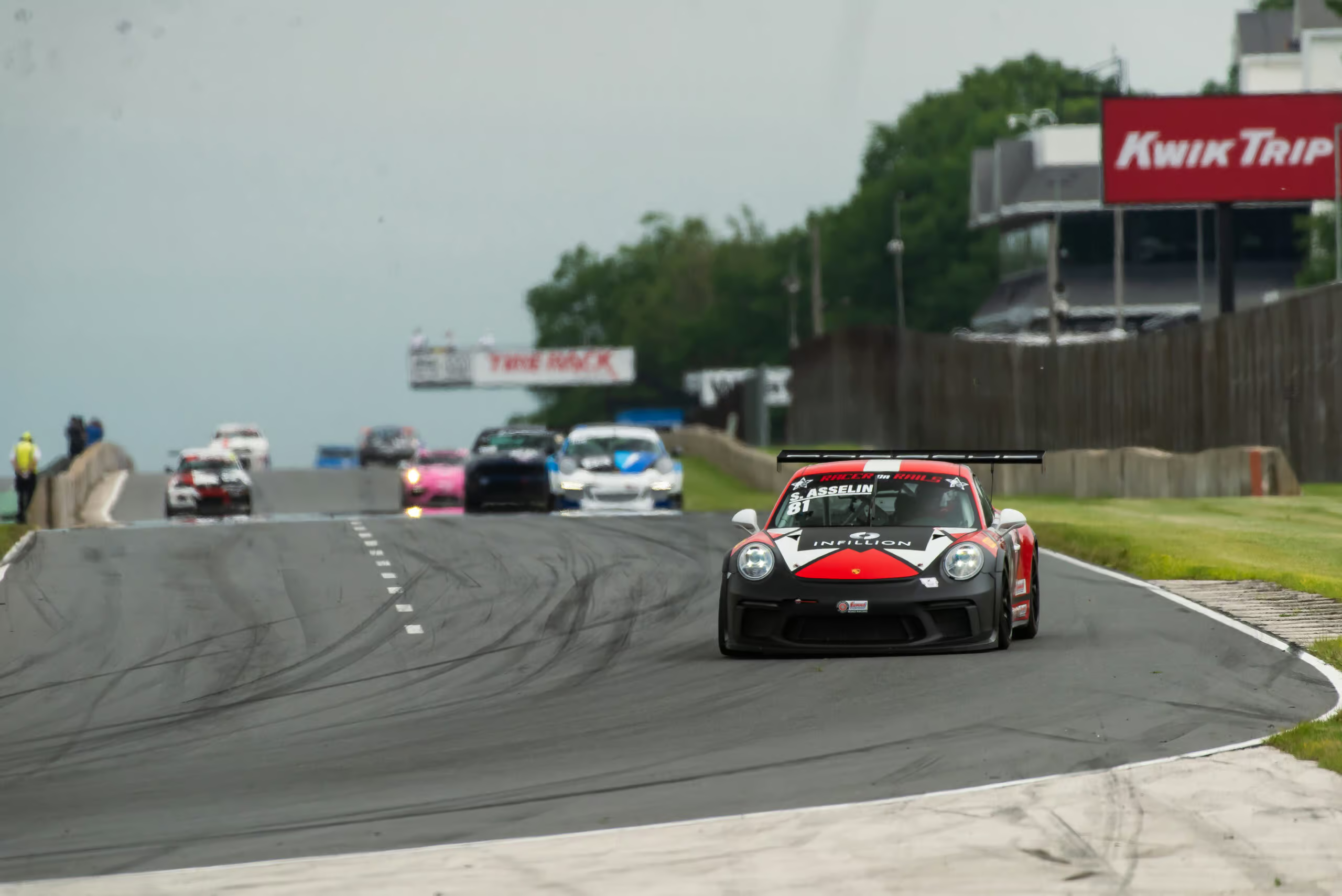
Simon’s sweet Porsche GT3 Cup Car in post race impound
Simon Asselin & Car Chief Jordan Allen (“The Doctor”)
#81 Porsche Motorsport 991.2 GT3 Cup | SCCA Class – GT2
2023 SCCA Touring 3 Points Champion
Racing in one of the most competitive SCCA grids, GT2
Third-fastest GT2 lap time of the weekend
Simon and Jordan have been working together for multiple seasons, and after a strong debut year in GT2 last season, they returned to challenge for the podium in 2025. This series offers the challenge of multi-class race groups including a large Spec Corvette field, Simon’s consistency and pace kept him at the front of the GT2 field, all while navigating the pack of slower class cars.
Friday Test Day – Cold Starts and First Impressions
We arrived at The Circuit before sunrise on Friday, greeted by well-below-freezing temperatures and frost covering everything—cars, buildings, and the track. Luckily, the team had already set up the night before, allowing us to jump straight into unloading and prepping for the 9:00–9:30 AM test session.
By the time the first cars hit the track, the frost had lifted, and the sun was breaking through. This was the first real-world drive for any of our drivers on the new layout, making it a crucial day of adaptation.
Driver Progress:
Simon Asselin: Locked in the 1:45 range, pushing near the expected top pace.
Dave Orem: Improved into the 2:06 range, showing steady progress.
Ron Tanemura: Battling fatigue, made strides before sitting out the final session to recover.
With simulator prep translating well to reality, we ended the day confident in the team’s progress heading into Saturday.
Saturday – Practice, Qualifying & Race 1
Saturday morning started with feedback sheets from Tyler Campbell, analyzing Friday’s data to pinpoint one or two focus areas for each driver. The goal: apply the learnings immediately in the morning practice and first qualifying session.
Ron had an early spin during morning practice, leading to the discovery of a failing battery. Missing part of practice, he rebounded well in qualifying. Dave executed perfectly, shaving seconds off his previous best lap.
Simon struggled with traffic in qualifying but still secures a start from row 2.
Saturday Qualifying Results:
Touring 3: Dave P2, Ron P5
GT2: Simon P3
Saturday Race 1 – Making History
T3 Race 1:
The first-ever sanctioned race on The Circuit was a split start, with Spec MX-5 Cup cars leading and Touring 3 cars behind. The race brings improving track conditions and with the help of lots of data and video analysis, defined goals and executing on our action plans, Dave charges to a 2nd place finish, while Ron continues to improve despite still recovering from food poisoning, finishing the race in 4th.
GT2 Race 1:
Better track conditions and cool air set the stage for Race 1 in GT2. Simon has some great racing of his own, as he trades positions with a few GT2 cars before finishing the race in 4th place.
Sunday – Morning Qualifying, Wet Track, Big Decisions
Early morning rain rolls in leaving us with a damp but drying track. Our turn is up for T3 qualifying and mixed conditions still exist. We are forced to make a strategy call on tires, so we go to Jordo at our Weather Desk. The decision is slicks, and it pays off as the track conditions improve and we begin finding speed in quali #2.
Sunday Qualifying Results:
Touring 3: Dave P2, Ron P3
GT2: Simon P3
Touring 3, Race 2 – The 1-2 punch!
The race begins with a 6-car battle into the first corner making for an exciting start. Dave sets the pace in class, while Ron, after fending off some light contact from another competitor, sticks to the the Z4M’s bumper and RoR takes a 1-2 finish in Race 2 for Touring 3. BOOM!
GT2 Race 2:
Simon has a solid start and runs in P3, involved in a 3-car battle for most of the race. After a restart from a full course caution, several cars experience wheelspin, resulting in a loss of 2 spots. Despite the setback, he fights his way back up, improving his personal best lap time by nearly three seconds (1:44.5) and finishes in P4.
Wondering what it’s like on the new circuit? Check out a fast lap in Simon’s Porsche 911 GT3 991.2 Cup Car
Final Thoughts – Goals, Smiles, Memories
As we packed up, we reflected on an incredible opening weekend. The new track, unpredictable conditions, and intense racing made for an unforgettable event.
Dave & Ron delivered a 1-2 finish in Touring 3.
Simon clocked the third-fastest GT2 lap of the weekend.
In 2023 we tried something out based on what we were hearing from our drivers and partners, how can we get quality track time outside of a race weekend to truly put in some work? Driver work, setup work, and generally car development work!
So we hosted our private run groups and even full on track days, in partnership with ProFormance Racing School at Pacific Raceways and Dundon Motorsports at the Ridge Motorsports Park. Those went over really well, so we’re building on that in 2024 with the following initial schedule.
Note that we will likely add more days for August – December and we’ll update this post as those days get finalized.
Private Run Group w/ProFormance Racing School @ Pacific Raceways
These events are held within the ProFormance HPDE days but it is our own run group, for licensed race car drivers and advanced HPDE drivers only. 30 Minute sessions every hour, for a total of at least 2 hours of track time and potentially more during the 4-5pm hour, all depending on available daylight conditions.
Check out the links to signup on Motorsportreg.com
PrivateTrack Day w/Dundon Motorsports @ The Ridge Motorsports Park
These events are entirely our own private events, with two run groups. A race car run group for all fully licensed and compliant race cars and a Dundon Motorsport Driver Street car group for vetted and experienced street car drivers. The street car group may be made up of street cars or non-licensed race car drivers driving race cars, but these cars are seriously fast. Due to how fast these cars and drivers are, we want to ensure there is not too large of a speed gap in between cars, to keep things safe.
The days are setup for 45 minute sessions for each group, alternating throughout the day and then the groups are usually combined at the last hour of day, mostly because most people have run out of human gas, gas gas, tires and/or brakes!
2021 was a great way to bounce back from 2020 and while COVID isn’t behind us, we’re thankful that we were able to make it to all but one of the planned competition and racing events that we originally planned and even added in a couple of extra race weekends.
Thank you to everyone who was a part of our journey in 2021!
2022 is shaping up to be an even more jam packed with track action and while we’re mostly booked up for each event, we have limited available capacity to have you join us at the local .
If you aren’t already driving with us, consider this an open invitation. We are here to help! Our current SCCA, ICSCC (Conference), NASA, Revolution Racing League and GT Celebration events are listed below.
If there are any race weekends you would like some crew and coaching support for, please feel free to contact us via e-mail, phone or messenger – raceronrails@gmail.com – (206) 475-1114
Well, 2020 was a bit of a weird year. So what’s the best way to forget about it? Look forward to an awesome and packed 2021 racing and driving calendar.
We are in the business of making smiles and lifetime memories and one of the main ways we do this is by helping people get onto a track. We can help you with the car set up and care, as well as trying to improve the performance of both you and the vehicle.
We want to announce and extend an open invite for those that are interested that we are here to help. Our team has a calendar of events planned with room for additional support for each weekend as needed! Our current SCCA, ICSCC (Conference) and Global Time Attack events are listed below. If there are any race weekends you would like some crew and coaching support for, please feel free to contact us via e-mail, phone or messenger! Let us help you be your best on track!
Give us an E-mail or call to discuss options! raceronrails@gmail.com – (206)475-1114
2021 Race and Track Schedule:
January 15 – 17: Auto Club Speedway SCCA Majors Tour – Fontana, CA
February 5 – 7: Circuit of the Americas SCCA Majors Tour – Austin, TX
February 19 – 21: Buttonwillow SCCA Majors/Hoosier Super Tour – Buttonwillow, CA
March 19 – 20: Thunderhill Raceway SCCA Majors Tour – Willows, CA
April 2 – 4: The Ridge Motorsports Park Global Time Attack – Shelton, WA
April 30 – May 2: Portland International Raceway Cascade Sports Car Club – Portland, OR
May 14 – 16: Pacific Raceways IRDC Tribute to the Volunteers – Kent, WA
May 28 – 30: Pacific Raceways SCCA Majors Tour – Kent, WA
June 4 – 6: Spokane County Raceway Park ICSCC – Spokane, WA
Jun 18 – 20: Portland International Raceway Cascade Sports Car Club – Portland, OR
July 16 – 18: Pacific Raceways IRDC Summer Classic – Kent, Washington
July 23 – 25: The Ridge Motorsports Park Global Time Attack – Shelton, WA
August 13 – 15: Portland International Raceway Cascade Sports Car Club Dash for Kids – Portland, OR
August 27-29: The Ridge Motorsports Park IRDC – Shelton, WA
September 28 – October 3: Indianapolis Motor Speedway SCCA Runoffs – Indianapolis, IN
October 16: Portland International Raceway 8 Hour Endurance Race – Portland, OR (tentative)
November 12 – 14: Buttonwillow Global Time Attack Final – Buttonwillow, CA
December 4 – 5: Circuit of the Americas World Racing League – Austin, TX
The staple of what we do is provide service to the racing community. One of the primary aspects of that is to be at the track, to help you with the car set up and care, as well as trying to improve the performance of both you and the vehicle. We want to announce and extend an open invite for those that are interested that we are here to help. Our team has a calendar of events planned with room for additional support for each weekend as needed! Our current ICSCC Conference as well as intended NASA NorCal events and SOVERN events will be listed below. If there are any race weekends you would like some crew and coaching support for, please feel free to contact us via e-mail, phone or messenger! Let us help you be your best on track!
Give us an E-mail or call to discuss options! raceronrails@gmail.com – (206)475-1114
ICSCC Conference
Event Schedule:
April 19-21 (Fri-Sun) – Mission Race Way Park –
British Columbia
May 3-5 (Fri-Sun) – Portland International
Raceway – Portland, Oregon
May 10-12 (Fri-Sun) – Pacific Raceways – Kent,
Washington
May 31-Jun 2 (Fri-Sun) – Spokane County Raceway
Park – Spokane, Washington
Jun 14-16 (Fri-Sun) – Portland International
Raceway – Portland, Oregon
July 19-21 (Fri-Sun) – Pacific Raceways – Kent,
Washington
Aug 16-18 (Fri-Sun) Portland International
Raceway – Portland, Oregon
Aug 23-25 (Fri-Sun) – The Ridge Motorsports Park
– Shelton, Washington
SOVERN:
June 7-9 (Fri-Sun) – Spokane County Raceway Park
– Spokane, Washington
July 5-7 (Fri-Sun) – Pacific Raceways – Kent,
Washington
July 26-28 (Fri-Sun) – Portland International
Raceway – Portland, Oregon
Sep 7-9 (Fri-Sun) – Portland International
Raceway – Portland, Oregon
Sep 27-29 (Fri-Sun) – Pacific Raceways – Kent,
Washington
October 5-6 (Sat-Sun) – Maryhill Hill Climb –
Mary Hill, Washington
NASA NorCal:
Mar 15-17 (Fri-Sun) – Sonoma Raceway – Sonoma,
California
Aug 2-4 (Fri-Sun) – Thunderhill Raceway –
Willows, California
In a couple weekends, we’re headed back to Portland International Raceways and the first time I’ll get to drive the track for more than one session (in real life) this year and since I was on the Speed Secrets Podcast, earlier in the spring. I got some live coaching from Ross Bentley and have been excited to implement the tips I heard. Check out the podcast episode here and subscribe – it’s an awesome podcast with a wide variety of guests and every time, I learn a ton.
So let’s take a lap around the track and go through each sector as defined by the sectors on Track Attack. Below we’ll be using illustrations from real data from a pair of front-running “spec” racing class cars: my PRO3 and Will Schrader’s Spec Miata. Both are considered low-power momentum cars but there is enough power and weight difference you’ll see different things happening.
If you are a Spec Miata or PRO3 driver in the Pacific Northwest (or have similar cars), you can request to join the respective teams on Track Attack and get access to the session data that we’re using in these examples. (Link to PRO3 data share team and Northwest Spec Miata Tour)
We’ve broken up PIR w/chicane into 4 sectors. Each sector is a combination of corners and are split halfway through a ‘straight away’.
Elevation change: None
PIR is like the Lime Rock Park of the west coast. In the chicane configuration, there are 7 right hand turns, compared to 2.5 left hand turns. But unlike Lime Rock, the elevation change is near zero. Check out this video where the data overlay shows the elevation change – there is just under 10 feet of total elevation change.
No real elevation change but there are still some tricks on banking that the track holds.
Segment 1: The festival chicane
The first segment starts at the start/finish line, of which the speed that is carried before the first braking zone is determined heavily by the exit out of T12 on the previous lap and if you might have caught a draft down the front straight.
Braking for T1 will depend on the car and whether its a qualifying lap or a race lap. In a PRO3 car and a qualifying lap, you can hit the brakes hard right after passing the 400 board and what ends up being right before the 300 marker. Note, this is hard to replicate lap after lap. After hitting the brakes hard, start coming off of them and you should already be looking for the apex of T1. It’s a good practice to put the right-side tires on the FIA curbing at the apex of T1 and even dropping a tire inside of the curbing isn’t bad but puts more stress on the suspension components.
Think about this: When are you releasing the brakes as you enter the corner for T1? Play around with that.
You’ll want to take a line where you can hit T2 with a late apex. Why? There’s a decent straight-away from full-throttle at the exit of T2, all the way until T4. Focus on doing what you can to get to full-throttle as soon as you possibly can coming out of T2. Usually when I see data of someone really moving through this segment, it is all about the minimum speed they carry through T1 and how quickly they can get to full-throttle out of T2. Clearly, there is a trade-off here but that’s the trick – finding the right balance and compromise for you and your car.
Also, the steering input for the change in direction to turn for T2 is relatively abrupt and hard. Remember, slow speed –> fast hands, fast speed –> slow hands.
Comparing the lines of two front-running cars: Blue is a PRO3 car and Yellow is a Spec Miata. What differences do you see?
Segment 2: No rest – Attack!
Segment 2 includes T4 – T6 and is one of the areas that separates good from great laps. It can be easy to coast through this segment, but when you’re looking for the maximum lap time, you need to attack!
Same two cars: Yellow (Spec Miata) and Blue (PRO3). There is a 250-400lbs weight difference depending on the Spec Miata. Why do you think each car may be taking different lines?
T4 is somewhat of a false apex – you don’t absolutely have to hit the curbing but the benefits of staying closer to the curbing is that you travel less distance and you have more room to catch the car, if and when the car is upset by the bumps. When you brake depends on your car but generally speaking, with the chicane, you can go pretty deep into the braking zone and brake pretty lightly relative to braking for T1.
Think about: As in segment 1, when are you coming off the brakes as you enter T4?
As you dive into the T4, the rear of the car may start sliding, which is a good thing! Use maintenance throttle to settle it down and slowly start going to full throttle or modulating accordingly. How much throttle you can give it will depend on the speed you carried through mid-corner and how well the rear-left suspension components are absorbing the bumps. There is a lot of load on that rear-left, all the way through the exit of T5. Is your suspension bottoming out?
As you approach T5, you’ll have to either breathe off the throttle to get the car to rotate or give it some very slight braking. Get turned in and hit that curbing for T5. Then give it as much throttle as it will take and let the car release to the driver’s left as you approach T6.
T6 has different schools of thought. One school says sacrifice the corner and run the shortest distance possible. The other says that you should hit the corner with a wide entry and get an amazing run towards T7, where you don’t flare out as much on the exit of T6. I’ve seen data from both approaches and it’s really a toss-up. Find what works best for you and your car.
Just remember that the outside of T6 is off-camber and usually has a ton of marbles. You don’t want to be caught on the outside of T6 almost ever (save for rain) it will be slow and you will get passed.
Going fast through segment 2 should feel like you are on the ragged edge, having to catch the car slightly throughout the entire complex. This is no time to rest – attack!
Segment 3: The banana straight!
In my opinion, this is the second most important segment of the track. T7 leads onto the longest “straight” on the lap, so getting onto full throttle, without backing out is the most important thing here.
Where you determine your braking point will heavily depend on your car but the goal should always be to be at or near full throttle right at the apex of T7.
Can you see the ever so slight differences between the PRO3 (blue) and the Spec Miata (yellow)?
Think about: Where are your eyes when you are on the brakes for T7? Get them on the apex as soon as you possibly can.
Use one fluid motion to get the steering input for the corner and when you are pointed at the apex, commit and get to full throttle as quickly as you can. In all of my fastest laps, I have a healthy two tires on the T7 curbing and will have a slight slide on the exit, of which a quick steering correction will get it to stop and doesn’t require a lift. Over slide on the exit or have to lift after apex and you are dead in the water.
Segment 4: Brown trousers
In my opinion, this is the most important complex of the lap. It is the scariest and thus, even among good drivers, there is more variance in segment times than in any other segment.
The entry into T10 is the most important and it is much less about how late you can brake and more about how well balanced the car can be, as you carry a higher amount of speed through the corners.
Think about this: Will a car that is stood up on its nose because the driver braked super late, turn better than a car that is balanced front to back because the driver braked maybe a little earlier and lighter?
Some drivers can pull off (in a PRO3 car) braking at the 200 marker and keep the car balanced and others brake at the 300 and it works just as fine. Figure out what works for you and your car.
Make it your job to always, and I mean always put tires on the drivers-left curbing of T10. Then make as a straight of a line as you can to brake in a straight-line for T12. This means that you might miss the curbing on T11. That’s ok!
Brake in a straight line for T12, focus on when you’re going to release braking for T12 and get just like T7, get your eyes to the apex of T12 as quickly as you can. Turn in with a single, smooth movement and just nibble or have a full tire on the curbing of T12. This is slightly less important but if you do this, you’ll know for sure that you’ll have enough track on the exit and avoid hitting the tire walls for the drag strip (of which I’ve hit) or along the main wall.
As Ross suggested during the podcast, the goal is to get to full-throttle as quickly as possible. If you find yourself near the apex of T12 and at 50-75% full-throttle, just give it the beans! Go all the way and know that it might slide a little on the exit but you usually don’t need to lift to stop the sliding – a quick steering wheel correction will be plenty.
After that, it’s smooth sailing to start/finish. Release the car and have the lightest hands on the steering wheel as possible. Any steering input while at full-throttle is friction and friction means going slower.
Other things to consider
People say that Portland doesn’t use up brakes and tires and that’s sort of true but when you’re pushing, everything makes a difference. Using the curbs is really important but also has led to pad knock-back for several drivers, which isn’t fun.
Track temperature makes a huge difference on available grip and can swing 20-40 degrees from the morning to the late afternoon. That could make a difference of up to a second on lap times or more.
Track records are made on <100F surface temps, <80F air temperature, fresh tires, qualifying weight, a draft and putting it all together on the first 2-3 laps of a session.
That’s it! Let us know what you think about the guide and feel free to comment and share any of your tips and tricks for PIR. Do you do different things? If so, share it and tell us why.
What: The very first time I crashed, which happened to be an HPDE road trip/event.
If I knew then, what I know now:
I would have actively sought out training on how to handle “going off track.” Going off track is not a bad thing inherently and will happen. Handling it properly would have saved me a ton of money.
Had a HANS or NecksGen device: the impact was a classic sudden forward neck movement, with a concrete wall.
Reinforced that in motorsports, even recreational – if you’re competitive (I am) it’s not if you will crash, but when you will crash. How are you going to move forward?
This car, was technically, my wife’s car. A few years prior, I had decided it was time to get back into ‘car game’. It was about 3-4 years from when I had graduated from college, had paid off my student loans and bought a house. Prior to college and for some time in college, I was active in ‘modifying’ street cars. But after several cars, experiments, blown engines and essentially sunk money, I bought a 1999 Ford Contour SVT (black), which had an aftermarket exhaust, broken sun-roof and called it good. So I thought.
Soon after we bough a house, we had an STi and then an Evo 9. This was in 2008, maybe 2009 but not sure why the pictures look like it was in 1988 or 1989.
Yes, we did car shows and here is my wife claiming a prize for best something. Oh the shame…
Proof from the car shows…
And we even did photo shoots. Oh, the double shame!!!
I slowly took over the Evo because I had gone too far with the STi, making it not track-capable. With an upgraded turbo and 400whp, it was too much car for to handle and very likely wouldn’t make it a day or two without over-heating or blowing up as EJ25 engines were and are notorious for not liking even mild track sessions.
I’ll be writing a car profile post and update this article later on, but in terms of specs, it had the basic bolt-on’s, a tune by Cobb Tuning, a harness bar, some gauges, upgraded brakes (lines, pads and rotors) and I removed the rear seats for “weight reduction.” 😆 Functionally, it allowed space to bring alone a full set of track tires/wheels, a jack, jack-stands and pretty much everything I needed for a track day.
My experience thus far: Intermediate run group, on the cusp of Advance
This was the first year that I had decided I was done with simply modifying cars and hard-parking. I had taken an HPDE full-day event the prior November and the bug had bit. I had spent that entire spring and summer, attending track days and this was also the first year a friend and I had started developing Track Attack. Each time we went out on-track, it was not only fun but a chance to test and improve Track Attack.
At the time, I had somewhere around 8-10 track days, without any real incident; a spin here and there. Generally, I felt quite ‘seasoned’ by the time this trip came around but by no-means did I feel fast. I had also done a couple autocross events and had decided that was not my path. Nothing wrong with Autocross but all that standing around, with no practice runs and for at most 4 under 60 second runs (of which I sucked at all of them) – I was OK sticking with track days. 🙂
The setting: A three-day track day road trip (Portland International Raceways and Oregon Raceway Park)
I was excited and intimidated a little about Portland, mainly because it had the ‘International’ in the name – implying, at least in my head, the more professional and potentially hard aspect of the track.
The back-straight at PIR getting some instruction and likely told I suck.
Coming off Turn 12 at PIR
Holding up traffic in the Festival Chicane
The first two days at Portland went great! I had hired an instructor for the first day at each track, to help guide me through the track as it was my first time at each. At the end of the day on Friday, we caravaned over the mountain range. I stayed with a friend (Robert) I had made in my modifying days, that was a Shop and History (I think) teacher, in The Dalles, OR. He was/is a big car guy and had just gotten into Evo’s and was gracious enough to let me stay at his house.
That first day went really well and aside from frustrations with the Track Attack app (no cell phone reception at all) was ready to get back to the track and make some serious gains on my lap times. That Sunday morning, Robert came out in the AM and we were able to give parade rides, which was fun to show him around the track. Once he left, it was time to get back on it.
What happened
It was what would have been the second to last session of the day. I forget my exact lap times, but I want to say they were in the 2:10-2:15 range, of which looking back on it now, is well below the abilities of that car. I honestly don’t recall having too much of a structured learning or driver development plan, so I was pretty much just lapping around “trying to go faster” but no real thing I was actively or consciously working on.
Oregon Raceway Park is an incredible track, with lots of rolling hills, blind corner exits and no real long straightaway, giving little time for brakes to cool down or a rest for the driver. It is ran primarily in the clock-wise direction, though it is regularly run counter-clockwise. It’s out in the middle of nowhere, high central desert, Oregon, where if you go off, there really isn’t anything to hit. Generally, go off, pick up small rocks and dust – come back into the paddock, clean and vacuum your car and you’re back at it.
Except one section: Start/Finish main straight with a wall
Check out this video of one of the best club racers (and drivers in general), Cody Smith in a race at ORP. You’ll see that right at the last corner, there is a wall that protects the hot-pits. The only real place to get in trouble here is that wall and that’s what I learned.
On what would end up being my last lap for that weekend, I was coming up on the final turn, I braked, turned but turned in too early and probably too lazily. As I started exiting the corner, was on throttle but noticed I was going to run out of road and I lifted. 🙁
Not sure if the car actually dropped a tire but the rear end whipped around and next thing you know, I am sitting there, staring at a wall and corner workers running over to me. I then look to my left to see if any other car is going to collect me and this awesome green E36 M3 purposefully goes off-track, along with a nice 370z. No damage to them, aside from a dusty car.
Within 10 minutes, I’m out of the car, physically fine and am able to limp the car back to the paddock, where front end is pushed in a few inches, the Seibon carbon fiber hood latch is broken but that’s about it. If it weren’t for the leaking radiator, I might have even tried to drive it home.
The aftermath
First, I have to thank Don Kitch Jr on how calmly he handled himself (not having been his first rodeo by a lot) as that helped calm me down. I had recently started working with English Racing, in Camas, WA and made the call to see if I could have the car towed to their shop, so they could take over assessing and fixing the car.
I also called my insurance and told them I had run into a mechanical issue while on a road trip and needed a tow truck. With no approved partner within 100 miles, they allowed me to use the local tow truck provider (a story for another time) and I had the car towed to English Racing, with me going along for the ride. Myles Kerr (Gringo Integra) was incredibly awesome, meeting me at the shop (I think they were actually there anyway) and giving me a ride to the local airport, where I picked up a rental car and drove home.
At the end of the day, the damage wasn’t bad at all and the learnings were great. The majority of the front end needed to be replaced (front bumper cover, lower lip, radiator support, radiator, intercooler, headlights [I think]). The rest of the body parts were repairable and while it was at a body shop, I had the body shop massage all of the fenders so I could easily fit the 275/45/17 rubber I was running without rubbing and had English do a full mechanical evaluation, tune-up, install a new TRE rear differential, bigger injectors, new fuel pump and a new tune, bringing the power to 334whp and 276ft/lb torque.
The Dark Side
I’m not gonna lie, I had some dark thoughts in the first 24-36 hours after the incident. Even before I got out of the car, staring at the wall, I thought to myself – “What the hell am I doing? This isn’t for me. I’m not good at this and I can’t afford this. Did I just financially ruin us?”
The scariest thoughts were those “this isn’t for me and I’m not good at this” thoughts. I had already heard from Don and other experienced drivers that crashing on-track isn’t a question of “if but when” it will happen. And multiple “when’s.”
Luckily (or maybe not), I’ve had a history of dealing with thinking and being told that certain things weren’t for me and that I sucked at them. In most cases, I’ve been stubborn and hard working enough to prove others and myself wrong. So it took some time, but I consciously decided that this incident would not hold me back. Motorsports and specifically, being the best driver I could possibly be was something I wanted to be a significant part of my life. So I picked myself up, dusted off, fixed my car and got back it.
At ORP a year later and more than 10 seconds faster than the prior year.
If I knew then what I know now: I am not sure I would have changed a lot. The never give up attitude can get you along way at the track, and in the end I ended up driving a great car!
The line up from the Family at my first track day!
My first track day was my 18th birthday gift from my parents. I thought it was the best thing I ever could have received as a gift. A chance to drive as fast as you can and not worry about the law. It turned out to be SO much more than just a thrill. My dad was always into track events as far back as I remember. As kids we would get to go watch him drive his, at the time Porsche 912, at the then called Seattle International Raceway (SIR) now called Pacific Raceways. I was hooked by the motorsport bug early. This brings us back to modern times at Proformance Race School for the One Day Advanced Driving School. Excitement level: high!
My car: 1985 Ford Mustang SVO Comp Prep – needed to be prepped
Leading up to the event we went over the recommended things to do before a day at the track. That list will be covered in another post but needless to say I did non of them. The car I had at the time was going to be great for this event. I was going to drive my 1985 Ford Mustang SVO Comp Prep. It was a bare bones version of the special edition SVO Mustang that was built to be sold to club racers in the 80’s. One problem was the car had no motor. So in the weeks and days leading up to the event we were trashing on the old SVO to get it running again. There is a longer story for another time. Got the car running about 1:30 am the day of the track day. So much for a good nights rest…. Wake up early and warm the cars up and I find a coolant leak from a bad sending unit under the intake manifold. Can’t drive a leaky car on track. Bummer factor: Max at this point.
Drivers meeting.
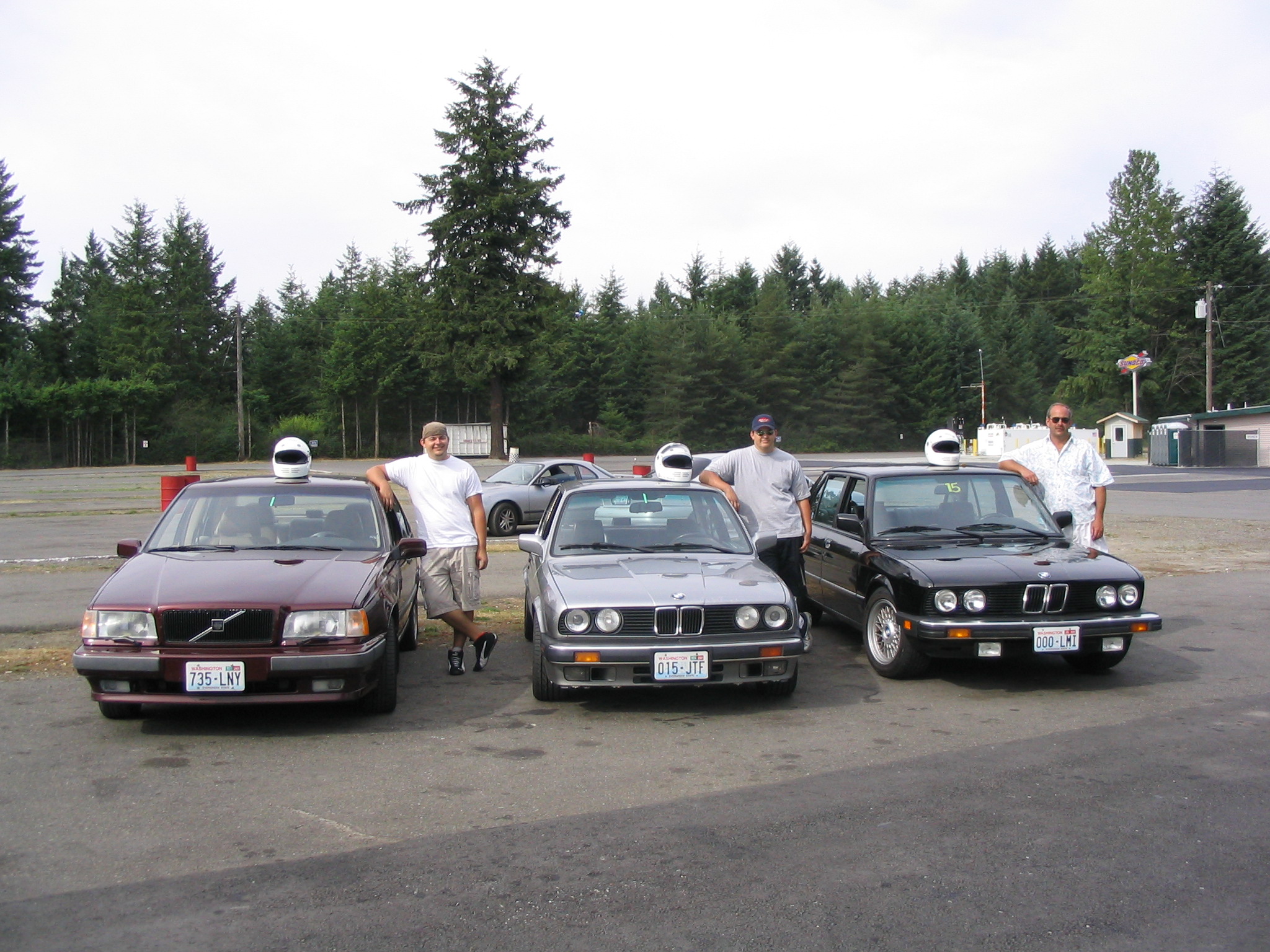
Enter Dad for the save. He had recently got into BMW’s and was getting an E30 325is ready for track duty. He also had gone through and rebuilt an e28 533i BMW to daily drive as well. Being that he had two capable track worthy cars and is a 100% bad ass dude, he offered to let me drive the E30 for my first event. This may have been a bad thing because I have a couple E30 track cars, now. We unload my gear from my car to the E30 and dads gear from the E30 to the E28 and we were on the road. Excitement Level: Back to pumped!
The day of the event
It was the most enlightening thing I have ever done in a car. In the morning we did driver skills training with a panic braking stage, an eyes up flag drill and an emergency lane change drill. In these drills the basics of driver safety are tough, things like steering wheel hand position, seating position and were to look out the windshield. I felt like I was a sporting driver before but I had know idea I was just passing over the simple things to make me a better driver. The main thing that set in was eyes up and forward looking. Look to see whats ahead, what a novel thing. I still practice looking ahead every time I get in a car. Feeling pretty mind blown at this time.
The afternoon was spent lapping at Pacific Raceways. Now we are getting into some speed. Using the ideas we learned in the morning to improve our actions during spirited driving. I had a great instructor. She was calm and was very clear on instruction. As the afternoon progressed my vein tap was deeper and deeper. As I started getting more comfortable in the car the speeds came up and the fun factor as well. I would say I was getting to maybe 70% of the car capabilities but at the time was more than enough to fill my speed fix at time. Later this would change, but being the first time I had done anything at speed on a track I was cool.
All happy after a good day.
Literally the most valuable driving thing I’ve ever done
To this day I think this is the most valuable thing I have done to help my safety as a regular day to day driver. The lessons of eyes up and looking forward has become how I drive, not just something to do when I drive. Following this has saved myself and property from many (read lots of times) events on the road. Being able to see whats coming and react/ anticipate to whats about to happen, you end up being out of a situation before it even happens. You can then watch it and go “man, Glad I wasn’t in that” rather than “damn, I wish I would have seen that.” In my opinion this course should be done by anyone with a drivers license. The roads would be a much safer place. This was my gateway into the track world.
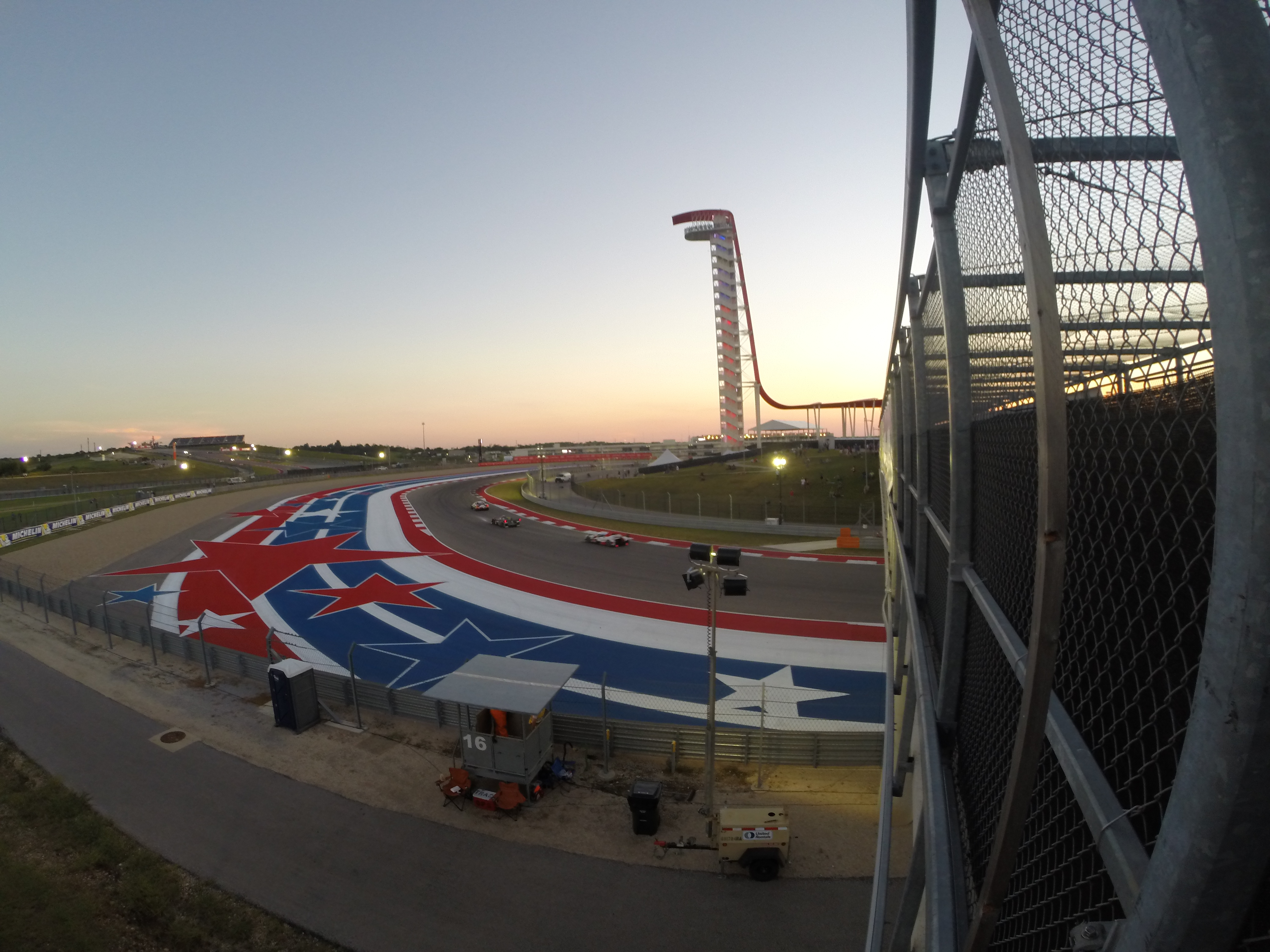
Looking out the pit-lane exit at Circut of the Americas
What: Track walks, why you like them, even if you don’t know it yet
If I knew then, What I know now: I would have studied harder on these when I was younger. I would be a better driver and team member overall, now as a result.
Walking the track before an event is a very important part of your race or track weekend. It spreads across all forms of motorsports, and any amount of wheels used. Getting your feet on the same ground you will be driving your car on will give you valuable perspective regarding placement or the vehicle, surface conditions, line options and so on. It is a great way to get the track layout in your head prior to getting into or on your machine. There are a couple of key things to pay attention to and try to do while on a track walk. I will try to outline some of them to help you get the most out of your next track walk. I will start with some of my experience from the first events I went to as a young lad in high school with my buddies.
A group of friends of mine in school were also into cars. We would set up a couple of days a year where we would all meet up the day before an auto cross event, hang out at one of the guys cabins, and then take all of our cars to the event the next day. Auto cross was a good introduction into motorsports as a driver for me. The first day I went to an event was with the Porsche Club (PNW Region). I had a little old VW Jetta that had some sticky tires on it. We got to the event, stood through the drivers meeting, then everyone set out and walked around the course that had been set up. A course walk at an auto cross is essential. The track will never be the same from event to event, so getting a feel for the layout is an important first step. Auto cross does not allow for a lot of set up and testing time, so getting the most out of your runs is key. I learned how valuable it was. I was able to pip my friend on our first time out, and he was driving a 911. There were more events after that, and as I grew to understand the track walk it made perfect sense to me.
Flash forward 15 years and now we are doing track walks every week we go to the track. I went out and rode a new Motocross track a few weeks back – I did not get a chance to walk it, but I took 4-5 laps at just above a walking pace just to feel the place out – 2 laps later I was ripping around just fine. We will often times end our first night at the track with a track walk. It is a great way to wind down after a work day, and also a good way to walk some miles if you did not get a chance to before! My first race back after a couple of years of just crew work, I ended up racing at the Ridge in Shelton. It is a place I had driven before, but it had been a while. We took the time the night before the race to walk the track, twice actually. It was great. I had one of the instructors at the track walking with us and they provided great insight to where to place the car due to seems in the blacktop in braking zones. Entry and exit lines were discussed. Gear selection (which can depend a lot on your equipment) was discussed. I felt a lot better after walking the track to just jump in the next day and go. Everything was fresh in my mind again.
Elevated view of the turn 17-18 complex at Circut of the Americas
Gama asked me to do a track walk with him this weekend at Pacific Raceways in Kent. We have a race this weekend in the Pro3 car and he will be the only driver for the team this weekend as Manu’s car had a mechanical issue we found during a post-race inspection (more on that later). I was quick to agree, as I have had many track days there, and 2 school days at that track, but had never actually walked a full lap in all of my years. I had been to points of the track, but not all of the way around on foot. We will be walking the track tonight and I am going to make notes, and take pictures to share our experience with the walk!
We try to track walk every weekend. it is good exercise, knowledge, and you will have a great feel for the layout the first time you are behind the wheel at speed. Be prepared for a walk, and be prepared for weather as well! Some tracks are large, and weather can be different from one side to the other. One of the other things that will help you a lot with our track walk, is walking with someone with lots of knowledge of that track for insight. Most racers are instructors also, so their points of view are sound usually! Just walking the track can gain you a lot, but having someone there to compare notes and tips with is very beneficial. Having someone that drives a similar vehicle is even better!







 or
or