Posted on

Portland Hoosier Super Tour Recap: Setup Windows, Mental Unlocks, and a T3 Weekend Sweep

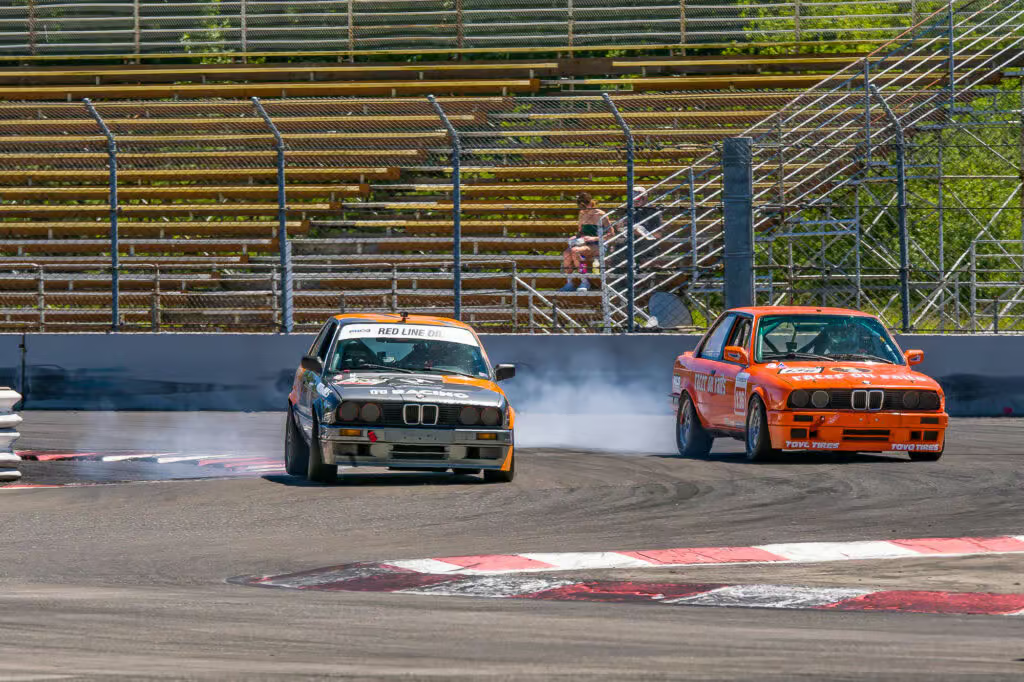
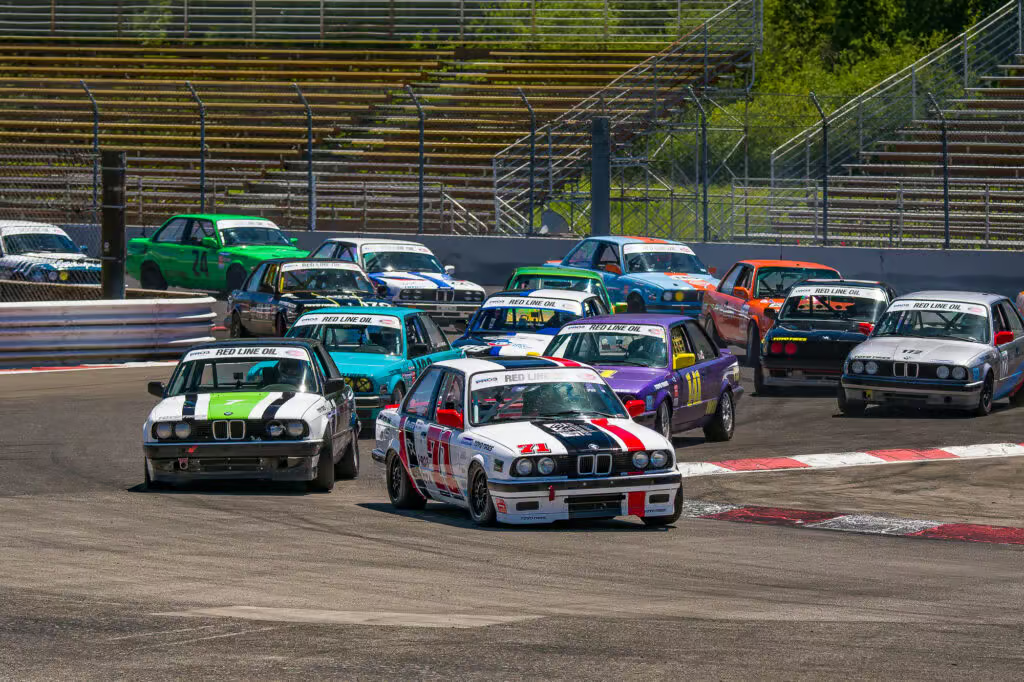
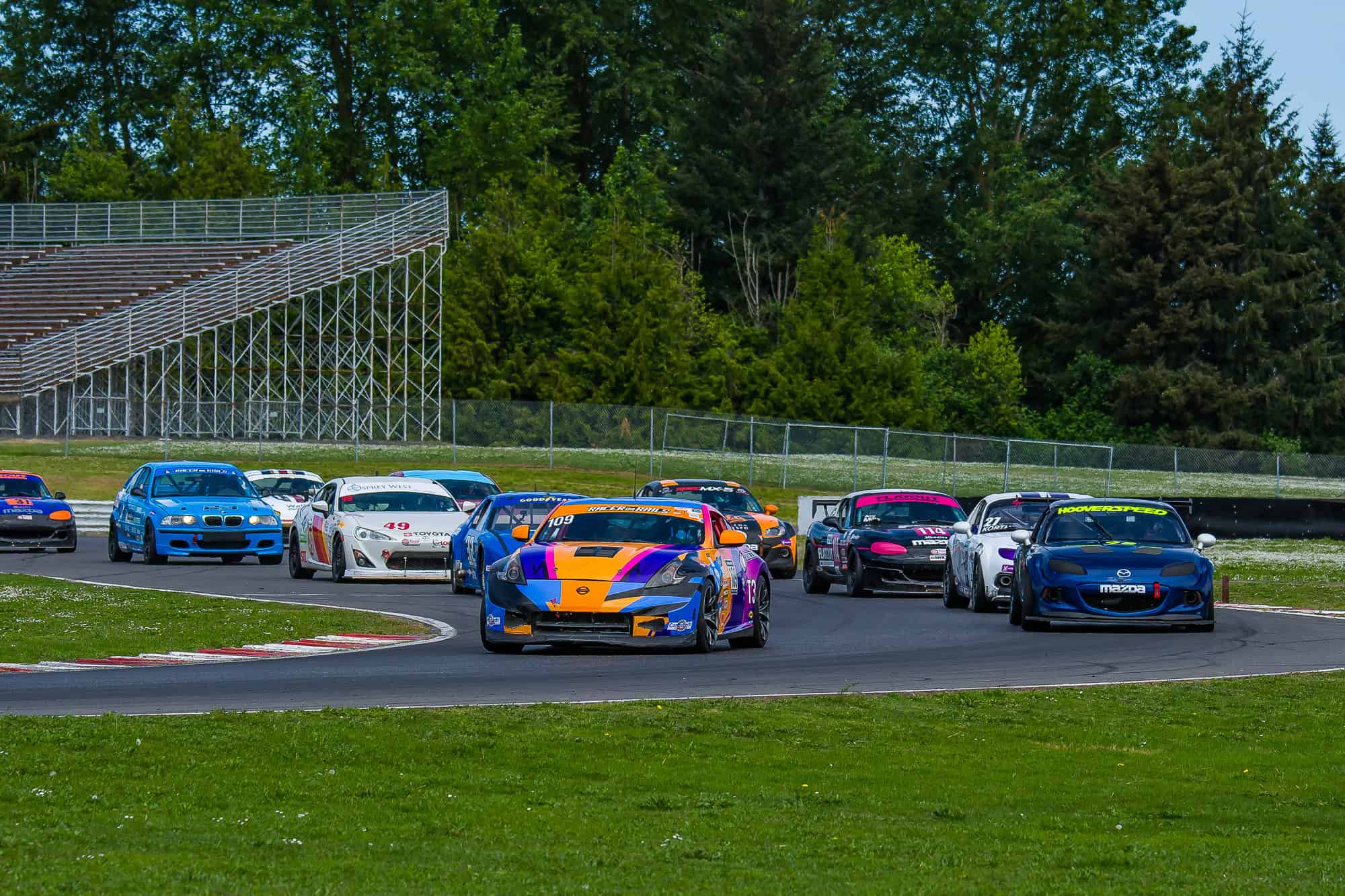
Racer on Rails Nissan 370Z leading a mixed Touring 3 race group through Portland International Raceway during the Oregon SCCA Hoosier Super Tour.
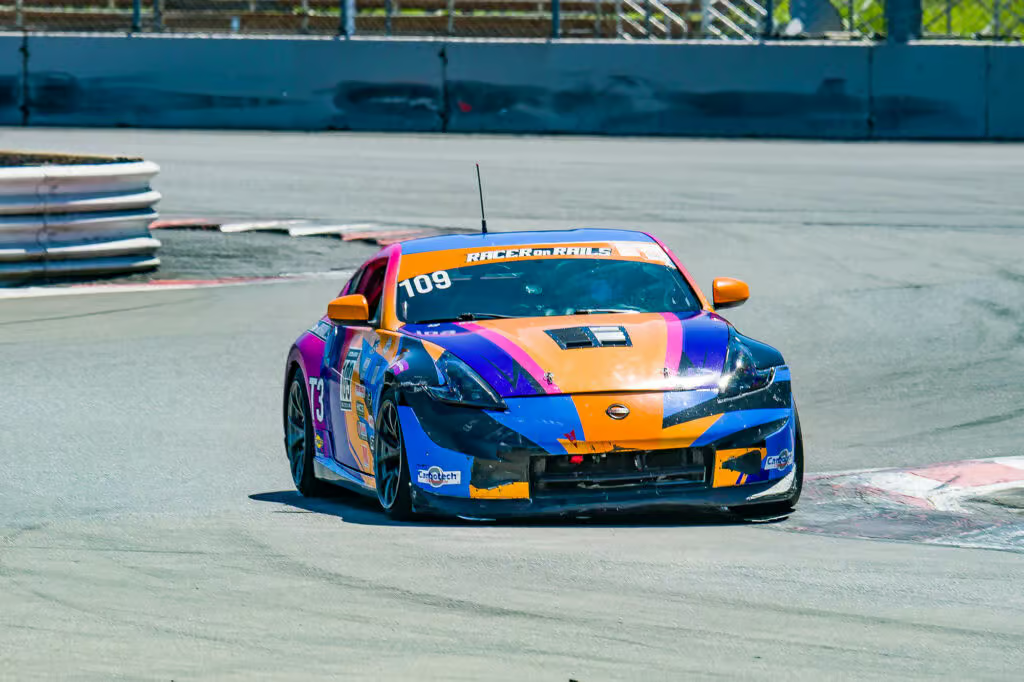
Gama Aguilar-Gamez leads the Touring 3 field in the Racer on Rails Nissan 370Z during the Oregon SCCA Hoosier Super Tour at Portland International Raceway.

The SCCA Hoosier Super Tour is one of the biggest stages in amateur road racing. It is where regional racers, national contenders, Runoffs hopefuls, longtime club racers, and professionally prepared teams all end up in the same paddock, chasing the same thing: speed that holds up when the stopwatch and the field both get serious.

For Racer on Rails, weekends like this matter because they are more than another race on the calendar. They are measuring sticks. They show where the cars are, where the drivers are, where the team is operating well, and where the next layer of performance is hiding.

This round brought us back to Portland International Raceway for the Oregon SCCA Hoosier Super Tour. PIR is a uniquely Northwest kind of racetrack. It sits inside a major city, close to the Columbia River, built on land with real history, surrounded by trees, planes, cyclists, and the strange calm of a public park that also happens to host serious race cars. It is one of those places that feels easy until you try to be fast there.

On paper, Portland looks simple. It is flat, relatively short, and does not have the obvious “monster corner” personality of a place like Road America, Thunderhill, or Sonoma. But that is exactly the trap. PIR asks for precision everywhere. The lap is full of medium-speed commitment, heavy braking moments, curb usage, track-out discipline, and small setup decisions that either build confidence or quietly steal time every lap. If the car is not underneath you, the track exposes it. If the driver is not fully committed, the stopwatch tattles immediately.

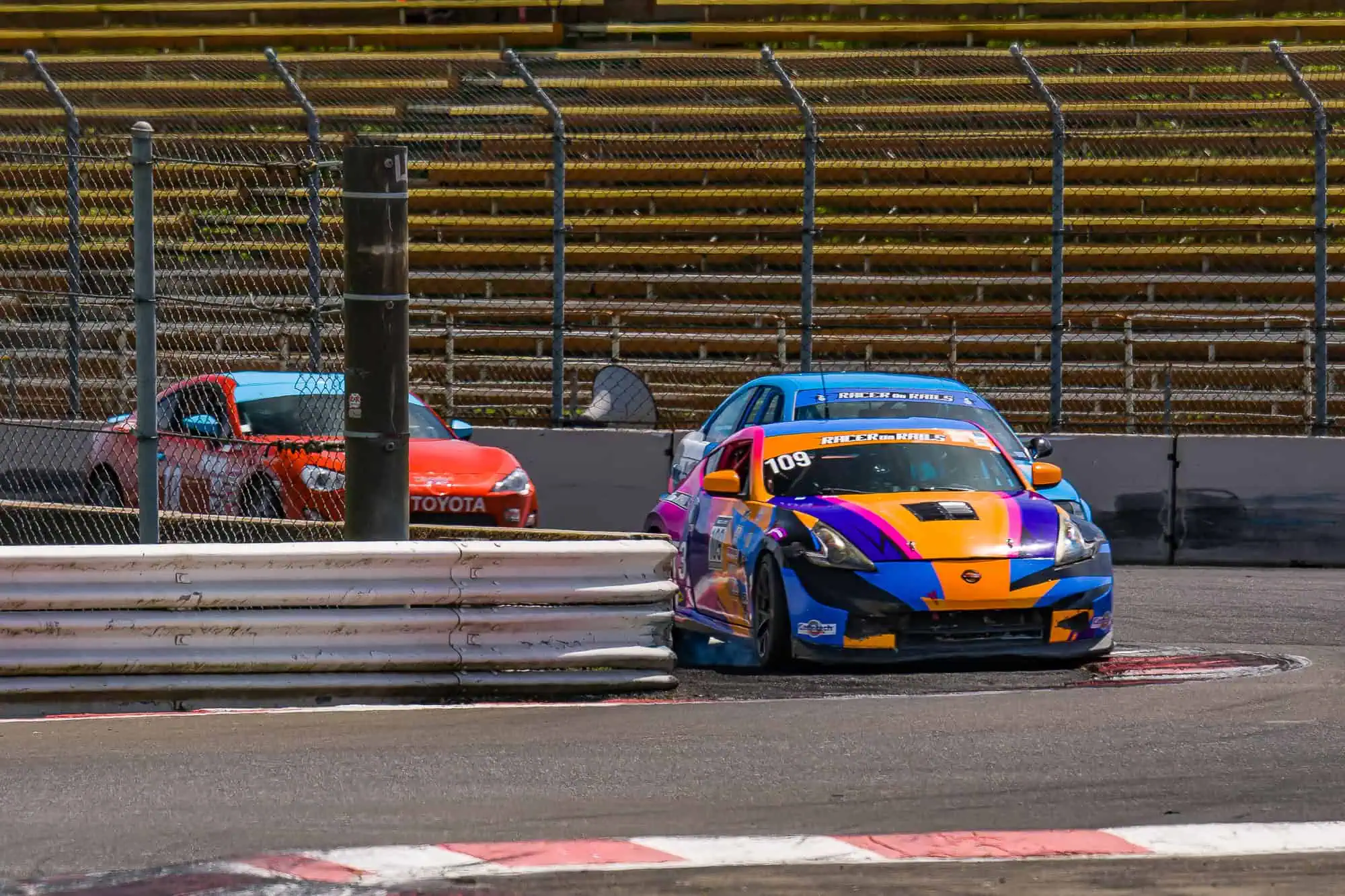
Racer on Rails Nissan 370Z Touring 3 race car driving over the curbing at Portland International Raceway with race traffic behind.  | (C) 2025 Doug Berger | DBPics
The Portland chicane rewards commitment, curb confidence, and a car that stays predictable under braking and turn-in. (C) 2025 Doug Berger | DBPics

Our weekend lineup had a little bit of everything.

Chris Johnson was back in his Spec E46 in Touring 3 for the first time since last July. Gama Aguilar was in the Nissan 370Z, also in Touring 3, continuing the development push from Thunderhill. Beef Wellington brought out his Touring 2 BMW M240iR. And while Ron Tanemura was not technically in one of our cars, he was still part of the broader Racer on Rails driver development program, racing a Spec Racer Ford Gen3 with Flat Out Racing and continuing to work with Tyler through our coaching services.

Different cars. Different goals. Same weekend. Same stopwatch.

Chris Johnson: Back in the Saddle, Then Fully Lit

Chris started the weekend exactly where you might expect after nearly a year away from the car: knocking the dust off.

The Spec E46 was on older tires, Chris was rebuilding rhythm, and the first part of the test day was about getting reconnected with the car. Braking points. Corner entries. Trust. References. The little internal checklist every driver has to rebuild after time away.

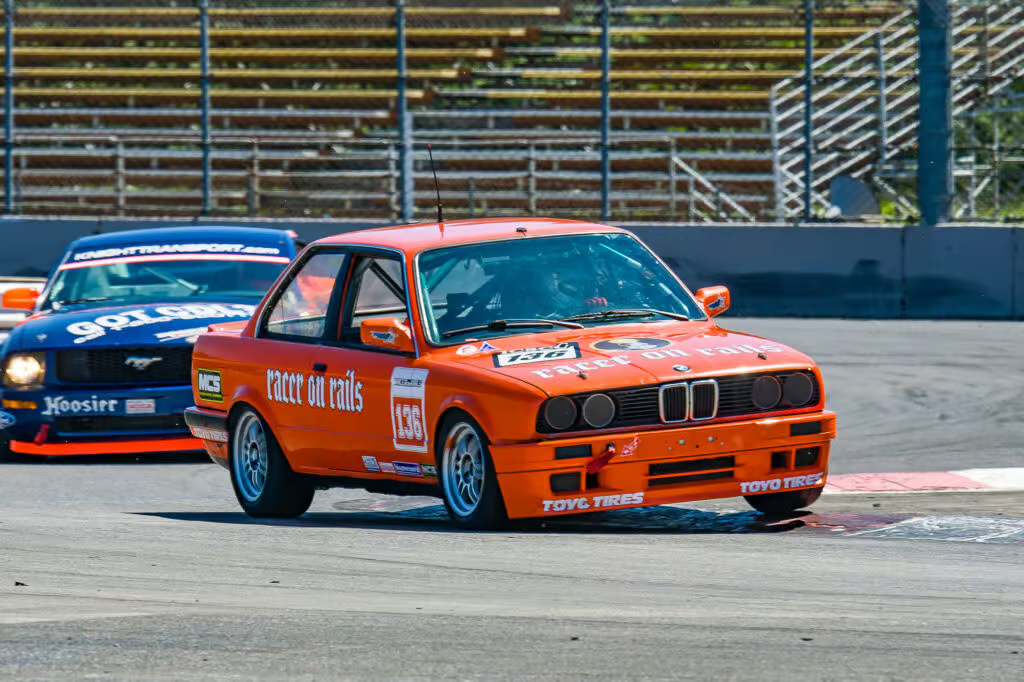
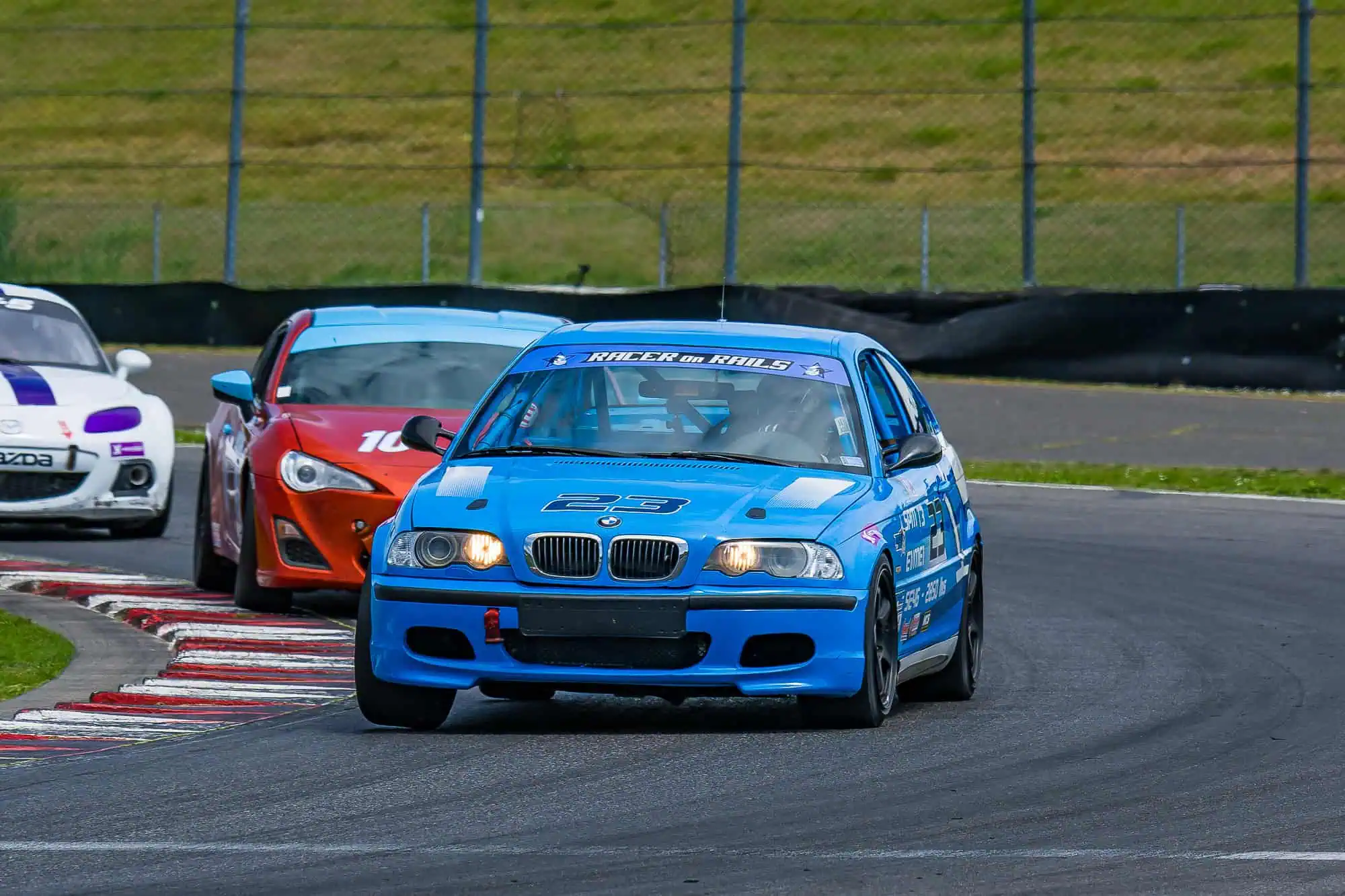
Chris Johnson driving the blue Racer on Rails BMW Spec E46 Touring 3 race car through Portland International Raceway with race traffic close behind.
Chris Johnson returned to the seat of his Spec E46 in Touring 3 and spent the weekend rebuilding rhythm, confidence, and pace. (C) 2025 Doug Berger | DBPics

By the end of the first test day, though, the fog was clearing. Even as the track got hotter and conditions worsened, Chris started closing back in on his personal best lap times. That was the first sign that the speed had not gone anywhere. It was still there, sitting under the surface, waiting for him to believe it was available again.

The next day, we had one of those conversations that matters more than a shock adjustment or tire pressure change.

Chris was talking through what he was feeling in the car, but underneath the words were a few limiting thoughts. Not excuses. Not weakness. Just the normal stuff drivers tell themselves when confidence is still a lap or two behind capability.

The conversation was about the things we tell ourselves. What we accept as true. What we assume is possible. What we decide is “about where we are” before the car and the data have actually said that.

Something clicked.

In Saturday’s race, Chris came alive. He got pulled into a tight battle with a few out-of-class cars that were absolutely flying, and that extra competitive energy did exactly what a good race battle should do. It sharpened him. It pulled his eyes forward. It made him stop driving the idea of the lap and start racing the car in front of him.

The result was a major unlock. Chris knocked roughly a second from his previous bests and started driving with the kind of intent we knew was still there.

Sunday morning, he was determined to prove Saturday was not a one-off. He wanted to build on the confidence instead of simply enjoy the memory of it.

He did.

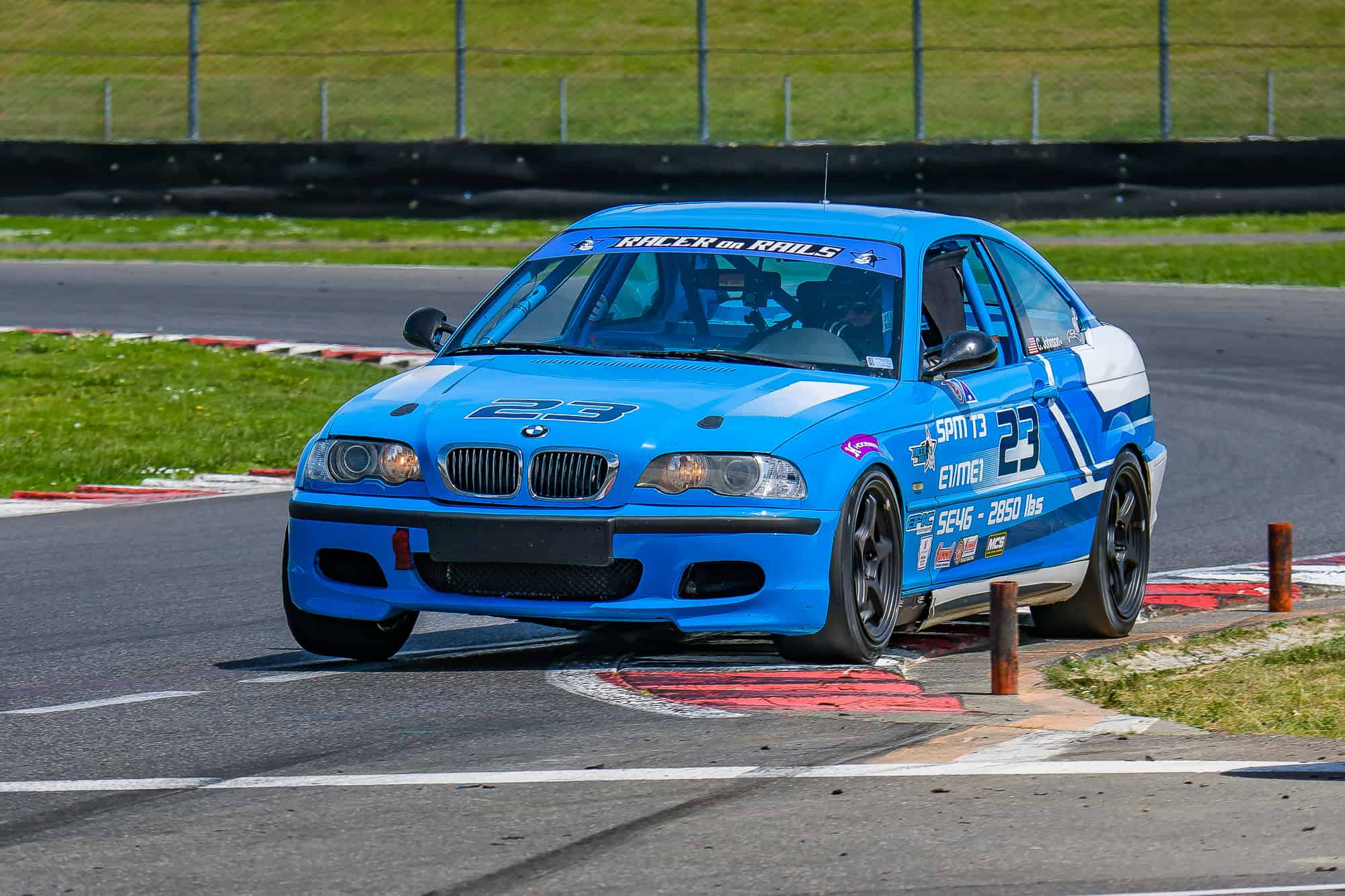
Blue Racer on Rails BMW Spec E46 Touring 3 race car using the curbing at Portland International Raceway during the Oregon SCCA Hoosier Super Tour.
By Sunday, Chris was driving with more commitment and using the confidence from Saturday’s race to unlock another step forward. (C) 2025 Doug Berger | DBPics

In Race 2, Chris carried the lessons forward. He cleared the cars he had been battling with on Saturday and found himself racing farther up the field, with new competition and a new target. That is always one of the best signs in driver development: yesterday’s mountain becomes today’s baseline.

The wild part? He did all of this while nursing an engine that had given us a scare on Friday. Chris had an over-rev, followed by white smoke out the tailpipe. Jordan kept a close eye on the car for the rest of the weekend, and thankfully it made it through without getting worse.

So yes, Chris had a big weekend on the stopwatch. But the bigger unlock was mental. This was a driver remembering that confidence is not something you wait around to receive. Sometimes you have to go take a bite out of the lap and let the confidence catch up.

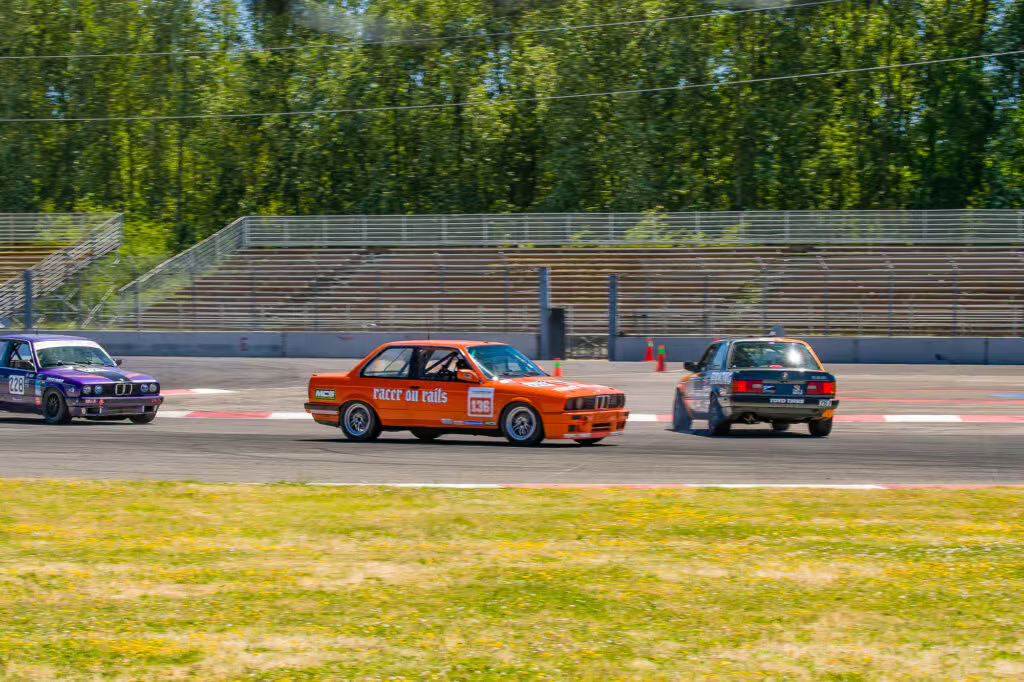
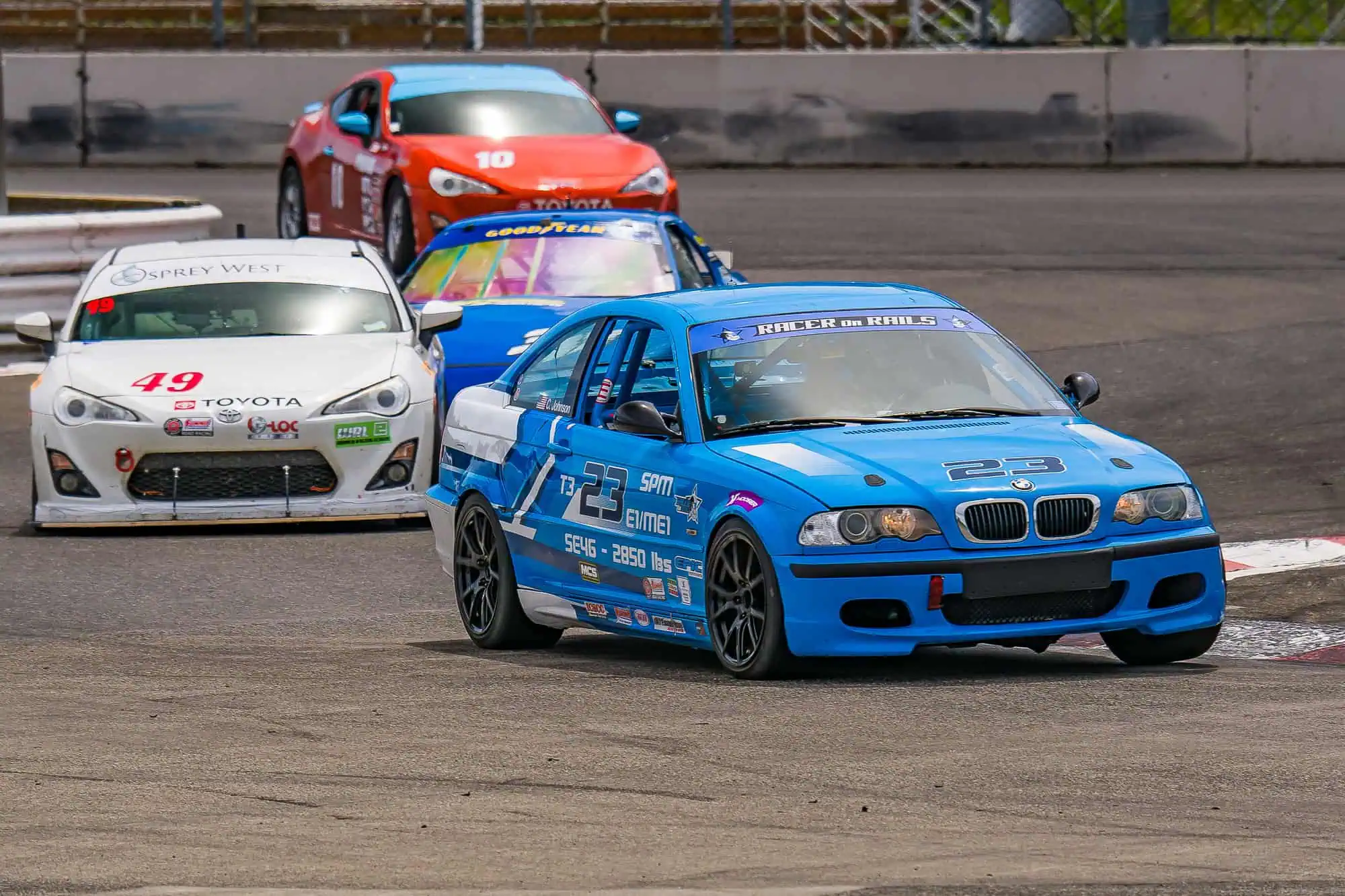
Chris Johnson driving the blue Racer on Rails BMW Spec E46 Touring 3 race car ahead of race traffic at Portland International Raceway.
Chris found himself racing harder, cleaner, and farther up the field as the weekend progressed. (C) 2025 Doug Berger | DBPics

Beef Wellington: A Short Weekend, But the Right Call

Beef’s weekend ended earlier than anyone wanted.

The BMW M240iR had a solid shakedown at Pacific Raceways the week before, so we came into Portland expecting to continue learning the car and building momentum. Instead, the car started overheating after only four or five flying laps.

At first, it looked like the usual race-car mystery novel: temperatures okay, then suddenly not okay. The car would run fine, then start building too much coolant pressure and blow through the expansion tank valve.

The team worked through the problem methodically. Cooling system. Pressure behavior. Failure pattern. Repeatability. The ugly little clues all started pointing in the same direction.

Head gasket.

Mega bummer.

That is never the way we want a weekend to end, especially with a new-to-him but still used/junkyard engine. But there is a version of this story that is much worse. We caught it before destroying the whole engine, avoided turning a repair into a full-scale catastrophe, and got the car pointed toward the work needed before June Sprints at Road America later in the month.

Sometimes race weekends are about trophies. Sometimes they are about knowing when to stop digging.

This was the right call. Not fun. Not glamorous. But right.

Ron Tanemura: Expanding the Driving Toolbox

Ron’s Portland weekend had a different purpose.

He was in a Spec Racer Ford Gen3 rental with Flat Out Racing, while continuing to work with Tyler as part of the Racer on Rails coaching program. The goal was not simply to jump in a new car and chase a number. The goal was to expand his driving range.

That matters.

Ron has been intentionally building a broader driving education. Different platforms. Different sensations. Different demands. The SRF3 is a very different animal from a BMW sedan. It is lighter, more direct, more exposed, and less forgiving of half-commitment. It wants clearer inputs. It rewards decisiveness. It asks the driver to be comfortable with the car moving underneath them.

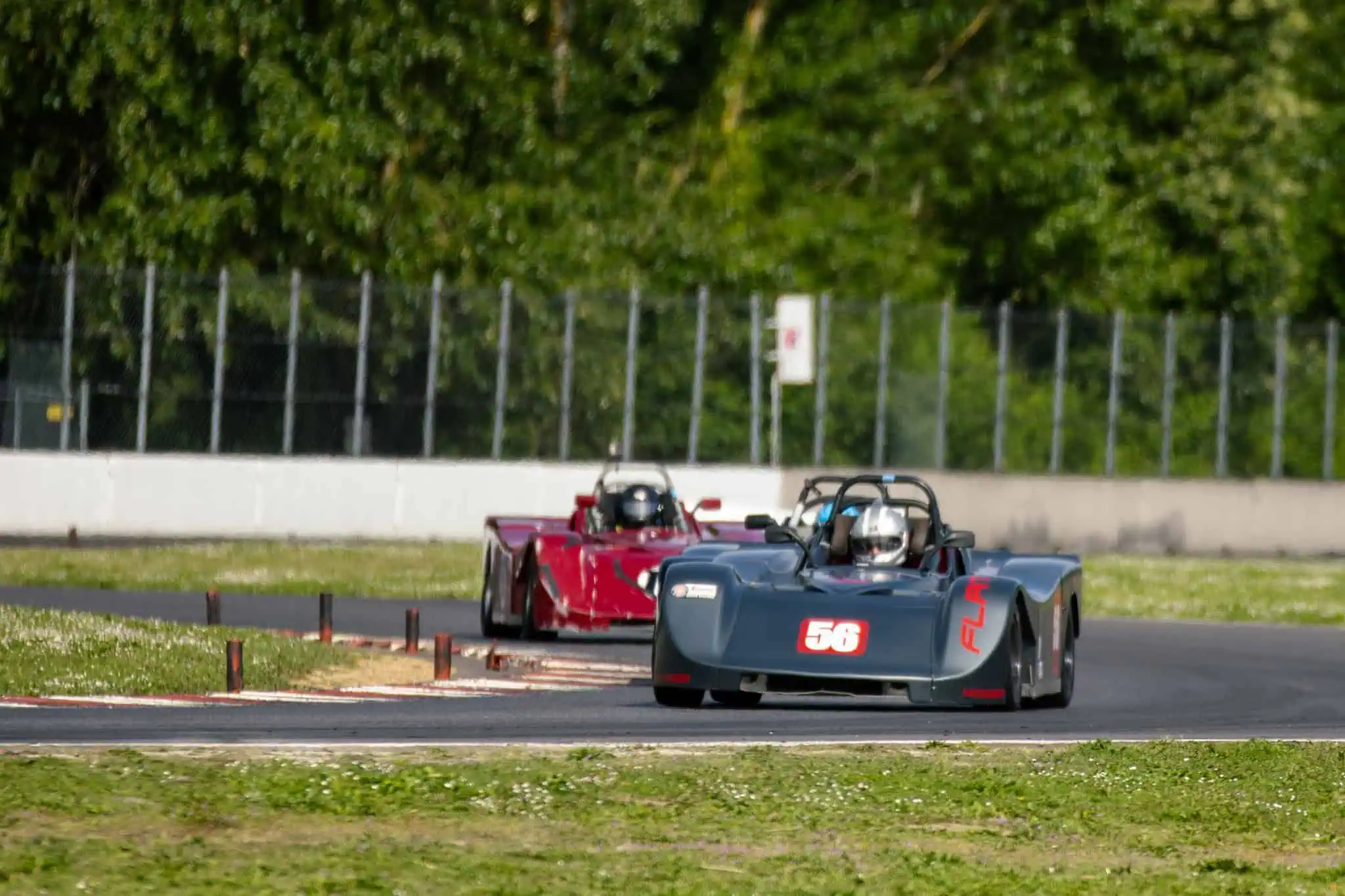
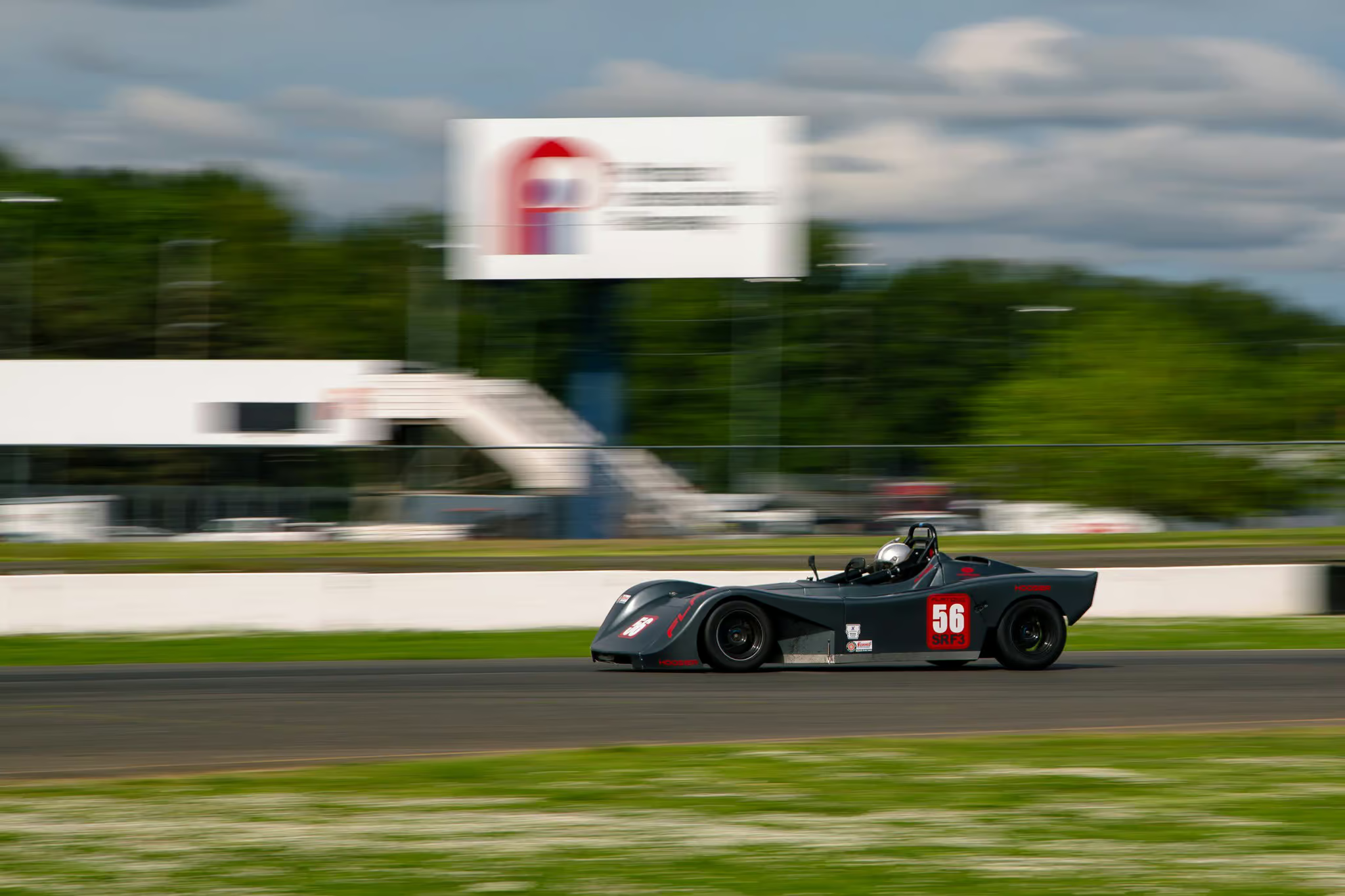
Ron Tanemura driving a black Spec Racer Ford Gen3 through Portland International Raceway during an SCCA race weekend.
Ron Tanemura used the Spec Racer Ford Gen3 weekend to expand his driving range and build a new real-car baseline. (C) 2025 Doug Berger | DBPics

For Ron, the weekend established something important: racing the SRF3 is viable for him. He handled the starts well, showed good awareness, avoided major self-inflicted issues, and built a baseline he can come back to.

The next layer is not secret. It is also not simple.

It is about closing the gap between understanding and execution. Ron has done real work in the sim. He knows a lot of the “recipe” for the car and track. But the real car adds sensation, consequence, tire feel, traffic, imperfect references, and the pressure of being around other drivers. That gap between knowing and doing is where driver development actually lives.

The coaching takeaway was clear: more commitment, more decisive brake release, clearer throttle discipline, more willingness to let the car rotate, and more assertive racecraft once the race settles in.

That is exactly why this was a valuable weekend. Ron did not just collect laps. He collected a sharper understanding of what the next phase of work needs to be.

Black Spec Racer Ford Gen3 race car speeding past the Portland International Raceway front straight during an SCCA race weekend.
A new car, a new rhythm, and another layer in Ron’s broader driver development plan. (C) 2025 Doug Berger | DBPics

And that is the whole point of a driver development plan. Not every weekend is supposed to be a finished product. Some weekends are supposed to reveal the next door.

Gama Aguilar: Engineering the Window

For Gama and the Nissan 370Z, Portland was about building on the lessons from Thunderhill.

At Thunderhill, we had speed, but we were still fighting the car. The Z had pace in flashes, but it was not yet living in a consistent, repeatable window. Under braking and turn-in, the car still had moments where it felt like it was asking for trust without giving enough trust back.

Before Portland, Ian spent a full week digging into the chassis, working through an engineering workbook, checking assumptions, and giving the car the kind of measured attention that separates guessing from development. We are not going to give away every detail of what we found, but the big picture was clear: there was systemic pace hiding in the car.

That was the unlock.

This was not about finding one magic adjustment or chasing a one-lap setup. It was about understanding the car at a deeper level, getting it into a healthier operating window, and creating a foundation we could actually build on across a full weekend.

From there, we reset the approach. The chassis setup moved in a better direction. The car became more predictable. We switched to nitrogen in the tires, including multiple purge cycles to reduce the influence of air and moisture. Then we started fresh on understanding pressure build, temperature behavior, and how to keep the tire in a usable window from the first hard lap to the last.

That became the real work of the weekend.

Not “what makes one fast lap?” but “what makes the car fast, repeatable, and trustworthy every time we lean on it?”

By Friday, the difference was obvious. For the first time ever in the 370Z, we could push the car hard every session and have it respond the same way. The car was no longer giving us a narrow little keyhole of performance. It gave us a window. And once we had a window, we could finally start doing real race-car work.

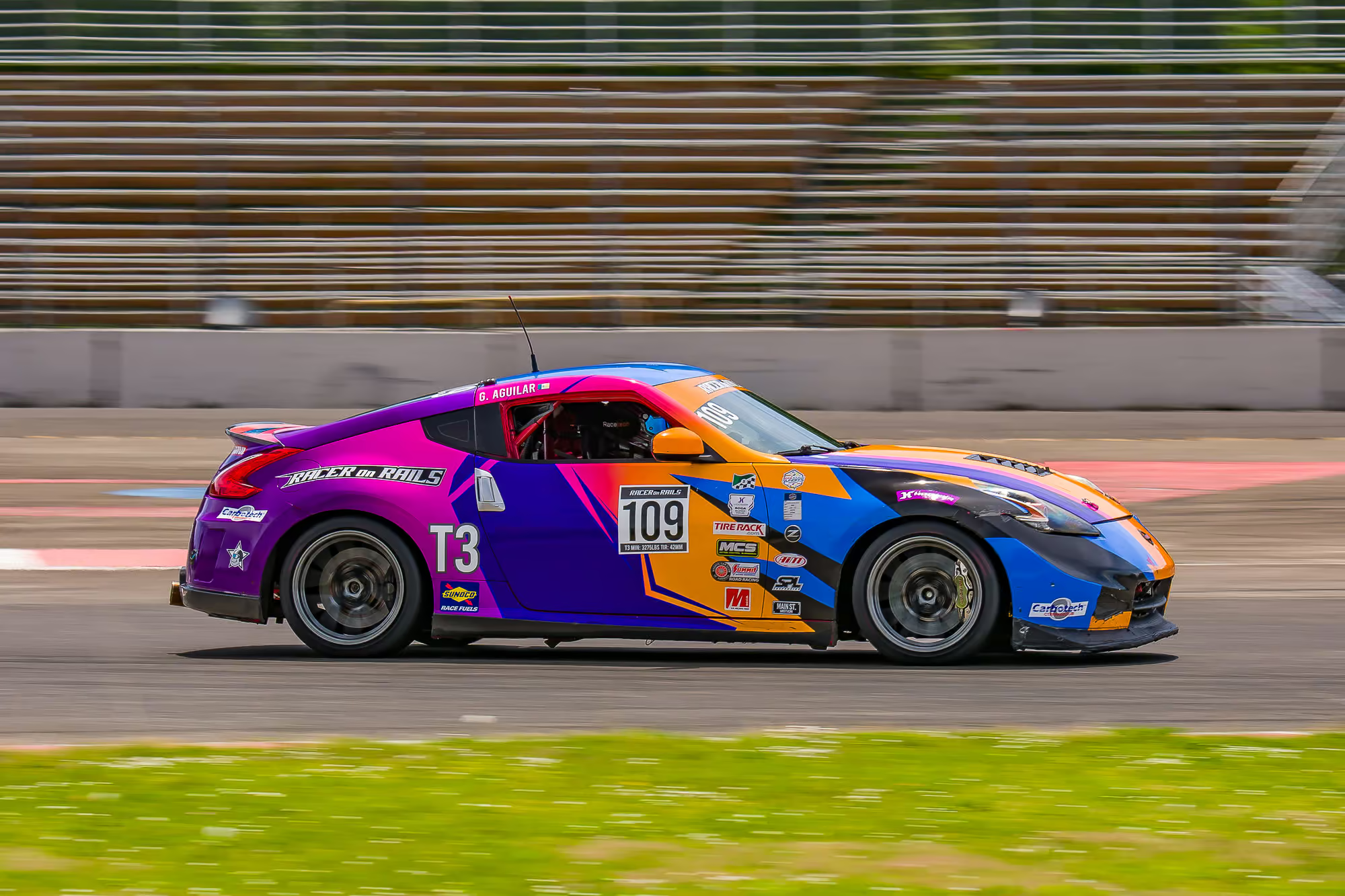
Side profile of the Racer on Rails Nissan 370Z Touring 3 race car at speed on the front straight at Portland International Raceway.
After ride height, suspension geometry, nitrogen, and tire pressure work, the 370Z finally delivered a repeatable setup window. (C) 2025 Doug Berger | DBPics

That is a big deal.

The official Race 1 time cards showed the progress starting to show up on paper, with the #109 370Z quickly moving from a 1:26.946 opening lap into a 1:24.759, then a 1:24.526, then a 1:24.701. More important than the single lap was the shape of the run. The car stayed in the window. The laps stayed usable. The team finally had a platform we could tune instead of survive.

By the race weekend, we were fine-tuning instead of firefighting.

The result was an easy Touring 3 pole, a Saturday T3 win, and then another T3 win on Sunday to complete the weekend sweep.

Saturday was not without drama. At the start, there was unnecessary contact with the STU pole sitter that could have ended the race before it properly got going. Thankfully, the Apex forged wheel took an absurd hit and somehow held on. The car survived, the tire held, and we were able to finish.

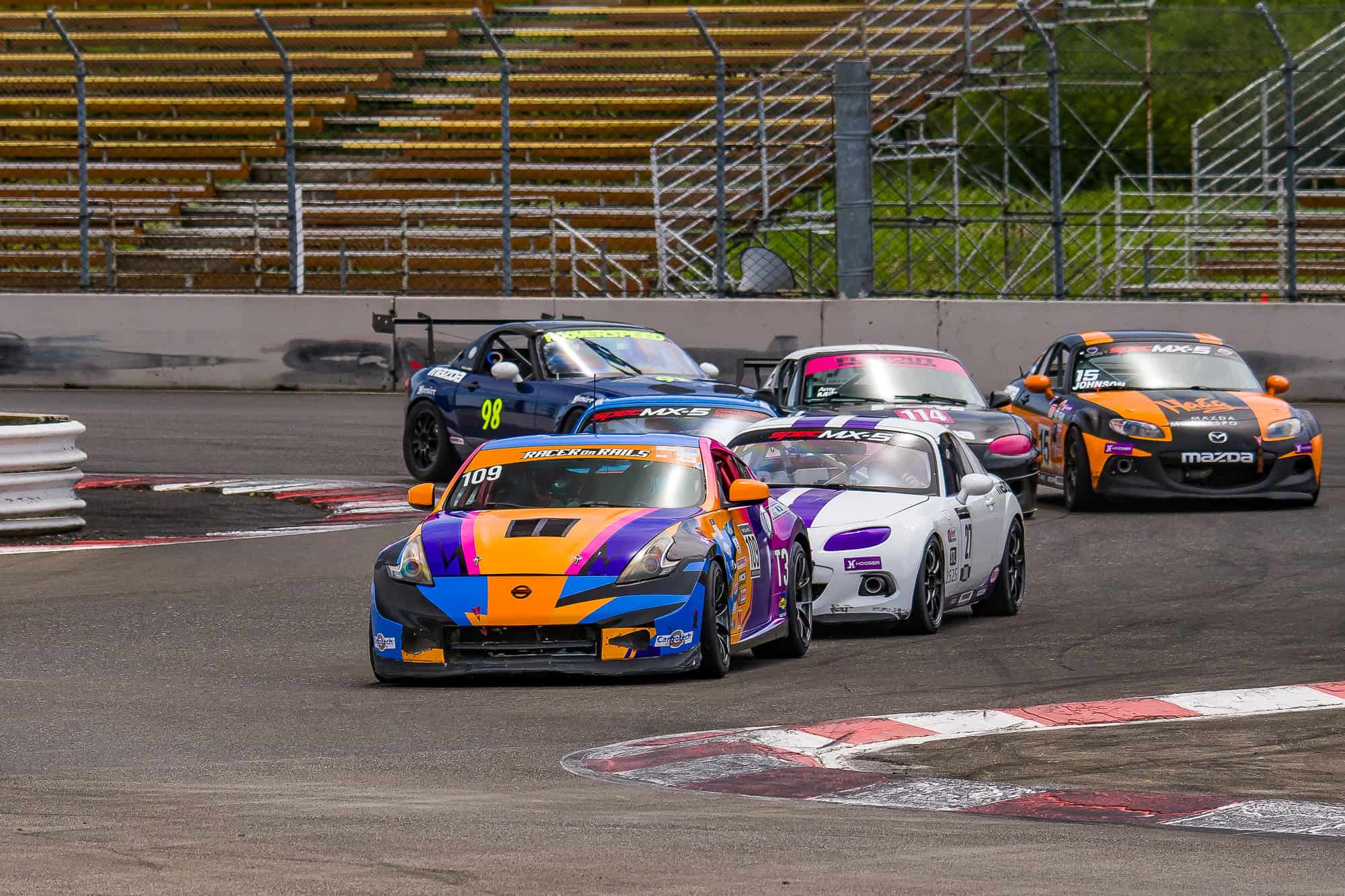
Racer on Rails Nissan 370Z leading a tight pack of race cars through the Portland International Raceway chicane during the SCCA Hoosier Super Tour.
Saturday’s race had contact, traffic, and plenty of chicane chaos, but the 370Z stayed together and brought home the Touring 3 win. (C) 2025 Doug Berger | DBPics

On Sunday, we replaced the damaged wheel and tire, put our heads down, and went for a maximum race-pace push.

That was the most encouraging part of the weekend. Not just winning. Not just getting through the races. But seeing that the car had pace in conditions that were not perfect. The overcast morning cloud cover had burned off by the time our Sunday race started, the track was warmer, and the car still had the ability to push toward the kind of pace we have seen from some of the strongest Touring 3 drivers at this event in prior years.

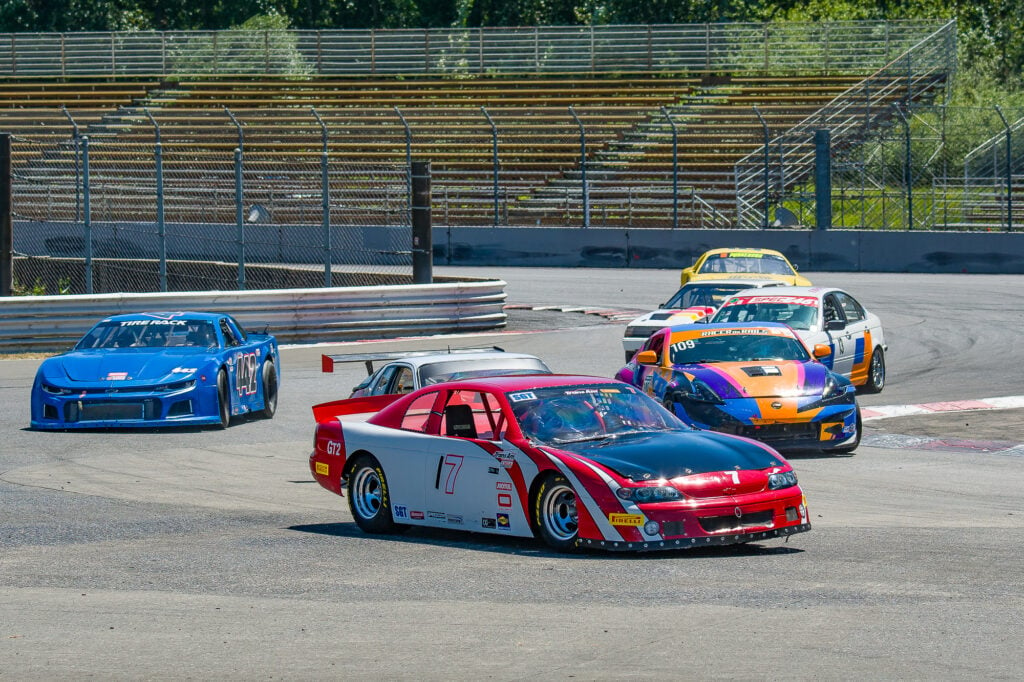
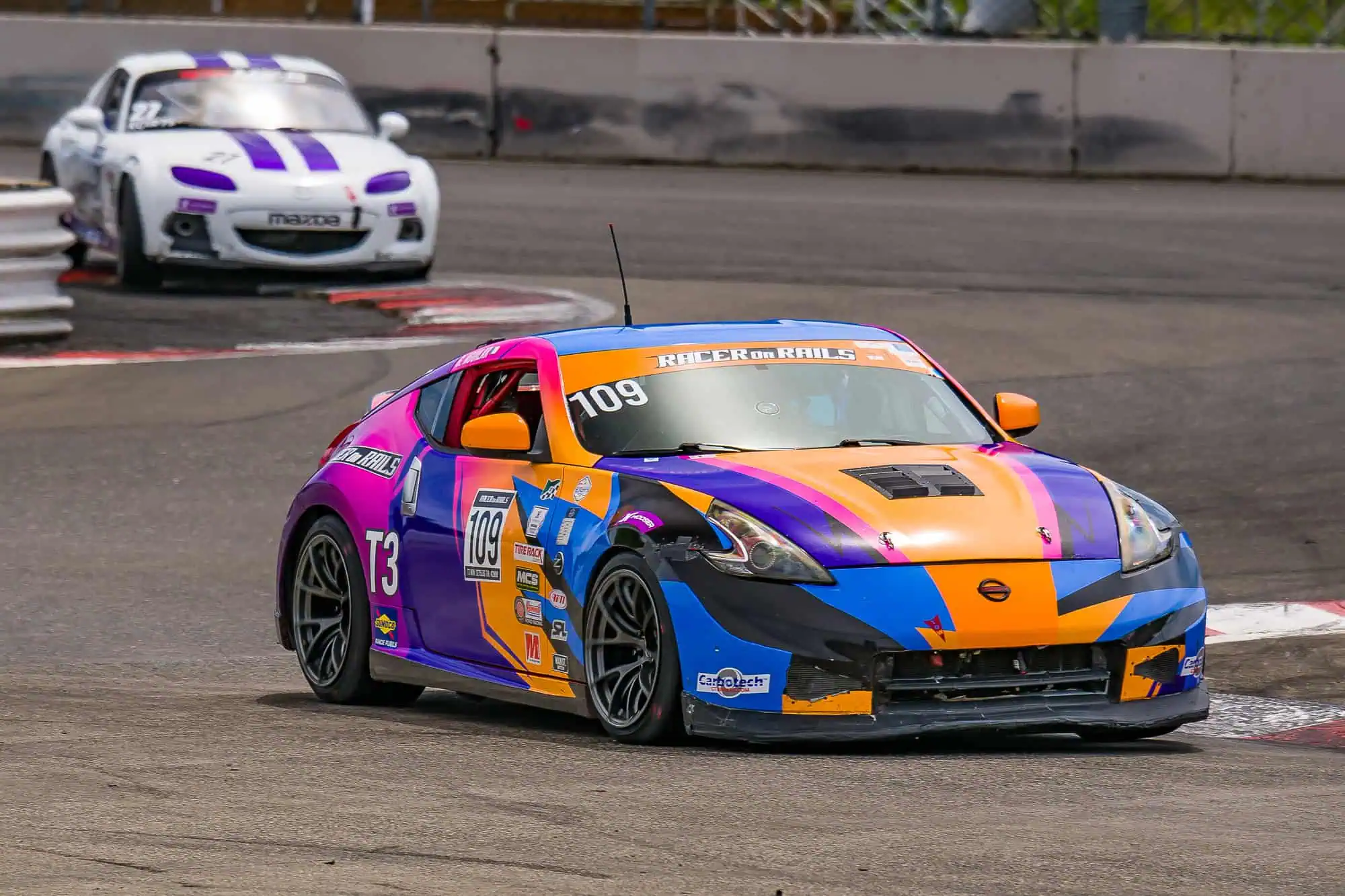
Gama Aguilar-Gamez driving the Racer on Rails Nissan 370Z Touring 3 race car through Portland International Raceway with a Spec MX-5 behind.
The weekend’s biggest win was not just the result. It was finally having a 370Z that could be leaned on lap after lap. (C) 2025 Doug Berger | DBPics

That is the good stuff.

The kind of weekend where the notebook matters as much as the trophy.

The Team Behind the Weekend

Like most race weekends, Portland had its share of curveballs.

Jordan’s personal car broke down on the way to Portland. Beef’s M240iR tried to turn Friday into a cooling system crime scene. Chris’s Spec E46 had to be monitored all weekend after an over-rev and smoke. The Z needed continued tuning and then a wheel/tire change after race contact.

None of that is unusual in racing. That is the job.

What mattered was how the team responded.

Ian’s engineering work before the event gave the Z a new foundation. Jordan kept Chris’s car alive and monitored. Tyler continued guiding drivers through both technical and mental development. The crew absorbed the chaos, kept working the problems, and moved the weekend forward.

That is what we want Racer on Rails to be.

Not just a shop that brings cars to the track. A team that develops cars, develops drivers, solves problems, and helps people leave the weekend with better tools than they arrived with.

Portland gave us a lot.

A Touring 3 weekend sweep for the 370Z. A major mental unlock for Chris. A hard but smart diagnostic call on Beef’s BMW. A valuable SRF3 baseline for Ron. A stronger engineering process for the team. And a reminder that race weekends are rarely clean, but they can still be deeply productive.

We left Portland feeling like the whole program moved forward.

Goals. Smiles. Memories. LFG.

Posted on

Track Walk: Portland International Raceways

In a couple weekends, we’re headed back to Portland International Raceways and the first time I’ll get to drive the track for more than one session (in real life) this year and since I was on the Speed Secrets Podcast, earlier in the spring.  I got some live coaching from Ross Bentley and have been excited to implement the tips I heard.  Check out the podcast episode here and subscribe – it’s an awesome podcast with a wide variety of guests and every time, I learn a ton.

So let’s take a lap around the track and go through each sector as defined by the sectors on Track Attack.  Below we’ll be using illustrations from real data from a pair of front-running “spec” racing class cars: my PRO3 and Will Schrader’s Spec Miata.  Both are considered low-power momentum cars but there is enough power and weight difference you’ll see different things happening.

If you are a Spec Miata or PRO3 driver in the Pacific Northwest (or have similar cars), you can request to join the respective teams on Track Attack and get access to the session data that we’re using in these examples. (Link to PRO3 data share team and Northwest Spec Miata Tour)

We’ve broken up PIR w/chicane into 4 sectors.  Each sector is a combination of corners and are split halfway through a ‘straight away’.

Elevation change: None

PIR is like the Lime Rock Park of the west coast.  In the chicane configuration, there are 7 right hand turns, compared to 2.5 left hand turns.  But unlike Lime Rock, the elevation change is near zero.  Check out this video where the data overlay shows the elevation change – there is just under 10 feet of total elevation change.

YouTube player

No real elevation change but there are still some tricks on banking that the track holds.

Segment 1: The festival chicane

The first segment starts at the start/finish line, of which the speed that is carried before the first braking zone is determined heavily by the exit out of T12 on the previous lap and if you might have caught a draft down the front straight.

Braking for T1 will depend on the car and whether its a qualifying lap or a race lap.  In a PRO3 car and a qualifying lap, you can hit the brakes hard right after passing the 400 board and what ends up being right before the 300 marker.  Note, this is hard to replicate lap after lap.  After hitting the brakes hard, start coming off of them and you should already be looking for the apex of T1.  It’s a good practice to put the right-side tires on the FIA curbing at the apex of T1 and even dropping a tire inside of the curbing isn’t bad but puts more stress on the suspension components.

Think about this: When are you releasing the brakes as you enter the corner for T1?  Play around with that.

You’ll want to take a line where you can hit T2 with a late apex.  Why?  There’s a decent straight-away from full-throttle at the exit of T2, all the way until T4.  Focus on doing what you can to get to full-throttle as soon as you possibly can coming out of T2.  Usually when I see data of someone really moving through this segment, it is all about the minimum speed they carry through T1 and how quickly they can get to full-throttle out of T2.  Clearly, there is a trade-off here but that’s the trick – finding the right balance and compromise for you and your car.

Also, the steering input for the change in direction to turn for T2 is relatively abrupt and hard.  Remember, slow speed –> fast hands, fast speed –> slow hands.

Comparing the lines of two front-running cars: Blue is a PRO3 car and Yellow is a Spec Miata.  What differences do you see?

Segment 2: No rest – Attack!

Segment 2 includes T4 – T6 and is one of the areas that separates good from great laps.  It can be easy to coast through this segment, but when you’re looking for the maximum lap time, you need to attack!

Same two cars: Yellow (Spec Miata) and Blue (PRO3). There is a 250-400lbs weight difference depending on the Spec Miata. Why do you think each car may be taking different lines?

T4 is somewhat of a false apex – you don’t absolutely have to hit the curbing but the benefits of staying closer to the curbing is that you travel less distance and you have more room to catch the car, if and when the car is upset by the bumps.  When you brake depends on your car but generally speaking, with the chicane, you can go pretty deep into the braking zone and brake pretty lightly relative to braking for T1.

Think about: As in segment 1, when are you coming off the brakes as you enter T4?

As you dive into the T4, the rear of the car may start sliding, which is a good thing!  Use maintenance throttle to settle it down and slowly start going to full throttle or modulating accordingly.  How much throttle you can give it will depend on the speed you carried through mid-corner and how well the rear-left suspension components are absorbing the bumps.  There is a lot of load on that rear-left, all the way through the exit of T5.  Is your suspension bottoming out?

As you approach T5, you’ll have to either breathe off the throttle to get the car to rotate or give it some very slight braking.  Get turned in and hit that curbing for T5.  Then give it as much throttle as it will take and let the car release to the driver’s left as you approach T6.

T6 has different schools of thought.  One school says sacrifice the corner and run the shortest distance possible.  The other says that you should hit the corner with a wide entry and get an amazing run towards T7, where you don’t flare out as much on the exit of T6.  I’ve seen data from both approaches and it’s really a toss-up.  Find what works best for you and your car.

Just remember that the outside of T6 is off-camber and usually has a ton of marbles.  You don’t want to be caught on the outside of T6 almost ever (save for rain) it will be slow and you will get passed.

Going fast through segment 2 should feel like you are on the ragged edge, having to catch the car slightly throughout the entire complex.  This is no time to rest – attack!

Segment 3: The banana straight!

In my opinion, this is the second most important segment of the track.  T7 leads onto the longest “straight” on the lap, so getting onto full throttle, without backing out is the most important thing here.

Where you determine your braking point will heavily depend on your car but the goal should always be to be at or near full throttle right at the apex of T7.

Can you see the ever so slight differences between the PRO3 (blue) and the Spec Miata (yellow)?

Think about: Where are your eyes when you are on the brakes for T7?  Get them on the apex as soon as you possibly can.

Use one fluid motion to get the steering input for the corner and when you are pointed at the apex, commit and get to full throttle as quickly as you can.  In all of my fastest laps, I have a healthy two tires on the T7 curbing and will have a slight slide on the exit, of which a quick steering correction will get it to stop and doesn’t require a lift.  Over slide on the exit or have to lift after apex and you are dead in the water.

Segment 4: Brown trousers

In my opinion, this is the most important complex of the lap.  It is the scariest and thus, even among good drivers, there is more variance in segment times than in any other segment.

The entry into T10 is the most important and it is much less about how late you can brake and more about how well balanced the car can be, as you carry a higher amount of speed through the corners.

Think about this: Will a car that is stood up on its nose because the driver braked super late, turn better than a car that is balanced front to back because the driver braked maybe a little earlier and lighter?

Some drivers can pull off (in a PRO3 car) braking at the 200 marker and keep the car balanced and others brake at the 300 and it works just as fine.  Figure out what works for you and your car.

Make it your job to always, and I mean always put tires on the drivers-left curbing of T10.  Then make as a straight of a line as you can to brake in a straight-line for T12.  This means that you might miss the curbing on T11.  That’s ok!

Brake in a straight line for T12, focus on when you’re going to release braking for T12 and get just like T7, get your eyes to the apex of T12 as quickly as you can.  Turn in with a single, smooth movement and just nibble or have a full tire on the curbing of T12.  This is slightly less important but if you do this, you’ll know for sure that you’ll have enough track on the exit and avoid hitting the tire walls for the drag strip (of which I’ve hit) or along the main wall.

As Ross suggested during the podcast, the goal is to get to full-throttle as quickly as possible.  If you find yourself near the apex of T12 and at 50-75% full-throttle, just give it the beans!  Go all the way and know that it might slide a little on the exit but you usually don’t need to lift to stop the sliding – a quick steering wheel correction will be plenty.

After that, it’s smooth sailing to start/finish.  Release the car and have the lightest hands on the steering wheel as possible.  Any steering input while at full-throttle is friction and friction means going slower.

Other things to consider

People say that Portland doesn’t use up brakes and tires and that’s sort of true but when you’re pushing, everything makes a difference.  Using the curbs is really important but also has led to pad knock-back for several drivers, which isn’t fun.

Track temperature makes a huge difference on available grip and can swing 20-40 degrees from the morning to the late afternoon.  That could make a difference of up to a second on lap times or more.

Catching a draft can also make a huge difference, upwards of .5 seconds on a lap.  So if you can get a tow early on the main or back straight aways, do it!

Track records are made on <100F surface temps, <80F air temperature, fresh tires, qualifying weight, a draft and putting it all together on the first 2-3 laps of a session.

That’s it!  Let us know what you think about the guide and feel free to comment and share any of your tips and tricks for PIR.  Do you do different things?  If so, share it and tell us why.

Posted on

Pad Knock-Back for Drivers: What is it, how to anticipate it and how to best clean up your undies!

It was August 2015 at Portland International Raceways – the second time at Portland of the year, running the chicane configuration.  It was the second year with my BMW E30 PRO3 race car and this year, was sporting a fresh engine, baller status OS Giken rear-slip LSD rear differential and a fresh exterior paint job.

On the second session of the day, I am feeling good and starting to get into a groove.  Come off turn 7 into the back-straight away, hammer down… 4th gear… 5th gear… BRAKES, hit the FIA curbing on the left, downshift, back to throttle… BRAKES!!!  I said BRAKES!!!  OH $H!%!?!?!?!  No BRAKES!!! Grass… sliding… spinning… no, please no wall!!!  Pump the brake pedal again… oh, brakes!  They work!  I’m alive!  The car isn’t destroyed!  But WTF just happened?!?!?

This is the infamous pad knock-back zone at PIR

What is it?

Pad Knock-back is when for various reasons, the brake pad loses contact with the caliper piston that presses the brake pad against the brake rotor/disc.  The contact is lost for one of two reasons (below) and the result is that the driver goes to apply the brakes and the pedal falls to the floor, with little to no brake pressure on that first application.  The brake system is moving the piston but the piston lost contact with the pad, so it’s moving air and slowing down nothing.

As soon as the the driver releases the brake pedal and pumps the pedal again, the pressure usually returns and the brakes work again.  The problem is that sometimes drivers don’t realize what has happened and don’t hit the brake pedal again, that second time around at all or in time.  And bad stuff can happen when you need to hit the brakes but they aren’t there.

How and why #1: Worn out caliper components

Caliper components live a hard life, especially on a race car.  They are called on to not only slow the car down aggressively with degressive braking but also help the car rotate with long durations of trail-braking.

All of this hot and cold and hot and cold and hot and cold… action makes seals burn up, brake fluid overheat or even boil if it contains water or air bubbles and the metal components deform and lose their snug fit amongst the other brake components.  According to this great and much more technical deep dive analysis from NASA Speed News, even a slightly deformed rotor can cause the pads to separate from the pistons and the pistons to fall deep into their bores.

The fix? Rebuild or replace your calipers at least.  For us, this quickly fixed the problem.  On that first experience, we had back in August of 2015, we bled the brakes and went out for a 1 Hour mini endurance race – the brakes felt better but were still getting knock back every lap before braking for turn 12.

Before Sunday AM qualifying, we sourced a new set of calipers from Advance Auto Fabrication (who also did all of the off season upgrade work), got them installed and presto!

Putting the finishing touches on new calipers for the weekend at Portland International Raceways

Pad nock-back was gone! Over the subsequent years and travels to various tracks we realized that PIR uniquely had the most FIA curbing of all the tracks on our schedule. If a set of calipers had more than 3 race weekends on them prior to heading to PIR, we’d slap on a new/rebuilt set of calipers.

Here is a video of a competitive race at PIR – note the use of the FIA curbing towards the end of each lap (turns 10 – 12):

YouTube player

How and why #2: Driving hard on the curbing/gators

You might have fresh brake components but if you’re driving hard, eating up apexes and letting the car track out, odds are you are driving on the curbing, if the track has them.

Tracks have a variety of curbing designs but the end result is almost always the same, they cause vibrations that can and do shake up brake components – pad knock-back! This is so common that if you were to watch any pro-level sports car racing on TV or online, you’ll see brake lights light up as the cars are roaring through straight-aways. The drivers aren’t brake checking or trying to confuse a trailing opponent. They are lightly tapping the brakes to get the pistons seated back next to the pads and ultimately, make sure they have a brake pedal.

This is part of what happened to us in Portland in 2015 and just about every other time we went back. But this past June of 2017, we were at Spokane County Raceways, who does have apex and exit curbing.

Here is a pretty fast qualifying lap at Spokane County Raceways.  Note the elevation chart – it shows that it is pretty flat but if you listen closely, each of one those changes in elevation is going over a seam in the road.  Each of those bumps plus the curbing result in harsh vibrations applied to the braking system.

YouTube player

We’ve been there twice before this, all have been 3-4 days of being on track and not a single issue.

Well this year, we were competing for pole and wins – nearly breaking the track record for a PRO3 car on Sunday AM qualifying. Sunday afternoon, final race of the season – qualified 2nd and was ready to make a great start and pull away.

Coming around the final turn and… GREEN FLAG! Full throttle in 3rd gear… I got a decent start and I have the inside for turn 2. Exit of turn 2 and in the lead, barely positioning myself for the outside of turn 4. Full throttle… 3rd gear… 4th gear… 5th gear… wait for it, wait for it, wat for it… BRAKES! NO BRAKES!?!? WTF is going on? I don’t want to die!

Note – Spokane is an old school track. High speed, built on a budget and in the high desert of Eastern Washington. The pavement nowadays is good. Not great, not horrible – but good. Stay on track with maybe a dropped wheel here and there, and everything is good. Go on an excursion, there will be pain. There are big rocks and boulders watching the action, waiting for a visit.

I was able to pump the brake pedal and luckily – this was the first lap of the race. We were still in traffic with faster cars so we weren’t going at full speed for that corner, which is usually a 4th gear corner.

We’ll update this post later on with the video from the race but what does pad knock-back look from a data standpoint?

An not annotated version of the pad knock-back session

Here is what is really happening on the lap

A few positions were the only thing lost in this occasion but it hammered home the lesson, always pump the brake pedal in between braking zones.

What should you do? Pump that brake!

The more I’ve been racing and steadily improving, getting closer to the front of the pack, stuff just keeps breaking or getting tweaked.  It’s a natural consequence of just pushing the equipment to the limit.  The braking system is not just the most powerful system on road racing and street cars, but it is the thing (and how it’s used) that separates the good from the great and the great from the greatest.

If you watch any form of pro-level racing, even NASCAR, you’ll see the drivers pumping that brake with their left foot because pad knock-back and other potential failures are a fact of life.  It happens all the time, so from now on, assume it will happen every time you go on track, every lap and on just about every braking zone.  PUMP THAT BRAKE!

YouTube player

Posted on

No training or exercise for 2 months = Not great performance

Surgery…

On July 7th, 2017 I went in for what was supposed to be a minor surgery.  I was diagnosed with a non-cancerous cyst, which is quite common except for it was located right on top of my tailbone (not on the tailbone but right next to it).  This meant that I was regularly sitting on it, especially when I would slouch.

It had originally come up 3 or 4 years ago after 6 months of karting all the time.  I thought it was just a result of all that trauma to my tailbone.  It was an annoyance but never very painful until this past June, during the second Portland International Raceways weekend.  After the first day of testing, I woke up sore all over my body and my cyst was really tender.

YouTube player

I ignored all the pain and discomfort and made it through the weekend but went to the doctor the following week.  It turned out that my cyst had gotten so swollen, it was infected and those body aches, were my body fighting the infection.

Long story short, I needed surgery to have it completely removed.  It is a straight-forward procedure and usually within a week, someone can go back to normal activities, but because of the location, the recovery was at least 2 weeks and possibly up to 2 months before feeling ‘normal’ again.  Well for me, it ended up being the 2 months.

+ Bad Decisions

For 2 months, I wasn’t able to workout, do much simulator training and was on various combinations of pain medications.  2 weeks after the surgery, I decided to compete in a race at Pacific Raceways, where I got pole and finished P2 but I needed help getting into the car, out of the car and was icing my incision all day long.

A week after the Pacific race, I was reading to my kiddo and his friend, but I was also laid up, trying to take the load off my incision.

The next couple of weeks were really tough.  I don’t know how differently or faster things would have healed if I had not raced but I think it slowed things down.  A checkup with the surgeon a couple weeks later showed everything looked good but she was surprised to hear that I was in so much pain.

I headed her advice and just tried to rest up, sprinkling in some yoga and days of more walking.  1.5 months after the surgery was the August 19-20 Dash for Kids race, back at Portland International Raceways.

Our setup at Portland International Raceways

= Sub-Par Performance

During the race weekend, we decided to hit the ‘reset’ button on our suspension setup, seeking coaching and advice from the 2016 PRO3 Champion, Olivier Henrichot (a future post on that experience).  We made dramatic changes to the setup, where in the end, I was able to hit the same lap times as before, with less of an effort and more confidence in feedback from the car.

All good things except, I was beat.  On Friday, we had 4 total on-track session and I awoke on Saturday AM, full-body sore.  Saturday, was a typical day of practice, qualifying and the 1-hour race, of which this time, I was splitting seat time with Olivier. We won the race but I again felt beat, after a 30 minute stint.

The next morning, we only had qualifying in the AM and the main race in the afternoon; not a ton of physical workout time.  I qualified P2 and was ready to go for the win during the race.  But about 5 laps into the race, my lower back started hurting.  Halfway through the race, it was throbbing and I was actively thinking about it during the front and back straightaways.  Not a good.

Qualified P2 for the main PRO3 race on Sunday

Long story short, I did not perform anywhere near my full or regular potential and one big reason that I was just not physically fit enough.  Here is the race video from the weekend, of which again, isn’t all bad and 1 year ago, I would have been thrilled to finish P3.

YouTube player

But How Did I Do So Well at Pacific?

I’m not entirely sure but I think that while I was in pain during the race, I still had more of my strength, stamina and was also on lots of Ibuprofen, which could have masked some of the pain.  At Portland, I think my strength, stamina and reflexes were not at the same level.  This variables resulted in a heavier mental toll and it started impacting me even worse.

At the end of the day, it’s not like I really sucked.  I still finished on the podium, against a couple of strong drivers that I’ve battled with all year.  Jeff McAffer, who overtook me for P2, had a really strong race, with the fastest lap of the race.  Olivier and I also won the 1-Hour endurance race!

The main point is that to perform at or near peak levels, you need to be mentally and physically at your peak.  I know there are drivers that aren’t into physical fitness and they are solid, if not incredible drivers.  They have other strengths, such as functional fitness and years and years of experience.  I don’t have more than a few years of racing experience, so I rely on physical fitness as a way to compete.

Moving Forward

For me personally, I am much healthier now and turning my training back up.  It will be some time before I’m as physically as fit as before but that is the goal.  And if in the future, I am injured, I am going to bite the bullet and rest/heal properly before trying to get back into the cockpit.


Posted on

I crashed: HPDE Edition

What: The very first time I crashed, which happened to be an HPDE road trip/event.

If I knew then, what I know now:

  1. I would have actively sought out training on how to handle “going off track.” Going off track is not a bad thing inherently and will happen. Handling it properly would have saved me a ton of money.
  2. Had a HANS or NecksGen device: the impact was a classic sudden forward neck movement, with a concrete wall.
  3. Reinforced that in motorsports, even recreational – if you’re competitive (I am) it’s not if you will crash, but when you will crash.  How are you going to move forward?

Things you should check out:


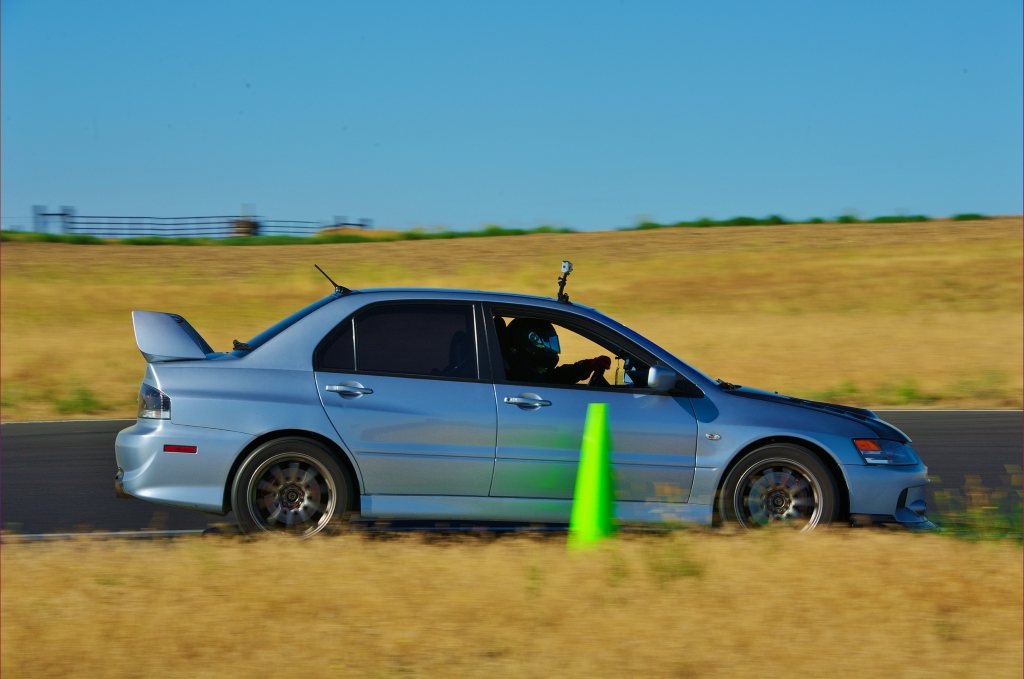
The car: 2006 Mitsubishi Lancer Evolution 9 GSR

This car, was technically, my wife’s car. A few years prior, I had decided it was time to get back into ‘car game’. It was about 3-4 years from when I had graduated from college, had paid off my student loans and bought a house. Prior to college and for some time in college, I was active in ‘modifying’ street cars.  But after several cars, experiments, blown engines and essentially sunk money, I bought a 1999 Ford Contour SVT (black), which had an aftermarket exhaust, broken sun-roof and called it good.  So I thought.

Fast forward to 2011 and we had a heavily modified (and unnecessarily) 2008 Subaru WRX STi (mine) and a 2006 Mitsubishi Lancer Evolution GSR (my wife’s).

Soon after we bough a house, we had an STi and then an Evo 9. This was in 2008, maybe 2009 but not sure why the pictures look like it was in 1988 or 1989.

Yes, we did car shows and here is my wife claiming a prize for best something. Oh the shame…

Proof from the car shows…

And we even did photo shoots. Oh, the double shame!!!

I slowly took over the Evo because I had gone too far with the STi, making it not track-capable.  With an upgraded turbo and 400whp, it was too much car for to handle and very likely wouldn’t make it a day or two without over-heating or blowing up as EJ25 engines were and are notorious for not liking even mild track sessions.

I’ll be writing a car profile post and update this article later on, but in terms of specs, it had the basic bolt-on’s, a tune by Cobb Tuning, a harness bar, some gauges, upgraded brakes (lines, pads and rotors) and I removed the rear seats for “weight reduction.”  😆  Functionally, it allowed space to bring alone a full set of track tires/wheels, a jack, jack-stands and pretty much everything I needed for a track day.

My experience thus far: Intermediate run group, on the cusp of Advance

This was the first year that I had decided I was done with simply modifying cars and hard-parking.  I had taken an HPDE full-day event the prior November and the bug had bit.  I had spent that entire spring and summer, attending track days and this was also the first year a friend and I had started developing Track Attack.  Each time we went out on-track, it was not only fun but a chance to test and improve Track Attack.

At the time, I had somewhere around 8-10 track days, without any real incident; a spin here and there.  Generally, I felt quite ‘seasoned’ by the time this trip came around but by no-means did I feel fast.  I had also done a couple autocross events and had decided that was not my path.  Nothing wrong with Autocross but all that standing around, with no practice runs and for at most 4 under 60 second runs (of which I sucked at all of them) – I was OK sticking with track days.  🙂

YouTube player

The setting: A three-day track day road trip (Portland International Raceways and Oregon Raceway Park)

Most of my track days were with either ProFormance Racing School or The Ridge Racing School (now the majority of their events run by Turn 2 Lapping).  Each year, ProFormance racing school would organize a ‘road trip’, hitting Portland International Raceways for two days and Oregon Raceway Park for another two days (Thursday through Sunday).

I was excited and intimidated a little about Portland, mainly because it had the ‘International’ in the name – implying, at least in my head, the more professional and potentially hard aspect of the track.

The back-straight at PIR getting some instruction and likely told I suck.

Coming off Turn 12 at PIR

Holding up traffic in the Festival Chicane

The first two days at Portland went great!  I had hired an instructor for the first day at each track, to help guide me through the track as it was my first time at each.  At the end of the day on Friday, we caravaned over the mountain range.  I stayed with a friend (Robert) I had made in my modifying days, that was a Shop and History (I think) teacher, in The Dalles, OR.  He was/is a big car guy and had just gotten into Evo’s and was gracious enough to let me stay at his house.

That first day went really well and aside from frustrations with the Track Attack app (no cell phone reception at all) was ready to get back to the track and make some serious gains on my lap times.  That Sunday morning, Robert came out in the AM and we were able to give parade rides, which was fun to show him around the track.  Once he left, it was time to get back on it.

What happened

It was what would have been the second to last session of the day.  I forget my exact lap times, but I want to say they were in the 2:10-2:15 range, of which looking back on it now, is well below the abilities of that car.  I honestly don’t recall having too much of a structured learning or driver development plan, so I was pretty much just lapping around “trying to go faster” but no real thing I was actively or consciously working on.

Oregon Raceway Park is an incredible track, with lots of rolling hills, blind corner exits and no real long straightaway, giving little time for brakes to cool down or a rest for the driver.  It is ran primarily in the clock-wise direction, though it is regularly run counter-clockwise.  It’s out in the middle of nowhere, high central desert, Oregon, where if you go off, there really isn’t anything to hit.  Generally, go off, pick up small rocks and dust – come back into the paddock, clean and vacuum your car and you’re back at it.

Except one section: Start/Finish main straight with a wall

Check out this video of one of the best club racers (and drivers in general), Cody Smith in a race at ORP.  You’ll see that right at the last corner, there is a wall that protects the hot-pits.  The only real place to get in trouble here is that wall and that’s what I learned.

YouTube player

You see what happened at 2:32 mark?  That’s exactly what happened to me. 

On what would end up being my last lap for that weekend, I was coming up on the final turn, I braked, turned but turned in too early and probably too lazily.  As I started exiting the corner, was on throttle but noticed I was going to run out of road and I lifted.  🙁

Off-Throttle Oversteer: Engaged

Not sure if the car actually dropped a tire but the rear end whipped around and next thing you know, I am sitting there, staring at a wall and corner workers running over to me.  I then look to my left to see if any other car is going to collect me and this awesome green E36 M3 purposefully goes off-track, along with a nice 370z.  No damage to them, aside from a dusty car.

Within 10 minutes, I’m out of the car, physically fine and am able to limp the car back to the paddock, where front end is pushed in a few inches, the Seibon carbon fiber hood latch is broken but that’s about it.  If it weren’t for the leaking radiator, I might have even tried to drive it home.

The aftermath

First, I have to thank Don Kitch Jr on how calmly he handled himself (not having been his first rodeo by a lot) as that helped calm me down.  I had recently started working with English Racing, in Camas, WA and made the call to see if I could have the car towed to their shop, so they could take over assessing and fixing the car.

I also called my insurance and told them I had run into a mechanical issue while on a road trip and needed a tow truck.  With no approved partner within 100 miles, they allowed me to use the local tow truck provider (a story for another time) and I had the car towed to English Racing, with me going along for the ride.  Myles Kerr (Gringo Integra) was incredibly awesome, meeting me at the shop (I think they were actually there anyway) and giving me a ride to the local airport, where I picked up a rental car and drove home.

At the end of the day, the damage wasn’t bad at all and the learnings were great.  The majority of the front end needed to be replaced (front bumper cover, lower lip, radiator support, radiator, intercooler, headlights [I think]).  The rest of the body parts were repairable and while it was at a body shop, I had the body shop massage all of the fenders so I could easily fit the 275/45/17 rubber I was running without rubbing and had English do a full mechanical evaluation, tune-up, install a new TRE rear differential, bigger injectors, new fuel pump and a new tune, bringing the power to 334whp and 276ft/lb torque.

YouTube player

The Dark Side

I’m not gonna lie, I had some dark thoughts in the first 24-36 hours after the incident.  Even before I got out of the car, staring at the wall, I thought to myself – “What the hell am I doing?  This isn’t for me.  I’m not good at this and I can’t afford this.  Did I just financially ruin us?”

The scariest thoughts were those “this isn’t for me and I’m not good at this” thoughts.  I had already heard from Don and other experienced drivers that crashing on-track isn’t a question of “if but when” it will happen.  And multiple “when’s.”

Luckily (or maybe not), I’ve had a history of dealing with thinking and being told that certain things weren’t for me and that I sucked at them.  In most cases, I’ve been stubborn and hard working enough to prove others and myself wrong.  So it took some time, but I consciously decided that this incident would not hold me back.  Motorsports and specifically, being the best driver I could possibly be was something I wanted to be a significant part of my life.  So I picked myself up, dusted off, fixed my car and got back it.

At ORP a year later and more than 10 seconds faster than the prior year.

Posted on

Days 16, 17 and 18 – 30 Days of Racing in a row

This is a combo article because I frankly fell behind righting as the race weekend took over.

Back to PIR to get the bad taste out of my mouth

The last time we were at Portland International Raceways (May 2017), the weekend was going great but on the main points race Sunday afternoon, the race was over by turn 3.  A couple of Spec E46’s were tussling ahead, one got pushed off and insisted on getting back on track, immediately spun when the front tires grabbed and got side-swiped. While it sucked for the team, we fared much better than two other PRO3 cars which were nearly totaled.

YouTube player


As an aside, another example of how important it is to know how to properly go off track and apply those techniques, every time – even in racing conditions. The reality is that going off will happen and applying those techniques will save you and everyone else a lot of money in the long run.

That race was run without a chicane (usually reserved for endurance races) and this would be the first of two race weekends with the chicane, aptly named the “Chicane Challenge” and I was really excited to see how the investment in simulator time would pay off.

Friday Test and Tune Day – .5 seconds faster right off the trailer

This isn’t a perfect comparison because of differences in weather conditions but when I looked at my first session off the trailer this Friday versus the same first session, in August 2016 (the last time I ran PIR with a chicane), I was ~.5 seconds faster and broke the 1:30.000 barrier for the second time.

What happened? Softer braking, which lead to higher min-speeds through each corner.

Looking at the data comparison below, it’s clear to see that I was able to use less brake pressure and carry more mid-corner speed AND get on throttle (and full throttle) sooner than a year ago. On this specific session, I remember letting the tires warm up and then attacking the corners and surprising myself that I had so “easily” hit a 1:29.xxx lap time. On the following lap, I tried to repeat it but found that while carrying more speed through the turns 4-5 transition area, the bumps in the road unsettled the car too much while I was on throttle, causing the left rear corner to break loose.

A comparison of my off the trailer, 1st session on a test and tune in August 2016 versus June 2017.  Look at the brake pressure differences and the delta chart.

Also, I was driving on relatively old tires (Toyo Proxes RR 225/45/15’s) that were on their third race weekend and their 12th heat cycle. There is an urban legend that PIR “likes old tires” and my personal interpretation is that PIR is a very smooth and grippy track and thus older tires still work well but newer tires are still going to be optimal.

A track map of Portland International Raceways, with a Chicane

The rest of the day I stayed on the old tires and struggled to break 1:30.xxx as the day got hotter and grip went away but we focused on helping that rear left corner take the beating. With PIR being a 12 turn, clockwise track and only 3 of the 12 turns being left handers the car left rear tire is under constant heavy loads, trying to get out of nearly every corner as quickly as possible.

Saturday Qualifying, Points Race 1 and 1-Hour Enduro Race

This was a unique weekend with the Saturday Group 1 race being a championship points race, along with the Sunday race. So each day we would start with a clean slate, qualify in the AM and race in the PM.

First up was Group 1 qualifying, which went ok but I couldn’t find good track position, to get me a solid draft on laps 2-4, where the fastest lap times would come happen.  I ended up with a 1:30.092 and qualified 4th.  Not bad but not great, being .5 seconds clear of 5th place but almost .7 seconds from pole – ouch.

In Group 8 qualifying, we strapped on some new tires so I could scrub them in for Sunday’s race and boom, 1:29.635!  New personal best and, it didn’t seem too hard.  The big difference?  Carrying a tiny bit more speed into the chicane, more speed into turn 7 and through turns 10-12.

Group 1 Points Race: 3rd Place

At the start of the race, I got a really good start and was behind a the Spec E46 of Dan Rogers, who has a ton of race craft.  We were on the inside for turn 1 and more importantly, the outside of turn 2, which is the chicane.  On these low speed, high G-force turns, in traffic, it is generally best to be on the outside, because you have less steering input and can get on the throttle sooner.  This is because when going two or three wide, we aren’t going at normal speeds, we’re going 10-15 mph slower and thus nowhere near the traction limit.

This gave me a solid run through the chicane and coupled with an incident where another PRO3 car tried to squeeze through where there was no room, spinning both cars – I was in the lead by turn 3 and leading my first PRO3 race?!???!

Leading my first PRO3 race ever, holy crap! Maintain, maintain, maintain….

I lead for a few laps but eventually, Brian Bercovitz got me and pulled away.  Then the PRO3 who spun the other car, caught up and when we were going around slower traffic, he got a clean run out of a corner while I had to check up and he got past.  I ended up in P3 but further improved my personal fastest lap time.

YouTube player

Group 8 1-Hour Race: 2nd place for being greedy

The 1-hour races are basically more practice for me – I like doing them by myself because I can just focus on hammering out laps and hard-coding improvements.  I always strap on the oldest tires I have on-hand and try to set fast and consistent laps.

This was no different and from the start I was battling with a regular foe and friend, Jeff McAffer.  I was in the lead the majority of the race but Jeff was able to stick with me the entire time.

After the mid-way pit stop, I decided to try to push a bit more as I was hitting 1:29 lap times, on crappy tires and a greasy track.  Suddenly, 1:29.7xx!  I felt like that lap time wasn’t too hard to get, so I went for a repeat but the tires didn’t agree.

This could have easily been just my inputs but my hypothesis is that I over-pushed the tires and I was asking them to do a qualifying lap when they were in lap 35 of a race.  I had the win in the bag and Jeff about 5 seconds behind but I got greedy, went off and ended up in P2.

This is not a good POV at turn 12 at Portland International Raceways

Now I know there is a reason for the saying…

“Go only as fast as you need to finish where you’re going to finish.”

Sunday Group 1 Race

One thing that I started doing this year is running just Group 1 and Group 8, which means I get a solid amount of track time and on Sunday, I only have one group to worry about. This way I’m rested and not rushing on the day that usually counts.

Sunday Group 1 Qualifying: 1:29.874 P4

Coming off of the Saturday’s lap times, where I got a 1:29.466 in the afternoon Group 1 race, with fresh tires but loaded up on weight for race trim, I felt that I had the potential for a very low 1:29 in qualifying and thus in the running for pole. I just needed to have good track position on laps 2-4, where I could get a draft on at least one of the straightaways. But it wasn’t to be – I went out and was stuck in “no man’s land” for the first part, then I slowed down and waited for a group of PRO3 cars to come by so I can get behind them. I was able to finally do so and had a low 1:29 going but got behind a PRO3 car that slowed down way too much for turns 10 – 12. It was still good enough for a P3 but I knew I had the pace to battle for the podium and possibly the win. If I would have had an average sector time for turns 10 – 12, I would have been easily with a 1:29.4xx with my rolling best lap being a 1:29.522.

Purple cells = rolling fastest lap and yellow cells = fastest segment times

Sunday Group 1 Race: P7 finish due to a late race off-track excursion

The race started well and hard for most everyone, with a clean first lap.  I tried hard to make up at least one spot on the start but it didn’t happen, so I was stuck behind the #81 of Brad McAllister, who is a strong driver and PIR is one of his strongest tracks.  He’s also a pretty tough pass, with a strong racing history in the SCCA Playboy MX-5 Cup, PRO3 and recently the TRANS-AM TA2 series.

Brian Bercovitz, one of the regular competitors I’m trying to best started from the back because he had a mechanical during qualifying and eventually caught up to us.  The couple laps leading to Brian catching us, I had to brake harder than normal to not ram Brad going into the chicane, which over-heated (I think) my front tires.  Going into turns 5 and 6, my front end washed out, and as I was waiting for the fronts to grip, the rear-end swung out and I went-off track.

YouTube player

It was not too bad but just enough time for a couple cars to pass me and by then the tires were too hot and the distance too great for me to catch up and make up the spots.

I ended up finishing 7th and I think if we can do a better job of tire pressure management (to give me more life towards the end of the race) and I can do a better job of not screwing up, there was a 3rd place finish in the stars and maybe better.

Overall, a great weekend and new personal bests!

While I’m not terribly happy with the Sunday result, overall we made a ton of progress on the car and my driving.  There is one more race at PIR with a Chicane in August and I believe we’ve gathered the knowledge to fight for poles and a win.  We know what we can do to drop some low 1:29’s and maybe even get into the 1:28’s, which is encroaching on track record territory.  Let’s cross our fingers for some sunny and not too hot, weather in August!

Posted on 2 Comments

Rose City Opener 2017 – Race Weekend Recap Portland International Raceways No Chicane

What: First sprint race weekend of the year, shaking down the car with new upgrades, testing and experiencing the highs and lows of racing.

If I knew then, what I know now: 

  1. Make no assumptions on communication!  Make sure everyone on your team knows exactly what is happening and when.  We lost a day to shake down the car and found an obscure issue with the new transmission resulting in more lost track time on Saturday.
  2. Make sure you know what kind of qualifying is happening, open session or pressure style and adjust tire pressures accordingly.
  3. Plan where you want to be on pre-grid for open session qualifying wisely so that you can benefit from drafting other cars in class and even faster cars.

Products that made life easier in this post: 


Kick off to the sprint season

As I mentioned the 6 Hours on the Ridge post, I primarily race with ICSCC, which is a sprint race focused sanctioning body.  Aside from the endurance races that bookend the start and end of the season, each race weekend is made up of the following elements (for the most part):

  • Friday test and tune – usually for race cars only but sometimes includes High Performance Driver Education (HPDE drivers).
  • Saturday – Practice, qualifying, non-points races and a 1 hour endurance race.
  • Sunday – Final qualifying and points races

Here is a picture of the announcement for the race weekend of which if you do a couple of groups, that is plenty of track time.  This weekend and for the full year, I did Group 1 (the main group for the PRO3 annual championship) and the Mini-Enduro.

The schedule for the first sprint race of the season. I’m in Group 1.

Shaking down a refreshed car

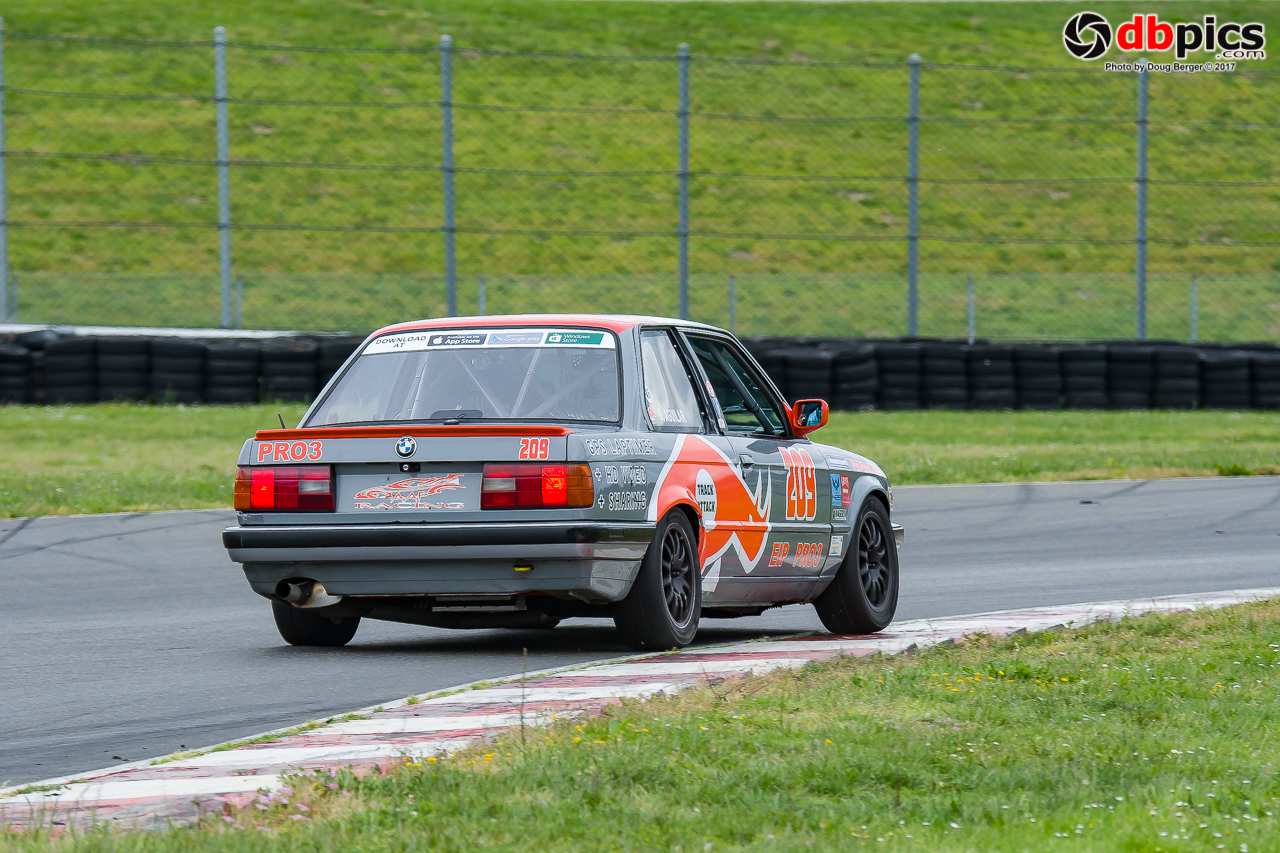
Initially I was supposed to get the #209 Track Attack PRO3 car back from Advanced Auto Fabrications at the 6 hour race but when they were doing final checks on it, they found that the newly rebuilt transmission wouldn’t go into third gear.  So we decided to have that fixed and bring it down for this weekend, where I would shake the car down and ‘take delivery’ from all the repairs and upgrades they did.

What I did not make explicitly clear was that I expected AAF and crew to be there on Friday, which they would do more often than not, but not always.  I even checked in the Monday prior to make sure all was on schedule but I did not explicitly ask about Friday.

Big mistake because when we drove down on Thursday night, so we could be all unloaded and ready to drive on Friday AM, the gigantic black AAF hauler was nowhere to be seen.  AAF and crew decided to skip the test and tune due to the limited amount of track time and forecasted rain in the morning.  They’re not scared of rain, just that if it isn’t supposed to rain on Saturday or Sunday, the risk of damage is higher than the benefit.

Regardless, we made the most of the day by working on odds and ends in the RV, spend some quality time with the family, caught up on work and chatted with folks up and down the paddock.  The AAF crew showed up on Friday evening and by Saturday AM, was all set for the first on-track session.

YouTube player

As I got going in the morning practice run, it took me a few laps to get into the groove of things, remember the course and get up to speed.  Initially letting several cars pass me but then quickly catching and passing them again.  Lap times were solid, with nearly a .8 second improvement from the year prior. SWEET!

When we came off the track, a fellow PRO3 driver mentioned that they saw smoke coming out of the back of my car, a light smoke but consistent.  We checked the car and sure enough, the rear and under body was coated with transmission oil.  We were leaking somewhere from this newly rebuilt transmission that aside from this, seemed to be running great.


That is transmission oil – note that it is everywhere.

Over the next several hours, we went step by step, replacing the main rear transfer seal and then the shifter seal.  We thought we had it addressed but after the non-points race, still had oil.

Long story short, it turns out that when the transmission was sent for a rebuild, they took my old transmission in as a core and sent back a different transmission, from an older model of the E30, which had a different kind of shift mount assembly.  This assembly had two bolts that mounted to the top of the transmission, which served the purpose of securing the assembly and sealing two bolt holes into the transmission itself.

We don’t run the OEM shifter assembly, opting instead for the incredibly awesome CAE shifter assembly, which meant those holes were completely exposed and the source of the leak.  This obscure situation had never come up with this crew of people who have been racing E30’s for over 10 years and built and rebuilt dozens of PRO3 cars.

We didn’t figure this out until Saturday early evening, after we opted to not run the 1 hour endurance race, to save the transmission (if it kept leaking) for the Group 1 qualifying and racing on Sunday.  We felt the risk was too high to run low on transmission oil in the 1 hour and potentially damage the transmission itself.

In conclusion, lack of communication and shaking down the car resulted in a completely lost Friday of running and 1 hour of endurance racing.  Sigh.

Qualifying

For the weekend, we had two qualifying sessions, one for the 1 hour endurance race and qualifying times for the Group 1 race.

1 Hour endurance race pressure qualy

Something unique to the Cascade Sports Car Club, which I love is pressure qualifying.  One out lap, one flying lap and one in lap.  Unfortunately, we did not realize this until we got to grid and didn’t adjust the tire pressures accordingly to compensate for the much fewer laps we’d run.  At least everyone else was in the same boat.  I love this type of qualifying because it eliminates the ‘draft’ variable – this is all on you as a driver, to make a fast lap happen there and then.  Not relying on getting a draft from a faster car or following and learning from a faster driver.  At a track like PIR, especially with no chicane on the front straight, a draft can make a HUGE difference, in the order of .25 seconds or more if you can get the right draft on the front and back straights.

Here is the video of my ME2 qualifying lap, which put me on pole for ME2 class but was a solid one second slower than my fastest laps in a regular qualifying session.

YouTube player

Group 1 qualy

Qualifying for Group 1 was spread across the fastest lap times in the Saturday non-points race and Sunday AM qualifying.  The fastest time across those two sessions would count towards the final grid placement.

In the Saturday AM race, I qualified 4th with a mid-1:22 lap time and finished the race in 3rd.  It was an excellent race, where I got a great start and was running in 2nd before turn 2 of the first lap.  I tried to hitch myself to Brian Bercovitz, the eventual race winner but he got away and was stuck battling with Corey Peters for 2nd place.  I ran in 2nd for about half of the race but I ended up going too hot into turn 1, went wide and that was enough of a mistake for Corey to capitalize.  That meant Kyle Byers in the #55 PRO3 car was on my tail.  We ended up battling pretty hard, exchanging some bumper paint but nothing serious – just good, solid, respectful, hard racing.  He ended up getting a little sideways on the second bump he gave me and that was enough for me to pull away and finish in third, with a lap time of 1:22.274 and a new personal best.

Sprint non-points race results and qualifying 1 times

I would normally post the video here but I forgot to hit ‘record’ – I’ll try to get the videos from Corey and Kyle to share.

Sunday AM qualy brought out excellent conditions; dry, sunny and a cool breeze in the low 60’s.  I got on the grid early and was the lead PRO3 car on track but after a few laps, I realized I was reproducing low 1:22 lap times while everyone else was running in a pack and getting help with drafts.  So I came into the hot pits, checked tire pressures and waited for the right pack to come by and tail them.

I eventually got behind the pack with Corey Peters coming off of the back straight but he quickly picked up on my game and pulled off on the main straight away.  No issues, there was still another couple of cars to get behind.  On a decent flyer though, another driver, who I used for a draft and got by on turn 1 decided it was time to race and dove in to overtake in turn 7.  Why?!?!?!  What makes this more frustrating is that he then pulled off and slowed down that same lap, in the following straight away.   I can’t confirm but I think he also picked up on what I was planning and decided to ruin my lap.

No issues again and finally, I saw Brian Bercovitz and got behind him for one last final flying lap.  All looked good, with the predictive lap timer showing a 1:21.8xx for the first part of the lap but then I missed a downshift to third on the only left hand turn on the course.  This ended up still producing a solid lap time but I ended up qualifying in 5th place, where as if I would have executed, I would have qualified third and possibly 2nd in class.

The Main Race

The goal was simple: get a solid start, make up a couple positions in the traffic and be in the top three by the end of lap 1.  This would give me a fighting chance to get near the front and try to stick with Brian, who was on pole for our class.  I found during qualifying that if I could get behind him, I was able to keep the gap nearly the same.

Below is the race video and note, it has no data overlay.  The reason?  I didn’t complete a single lap.  I got a solid start and wedged myself in a position to go after 2nd, 3rd and possibly first by turn 7.  Unfortunately, up ahead, a Spec E46 car went off to the left and tried to get themselves back on the track without waiting for the pack to go by (my opinion).  When his front tires, who were turned to the right, hooked up on the track surface, they gripped and shot him across the track and into the on-coming pack of angry PRO3 cars.

YouTube player

I saw it happening, moved to the right but still got a glancing blow on the rear quarter panel.  Initially I thought all was well because it didn’t really knock me anywhere but as soon as we hit turn 7 (right hand turn leading to the back straight), I saw and heard heavy tire rub and then the cabin was engulfed in tire smoke.  I went into the hot pits, got checked for fire but the damage was too much.  We could have swapped tires and rolled the fender in the hot-pit but we would have gone a couple laps down and I didn’t think it was worth it and called it a day.

Conclusion

It was a tough way to start the sprint season but when you sign up to go racing, this is a potential outcome that can happen any weekend.  I take 100% accountability for what happened and don’t blame the Spec E46 driver in any way.  All things considered, had a great time with friends and family, personal best lap times, fixed teething issues on the car and was still able to take it home, running and with some cosmetic repairs needed before the next race.  There were three other cars involved in the incident and they would take my place in an instant as their cars did not fair as well.

Damaged driver side quarter panel and hard rubbing on tire.

The guys using a jack bar to roll the fender so the tire could clear.