Posted on

Racer on Rails at Portland: Heat, Heart, PRO3 Lessons, and Runoffs Testing at The Dash for Kids

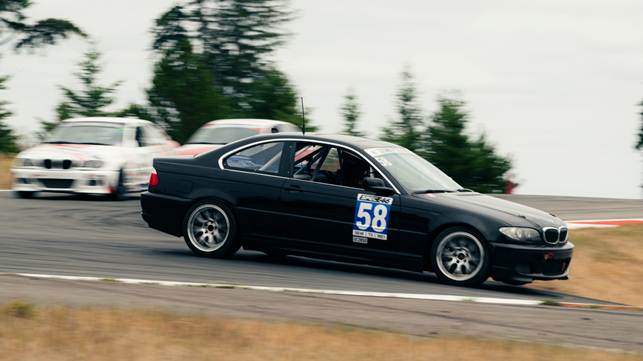
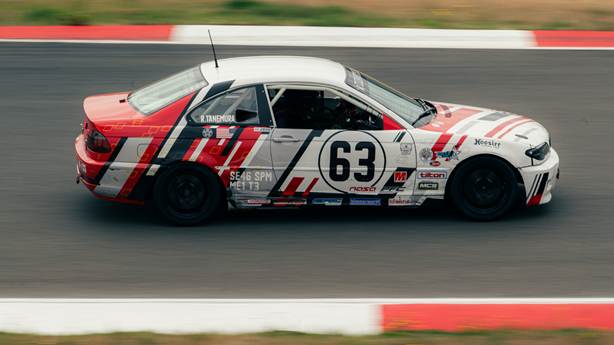
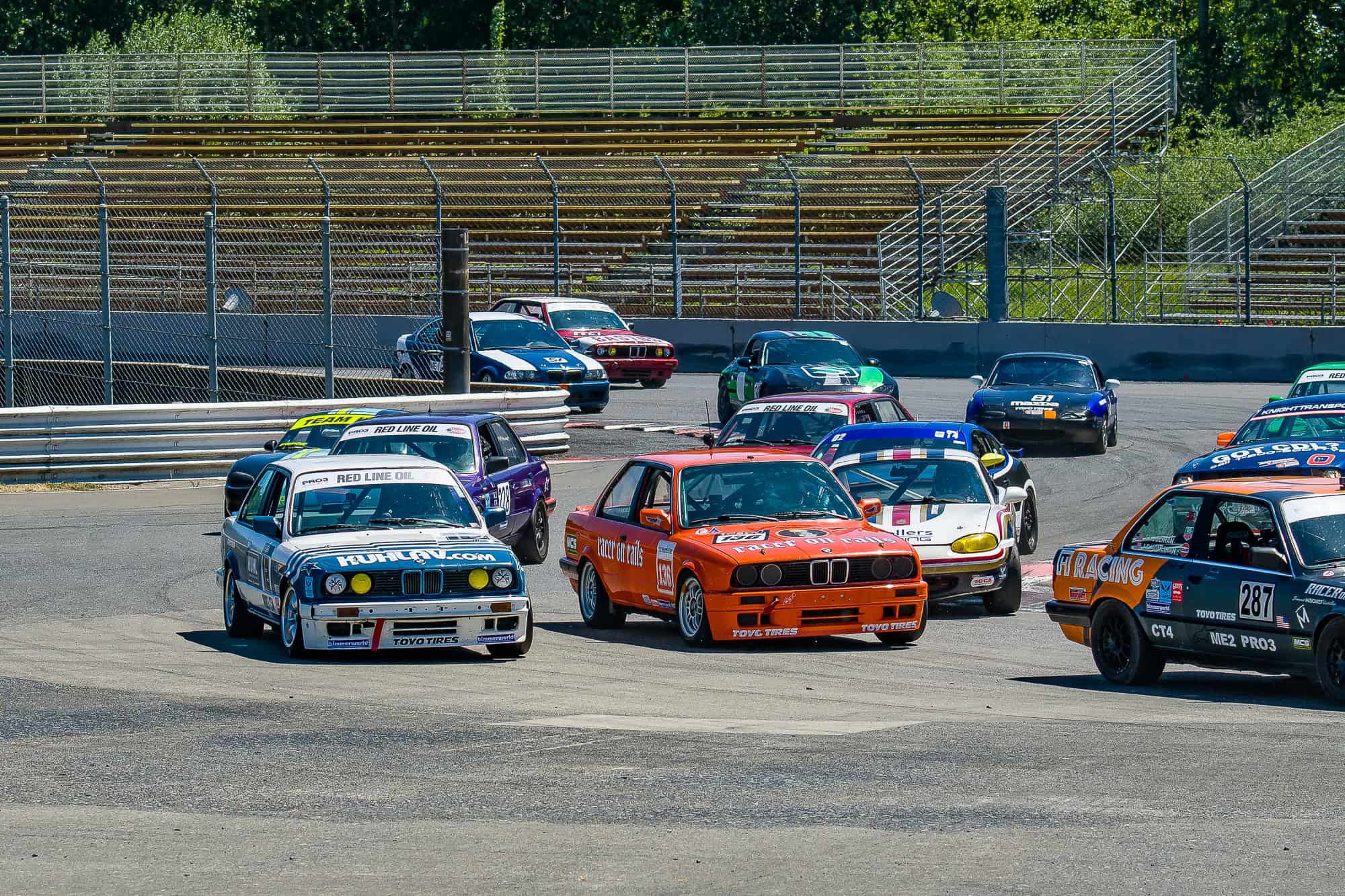
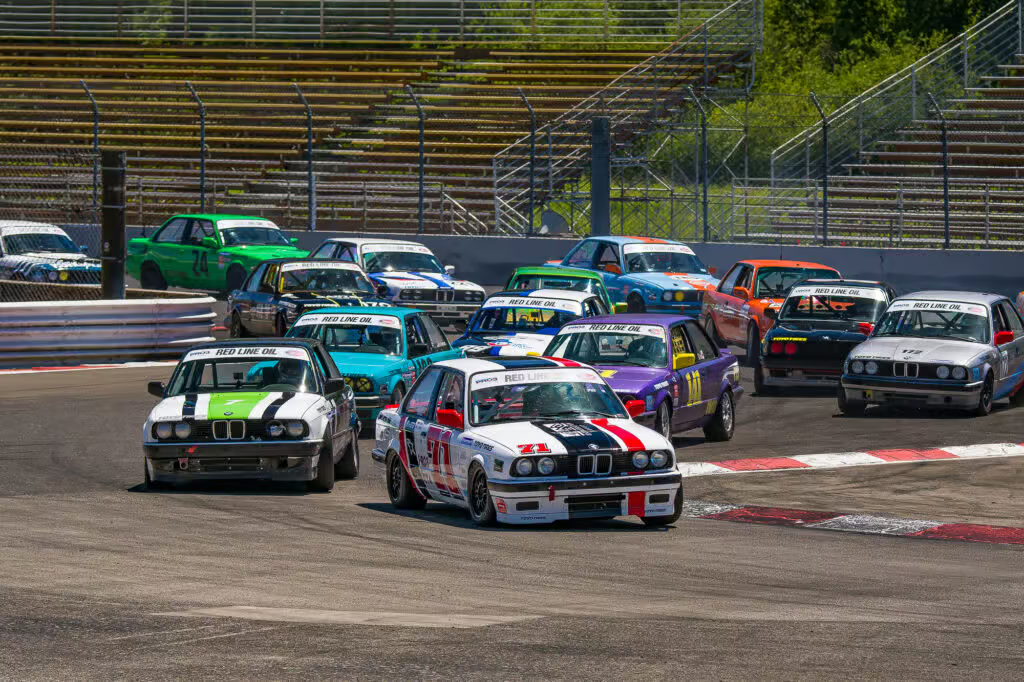
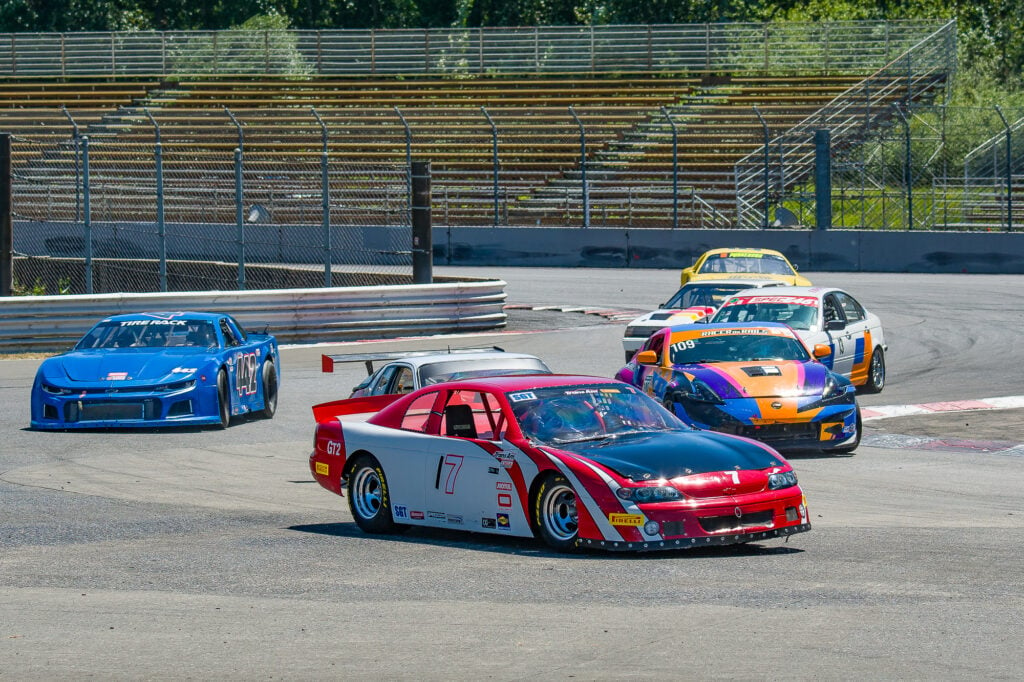
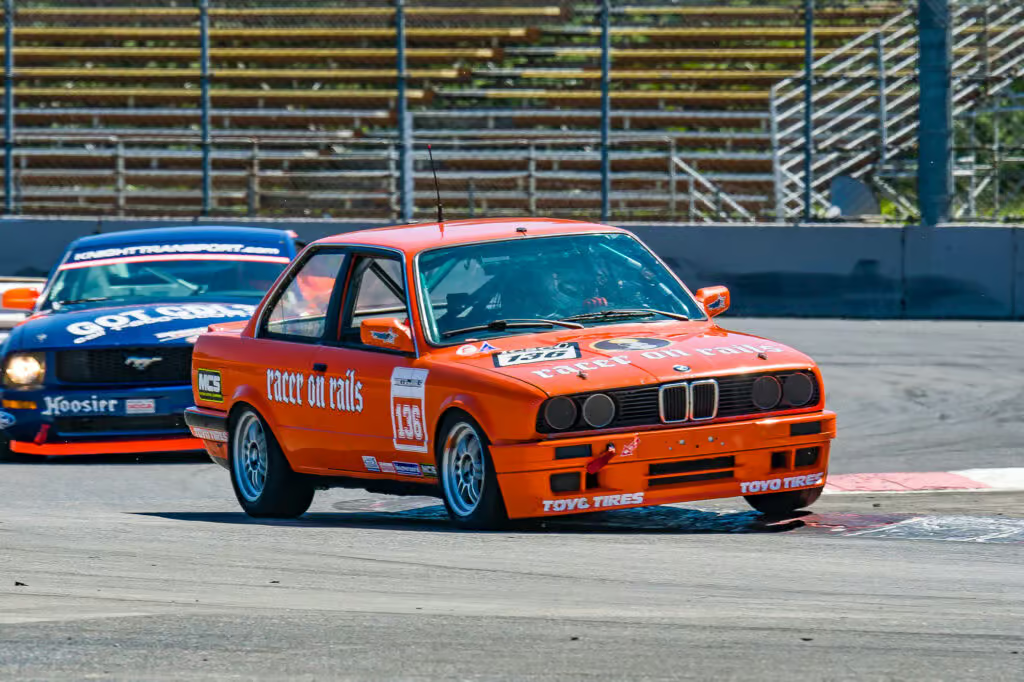
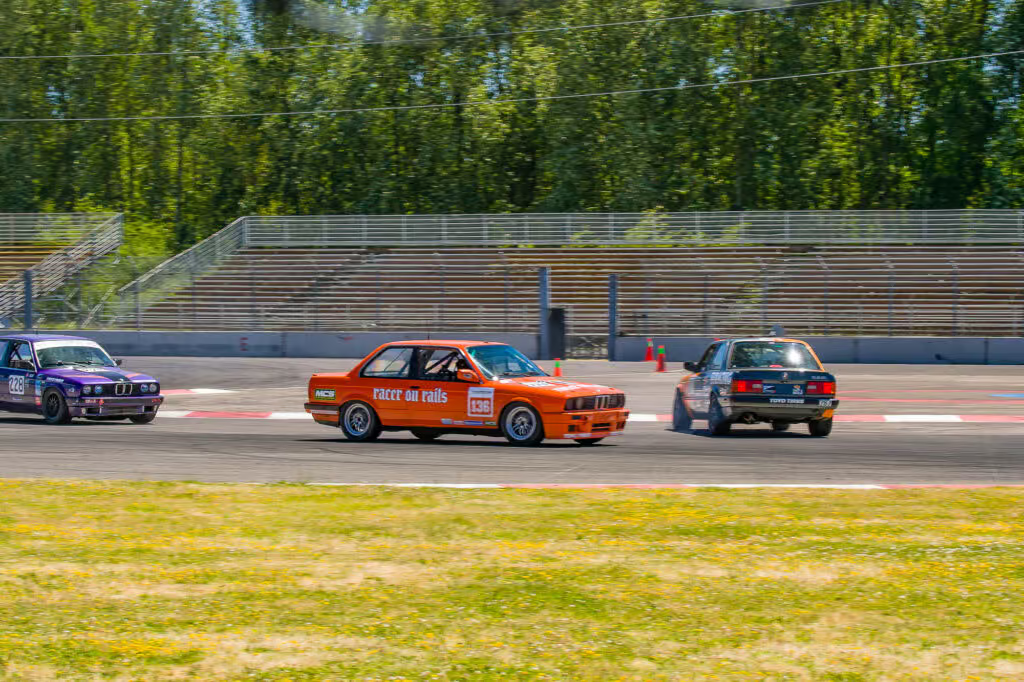
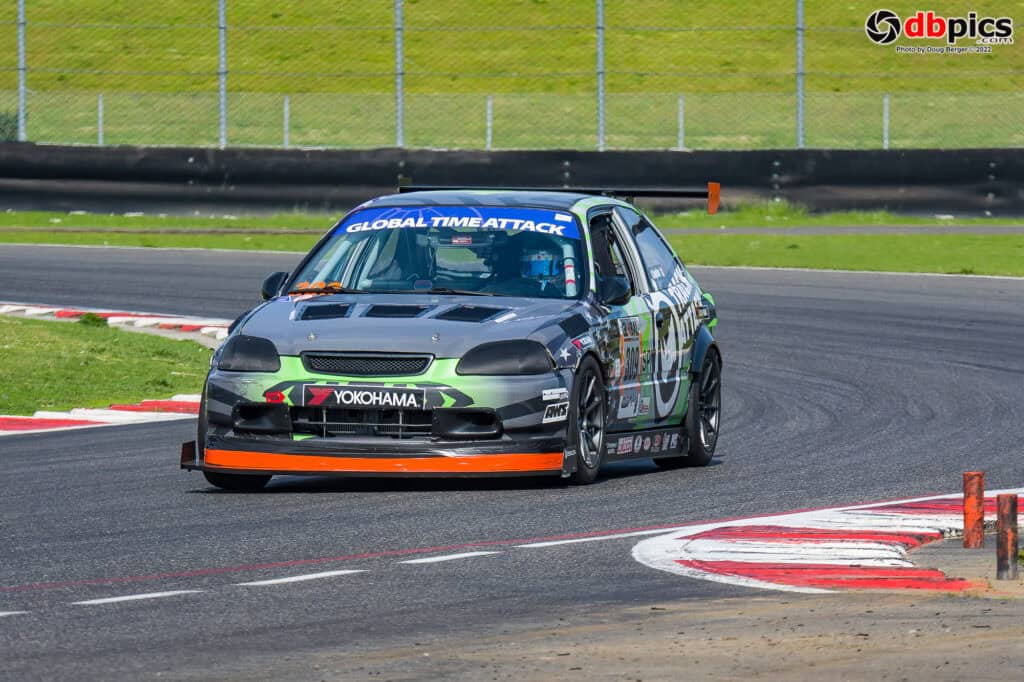
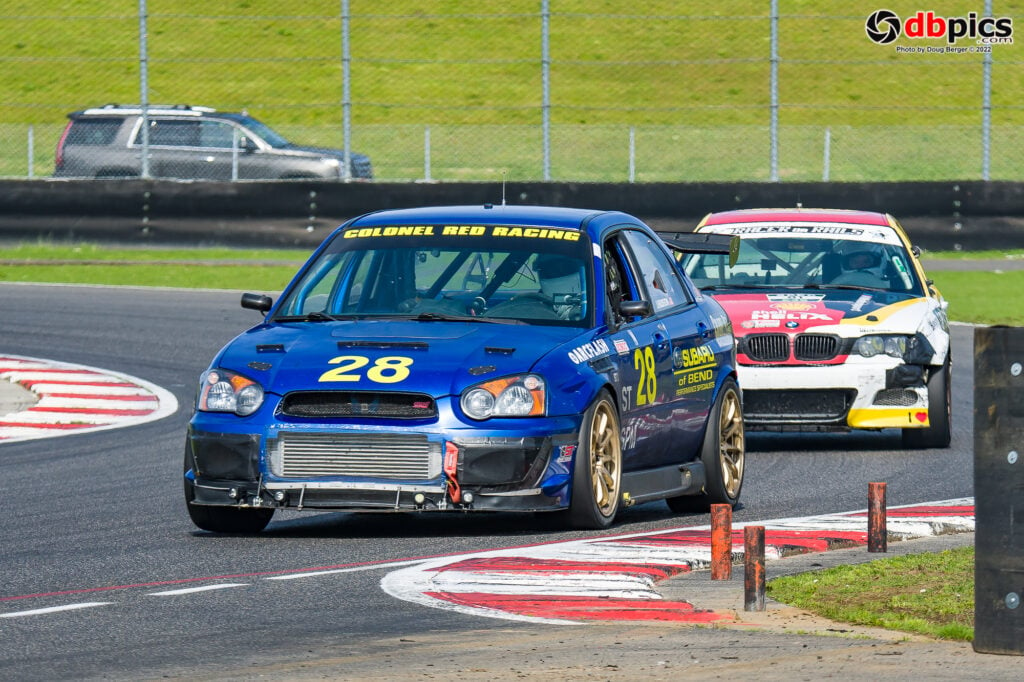
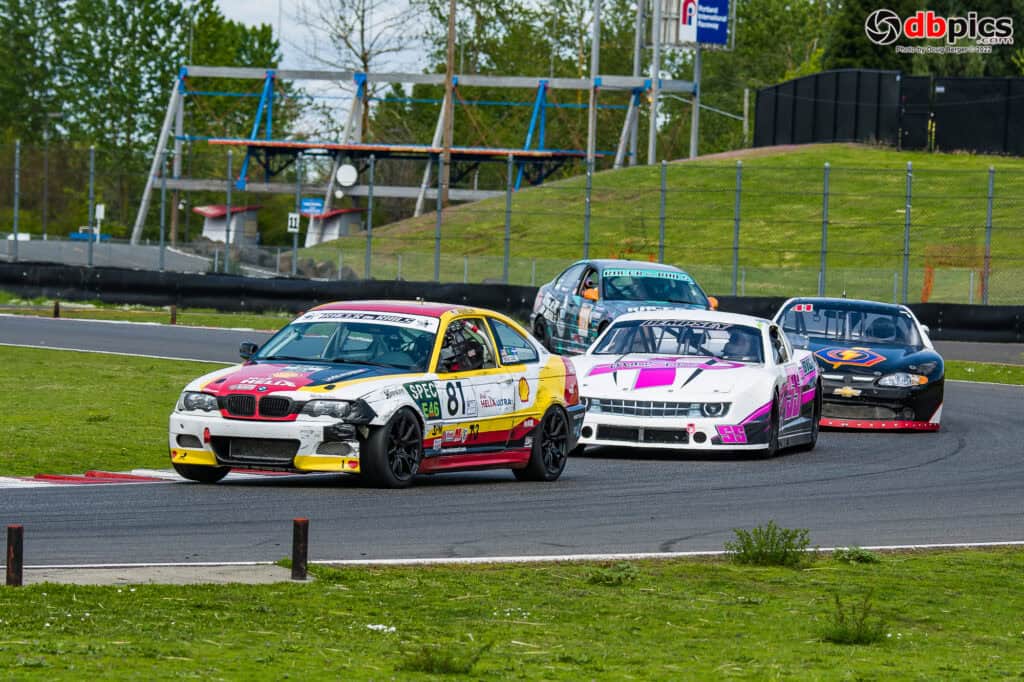
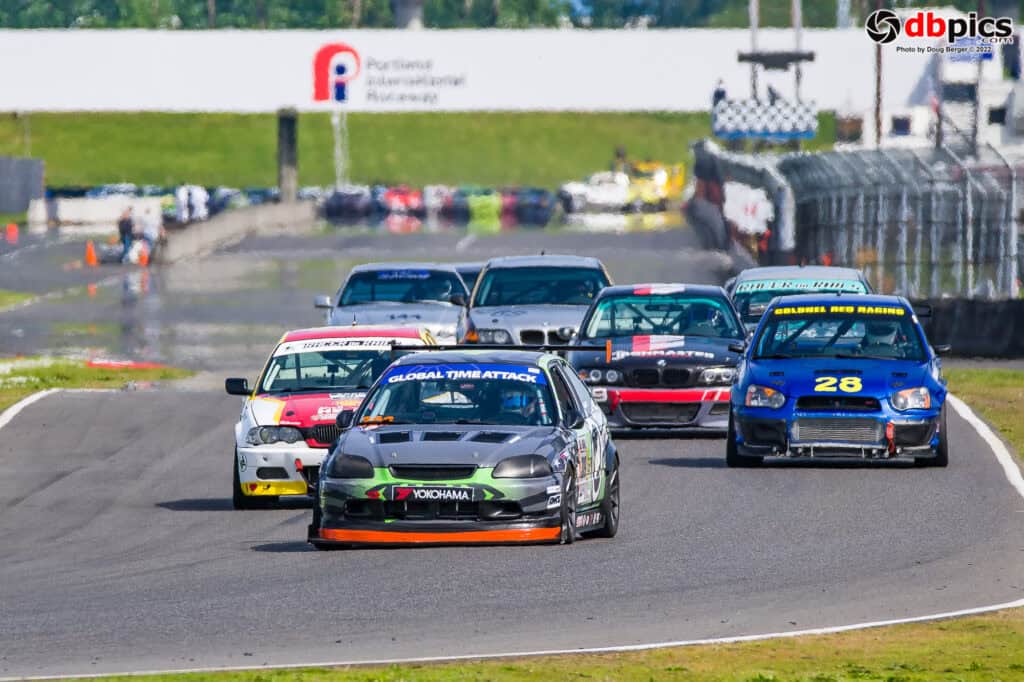
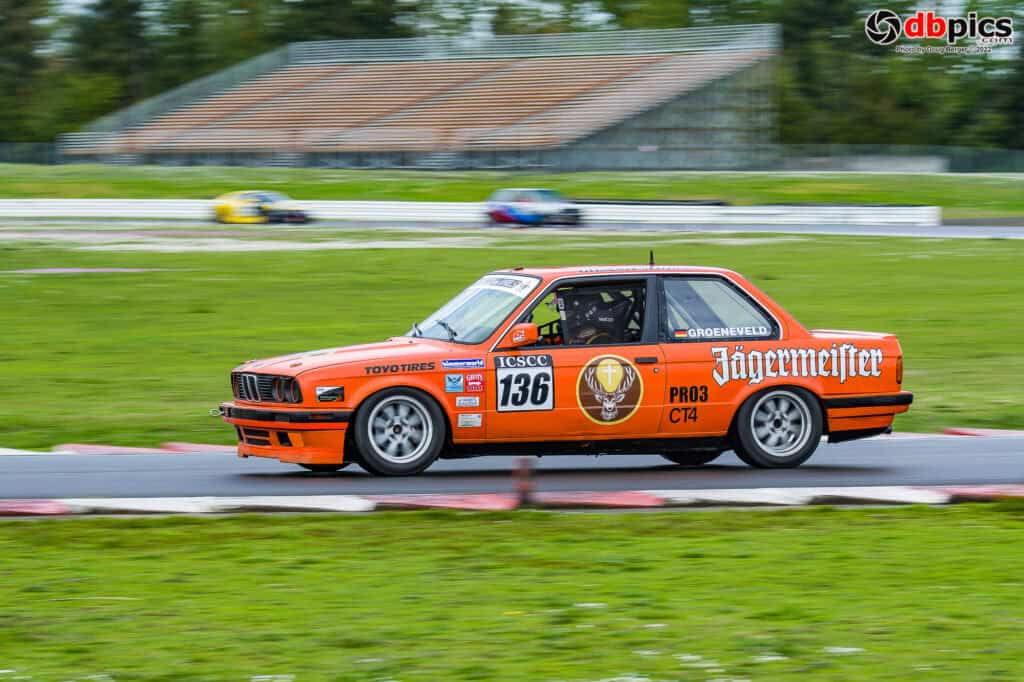
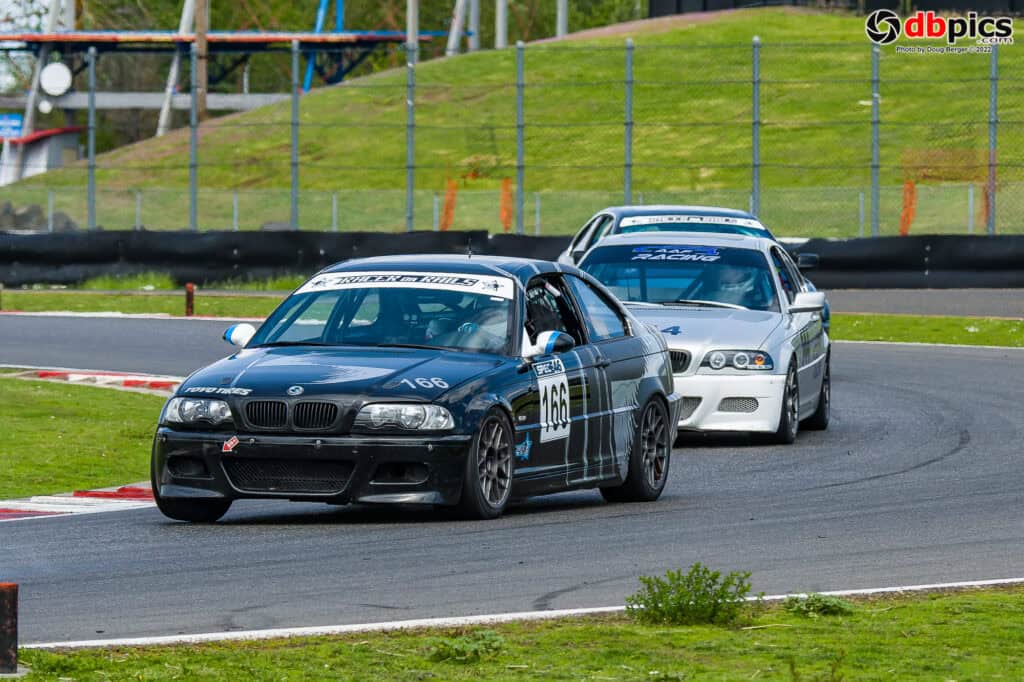
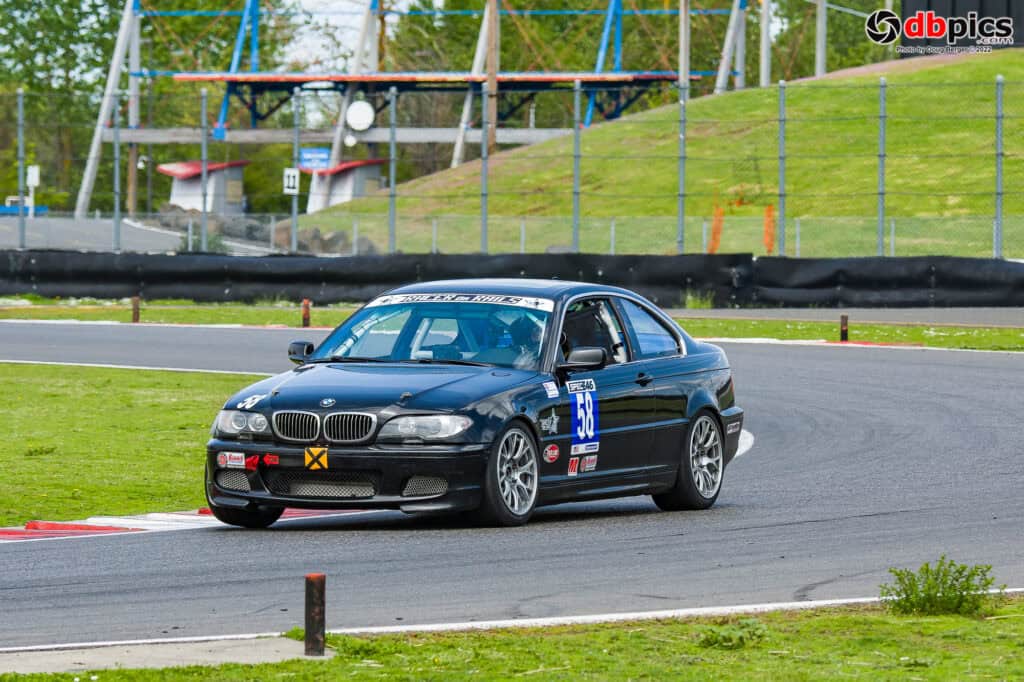
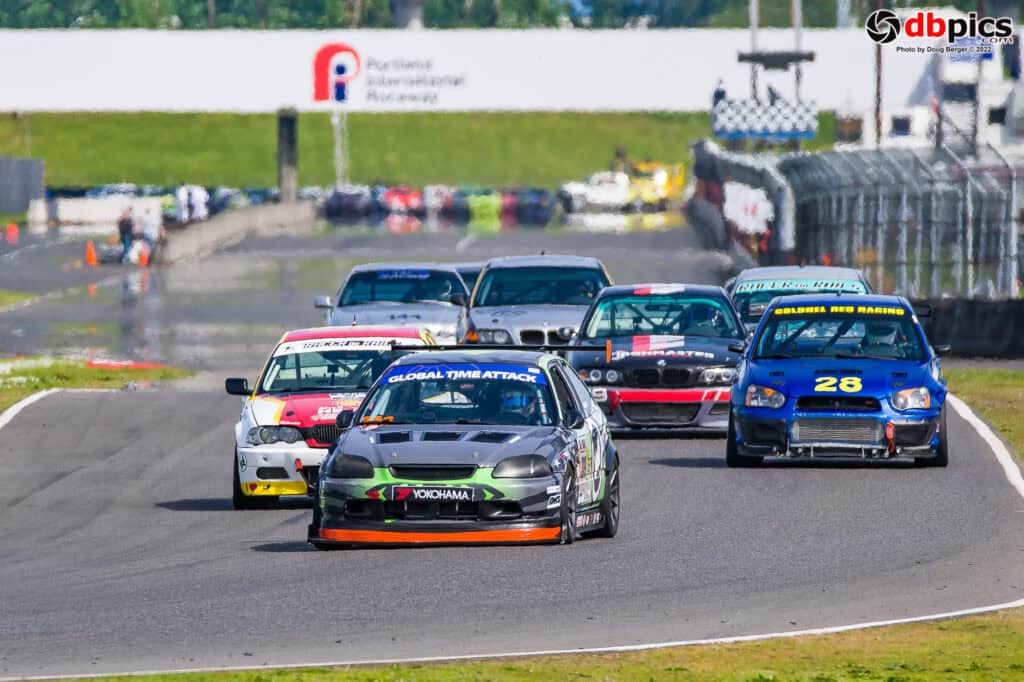
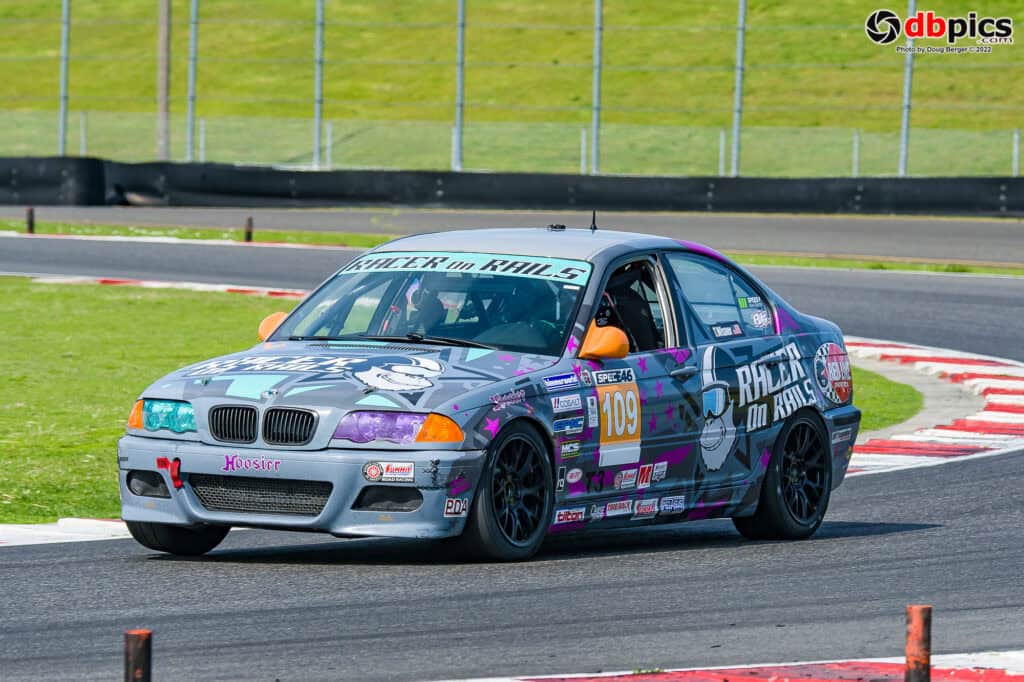
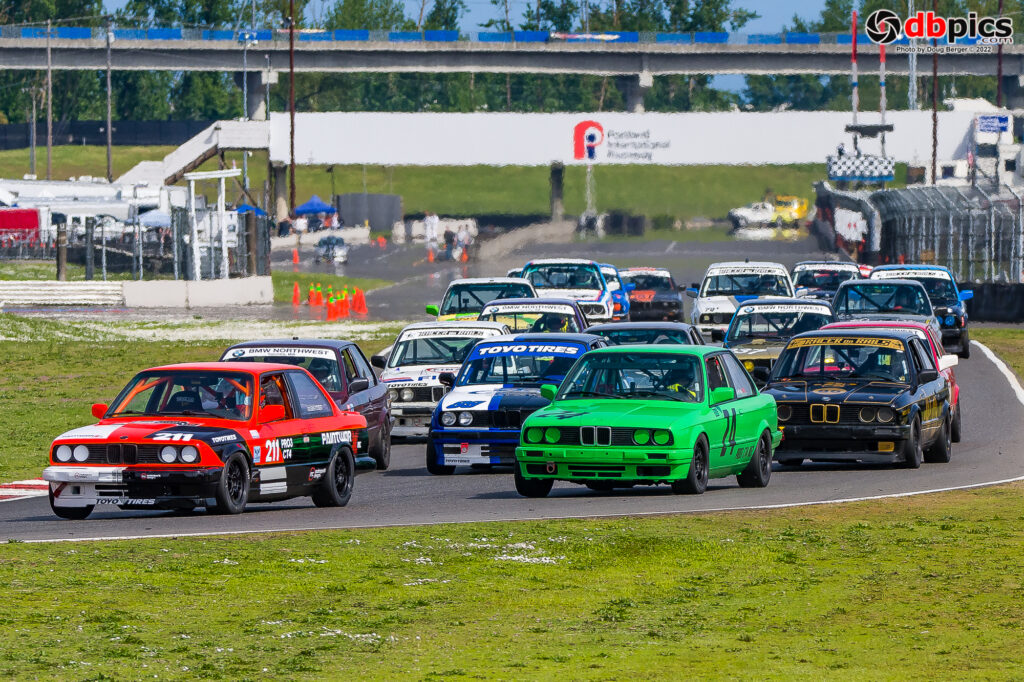
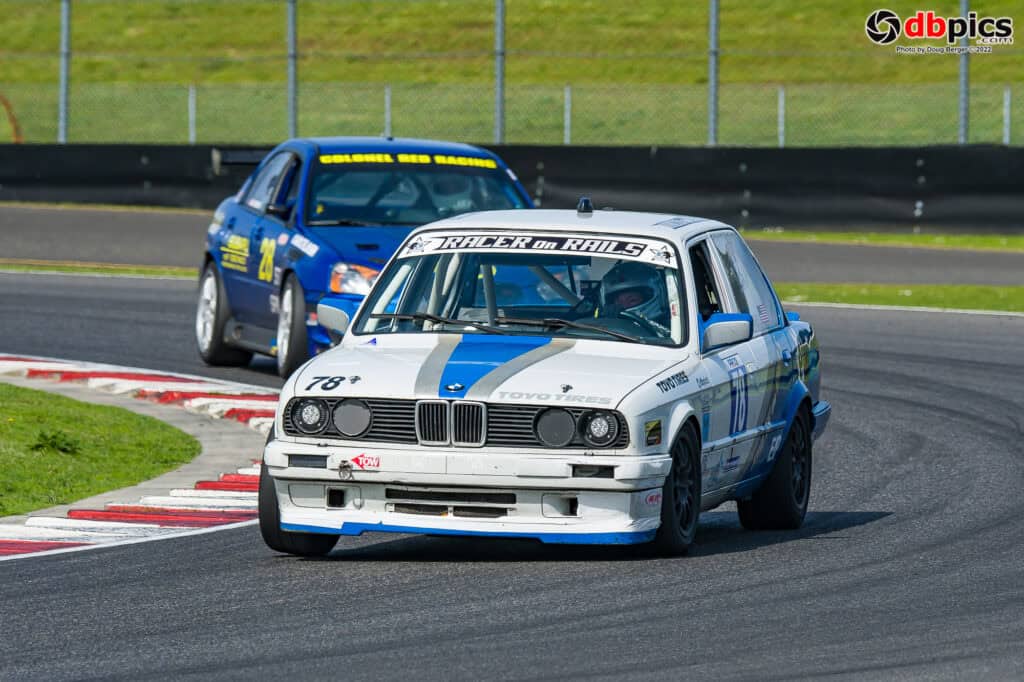
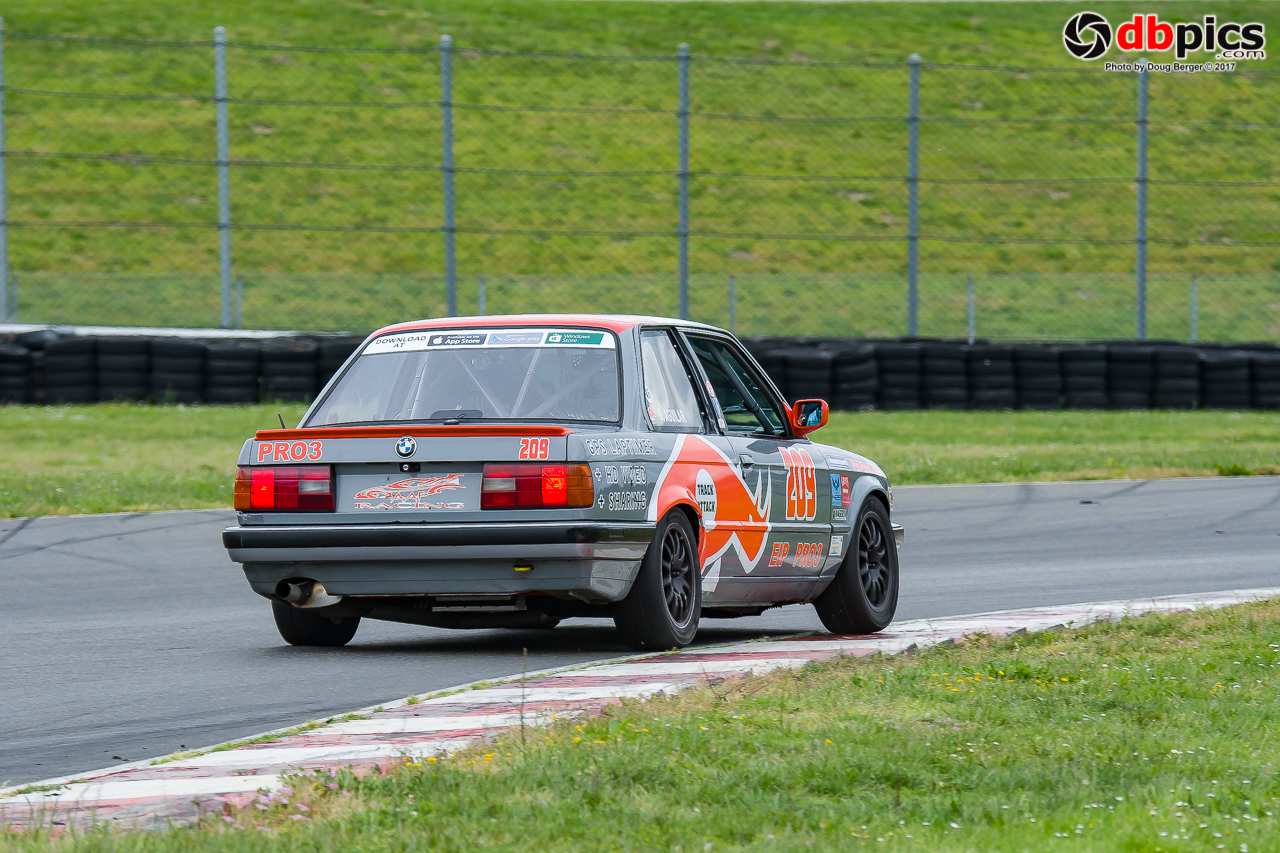
Ron Tanumera driving through the PIR festival chicane in the Racer on Rails BMW PRO3 race car.

Portland International Raceway has a way of making club racing feel bigger than the lap chart.

Maybe it is the setting. PIR sits inside Delta Park in North Portland, tucked into one of the more unique pieces of motorsport geography in the country. Long before it became a racetrack, the land was Vanport, a wartime city built to house Kaiser shipyard workers during World War II. At its peak, Vanport was home to nearly 40,000 people and was the second-largest city in Oregon. In 1948, the city was destroyed by flooding. Years later, the remaining street grid helped form the bones of what would eventually become Portland International Raceway, with the first Rose Cup race held in 1961.

That history matters. PIR is not just another track carved into an empty field. It is a public park, a community gathering place, and one of the great regional motorsports homes in the Pacific Northwest. It is flat, fast in places, technical in others, and just awkward enough to reward drivers who can get the car rotated, settled, and back to power without wasting motion.

For this weekend, Racer on Rails returned to PIR with Cascade Sports Car Club for an ICSCC Conference race weekend, The Dash for Kids XLII.

For anyone newer to Northwest club racing, ICSCC, often simply called “Conference,” is the International Conference of Sports Car Clubs. Founded in 1957, it is an association of independent sports car clubs across Oregon, Washington, and British Columbia, and it remains one of the core regional racing structures in the Pacific Northwest. One of the things that makes Conference special is that it is very much club-powered. Drivers are represented through their member clubs, and those clubs participate in the governance of the series. It creates a regional racing culture that feels practical, involved, and very connected to the people actually building, towing, fixing, flagging, and racing the cars.

Cascade Sports Car Club is one of those foundational clubs. Cascade began in 1953 as the 4-Cylinder Sports Car Club of Oregon, changed its name to Cascade in 1956, and has grown into a club with a year-round schedule that includes track days, driver education, road racing, rallies, and volunteer support for major events at PIR.

The Dash for Kids is one of Cascade’s signature weekends. It blends Conference championship road racing with a community charity event, including race car rides, paddock access, family activities, and fundraising for local organizations. The 2026 event marked the 42nd running of The Dash, with race car rides offered during lunch on Saturday and Sunday for donations to the charity.

That meant this weekend had two lanes of purpose for us.

One lane was competition and development.

The other was community.

And, by the end of the weekend, we got a full serving of both.

The Racer on Rails Plan

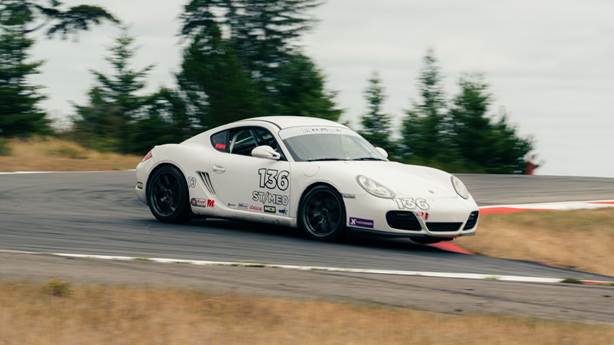
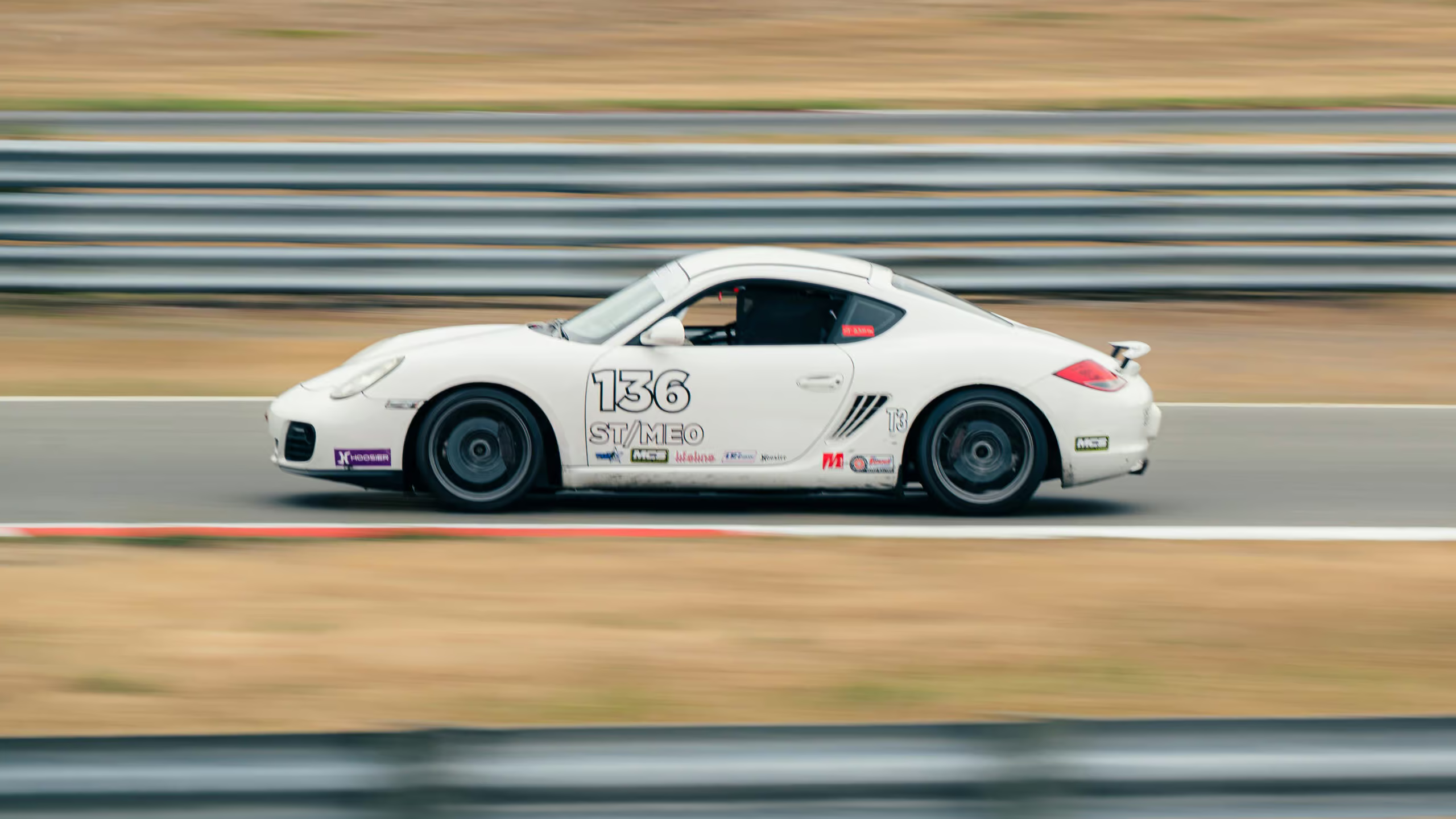
Originally, we expected to have three drivers on the weekend but one driver had to bow out last minute which left us with two primary competition programs. The silver lining was that open third slot gave us an opportunity to bring out the Racer on Rails #136 Spec E46 race car to give some lunch time charity rides! Can’t complain about that!

For Ron, the goal was not results-first. The goal was development-first.

Ron’s larger arc this season has been about building the kind of adaptable driving skill that transfers across platforms. He has driven Spec E46, the Porsche Cayman GT4, Spec Racer Ford 3, and now PRO3. The long-term objective is not simply to be fast in one car. It is to become the kind of driver who could step into an endurance team environment and be trusted: aware, consistent, confident, mechanically sympathetic, and able to keep the car in a competitive window.

That is a very different target than chasing a single lap time.

PRO3 is an excellent tool for that kind of work.

The class began in the Pacific Northwest in 2002, growing out of a group of BMW E30 racers and friends connected to the Puget Sound BMW CCA scene. It has since become one of the strongest amateur racing classes in ICSCC, the PNW, West Coast and if the group raced nationally, it would be one of the largest racing classes at any weekend, with large grids and deep competition.

It also has a very specific personality. People often casually describe PRO3 as a spec class, and while the rules are restrictive, it is better understood as a tightly controlled, Improved Touring-based formula. The cars are BMW E30 325i chassis with stock M20B25 engines, controlled tires, and rules designed to keep the emphasis closer to the driver ability end of the spectrum rather than spending or exotic development.

More importantly, they are analog. No ABS. No traction control. No stability control. Many cars run without power steering. The braking window is narrow, the tires are easy to over-ask, and the car will absolutely tell on you if your inputs are sloppy. That makes PRO3 one of the best classrooms in Northwest racing.

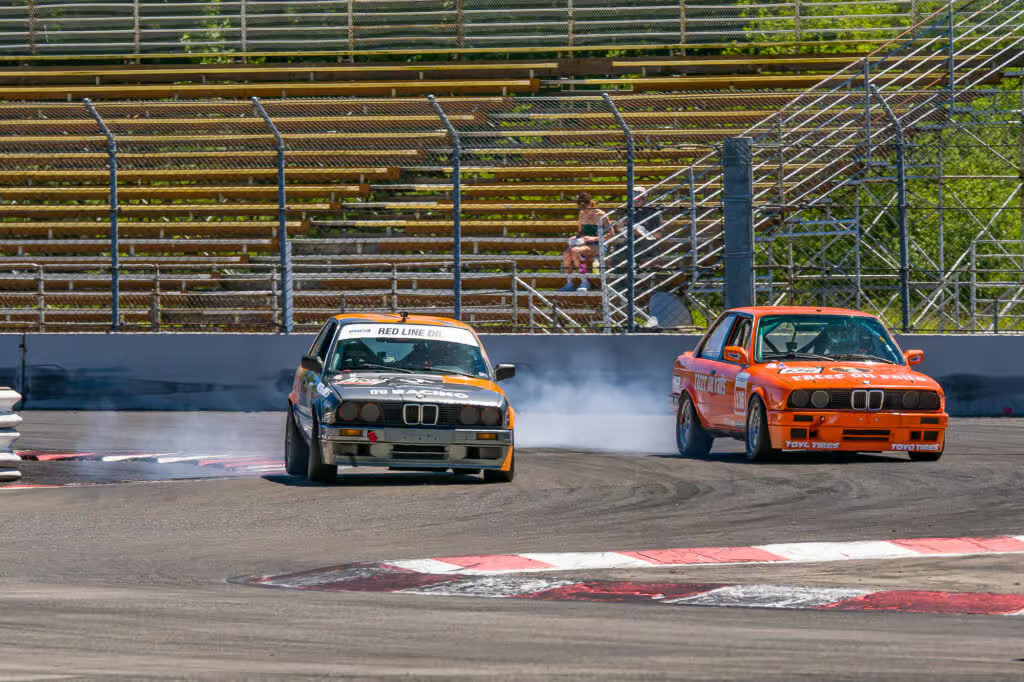
John Hoolihan and Ron Tanemura demonstrating just how analog the PRO3 race cars - locking up going into T1 at PIR.
John Hoolihan and Ron Tanumera demonstrating just how analog the PRO3 race cars – locking up going into T1 at PIR.
(C) 2025 Doug Berger | DBPics

It is also where Gama started racing, and that matters. We have seen it again and again: drivers who can run at the front in PRO3 tend to carry that skill into almost anything else they drive. It teaches commitment, car control, racecraft, mechanical sympathy, and humility. The car is not going to save you. You have to do the work.

For Gama and the 370Z, the weekend had a different purpose. This was a test event for the SCCA Runoffs at Road America later in the year. On paper, PIR and Road America do not look like twins. Road America is longer, faster, and more dramatic, with far more elevation change. But from a setup and systems-testing perspective, PIR still gives us useful information.

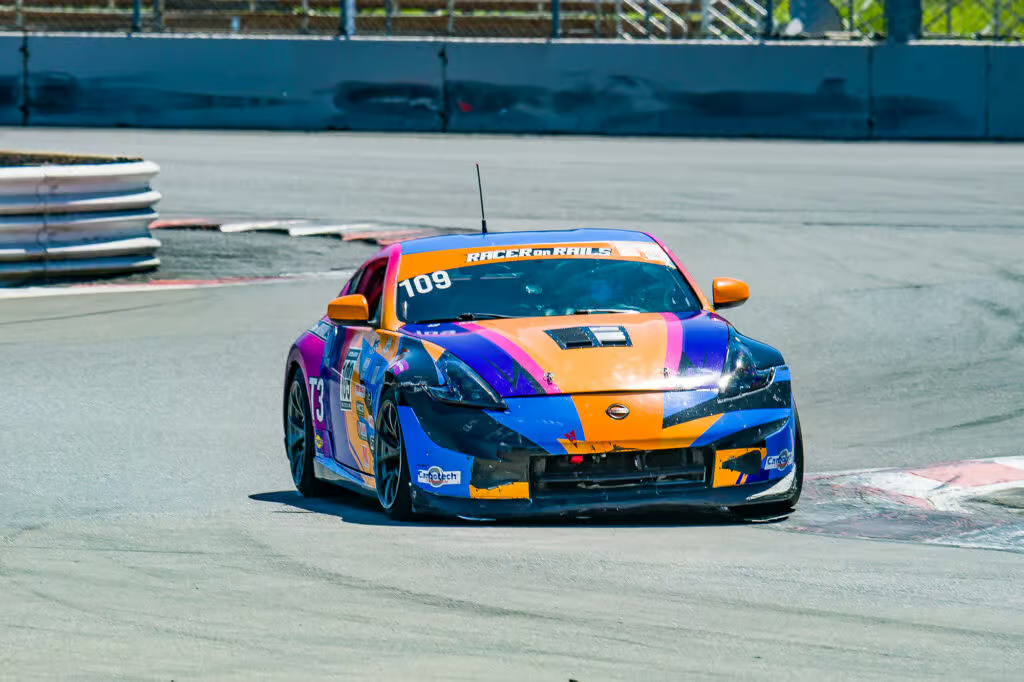
Gama Aguilar bombing through the PIR Festival Chicane in his 2011 Nissan 370Z Nismo road race car, running in SCCA Touring 3 Specification.
(C) 2025 Doug Berger | DBPics

PIR’s flatness, surface, braking zones, and mechanical-grip demands make it one of the best regional proxies available to us. It would not answer every Road America question, but it could answer some important ones: Do we have real pace? Can the car stay cool? Can we run hard in race conditions? Can we trust the package over a longer stint?

With hot weather forecast in the mid to high 90’s Fahrenheit across the weekend, those questions became even more relevant.

Friday: Promise for the Z, Trouble for the PRO3

Friday test day split into two very different stories.

For the 370Z, the car felt good right away. Track space was limited, and with traffic it was difficult to build a truly representative lap, but the underlying feeling was positive. The plan became straightforward: use Friday to get the car into its window, then put on a new sticker tire set Saturday morning and take two shots at qualifying.

The first shot would come in the morning mini-enduro qualifying session.

The second shot would come in Group 4, where Gama had also entered in ST. Group 4 had faster big-bore traffic, but fewer cars overall. That gave us a better chance of finding the clean air needed to see what the car could really do.

Ron’s Friday was much less tidy.

The PRO3 car developed shifter issues, possibly tied to a deeper transmission issue (Note – We would later confirm the transmission itself was healthy; the shifter issue was the real culprit). Rather than force the car through a compromised test day and risk making things worse, the team made the right call: park it early, diagnose what we had, and prepare to get Ron back on track Saturday.

That kicked off one of those classic club-racing logistics adventures.

Mitchell drove back up to Seattle on Friday evening, grabbed the spare transmission from the shop, and headed back down early Saturday morning. By 7:00 a.m., the team was back under the lift, working to get the transmission into the car and get Ron back in the fight.

No velvet rope. No magic wand. Just people, tools, caffeine, and the quiet soundtrack of “well, this is what racing asks today.”

Saturday Morning: Thrash, Traffic, and One Clean Lap

The team got the PRO3 car back together Saturday morning, but the shifter assembly continued to fight back. It had come loose and was operating strangely enough that even after the transmission swap, there was still work to do.

The good news: the team got it functioning.

The bad news: Ron missed qualifying for both Saturday races.

That meant he would start from the back.

For a driver-development weekend, that is not always a bad thing. It is not convenient. It is not ideal. It definitely makes the day louder. But it gives a driver exactly the kind of work that cannot be simulated cleanly: traffic, starts, passes, imperfect rhythm, and the need to adapt to the car you have rather than the car you wish you had.

Meanwhile, Gama rolled into Saturday morning qualifying on new tires hoping to get a clean representative lap in the 370Z.

That part did not go to plan.

By the time we got to pre-grid, there were already more than 25 cars lined up. The decision was to go to the back and create space, but with 50-plus cars on track, including a large Spec Miata field, there simply was not enough clear racetrack to put the lap together. Then the session ended early due to an incident.

So we waited for Group 4.

This time, the track-space plan finally worked. Fewer cars. Faster traffic. A better rhythm. And then, finally:
1:23.592.

https://www.instagram.com/reel/DZnKfwEgRnP

That lap put Gama P9 overall in Group 4 qualifying and P1 in ST. More importantly, it gave us the first clean signal that the 370Z had real pace in the package.

Was it perfect? No.

There was still time left on the table. Based on feel, predictive timing, and the work Gama and Tyler had done around the car’s potential, the estimate was that a 1:23.2 was likely available in that session. With a cleaner sticker-tire run and a true max-effort qualifying format, the team believes a 1:23.0, and possibly even a 1:22.8, was realistic, even in with temperatures already at 80F by 9am.

But for the goal of the weekend, the message was clear: the car had the nationally competitive pace we expected.

Now we needed to find out if it could survive the heat.

Ron Starts at the Back and Gets to Work

Ron’s Saturday was the kind of day that can turn into a throwaway if the driver lets it.

He did not.

After missing qualifying, he started from the back in Group 2 and worked his way forward to P10 in a 22-car PRO3 field, with a best lap of 1:31.721.

Then he backed it up in Group 5, finishing P5 in CT4 with a best lap of 1:31.210.

That was a big deal.

Not because P10 or P5 are magic numbers by themselves, but because of how he got there. Ron had to adapt after a messy mechanical start to the weekend. He had to race from the back. He had to get close to other cars, work through battles, and keep the car moving forward.

Ron making moves early in the Group 1 PRO3 race, starting from the back.
Ron making moves early in the Group 1 PRO3 race, starting from the back. (C) 2025 Doug Berger | DBPics

This is exactly the kind of growth we wanted from PRO3.

In clean air, drivers can work on lap time. In traffic, they have to work on craft. Portland forced Ron into the craft side of the ledger, and by the end of Saturday he was not just circulating. He was racing people. He was putting the car in places that mattered. He was becoming more comfortable with the car moving around underneath him.

That is the good stuff.

Not shiny, not always obvious from the outside, but very real.

The 370Z Race: Pace Confirmed, Cooling Not Yet Solved

Saturday afternoon, the 370Z lined up for the Group 4 race.

The goal was not necessarily to chase the race result. The goal was to run the car hard in heat and see what we had from a reliability and cooling standpoint.

The afternoon temperatures were already brutal, climbing from around 90 degrees toward the mid-90s as the race went on. That was useful. We are unlikely to see those exact conditions at Road America in early October, but that was the point. If the car could stay cool at full tilt in this environment, we would have a lot more confidence heading into the Runoffs.

Unfortunately, the race showed us that there is still work to do.

Early on, the car was running normally in clean air. Then, after a full course yellow around six or seven laps in, water temperature warnings started to appear. The car was not done, but it was no longer free to race at full attack. Gama had to manage it with lift-and-coast into braking zones, short-shifting around 7,000 rpm, and rolling back into throttle more gently than normal.

That kept the car alive and allowed us to finish, winning ST with a best race lap of 1:24.826.

But the result was not the lesson.

The lesson was that if we had needed to battle hard, defend, attack, or run nose-to-tail for position, we would have been compromised. The pace is there. The car is closer. But the cooling system still needs more margin before Road America.

Gama Aguilar bombing through T1 at Portland International Raceway in his Nissan 370Z Nismo.
Gama Aguilar bombing through T1 at Portland International Raceways in his Nissan 370Z Nismo. (C) 2025 Doug Berger | DBPics

That was valuable information.

We had also entered the one-hour mini enduro, which would have been the closest proxy for the 45-minute Runoffs race distance. But with the car already showing heat-management limits, and with the afternoon only getting hotter, there was no reason to keep poking the dragon with a torque wrench.

We had learned what we needed to learn.

The team made the call to park the car for the rest of the weekend. The official results show the 370Z as a DNS for the mini enduro, which was exactly the right decision.

Sometimes the smartest lap is the one you do not run.

Sunday Morning: Ron Finds Another Gear

Sunday morning was Ron’s chance to reset.

The car was back. The conditions were better than they would be later in the day. The goal was to make the most of the cooler track before the heat came in.

Ron got after it.

In Group 2 qualifying, he dropped into the 1:30s with a 1:30.946, good for P11 in PRO3.

Then, in Group 5 qualifying, he put together a 1:30.554 and qualified P1 in CT4.

Pole position. 💪🏾

The first pole position of Ron’s driving career. Let’s go!!!

Ron getting after it through the festival chicane.
Ron getting after it through the festival chicane. (C) 2025 Doug Berger | DBPics

That moment deserves to breathe a little.

Ron’s weekend started with the car parked early, a transmission run to Seattle, a Saturday morning thrash, missed qualifying, and back-of-grid starts. By Sunday morning, he had settled himself, kept building, and put the car at the top of the CT4 sheet.

That is not just pace. That is resilience.

And in a PRO3-based car, it means something. These cars do not give you lap time for free. You have to ask the right questions with your hands, feet, eyes, and timing, then listen carefully when the car answers back.

Ron was getting more comfortable throwing the car around. More comfortable letting it move. More comfortable staying in the fight when the environment got messy.

That is the development arc.

Sunday Afternoon: Racing in the Skillet

By Sunday afternoon, PIR was hot.

Very hot.

Air temperatures were deep into the 90s, with track temperatures well above 130 degrees. No one was expecting record pace in those conditions. This was about execution, racecraft, and keeping the car underneath you while everyone else was dealing with the same greasy, overheated racetrack.

In the Group 2 PRO3 race, Ron had challengers all around him. That is what happens when you start to make your presence known. People race you differently. They expect you to be there. They fight harder.

Not an inch to give in PRO3 racing, little mistakes have big time costs.
Not an inch to give in PRO3 racing, little mistakes have big time costs. (C) 2025 Doug Berger | DBPics

Ron started in position, battled early, and kept working through the race. He got past the group he had been racing with the day before and finished P8 in PRO3, only a couple of seconds behind the next cluster of cars up the road. His best lap was a 1:31.354 in the heat.

P8 in PRO3 is nothing to sneeze at.

That mid-pack and front-mid-pack zone in PRO3 is filled with serious drivers. In a class that deep, moving from “learning the car” into “competing with the pack” is a meaningful step.

Then came the Group 5 CT4 race.

Starting from pole, Ron got mugged at the start and had to fight for the rest of the race with Payden Baxter and Matthew King. It turned into exactly the kind of race he needs more of: pressure, passing, defending, imperfect lines, and decisions that had to be made quickly.

He finished P3, on the podium, with a best lap of 1:31.164. That was barely off his Saturday CT4 race pace and impressively close to his cooler-session qualifying benchmark, considering the heat.

Mega.

A first pole. A podium. A P8 in PRO3. A weekend that began with mechanical drama and ended with real signs of competitive belonging.

Awesome work, Ron.

More Than Lap Time

The biggest thing from Ron’s weekend is that the progress was not just numerical.

Yes, the lap times improved. Yes, the results got better. Yes, he put the car on pole in CT4 and ended the weekend with a podium.

But the more important part is that he had to keep the fundamentals alive when the racing got loud around him.

That is one of the hardest transitions for any developing driver. It is one thing to drive well in clean air when the plan is simple. It is another thing to drive well when someone gets alongside, a start gets messy, the car moves underneath you, or a pass does not happen in one corner.

Portland gave Ron a full buffet of those moments.

The next step is making that craft more deliberate and more repeatable. Not just being fast, but being able to access the driving under pressure. Not just getting close to cars, but knowing what to do with that closeness. Not just reacting to a battle, but shaping it.

That is exactly why we wanted him in PRO3.

Dash for Kids: The Other Reason We Were There

While the racing side of the weekend gave us plenty to work through, The Dash for Kids gave the weekend a bigger frame.

During lunch on Saturday and Sunday, racers and teams offered ride-alongs in race cars and exotic cars, with donations going toward the weekend’s charity. Cascade’s format makes the paddock feel open and welcoming, with spectators able to see the cars, talk with drivers and crew, and get a closer look at the machinery that usually flashes by from the other side of the fence.

For Racer on Rails, that meant bringing down the Silver Bullet Spec E46, installing the extra seat, and joining the ride program.

After making the decision to park the 370Z, that actually became a perfect pivot. The competitive work was done. The car had told us what we needed to know. So instead of forcing more laps into worsening heat, we cooled down, reset, and had fun giving people rides around PIR.

That is a good race weekend.

Not because every plan worked perfectly. It did not.

Because the weekend gave us the right answers.

The 370Z showed pace, then showed us the next engineering problem. Ron got hit with mechanical adversity, then turned the weekend into one of his strongest development steps of the year. The team handled a transmission swap, shifter issues, hot conditions, traffic, race starts, and charity rides.

That is club racing in full color.

Final Takeaways

For Gama and the 370Z, Portland confirmed that the car has real speed. The 1:23.592 in Group 4 qualifying was the cleanest read of the weekend, and the team believes there is more available with a true max-effort qualifying format and cleaner track space. But the race also confirmed that cooling remains a priority before Road America. The car can run. The car has pace. Now it needs more thermal margin.

For Ron, Portland was a major step.

He missed Saturday qualifying, started from the back, raced forward, kept improving, put the car on pole for the first time in his driving career, finished P8 in a very competitive PRO3 field, and ended the weekend with a CT4 podium.

More importantly, he became a little more of the driver he is working to become.

Adaptable. Confident. Aware. Comfortable in the fight.

That is what we came for.

And with The Dash for Kids wrapping the weekend in community, ride-alongs, family energy, and a reminder that racing can be both serious and generous, Portland gave us exactly the kind of weekend that sticks around after the trailer doors close.

Goals. Smiles. Memories.

That one checks all three.

Posted on

Race Report 5 & 6: Portland International Raceways – Finally!

And we’re back from the winter 2022 trip with four race weekends under our belt, at new tracks for most of us and ready to come back to familiar ground where nothing would be easier but instead the challenges would be different.

This is post will cover two race weekends as we were at Portland International Raceways April 29 – May 1 for the ICSCC season opening race (Rose City Opener, hosted by Cascade Sports Car Club) and then back again two weeks later, for the SCCA Hoosier Super Tour stop, a part of the US Majors Tour.

Home track advantage

Wait, aren’t most of the people who race at these events, also from the region? For the ICSCC race – absolutely. A little less for the Hoosier Super Tour but that’s not exactly what we mean here. One of the many challenges of each of the stops on the winter trip was that even though we spent countless hours on the simulator training for each track, and it made a massive impact – we were still driving the tracks either for the first time or the first time in the specific race car each of us were driving.

That’s not a BMW or Porsche?!?!? Gama taking the EK Honda Civic with a K24 swap out for it’s maiden race weekend at a known and comfortable space – Portland International Raceways. Photo credit: Doug Berger

That means that at minimum, some material amount of our mental capacity was still being allocated for learning the track. That also means less mental capacity to think about improving on a specific corner or to focus on race craft.

So what happens when you get to a track that you’ve driven hundreds, if not thousands of laps on in real life, simulator and in a variety of conditions and cars? All that occupied mental capacity (and some), comes back and becomes available to be used on another area of improvement. That could be anything from fine tuning a specific setup component for given conditions, exploring different lines/entry speeds into a corner or working on race craft.

It could be anything but the bottom line is that the ability to learn and improve is simply easier because there is one big important thing to think about much less.

So what happened? New Personal Bests All Around!

The ICSCC weekend was held using the non-chicane configuration which further simplifies the course and results in really only ~7 corners total.

Ann in the Porsche Cayman GT4 Clubsport – Finally!!!

Ann in the Porsche Cayman GT4 Clubsport had never driven PIR without a chicane but we had a sense of what her pace would have been from her lap times at Portland last August (2021) with a chicane.

This would also be Ann’s first time driving on Hoosier A7 tires. Results? Ann immediately jumped into the 1:13’s early in the weekend and while she was able to sustain that pace, it looked like there was more low hanging fruit.

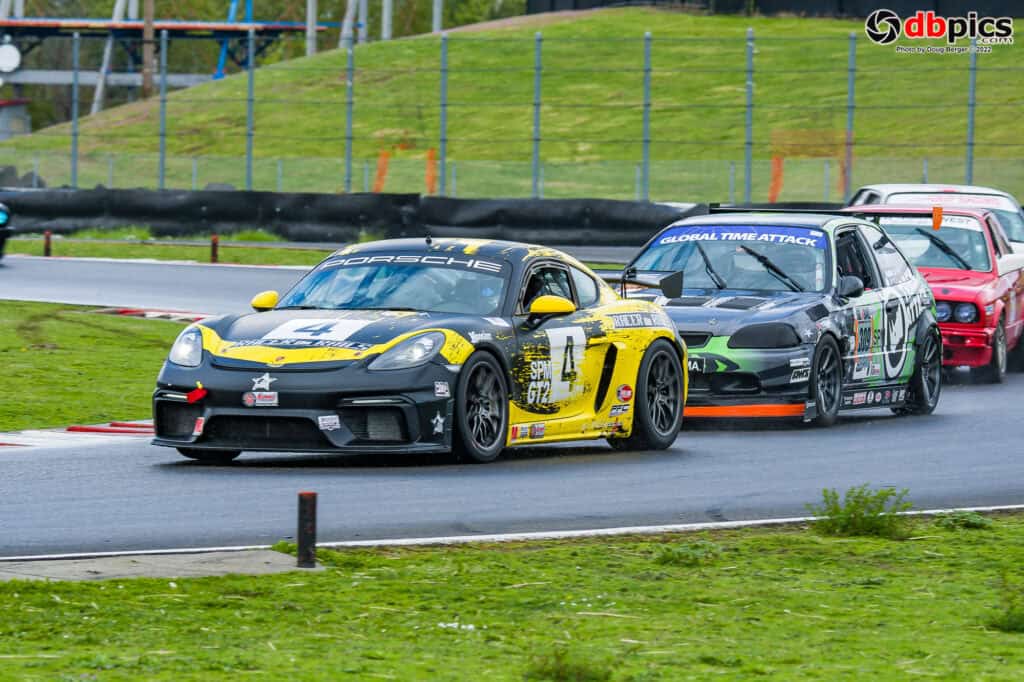
One of these is not like the others. Ann Doherty in her Porsche Cayman GT4 Clubsport crashing the GT1 class party.

In the Group 4 race, where she was in the middle of GT1 class cars — You read that correctly, while she was competing in the GT2 class (there were only 2 cars in class that weekend), she was in the front half of the GT1 cars! She put her head down to defend and get as far up the grid as possible and she dropped into the 1:12’s with a scorching 1:12.842. In that race, she would have finished in P3 overall and P3 amongst the GT1 class cars.

And the prior days Group 1 race, when the race started in wet conditions and transitioned to somewhat dry conditions, she was P1 overall and lapped almost every single car except the EK Honda Civic (driven by Gama and more on that below)… twice!

Mega, mega, mega drive by Ann.

Cascade Sports Car Club – Rose City Opener XXX at Portland International Raceway | Ann (#4) and Gama (#309) lapping every single car in the field one time and lapped almost every car a second time before finishing P1 and P2 overall and in SPM class. Photo credit: Doug Berger

When we returned two weeks later for the Hoosier Super Tour event May 13 – 15, the goal was to build on the gains from the first PIR weekend to put it all to work against a stacked GT2 field featuring a Dodge Viper, TA2 Chevy Camaro, a few additional stock cars, nearly tube-frame chassis E46 M3 and even a Porsche 997 Carrera Cup car!

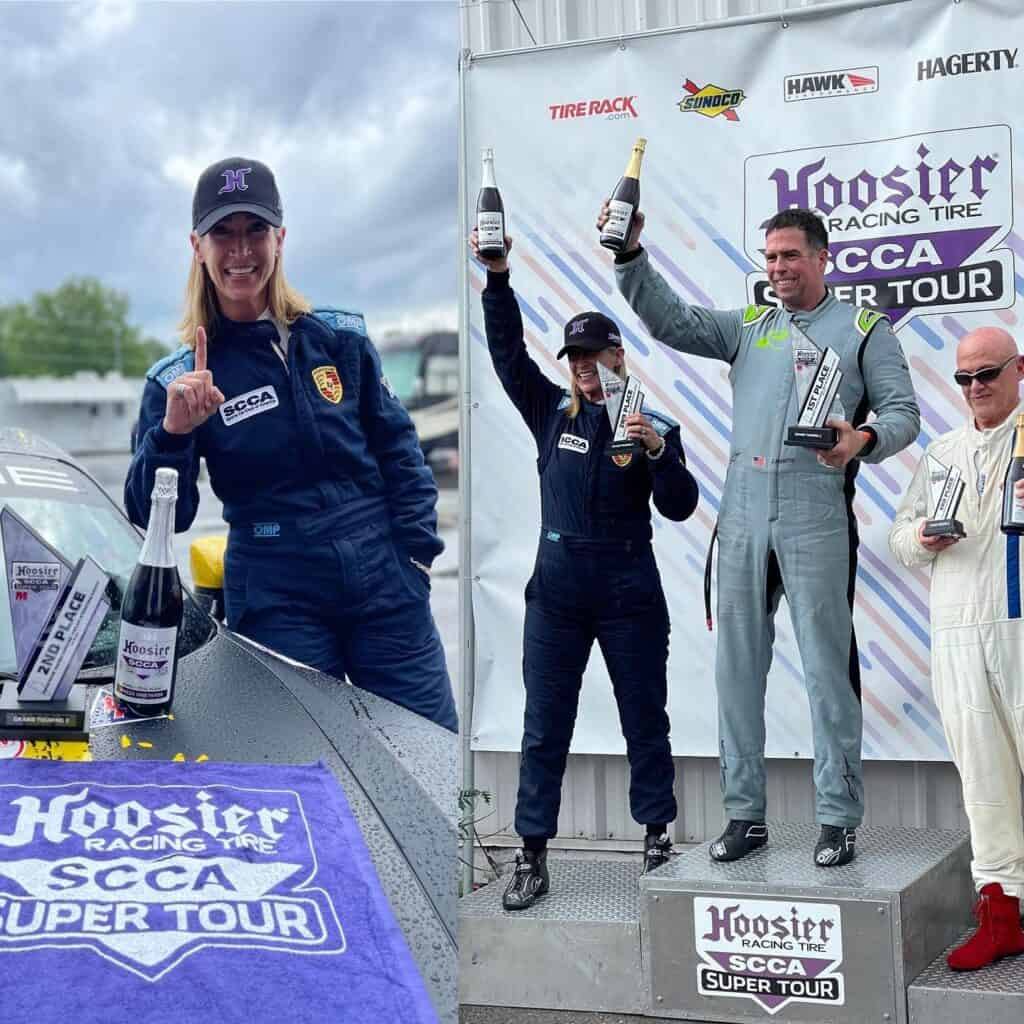
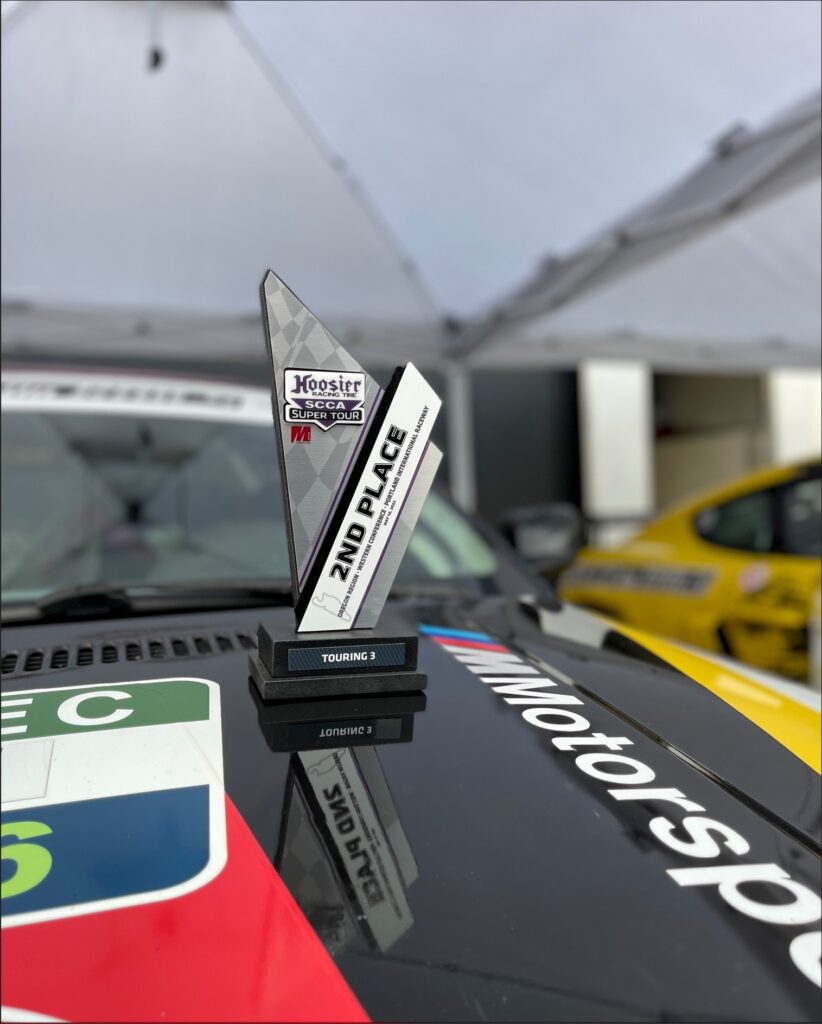
Results? Even more gains and finally, finally – Ann’s 1st SCCA Hoosier Super Tour podium (P2) came on Sunday afternoon’s final race in complete downpour conditions. In dry conditions? Ann improved her personal best lap time by 4.5 seconds from the prior August – incredible progress! In clear air, Ann was competitive for podium contention but in the race, the straight line advantage for the more powerful cars was simply too much for her to keep them behind her for the entire race distance.

So many close podiums in the first 4 races of the year but it finally all came together for Ann in Portland and in the rain.

Simon in the BMW 330ci Spec E46 running in SE46, Touring 3 and SPM

For Simon, we had done 8 Hour Enduro in his car last October and he had done mid-1:19’s here and there and average fast pace was in the high 1:19’s/1:20’s.

Similar to Ann, Simon was immediately on the pace, consistently in the 1:19’s, along with a few other Spec E46 cars but by the end of the weekend, Simon was one of only two Spec E46’s to drop into the 1:18’s and separating himself from the pack of Spec E46’s and closing the gap to Chris Hart, who is an incredibly fast, consistent and national caliber driver. Chris placed P3 in the 2021 SCCA Runoffs in Touring 3 class, past PRO3 champion and spent many years driving stock cars professionally – this guy can wheel!

Simon in the hunt, looking for a way around a turbocharged Subaru WRX STI in the Group 1, SPM race. Photo credit: Doug Berger

During the SCCA Hoosier Super Tour stop, Simon similarly built on his gains from the first weekend and was immediately doing 1:26 lap times – improving his past personal best but on Hoosier Tires versus Toyo Proxes prior. About mid-day on the test day, we did a lead follow session with Simon and I (Gama) with first Simon leading and Gama following – doing mid to low 1:26 lap times and then we switched. Simon was able to follow closely and we both consistently did mid to high 1:25’s – BOOM! New personal bests and now having done lap times that are at the very pointy edge of the Touring 3 and Spec E46 field.

Saturday, Simon qualified on pole for his first Hoosier Super Tour pole position and in wet conditions! During the race, we had dry conditions so at the start Gama got in front of Simon and Chris Hart. About 4-5 laps into the race, Chris had an overheating issue and DNF’ed while Chris, Gama and Simon were running almost nose to tail.

After Chris pulled off track, Simon stuck to the rear of Gama’s bumper and finished P2 for another Hoosier Super Tour podium finish!

Simon’s 4th podium of the year and currently leading the Hoosier Super Tour points standing in Touring 3 (with Dave in 2nd place)

Unfortunately a failing lower ball joint was found in Simon’s car post-race and due to not having press tools at the track, that ended his weekend.

Simon leading a pack of ground pounders through Turn 12 at Portland International Raceways. Photo credit: Doug Berger

Dave skipped the first ICSCC Portland race and drove at Pacific Raceways during our second stop at PIR.

But wait – there were a lot more cars in the Racer on Rails Paddock(s)!

Now that we’re in the thick of the PNW racing season, the SCCA US Majors and Hoosier Super Tour races start to die down (races are still held but mostly out of our region) and we start to dial up the races from our local sanctioning body, the International Conference of Sports Car Clubs (ICSCC).

For the Rose City Opener, we had our group of PRO3 drivers out for their first race of the year and I (Gama) brought out a personal passion project for it’s second race weekend but it’s first with the current power plant – a JDM K24A swap with a JDM Honda Integra Type R transmission and a pretty heavy duty Limited Slip Differential from MFactory.

At a familiar place, the goal with the Honda was to simply get some race mileage on the new chassis, make sure it was running properly, figure out what likes to shake loose and see if we could put down some consistent competitive laps at 80-90% effort. And boy did the Honda deliver!

That little K24A Honda Civic, leading the pack (aside from Ann who had checked out in her Porsche Cayman) to Turn 1 at the start of the SPM Sunday afternoon race. Photo credit: Doug Berger

We worked through some gremlins but with absolutely zero focus on speed, the Honda was consistently doing extremely fast Spec E46 lap times and on Yokohama A052 tires (a really sticky street tire but nothing like a Hoosier tire). There is some serious potential in this car and we’re excited to further develop it over the season. It will be mid June before we see the Honda out again and it should have some new upgrades that will help with reliability and maybe a bit more speed.

Across the rest of the team, every driver improved their personal best lap times with no Chicane at Portland in a 20+ car field and pushing towards the front in PRO3 and a 10+ car field in Spec E46.

What better way to end this race report than with some in-car video of what a very angry Honda 4 cylinder engine based Civic sounds like, bombing around Portland International Raceways at the same speeds that a front running Spec E46 does?

Turn those headphones down a tiny bit and enjoy!

YouTube player
Gama in the #309 K24A Honda Civic Hatchback doing a low 1:18 lap time during Sunday AM qualifying.
Posted on

2019 Race Support Schedule

The staple of what we do is provide service to the racing community.  One of the primary aspects of that is to be at the track, to help you with the car set up and care, as well as trying to improve the performance of both you and the vehicle.  We want to announce and extend an open invite for those that are interested that we are here to help.  Our team has a calendar of events planned with room for additional support for each weekend as needed!  Our current ICSCC Conference as well as intended NASA NorCal events and SOVERN events will be listed below.  If there are any race weekends you would like some crew and coaching support for, please feel free to contact us via e-mail, phone or messenger!  Let us help you be your best on track!

Give us an E-mail or call to discuss options! raceronrails@gmail.com – (206)475-1114

ICSCC Conference Event Schedule:

  • April 19-21 (Fri-Sun) – Mission Race Way Park – British Columbia
  • May 3-5 (Fri-Sun) – Portland International Raceway – Portland, Oregon
  • May 10-12 (Fri-Sun) – Pacific Raceways – Kent, Washington
  • May 31-Jun 2 (Fri-Sun) – Spokane County Raceway Park – Spokane, Washington
  • Jun 14-16 (Fri-Sun) – Portland International Raceway – Portland, Oregon
  • July 19-21 (Fri-Sun) – Pacific Raceways – Kent, Washington
  • Aug 16-18 (Fri-Sun) Portland International Raceway – Portland, Oregon
  • Aug 23-25 (Fri-Sun) – The Ridge Motorsports Park – Shelton, Washington

SOVERN:

  • June 7-9 (Fri-Sun) – Spokane County Raceway Park – Spokane, Washington
  • July 5-7 (Fri-Sun) – Pacific Raceways – Kent, Washington
  • July 26-28 (Fri-Sun) – Portland International Raceway – Portland, Oregon
  • Sep 7-9 (Fri-Sun) – Portland International Raceway – Portland, Oregon
  • Sep 27-29 (Fri-Sun) – Pacific Raceways – Kent, Washington
  • October 5-6 (Sat-Sun) – Maryhill Hill Climb – Mary Hill, Washington

NASA NorCal:

  • Mar 15-17 (Fri-Sun) – Sonoma Raceway – Sonoma, California
  • Aug 2-4 (Fri-Sun) – Thunderhill Raceway – Willows, California
  • Sep 14-16 (Fri-Sun) – Mid-Ohio Sports Car Course – Lexington, Ohio

Current Unavailable dates:

 – Mar 3-4 (Sat-Sun)

– April  25-29 (Thus-Mon)

 – June 6-10 (Thurs-Mon)

 – June 22-25 (Sat-Tues)

 – July 11-15 (Thurs-Mon)

 – Aug 29 – Sep 1 (Thurs – Mon)

 – Sep 19-23 (Thurs-Mon)

 – Oct 17-21 (Thurs-Mon)

Posted on

Track Walk: The Ridge Motorsports Park

Welcome to The Ridge!  The Ridge is the newest track in the Pacific Northwest that is generally available to the public (Vancouver Island Motorsports Park opened recently but is a private track).

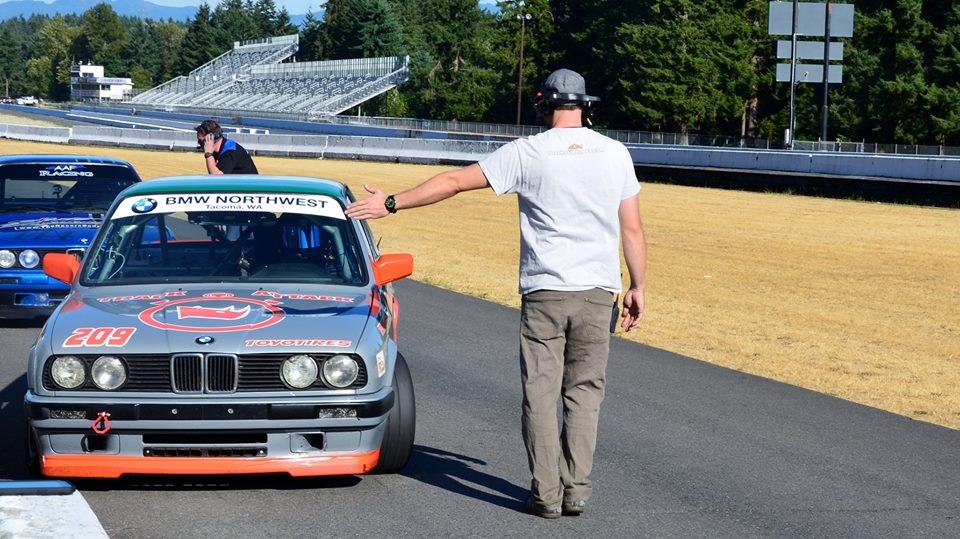
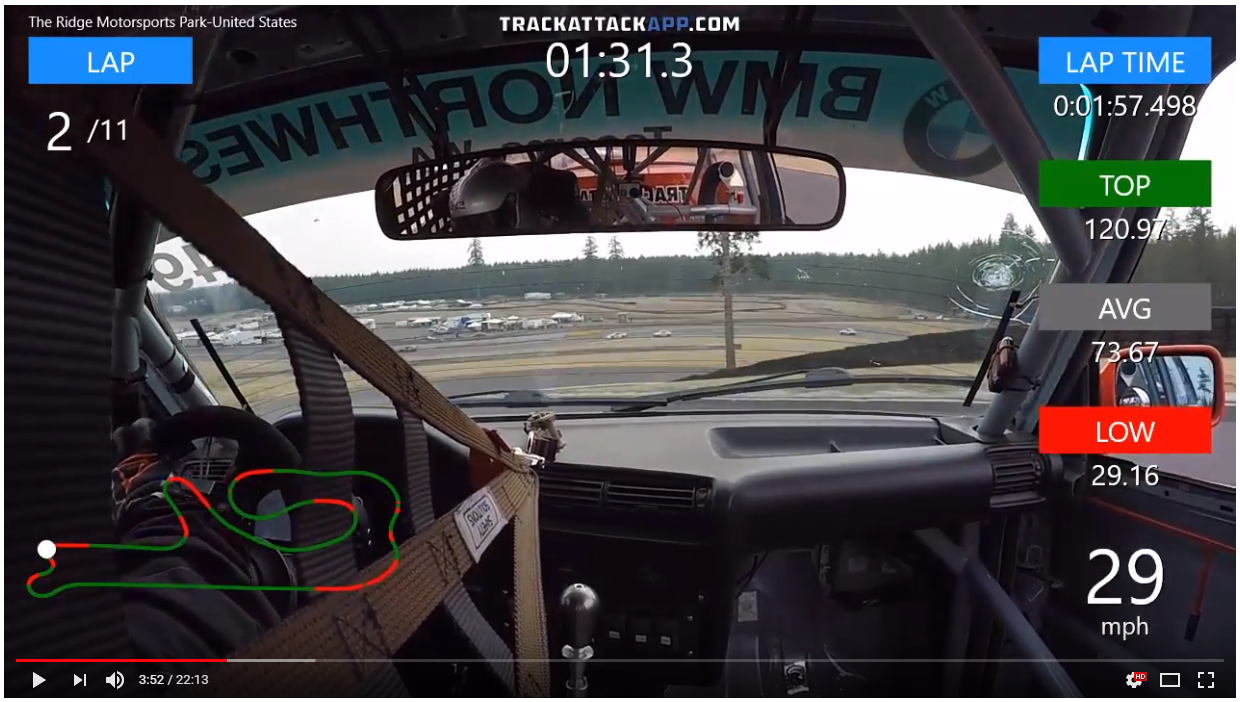
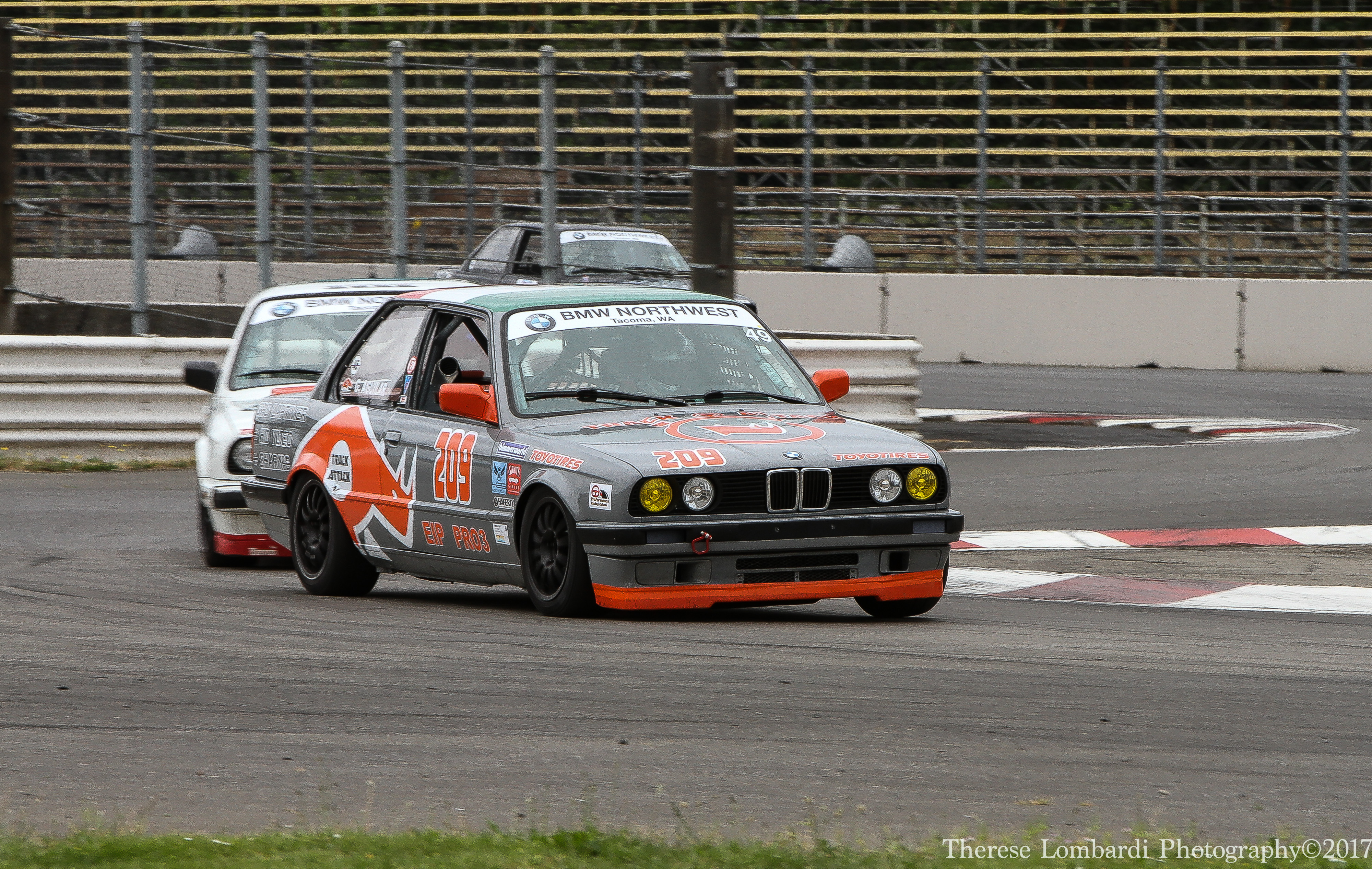
Similar to the Portland International Raceways (with a Chicane) track walk, we’ll use the Track Attack #209 PRO3 race car, a relatively low powered “momentum” car, to illustrate how to get around the track.  The session data we are  using for this is available here on Track Attack – feel free to request it.

We’ve also broken the track down into 6 segments, each segment is defined right before the major major braking/slowing down zones.

Braking a track down into sections, makes it easier for people ‘consume’ it and prioritize where to get focus.

Before you read on, watch this complete lap from a dry race in September of 2017.  Read the article and the re-watch the video.

YouTube player

Segment 1: The Uphill

This segment starts at s/f and goes all the way up to the first major braking zone (not including braking for T2) entering the Carousel.  The first thing here is that this segment is a 76ft climb in elevation.  The equivalent of an 8 story building.  Yeah.  So every single loss of mph as you make your way up the hill, will be penalized with a multiplier as you go uphill – keeping the momentum going is a top priority.

Momentum is important – check!  Turn 1 – get ready for a trouser check.  Turn 1, in some cars, can be taken flat, without lifting.  This is similar to T1 at Spokane but the distance between T1 apex and turn-in for T2 is not as long, so in cars that are faster than a Spec Miata, experiment with caution.  Personally, the most I’ve ever been able to get away with is a ~4/10 braking effort – just a tad more than a brush of the brakes, go back to tad of maintenance throttle and then back on the brakes, about the same amount for the downshift to 4th gear and then going back up the hill.

As you get the car past the apex of T2, it’s really important to get close to the curb of T3 but don’t take too big of a bite off of it, as it will send your car back to track-left, which is not the ideal line for the remainder of the complex.  Once you get to full-throttle, you absolutely cannot lift.  After T3, stay track-right, to setup a wide arch into T5 and then release the car to driver’s-right.  This whole time between T3 through T5, when you’re pinned to full throttle, you will feel the back end wanting to step out.  That’s ok – simple counter steering corrections (small ones), while staying flat, will take care of them.

After this, it’s smooth sailing to The Carousel – find a straight line to follow, that will set you up on track-right, for T6 (The Carousel), which is a long, flat left-hand sweeper.

Segment 2: The Carousel

This segment is just one corner.  Why?  It’s long and hard to get right.  This corner can be taken many ways but here is one that has proven well in racing and qualifying conditions.  Set yourself up track right but not necessarily right on the edge of the track.  Brake a little later than feels comfortable with a solid 6-7/10 effort and after the initial bite, start trailing off and turning into the corner, like if you were trying to double-apex the corner.

The backend may start to come out as you turn-in so get ready to catch the backend with some maintenance throttle.  Try to keep the car tucked in tight to the inside edge of the corner and if it washes out a little mid-corner, that’s ok and that just means you can back on throttle even more aggressively for corner-exit, because you don’t need as much steering input.

Don’t mind what looks like me driving off the course, that’s just a natural occurrence of margin of error of GPS signals and the stitching together of satellite images for maps.

About 35-40% through the corner, you want to be on-throttle and free here on out, you don’t lift.  Start your ascension to full-throttle and as you feel the backend come out, pause the throttle application and give it a steering correction but DO NOT LIFT!  For me, there is a single, tall tree out in the horizon of this corner and the instant I see that tree, I go full-throttle, no matter where I am.

From here, let the car release all the way to track-right, the very edge if needed.  A lot of people don’t get out here because they want to setup far left for the next segment and that’s a trade-off you can decide to make.

Segment 3: The Thumb

This is one of the trickiest parts of the track.  It combines a big compression and low-speed traction event at 8a and 8b but also a super hard, decreasing radius turn at T11 (aka The Thumb).

As you come out of The Carousel, it’s ok to stay driver’s left and then draw a straight line as you go downhill at 8a.  Stay on throttle until right before you feel the ground fall away, lift and synchronize the compression event with your braking.  When you do this right, you don’t need to brake as hard because the compression event gives more bite to front-end.  Downshift (if you have to), wait for the car to rotate a tick and then get back to maintenance throttle.  You want to get on full throttle here as quickly as you can but the sliding plus the acceleration means that it will be really easy to get on-power over-steer, so be aggressive but careful with your throttle application.  After you get to full throttle, it’s a full throttle ride all the way up the hill, which is another 36 foot climb (almost a 4 story building).  Every mph you unnecessarily drop or every split second of having to lift from throttle, will make you pay dearly at the top of the hill.

Where you brake for the thumb will be determined by the car and how fast you’re going.  In a PRO3 car, the engine is spinning at 6,500RPM and ~103mph and we wait to come off throttle just before the curbing on the left and are well into the brakes at those curbs.

You don’t need to track all the way to driver’s right to setup for the thumb, about mid-track is fine in most cars.  Next, is one of the hardest corners to get right – find the late apex and make it your job to hit that curbing with your LF tires.  Getting on those tires, in 3rd gear (in many cars, 2nd gear in Spec Miatas), means you can get on the throttle hard and have plenty of room on the exit of the corner.  Be ready for the car to wash out and go on the exit curbing and maybe even drop a rear tire on the exit of the corner but that’s ok – DO NOT LIFT!

Segment 4 & 5: The Ridge Straight

I’ve broken this segment into two segments because it contains two corners, which are taken very differently and I wanted to leave the last segment being the last corners before the front straight away.

First is the very deceiving Turn 12 right-hander.  It’s deceiving because you can actually car a good amount of speed here and the corner opens up quite a bit on the exit, which means there is a plenty of room for corrections if you maybe got on-throttle too early.

The trick here is to get to the apex and be on full-throttle at the apex.  There is a bump or bulge right at the apex, which will feel like it kicks your car away as you hit but get to full-throttle, stay in it and ride it out.  You’ll almost for sure have the car sliding a little just past exit – a simple steering correction will get it back under you and you can keep going.  Then start making your way over to track-right, to setup for the Ridge complex.

As you approach the corner, you’ll see that the ground starts falling away in the middle of the braking zone – YIKES!!!  This means you have to have your heavy braking done before the ground starts falling away.  Looking at the data, the drop-off is a 7 foot decline in elevation over a 150 foot distance.  150 feet when you’re travelling at 75mph, goes by pretty fast, so this is a split second decision.

As you approach turn-in for the corner, stay on the brakes ever so slightly, so that when you turn in full, the noise is loaded up and will help rotate the car.  It’s ok to bite off a little bit of the curb but don’t get over zealous.

Give it some throttle as soon as you get past the corner, turn for the right hander and stick to track-right as much as you can.  If at all possible, stay off the brakes but you might need to brush the brakes to help the front-end bite.

Segment 6: The Front Straight

The lap is almost over!  You’re barreling down the Ridge Complex, a nearly 80 foot drop and you need to decide what to do for the last corner before the main straight away.  There are couple school’s of thought:

  1. Geometrical fastest line: Swing out wide, carrying more speed because you have a wider arc, a single late apex at Turn 15 and then pin the throttle down until start/finish.
  2. Shortest distance line: Stay a little closer to the inside, use the banking in the corner, travel less distance and hit the apex of Turn 15 at the same spot.

This really depends on what kind of car you have and the track conditions on the outside of Turn 15.  In race weekends, that wide line isn’t used much, so there ends up being a lot of marbles out there.   Great for the rain but not for the dry.

At least in a PRO3 car, we have more grip than power, so as is with many of the other corners, the less distance we have to travel, the better so Option 2 is what you’ll see in the data.

Now, I can totally see an argument even for a PRO3 car to setup for a single flying lap to go super wide, throwing away the lap time for that current lap and setting up for a higher top speed going into Turn 1 or even setting up a competitor for a pass at the end of the straight.

You’ll see in the data that I’m on throttle about mid-corner and full-throttle at about 3/4 of the way of the corner.  After that, it’s about finding the straightest line possible through Turn 16 and the least amount of steering input all the way down the front straight away.

Conclusion: The Ridge is awesome.  Go drive it!

The Ridge is really a fun track.  Newer and well take cared of pavement and plenty of run off room in most corners.  You can get in trouble and it makes you pay but most of the time, it’s dirt and rocks on your car to go along with a bruised ego.

The facilities are constantly improving and with a motocross and a kart track that is a mini version of the big track, there’s few places that can compare.  The downside is that it is located about 30 minutes northwest of Olympia, WA and Shelton has limited hotels but coming out in an RV or camping, is an absolute blast.  Best of all, there are no drag races so every evening, you can do a complete track walk.

Check out the The Ridge Motorsports Park website and Motorsportsreg.com for upcoming events you can sign up for, to drive the Ridge!


Posted on

Track Walk: Portland International Raceways

In a couple weekends, we’re headed back to Portland International Raceways and the first time I’ll get to drive the track for more than one session (in real life) this year and since I was on the Speed Secrets Podcast, earlier in the spring.  I got some live coaching from Ross Bentley and have been excited to implement the tips I heard.  Check out the podcast episode here and subscribe – it’s an awesome podcast with a wide variety of guests and every time, I learn a ton.

So let’s take a lap around the track and go through each sector as defined by the sectors on Track Attack.  Below we’ll be using illustrations from real data from a pair of front-running “spec” racing class cars: my PRO3 and Will Schrader’s Spec Miata.  Both are considered low-power momentum cars but there is enough power and weight difference you’ll see different things happening.

If you are a Spec Miata or PRO3 driver in the Pacific Northwest (or have similar cars), you can request to join the respective teams on Track Attack and get access to the session data that we’re using in these examples. (Link to PRO3 data share team and Northwest Spec Miata Tour)

We’ve broken up PIR w/chicane into 4 sectors.  Each sector is a combination of corners and are split halfway through a ‘straight away’.

Elevation change: None

PIR is like the Lime Rock Park of the west coast.  In the chicane configuration, there are 7 right hand turns, compared to 2.5 left hand turns.  But unlike Lime Rock, the elevation change is near zero.  Check out this video where the data overlay shows the elevation change – there is just under 10 feet of total elevation change.

YouTube player

No real elevation change but there are still some tricks on banking that the track holds.

Segment 1: The festival chicane

The first segment starts at the start/finish line, of which the speed that is carried before the first braking zone is determined heavily by the exit out of T12 on the previous lap and if you might have caught a draft down the front straight.

Braking for T1 will depend on the car and whether its a qualifying lap or a race lap.  In a PRO3 car and a qualifying lap, you can hit the brakes hard right after passing the 400 board and what ends up being right before the 300 marker.  Note, this is hard to replicate lap after lap.  After hitting the brakes hard, start coming off of them and you should already be looking for the apex of T1.  It’s a good practice to put the right-side tires on the FIA curbing at the apex of T1 and even dropping a tire inside of the curbing isn’t bad but puts more stress on the suspension components.

Think about this: When are you releasing the brakes as you enter the corner for T1?  Play around with that.

You’ll want to take a line where you can hit T2 with a late apex.  Why?  There’s a decent straight-away from full-throttle at the exit of T2, all the way until T4.  Focus on doing what you can to get to full-throttle as soon as you possibly can coming out of T2.  Usually when I see data of someone really moving through this segment, it is all about the minimum speed they carry through T1 and how quickly they can get to full-throttle out of T2.  Clearly, there is a trade-off here but that’s the trick – finding the right balance and compromise for you and your car.

Also, the steering input for the change in direction to turn for T2 is relatively abrupt and hard.  Remember, slow speed –> fast hands, fast speed –> slow hands.

Comparing the lines of two front-running cars: Blue is a PRO3 car and Yellow is a Spec Miata.  What differences do you see?

Segment 2: No rest – Attack!

Segment 2 includes T4 – T6 and is one of the areas that separates good from great laps.  It can be easy to coast through this segment, but when you’re looking for the maximum lap time, you need to attack!

Same two cars: Yellow (Spec Miata) and Blue (PRO3). There is a 250-400lbs weight difference depending on the Spec Miata. Why do you think each car may be taking different lines?

T4 is somewhat of a false apex – you don’t absolutely have to hit the curbing but the benefits of staying closer to the curbing is that you travel less distance and you have more room to catch the car, if and when the car is upset by the bumps.  When you brake depends on your car but generally speaking, with the chicane, you can go pretty deep into the braking zone and brake pretty lightly relative to braking for T1.

Think about: As in segment 1, when are you coming off the brakes as you enter T4?

As you dive into the T4, the rear of the car may start sliding, which is a good thing!  Use maintenance throttle to settle it down and slowly start going to full throttle or modulating accordingly.  How much throttle you can give it will depend on the speed you carried through mid-corner and how well the rear-left suspension components are absorbing the bumps.  There is a lot of load on that rear-left, all the way through the exit of T5.  Is your suspension bottoming out?

As you approach T5, you’ll have to either breathe off the throttle to get the car to rotate or give it some very slight braking.  Get turned in and hit that curbing for T5.  Then give it as much throttle as it will take and let the car release to the driver’s left as you approach T6.

T6 has different schools of thought.  One school says sacrifice the corner and run the shortest distance possible.  The other says that you should hit the corner with a wide entry and get an amazing run towards T7, where you don’t flare out as much on the exit of T6.  I’ve seen data from both approaches and it’s really a toss-up.  Find what works best for you and your car.

Just remember that the outside of T6 is off-camber and usually has a ton of marbles.  You don’t want to be caught on the outside of T6 almost ever (save for rain) it will be slow and you will get passed.

Going fast through segment 2 should feel like you are on the ragged edge, having to catch the car slightly throughout the entire complex.  This is no time to rest – attack!

Segment 3: The banana straight!

In my opinion, this is the second most important segment of the track.  T7 leads onto the longest “straight” on the lap, so getting onto full throttle, without backing out is the most important thing here.

Where you determine your braking point will heavily depend on your car but the goal should always be to be at or near full throttle right at the apex of T7.

Can you see the ever so slight differences between the PRO3 (blue) and the Spec Miata (yellow)?

Think about: Where are your eyes when you are on the brakes for T7?  Get them on the apex as soon as you possibly can.

Use one fluid motion to get the steering input for the corner and when you are pointed at the apex, commit and get to full throttle as quickly as you can.  In all of my fastest laps, I have a healthy two tires on the T7 curbing and will have a slight slide on the exit, of which a quick steering correction will get it to stop and doesn’t require a lift.  Over slide on the exit or have to lift after apex and you are dead in the water.

Segment 4: Brown trousers

In my opinion, this is the most important complex of the lap.  It is the scariest and thus, even among good drivers, there is more variance in segment times than in any other segment.

The entry into T10 is the most important and it is much less about how late you can brake and more about how well balanced the car can be, as you carry a higher amount of speed through the corners.

Think about this: Will a car that is stood up on its nose because the driver braked super late, turn better than a car that is balanced front to back because the driver braked maybe a little earlier and lighter?

Some drivers can pull off (in a PRO3 car) braking at the 200 marker and keep the car balanced and others brake at the 300 and it works just as fine.  Figure out what works for you and your car.

Make it your job to always, and I mean always put tires on the drivers-left curbing of T10.  Then make as a straight of a line as you can to brake in a straight-line for T12.  This means that you might miss the curbing on T11.  That’s ok!

Brake in a straight line for T12, focus on when you’re going to release braking for T12 and get just like T7, get your eyes to the apex of T12 as quickly as you can.  Turn in with a single, smooth movement and just nibble or have a full tire on the curbing of T12.  This is slightly less important but if you do this, you’ll know for sure that you’ll have enough track on the exit and avoid hitting the tire walls for the drag strip (of which I’ve hit) or along the main wall.

As Ross suggested during the podcast, the goal is to get to full-throttle as quickly as possible.  If you find yourself near the apex of T12 and at 50-75% full-throttle, just give it the beans!  Go all the way and know that it might slide a little on the exit but you usually don’t need to lift to stop the sliding – a quick steering wheel correction will be plenty.

After that, it’s smooth sailing to start/finish.  Release the car and have the lightest hands on the steering wheel as possible.  Any steering input while at full-throttle is friction and friction means going slower.

Other things to consider

People say that Portland doesn’t use up brakes and tires and that’s sort of true but when you’re pushing, everything makes a difference.  Using the curbs is really important but also has led to pad knock-back for several drivers, which isn’t fun.

Track temperature makes a huge difference on available grip and can swing 20-40 degrees from the morning to the late afternoon.  That could make a difference of up to a second on lap times or more.

Catching a draft can also make a huge difference, upwards of .5 seconds on a lap.  So if you can get a tow early on the main or back straight aways, do it!

Track records are made on <100F surface temps, <80F air temperature, fresh tires, qualifying weight, a draft and putting it all together on the first 2-3 laps of a session.

That’s it!  Let us know what you think about the guide and feel free to comment and share any of your tips and tricks for PIR.  Do you do different things?  If so, share it and tell us why.

Posted on

No training or exercise for 2 months = Not great performance

Surgery…

On July 7th, 2017 I went in for what was supposed to be a minor surgery.  I was diagnosed with a non-cancerous cyst, which is quite common except for it was located right on top of my tailbone (not on the tailbone but right next to it).  This meant that I was regularly sitting on it, especially when I would slouch.

It had originally come up 3 or 4 years ago after 6 months of karting all the time.  I thought it was just a result of all that trauma to my tailbone.  It was an annoyance but never very painful until this past June, during the second Portland International Raceways weekend.  After the first day of testing, I woke up sore all over my body and my cyst was really tender.

YouTube player

I ignored all the pain and discomfort and made it through the weekend but went to the doctor the following week.  It turned out that my cyst had gotten so swollen, it was infected and those body aches, were my body fighting the infection.

Long story short, I needed surgery to have it completely removed.  It is a straight-forward procedure and usually within a week, someone can go back to normal activities, but because of the location, the recovery was at least 2 weeks and possibly up to 2 months before feeling ‘normal’ again.  Well for me, it ended up being the 2 months.

+ Bad Decisions

For 2 months, I wasn’t able to workout, do much simulator training and was on various combinations of pain medications.  2 weeks after the surgery, I decided to compete in a race at Pacific Raceways, where I got pole and finished P2 but I needed help getting into the car, out of the car and was icing my incision all day long.

A week after the Pacific race, I was reading to my kiddo and his friend, but I was also laid up, trying to take the load off my incision.

The next couple of weeks were really tough.  I don’t know how differently or faster things would have healed if I had not raced but I think it slowed things down.  A checkup with the surgeon a couple weeks later showed everything looked good but she was surprised to hear that I was in so much pain.

I headed her advice and just tried to rest up, sprinkling in some yoga and days of more walking.  1.5 months after the surgery was the August 19-20 Dash for Kids race, back at Portland International Raceways.

Our setup at Portland International Raceways

= Sub-Par Performance

During the race weekend, we decided to hit the ‘reset’ button on our suspension setup, seeking coaching and advice from the 2016 PRO3 Champion, Olivier Henrichot (a future post on that experience).  We made dramatic changes to the setup, where in the end, I was able to hit the same lap times as before, with less of an effort and more confidence in feedback from the car.

All good things except, I was beat.  On Friday, we had 4 total on-track session and I awoke on Saturday AM, full-body sore.  Saturday, was a typical day of practice, qualifying and the 1-hour race, of which this time, I was splitting seat time with Olivier. We won the race but I again felt beat, after a 30 minute stint.

The next morning, we only had qualifying in the AM and the main race in the afternoon; not a ton of physical workout time.  I qualified P2 and was ready to go for the win during the race.  But about 5 laps into the race, my lower back started hurting.  Halfway through the race, it was throbbing and I was actively thinking about it during the front and back straightaways.  Not a good.

Qualified P2 for the main PRO3 race on Sunday

Long story short, I did not perform anywhere near my full or regular potential and one big reason that I was just not physically fit enough.  Here is the race video from the weekend, of which again, isn’t all bad and 1 year ago, I would have been thrilled to finish P3.

YouTube player

But How Did I Do So Well at Pacific?

I’m not entirely sure but I think that while I was in pain during the race, I still had more of my strength, stamina and was also on lots of Ibuprofen, which could have masked some of the pain.  At Portland, I think my strength, stamina and reflexes were not at the same level.  This variables resulted in a heavier mental toll and it started impacting me even worse.

At the end of the day, it’s not like I really sucked.  I still finished on the podium, against a couple of strong drivers that I’ve battled with all year.  Jeff McAffer, who overtook me for P2, had a really strong race, with the fastest lap of the race.  Olivier and I also won the 1-Hour endurance race!

The main point is that to perform at or near peak levels, you need to be mentally and physically at your peak.  I know there are drivers that aren’t into physical fitness and they are solid, if not incredible drivers.  They have other strengths, such as functional fitness and years and years of experience.  I don’t have more than a few years of racing experience, so I rely on physical fitness as a way to compete.

Moving Forward

For me personally, I am much healthier now and turning my training back up.  It will be some time before I’m as physically as fit as before but that is the goal.  And if in the future, I am injured, I am going to bite the bullet and rest/heal properly before trying to get back into the cockpit.


Posted on

Burn 1,000 calories in an hour, lower back pain, kidneys and dehydration

What: A small addendum to the cardio training post, let’s expand on it with a real world experience that happened just a few weeks ago at Pacific Raceways.

If I knew then what I know now: Hydration, hydration, hydration – start it at least 5 days prior the first day on track and keep it up while you are on track.  Simply drinking lots of water the weekend of, is not enough.

Check out: 


1 Hour Mini Enduro’s as a Workout

Most of my racing is a sprint format, but each Saturday afternoon, there is a 1 Hour Mini-Endurance race (referred to as Enduro’s but spell check hates this word). During the May 20th 1-Hour Enduro at Pacific Raceways, I decided to start a ‘workout’ using my Apple Watch to track my heart rate and calories burned, more accurately.  In this mode, the watch samples movement, skin temperature, heart rate, etc. at least 1x per second, versus about 1x per minute, while generally going about your day.

So what happened?

First, Pacific Raceways is already a physically demanding race track – super old school, banked turns, big time elevation change and even catching air on all 4 wheels.  Before I even looked at the data, this is how I felt:

Thank Goodness for the Dead Pedal: While you probably aren’t going to be able to tell from the video, the combination of braking, lateral g-forces, camber in the road and downhill ascent of 3a and 3b complex, make it super grueling as you are carrying a good amount of speed.  I found myself hanging on for dear life, thanking my OMP seat, Schroth harnesses and most importantly – the dead pedal.  After each session I found myself thinking – “man, if it weren’t for the dead pedal – I think I would have fallen out of the seat.”

Oh dead pedal, how I love thee!

Dehydration: That day was warm but not ‘hot’ with a high of 72 degrees Fahrenheit.  I have a helmet blower system hooked up to my Stilo ST5 GT Wide Composite SA2015 Helmet with Noise Attenuating Ear Muffs (Large), of which after experiencing this – I don’t know how everyone doesn’t have one.  And we were planning to run the Cool Shirt CS-12 Club System but we forgot to pickup ice.  No worries, we went on regardless.  Well after a day of two qualifying sessions, one 20 minute race and an hour race, I felt drained and truly dehydrated – with my lips feeling chapped, which is a rare occurrence for me.  I’ve probably used chap-stick or lip balm maybe a half-dozen times in my life.  I have a rule that 7 days prior to stepping into a race car, I don’t drink any alcohol (usually wine) and that week, I bent the rules and I think that didn’t help.  While I only had a couple glasses with dinner, I could feel the difference.

Lower-Back Pain: Yeah – even this!  WTF!?!?!  I climbed out of the car with my lower back, not throbbing, but sure as crap not feeling great.  During the race I felt sharp pains and while I’ve had back issues the past few years – a combination of physical therapy, cross-training, plyometrics, stretching and chiropractor visits have my back in pretty good shape. Even still, I had back pain.  One theory, was that this was actually kidney related as it is common to have lower back pain, from your kidneys, when you’re too dehydrated and I felt it.

As an aside, the following morning I was pretty sore – especially on my right foot, calf, lower back, right shoulder, forearm and hand.  These PRO3 cars don’t have power-steering or ABS, so they are quite the analog animal to manhandle.

The data says… holy crap!

Calories burned during an auto race
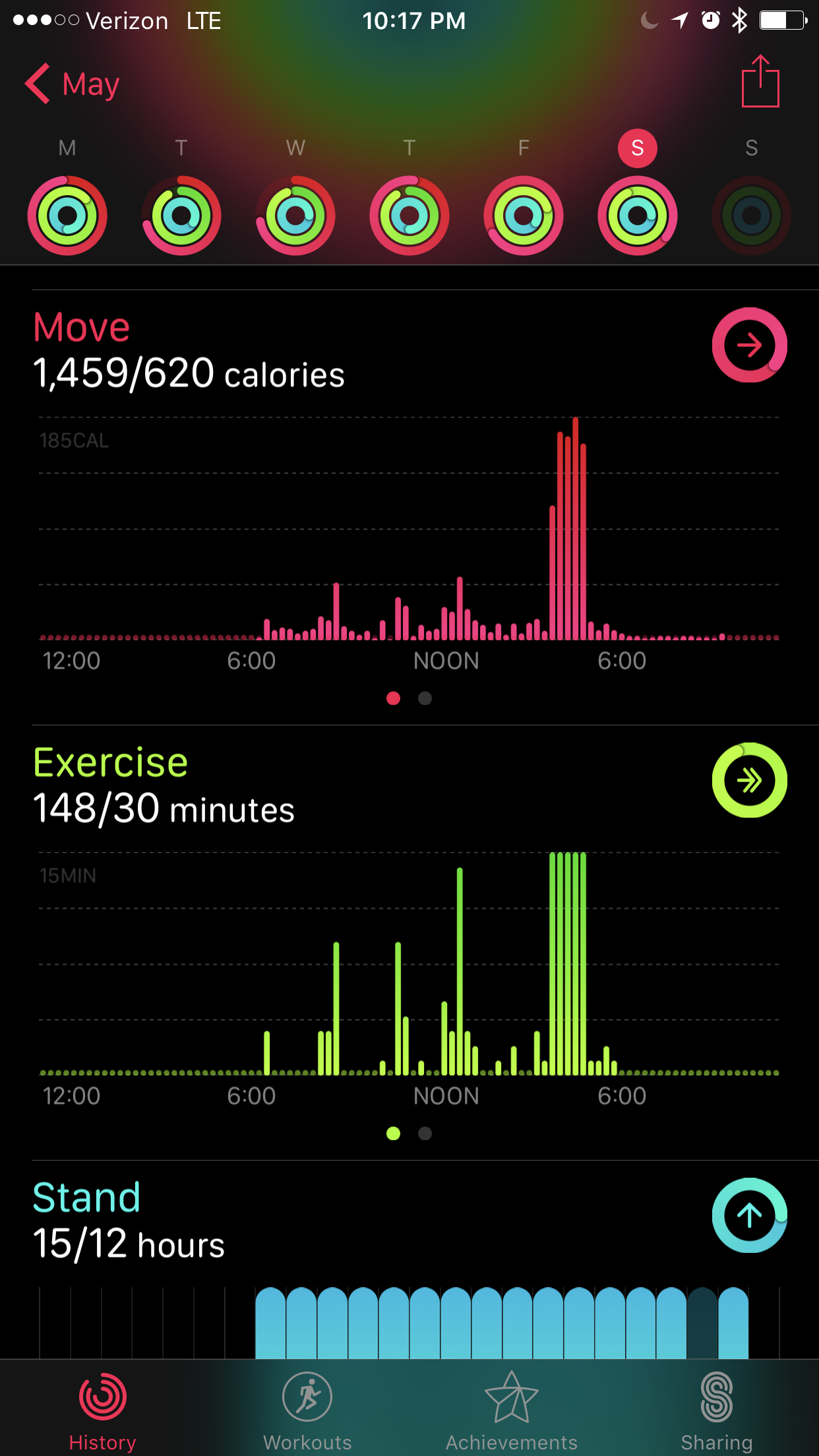
This is the health data from throughout the day. You can see the spike when I logged a workout during the 1-hour endurance race. I didn’t log a workout during the earlier three sessions (two qualifying sessions and one non-points race)

Here is an hour by hour breakdown of my heart rate – note that during the 1-hour endurance race, my heart rate reached around 160-165 beats per minute.


Think about this – when was the last time you did a workout and burned (approximately) 1,000+ calories?  I am talking about just the logged ‘workout’ because in the previous three sessions, I didn’t have the Apple Watch Nike+ 42mm logging calories or else the full day of calories burned would have been 2,000+.  That is a TON of calories and physical effort.
Conclusion

Competitive racing is a legit, physical sport that is incredibly demanding.  We are using our hand-foot-eye coordination, reflexes, core-strength, neck-strength, arm-strength, leg-strength, cardio stamina and mental stamina, just like happens in many other ‘high intensity sports’.

If you are and an avid racer, actually competing and on a regular basis – I highly encourage you to have a regular training program and eat well at minimum to avoid injury and really, to help improve your performance.  Yes, you need to know what to do with your driver inputs to go fast but you also need to be able to physically do this, consistently and over long periods of time – especially for all those endurance racers.  If you aren’t exhausted when you get out of a race car – you’re just not driving hard/fast enough.

Posted on

Days 16, 17 and 18 – 30 Days of Racing in a row

This is a combo article because I frankly fell behind righting as the race weekend took over.

Back to PIR to get the bad taste out of my mouth

The last time we were at Portland International Raceways (May 2017), the weekend was going great but on the main points race Sunday afternoon, the race was over by turn 3.  A couple of Spec E46’s were tussling ahead, one got pushed off and insisted on getting back on track, immediately spun when the front tires grabbed and got side-swiped. While it sucked for the team, we fared much better than two other PRO3 cars which were nearly totaled.

YouTube player


As an aside, another example of how important it is to know how to properly go off track and apply those techniques, every time – even in racing conditions. The reality is that going off will happen and applying those techniques will save you and everyone else a lot of money in the long run.

That race was run without a chicane (usually reserved for endurance races) and this would be the first of two race weekends with the chicane, aptly named the “Chicane Challenge” and I was really excited to see how the investment in simulator time would pay off.

Friday Test and Tune Day – .5 seconds faster right off the trailer

This isn’t a perfect comparison because of differences in weather conditions but when I looked at my first session off the trailer this Friday versus the same first session, in August 2016 (the last time I ran PIR with a chicane), I was ~.5 seconds faster and broke the 1:30.000 barrier for the second time.

What happened? Softer braking, which lead to higher min-speeds through each corner.

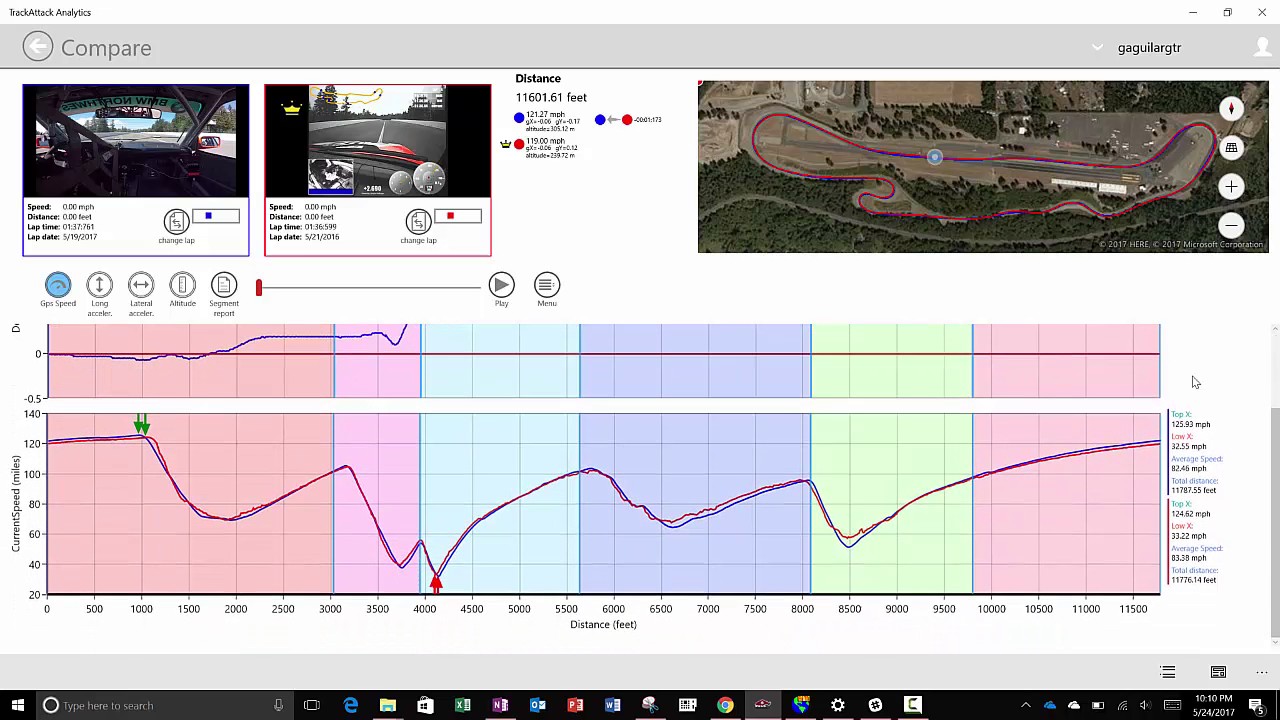
Looking at the data comparison below, it’s clear to see that I was able to use less brake pressure and carry more mid-corner speed AND get on throttle (and full throttle) sooner than a year ago. On this specific session, I remember letting the tires warm up and then attacking the corners and surprising myself that I had so “easily” hit a 1:29.xxx lap time. On the following lap, I tried to repeat it but found that while carrying more speed through the turns 4-5 transition area, the bumps in the road unsettled the car too much while I was on throttle, causing the left rear corner to break loose.

A comparison of my off the trailer, 1st session on a test and tune in August 2016 versus June 2017.  Look at the brake pressure differences and the delta chart.

Also, I was driving on relatively old tires (Toyo Proxes RR 225/45/15’s) that were on their third race weekend and their 12th heat cycle. There is an urban legend that PIR “likes old tires” and my personal interpretation is that PIR is a very smooth and grippy track and thus older tires still work well but newer tires are still going to be optimal.

A track map of Portland International Raceways, with a Chicane

The rest of the day I stayed on the old tires and struggled to break 1:30.xxx as the day got hotter and grip went away but we focused on helping that rear left corner take the beating. With PIR being a 12 turn, clockwise track and only 3 of the 12 turns being left handers the car left rear tire is under constant heavy loads, trying to get out of nearly every corner as quickly as possible.

Saturday Qualifying, Points Race 1 and 1-Hour Enduro Race

This was a unique weekend with the Saturday Group 1 race being a championship points race, along with the Sunday race. So each day we would start with a clean slate, qualify in the AM and race in the PM.

First up was Group 1 qualifying, which went ok but I couldn’t find good track position, to get me a solid draft on laps 2-4, where the fastest lap times would come happen.  I ended up with a 1:30.092 and qualified 4th.  Not bad but not great, being .5 seconds clear of 5th place but almost .7 seconds from pole – ouch.

In Group 8 qualifying, we strapped on some new tires so I could scrub them in for Sunday’s race and boom, 1:29.635!  New personal best and, it didn’t seem too hard.  The big difference?  Carrying a tiny bit more speed into the chicane, more speed into turn 7 and through turns 10-12.

Group 1 Points Race: 3rd Place

At the start of the race, I got a really good start and was behind a the Spec E46 of Dan Rogers, who has a ton of race craft.  We were on the inside for turn 1 and more importantly, the outside of turn 2, which is the chicane.  On these low speed, high G-force turns, in traffic, it is generally best to be on the outside, because you have less steering input and can get on the throttle sooner.  This is because when going two or three wide, we aren’t going at normal speeds, we’re going 10-15 mph slower and thus nowhere near the traction limit.

This gave me a solid run through the chicane and coupled with an incident where another PRO3 car tried to squeeze through where there was no room, spinning both cars – I was in the lead by turn 3 and leading my first PRO3 race?!???!

Leading my first PRO3 race ever, holy crap! Maintain, maintain, maintain….

I lead for a few laps but eventually, Brian Bercovitz got me and pulled away.  Then the PRO3 who spun the other car, caught up and when we were going around slower traffic, he got a clean run out of a corner while I had to check up and he got past.  I ended up in P3 but further improved my personal fastest lap time.

YouTube player

Group 8 1-Hour Race: 2nd place for being greedy

The 1-hour races are basically more practice for me – I like doing them by myself because I can just focus on hammering out laps and hard-coding improvements.  I always strap on the oldest tires I have on-hand and try to set fast and consistent laps.

This was no different and from the start I was battling with a regular foe and friend, Jeff McAffer.  I was in the lead the majority of the race but Jeff was able to stick with me the entire time.

After the mid-way pit stop, I decided to try to push a bit more as I was hitting 1:29 lap times, on crappy tires and a greasy track.  Suddenly, 1:29.7xx!  I felt like that lap time wasn’t too hard to get, so I went for a repeat but the tires didn’t agree.

This could have easily been just my inputs but my hypothesis is that I over-pushed the tires and I was asking them to do a qualifying lap when they were in lap 35 of a race.  I had the win in the bag and Jeff about 5 seconds behind but I got greedy, went off and ended up in P2.

This is not a good POV at turn 12 at Portland International Raceways

Now I know there is a reason for the saying…

“Go only as fast as you need to finish where you’re going to finish.”

Sunday Group 1 Race

One thing that I started doing this year is running just Group 1 and Group 8, which means I get a solid amount of track time and on Sunday, I only have one group to worry about. This way I’m rested and not rushing on the day that usually counts.

Sunday Group 1 Qualifying: 1:29.874 P4

Coming off of the Saturday’s lap times, where I got a 1:29.466 in the afternoon Group 1 race, with fresh tires but loaded up on weight for race trim, I felt that I had the potential for a very low 1:29 in qualifying and thus in the running for pole. I just needed to have good track position on laps 2-4, where I could get a draft on at least one of the straightaways. But it wasn’t to be – I went out and was stuck in “no man’s land” for the first part, then I slowed down and waited for a group of PRO3 cars to come by so I can get behind them. I was able to finally do so and had a low 1:29 going but got behind a PRO3 car that slowed down way too much for turns 10 – 12. It was still good enough for a P3 but I knew I had the pace to battle for the podium and possibly the win. If I would have had an average sector time for turns 10 – 12, I would have been easily with a 1:29.4xx with my rolling best lap being a 1:29.522.

Purple cells = rolling fastest lap and yellow cells = fastest segment times

Sunday Group 1 Race: P7 finish due to a late race off-track excursion

The race started well and hard for most everyone, with a clean first lap.  I tried hard to make up at least one spot on the start but it didn’t happen, so I was stuck behind the #81 of Brad McAllister, who is a strong driver and PIR is one of his strongest tracks.  He’s also a pretty tough pass, with a strong racing history in the SCCA Playboy MX-5 Cup, PRO3 and recently the TRANS-AM TA2 series.

Brian Bercovitz, one of the regular competitors I’m trying to best started from the back because he had a mechanical during qualifying and eventually caught up to us.  The couple laps leading to Brian catching us, I had to brake harder than normal to not ram Brad going into the chicane, which over-heated (I think) my front tires.  Going into turns 5 and 6, my front end washed out, and as I was waiting for the fronts to grip, the rear-end swung out and I went-off track.

YouTube player

It was not too bad but just enough time for a couple cars to pass me and by then the tires were too hot and the distance too great for me to catch up and make up the spots.

I ended up finishing 7th and I think if we can do a better job of tire pressure management (to give me more life towards the end of the race) and I can do a better job of not screwing up, there was a 3rd place finish in the stars and maybe better.

Overall, a great weekend and new personal bests!

While I’m not terribly happy with the Sunday result, overall we made a ton of progress on the car and my driving.  There is one more race at PIR with a Chicane in August and I believe we’ve gathered the knowledge to fight for poles and a win.  We know what we can do to drop some low 1:29’s and maybe even get into the 1:28’s, which is encroaching on track record territory.  Let’s cross our fingers for some sunny and not too hot, weather in August!

Posted on

Day 9 – Going for the win!

It’s race day!  Although I had races yesterday, today was the big race – the race that counts towards the PRO3 Championship, one of the most contested and desired club racing crowns in the pacific northwest and if this series was national, I think it would be up there with a Spec E30 or Spec Miata national championship.  Big fields, hard racing and really needing to drive these cars to the limit, without losing momentum to go fast.

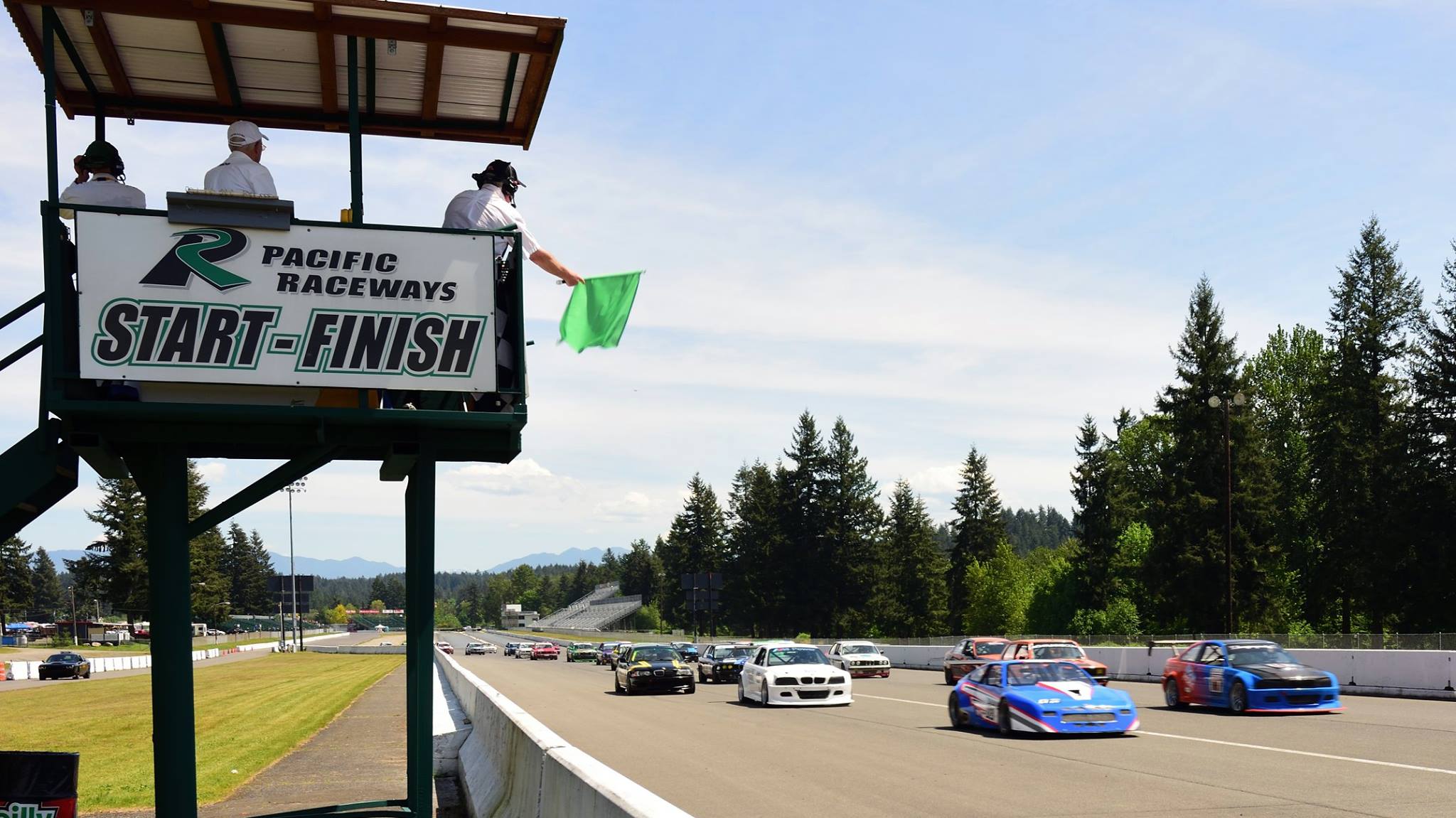
Taking the green flag on race day at Pacific Raceways

The plan of attack

Yesterday, I improved some of my personal best lap times by over a second and in worsening conditions.  I turned a 1:37.2xx in the afternoon, which was nearly 10 degrees warmer than during qualifying in the AM and repeated that almost exactly, in the second half of the 1-hour endurance race… with tires going on their 11th and 12th heat cycle!

So today my goal was to keep improving and try as best as I could to crack the 1:36.xxx range of lap times, of which in my going back through official race records on the ICSCC.com website, there are less than ten people who have ever gone under 1:37.000 in a PRO3 car, at Pacific Raceways on official record.

Part of this is that up until a few years ago, the track surface turns 8 and 9 were absolutely horrendous.  They were the original concrete or whatever the surface type was, full of bumps, pot holes and smoothened over years and years of beatings.

Pacific Raceways – it’s a beast!

It got so bad that a few track day organizations essentially boycotted holding events there because they had customers, with really nice cars, suffer bent wheels and damaged tires.  The reality was that it wasn’t great, not the worst ever but because it was deterring people from coming to the track, it needed to be fixed.   Here is a video of Cody Smith, of Code Red Racing, who also won the PRO3 Championship in 2013, flying through Pacific Raceways.  Cody is fast and smooth!

YouTube player

How’d it go?  1:37.104!

This time, we decided to start towards the back of the field and use the first few laps to warm up the tires, build tire pressures, get a solid lap in and then adjust track position.  We did just that and towards the middle of the session, I fell back to latch on a to pack of PRO3 cars running together.  Though I didn’t know for sure, I felt like I was faster than the whole group, so I fell back, created some space so that ideally, I’d be catching them the hardest at the end of the lap and getting the tow from them on the main straight away.

So close!!!

And it worked!  I actually had a 1:36.9xx going for most of the lap but on the turn 8, I got just the tiniest bit of sideways and I think that caused the lap to not be better.  Regardless, I was happy to get it and in the end, it would have been a stretch, in that session to go faster.  The consolation for me was that in that session specifically, I made an improvement but the competition ahead and behind did not.

So how did I make the improvement?

Data and video.  I recorded the video below to go into more detail but essentially, I focused on three things (see below the video):

YouTube player
  1. Comparing with a faster driver: I had the benefit of getting a hold of data and video from another driver, who was faster than me (and won the PRO3 championship last year) and leveraged an alpha tool we’ve been working on with Track Attack.  Essentially, with Track Attack, we’ve figured out how to make data from different systems, comparable with each other.  Olivier uses RaceLogic’s Video VBOX and I use AIM or Track Attack on iOS.  In the video below, you can see how I used this tool to compare the data and see where Olivier was gaining the advantage.  Conclusion? Corner entry and mid-corner.  Oliver was consistently able to roll more speed into a corner, maintain it mid-corner and then carry that advantage on the straights.  He was and still is, much better under braking and controlling the slide of the car.
  2. Understand the line and what the differences looked like: Similar to Olivier, I am also a very visual learner.  Though I understand data, graphs and tables, I have an athletic background, where muscle memory and training are critical.  So being able to see what a faster lap time and specific segments look like from outside the car and from the driver inputs, was incredibly valuable.  I was able to see in the track map comparisons, the differences in the lines taken.  He would usually brake earlier and turn in later for most corners, trying to carry as much speed as possible.  You could visibly see how he had to dance with the car in mid-corner and be more precise getting on throttle, to not light up the tires.
  3. Theoretical fastest lap: Lastly, one awesome feature we have in the Track Attack alpha product, is the ability to generate segment times AND the video associated with each of those segments.  Further, we stitched together all of those segments, to show what the theoretical fastest lap time actually looks like.  I generated this video and watched it over, and over, and over and over again, trying to program the muscle memory of that lap into my eyes, mind, hands, feet and core.  I wanted that low 1:36.xxx lap time infused into every fiber of my being.

When will this be available?!?!?!

Soon! Racer on Rails is intended to be un-biased about products, so I won’t talk about it much here but know that we’re working on this with the Track Attack team and that this summer, this type of analysis and capabilities will be available to everyone and support all major data acqusition system file types (AIM, MoTec, Bosch, RaceLogic, TraqMate, Alfano and Unipro).

Race Result: Qualified P3 and Finished P3

This was an awesome race, see the video below.  The high points are that I got a decent start, positioned myself exactly where I wanted to be and was able to make a really fun overtake on lap 2, turn 2 to get into 2nd position.  I knew that if I got behind Brian Bercovitz, I would have to stay with him and pressure him into making mistakes because he is a good driver and has a rocket ship car (not that mine is a slouch).

YouTube player

I found myself in just that position a couple laps in and determined that I had an advantage on him under heavy braking (for turns 2, 3a, 3b and to a lesser extent, 8) but he did a great job through 5a, 5b, 6 and 7.  So at the end of each lap, we’d end up about the same distance and with me being close enough to tuck under his draft.  Trying to go for an overtake going into turn 2, I decided to try to get an incredible run out of turn 8 and while doing so, carried too much speed into the corner, got sideways, saved it but let two cars by.

That was just under halfway through the race and while I had a better pace than those to cars, with the rear tires getting lit up during that drift, I had to baby the tires and by then, the gap was too big to overcome.  I technically finished 4th but due to the 2nd place finisher being disqualified for being under-weight, I inherited 3rd place.

Taking the green flag on race day!

Although I was disappointed a little with my mistake, overall, the weekend and day was a great success.  We made improvements on the car, the driver and lap times.  We established that we can compete for wins and just need to be more consistent.  Thanks to the whole crew for all the work before, during and after the weekend.  This hardware is for you all!


Posted on

Day 8 – First Real World Race Day

As I mentioned yesterday, today was the first official day of the race weekend, with four sessions on the schedule:

  • Group 1 Qualifying
  • Group 8 Qualifying
  • Group 1 Non-Points Sprint Race: ~20 minute race with results not counting towards the PRO 3 championship but your fastest lap counting towards the final qualifying grid)
  • Group 8 Race: 1 Hour mini-endurance race that counts towards the 2017 Mini-Endurance championship (I’ve won the championship the last two years in a row!)

Yesterday, I felt like I had established a new level of performance with the car and my driving, by improving my personal best lap time at Pacific Raceways by nearly .5 seconds and being able to repeat it, though in just one lap, with a set of brand new tires on a ‘heat cycle’ run.

Today, my goal was to take those new tires, and do a qualifying run in them for Group 1, improve on my personal best lap time and then put them away until Sunday.  Then swap back on the older set of tires, which would be going on their 10 – 12th heat cycles and while still good from a tread standpoint, I fully expected the performance to start wearing off towards the end of the 1 hour endurance race.

How’d it go?

Group 1 AM Qualifying 

Time of Day: 9:26 AM

Conditions: Mostly sunny, 61 degrees Fahrenheit

Result: 1:37.617 (new personal best by ~.2 seconds)

Similar issue as I had during qualifying for Group 1 in Portland but I didn’t position myself best in the pack during pre-grid.  I got out early in the line up and while I was at the front, I didn’t have the benefit of a draft like when running in a pack.  I did about 4 laps but not cracking the 1:38 barrier.  So I decided to back off a bit and get behind a pack of PRO3 cars to catch their draft.  After a couple laps, I was able to get a 1:37.766 but then was too close to them and basically started ‘racing’, so I tried to back off a little before the start of a lap and then make a run but I’d get too close about halfway through the lap and the lap would get ruined.  Either way, minor improvement and felt like I at least collected enough data of several low 1:38’s, which used to be my personal best and figure out what to do.

Group 8 (Mini Enduro) AM Qualifying 

Time of Day: 11:30 AM

Conditions: Mostly sunny, 68 degrees Fahrenheit

Result: 1:37.533 (new personal best by ~.1 seconds)

With the field being lighter for Group 8, track position wasn’t as important, so I just went out and tried to put down fast laps immediately after doing more of a warm up lap on my out-lap.  Since these were the old tires, we were trying to make sure we’d get them up to temperature and pressures for the race in the afternoon.  I did two fast laps of 1:37.855 and then 1:37.533. BOOM! Another personal best.  What was I doing?  Just focusing on having next to no transition period from ending trail-braking to throttle application, especially on the longer corners like turn 2 and turn 8.  I came in to the hot-pits for a pressure and tire temp check and was out but was only able to put down a 1:37.792.  The good news?  1:37’s were starting to feel like the new normal!

Group 1 – 20 Minute Non-Points Race 

Time of Day: 1:50 PM

Conditions: Mostly sunny, 75 degrees Fahrenheit

Result: 2nd place finish and 1:37.258 (new personal best by ~.3 seconds)

These races are interesting.  It’s racing but it doesn’t count towards point, so this year they changed it so that the laps count towards qualifying.  So, you should never try to win at all costs but the goal is more to get into a flow and go for some fast laps.  I qualified 4th but started third in class, because the pole setting car decided to start from the back OR they were late to grid.  Either way, my goal was the same – get a good start and stick my front bumper to the rear-bumper of the fastest PRO3 this year, Brian B in the Blaupunkt liveried car.

And that’s what happened!  Man, I am so happy about how this race went (video link below soon).  I knew at least at the time that I would have to work really hard to get the start I wanted and then work even harder/smarter to stick with Brian.  I pushed myself even more to be on maintenance, plus a little more, sometimes mid-corner and I found myself using throttle to get that final phase of rotation going in the slower corners of 3a and 3b.

2nd Place and a new personal best lap time!

The best thing?  Mid 1:37’s became the new normal, even in greasier but not horrible conditions.

Group 8 – 1 Hour Endurance Race 

Time of Day: 4:30 PM

Conditions: Sunny, 78 degrees Fahrenheit

Result: 1st Place finish and 1:37.364 (only .1 seconds off of personal best)

The fields aren’t typically super-stacked for the endurance races, usually only about 10-15 cars per class and with the SCCA Majors Tour happening in Portland this weekend, the overall field was much lower, with only about 19 or so total cars on the grid.  There would only be one strong competitor battling me, Jeff M in the newly painted green and black #24.  Jeff and I have shared many battles the last couple of years and he and his car are a rocket.  With tires nearing the end of their top end performance life, my goal was to just drive clean, consistent laps and hopefully win but not do anything stupid.

Enduro’s are an opportunity for more seat time for me, in a racing environment and over a long period of time to try different things.  I also like that one mistake won’t kill you and there is a strategy aspect to the race.

In the end, Jeff and I traded spots a couple times.  I was able to get him in the beginning and get in front but a mistake in turn 8 gave him the position back and I had to work to get it back.  After the mandatory pit-stop, I was able to get him back but due to traffic, worsening track conditions and his driving, I wasn’t able to pull away.  Aside from winning, what I am incredibly happy about is being able to put down a 1:37.364 in the second half of the race!  Man, I am so happy about that.

1st Place and almost matching my personal best!

Takeaways? A new normal and 1:36’s – here I come!

Today was an absolutely awesome day and from a driving standpoint, I believe the reason is that I have fresh in my body and mind, what it feels like to drive, look at data, see what to do differently, visualize what that looks like and make it happen.  I will create a separate post that looks only at the data analysis I did over the whole weekend and what I did to prepare myself to do things differently.

The last thing here, especially from the lap times from the endurance race, if I am getting near my personal best lap times on a nearly 80 degree day, in the second half of a 1-hour race and on 11 heat cycle tires, that means this car is capable of so much more.  If the driver can get it together or with a pro-level driver behind the wheel, today, this car could have probably turned a low 1:36.xxx.  Lots of progress but so much more to go!