Posted on

More Than a Race Weekend: Competition, Development and Community at the 2026 IRDC Summer Classic

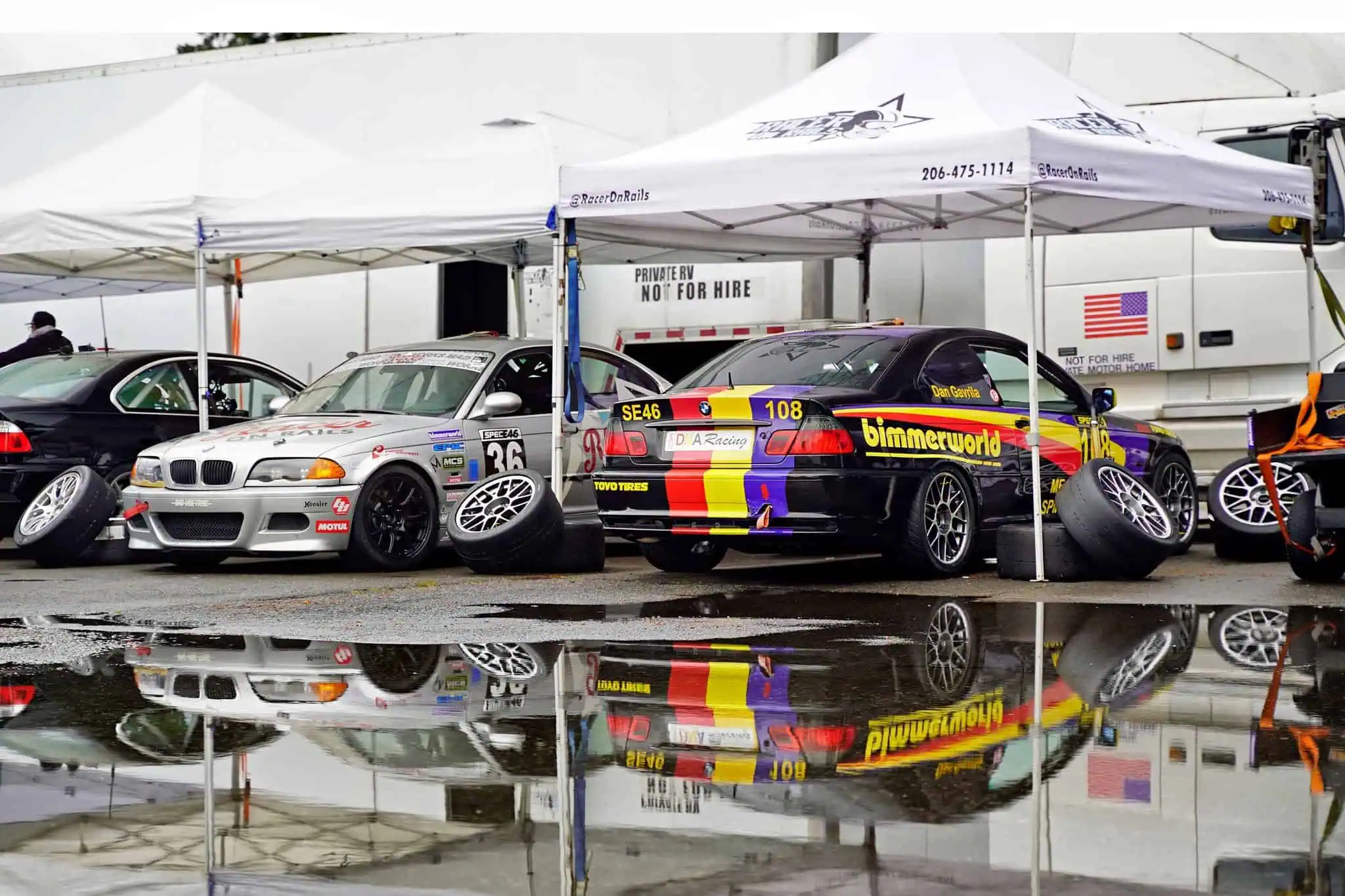
Racer on Rails-supported Spec E46 BMW race cars beneath paddock tents, reflected in rainwater at Pacific Raceways.

The IRDC Summer Classic is not just another race weekend at Pacific Raceways.

IRDC’s May event can produce excellent racing, but spring in the Pacific Northwest always arrives with an asterisk. Cold temperatures and rain can thin the entry list, scramble preparation plans and turn the weekend into an exercise in weather-radar interpretation.

The Summer Classic, traditionally held in late June or July, carries a different energy.

Good weather is never truly guaranteed around here, but the odds are much better. The fields grow, the paddock fills and the competition becomes stronger. It is one of the cornerstone events on the International Race Drivers Club calendar and, in many ways, the weekend when the local racing community is most fully assembled.

The 2026 Summer Classic took place June 26 through 28, with Friday testing leading into two days of qualifying, championship races and a one-hour mini-enduro on Pacific Raceways’ 2.25-mile road course. The event was held under the umbrella of the International Conference of Sports Car Clubs, the Pacific Northwest sanctioning body commonly known throughout the paddock as Conference.

For Racer on Rails, the weekend became a concentrated example of nearly everything we are trying to build.

We supported drivers fighting at the front of Spec E46. We helped another driver make systemic progress through coaching. We introduced a new novice to wheel-to-wheel competition. We kept Stefan Tomalik race-sharp while his own car was being prepared for GRIDLIFE GT competition. We welcomed NASA Northwest’s Jay Perry to Pacific Raceways for the first time and watched him progress from learning the circuit to winning on it. We helped Ellen Porter and Mathieu Martin fit racing into the realities of careers and parenthood. We supported more than half of the Spec E46 field in one form or another.

Then, after the engines went quiet, we partnered with Racecentric to bring racers, volunteers, tuners, time-attack competitors and automotive enthusiasts together at the Racer on Rails facility.

It was more than a race weekend.

It was competition, development and community sharing the same piece of pavement.

A Difficult Start to the Weekend

Saturday morning’s qualifying session provided an immediate reminder that even the Summer Classic can retain a little Pacific Northwest unpredictability.

The track was mixed and drying.

Everyone faced the same decision: wait for the surface to improve, choose wet-weather tires that might quickly overheat, or go onto the circuit with dry tires and accept that parts of the lap were not ready for them.

Most of the field chose dry tires.

The front half of the track was beginning to develop a usable line, but the back side remained damp in places. That mattered because the moisture was concentrated around the part of Pacific Raceways where drivers least want uncertainty: Turns 5A through 6.

That sequence is fast, committed and unforgiving. The car becomes light as the road falls away, the walls feel increasingly close and a driver must trust that the grip waiting on corner entry will still be there when the car reaches the apex.

Damp patches in that section are not merely inconvenient. They change the entire risk calculation.

Everyone had to balance the same questions. How quickly was the track improving? Where was the remaining water? How much commitment was justified when conditions could change from one corner to the next?

No risk, no reward.

Stefan Tomalik navigated the conditions with a 1:38.551, taking the top Spec E46 qualifying position. Dan Gavrila followed with a 1:38.645.

After an entire lap of changing grip, the difference between them was only 0.094 seconds.

It was an early indication that the two of them were going to spend the weekend operating in the same narrow window.

Keeping Stefan Race-Sharp

Stefan has spent much of the season rebuilding his BMW M3 for GRIDLIFE GT competition at WeatherTech Raceway Laguna Seca in September.

Preparing the car is only one part of that project.

The driver also needs preparation.

GLGT will place Stefan in a fast and varied field, surrounded by cars that generate lap time in very different ways. He will need to manage traffic, adapt to changing situations and make good decisions while racing against unfamiliar competitors.

That cannot be recreated through casual track time alone.

The best preparation for racing is racing, especially against people who demand your best.

For the Summer Classic, Stefan returned to the Racer on Rails Silver Bullet in Spec E46. The goal was to keep him competing, keep the decision-making muscles active and measure him against some of the strongest club racers in the region.

Dan Gavrila provided exactly that benchmark.

Dan is exceptionally fast at Pacific Raceways. He knows the circuit intimately and is capable of extracting pace from the car almost immediately. Stefan’s ability to qualify within a tenth of him in difficult conditions was impressive, but Saturday’s race would require something different.

Qualifying rewards the fastest individual lap.

Racing rewards the driver who can keep doing the work while managing traffic, pressure, tires and the changing behavior of the car.

Stefan converted the mixed-condition pole into a Spec E46 victory.

According to the official Saturday race results, he completed 17 laps with a best time of 1:31.346. Anthony Lo finished second, Dan third and Matt Dawson fourth, putting four Racer on Rails-supported or managed cars into the first four positions in class.

The strength of Stefan’s race was not limited to one lap.

The Saturday lap chart showed him repeatedly operating in the low 1:31s, 1:32s and 1:33s, continuing to apply pressure without allowing the quality of his driving to unravel.

That ability to repeat pace is essential.

A driver preparing for a larger, more unpredictable competition environment does not need a single firework of a lap. He needs an entire box of matches.

Sunday morning shifted the order.

With a dry circuit, Dan qualified on the Spec E46 pole with a 1:31.239. Stefan followed at 1:31.574, just 0.335 seconds behind.

Charles Beach qualified third at 1:32.197, while Anthony’s 1:32.199 left him only two thousandths of a second from the second row. Matt followed at 1:32.923, according to the official Sunday qualifying results.

The stage was set for another battle between Dan and Stefan.

Unfortunately, a mechanical concern that had been following Dan’s car throughout the season finally caught up with it.

The engine had regularly produced blue smoke on startup, suggesting that something inside was no longer entirely happy. Dan remained fast despite the warning signs, but the problem ultimately developed into a head-gasket failure and engine damage.

Even with the car deteriorating, Dan recorded a 1:32.031 during Sunday’s race. The speed remained, but the machinery could not carry him through to the finish at the front.

Stefan could.

The Sunday race results showed Stefan completing 17 laps and earning his second Spec E46 victory of the weekend, finishing 15.341 seconds ahead of Charles Beach.

Anthony placed third, Matt fourth and Wes Griffith seventh. Dan was classified eighth after completing 15 laps.

Stefan left the Summer Classic with two victories against serious competition.

More importantly, he had spent the weekend practicing exactly the kind of driving he will need at Laguna Seca: adapting to changing conditions, operating under pressure and delivering pace repeatedly rather than occasionally.

Anthony Lo’s Quiet Level-Up

Anthony Lo’s weekend deserves more attention than a pair of podium finishes alone might suggest.

Although we were not providing Anthony’s full trackside support program at the Summer Classic, Racer on Rails manages and maintains his car. That has given us a close view of the work he has put into his driving and the progress he has made over the past year.

The difference is visible from outside the car.

It is also visible in the timing sheets.

At the 2025 Summer Classic, Anthony qualified third in Spec E46 on both days. His Saturday qualifying time was a 1:32.751, followed by a best race lap of 1:33.002 and a second-place finish in the Saturday race.

On Sunday, he qualified with a nearly identical 1:32.752. His race ended after 13 laps, leaving him classified sixth, with a best lap of 1:33.018. The full progression can be seen in the 2025 Sunday qualifying, race results and lap-time report.

One year later, Anthony returned and delivered a more complete weekend in a nine-car Spec E46 field.

Saturday’s damp qualifying session does not provide a meaningful year-over-year comparison, but once the circuit dried, Anthony recorded a 1:32.637 during the race.

That was more than three-tenths quicker than his best race lap from the same event in 2025, and it helped carry him to another second-place finish.

Sunday provided the clearest measurement.

Anthony qualified with a 1:32.199, improving on his 2025 Sunday qualifying time by 0.553 seconds. That placed him only 0.002 seconds behind Charles Beach and less than one second from Dan’s class pole.

He followed qualifying with a third-place finish and a best race lap of 1:32.677, completing all 17 laps.

At this point in a driver’s development, progress is rarely measured in enormous chunks of lap time.

It lives in tenths.

It appears in consistency, confidence and the ability to execute across an entire weekend. It shows up when the driver is no longer searching for a fundamentally different technique, but refining braking points, releases, minimum speeds and the quality of every transition.

Anthony has put in the work, and he has genuinely leveled up.

Last year, the pace of drivers like Stefan and Dan represented something Anthony was chasing.

Now he is close enough that they need to keep checking their mirrors.

Systemic Progress for Wes Griffith

The Summer Classic was our first weekend working directly with Wes Griffith as a coaching client.

The objective was not to manufacture one spectacular lap. It was to understand the underlying behaviors limiting his performance and help him build a process that could produce repeatable improvement.

There is an important distinction between finding speed and learning how to become faster.

A driver can stumble into a personal best through favorable traffic, fresh tires, a particularly brave moment or a lap where several variables happen to align. That lap may be real, but it is not always transferable.

Systemic progress appears when the driver understands what changed, why it worked and how to reproduce it.

That was the work with Wes.

We focused on giving him clearer references and a more structured approach to the lap. Rather than trying to attack every corner at once, the goal was to reduce ambiguity, identify the largest opportunities and make deliberate changes that could be evaluated through data and driver feedback.

The results began appearing immediately.

Wes recorded a 1:36.135 during Saturday’s race, breaking through his previous personal-best territory. On Sunday, he lowered the mark again with a 1:35.927.

The lap times were exciting, but the more meaningful development was the process behind them.

Wes was not simply trying harder. He was becoming more precise about where and how he applied that effort.

He began improving his understanding of what the car needed, how the corner phases connected and where commitment would produce speed rather than merely additional risk.

He did not beat his personal best once and spend the rest of the weekend admiring it.

He reset it, learned from it and moved it again.

That is the kind of progress that can continue long after the weekend is over.

Matt Dawson and the Joy of 8,500 RPM

Matt Dawson arrived at the Summer Classic with two very different BMWs and two very different assignments.

In Spec E46, he continued developing within one of the weekend’s most competitive classes. Matt finished fourth on both Saturday and Sunday, recording best race laps of 1:33.069 and 1:33.645.

Then there was the Z4 M Coupe.

Matt purchased the car earlier this year, adding a machine with an SCCA National Championship-winning history to his collection.

It is a wonderfully distinctive race car, powered by an engine that rewards commitment all the way to its 8,500-rpm redline.
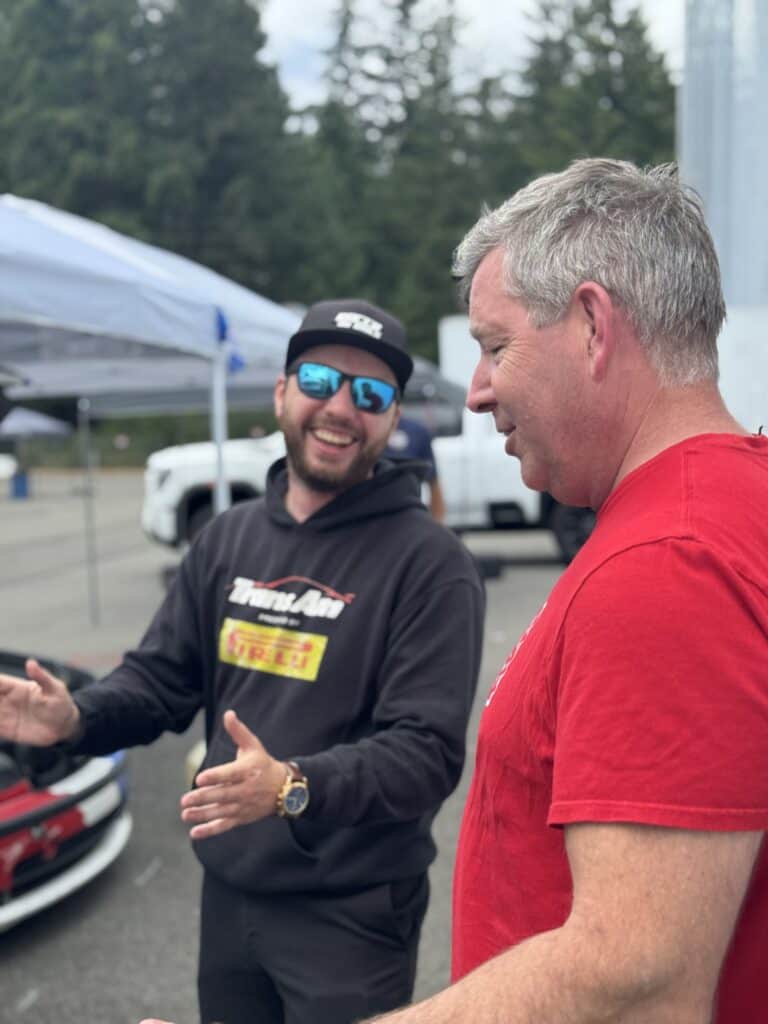
Tyler Campbell and Matt Dawson talk beside a race car in the Pacific Raceways paddock.
Tyler Campbell and Matt Dawson catch up in the paddock during a busy weekend of Spec E46 racing and seat time in Matt’s BMW Z4 M Coupe.

Matt was more than happy to explore the entire tachometer.

He entered the Z4 in the one-hour mini-enduro, completing 36 laps and finishing fourth in the MEO class. His best lap was a 1:30.689.

Learning a new race car is serious work.

The driver must recalibrate nearly everything: braking references, control effort, visibility, gearing, tire behavior and the subtle signals that indicate whether the car has more to give.

It can also be enormous fun.

Every time Matt climbed out of the Z4, he was grinning from ear to ear. Some cars make their case through engineering diagrams and trophy cabinets. Others make it every time the engine reaches the top of the rev range.

The Z4 managed all three.

Jay Perry’s First Visit to Pacific Raceways

The Summer Classic also welcomed Jay Perry from NASA Northwest for his first opportunity to race at Pacific Raceways.

Jay arrived with his C7 Corvette and a substantial learning assignment ahead of him.

Pacific Raceways is not a circuit that reveals all of its secrets immediately.

Its elevation changes obscure sightlines, several important corners are connected in ways that are not obvious from behind the wheel, and the fastest sections require a driver to build trust gradually.

Learning the track is one challenge.

Learning it while racing a powerful Corvette against experienced local competitors adds several more layers.

Jay embraced all of it.

He became quicker and more comfortable throughout the weekend, gradually piecing together the circuit while learning where the Corvette’s power, braking capability and balance could be used most effectively.

By Saturday’s race, Jay was already battling Dan Rogers in his BMW M3 GTR at the front of the SPO class.

Dan won, but only barely.

After 14 laps, the two cars were separated by just 0.347 seconds, with Jay recording a best lap of 1:27.930 in his first race at the circuit.

Jay returned Sunday with another day of knowledge stored away and immediately put it to use.

He lowered his best lap to a 1:25.046 and beat Dan to the finish by 1.894 seconds, splitting the weekend’s two races with a driver who brought both serious pace and extensive Pacific Raceways experience.

That is a serious achievement.
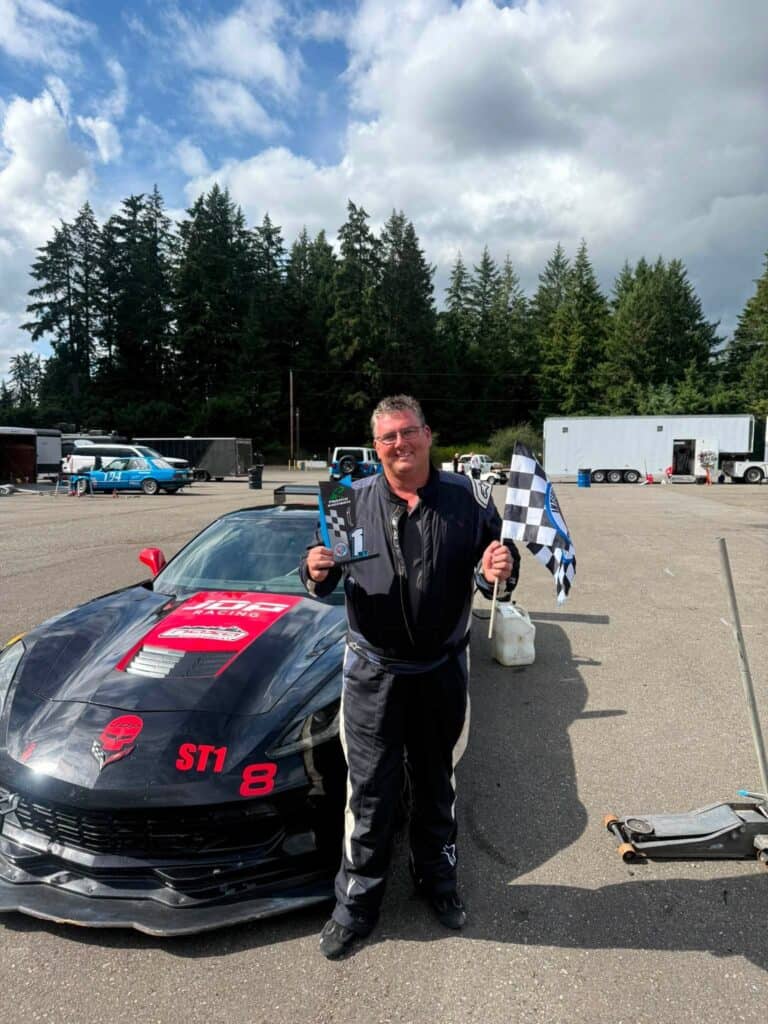
Jay Perry holds a first-place trophy and checkered flag beside his black C7 Corvette at Pacific Raceways.
NASA Northwest’s Jay Perry celebrates an SPO victory beside his C7 Corvette after learning Pacific Raceways and splitting the weekend’s races with Dan Rogers.

Jay did not simply visit a new track, collect some laps and head home. He learned quickly enough to challenge an established local front-runner, race him closely on Saturday and then find the additional performance needed to reverse the order on Sunday.

It was also exactly the kind of crossover we want to see more often.

Organizations such as NASA Northwest, IRDC and Conference may operate their own events and championships, but they are all part of the same regional motorsport community.

Drivers moving between them bring new cars, different experiences and fresh competition into each paddock.

Jay arrived to experience Pacific Raceways for the first time.

He left with a victory, a rapidly expanding notebook and a very good reason to come back.

Federico Mira Picone’s First Novice Weekend

Federico Mira Picone arrived at Pacific Raceways for his first novice race weekend in the Racer on Rails Jägermeister-liveried PRO3 car.

A first wheel-to-wheel event asks a great deal from a driver.

There are race starts, flags, traffic, passing decisions and procedures that cannot be fully recreated during a track day. The driver must learn to allocate attention across the entire environment while still operating the car quickly and accurately.

The objective is not simply to go faster.

It is to build awareness, judgment and capacity without allowing enthusiasm to outrun experience.

Federico’s first qualifying session took place on the same mixed and damp circuit that complicated the Spec E46 session.

He recorded a 1:55.205, but the time was much more representative of the conditions than his actual dry-weather potential.

Once the circuit dried and Federico became more comfortable, the stopwatch began shedding seconds in large handfuls.

During Saturday’s race, he recorded a 1:40.098, completed all 16 laps and won the novice class.

The roughly 15-second difference from qualifying was not the result of a magical transformation. It reflected the enormous contrast between a damp, mixed-condition session and a dry race, combined with Federico’s growing understanding of the car and the environment around him.

He returned Sunday and continued moving forward.

Federico qualified with a 1:40.674. In the race, he lowered his best to a 1:39.219 and earned his second novice-class victory, finishing only 0.952 seconds ahead of Kevin Sun after 13 laps.

Federico’s family and friends were present throughout the weekend, turning the occasion into more than a licensing exercise.

They were able to see the work, the nerves, the progress and the satisfaction that came with completing his first races successfully.

The car’s reliability also played an important role.

During earlier weekends with Ron Tanemura, we had worked through the transmission issues that previously affected the PRO3 car. That work meant Federico could focus on learning how to race rather than wondering which gear the car might choose to surrender next.

He is scheduled to complete his remaining two novice weekends with Racer on Rails this year, earn his full competition license and then decide what the next stage of his racing journey should become.

The first chapter was a strong one.

Ellen Porter and Mathieu Martin Make Space for Racing

Motorsport has a habit of consuming every available hour.

That makes participation especially challenging for Ellen Porter and Mathieu Martin, who are balancing demanding professional careers with raising two young daughters.

Getting both of them to the racetrack required its own exercise in scheduling, logistics and teamwork.

At the Summer Classic, they split the championship races. Mathieu competed in the large PRO3 field, while Ellen raced in CT4.

Ellen completed 15 laps in Saturday’s race, finishing 12th in CT4 with a best time of 1:39.887.

They then combined their efforts for the one-hour mini-enduro.

Mathieu and Ellen shared the No. 26 car, completing 32 laps and finishing third in the ME2 class. Their best lap was a 1:39.874.

Couples who race together may not eliminate every disagreement, but at least they can arrive at the discussion with timing data.

More importantly, Ellen and Mathieu demonstrate that motorsport does not need to be an all-or-nothing pursuit.

With the right equipment, planning and support system, racing can remain a meaningful part of a busy life.

Sometimes that means competing in separate classes. Sometimes it means sharing a car. Sometimes it means handing the steering wheel to your partner and trusting them to bring it back in one piece.

They made the space, shared the work and left with a podium.

Supporting More Than Half of the Spec E46 Field

The Spec E46 results also illustrated how deeply Racer on Rails has become connected to the local class.

We were providing trackside support for Stefan, Dan, Montey Mathison and Matt. Wes was working with us through coaching, and Anthony’s car remained under our management and maintenance program.

In one form or another, Racer on Rails was connected to six of the nine cars in the Spec E46 field.

The purpose is not to create a protected island inside the paddock.

It is the opposite.

When more drivers have access to strong preparation, dependable trackside support, engineering and coaching, the entire class improves.

Cars become more reliable. Drivers become more capable. The racing grows closer, and everyone is required to continue raising their level.

Saturday’s first four Spec E46 finishers were Stefan, Anthony, Dan and Matt.

On Sunday, Stefan won again, Anthony finished third and Matt fourth. Wes lowered his personal best multiple times, while Dan demonstrated race-winning pace before the engine problem ended his challenge.

That is the kind of environment we want to help create.

Competitive on the racetrack.

Collaborative in the paddock.

Relentlessly focused on improving both the drivers and the machinery.

Connecting the Motorsport Ecosystem

The weekend’s most important activity may not have appeared on a timing sheet.

Racer on Rails partnered with Racecentric to host a club and volunteer dinner and mini car show at our facility.

There was barbecue, cold soda, race cars, beautifully prepared show cars and people from several different corners of the automotive world.

Racers and volunteers spent the evening alongside tuners, builders, enthusiasts and time-attack competitors who might not ordinarily occupy the same paddock.

That mixture was intentional.

Motorsport is often presented as a pyramid, with professional racing at the top and every other form of participation stacked somewhere beneath it.

In practice, it behaves much more like an ecosystem.

Club racers need mechanics, engineers, fabricators, photographers, organizers and volunteers. Tuners benefit from lessons developed through competition. Time-attack drivers may eventually become wheel-to-wheel racers. Show-car owners can become track-day participants. Young enthusiasts can discover careers they did not know existed. Volunteers can build relationships with teams, and teams can become stronger members of the clubs that make their racing possible.

Every part feeds another.

The goal of the evening was to celebrate the club, thank the volunteers and create more opportunities for those different communities to rub shoulders.

Not through a formal conference or a carefully scheduled networking exercise, but over food, cars and the shared language of people who care deeply about machines.

For one evening, the Racer on Rails facility became more than a place where race cars are stored, prepared and repaired.

It became a gathering point for the broader automotive community.

That matters because the long-term health of racing will not be determined solely by what happens between the green and checkered flags.

It will also depend on whether there is an inviting, connected world surrounding the competition.

Progress in Every Direction

The 2026 IRDC Summer Classic produced strong results for Racer on Rails, but no single trophy or finishing position captures the weekend.

Stefan Tomalik won both Spec E46 races while sharpening the skills he will need for GRIDLIFE at Laguna Seca.

Dan Gavrila demonstrated front-running speed before a known mechanical concern developed into an engine failure.

Anthony Lo turned the promise of his 2025 Summer Classic into a more complete 2026 performance, improving his dry-weather pace and earning podium finishes on both days.

Matt Dawson raced hard in Spec E46, then spent the mini-enduro exploring the upper reaches of the Z4 M Coupe’s tachometer.

Jay Perry learned Pacific Raceways at remarkable speed, battling Dan Rogers throughout the weekend and leaving his first visit with an SPO victory.

Wes Griffith broke through previous limitations and lowered his personal best multiple times during our first coaching weekend together.

Federico Mira Picone completed his first novice event, won his class twice and took a major step toward earning his full competition license.

Ellen Porter and Mathieu Martin found a way to balance careers, parenthood and competition, then shared a podium finish in the mini-enduro.

Around them was a Racer on Rails operation preparing cars, coaching drivers, solving problems and supporting more than half of the Spec E46 field.

Then, when racing finished for the day, we opened the doors and brought the wider community together.

That was the real story of the Summer Classic.

Competition, driver development, vehicle preparation and community building do not need to exist as separate activities.

When they are connected intentionally, each one makes the others stronger.

That is the ecosystem we believe in.

And that is exactly what we are trying to build.
Posted on

Confidence, Consistency and Podiums at Watkins Glen – Porsche Club of America (PCA) July 2026

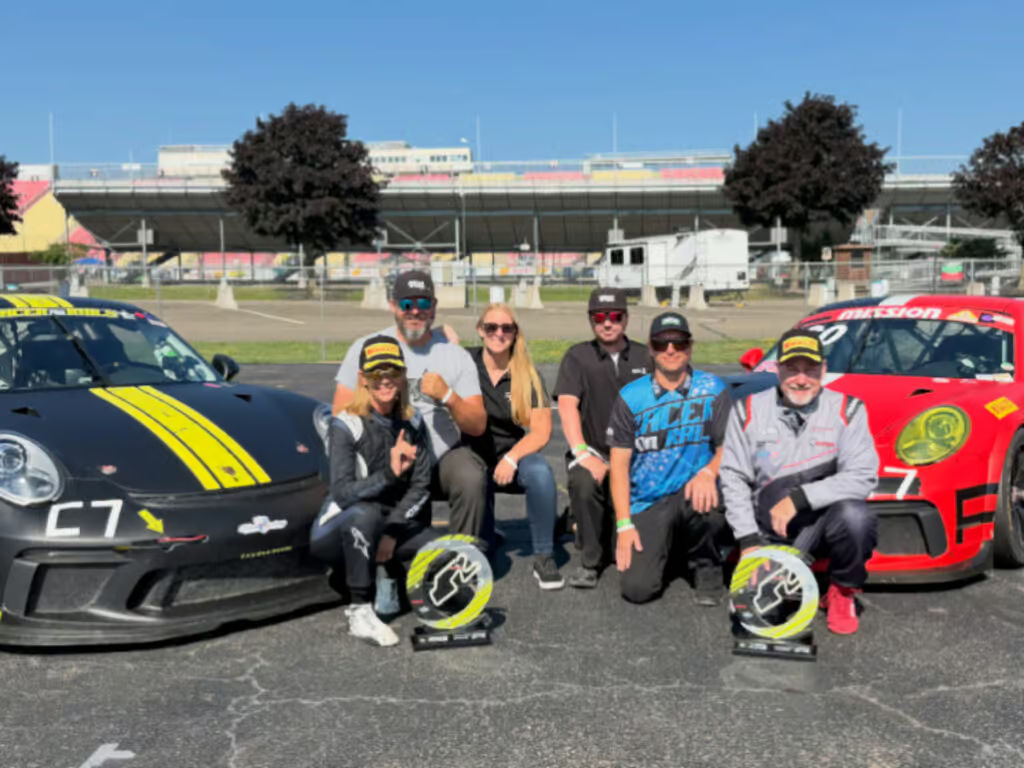
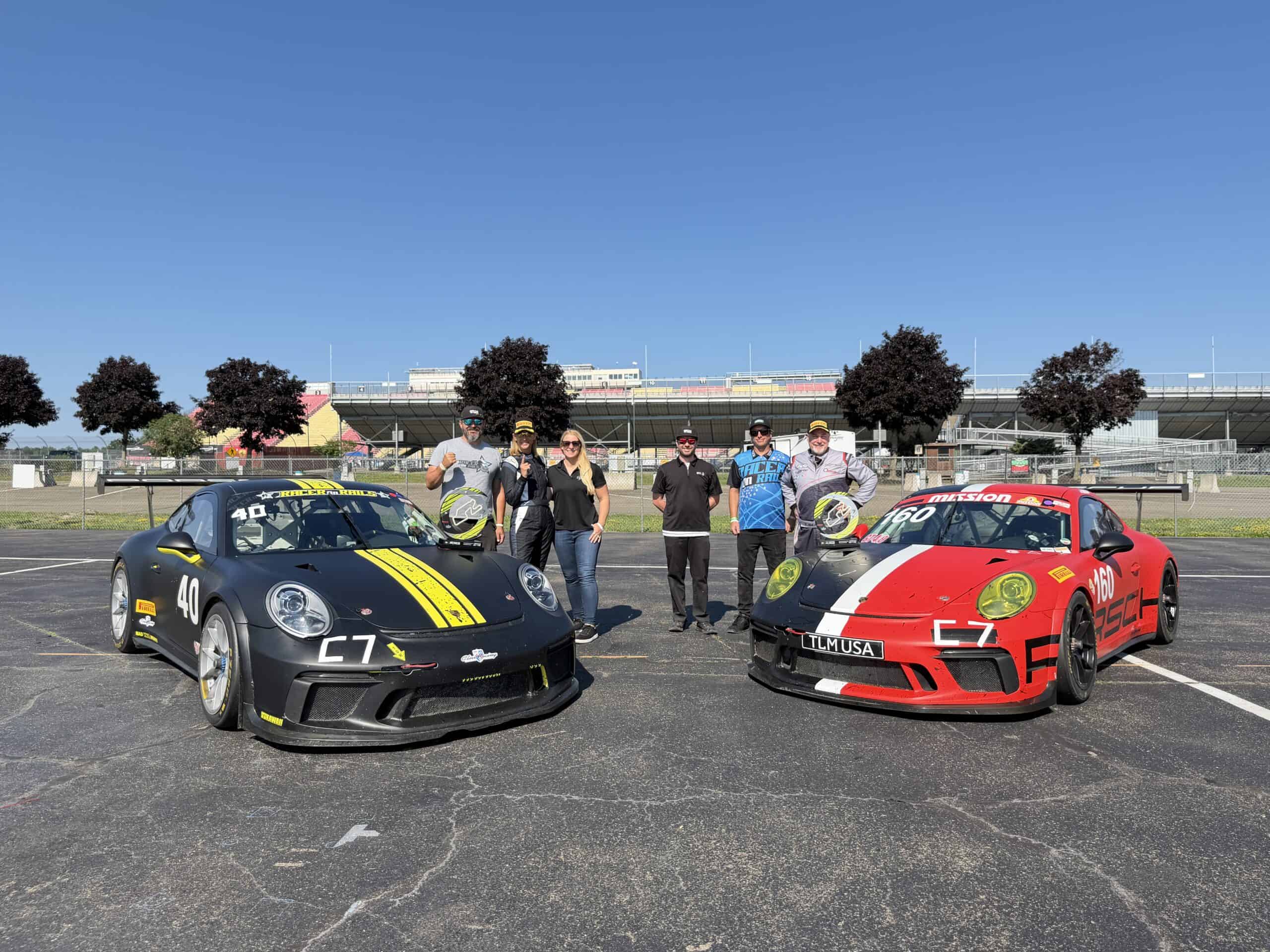
Racer on Rails team with Ann Doherty’s black Porsche race car, Thad Berger’s red Porsche and their podium trophies at Watkins Glen.

Watkins Glen International is a circuit that demands confidence.

Across its 3.45-mile Grand Prix layout, the speed is high, the consequences of hesitation are real and the car is almost always being asked to do more than one thing at a time. Braking zones arrive while the chassis is still loaded, elevation changes alter the balance beneath the driver and many of the most important corners require commitment well before the exit comes into view.

It is also one of North America’s most historic racing venues. Competition around Watkins Glen dates back to the first postwar road race through the village in 1948, and the circuit has remained one of the country’s defining motorsport destinations ever since.

For Racer on Rails, the Porsche Club of America Club Racing weekend presented two very different driver-development stories.

Longtime friend and client Thad Berger was returning to competition after a hiatus caused by a major rebuild of his car. Alongside him was Ann Doherty, whom we have supported throughout the season and who arrived at The Glen with momentum already building.

Ann’s program also included support from professional driver and coach Pippa Mann. The Racer on Rails crew consisted of Jordan Allen, serving as car chief for Ann’s 991.2-generation Porsche 911 GT3 Cup car; Ian Anderson, serving as car chief for Thad; and Tyler Campbell, working as race engineer and driver coach across both programs.

Tyler supported both drivers directly while collaborating with Pippa throughout Ann’s weekend.

The drivers arrived from different starting points, but the objective was the same: build trust in the car, sharpen the communication between driver and crew and turn that confidence into repeatable performance.

Carrying Momentum into the Weekend

Ann arrived at the PCA weekend with valuable recent experience at Watkins Glen.

Only a couple of weeks earlier, Racer on Rails had supported her during the SCCA race weekend at the same circuit. A combination of simulator work, preparation and focused coaching allowed her to arrive ready to perform, ultimately producing a third-place finish in Sunday’s race.

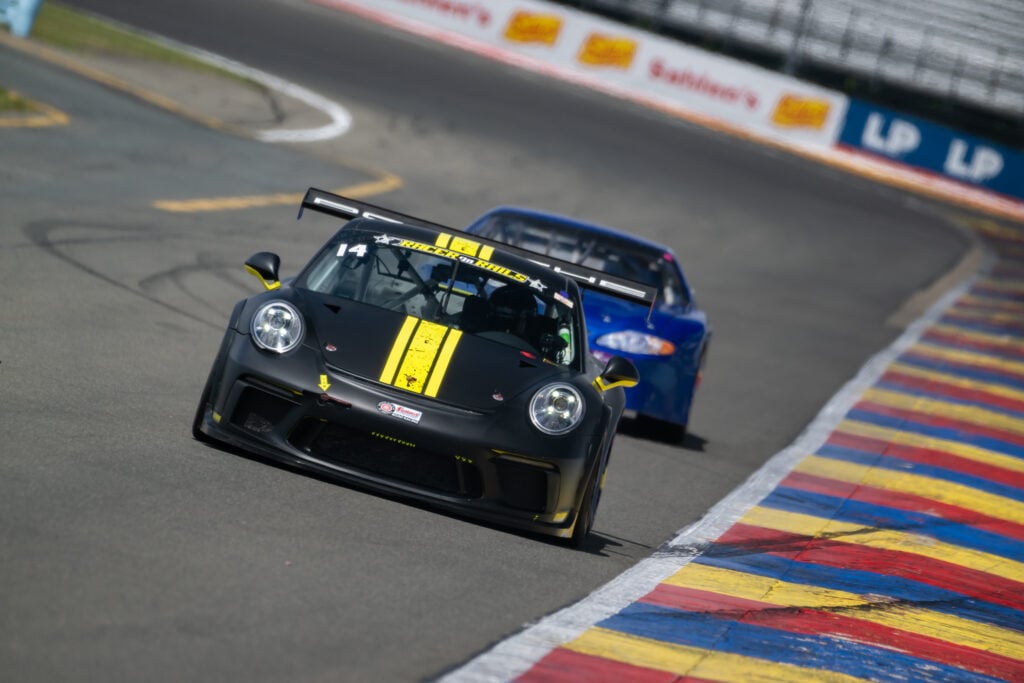
Ann Doherty drives the black-and-yellow Racer on Rails Porsche race car through a corner at Watkins Glen International.
Ann Doherty attacks Watkins Glen International in her black-and-yellow Racer on Rails Porsche during the SCCA Hoosier Super Tour weekend. Photo Credit: Trey Coleman

That recent experience meant the PCA weekend did not begin with Ann needing to relearn the circuit. Instead, she could immediately begin refining her driving, exploring the limits of the car and building on the progress already made.

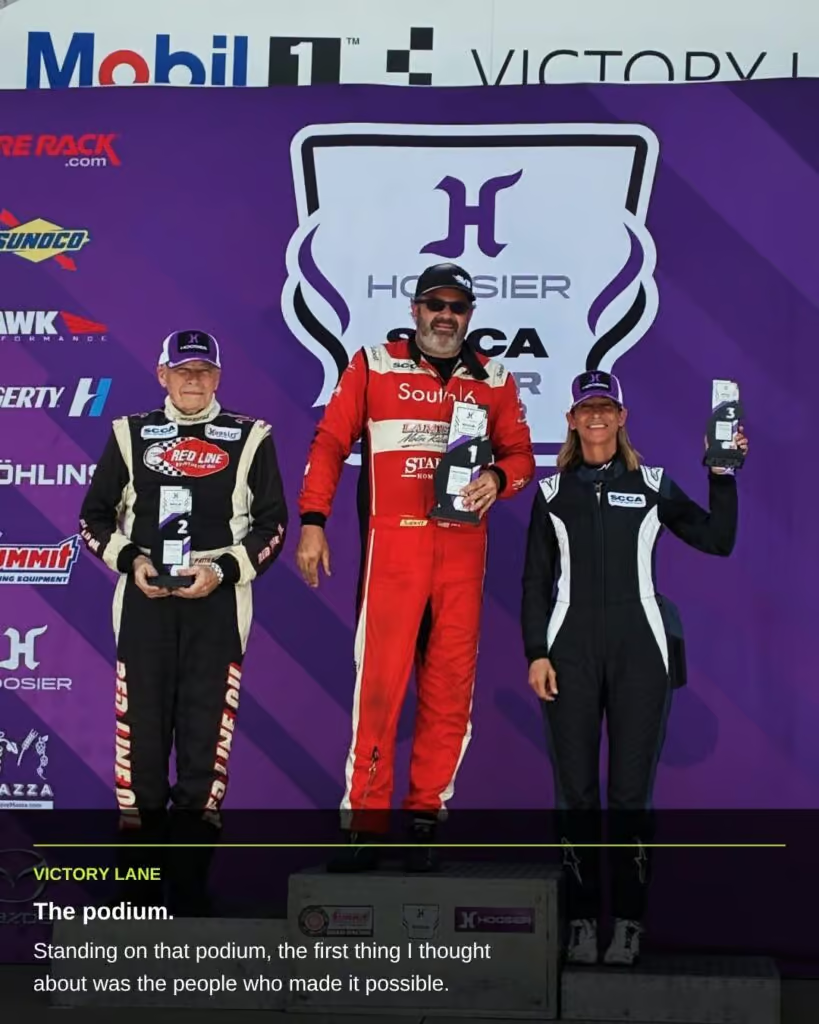
Ann Doherty celebrates a third-place finish on the SCCA Hoosier Super Tour podium at Watkins Glen International.
Ann Doherty celebrates a third-place finish at the SCCA Hoosier Super Tour weekend at Watkins Glen International.

Friday opened with two practice sessions before the field moved into qualifying and the weekend’s first race.

Ann quickly showed that the earlier preparation had carried over. She set a new personal-best lap and qualified second in GTC7 for the non-points race.

GTC7 is PCA Club Racing’s class for 2017 through 2021 Porsche 991.2-generation Cup cars. With the machinery tightly controlled by the regulations, performance comes down heavily to preparation, setup, execution and the driver’s ability to consistently extract speed from the platform.

When an issue struck the initial race leader, Ann was in position to capitalize.

She stayed composed, managed the race and brought the car home for the victory. Along the way, she continued lowering her personal best, eventually producing a 1:55.2 lap time before the end of Friday.

The victory was the visible result, but the larger story was the progression behind it.

Ann was becoming increasingly comfortable asking more from the car, and increasingly precise when describing what she needed from it.

Developing the Car as the Pace Increased

As Ann became faster, the setup needed to evolve with her.

The car that helps a driver build confidence early in their development is not always the same car they need once the pace begins to increase. As Ann carried more speed, committed earlier and asked more from the front axle, her feedback began to change.

Throughout Friday and Saturday, the team worked through a series of adjustments designed to preserve the confidence she had built while giving her the response she needed at a higher level of commitment.

She wanted more authority from the front of the car. At the same time, the increase in her pace meant she no longer needed the same level of aerodynamic stability she had previously relied upon.

Jordan and Tyler continued adjusting the platform around that feedback, while Tyler and Pippa worked together to maintain a consistent coaching framework.

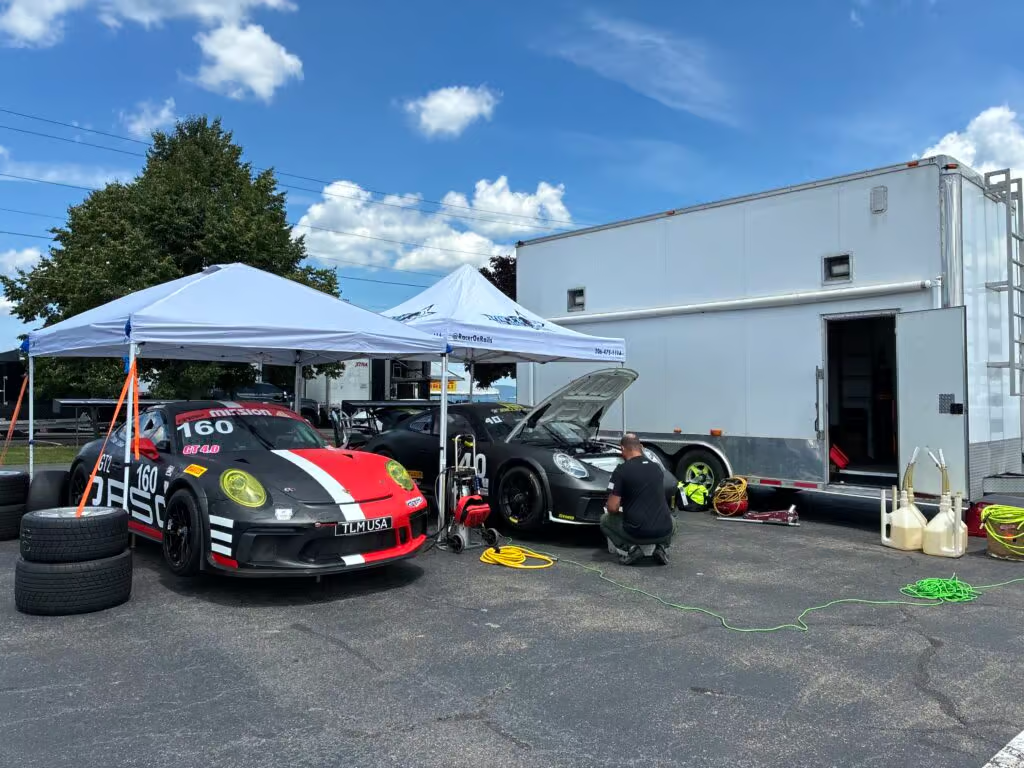
Racer on Rails team member works beside Ann Doherty’s Porsche as Thad Berger’s Porsche sits nearby in the Watkins Glen paddock.
The Racer on Rails crew prepares Ann Doherty’s and Thad Berger’s Porsche race cars between sessions in the Watkins Glen paddock.

The goal was not simply to make the car faster on paper.

It was to give Ann a car she understood, trusted and could use.

By the end of the process, the car was responding in a way that allowed her to drive with greater confidence. The lap times followed, but more importantly, so did the consistency.

Fighting Forward in the Heat

Saturday presented a different challenge.

Temperatures climbed, the points-race fields grew larger and Ann found herself racing in the middle of a group that included several newer 992-generation Cup cars.

Traffic became more difficult. The heat changed the car. The racing became more physical.

Despite those conditions, and some light contact from another competitor, Ann stayed in the fight. She managed the car, remained composed and finished second in GTC7 in the first points race.

The second points race was equally demanding.

The conditions continued to test both driver and car, and Ann did not feel as comfortable as she had earlier in the weekend. Even so, she continued working through the difficulty rather than allowing it to dictate the race.

The result was another second-place class finish.

Across the three sprint races, Ann earned:

  • One GTC7 victory
  • Two GTC7 second-place finishes
  • A new 1:55.2 personal-best lap

More importantly, the weekend showed that the speed developed through simulator work, preparation, engineering and coaching could be carried into changing conditions and converted into repeatable race results.

Rebuilding Rhythm with Thad

While Ann entered the weekend carrying recent Watkins Glen momentum, Thad’s program began from a very different position.

Thad has considerable experience at The Glen, but his return followed an extended break while his car underwent a fresh rebuild. That rebuild followed a major incident at Road Atlanta in 2024, when another car lost control on the back straight and collected Thad’s Porsche, causing significant damage to the passenger side.

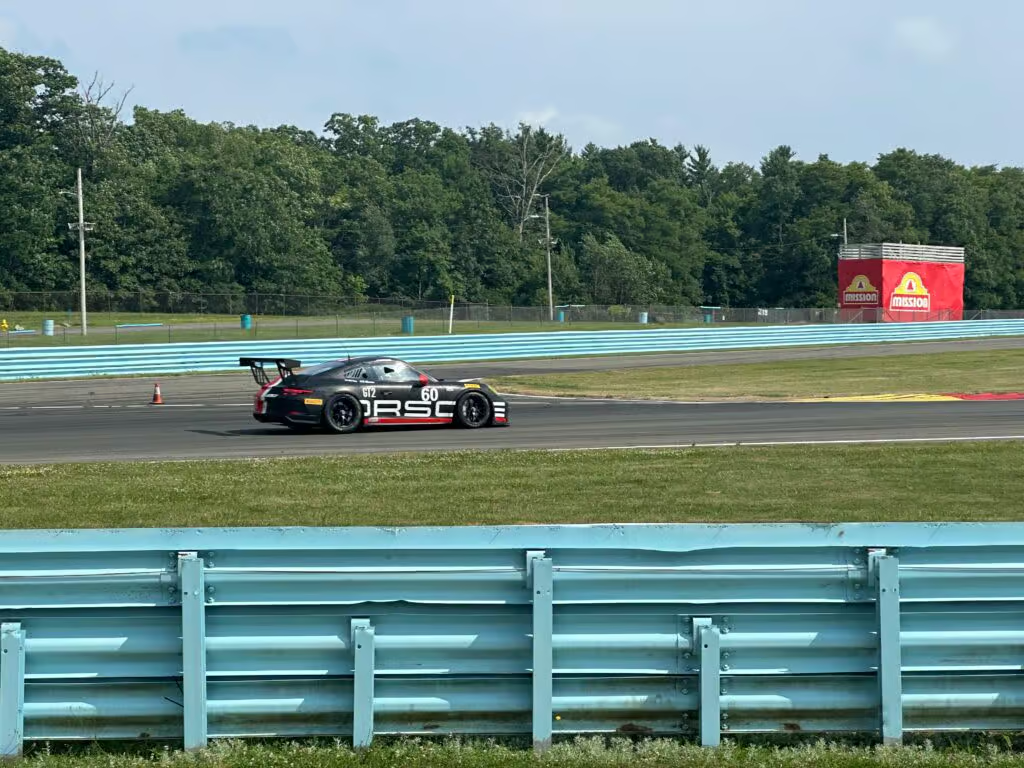
Thad Berger drives his No. 60 Porsche through the Bus Stop chicane at Watkins Glen International.
Thad Berger drives the No. 60 Porsche through Watkins Glen’s high-speed Bus Stop chicane during the PCA Club Racing weekend.

Before arriving at Watkins Glen with Racer on Rails, he had completed only one shakedown weekend with another team.

The familiarity with the circuit was still there.

The immediate trust in the rebuilt car was not.

We began the weekend with a baseline setup and then worked methodically through a series of changes intended to give Thad a car that responded the way he expected.

That process became an important driver-development exercise.

Thad is an experienced racer with significant seat time, but much of that experience had been instinctive. He had not previously spent as much time developing the language needed to describe the car’s behavior, identify what he wanted changed and anticipate how a particular adjustment should affect the platform.

After every session, we separated the conversation into two connected areas.

First, we reviewed the driving itself: lap strategy, execution, traffic management and the places where Thad could make better use of the car.

Then, we discussed the car.

We worked to identify what he was feeling, what he was asking the chassis to do and which adjustments could help the platform better support those instincts.

Before making each change, we talked through the expected effect. When Thad returned from the next session, he could confirm whether he felt what we had anticipated.

That feedback loop allowed him to connect a mechanical adjustment to the sensation behind the wheel.

It also gave the team increasingly precise information to work with.

Building Pace Through Understanding

With each session, Thad’s understanding of the car improved.

As his confidence in the platform grew, so did his confidence in his own feedback. He became more decisive when describing the car, more deliberate in his requests and more comfortable pushing once the setup began responding as expected.

The progress accelerated quickly.

By the later sessions, Thad was not simply setting personal-best laps. He was doing it while managing traffic, racing other cars and completing passes.

That combination of improving pace, racecraft and consistency became especially valuable in the two points races.

Despite qualifying several positions behind where he would eventually finish, Thad raced his way forward to third in class in both races.

Across the two contests, he completed a combined six in-class passes, earning two hard-fought podium finishes.

For a driver returning after a long interruption and adapting to a freshly rebuilt car, those results represented much more than two trophies.

They demonstrated what can happen when experience, engineering feedback and a structured development process begin working together.

Finding the Limit

The confidence built throughout the weekend carried directly into Sunday’s enduro.

As Thad became increasingly comfortable with the car, he began pushing harder than he had at any earlier point in the weekend.

While attacking Turn 8, he found the limit and spun the car.

After the spin, the Porsche would not restart, bringing the enduro to an early conclusion. It was not the ending anyone planned, but it was also not a reason to discount the progress that came before it.

Ian immediately began investigating the no-start condition and identified the cause within a couple of hours. With replacement parts on the way, the car should be repaired and ready for its upcoming International GT and Trans Am weekend.

Thad Berger races his No. 60 Porsche through the Watkins Glen Bus Stop between other competitors.
Thad Berger navigates the Watkins Glen Bus Stop in traffic during the PCA Club Racing weekend.

The spin was another piece of information.

Thad had started the weekend rebuilding trust in a freshly rebuilt car. By Sunday, he had become comfortable enough to push beyond where he had previously been willing to go.

Finding the limit is part of racing.

Sometimes that lesson arrives through a faster lap. Sometimes it arrives through a moment that creates a new problem for the crew to solve. Either way, it establishes the next step in the development process.

Thad returned from a lengthy hiatus, improved with every session, developed a stronger understanding of both the car and his own feedback, completed six in-class passes and earned podium finishes in both points races.

By Sunday, he was no longer searching for confidence.

He was using it.

Two Drivers, One Development Process

Ann and Thad arrived at Watkins Glen from very different starting points.

Ann carried momentum from her recent SCCA podium and used it to attack the weekend immediately. She set new personal bests, won Friday’s race and added two second-place finishes in the points races.

Thad arrived needing to rebuild rhythm and trust after time away from the car. Through a methodical process of setup changes, feedback and coaching, he rediscovered his pace and converted that progress into two podium finishes of his own.

Racer on Rails team with Ann Doherty, Thad Berger, their Porsche race cars and podium trophies at Watkins Glen.
From left: Ann Doherty, Jordan Allen, Pippa Mann, Tyler Campbell, Ian Anderson and Thad Berger with Ann’s and Thad’s Porsche race cars and their Watkins Glen podium trophies.

Between them, the Racer on Rails drivers earned:

  • One GTC7 victory
  • Two GTC7 second-place finishes
  • Two class third-place finishes
  • Six in-class passes for Thad
  • A new 1:55.2 personal best for Ann

Jordan Allen and Ian Anderson kept both cars supported through a demanding weekend, while the combined engineering and coaching effort from Tyler Campbell and Pippa Mann helped turn driver feedback into measurable progress.

There were trophies, personal-best laps and plenty of close racing.

But the most important result was the confidence built across both programs.

At a place as fast and demanding as Watkins Glen, confidence is not simply a feeling.

It is performance.

Posted on

Racer on Rails at Portland: Heat, Heart, PRO3 Lessons, and Runoffs Testing at The Dash for Kids

Ron Tanumera driving through the PIR festival chicane in the Racer on Rails BMW PRO3 race car.

Portland International Raceway has a way of making club racing feel bigger than the lap chart.

Maybe it is the setting. PIR sits inside Delta Park in North Portland, tucked into one of the more unique pieces of motorsport geography in the country. Long before it became a racetrack, the land was Vanport, a wartime city built to house Kaiser shipyard workers during World War II. At its peak, Vanport was home to nearly 40,000 people and was the second-largest city in Oregon. In 1948, the city was destroyed by flooding. Years later, the remaining street grid helped form the bones of what would eventually become Portland International Raceway, with the first Rose Cup race held in 1961.

That history matters. PIR is not just another track carved into an empty field. It is a public park, a community gathering place, and one of the great regional motorsports homes in the Pacific Northwest. It is flat, fast in places, technical in others, and just awkward enough to reward drivers who can get the car rotated, settled, and back to power without wasting motion.

For this weekend, Racer on Rails returned to PIR with Cascade Sports Car Club for an ICSCC Conference race weekend, The Dash for Kids XLII.

For anyone newer to Northwest club racing, ICSCC, often simply called “Conference,” is the International Conference of Sports Car Clubs. Founded in 1957, it is an association of independent sports car clubs across Oregon, Washington, and British Columbia, and it remains one of the core regional racing structures in the Pacific Northwest. One of the things that makes Conference special is that it is very much club-powered. Drivers are represented through their member clubs, and those clubs participate in the governance of the series. It creates a regional racing culture that feels practical, involved, and very connected to the people actually building, towing, fixing, flagging, and racing the cars.

Cascade Sports Car Club is one of those foundational clubs. Cascade began in 1953 as the 4-Cylinder Sports Car Club of Oregon, changed its name to Cascade in 1956, and has grown into a club with a year-round schedule that includes track days, driver education, road racing, rallies, and volunteer support for major events at PIR.

The Dash for Kids is one of Cascade’s signature weekends. It blends Conference championship road racing with a community charity event, including race car rides, paddock access, family activities, and fundraising for local organizations. The 2026 event marked the 42nd running of The Dash, with race car rides offered during lunch on Saturday and Sunday for donations to the charity.

That meant this weekend had two lanes of purpose for us.

One lane was competition and development.

The other was community.

And, by the end of the weekend, we got a full serving of both.

The Racer on Rails Plan

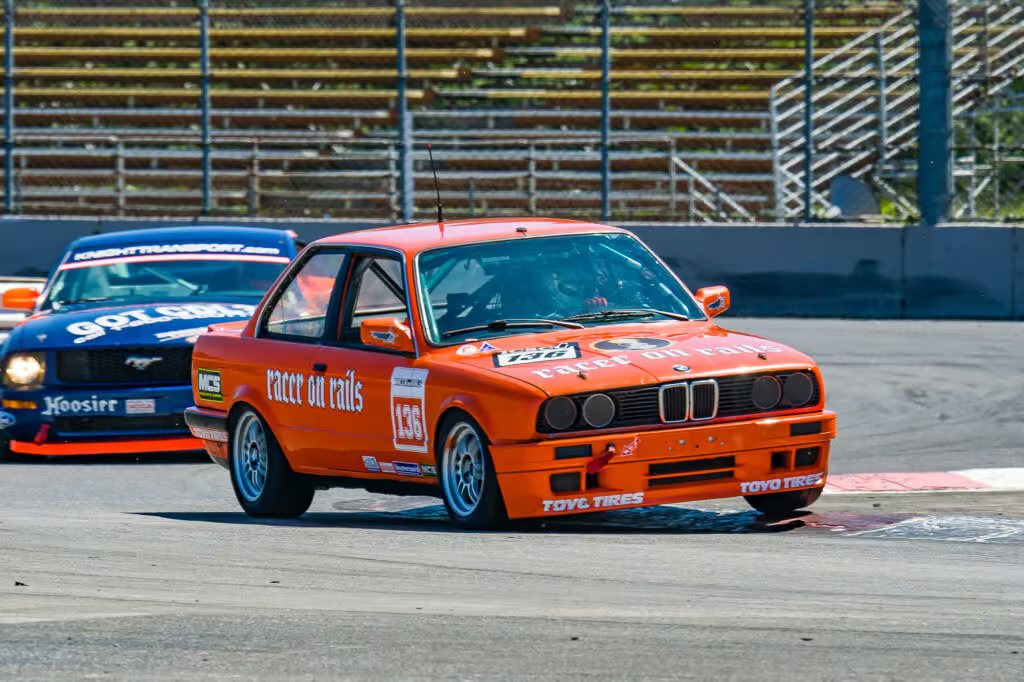
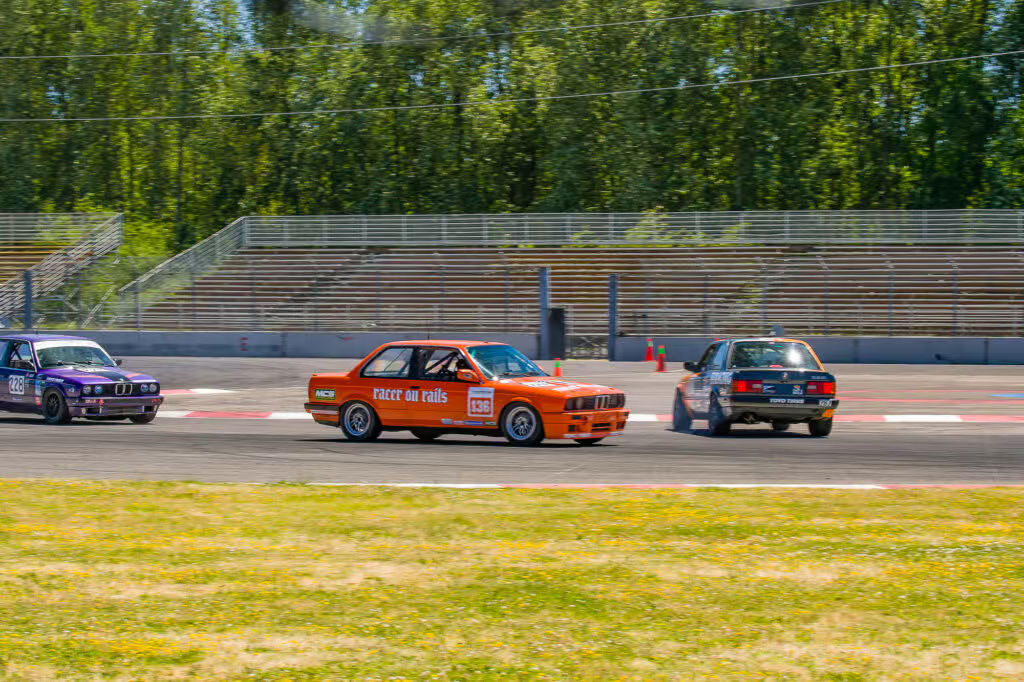
Originally, we expected to have three drivers on the weekend but one driver had to bow out last minute which left us with two primary competition programs. The silver lining was that open third slot gave us an opportunity to bring out the Racer on Rails #136 Spec E46 race car to give some lunch time charity rides! Can’t complain about that!

For Ron, the goal was not results-first. The goal was development-first.

Ron’s larger arc this season has been about building the kind of adaptable driving skill that transfers across platforms. He has driven Spec E46, the Porsche Cayman GT4, Spec Racer Ford 3, and now PRO3. The long-term objective is not simply to be fast in one car. It is to become the kind of driver who could step into an endurance team environment and be trusted: aware, consistent, confident, mechanically sympathetic, and able to keep the car in a competitive window.

That is a very different target than chasing a single lap time.

PRO3 is an excellent tool for that kind of work.

The class began in the Pacific Northwest in 2002, growing out of a group of BMW E30 racers and friends connected to the Puget Sound BMW CCA scene. It has since become one of the strongest amateur racing classes in ICSCC, the PNW, West Coast and if the group raced nationally, it would be one of the largest racing classes at any weekend, with large grids and deep competition.

It also has a very specific personality. People often casually describe PRO3 as a spec class, and while the rules are restrictive, it is better understood as a tightly controlled, Improved Touring-based formula. The cars are BMW E30 325i chassis with stock M20B25 engines, controlled tires, and rules designed to keep the emphasis closer to the driver ability end of the spectrum rather than spending or exotic development.

More importantly, they are analog. No ABS. No traction control. No stability control. Many cars run without power steering. The braking window is narrow, the tires are easy to over-ask, and the car will absolutely tell on you if your inputs are sloppy. That makes PRO3 one of the best classrooms in Northwest racing.

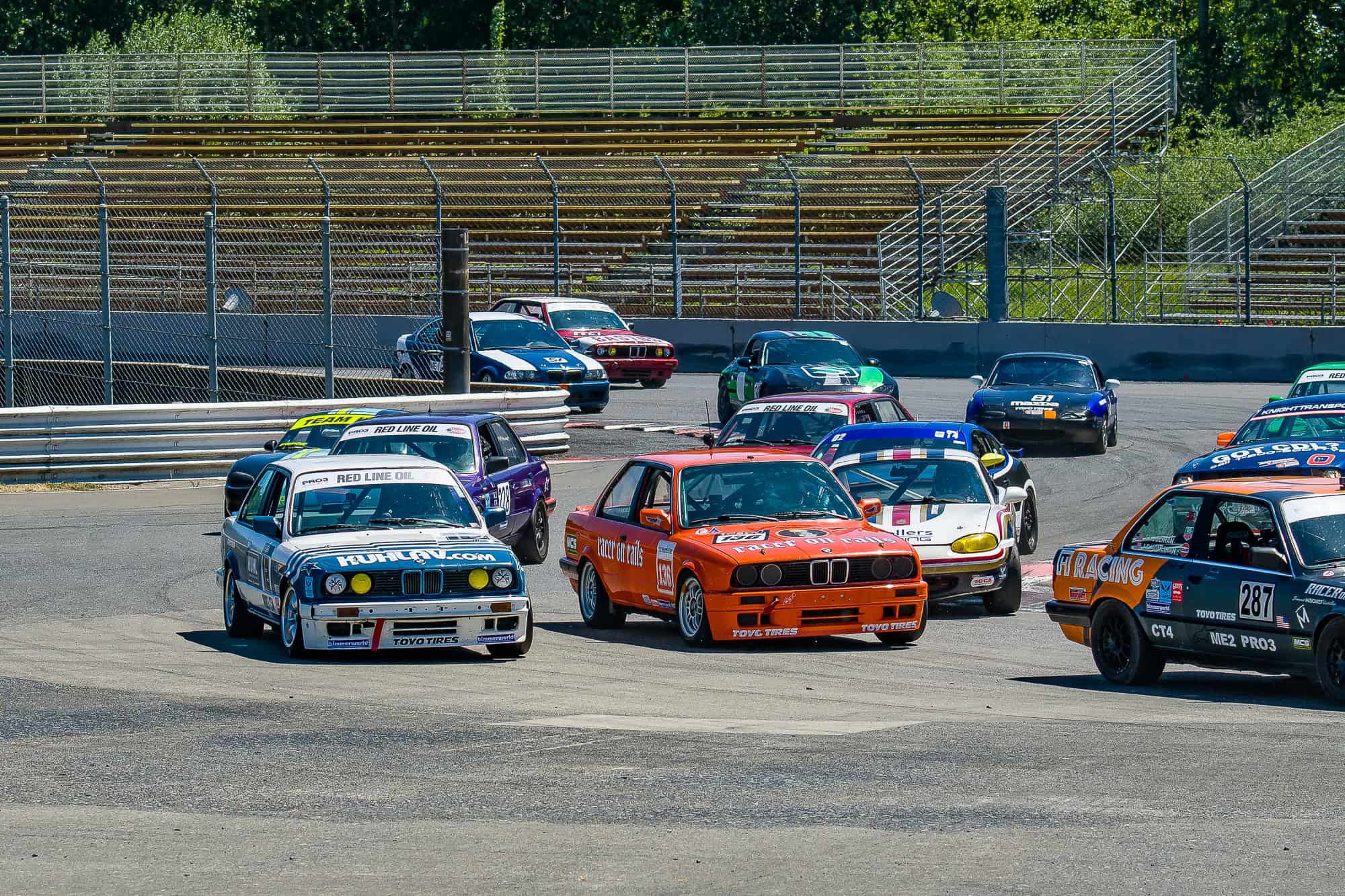
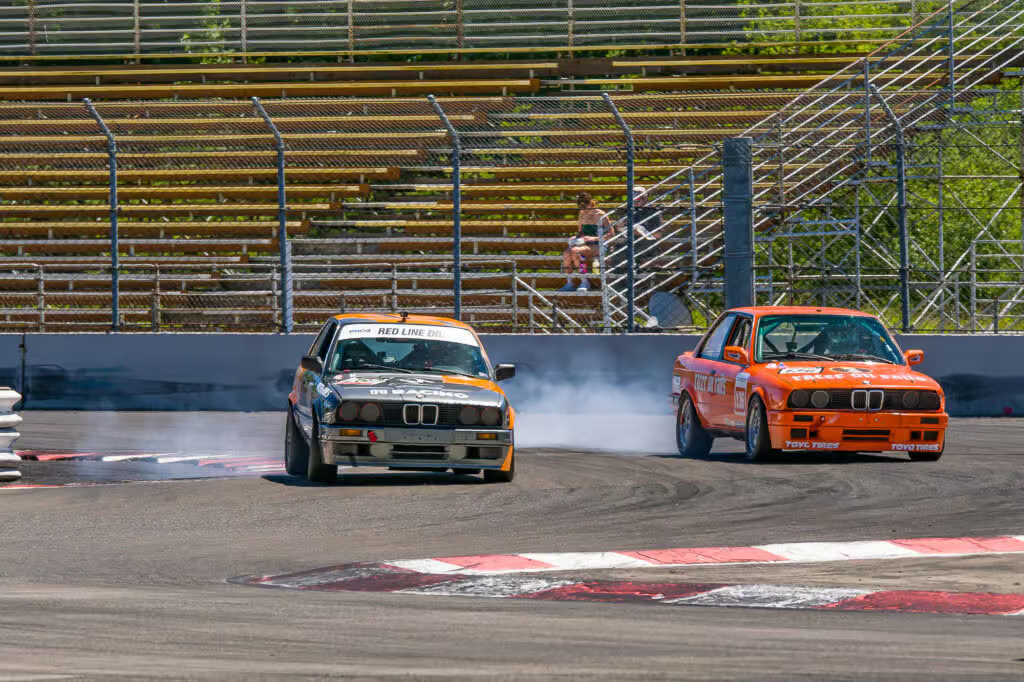
John Hoolihan and Ron Tanemura demonstrating just how analog the PRO3 race cars - locking up going into T1 at PIR.
John Hoolihan and Ron Tanumera demonstrating just how analog the PRO3 race cars – locking up going into T1 at PIR.
(C) 2025 Doug Berger | DBPics

It is also where Gama started racing, and that matters. We have seen it again and again: drivers who can run at the front in PRO3 tend to carry that skill into almost anything else they drive. It teaches commitment, car control, racecraft, mechanical sympathy, and humility. The car is not going to save you. You have to do the work.

For Gama and the 370Z, the weekend had a different purpose. This was a test event for the SCCA Runoffs at Road America later in the year. On paper, PIR and Road America do not look like twins. Road America is longer, faster, and more dramatic, with far more elevation change. But from a setup and systems-testing perspective, PIR still gives us useful information.

Gama Aguilar bombing through the PIR Festival Chicane in his 2011 Nissan 370Z Nismo road race car, running in SCCA Touring 3 Specification.
(C) 2025 Doug Berger | DBPics

PIR’s flatness, surface, braking zones, and mechanical-grip demands make it one of the best regional proxies available to us. It would not answer every Road America question, but it could answer some important ones: Do we have real pace? Can the car stay cool? Can we run hard in race conditions? Can we trust the package over a longer stint?

With hot weather forecast in the mid to high 90’s Fahrenheit across the weekend, those questions became even more relevant.

Friday: Promise for the Z, Trouble for the PRO3

Friday test day split into two very different stories.

For the 370Z, the car felt good right away. Track space was limited, and with traffic it was difficult to build a truly representative lap, but the underlying feeling was positive. The plan became straightforward: use Friday to get the car into its window, then put on a new sticker tire set Saturday morning and take two shots at qualifying.

The first shot would come in the morning mini-enduro qualifying session.

The second shot would come in Group 4, where Gama had also entered in ST. Group 4 had faster big-bore traffic, but fewer cars overall. That gave us a better chance of finding the clean air needed to see what the car could really do.

Ron’s Friday was much less tidy.

The PRO3 car developed shifter issues, possibly tied to a deeper transmission issue (Note – We would later confirm the transmission itself was healthy; the shifter issue was the real culprit). Rather than force the car through a compromised test day and risk making things worse, the team made the right call: park it early, diagnose what we had, and prepare to get Ron back on track Saturday.

That kicked off one of those classic club-racing logistics adventures.

Mitchell drove back up to Seattle on Friday evening, grabbed the spare transmission from the shop, and headed back down early Saturday morning. By 7:00 a.m., the team was back under the lift, working to get the transmission into the car and get Ron back in the fight.

No velvet rope. No magic wand. Just people, tools, caffeine, and the quiet soundtrack of “well, this is what racing asks today.”

Saturday Morning: Thrash, Traffic, and One Clean Lap

The team got the PRO3 car back together Saturday morning, but the shifter assembly continued to fight back. It had come loose and was operating strangely enough that even after the transmission swap, there was still work to do.

The good news: the team got it functioning.

The bad news: Ron missed qualifying for both Saturday races.

That meant he would start from the back.

For a driver-development weekend, that is not always a bad thing. It is not convenient. It is not ideal. It definitely makes the day louder. But it gives a driver exactly the kind of work that cannot be simulated cleanly: traffic, starts, passes, imperfect rhythm, and the need to adapt to the car you have rather than the car you wish you had.

Meanwhile, Gama rolled into Saturday morning qualifying on new tires hoping to get a clean representative lap in the 370Z.

That part did not go to plan.

By the time we got to pre-grid, there were already more than 25 cars lined up. The decision was to go to the back and create space, but with 50-plus cars on track, including a large Spec Miata field, there simply was not enough clear racetrack to put the lap together. Then the session ended early due to an incident.

So we waited for Group 4.

This time, the track-space plan finally worked. Fewer cars. Faster traffic. A better rhythm. And then, finally:

1:23.592.

https://www.instagram.com/reel/DZnKfwEgRnP

That lap put Gama P9 overall in Group 4 qualifying and P1 in ST. More importantly, it gave us the first clean signal that the 370Z had real pace in the package.

Was it perfect? No.

There was still time left on the table. Based on feel, predictive timing, and the work Gama and Tyler had done around the car’s potential, the estimate was that a 1:23.2 was likely available in that session. With a cleaner sticker-tire run and a true max-effort qualifying format, the team believes a 1:23.0, and possibly even a 1:22.8, was realistic, even in with temperatures already at 80F by 9am.

But for the goal of the weekend, the message was clear: the car had the nationally competitive pace we expected.

Now we needed to find out if it could survive the heat.

Ron Starts at the Back and Gets to Work

Ron’s Saturday was the kind of day that can turn into a throwaway if the driver lets it.

He did not.

After missing qualifying, he started from the back in Group 2 and worked his way forward to P10 in a 22-car PRO3 field, with a best lap of 1:31.721.

Then he backed it up in Group 5, finishing P5 in CT4 with a best lap of 1:31.210.

That was a big deal.

Not because P10 or P5 are magic numbers by themselves, but because of how he got there. Ron had to adapt after a messy mechanical start to the weekend. He had to race from the back. He had to get close to other cars, work through battles, and keep the car moving forward.

Ron making moves early in the Group 1 PRO3 race, starting from the back.
Ron making moves early in the Group 1 PRO3 race, starting from the back. (C) 2025 Doug Berger | DBPics

This is exactly the kind of growth we wanted from PRO3.

In clean air, drivers can work on lap time. In traffic, they have to work on craft. Portland forced Ron into the craft side of the ledger, and by the end of Saturday he was not just circulating. He was racing people. He was putting the car in places that mattered. He was becoming more comfortable with the car moving around underneath him.

That is the good stuff.

Not shiny, not always obvious from the outside, but very real.

The 370Z Race: Pace Confirmed, Cooling Not Yet Solved

Saturday afternoon, the 370Z lined up for the Group 4 race.

The goal was not necessarily to chase the race result. The goal was to run the car hard in heat and see what we had from a reliability and cooling standpoint.

The afternoon temperatures were already brutal, climbing from around 90 degrees toward the mid-90s as the race went on. That was useful. We are unlikely to see those exact conditions at Road America in early October, but that was the point. If the car could stay cool at full tilt in this environment, we would have a lot more confidence heading into the Runoffs.

Unfortunately, the race showed us that there is still work to do.

Early on, the car was running normally in clean air. Then, after a full course yellow around six or seven laps in, water temperature warnings started to appear. The car was not done, but it was no longer free to race at full attack. Gama had to manage it with lift-and-coast into braking zones, short-shifting around 7,000 rpm, and rolling back into throttle more gently than normal.

That kept the car alive and allowed us to finish, winning ST with a best race lap of 1:24.826.

But the result was not the lesson.

The lesson was that if we had needed to battle hard, defend, attack, or run nose-to-tail for position, we would have been compromised. The pace is there. The car is closer. But the cooling system still needs more margin before Road America.

Gama Aguilar bombing through T1 at Portland International Raceway in his Nissan 370Z Nismo.
Gama Aguilar bombing through T1 at Portland International Raceways in his Nissan 370Z Nismo. (C) 2025 Doug Berger | DBPics

That was valuable information.

We had also entered the one-hour mini enduro, which would have been the closest proxy for the 45-minute Runoffs race distance. But with the car already showing heat-management limits, and with the afternoon only getting hotter, there was no reason to keep poking the dragon with a torque wrench.

We had learned what we needed to learn.

The team made the call to park the car for the rest of the weekend. The official results show the 370Z as a DNS for the mini enduro, which was exactly the right decision.

Sometimes the smartest lap is the one you do not run.

Sunday Morning: Ron Finds Another Gear

Sunday morning was Ron’s chance to reset.

The car was back. The conditions were better than they would be later in the day. The goal was to make the most of the cooler track before the heat came in.

Ron got after it.

In Group 2 qualifying, he dropped into the 1:30s with a 1:30.946, good for P11 in PRO3.

Then, in Group 5 qualifying, he put together a 1:30.554 and qualified P1 in CT4.

Pole position. 💪🏾

The first pole position of Ron’s driving career. Let’s go!!!

Ron getting after it through the festival chicane.
Ron getting after it through the festival chicane. (C) 2025 Doug Berger | DBPics

That moment deserves to breathe a little.

Ron’s weekend started with the car parked early, a transmission run to Seattle, a Saturday morning thrash, missed qualifying, and back-of-grid starts. By Sunday morning, he had settled himself, kept building, and put the car at the top of the CT4 sheet.

That is not just pace. That is resilience.

And in a PRO3-based car, it means something. These cars do not give you lap time for free. You have to ask the right questions with your hands, feet, eyes, and timing, then listen carefully when the car answers back.

Ron was getting more comfortable throwing the car around. More comfortable letting it move. More comfortable staying in the fight when the environment got messy.

That is the development arc.

Sunday Afternoon: Racing in the Skillet

By Sunday afternoon, PIR was hot.

Very hot.

Air temperatures were deep into the 90s, with track temperatures well above 130 degrees. No one was expecting record pace in those conditions. This was about execution, racecraft, and keeping the car underneath you while everyone else was dealing with the same greasy, overheated racetrack.

In the Group 2 PRO3 race, Ron had challengers all around him. That is what happens when you start to make your presence known. People race you differently. They expect you to be there. They fight harder.

Not an inch to give in PRO3 racing, little mistakes have big time costs.
Not an inch to give in PRO3 racing, little mistakes have big time costs. (C) 2025 Doug Berger | DBPics

Ron started in position, battled early, and kept working through the race. He got past the group he had been racing with the day before and finished P8 in PRO3, only a couple of seconds behind the next cluster of cars up the road. His best lap was a 1:31.354 in the heat.

P8 in PRO3 is nothing to sneeze at.

That mid-pack and front-mid-pack zone in PRO3 is filled with serious drivers. In a class that deep, moving from “learning the car” into “competing with the pack” is a meaningful step.

Then came the Group 5 CT4 race.

Starting from pole, Ron got mugged at the start and had to fight for the rest of the race with Payden Baxter and Matthew King. It turned into exactly the kind of race he needs more of: pressure, passing, defending, imperfect lines, and decisions that had to be made quickly.

He finished P3, on the podium, with a best lap of 1:31.164. That was barely off his Saturday CT4 race pace and impressively close to his cooler-session qualifying benchmark, considering the heat.

Mega.

A first pole. A podium. A P8 in PRO3. A weekend that began with mechanical drama and ended with real signs of competitive belonging.

Awesome work, Ron.

More Than Lap Time

The biggest thing from Ron’s weekend is that the progress was not just numerical.

Yes, the lap times improved. Yes, the results got better. Yes, he put the car on pole in CT4 and ended the weekend with a podium.

But the more important part is that he had to keep the fundamentals alive when the racing got loud around him.

That is one of the hardest transitions for any developing driver. It is one thing to drive well in clean air when the plan is simple. It is another thing to drive well when someone gets alongside, a start gets messy, the car moves underneath you, or a pass does not happen in one corner.

Portland gave Ron a full buffet of those moments.

The next step is making that craft more deliberate and more repeatable. Not just being fast, but being able to access the driving under pressure. Not just getting close to cars, but knowing what to do with that closeness. Not just reacting to a battle, but shaping it.

That is exactly why we wanted him in PRO3.

Dash for Kids: The Other Reason We Were There

While the racing side of the weekend gave us plenty to work through, The Dash for Kids gave the weekend a bigger frame.

During lunch on Saturday and Sunday, racers and teams offered ride-alongs in race cars and exotic cars, with donations going toward the weekend’s charity. Cascade’s format makes the paddock feel open and welcoming, with spectators able to see the cars, talk with drivers and crew, and get a closer look at the machinery that usually flashes by from the other side of the fence.

For Racer on Rails, that meant bringing down the Silver Bullet Spec E46, installing the extra seat, and joining the ride program.

After making the decision to park the 370Z, that actually became a perfect pivot. The competitive work was done. The car had told us what we needed to know. So instead of forcing more laps into worsening heat, we cooled down, reset, and had fun giving people rides around PIR.

That is a good race weekend.

Not because every plan worked perfectly. It did not.

Because the weekend gave us the right answers.

The 370Z showed pace, then showed us the next engineering problem. Ron got hit with mechanical adversity, then turned the weekend into one of his strongest development steps of the year. The team handled a transmission swap, shifter issues, hot conditions, traffic, race starts, and charity rides.

That is club racing in full color.

Final Takeaways

For Gama and the 370Z, Portland confirmed that the car has real speed. The 1:23.592 in Group 4 qualifying was the cleanest read of the weekend, and the team believes there is more available with a true max-effort qualifying format and cleaner track space. But the race also confirmed that cooling remains a priority before Road America. The car can run. The car has pace. Now it needs more thermal margin.

For Ron, Portland was a major step.

He missed Saturday qualifying, started from the back, raced forward, kept improving, put the car on pole for the first time in his driving career, finished P8 in a very competitive PRO3 field, and ended the weekend with a CT4 podium.

More importantly, he became a little more of the driver he is working to become.

Adaptable. Confident. Aware. Comfortable in the fight.

That is what we came for.

And with The Dash for Kids wrapping the weekend in community, ride-alongs, family energy, and a reminder that racing can be both serious and generous, Portland gave us exactly the kind of weekend that sticks around after the trailer doors close.

Goals. Smiles. Memories.

That one checks all three.