
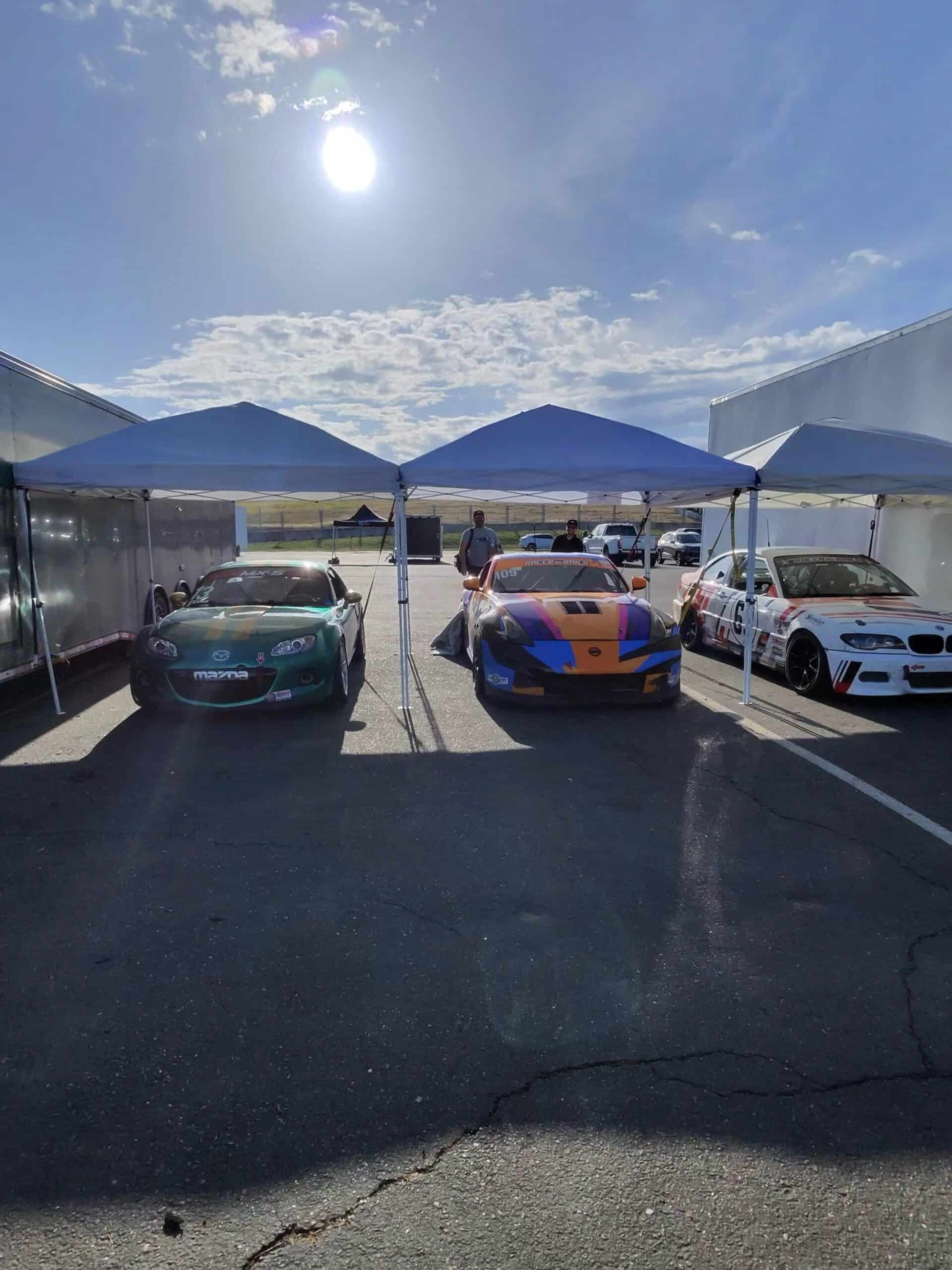
In late April, we wrapped up the final stop of our early-season West Coast racing trip with the 2026 SCCA U.S. Majors Tour at Thunderhill Raceway Park.
This trip started in February at Buttonwillow’s new “The Circuit” layout, continued through a NASA NorCal weekend at Sonoma Raceway, and finished at Thunderhill before the cars, hauler, and team made the long drive back to the Pacific Northwest.
For anyone newer to club racing, the SCCA U.S. Majors Tour is one of the national-level competition paths within the Sports Car Club of America. It brings together strong regional and national drivers, gives racers a chance to measure themselves against deeper fields, and, for many drivers, forms part of the path toward the SCCA National Championship Runoffs.
Thunderhill is always a fun place to end a trip like this. It has elevation, fast commitment corners, technical braking zones, and enough rhythm changes to keep a driver honest. For this event, we ran the Crows Nest configuration, which adds its own personality to the lap and rewards drivers who can stay patient, committed, and precise.
For Racer on Rails, this weekend had two main drivers:
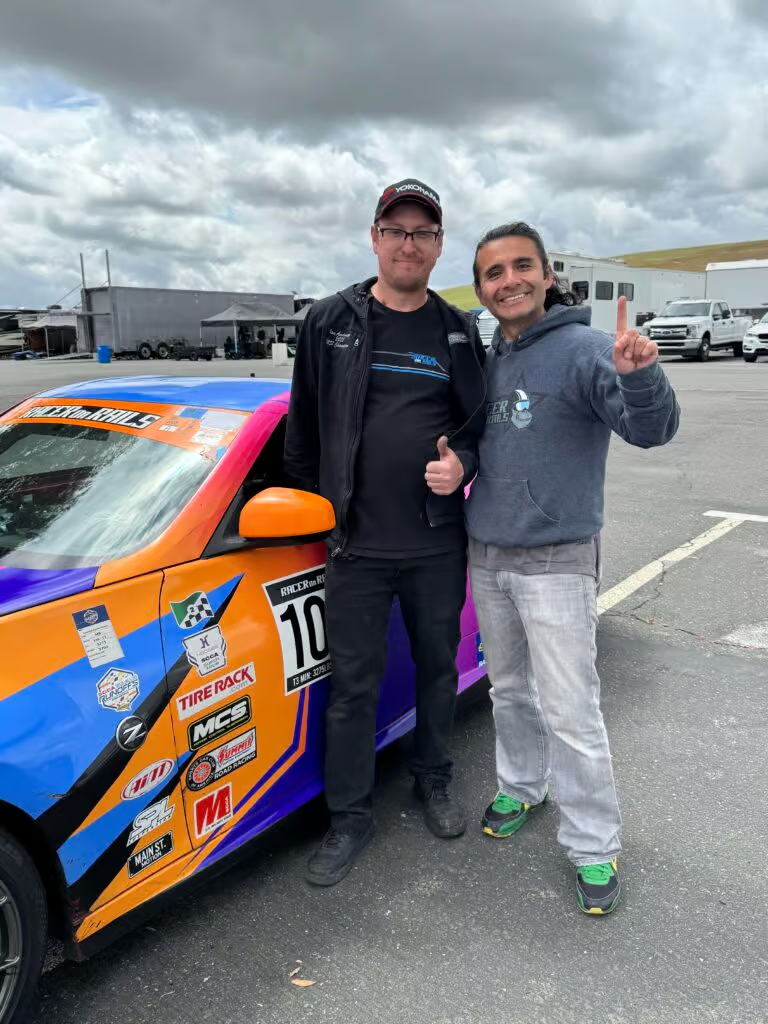
Gama Aguilar-Gamez in the No. 109 Nissan 370Z, competing in Touring 3
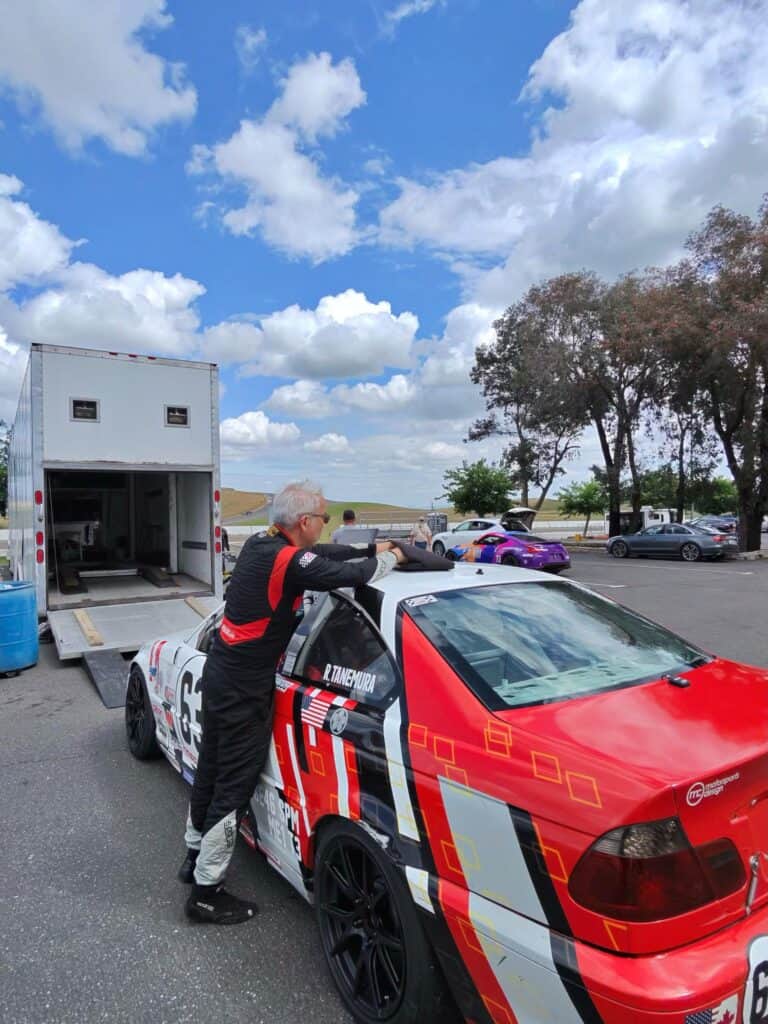
Ron Tanemura in his BMW Spec E46, competing in Touring 3 and STU
On paper, it was another race weekend. In reality, it was exactly the kind of weekend that shows why we love this sport so much. There were clear goals, real progress, hard-earned smiles, and a few memories that will probably get retold in the paddock for a long time.
Why We Were There
Every driver came into Thunderhill with a different mission.
For Gama, the weekend was an important step in the 2026 Runoffs journey. To qualify for the SCCA National Championship Runoffs, drivers need to complete the required number of race weekends and race finishes. After completing two races earlier in the season, Thunderhill became a critical opportunity to add two more finishes and move much closer to locking in the qualification path.
But the weekend was not just about checking a box.
The 370Z is still a car we are actively developing. It has shown strong pace, but like most serious race cars, especially one being pushed toward national competitiveness, the work is never really finished. Reliability, braking behavior, tire temperature, chassis balance, setup range, and driver confidence all remain part of the larger development puzzle.
For Ron, the goal was different but just as important.
Ron’s bigger mission this year is driver development. Not just getting faster in one car, at one track, in one situation, but becoming more adaptable, more trusted, and more complete as a driver.
A big part of that is variety. Different tracks. Different race groups. Different cars around him. Different levels of pressure. The long-term target is for him to be the kind of driver who can step into different racing environments, learn quickly, run cleanly, stay close enough on pace, and be trusted by the people around him.
That does not happen by accident.
It happens by putting yourself in new situations, then doing the work to understand them. It happens by learning how to drive a car when it moves around underneath you. It happens by getting comfortable being uncomfortable.
Thunderhill gave Ron exactly that kind of opportunity.
Ron’s Weekend: Raising the Baseline
Ron came into Thunderhill with a very clear goal: build on last year, get more comfortable with the car moving underneath him, and leave with a higher baseline as a driver.
That is one of the things we love about working with Ron. He is not just chasing a result. He is actively working on his craft. He pays attention to what the car is doing, what he is doing, and where the next layer of performance might be hiding.
Thunderhill gave him a perfect environment for that.
Last year, Ron’s best lap at Thunderhill was a 2:06.24. This year, he came close with a 2:06.46. On paper, that means he did not beat his previous personal best. But the timing sheet does not tell the full story.
The bigger win was consistency.
Last year, Ron had one lap in the 2:06 range, one lap in the low 2:07 range, and a handful of laps in the 2:08s. This year, he had five laps in the 2:06s, eight laps in the 2:07s, and seventeen laps in the 2:08s.
That matters.
A single fast lap is fun. A higher baseline is progress.
Ron’s own takeaway from the weekend was that he did not feel quite as “on it” as he did at Sonoma, but he was close enough to feel like his pace is becoming more real and more repeatable. That is exactly the kind of step we want to see from a developing driver.
The biggest learning was around car control.
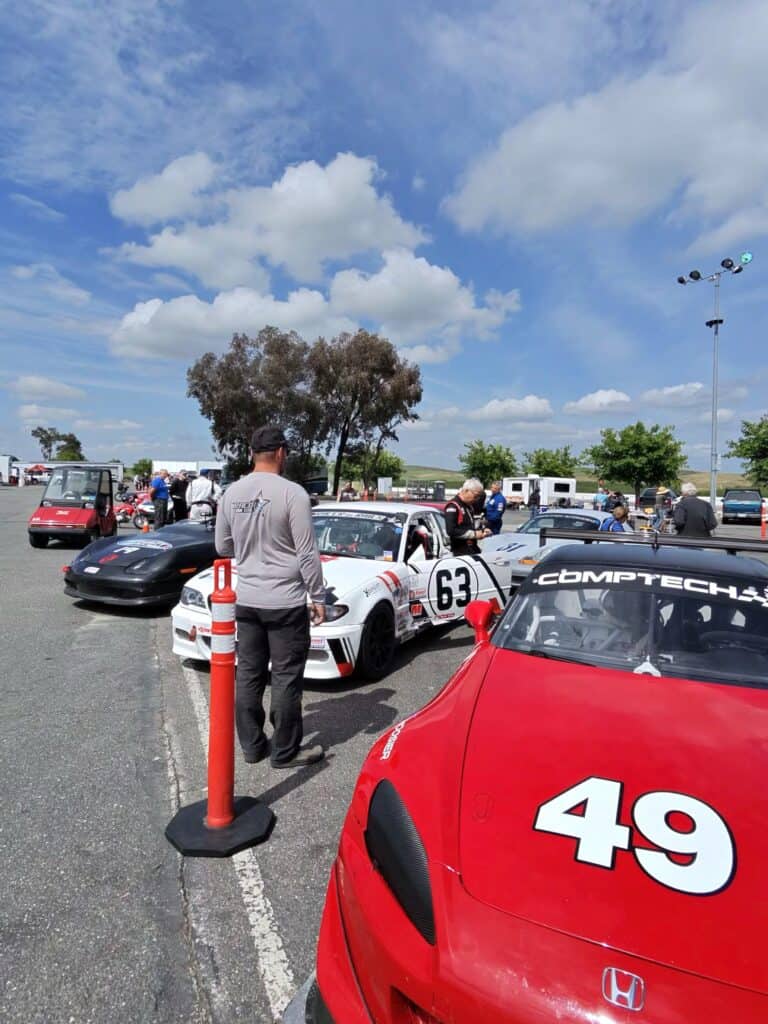
When Ron was faster, the car was moving. It was rotating. He was catching it, correcting it, and working with it instead of waiting for the car to feel perfectly settled. During Friday testing, especially in the later sessions, he started getting more comfortable with that feeling. The next challenge is learning how to access that level of commitment earlier in a session, instead of needing several laps to build into it.
That became one of his biggest themes from the weekend: push earlier, trust the car sooner, and learn to drive closer to the limit on demand.
Saturday showed that progress.
In his first Touring 3 qualifying session, Ron was quick and consistent, including a run of laps in the 2:06s before the session ended. Later, in his second qualifying session, he was fast immediately after the restart, showing that the pace was starting to become easier to access.
The races gave him a different kind of experience.
In Touring 3, Ron finished second in class. It was a solid result, but he did not have as much direct class competition around him as he would have liked. At Sonoma, he had more sustained battles, and Thunderhill was a little quieter in that regard.
But the weekend still gave him valuable race craft notes.
He worked on starts. He worked on positioning. He got reminders about following closer before the green, not over-defending Turn 1 when there is an opportunity to open the gap, and using commitment through fast corners to set up passing opportunities later in the lap.
Then Sunday threw the team a curveball.
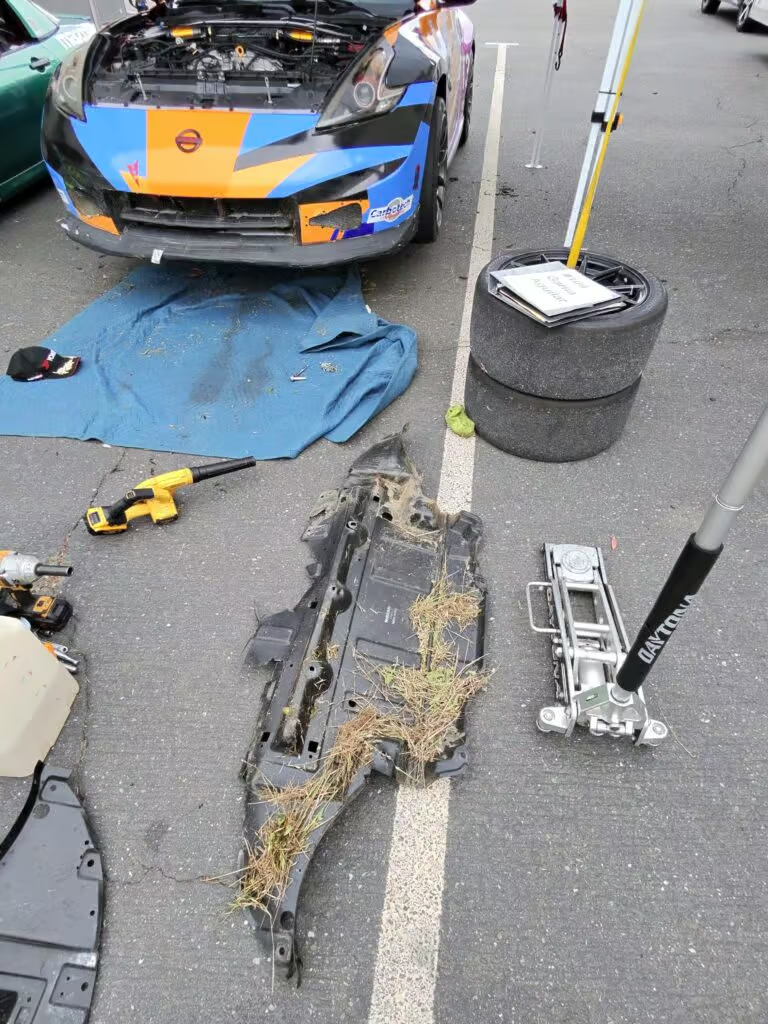
During Touring 3 qualifying, Ron quickly realized he had lost fourth gear. The transmission needed to be replaced, and the clock was not exactly being generous.
Thankfully, we had a spare transmission available.
The team looked at the schedule and knew it was going to be tight, but there was still a chance to get Ron back out for the STU race later that afternoon.
There was also something special waiting at the end.
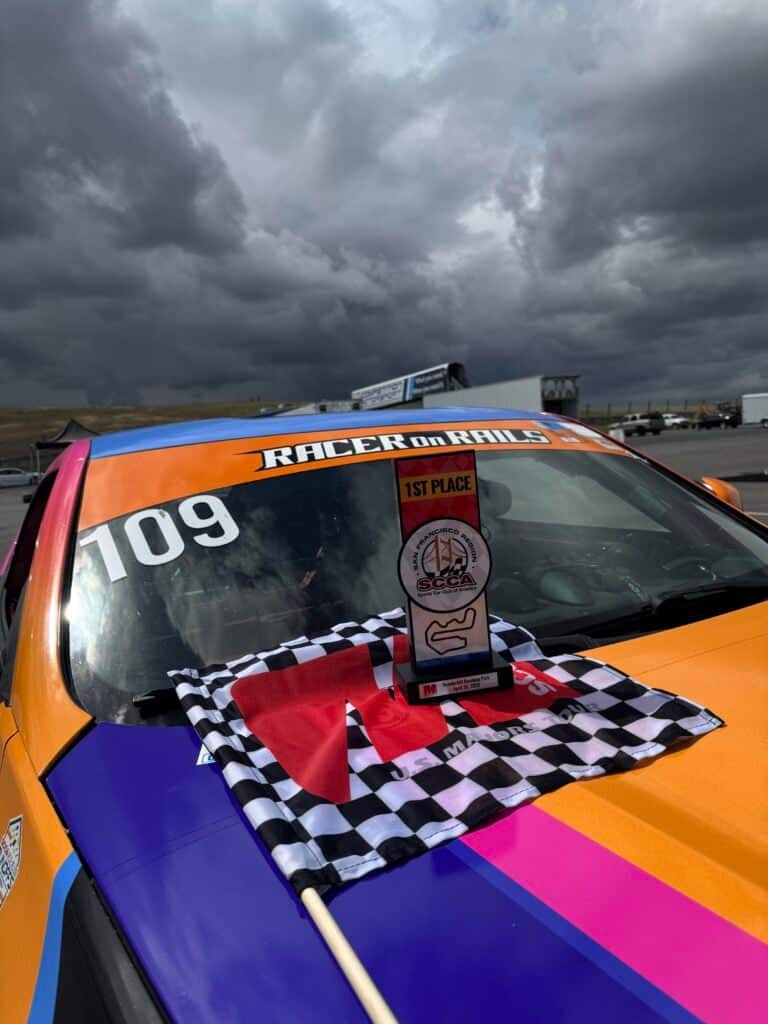
At SCCA Majors events, class winners often receive more than a trophy. This event was hosted by the San Francisco Region, and the class-win flags were a cool keepsake from the weekend.
So we made the call: let’s get Ron that flag.
The team jumped on the transmission swap, got the car buttoned up, warmed up, checked over, and ready. Ron made it to the race.
And he delivered.
He finished third overall in Group 2, won STU, and brought home the flag.
But the real story was not just the flag. It was the full arc of the weekend: clear goals, honest self-assessment, measurable progress, a mechanical setback, a team thrash, and one more chance to go race.
That is the kind of weekend that builds a driver.
Gama’s Weekend: Runoffs Progress and More 370Z Development
For Gama, Thunderhill was about two things: continuing the Runoffs qualification path and continuing to develop the No. 109 Nissan 370Z into a nationally competitive Touring 3 car.
This was only the second full race weekend of the season for the Z, and we came in with some important new learning.
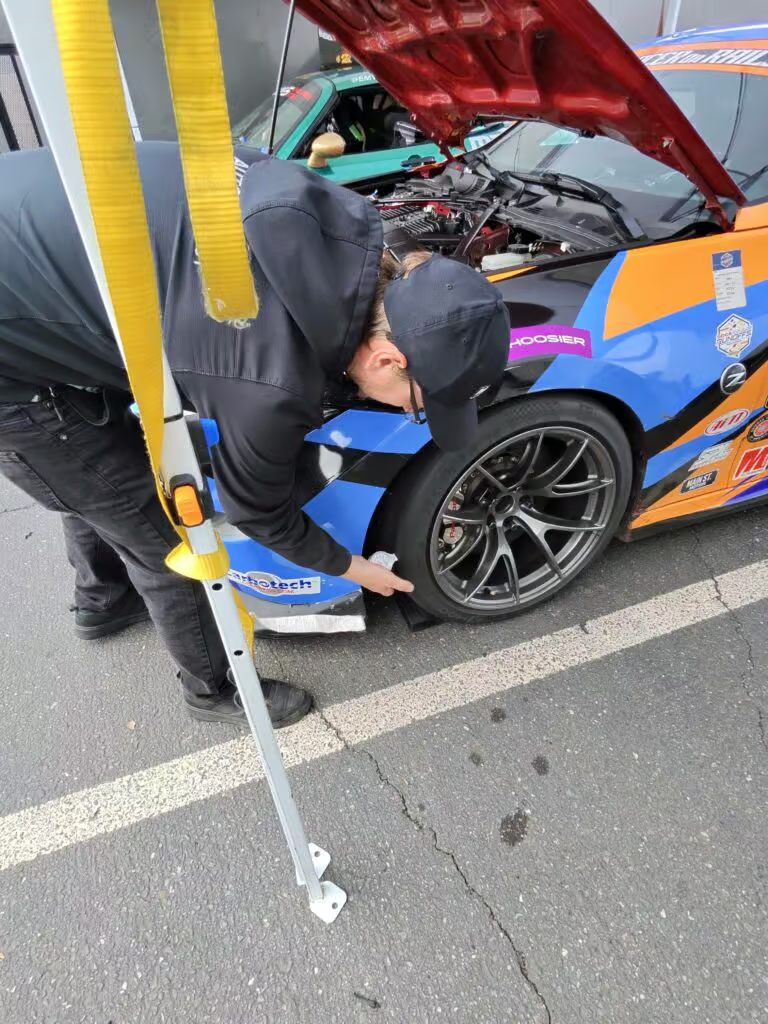
Before the event, Tyler spent time with our partners at Motion Control Suspension to better understand the internal behavior, adjustment range, and service considerations of our three-way dampers with external reservoirs. The details matter, and we came away with more tools in our toolbelt that have helped us start fine tuning the car’s behavior.
For a car like the 370Z, which has shown both pace and some sensitivity around braking behavior and tire temperature management, that kind of learning matters. We have been trying to understand how to make the car more compliant, more consistent, and easier to extract speed from over a full race distance.
The goal was not to find one magic adjustment. Race cars rarely work that way.
The goal was to understand the platform better, continue chipping away at reliability concerns, give the driver a car that communicates more clearly, and keep moving the program forward with discipline.
That is the unglamorous part of race car development. It is not always fireworks. Sometimes it is pressure checks, damper notes, tire readings, brake feel, driver feedback, and the quiet little decisions that add up to real progress.
Thunderhill gave us more of that.
On Saturday, Gama finished fifth overall in Group 1 and first in Touring 3, with a best lap of 2:02.789. That result mattered for the points and the Runoffs path, but it also showed that the 370Z had real speed in the class.
On Sunday, the priority was clear: finish the race, keep stacking Runoffs qualification progress, and bring the car home. Gama finished fourth overall and again first in Touring 3, adding another strong finish to the season.
Just as importantly, the weekend helped validate some of the direction we are taking with the chassis. The car became easier to work with, more predictable, and more useful as a development platform.
For Gama’s season, the biggest objective was to continue stacking the race finishes needed for Runoffs qualification. In that sense, the weekend did exactly what it needed to do.
For the car, it gave us more data.
For the driver, it gave more confidence.
For the team, it gave another reminder that the path to national-level competitiveness is built one weekend, one session, and one decision at a time.
The Bigger Picture
The easy version of a race recap is to talk about qualifying positions, lap times, race results, and trophies.
Those things matter. We care about them. We work hard for them.
But the best weekends usually have another layer.
Ron’s weekend was a perfect example. He hit the goals he came in with, but still left wanting more. That is a good place to be. He raised his baseline, got more comfortable with the car moving, built more race craft notes, identified where the next step is, and still came home with a class win flag after the team thrashed to get him back on track.
Gama’s weekend was different, but connected. The 370Z program took another step forward, the Runoffs path became more achievable, and we continued learning how to get more out of the platform without losing sight of reliability and drivability.
That is the heart of what Racer on Rails is becoming.
Yes, we prepare race cars. Yes, we support race weekends. Yes, we care deeply about setup, reliability, data, execution, and all the thousand little details that make a race car work.
But ultimately, we are here to help drivers become better drivers.
Sometimes that means building a faster car. Sometimes that means making a car easier to trust. Sometimes that means helping a driver understand what they are feeling. Sometimes that means creating the right environment for a driver to stretch, learn, and come back wanting more.
We want to help people set goals that matter to them, whether that is winning a national championship, earning a Runoffs invite, becoming more comfortable with car control, developing race craft, or simply leaving the track knowing they took a real step forward.
That is why weekends like Thunderhill matter.
The cars came back north to the Pacific Northwest with more miles on them, more notes in the book, and a few more stories for the paddock. For us, it felt like the right ending to the first chapter of the season.
And for our drivers, it was another reminder that progress in racing rarely arrives as one giant leap.
Most of the time, it shows up as one better corner, one cleaner race, one smarter adjustment, one hard-earned finish, and one flag you almost did not make it back on track to win.