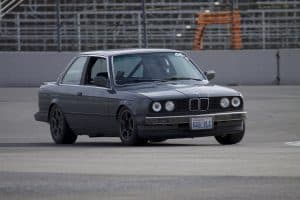
What: A small addendum to the cardio training post, let’s expand on it with a real world experience that happened just a few weeks ago at Pacific Raceways.
If I knew then what I know now: Hydration, hydration, hydration – start it at least 5 days prior the first day on track and keep it up while you are on track. Simply drinking lots of water the weekend of, is not enough.
Most of my racing is a sprint format, but each Saturday afternoon, there is a 1 Hour Mini-Endurance race (referred to as Enduro’s but spell check hates this word). During the May 20th 1-Hour Enduro at Pacific Raceways, I decided to start a ‘workout’ using my Apple Watch to track my heart rate and calories burned, more accurately. In this mode, the watch samples movement, skin temperature, heart rate, etc. at least 1x per second, versus about 1x per minute, while generally going about your day.
So what happened?
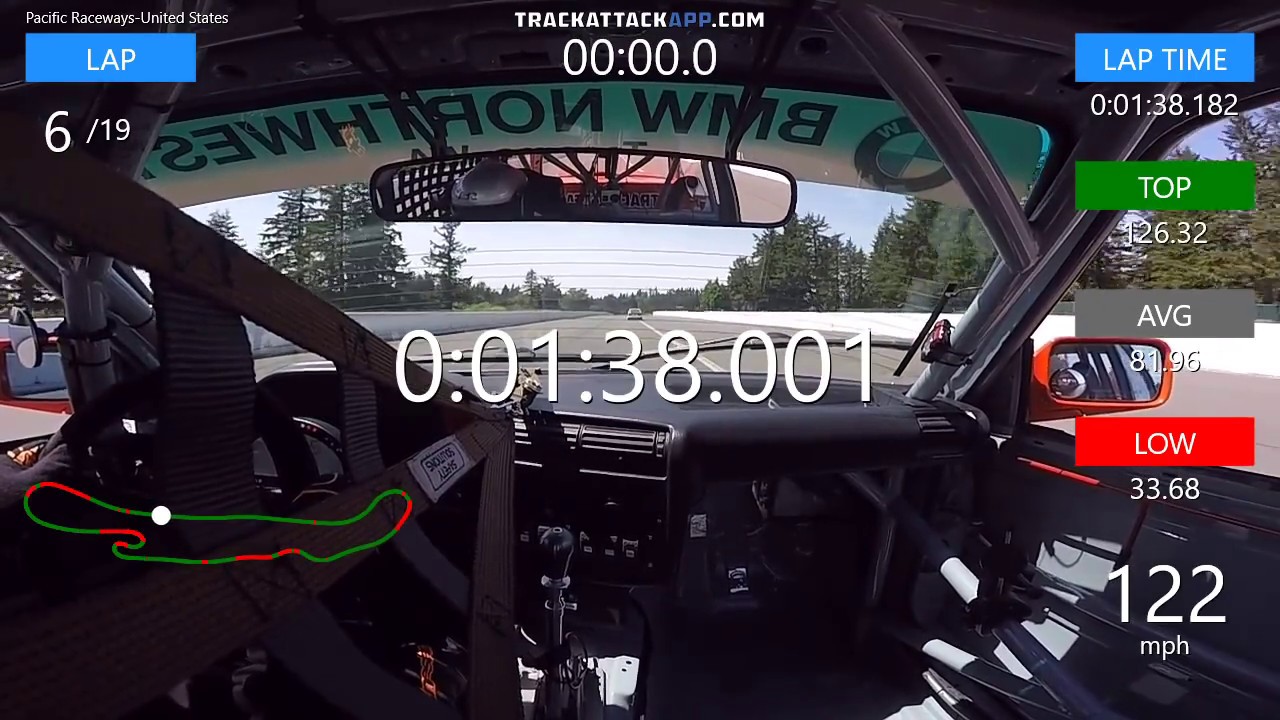
First, Pacific Raceways is already a physically demanding race track – super old school, banked turns, big time elevation change and even catching air on all 4 wheels. Before I even looked at the data, this is how I felt:
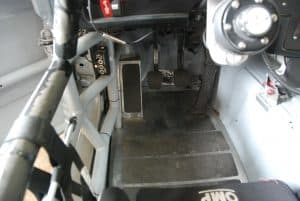
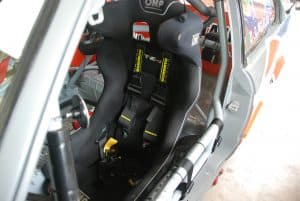
Thank Goodness for the Dead Pedal: While you probably aren’t going to be able to tell from the video, the combination of braking, lateral g-forces, camber in the road and downhill ascent of 3a and 3b complex, make it super grueling as you are carrying a good amount of speed. I found myself hanging on for dear life, thanking my OMP seat, Schroth harnesses and most importantly – the dead pedal. After each session I found myself thinking – “man, if it weren’t for the dead pedal – I think I would have fallen out of the seat.”
Oh dead pedal, how I love thee!
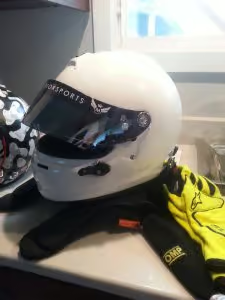
Dehydration: That day was warm but not ‘hot’ with a high of 72 degrees Fahrenheit. I have a helmet blower system hooked up to my Stilo ST5 GT Wide Composite SA2015 Helmet with Noise Attenuating Ear Muffs (Large), of which after experiencing this – I don’t know how everyone doesn’t have one. And we were planning to run the Cool Shirt CS-12 Club System but we forgot to pickup ice. No worries, we went on regardless. Well after a day of two qualifying sessions, one 20 minute race and an hour race, I felt drained and truly dehydrated – with my lips feeling chapped, which is a rare occurrence for me. I’ve probably used chap-stick or lip balm maybe a half-dozen times in my life. I have a rule that 7 days prior to stepping into a race car, I don’t drink any alcohol (usually wine) and that week, I bent the rules and I think that didn’t help. While I only had a couple glasses with dinner, I could feel the difference.
Lower-Back Pain: Yeah – even this! WTF!?!?! I climbed out of the car with my lower back, not throbbing, but sure as crap not feeling great. During the race I felt sharp pains and while I’ve had back issues the past few years – a combination of physical therapy, cross-training, plyometrics, stretching and chiropractor visits have my back in pretty good shape. Even still, I had back pain. One theory, was that this was actually kidney related as it is common to have lower back pain, from your kidneys, when you’re too dehydrated and I felt it.
As an aside, the following morning I was pretty sore – especially on my right foot, calf, lower back, right shoulder, forearm and hand. These PRO3 cars don’t have power-steering or ABS, so they are quite the analog animal to manhandle.
The data says… holy crap!
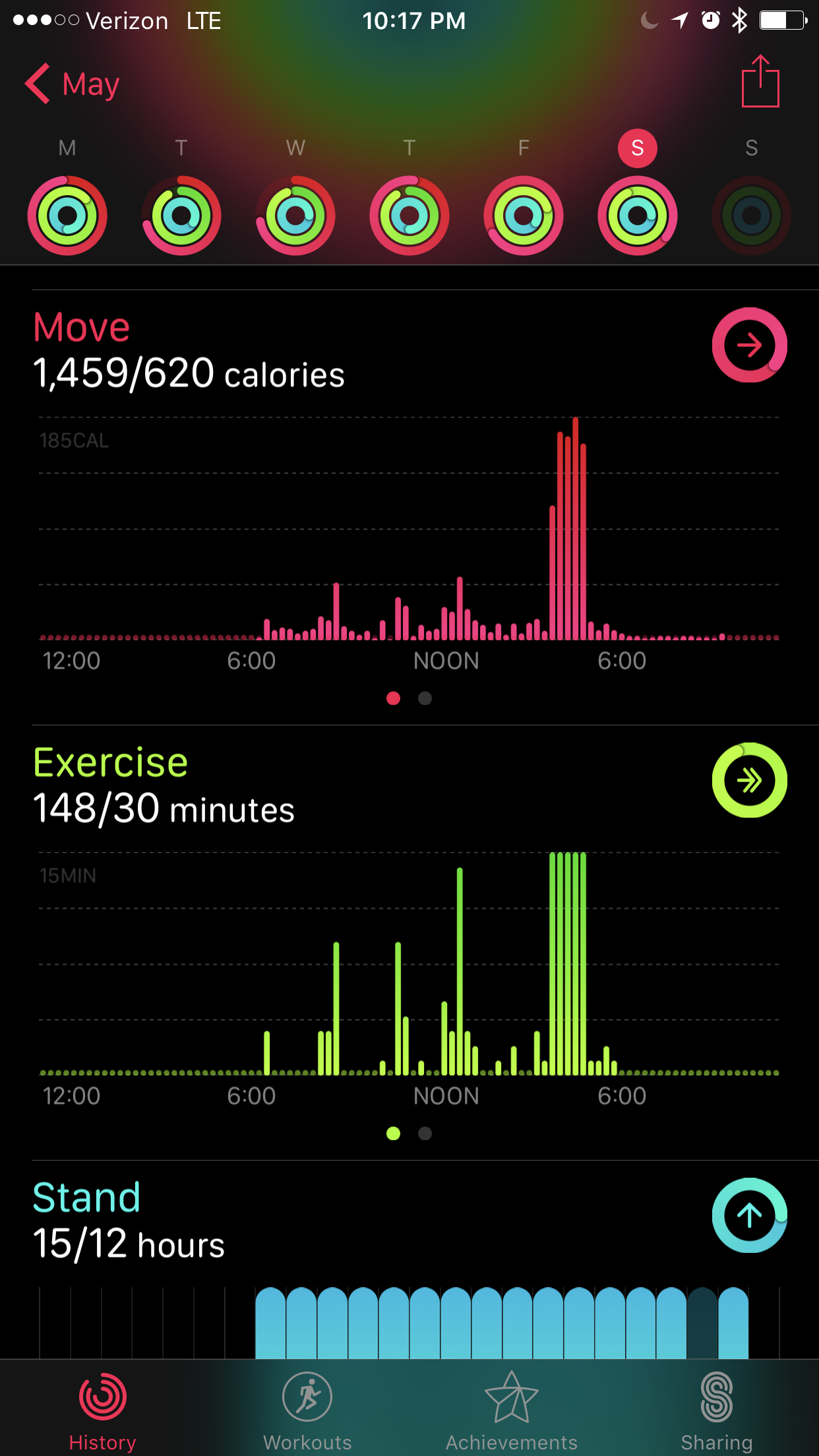
This is the health data from throughout the day. You can see the spike when I logged a workout during the 1-hour endurance race. I didn’t log a workout during the earlier three sessions (two qualifying sessions and one non-points race)Here is an hour by hour breakdown of my heart rate – note that during the 1-hour endurance race, my heart rate reached around 160-165 beats per minute.
Think about this – when was the last time you did a workout and burned (approximately) 1,000+ calories? I am talking about just the logged ‘workout’ because in the previous three sessions, I didn’t have the Apple Watch Nike+ 42mm logging calories or else the full day of calories burned would have been 2,000+. That is a TON of calories and physical effort.
Conclusion
Competitive racing is a legit, physical sport that is incredibly demanding. We are using our hand-foot-eye coordination, reflexes, core-strength, neck-strength, arm-strength, leg-strength, cardio stamina and mental stamina, just like happens in many other ‘high intensity sports’.
If you are and an avid racer, actually competing and on a regular basis – I highly encourage you to have a regular training program and eat well at minimum to avoid injury and really, to help improve your performance. Yes, you need to know what to do with your driver inputs to go fast but you also need to be able to physically do this, consistently and over long periods of time – especially for all those endurance racers. If you aren’t exhausted when you get out of a race car – you’re just not driving hard/fast enough.
I have been working on driving more consistent… err… consistently, with some success but today, it finally all clicked and came together like never before.
I woke up, tired as usual, did my stretching, some cross-crawls (thanks Ross Bentley and Speed Secrets!) and lazy eight’s, just like I do in the real world and got on my way. And for the first time ever, 20+ laps of just about all clean driving. I did drop some tires and got a little sideways but I forced myself to try to save the car, slow down and collect myself, just like in the real world. And it worked!
20+ laps of mostly clean running!
The best part? Nestled in there are five sub-1:20 lap times and I didn’t feel like I was risking life and limb to make them happen!
On average, what changed?
It was really just one segment – segment 7, which includes turns 10a, 10b, 11 and 12. The chicane in the back straight away and all the way to start/finish. With my next real-world race being at Portland International Raceways, this time being run with the ‘Festival Chicane’ in the annual Chicane Challenge event, getting a great run out of the chicane has been top of mind for me.
I made it my goal today to get the best dang run out of the chicane, on power and going to full throttle, without having to lift, the top priority and I think it’s worked! Here are a couple of proof points:
1. Braking earlier, settling the car, aiming towards the backside of the 10ab apex and getting on throttle faster.
The changes are small but they are making a difference.
2. No new personal best but the average fast lap, is faster!
Just barely but the trend holds true even for the fastest laps – I am braking slightly earlier, softer and getting on throttle sooner.
Comparison of yesterday’s and today’s average fastest lap. Small but there are differences in the right direction.
Today was one of the most satisfying days – not only was I able to get into a groove, I worked up a serious sweat and did not have a single incident – how it should be in the real world. I’m excited to keep this going and build momentum of sessions where I get serious laps in and while finding little nuggets of speed here and there.
When I first started a couple weeks ago, I would not have even dreamt of low 1:19 lap times. Now I believe they are not only possible but even 1:18’s are possible in the next 30 days!
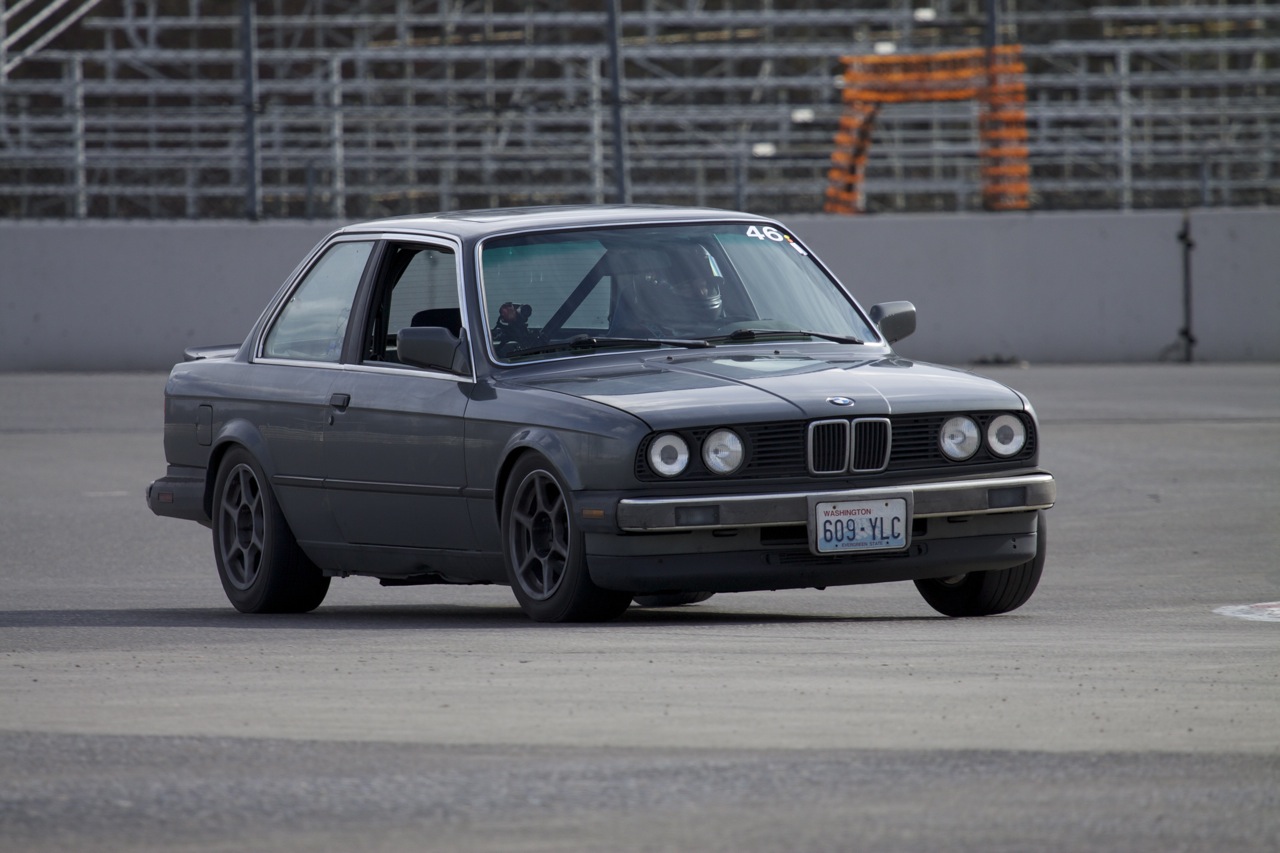
If I knew then, what I know now: I would have bought a Miata or E30!!!
Check out:Proformance Racing School if you are in the Pacific Northwest. One of the best driving and racing schools around with everything from half day track days to 2-day competition licensing school and more.
It has been almost 15 years since the first time I drove on track for the first time. When I started thinking about writing about it I was like, dang, it has been a long time. How am I going to be able to recall some of this stuff. I remember it like it was yesterday! It was a really nice day in June and my Dad had gotten both my twin brother and I “racing school” for a combination of our 18th birthday, and graduation presents from high school. It was a wicked good gift! At the time I had a Volvo. It was an 850, and did actually have a manual transmission. In all fairness, it was a terrible car for a track day. But for me, at the time, it was a great chariot for hustling for the first time. I started off the day a bit jealous. My brother already had a way cooler car than I did, and even though it was broken, he got to use another cool car which was an E30 BMW. I had my Volvo. Never the less. it was school day, and time to get after it!
We both attended the Proformance Race School at Pacific Raceways in Kent, Washington. I have actually been through their one day course, 2 times and each time was great! The second time I paid for it myself, and it was still worth it! It is a good balance of classroom instruction, low speed car control skills building, then a half of a day on the track with an instructor.
I remember being pretty intimidated when we started the classroom session. Lots of people there. Lots of serious machines also. None of that ended up mattering. Each instructor is set with you, for the day. They don’t care what you are driving, they just want you to learn how to drive the snot out of it, safely.
1. Classroom sessions
The classroom session was the part I did not care for. Having done some auto-x in the past, and lots of race watching in my past and felt I had a pretty good idea of what the flags were, and what a turn station was. Things got deeper than that though, and it was much more informative than I was expecting. The classroom session was not long and was out of the way first thing in the morning. Once you break in the class room it is time to get into the cars and start driving.
2. Low speed car-control skills
The first part of the driving curriculum is the low speed car control skills session. This was a lot of fun. We went through a few different scenarios and I found that later in life, these skills paid off in spades in the real life. There were emergency lane change drills. Braking and turning sharp (like making a ‘J’ with your car), Threshold braking, which is very different depending on if your car does or does not have anti-lock brakes. My Volvo obviously did. We did eyes up drills using a man with a flag, and a slalom course. These skills seem so basic, but being taught how to use them, and then implement them at higher speeds will make a huge difference in your skill set both on and off the race track and street.
This brings us to lunch break at this school. During lunch my brother, my dad and I got to chat a bit about the morning. Both of us were more excited with driving on the track that afternoon though.
3. Track Time!
After lunch it was track time. We took two laps in our cars with the instructor driving to show you the basic line and where each corner goes. After those 2 laps it was game time. My first session in the car was great. I was going fast, relatively anyway. I was turning laps on a race track! It was an amazing feeling. Not having to worry about cars in driveways. Kids playing the street were non-factor. You just get to haul ass!
I started getting into it more. My instructor was great, and encouraging throughout the afternoon as I picked up pace. We picked up enough pace to send my street welly tires strait to a fiery hell. They were by all accounts and purposes a street all season tire. By the end of the second session on track, they were screaming for mercy on every brake zone and corner. I also started to run into a fuel starve, or electrical issue. When exiting a left hand corner (of which Pacific has a majority of) the car would bog down, and then get on its way. It started to get frustrating. I felt like it was dampening my total experience, but it really was not. I needed to focus on skills building at that time, not how fast my car was going.
The start of a lifetime of motorsports
By the end of the day. I had not broken my car. I had not crashed into anything and I had learned a lifetime skill set that, as I said before, would show itself to pay off many times over in the real world. Mainly by avoiding idiots trying to crash into me! I was hooked. As it may be apparent. I found sport driving and racing to be what I truly love to do. It is a way for me to show aggression and not be physical (like boxing or wrestling, or martial arts). I can work my butt off in the car and it is a good work out. The mechanical symphony that is a race car is fascinating to me. I know this was going to be fun!
It’s race day! Although I had races yesterday, today was the big race – the race that counts towards the PRO3 Championship, one of the most contested and desired club racing crowns in the pacific northwest and if this series was national, I think it would be up there with a Spec E30 or Spec Miata national championship. Big fields, hard racing and really needing to drive these cars to the limit, without losing momentum to go fast.
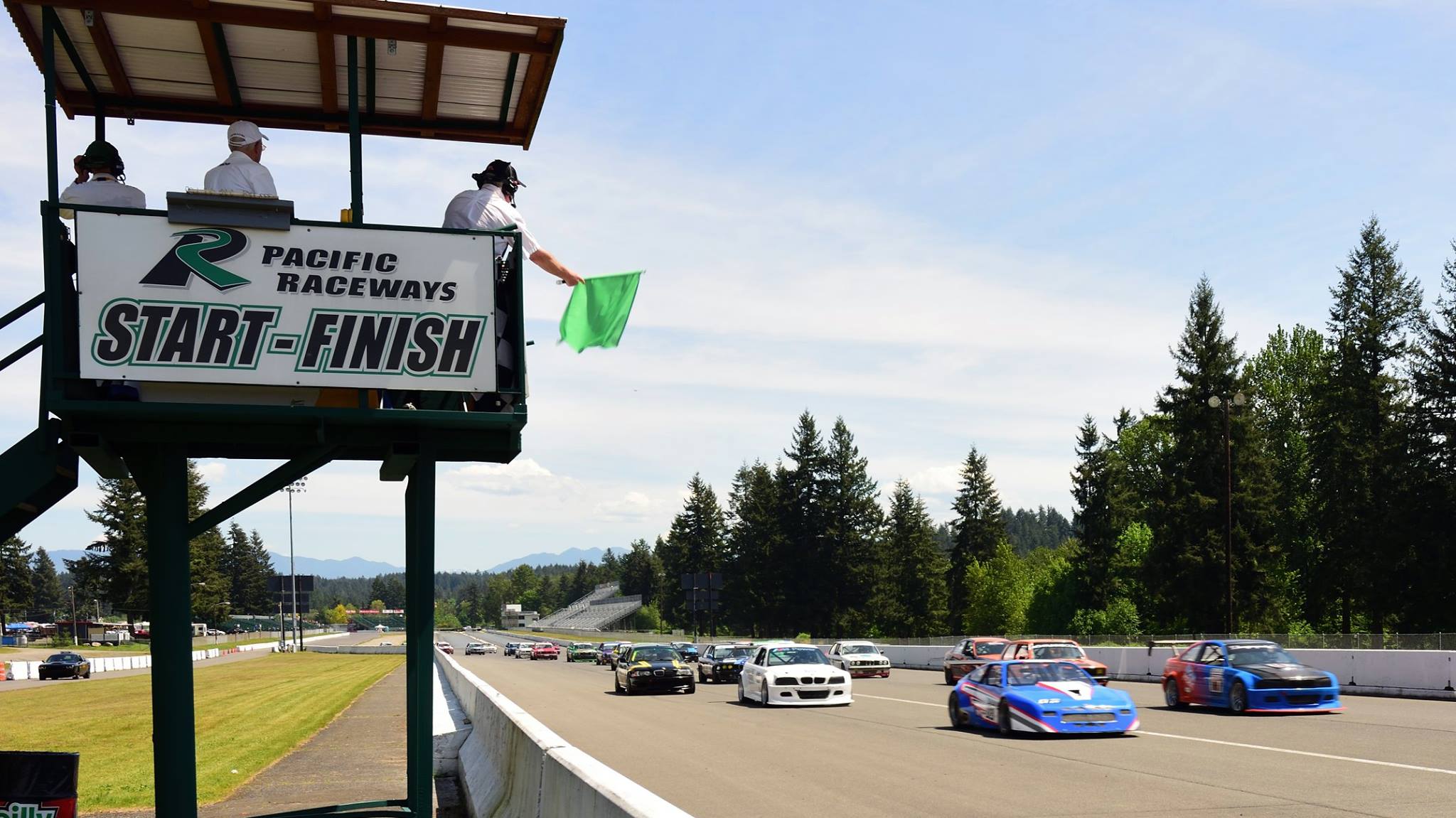
Taking the green flag on race day at Pacific Raceways
The plan of attack
Yesterday, I improved some of my personal best lap times by over a second and in worsening conditions. I turned a 1:37.2xx in the afternoon, which was nearly 10 degrees warmer than during qualifying in the AM and repeated that almost exactly, in the second half of the 1-hour endurance race… with tires going on their 11th and 12th heat cycle!
So today my goal was to keep improving and try as best as I could to crack the 1:36.xxx range of lap times, of which in my going back through official race records on the ICSCC.com website, there are less than ten people who have ever gone under 1:37.000 in a PRO3 car, at Pacific Raceways on official record.
Part of this is that up until a few years ago, the track surface turns 8 and 9 were absolutely horrendous. They were the original concrete or whatever the surface type was, full of bumps, pot holes and smoothened over years and years of beatings.
Pacific Raceways – it’s a beast!
It got so bad that a few track day organizations essentially boycotted holding events there because they had customers, with really nice cars, suffer bent wheels and damaged tires. The reality was that it wasn’t great, not the worst ever but because it was deterring people from coming to the track, it needed to be fixed. Here is a video of Cody Smith, of Code Red Racing, who also won the PRO3 Championship in 2013, flying through Pacific Raceways. Cody is fast and smooth!
How’d it go? 1:37.104!
This time, we decided to start towards the back of the field and use the first few laps to warm up the tires, build tire pressures, get a solid lap in and then adjust track position. We did just that and towards the middle of the session, I fell back to latch on a to pack of PRO3 cars running together. Though I didn’t know for sure, I felt like I was faster than the whole group, so I fell back, created some space so that ideally, I’d be catching them the hardest at the end of the lap and getting the tow from them on the main straight away.
So close!!!
And it worked! I actually had a 1:36.9xx going for most of the lap but on the turn 8, I got just the tiniest bit of sideways and I think that caused the lap to not be better. Regardless, I was happy to get it and in the end, it would have been a stretch, in that session to go faster. The consolation for me was that in that session specifically, I made an improvement but the competition ahead and behind did not.
So how did I make the improvement?
Data and video. I recorded the video below to go into more detail but essentially, I focused on three things (see below the video):
Comparing with a faster driver: I had the benefit of getting a hold of data and video from another driver, who was faster than me (and won the PRO3 championship last year) and leveraged an alpha tool we’ve been working on with Track Attack. Essentially, with Track Attack, we’ve figured out how to make data from different systems, comparable with each other. Olivier uses RaceLogic’s Video VBOX and I use AIM or Track Attack on iOS. In the video below, you can see how I used this tool to compare the data and see where Olivier was gaining the advantage. Conclusion? Corner entry and mid-corner. Oliver was consistently able to roll more speed into a corner, maintain it mid-corner and then carry that advantage on the straights. He was and still is, much better under braking and controlling the slide of the car.
Understand the line and what the differences looked like: Similar to Olivier, I am also a very visual learner. Though I understand data, graphs and tables, I have an athletic background, where muscle memory and training are critical. So being able to see what a faster lap time and specific segments look like from outside the car and from the driver inputs, was incredibly valuable. I was able to see in the track map comparisons, the differences in the lines taken. He would usually brake earlier and turn in later for most corners, trying to carry as much speed as possible. You could visibly see how he had to dance with the car in mid-corner and be more precise getting on throttle, to not light up the tires.
Theoretical fastest lap: Lastly, one awesome feature we have in the Track Attack alpha product, is the ability to generate segment times AND the video associated with each of those segments. Further, we stitched together all of those segments, to show what the theoretical fastest lap time actually looks like. I generated this video and watched it over, and over, and over and over again, trying to program the muscle memory of that lap into my eyes, mind, hands, feet and core. I wanted that low 1:36.xxx lap time infused into every fiber of my being.
When will this be available?!?!?!
Soon! Racer on Rails is intended to be un-biased about products, so I won’t talk about it much here but know that we’re working on this with the Track Attack team and that this summer, this type of analysis and capabilities will be available to everyone and support all major data acqusition system file types (AIM, MoTec, Bosch, RaceLogic, TraqMate, Alfano and Unipro).
Race Result: Qualified P3 and Finished P3
This was an awesome race, see the video below. The high points are that I got a decent start, positioned myself exactly where I wanted to be and was able to make a really fun overtake on lap 2, turn 2 to get into 2nd position. I knew that if I got behind Brian Bercovitz, I would have to stay with him and pressure him into making mistakes because he is a good driver and has a rocket ship car (not that mine is a slouch).
I found myself in just that position a couple laps in and determined that I had an advantage on him under heavy braking (for turns 2, 3a, 3b and to a lesser extent, 8) but he did a great job through 5a, 5b, 6 and 7. So at the end of each lap, we’d end up about the same distance and with me being close enough to tuck under his draft. Trying to go for an overtake going into turn 2, I decided to try to get an incredible run out of turn 8 and while doing so, carried too much speed into the corner, got sideways, saved it but let two cars by.
That was just under halfway through the race and while I had a better pace than those to cars, with the rear tires getting lit up during that drift, I had to baby the tires and by then, the gap was too big to overcome. I technically finished 4th but due to the 2nd place finisher being disqualified for being under-weight, I inherited 3rd place.
Taking the green flag on race day!
Although I was disappointed a little with my mistake, overall, the weekend and day was a great success. We made improvements on the car, the driver and lap times. We established that we can compete for wins and just need to be more consistent. Thanks to the whole crew for all the work before, during and after the weekend. This hardware is for you all!
Today is the first day I have driven in the real world since I started this 30 day challenge. As I mentioned in the race reports for the April 6 Hour Endurance race at the Ridge Motorsports Park and the sprint season opener at Portland International Raceways, I primarily compete with ICSCC in the PRO3 racing series. It’s like Spec E30 but with more room for modifications to the car, which translates to them being slightly faster. Today was Test and Tune Friday, a regular part of a race weekend where can test things out on the car, get the setup all dialed in and practice ourselves.
The goal: Running solid, get a baseline set and scrub in new tires
It’s been since last July 2016 that I’ve driven at Pacific Raceways, a track that is a throwback to the old days of race tracks. Walls, trees, earth and not much run off are the characteristics of the track. We’ve made some significant changes to the setup and balance of the car from last year, where we saw big improvements at The Ridge Motorsports Park and PIR after the changes. So the expectation was that those changes would also benefit Pacific Raceways and coupled with driver development, we’d make some big gains in lap times and overall pace.
Here is the video last year’s August race, where I finished 4th in class
Setting a baseline
During the test and tune, we had four sessions for the day and unfortunately, I would have to miss the 3rd session because of a work conflict (jumping on an important conference call). That left three sessions to make sure the car was running well, I was back up to speed with the track, make some progress and scrub in some sticker tires.
Session 1: After the first few laps of feeling confident the car was running well, I started to pick up the pace but a driver that was taking out his new (to him) PRO3 car out for the first time, had a mechanical issue, which caused a black flag all. On top of cutting the session short, I did not see two of the black flags and was later given a talking to and I promised to be more watchful. 🙁
Session 2: Go time! I was able to get make my way through traffic and on the second lap, back in the 1:38’s! My personal fastest had been a 1:38.2xx during the race above. More 1:38’s and finally – BAM! 1:37.766 – now we’re talking! I only got one lap in the 1:37’s but I knew I had figured something out and the rest were in the low 1:38’s. A new normal!
Session 3 (the last session of the day): As much as I wanted to keep the other tires on, I had to be disciplined and put on some sticker tires, knowing that the only goal was to get a healthy heat cycle on them and dial in the tire pressures so that they could be used during qualifying tomorrow. So I put them on and despite them being new, still easy 1:38’s and a 1:38.064. KABOOM! Insert super excited emoji here!
Sticker tires!
So how did I shave .5 seconds off of my personal best lap time?
There are likely more than this but here’s my take:
The weather: Today was mostly sunny, light breeze with a high of 71 degrees Fahrenheit. It was 81 degrees Fahrenheit on July 24, 2017. Warmer weather usually results in less power and a slippery track.
Car balance: Last year, we noticed that I was struggling with rear wheel spin getting out of almost all corners, so we made a late-season change by lowering the ride height of the rear and artificially putting more weight back there, to get more traction. That made a huge difference immediately. Over the off-season, the folks at Advanced Auto Fabrication installed an absolute work-of-art fuel cell, in conjunction with the OEM fuel tank. This had two benefits:
Endurance ready – We now had a fuel system with enough fuel to run 3 hours straight!
Weight balance/distribution – due to the new hardware, we could remove the nearly 100lbs of ballast in the passenger seat area and moved all that weight back, where we need it for more traction. We also can add fuel to the fuel cell, along with ice and water to the cool suit which was moved back there too, to make sure we’re at minimum weight. More weight backwards is a good thing!
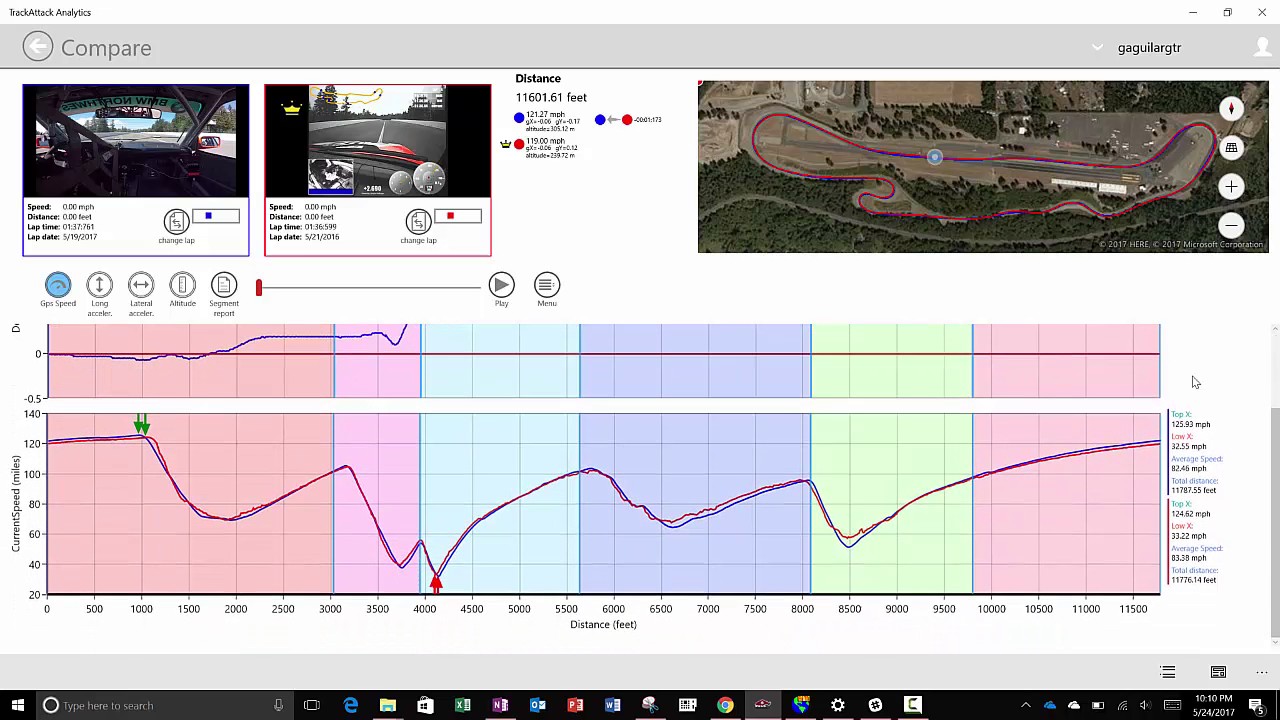
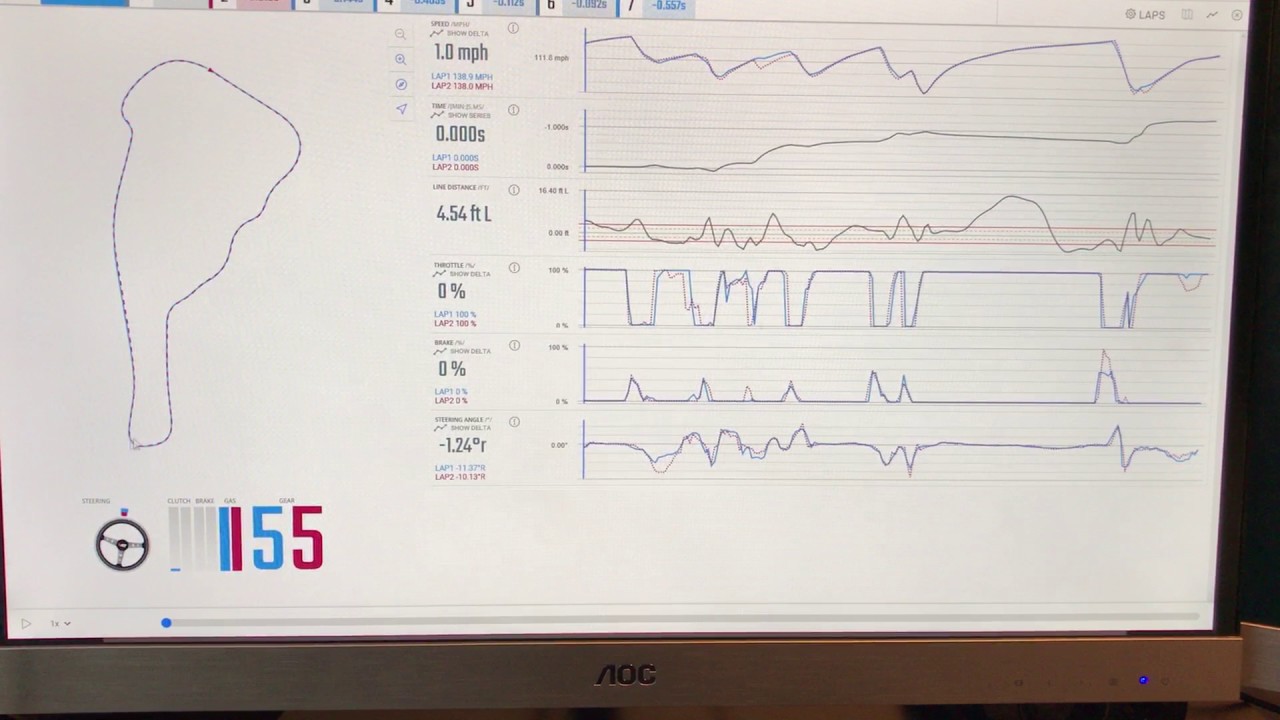
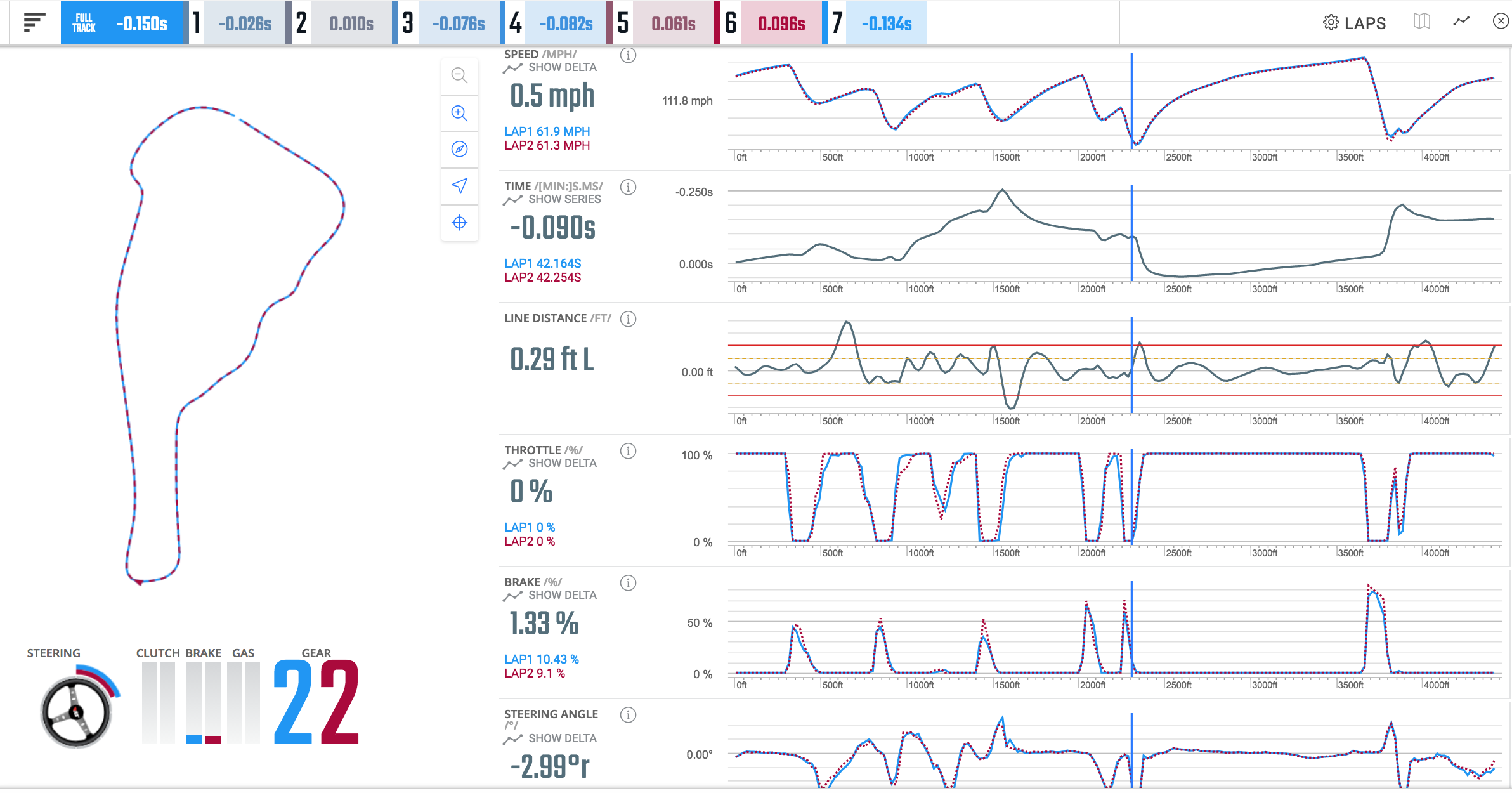
Specifically, here is a comparison of my speed trace from last year’s fastest lap and today. Note, this is an alpha product of Track Attack that won’t be released but something similar is coming out soon and super excited to share more about that. Note, Racer on Rails is a completely separate entity from Track Attack, but I am also on the Track Attack team as a co-founder.
Comparing a 1:37.761 from today to a 1:38.215 from July 2016
Notice how in segment one, in the red line, I braked earlier, softer and carried more speed into the corner and it also translated to a higher top speed at the end of that zone.
In segments 2 and 3, I also braked earlier and got on the throttle sooner. In segment 4, I carried more speed into the scariest part of the track (turns 5a and 5b) but I lost a little bit in the exit. Lastly, in segment 5, I braked earlier, got the car turned and back on throttle sooner.
This is what lunch looks like for me. Burritos + data + video. All FTW!
So what change corresponded with how much of the improved times? I have no idea but I think all three helped and since I’m not doing any more major updates to the car, I’m going to believe in the driver changes and continue grinding on the data and video.
The corner that leads to the longest straight away. Why? Because any speed lost coming out of that corner, is magnified by the length and amount of time you spend accelerating or at top speed.
The scariest corner or section of the track. Why? It’s scary. 🙂 If it is scary, than there is a higher probability that most sane people will want to check up and give themselves some room and time to correct for mistakes (and not crash). If you can be less scared or ignore your bodies natural urges to be physically safe and/or alive, you can have an edge! Easy, right?
Sector 6 is not particularly scary and has plenty of run-off AND we’re in the virtual world, so there is less of a fear for life. This is a plain, #1 scenario – it is a long straight away, so don’t screw it up or you’ll pay.
A track map of Road Atlanta, in Braselton, GA
The approach I took
Most of my preparations for this change were mental as I didn’t drive much on Sunday. In fact, we lost track of time in the AM and missed church. 🙁 So I just realized that in my braking for Turn 6, according to the Virtual Racing School data trace, I was using near 100% of the braking force, when I actually needed to brake more like 50% and trail the braking in longer and a similar situation on Turn 7.
Look at the differences in the brake pressure used. I am the red dotted line. Good-ness!
So I visualized applying the brake more gently, and holding it longer, anticipating the rear end to come around and being able to get on the throttle. I visualized the same for Turn 7 and long behold – literally, on the very first flying lap, made it work! ON THE VERY FIRST LAP! Unfortunately it was a dirty lap because I dropped a tire elsewhere. iRacing is pretty strict in terms of clean versus dirty laps. Even dropping one tire can have a lap not count or worse, count against you in a race. I’m glad that officials in real world racing aren’t as strict.
A little too excited. Change the setup and carry on.
I’ll admit – I got a little excited and screwed some laps because of how I excited I was at the progress and then realized I hadn’t even changed the setup on the car to the same setup from the reference lap on VRS. So I took a break to collect myself and load the setup. In doing this, I realized I didn’t know how to do this. I was able to easily download the setup file (.sto) but I had no idea how to load it.
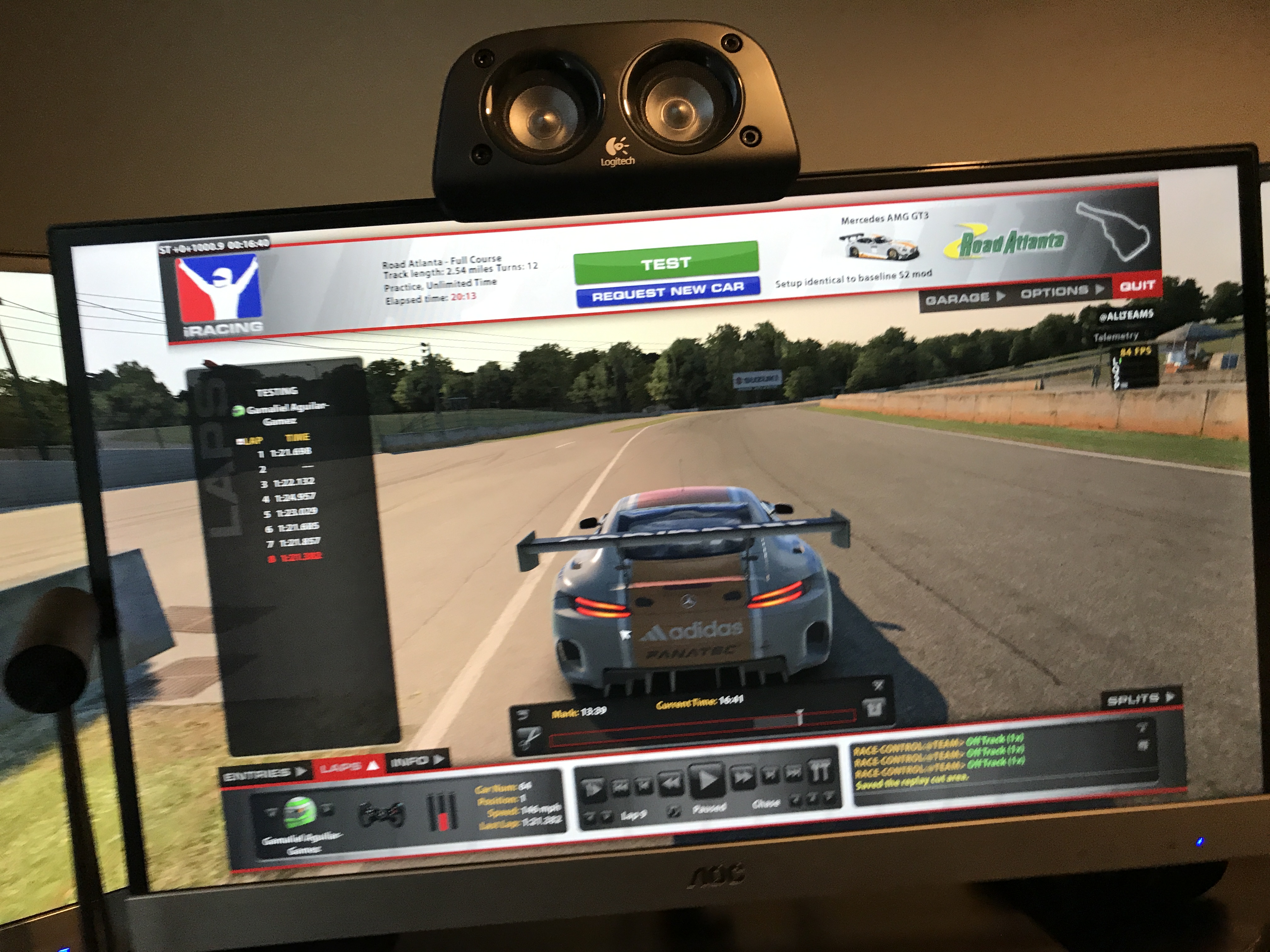
After taking a few breaths to chill out, I got back out on track and proceeded to hammer out a string of 1:21.xxx laps and one point even having a 1:20.8xx lap going. I screwed it up by over-slowing for the chicane but I felt like ‘I got it’ and there’s still room for improvement. My new fastest lap time is 1:21.382, almost one whole second faster than the day prior.
New fastest lap time! 1:21.382 and room to grow!
Tomorrow – more of the same.
My goal tomorrow and possibly the next day is to be able to make this new way of driving the norm. I am going to try to do 30 minutes or more of 1:21.xxx lap times. If I can be within .5 seconds of that fastest lap time, consistently – I will feel confident that I’ve adopted these learnings and then can transition to another segment of the track. I love data (and video)!
I’ve seen several articles on taking on a new thing by doing that thing for 30 days in a row, such as running a marathon (30 marathons in 30 days), stretching 10 minutes a day for thirty days, meditating, doing 15 burpees per day for thirty days and so on.
Why?
Usually it’s help start a new habit, kick a habit or accelerate development in something. No difference here, I’m doing this to get faster and have fun!
The goal: 1 hour of racing per day, everyday, for 30 days.
While I wish I could race a real, physical race car each day, I don’t have that kind of scratch or logistics setup but I do have a pretty sweet sim racing setup and iRacing.
So everyday, usually in the early AM’s, I’m going to practice and/or race on iRacing. Through the next 30 days, I’ll also have at least 2 full race weekends where I’ll be racing in the real world. So for those days, I won’t be on the simulator but instead on a race track, in my race car! Yeah!
What do I expect to happen?
I’m not exactly sure but I am at least hoping to get noticeably faster in the virtual world, hammer out details on my sim setup and be better at learning to get fast.
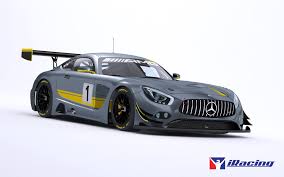
To stay focused and reduce variables, I am going to focus on just one car and one track. The Mercedes AMG GT3 and Road Atlanta. Why? Having a rabbit to chase. I’m a huge believer and advocate in the power of data + video.
Literally thousands of virtual laps of this track but have yet to actually drive it.
Here is a good review of the car, right before it was released by the crew at Inside Sim Racing.
There is a new service that recently launched, Virtual Racing School, and while I’m new to it also, I am in love with the premise and potential of what they are doing. With a simple download and activation, VRS logs all of your iRacing data and video and saves it to your profile. No downloading, uploading or anything to deal with. Just install, activate, drive and you’re all set.
As part of the service, they also have data packs for certain cars and track combinations and even setups, that you can automatically use as a reference point to work towards. This is massive! Having someone else who is much faster than you, in the same car, same track and similar conditions is one of the best ways to learn and learn fast.
Getting ready
So I decided to start the journey, one day ahead and get my day 1 as smooth as possible. I booted up my computer, installed updates to Windows, iRacing and NVIDIA. My goal was to be able to simply wake up the next morning, do my morning routine and be up and running, in a race car within 15 minutes of getting out of bed.
I’ll create a post later on with the details on my current sim setup, so you all can get the full details then but at a high level, here is the setup:
Custom built PC – my first.
About a decent level up from minimum specs to be able to handle Oculus virtual reality.
Intel i5 processor (can’t remember the exact model)
Logitech 5.1 surround system but I can only get 2.1 to work. 🙁
3 AOC 24″ Monitors – got them on Best Buy on sale. They’re pretty good but the back sucks for mounting them to a triple monitor stand. More on that in a separate post.
So, while I technically have a motion simulator and I have an Oculus and have used them for iRacing, I will most likely not use them very often over these 30 days. Main reason: we live in a tiny apartment and I’ll be doing most of my daily racing in the early AM, while my wife and 2 year are asleep, 15 and 40 feet away, respectively. The motion simulator isn’t super loud but it makes noise and my wife has complained about it before.
The Oculus is AWESOME but I sweat easily and have found that when I’ve worn it for 20 minutes plus of intense driving, I sweat pretty bad and the lenses start fogging up. So I’ll be using the triple monitors and headphones, without motion.
What: The decade long story of me trying to build a track car
If I knew then, what I know now: I would do the same damn thing
Product to check out: Strait jacket. No seriously, like for the crazies. But try to get a fire-resistant one so you can wear it on the track!
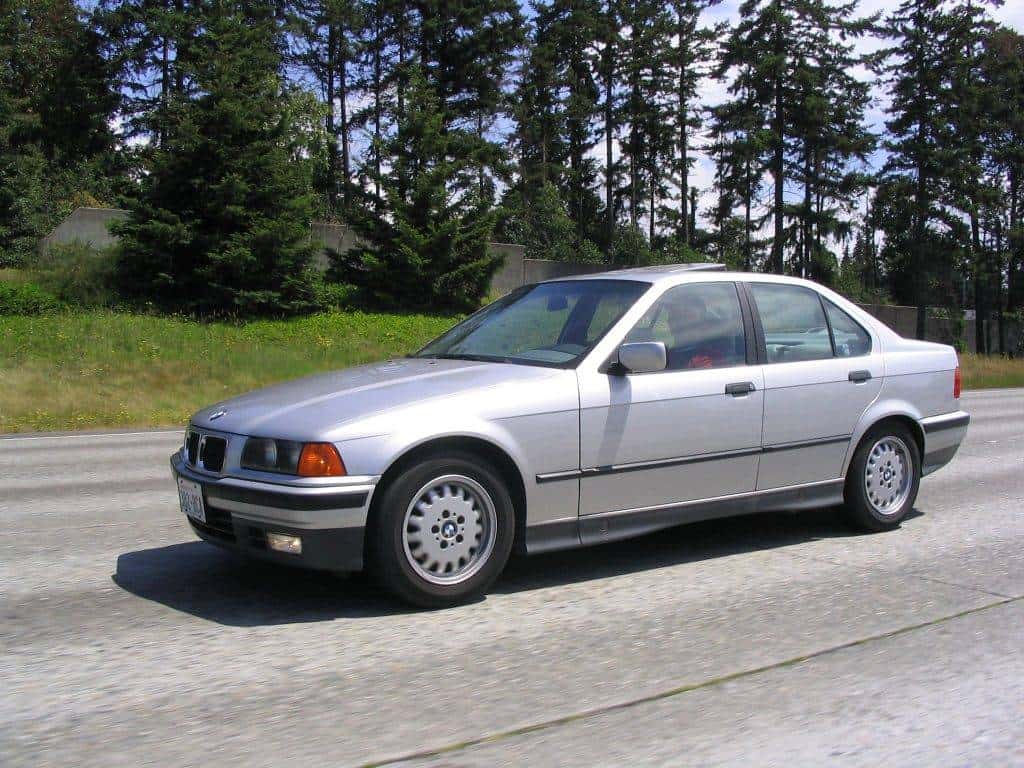
My first cool car – 1993 BMW 325i
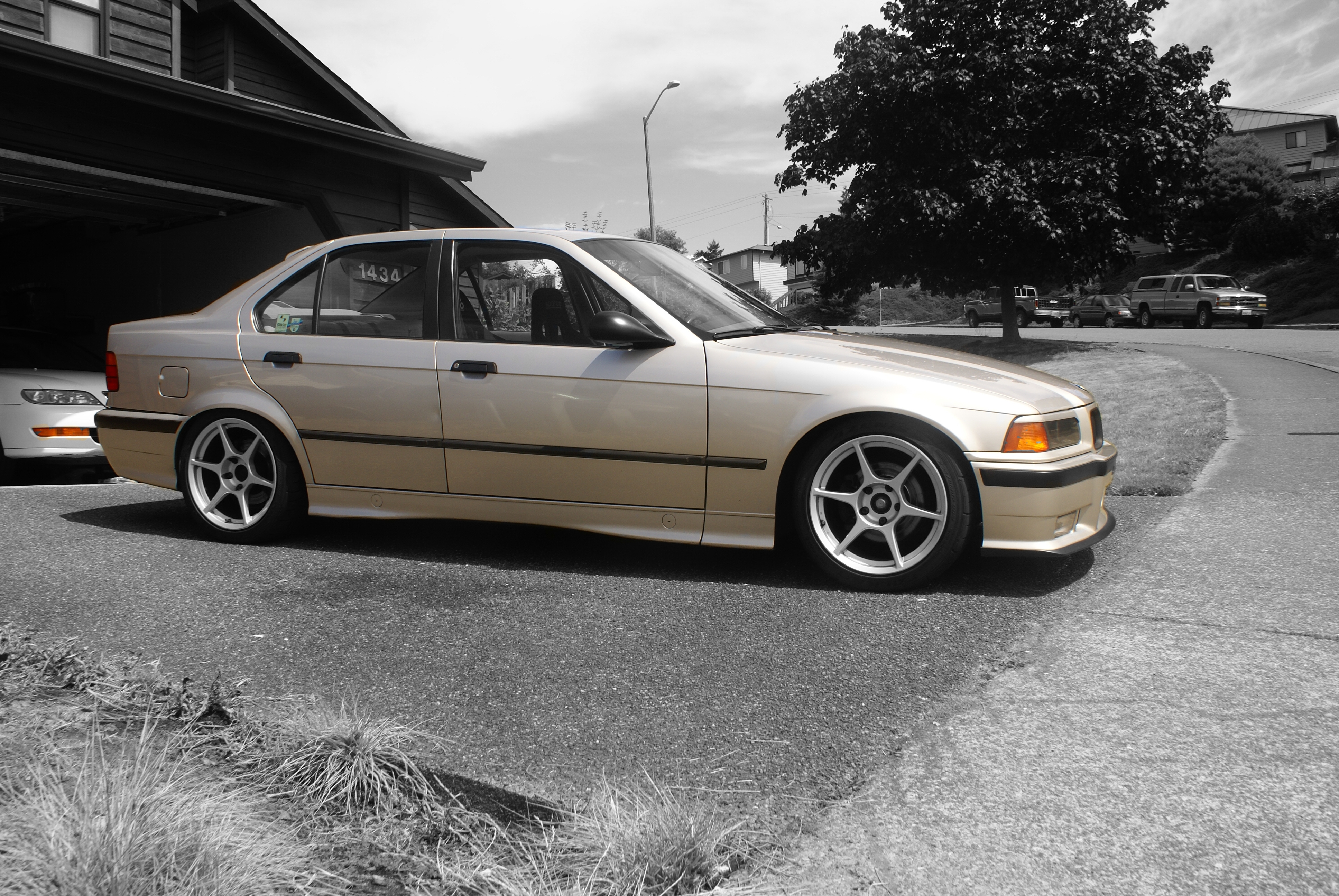
One of the things we would like to share are some of the projects that we are working on during our own free time. I will share the tale of my track car that I am building. It starts many years ago, and actually involves several cars at this point. The story goes! In 2004, I bought a 1993 325i from a nice couple and started driving it. I was always a car guy, and was one year graduated from high school and really wanted a “cool” car. This is what I ended up with. I loved that car and drove it everywhere I could!
Cool car… ENGAGED!
As the years go past, I became more of a race participant, than a fan. I started working at the track on the weekends helping people with their race cars and stuff. At the same time, I also started getting into driving as a sport more. My BMW was the perfect delivery device for an entrance into motor sports. It was a good solid car, had good power, great brakes and handling. I started to modify it for auto-cross, then eventually took the next step and started to prep it for track days. I did a few track school days and got really hooked. From then on, I was building a race car!
Transitioning from a ‘street’ car to a ‘race’ car
I stripped most of the interior out of the car to save the weight, also removing the sound deadening at the same time (which was a BIG job!). I got a fixed back racing seat, and a roll bar, some harnesses. I made it loud. Put a performance clutch and flywheel in it. Installed a shorter differential, got bigger brakes for it. And was still driving the car everyday. It was fun, but loud and uncomfortable. I loved it. I drove over 100k miles in that car while I had it, but ultimately had to sell the car just short of it being a full race car due to a crash I had while driving a fellow racers car (that will be a story for a different day!).
I made it loud. Put a performance clutch and flywheel in it. Installed a shorter differential, got bigger brakes for it. And was still driving the car everyday. It was fun, but loud and uncomfortable. I loved it.
We had gotten into Chump Car racing and had helped some people on a few events and as a result, had earned a chance to drive the car for a 36 hour race in Spokane in 2013. I had never driven at Spokane before, and was a little nervous, but was feeling OK because we were racing the same car that I drive all of the time, an E36. I was racing hard with the front runners during the race when I lost track of my internal map, and made a poor move to pass that landed me on the dirt. I lost it, and the car was wrecked. Then I had to pay for it.
Going racing always carries risk
I ended up selling my beloved 325 to a very close friend of mine. He was a fellow racer, and had been looking for a chassis to do his own build on. My car was a prime choice for him to use, and we struck a deal. I was able to recover and pay for the car I crashed by selling my race car. That was a hard lesson, but a very valuable one! I learned that your track car, can be gone in 2 seconds and there may be very little you can do about it! It took a little bit of time for me to start thinking about my 325 after selling it. But as time past, I missed it more and more.
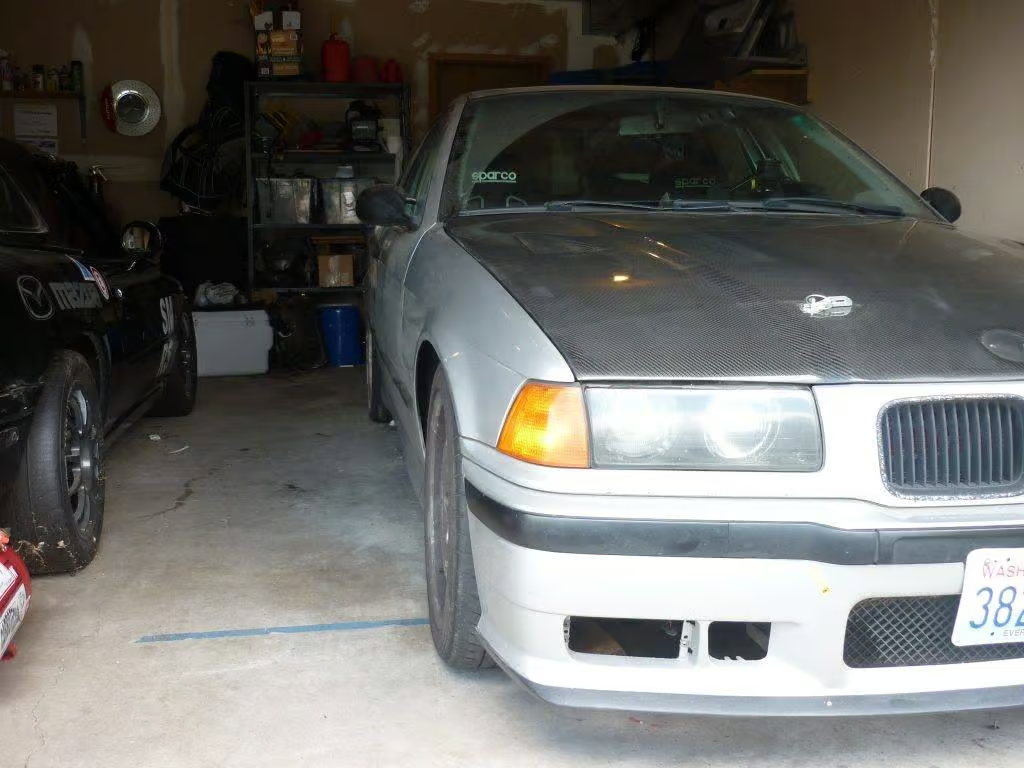
Three years after the crash, I was able to get back into a race car again, and felt very good when doing it. I then went on the hunt for a new track car. I found a 1994 325 that had some decent prep done by a nice couple that was going to turn it into a rally car. I found it on Craigslist after they just ended up going out and finding themselves a finished Volvo rallycar to use. I bought the car, and it felt like home! I Started getting it ready to track with and found a couple of good deals online for some good used race bits. The game was on.
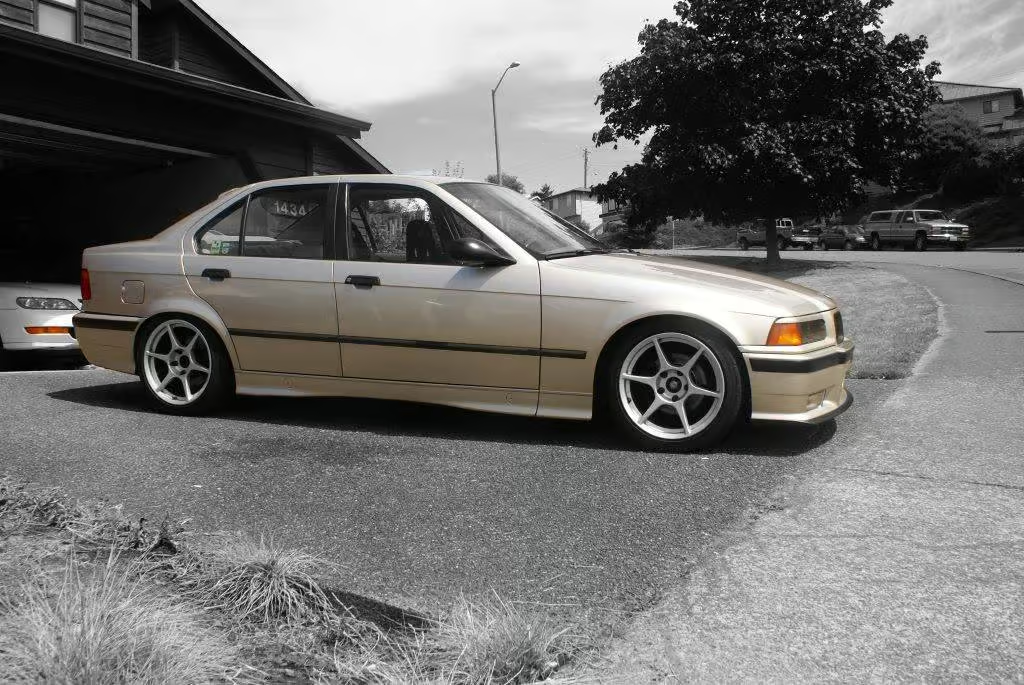
Getting goldie all hooked up!
There were a few things it had been prepped better and that I had not done yet on my previous 325, but was not nearly as far a long in other areas. I started to chip away at a to-do list and now it is starting to shape up nicely! This is where the story starts to get interesting. In an attempted to get the new 325 spec’d out like the old one. I struck up conversation with my friend who had bought mine before. He had not really done much with the chassis, and was maybe thinking about getting rid of the car to do something else. We talked about it a few times over the next couple of months, and eventually came to a deal for me to buy the car back from him! The idea is to get a lot of the cool or good stuff I had before swapped over to this new car since it was much more complete at this time.
The new car sitting all nice and clean!
Two become one
As of today, I have the two cars in the shop currently becoming one! It has been a very long process, but I am very excited to have gone full circle and have a car to use for track days and racing that I will be proud of. I like the idea of building one over buying a car. You have the chance to spend way more money doing so, but by building the car yourself, it is bespoke, and custom fit for YOU. That is what I find so great about it. The car is my version of what I think is a good way to hit the track! There is no right or wrong way, but the more miles you log, the more you will know what you want to do and do not want when you are out there! I will share more as further stages of build happen! I would say that this car is my “baby” but it will never be treated like a baby. It will be used, hard, but well cared for. This is my racing appliance! Thanks for letting me share some about my track car build, and always remember to have fun!
What: First sprint race weekend of the year, shaking down the car with new upgrades, testing and experiencing the highs and lows of racing.
If I knew then, what I know now:
Make no assumptions on communication! Make sure everyone on your team knows exactly what is happening and when. We lost a day to shake down the car and found an obscure issue with the new transmission resulting in more lost track time on Saturday.
Make sure you know what kind of qualifying is happening, open session or pressure style and adjust tire pressures accordingly.
Plan where you want to be on pre-grid for open session qualifying wisely so that you can benefit from drafting other cars in class and even faster cars.
As I mentioned the 6 Hours on the Ridge post, I primarily race with ICSCC, which is a sprint race focused sanctioning body. Aside from the endurance races that bookend the start and end of the season, each race weekend is made up of the following elements (for the most part):
Friday test and tune – usually for race cars only but sometimes includes High Performance Driver Education (HPDE drivers).
Saturday – Practice, qualifying, non-points races and a 1 hour endurance race.
Sunday – Final qualifying and points races
Here is a picture of the announcement for the race weekend of which if you do a couple of groups, that is plenty of track time. This weekend and for the full year, I did Group 1 (the main group for the PRO3 annual championship) and the Mini-Enduro.
The schedule for the first sprint race of the season. I’m in Group 1.
Shaking down a refreshed car
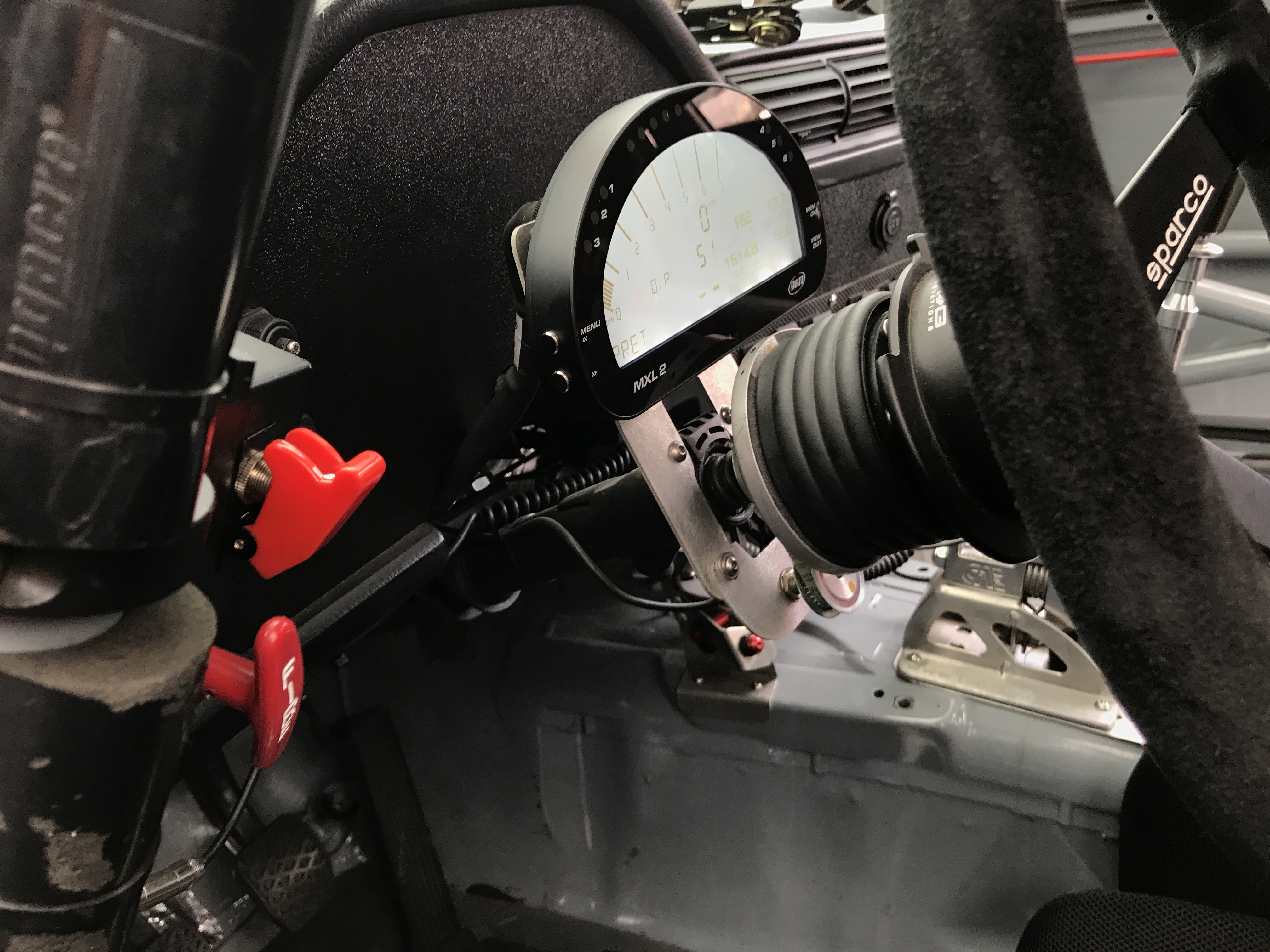
Initially I was supposed to get the #209 Track Attack PRO3 car back from Advanced Auto Fabrications at the 6 hour race but when they were doing final checks on it, they found that the newly rebuilt transmission wouldn’t go into third gear. So we decided to have that fixed and bring it down for this weekend, where I would shake the car down and ‘take delivery’ from all the repairs and upgrades they did.
What I did not make explicitly clear was that I expected AAF and crew to be there on Friday, which they would do more often than not, but not always. I even checked in the Monday prior to make sure all was on schedule but I did not explicitly ask about Friday.
Big mistake because when we drove down on Thursday night, so we could be all unloaded and ready to drive on Friday AM, the gigantic black AAF hauler was nowhere to be seen. AAF and crew decided to skip the test and tune due to the limited amount of track time and forecasted rain in the morning. They’re not scared of rain, just that if it isn’t supposed to rain on Saturday or Sunday, the risk of damage is higher than the benefit.
Regardless, we made the most of the day by working on odds and ends in the RV, spend some quality time with the family, caught up on work and chatted with folks up and down the paddock. The AAF crew showed up on Friday evening and by Saturday AM, was all set for the first on-track session.
As I got going in the morning practice run, it took me a few laps to get into the groove of things, remember the course and get up to speed. Initially letting several cars pass me but then quickly catching and passing them again. Lap times were solid, with nearly a .8 second improvement from the year prior. SWEET!
When we came off the track, a fellow PRO3 driver mentioned that they saw smoke coming out of the back of my car, a light smoke but consistent. We checked the car and sure enough, the rear and under body was coated with transmission oil. We were leaking somewhere from this newly rebuilt transmission that aside from this, seemed to be running great.
That is transmission oil – note that it is everywhere.
Over the next several hours, we went step by step, replacing the main rear transfer seal and then the shifter seal. We thought we had it addressed but after the non-points race, still had oil.
Long story short, it turns out that when the transmission was sent for a rebuild, they took my old transmission in as a core and sent back a different transmission, from an older model of the E30, which had a different kind of shift mount assembly. This assembly had two bolts that mounted to the top of the transmission, which served the purpose of securing the assembly and sealing two bolt holes into the transmission itself.
We don’t run the OEM shifter assembly, opting instead for the incredibly awesome CAE shifter assembly, which meant those holes were completely exposed and the source of the leak. This obscure situation had never come up with this crew of people who have been racing E30’s for over 10 years and built and rebuilt dozens of PRO3 cars.
We didn’t figure this out until Saturday early evening, after we opted to not run the 1 hour endurance race, to save the transmission (if it kept leaking) for the Group 1 qualifying and racing on Sunday. We felt the risk was too high to run low on transmission oil in the 1 hour and potentially damage the transmission itself.
In conclusion, lack of communication and shaking down the car resulted in a completely lost Friday of running and 1 hour of endurance racing. Sigh.
Qualifying
For the weekend, we had two qualifying sessions, one for the 1 hour endurance race and qualifying times for the Group 1 race.
1 Hour endurance race pressure qualy
Something unique to the Cascade Sports Car Club, which I love is pressure qualifying. One out lap, one flying lap and one in lap. Unfortunately, we did not realize this until we got to grid and didn’t adjust the tire pressures accordingly to compensate for the much fewer laps we’d run. At least everyone else was in the same boat. I love this type of qualifying because it eliminates the ‘draft’ variable – this is all on you as a driver, to make a fast lap happen there and then. Not relying on getting a draft from a faster car or following and learning from a faster driver. At a track like PIR, especially with no chicane on the front straight, a draft can make a HUGE difference, in the order of .25 seconds or more if you can get the right draft on the front and back straights.
Here is the video of my ME2 qualifying lap, which put me on pole for ME2 class but was a solid one second slower than my fastest laps in a regular qualifying session.
Group 1 qualy
Qualifying for Group 1 was spread across the fastest lap times in the Saturday non-points race and Sunday AM qualifying. The fastest time across those two sessions would count towards the final grid placement.
In the Saturday AM race, I qualified 4th with a mid-1:22 lap time and finished the race in 3rd. It was an excellent race, where I got a great start and was running in 2nd before turn 2 of the first lap. I tried to hitch myself to Brian Bercovitz, the eventual race winner but he got away and was stuck battling with Corey Peters for 2nd place. I ran in 2nd for about half of the race but I ended up going too hot into turn 1, went wide and that was enough of a mistake for Corey to capitalize. That meant Kyle Byers in the #55 PRO3 car was on my tail. We ended up battling pretty hard, exchanging some bumper paint but nothing serious – just good, solid, respectful, hard racing. He ended up getting a little sideways on the second bump he gave me and that was enough for me to pull away and finish in third, with a lap time of 1:22.274 and a new personal best.
Sprint non-points race results and qualifying 1 times
I would normally post the video here but I forgot to hit ‘record’ – I’ll try to get the videos from Corey and Kyle to share.
Sunday AM qualy brought out excellent conditions; dry, sunny and a cool breeze in the low 60’s. I got on the grid early and was the lead PRO3 car on track but after a few laps, I realized I was reproducing low 1:22 lap times while everyone else was running in a pack and getting help with drafts. So I came into the hot pits, checked tire pressures and waited for the right pack to come by and tail them.
I eventually got behind the pack with Corey Peters coming off of the back straight but he quickly picked up on my game and pulled off on the main straight away. No issues, there was still another couple of cars to get behind. On a decent flyer though, another driver, who I used for a draft and got by on turn 1 decided it was time to race and dove in to overtake in turn 7. Why?!?!?! What makes this more frustrating is that he then pulled off and slowed down that same lap, in the following straight away. I can’t confirm but I think he also picked up on what I was planning and decided to ruin my lap.
No issues again and finally, I saw Brian Bercovitz and got behind him for one last final flying lap. All looked good, with the predictive lap timer showing a 1:21.8xx for the first part of the lap but then I missed a downshift to third on the only left hand turn on the course. This ended up still producing a solid lap time but I ended up qualifying in 5th place, where as if I would have executed, I would have qualified third and possibly 2nd in class.
The Main Race
The goal was simple: get a solid start, make up a couple positions in the traffic and be in the top three by the end of lap 1. This would give me a fighting chance to get near the front and try to stick with Brian, who was on pole for our class. I found during qualifying that if I could get behind him, I was able to keep the gap nearly the same.
Below is the race video and note, it has no data overlay. The reason? I didn’t complete a single lap. I got a solid start and wedged myself in a position to go after 2nd, 3rd and possibly first by turn 7. Unfortunately, up ahead, a Spec E46 car went off to the left and tried to get themselves back on the track without waiting for the pack to go by (my opinion). When his front tires, who were turned to the right, hooked up on the track surface, they gripped and shot him across the track and into the on-coming pack of angry PRO3 cars.
I saw it happening, moved to the right but still got a glancing blow on the rear quarter panel. Initially I thought all was well because it didn’t really knock me anywhere but as soon as we hit turn 7 (right hand turn leading to the back straight), I saw and heard heavy tire rub and then the cabin was engulfed in tire smoke. I went into the hot pits, got checked for fire but the damage was too much. We could have swapped tires and rolled the fender in the hot-pit but we would have gone a couple laps down and I didn’t think it was worth it and called it a day.
Conclusion
It was a tough way to start the sprint season but when you sign up to go racing, this is a potential outcome that can happen any weekend. I take 100% accountability for what happened and don’t blame the Spec E46 driver in any way. All things considered, had a great time with friends and family, personal best lap times, fixed teething issues on the car and was still able to take it home, running and with some cosmetic repairs needed before the next race. There were three other cars involved in the incident and they would take my place in an instant as their cars did not fair as well.
Damaged driver side quarter panel and hard rubbing on tire.The guys using a jack bar to roll the fender so the tire could clear.
What: Motorsports is exactly that, a sport that revolves around motors. It is a sport, thus health and fitness is important. Road racing works your heart (and lungs) like if you were running a marathon. A healthy heart is critical!
If I knew then, what I know now: Have a healthy mix of aerobic, anaerobic and strength training to your work out program. Too much of anything is not good. I’ll cover this in a separate post.
Bodyglide Anti-Chafe Balm – nipple chafing and bleeding is real and no joke. Depending on the shirt I am wearing, if I am running more than 4 miles, it’s required.
Foundational truths
Before we dive into what should be done, let’s all get on the same page about what happens when you’re driving and especially when you’re competing.
Your heart is important: This is not a question or an opinion. It is important for you to not only live but to handle stressful situations. While most of us enjoy putting a car, motorcycle, kart or boat through it’s paces, the fact that your heart rate goes up, means that it is a stressful situation, where your body and heart (and lungs) specifically, work harder.
Oh yeah, the lungs: The lungs are the things that bring oxygen into the bloodstream, of which then the heart pumps all that good, nutrient and oxygen rich goodness all over the body. Then the various body parts use that goodness to power themselves, such as the brain, eyes, muscles, literally everything in your body.
Maximum Heart Rate (MHR)
Per above, as we get older, this goes down. See below and find your age.
Find your age and see what the estimated ranges are for you.
I am currently 33 (less than a month from 34) and what this says is that my maximum heart rate is around 185 Beats Per Minute (bpm). If I were to get my heart going above that OR near that level for too long, I’d probably end up in a hospital unless I explicitly trained my heart for those situations.
It’s been documented in several articles, studies and my own personal data collection (below) that for a racing car driver, the heart rate can range from 120 – 160bpm, throughout a race.
Below is an example from a race, in August this past summer as I was wearing an Apple Watch and collected heart rate data (note – I did not start a workout session and thus why it didn’t collect data every 1 second). Note that you can see when I started doing warm up exercises before getting into the car and my heart rate picking up as we got into the thick of the race. If I remember correctly, the race started ~4:35pm and was a 1-hour race.
Heart Rate data from my Apple Watch during a 1-hour endurance race.
Update: When I was originally writing this post, I looked everywhere for this screenshot below. This was taken using a Fitbit Surge, during a day of three races and near 100 degree heat. That is some serious heat, sweat and elevated heart rate. Racing is no joke!
Heart rate logs from one day of intense racing in nearly 100F.
Now, here is a screenshot from a 4+ mile run I did recently as well at a ~9:00 minute mile pace. Not super fast but not a slouch by most measures.
August 2017 ~6 mile run using Endomondo and a Polar Heart Rate monitor
What does this tell us? Driving at even 7/10’s in a track day or racing session for ~20 minutes is the equivalent, cardiovascularly, as going for a relatively intense run. So you are sitting in a hot race car, covered head to toe with fire-resistant material and your heart and lungs are working like if you were running a half-marathon.
Ok, healthy heart and lungs are important, but why again?
Like everything else on this site, it’s about helping you be a better driver. A driver who makes good decisions, usually, ends up being a faster and more consistent driver than someone who doesn’t make good decisions. Several things can lead to someone making bad decisions behind the wheel (on-track that is):
Being nervous or confused (which usually elevates the heart rate)
Being scared (which usually elevates the heart rate)
Being angry aka the red mist! (also elevates the heart rate)
Being tired (I won’t repeat again)
It gets more difficult to make good decisions, quickly, when you are tired, sweaty and out of breath. So the goal here is to condition your heart and lungs in a way, that you’re comfortable being in the stamina & endurance zones, and can make good decisions.
I personally felt like my overall athletic and aerobic endurance was and is a competitive advantage in most races, as I felt just as fresh at the start of a race, as I did at the beginning. Start strong and finish just as strong! This was even more pronounced on the 1 hour or longer races and especially when it was over 90 degrees Fahrenheit.
What should you do?
Disclaimer: We are not doctors, nor play them on TV. Consider consulting your doctor before taking on a new exercise program.
We will cover other types of exercise for different benefits in future posts but for here, we will focus on cardio health. The goal is to do exercises, that have you for the most part, in the stamina & endurance zones. It’s ok to peak every once in a while into the conditioning zone or drop momentarily into the weigh loss zone.
Most of my driving sessions are 20 or 30 minutes and sometimes 60 minutes long. So I target conditioning myself to be able to easily handle 30 minutes by exercising for 45-60 minutes and having regular (about every other week) 60-75 minute workout sessions, usually 6+ mile runs. This is grounded in a theory from playing football and Taekwondo. Practice should be harder than the actual competition (most of the time) so that at least from a conditioning standpoint, the competition will be a relative breeze or you at least have plenty of reserves to go harder.
Here are some top exercises and plans to consider:
Running: It’s pretty much free. I found it the best to sign up for a race that forces you to build up to a goal, set a schedule and stick to it. Better yet, do a race with a friend or two, so you have support and accountability for when you’re too lazy to run in the rain.
Highly suggest downloading an app like Endomondo, Nike Run Club or MyRunKeeper. They all have some kind of functionality where you can state your goal (like run a 10k), the pace you want to have and when your race will be held. They come up with a personalized training program to build up your performance, you just run! Sometimes these are in premium memberships but you can easily find training plans online and just track them manually.
Here is the training plan I am using to run a half-marathon in September.
I’ve also used running on days while I am at the track to do track walks, after the track has gone cold for the day.
Cycling: One downside to running is the repetitive joint impact throughout the body, especially toes, ankles, knees, hips and back. Cycling is a great alternative to running for cardiovascular performance. I personally bought a used Bianchi road bike and over the past few years have used it off and on as an alternative to running.
Same plan though – whatever time you were planning to run, get on a bike in the gym or on a trail and cycle up a storm.
Swimming: Admittedly, I am the least experienced here as I rarely get in a pool but I know it is great for aerobic exercise, working the body overall, core development and joint relief. If you have access to a pool, get on it!
Conclusion
Cardiovascular health and performance are not just important to live but they can give you a significant performance edge in driving. There is a reason you see several top professional drivers all over the world, also spend significant amounts of time doing the exercises above and in examples like Jenson Button, competing in Iron Man and Triathlon competitions.
Consider regular cardiovascular exercise to be part of keeping yourself healthier and it has a big potential upside to your driving.