2021 was a great way to bounce back from 2020 and while COVID isn’t behind us, we’re thankful that we were able to make it to all but one of the planned competition and racing events that we originally planned and even added in a couple of extra race weekends.
Thank you to everyone who was a part of our journey in 2021!
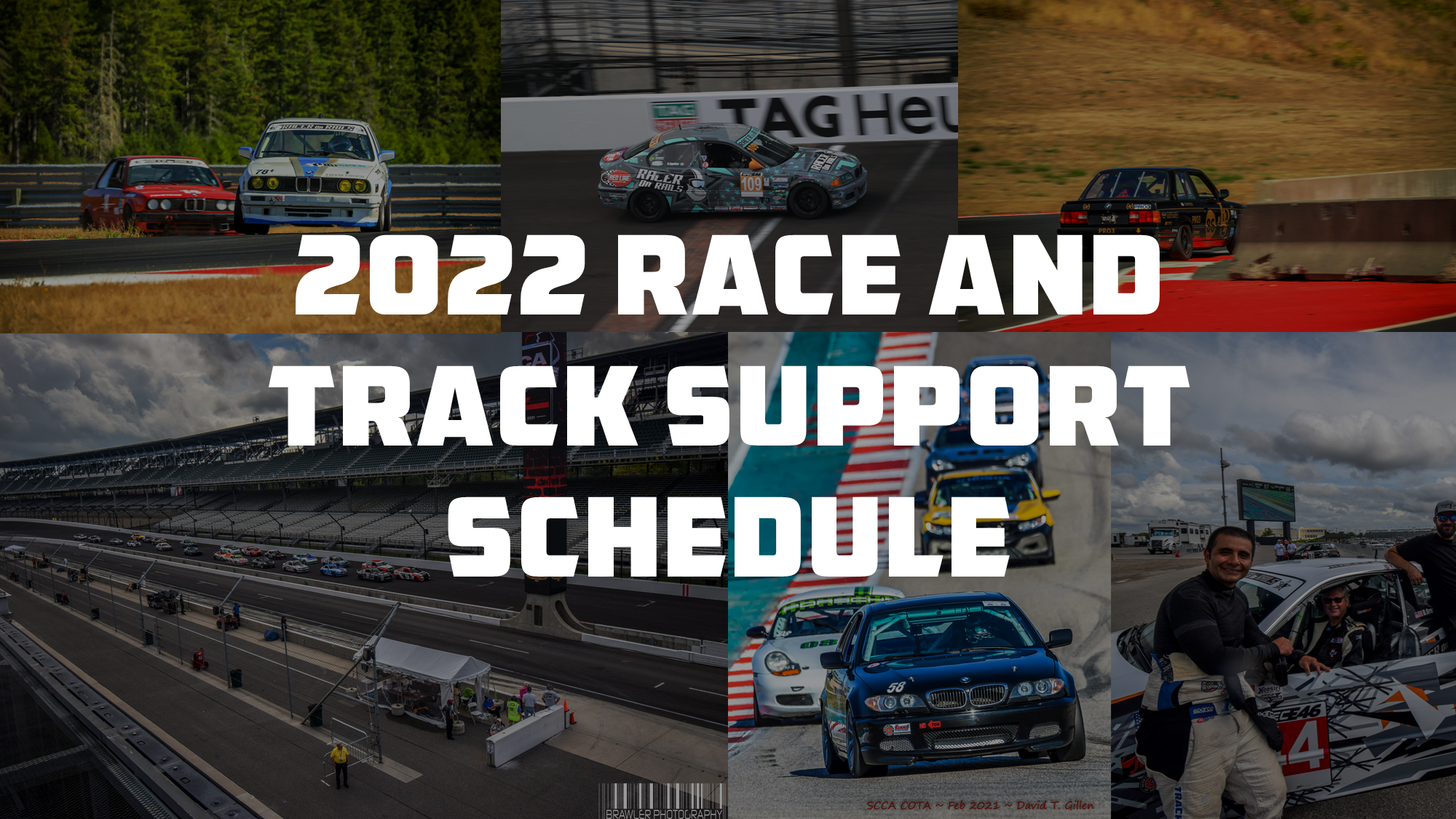
2022 is shaping up to be an even more jam packed with track action and while we’re mostly booked up for each event, we have limited available capacity to have you join us at the local .
If you aren’t already driving with us, consider this an open invitation. We are here to help! Our current SCCA, ICSCC (Conference), NASA, Revolution Racing League and GT Celebration events are listed below.
If there are any race weekends you would like some crew and coaching support for, please feel free to contact us via e-mail, phone or messenger – raceronrails@gmail.com – (206) 475-1114
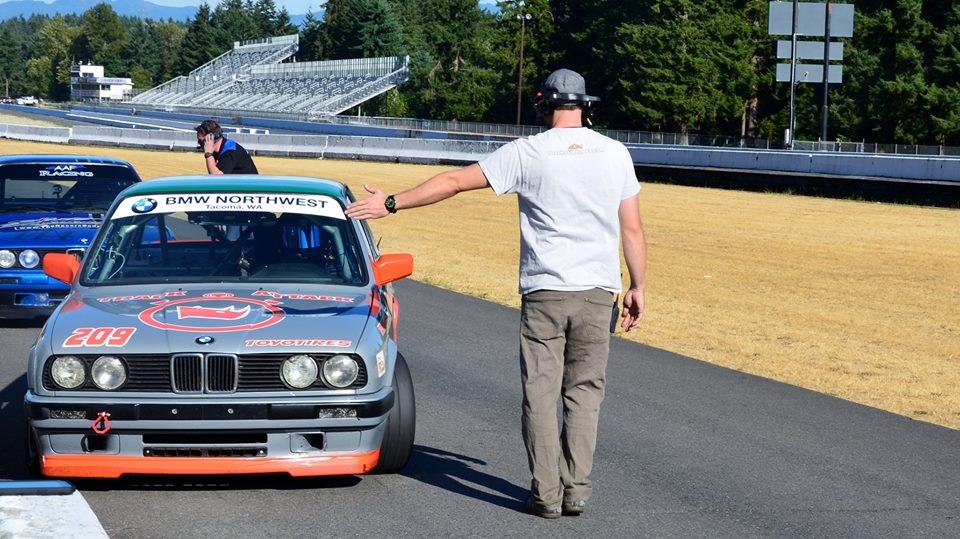
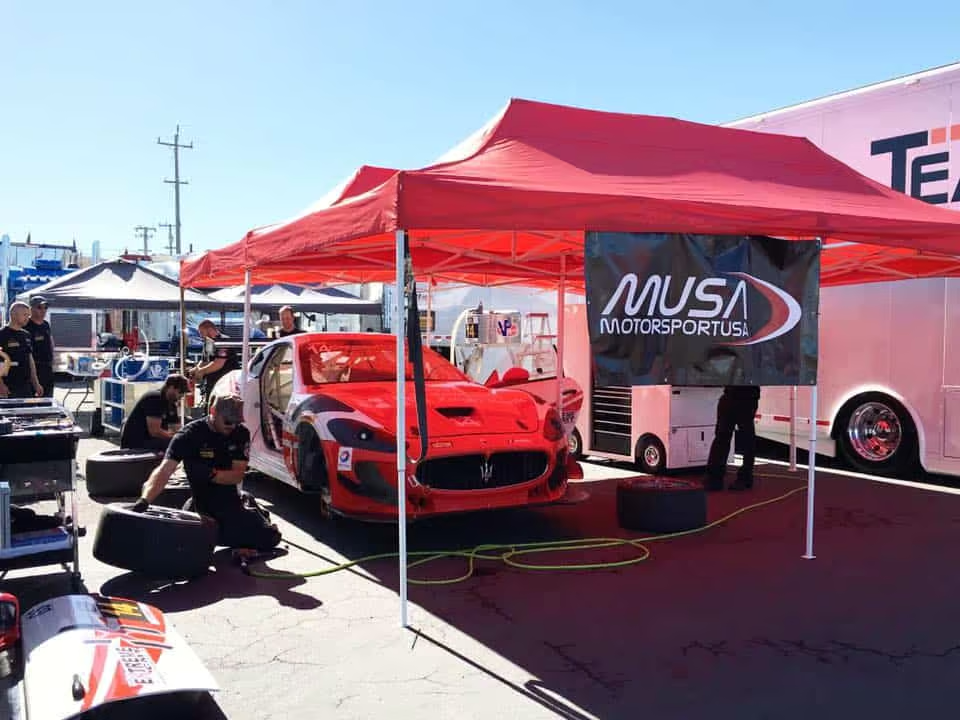
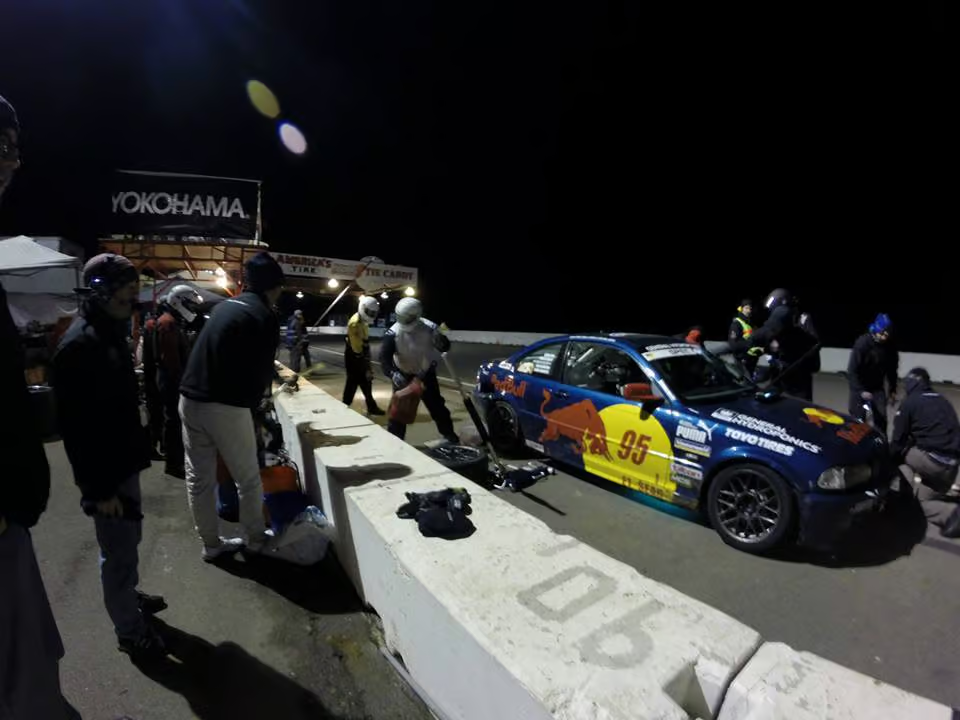
The staple of what we do is provide service to the racing community. One of the primary aspects of that is to be at the track, to help you with the car set up and care, as well as trying to improve the performance of both you and the vehicle. We want to announce and extend an open invite for those that are interested that we are here to help. Our team has a calendar of events planned with room for additional support for each weekend as needed! Our current ICSCC Conference as well as intended NASA NorCal events and SOVERN events will be listed below. If there are any race weekends you would like some crew and coaching support for, please feel free to contact us via e-mail, phone or messenger! Let us help you be your best on track!
Give us an E-mail or call to discuss options! raceronrails@gmail.com – (206)475-1114
ICSCC Conference
Event Schedule:
April 19-21 (Fri-Sun) – Mission Race Way Park –
British Columbia
May 3-5 (Fri-Sun) – Portland International
Raceway – Portland, Oregon
May 10-12 (Fri-Sun) – Pacific Raceways – Kent,
Washington
May 31-Jun 2 (Fri-Sun) – Spokane County Raceway
Park – Spokane, Washington
Jun 14-16 (Fri-Sun) – Portland International
Raceway – Portland, Oregon
July 19-21 (Fri-Sun) – Pacific Raceways – Kent,
Washington
Aug 16-18 (Fri-Sun) Portland International
Raceway – Portland, Oregon
Aug 23-25 (Fri-Sun) – The Ridge Motorsports Park
– Shelton, Washington
SOVERN:
June 7-9 (Fri-Sun) – Spokane County Raceway Park
– Spokane, Washington
July 5-7 (Fri-Sun) – Pacific Raceways – Kent,
Washington
July 26-28 (Fri-Sun) – Portland International
Raceway – Portland, Oregon
Sep 7-9 (Fri-Sun) – Portland International
Raceway – Portland, Oregon
Sep 27-29 (Fri-Sun) – Pacific Raceways – Kent,
Washington
October 5-6 (Sat-Sun) – Maryhill Hill Climb –
Mary Hill, Washington
NASA NorCal:
Mar 15-17 (Fri-Sun) – Sonoma Raceway – Sonoma,
California
Aug 2-4 (Fri-Sun) – Thunderhill Raceway –
Willows, California
With the explosive growth of simulator driving for not just training but actual competition, big time dollars and rewards attached, we get more and more questions about how to get started building a simulator setup and specifically, what to get.
Still wondering if simulator driving is really that worth it? Check out this podcast from Speed Secrets and this video about William Byron – now a driver for Hendricks Motorsports, who didn’t grow up driving karts or cars but rather, simulators.
This can be a complicated space because there are a lot of options. In this second post, let’s go down one specific path base on what we think is the most important question.
Why do you want a simulator setup? I want to use simulators to accelerate my driving or car in the real world.
eSports is exploding in popularity with games like Madden, Fortnite and Halo being at the center global gaming tournaments. Gamers from around the world train and compete against world-class gamers at in-person and virtual tournaments all over the world and for real money.
This is not a spoof! That is a real picture of thousands of people watching gamers compete on-stage!
This post is focused primarily for those who want currently or are planning to drive in the real-world and want to use simulators to accelerate their development. Getting to the track in the real-life to get quality seat time, driver coaching, and car development is not cheap. Simulators are an excellent path to do all of those things more often, at a lower cost and increasingly with direct correlation to what happens in the real world.
Recommendation: Go with a PC-based simulator like iRacing, Assetto Corsa (PC edition), Assetto Corsa Competizione or RFactor 2. Yes, Gran Turismo and Forza have had tournaments where the winners compete in real life for chances to be race car drivers as a profession but those are the exceptions.
It’s time to get serious with triple monitors and the very best components you can buy.
Things to get:
There is no way to get around it – this will be more expensive because you are trying to replicate real life, of which a lot of what happens in real life is about how the car and track sound and feel of your inputs.
A quality PC that can keep up with the display you want. The main thing here is a decent processor and ram but the beefiest graphics card you can get and the bar at this level is a little higher than at the ‘simulator only’ level. Here are a couple options:
A PC desktop with a decent i7 processor, 16GB+ of RAM and a 6GB Nvidia GeForce GTX1070 or equivalent from AMD. Get the absolute best graphics card you can get – it will be worth it.
40”+ single monitor/TV: this is not really an option. If you want to really focus on improving your real-world driving, you need an immersive experience.
Sim rig with a seat
A sim rig/cockpit is no longer optional. You need the seating position, field of view and access to the driver controls to be as close to real-life as possible and you can only really do that with a proper and sturdy sim rig. Here are a few options:
DOF Reality – makes a very low cost sim chassis that also includes motion.
RSeat – makes all kinds of sim chassis with and without motion. Most importantly, they look very stout.
Sim Lab – we recently got a GT1 Evo chassis and are loving the sturdiness and adjustability
Motion platform
Yes, it’s now close to a requirement. Driving in race cars on tracks is a rough experience where you’re getting tossed around as you go over bumps and curbs. The feeling of the car pitching forward when you hammer the brakes, the car getting upset as you take too much curb or the backend coming loose when you carry too much speed into a corner or get on throttle too quickly – you need to feel that. All of those things in real life tell you what’s going on and they remind you of the mortal consequences of having more bravery than talent.
Want everything integrated and ready to rock? There several companies who sell fully built and ready to rock motion simulators. Here are a few:
There are few other things that will accelerate your driver development than quality motion simulator seat time.
The quality of your experience is completely dependent on the components you put into your PC and peripherals. If you want better graphics, get a better graphics card. Want better FOV, change your display setup. Want an even more immersive motion experience with real-time data streaming and coaching? You can do that too!
The force feedback and vibration capabilities of the steering hubs and transducers on the market are amazing. You can buy components and configure then so that you feel everything on your feet, butt, abs, legs and hands as you do in real life. You will have a generally authentic steering input and feedback experience.
There is a growing number of retail locations where you can rent seat time on very high-end simulators and get coaching from top-level coaches.
Cons:
No longer “welcome”, you are right in the middle of the slippery slope! It is now the cost of a small car to get a decent motion simulator up and running. It starts in the $5-10k range and goes into the $50-75k range. There are simulators well above those ranges but those are reserved for commercial applications.
Driving consistently well in a simulator is hard and even more difficult with motion. Most people are lucky to end their first 30 minutes in a simulator simply not crashing or losing control. Stick with it!
Pretty much everything is more complicated to setup. There is almost no plug and play experience for any component. You need to connect them, install drivers and configure/calibrate.
The physics and tire model are better than the console world but vary across simulator platforms.
There is even more you can buy, which can be good – for example, buttkickers are sound based vibration devices that give even more feedback to the seat, pedals and generally corners of the car.
Example setups: I’ve only built one motion rig and would be considered “entry level” for a quality motion experience.
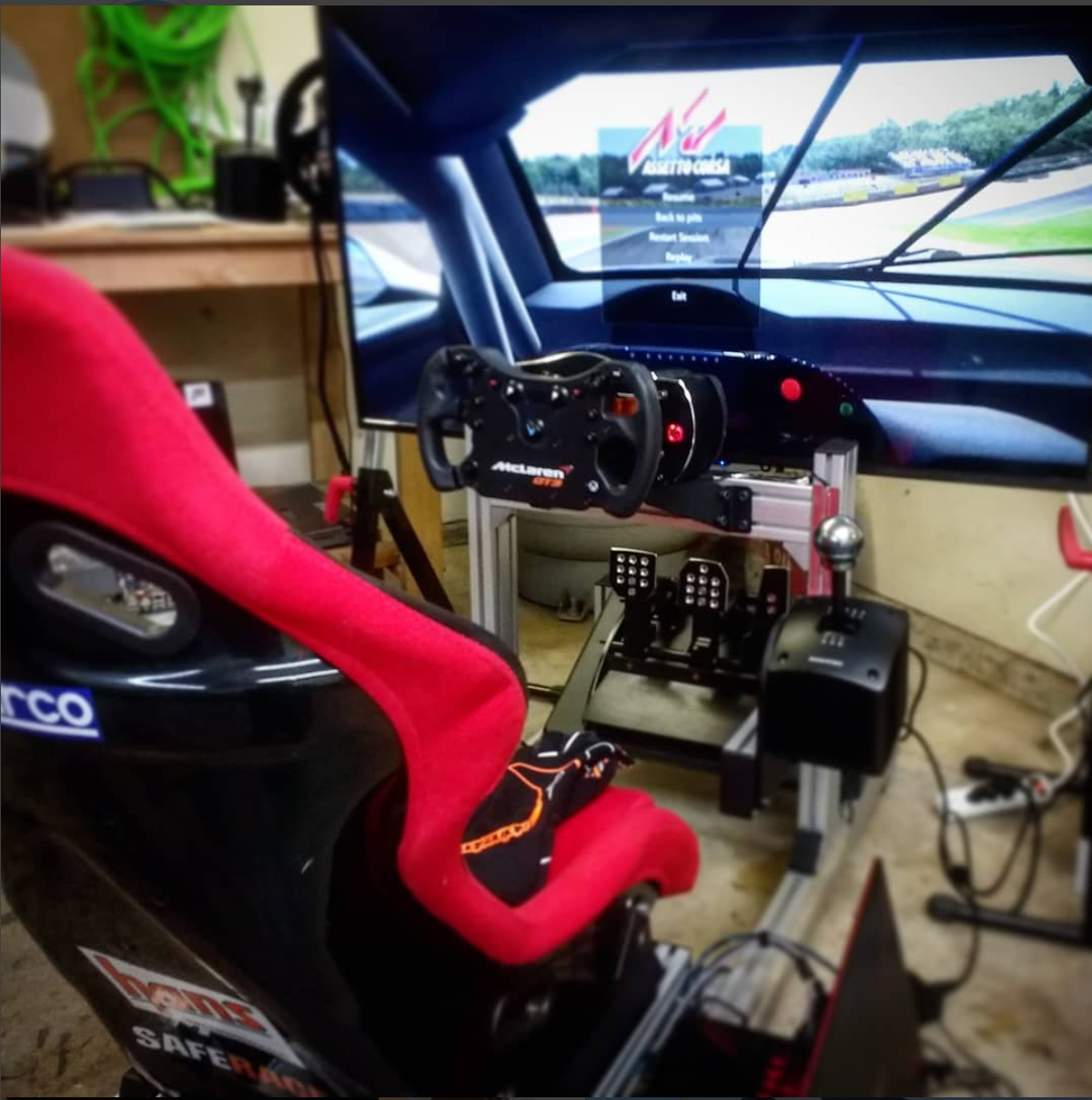
Example 1: Entry level, motion with a rig: Everything here is exactly what I have on my current motion sim but my graphics card cost a bit more a year ago than they do today.
Total Cost: $8,741.39 (doesn’t include taxes or shipping)
Custom built desktop gaming PC w/Nvidia GTX1080Ti: $1,200
iRacing subscription: $80/year
SimXperience Accuforce Hub and steering wheel w/button box: $1,299.00
If I knew then what I know now, what would I do differently?
The Next Level Racing cockpit is pretty good, and I don’t entirely regret my purchase decision, especially because their motion platform integrates seamlessly BUT if I were building another rig (which I will in the next 6 months or so), I would try the DOF motion cockpit because I don’t love the following about the Next Level Racing cockpit:
The flex in the chassis, especially under heavy braking. First, it flexes and since it wasn’t designed to flex in the first place, the amount of flex is variable. This isn’t great when you are trying to hit your marks lap after lap or making minor adjustments to brake application to shave off tenths of seconds.
Lack of adjust ability. Having the seating position, steering wheel, shifter and pedals in the perfect position for your body is critical to driving fast and driving consistent. Any unnecessary mental energy used to figure out where things are or having to adjust to not having the controls in natural/intuitive positions will make you go slower. The NLR rig is essentially fixed in place after you set things up and for me personally, we had to add a wood block to the pedal box so that my heels could stay planted and reach properly. The manual shifter position is okay, but I really wish I could move it another inch or two closer to me. Lastly, with the motion set, the slider doesn’t work.
You listed the Fanatec pedals but you have some other fancy looking pedals. What gives?
Yes, when the Thrustmaster wheel hub failed after about a year of use, I upgraded to the Fanatec hub but I wanted as close to the real-world race car pedal feel as possible. On this rig I currently have the Derek Spears Designs pedals which are amazing and use real Wilwood racing pedal box components. You don’t need these if you are only simulator racing. I also have two other rigs with the Fanatec V2.5 Clubsport pedals, both the floor mounted and the hanging configurations. They are solid and when you add the bump stops for the brake pedal, they are close to the DSD pedals but still substantially lower cost.
I’ve been to Imola before. 2 years ago, we were in Italy for a hackathon week with my teammates on Track Attack, who are based out of the Friuli region, in the northeast area of Italy. My wife, 1-year old son and I spent a week in a tiny medieval town centrally located to Pisa and Firenze (Florence). One day, we took a day trip to Autodromo de Enzo I Dino Ferrari, also known as Imola.
Visiting Imola in 2015 during a Lamborghini private event and 100F+ temps.
Lamborghini was holding a private test event, but we were still allowed in, because technically, Imola is a city park. We walked the grounds, from the outside and inside the track. My favorite Top Gear episode of all time is the Imola episode, where the crew tries to match the lap time of the Stig’s Italian cousin. I drove Imola for the fist time in the Formula 1 car simulator at the Imola museum. I drove the track for 30+ hours in a Mercedes AMG GT3 on iRacing, to prepare. We did a track walk on Wednesday evening before the Thursday free practice.
It still scared the shit out of me.
Thursday, May 24th, 2018: Optional free practice
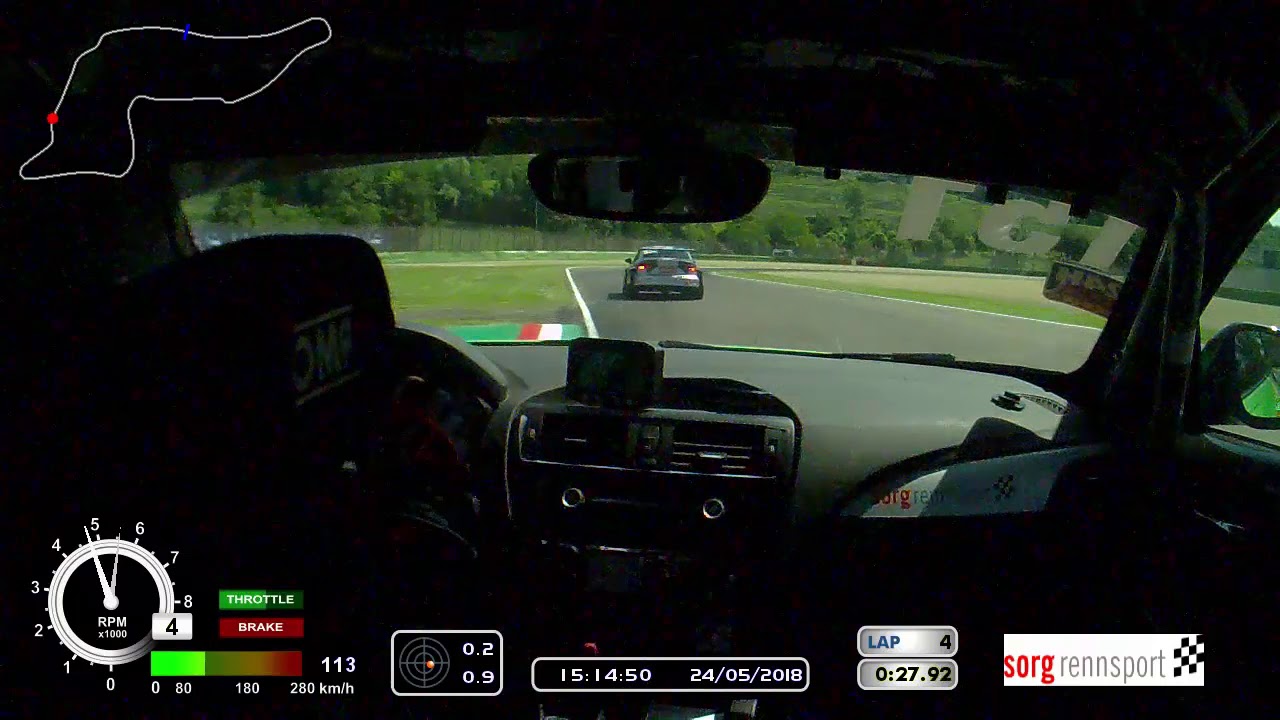
We signed up for the optional free practice. 2 sessions. 90-minutes each. 4 drivers. We decided to give each driver 20 minutes at each session. Seth would go out first and get a sense for the car and lay down some reference data for us to chase. And he did just that; a 2:06.XXX and not a single clean lap.
When I played football in high school, I was always scared, and I didn’t suck. Especially in the games. One of the coaches could sense it in me and other players, so he said once “half the battle is showing up. Just show up to compete and your training will take over.”
That is why I raised my hand and asked to go second. It was surreal, overwhelming and humbling. I’ve read articles from other first time and regular pro drivers, who have said that in these pro series, the time on track for getting up to speed is limited and regularly interrupted by incidents. To be honest, I shrugged those stories off and thought, “could it really be much worse than a competitive club racing weekend?” Yes. That is exactly how it is.
Not a single driver had a clean 20 minutes. None of us had a single lap where we weren’t being overtaken by at least a few cars.
This was our new reality and pretty much everything we articulated to explain our pace was an excuse. Dan Rogers, came up to speed the fastest outside of Seth, having a ton more experience (a 2:10.XXX best lap), then me (2:12.XX) and then Rob (2:16.XXX).
We reviewed data to look for places and ways to get up to speed but it was obvious. We were driving tentatively, over-slowing on pretty much every corner in general and especially when being overtaken, which was almost every corner.
A common site throughout the weekend. Drive, debrief, data and repeat. Photo credit: Petr Frýba
All my racing has been multi-class racing, with rarely being in the fastest car on track but this is a whole other level. The closing speeds and acceleration of pretty much every other car was insane, especially the GT3 cars. The message from Seth was clear, though he tried to be gentle with us – time to drop excuses and drive. Yes, the other cars are faster, but we have to figure it out and at least mid-corner speed, we could hang with almost all the cars; Seth had already proved it. I was driving almost dangerously slow.
When it was time for the second session, it was the same, I got three (3) complete laps over a ~25 minute period. But I was determined to drive confidently and hard. A couple of 2:10.XXX on the last two laps and on the third lap, where I came into the pits due to another Code 60, I had a 2:09.XXX going, backed up by a rolling best lap of 2:09.269.
Dan would get down to a 2:08.XXX and Rob got down to a 2:10.XXX – we were all progressing! Seth would not drive the second session, to give us more seat time but he would qualify the next morning and start the race.
By the end of the day, we had no real idea how we stacked up against the competition. We only knew that we were improving at a good pace and that the 131 car had a stacked lineup of drivers, with one of them being the reigning European BMW Cup champion. He had been driving a specific M235i Racing car for close to two years and he was/is good.
Code 60: Your new best friend or mortal enemy
Instead of full course yellows, Creventic has “Code 60’s”. Purple flags come out, with a big circled 60 in the center. When the Code 60 comes out, all cars a required to slow down, in a smooth deceleration to no more than 60 Kmph. It’s intended to get cars down to a safe speed so whatever caused the incident can be cleaned up and maintain the gaps between the cars.
See it. Remember it. Respect it. You’ll see it a lot.
In the race, if a Purple 60 comes out and you are near the pits, it gives you an opportunity to swap drivers, change tires and/or fuel up while losing the least amount of track position. The other side of the blade though is that if you are past the pit exit, it will take up to 4 minutes to make it back to the pit entrance and in that timeframe, the issue might be cleaned up.
Cars do not bunch up for the restart, it’s a simple call for green flags when the Code 60 goes away. There are random radar guns around the track to check for speeding and they also look at your lap time for a complete lap of a code 60. If it is faster than a 4:55, you are penalized. We ended up serving a 12 second penalty one time during the race.
Friday, May 25th, 2018: Practice, qualifying and race part 1 (4 hours)
The next morning, we all went out and made improvements. I got down to a 2:08.643 in my only complete lap and then a code 60, with a 2:07.XXX on the board. Rob got down to a 2:09.XXX and Dan to a 2:06.XXX.
Next Seth went out to qualify and though we had strict orders to stay off the yellow curbing on all corners, so we could make sure the car survived the 12 hours, the restraints were off for Seth and he went hog wild! He got down to a 2:02.719, putting is in P2 for the race.
The race started off crazy but mostly clean! Seth was able to get a good start and stay in P2. He was in the car for just over 1 hour and 40 minutes and then a Code 60 came out and it was my turn. Being the driver on-deck, there were several false starts, where it was almost time to go but then not.
I got in the car, refueled and then got going. Generally, I was able to get up to my speed quickly, steadily improving lap times and topping out at consistent 2:07.xxx’s regardless of traffic. When I was at the fuel station, I was told on the radio to have my windows up, but that requirement was only during re-fueling, at the refueling station (we couldn’t refuel at our pit spot). I interpreted the message as “have them up at all times”, which meant I wasn’t feeding fresh air to the air-conditioned helmet blower. Somewhere after the 1 hour and 15-minute mark, the heat really started to get to me; everything was hot. Like a heat I’ve only experienced once before when my cool suit didn’t work in a PRO3 car and 100F weather. I figured I’d get the call at any minute to pit but no call and no Code 60. What would end up being about 90 minutes into the stint, I started shaking and getting cold shivers. I radioed in that I probably only had 10 or so more laps in me.
To be honest, I had no idea what was radioed back but it was not “ok, pit next lap”. I kept driving, trying to remain focused, keep a semblance of a pace and not crash. Finally, the call came in to pit. I thought it was because they realized that I was in bad shape, but it was because I was minutes away from going over the 2-hour at a time driving limit.
Driver change! Photo credit: Petr Frýba
I come in to the pits, stumble out of the car, Rob goes in and I start looking for any source of hydration. About five minutes after being out of the car, I do a heart rate check on my Apple Watch and… 136BPM. Holy crap. And I am still on fire and can’t seem to drink enough water or the special Italian “Gatorade”. A few minutes later, back in the trailer changing, I get the news that Rob is in the beach after an incident with a GT3 car. With only ~4 minutes left in the first 4 hours, the workers do not pull us out of the beach and we can’t get it back to the pits for inspection and repairs. The first 4 hours come to an end we are down 3 laps from the lead.
The end of our day 1 with less than 5 minutes to go.
An hour or so later, we were able to look at the car, from afar while it sat in parc ferme (impound).
Our chariot in Parc Ferme – dirty and slightly broken
Luckily, the car is in the corner and the Sorg crew checks it out and determines we have some bent and broken suspension components. This eliminates the option to have Dan start the race with the car as is, shake off the rocks and get a sense for how the car runs.
We decided to take a 10-lap penalty, so we could make repairs before the race restarts Saturday morning. That night we had an excellent spaghetti dinner at the Villa we stayed at (was built in 1420 and owned at one point by Napoleon Bonaparte’s grandmother) and finalized the plan.
Dinner at Napoleon Bonaparte’s grandmother’s villa. Built in 1420 and furniture from the 1700’s…
We were P1 for a good chunk of part 1 of the race because of good luck with Code 60’s but our fastest pace was still slower than our main competition (#131). With the 10-lap penalty, all we could really do is put our heads down, put down clean laps, stay out of trouble and hope the endurance gods would punish the competition.
Saturday, May 26th, 2018: Race part 2 (8 hours)
Dan would start the race, put down solid laps, stay out of trouble and then hand over the car to Seth. Seth would go in and do the same, getting back as many laps as possible – hoping that Seth could match lap times with their fastest driver and we would be faster than the rest of their drivers.
Over the general race pace, that would end up being the case – we steadily clawed back laps from the 2nd place car but slowly we’d lose ground to the first place #131.
Dan Rogers (@epsdan) riding the curbs to get us some laps back. Photo credit: Petr Frýba
In the third stint, I went back in for what would end up being about 1 hour and 45-50 minutes, safely clear of the 2-hour driving limit. I was able to get up to speed even faster than Friday and in the second half of the stint, when the heat soak returned, and I realized the Camelback with a mix of water and Italian Gatorade was not connected to my helmet, something clicked. Something that Seth had been preaching to us for the past 24 hours (and will be reserved for another time). I trusted his advice and just did it, and the car didn’t go off into the dirt or in a wall – it held. The times started steadily falling, the 2:06’s started coming effortlessly, almost regardless of where traffic was interfering. And then, a 2:05.xxx! And then another 2:05 in the predictive lap timer but spoiled by traffic and another, spoiled by… me (I was getting greedy).
Traffic or not, need to make up time! Photo credit: Petr Frýba
I was ecstatic but drained and as I’ll write about in another post, I didn’t have the stamina to sustain 2:05’s. I had already started driving with the windows cracked and on the straight-aways, I’d put my hand out of the window to funnel outside air in and help cool me down. The time went by much faster this stint and before I knew it, the call was in to pit. There was a Code 60 for a badly damaged car which would take 10-15 minutes to clear up, so though the Code 60 came out right after I had passed the pit entrance, I was able to circle back around and pit, under the Code 60 and Dan was able to get back in the car and on track before the green flag flew.
Dan had a great second stint, consistently hitting 2:07’s and staying out of trouble. We had clawed back more laps and with Seth going in for the closing stint, it would be close. Enough green flag running or advantageous Code 60’s is what we needed. Seth came out with a full head of steam and immediately started putting down 2:03’s and 2:04’s – getting back 8-12 seconds per lap to P2. With an hour left in the race, the cars started falling like flies. One car after another, breaking down on track or barely limping back to the pits for a repair but no Code 60. Finally, with about 15 minutes left in the race, one of the leading GT3 cars, a beautiful matte-red Mercedes AMG GT pulled to the side of the track with a collapsed front wheel. Even though it pulled off in a decently safe area, the Code 60 came out, leaving only a few minutes to finish the race and with that, our chances of P2 washed away.
One of the overall race contenders, broken down with less than 15 minutes to go in the race.
After 8 hours, we had clawed back a full 10 laps and were only 20 seconds away from P2. Another few laps of green flag running… but that’s racing!
Seth Thomas (@racerseththomas) bringing it home in P3 Photo credit: Petr Frýba
Podium finish to top off a great weekend
Despite not being able to claw back P2, we still made it on the podium and it was also my first experience actually standing on a podium, let alone the same podium and podium room that mega stars of racing have been in and stood on. Overall it was a great experience and looking forward to the next race, which we’re targeting the 24 hour race at Circuit of the Americas in November or possibly Barcelona in September.
Before we get into the actual on-track action and the race, let’s talk about the car we drove for the 12 hours of Imola.
BMW M235i Racing by Sorg Rennsport
The story goes that a prominent leader in BMW Motorsport was at the 24 Hours of The Nürburgring several years ago and noticed that in the sub-GT4 categories, there were several BMW’s competing but they were old (E30’s and E36’s) and took a ton of work to get them race ready and maintained, let alone competitive.
With Mazda having a full factory developed and globally homogulated Global MX-5 Cup Car, BMW decided to build their own solution. Since its launch in 2014, the BMW M235i Racing has seen steady uptake in the marketplace, with BMW Cup Racing series all over Europe, in endurance races like the Creventic 24 Hour Series, VLN and in professional touring classes all over the world, like the TC classes in Pirelli World Challenge. As an entry-level professional race car, its hard to beat the value despite the sticker price and driving experience, as we’ll cover below.
The VLN BMW M235i Racing Cup Series Photo Credit: VLN
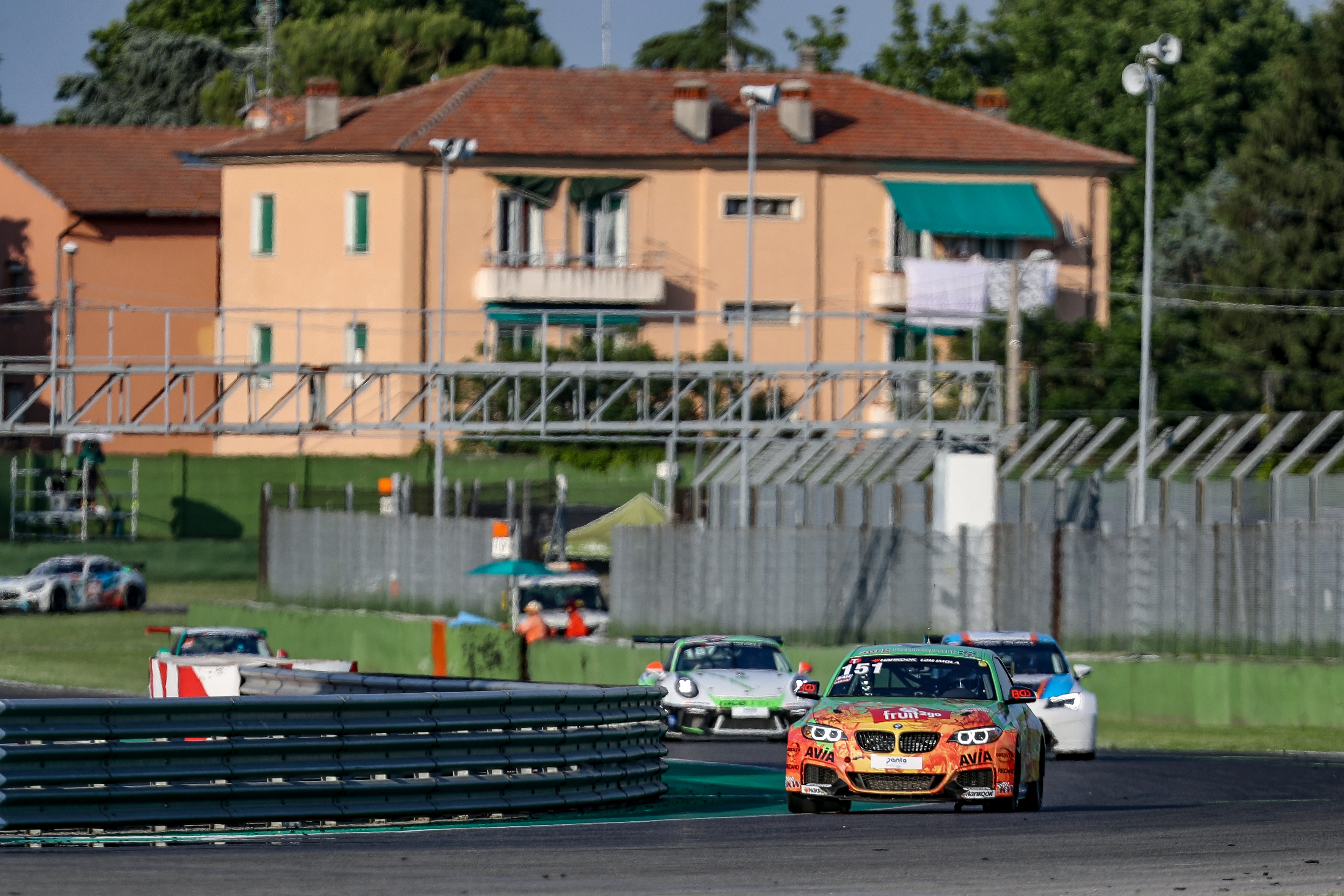
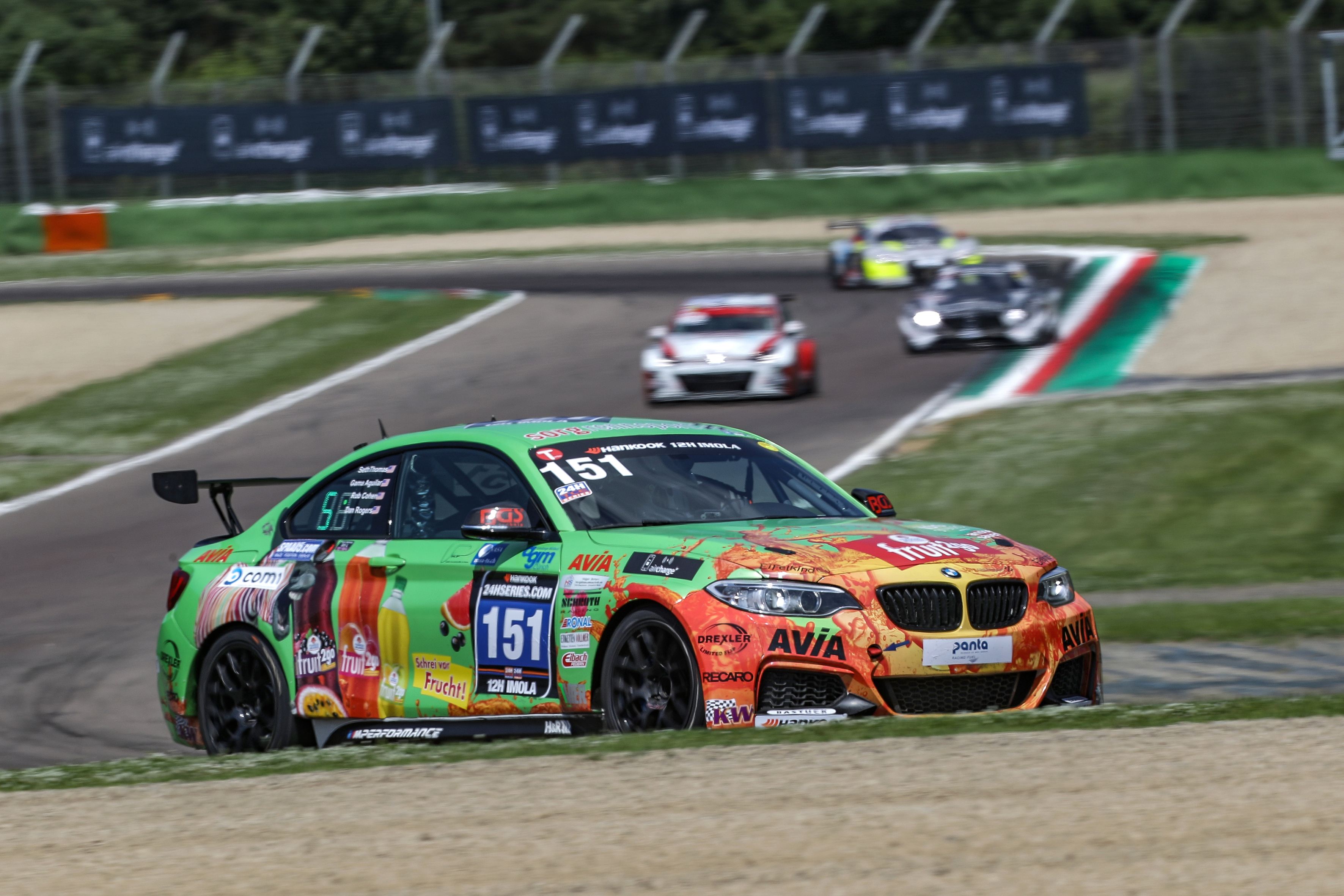
We were originally supposed to drive this car below but in the prior 24 Hour of Nurburgring race, it was wrecked a couple times and was down for repairs. So Sorg prepared and brought out the “Orange Juice car” as my son named.
The car we were originally going to drive but was damaged at the Green Hell. Photo credit: Petr Frýba
The “Orange Juice Car” Photo credit: Petr Frýba
The basics
DIMENSIONS
Length: 4,454mm
Max. width: 1,862mm (without mirrors)
Height: 1,380mm
Wheel base: 2,690mm
Max. track width: 1,608mm
ENGINE / TRANSMISSION
Straight six-cylinder petrol engine
BMW M Performance TwinPower Turbo
Capacity: 2,979ccm
Output: 245kW (333bhp)
Torque: 450Nm
Racing exhaust with racing catalytic converters
Steering wheel with shift paddles and lights on the steering wheel (awesome!!)
BMW M Performance limited-slip differential
TANK Motorsport safety tank
SUSPENSION / STEERING
KW dampers
H&R suspension springs
Front: H&R anti-roll bar (2-way)
Rear: H&R anti-roll bar
BRAKES
Front: High-performance motorsport braking system –
Performance Friction (PFC); 4-pot fixed calliper
Rear: BMW M Performance 2-pot braking system
ABS / DSC / ASC
BMW Motorsport specific racing application
TYRES / WHEELS
18×10 inch alloy rims
265/60/18 tires – we ran Hankook full racing slicks though we’ve seen this car run on Pirelli’s, Dunlops and Michelin’s across the globe
SAFETY COMPONENTS
Cage with DMSB certificate and FIA approval
6-point racing harness from Schroth
Racing seat RECARO Pro Racer SPG (we had an OMP HTC-R carbon seat)
Exterior
The car is built a ‘body in white’ to make it super easy for a great wrap job. It is the 235i body with the body panels from the M2, which presumably provide a variety of aero benefits. Sorg has it outfitted with the optional rear wing, which is adjustable to aid in rear down-force.
Seth Thomas getting acquainted with the car. You can see the body in white and the full body wrap.
Bottom line, it looks awesome in just about every livery I’ve seen. A bit boxy compared to most sports car but expected for a BMW. The aero bits make it look aggressive and with the incredibly meaty 265-wide slicks, it looks beefy from every angle. You’ll notice that in most pictures, we ran with the windows up. It comes with the power windows still and fully functional. It wasn’t until the cockpit got really hot, that we’d crack a window to circulate air and feed cooler air into the helmet blower.
Interior
This car is the standard for every production-based race car, even a club race car. Period. The interior was clean and tidy with the factory dash just about fully intact. The steering wheel had shift lights, programmed to keep us within the meaty part of the power band and the small LCD screen that read out the amount of fuel we’ve used since the last refill/reset, lap times, water and oil temperatures.
Straight factory look and yes, my eye line is only a couple inches higher than this…
The shifters were in perfect position to shift up and down without readjusting your hands. The OMP HTC-R carbon fiber seat was on sliders, to accommodate several driver heights, of which for us ranged from 5’6″ for me to just over 6′ for Seth Thomas. I normally don’t love sliders but these were solid and provided all of the range we needed.
Much of the interior is trimmed with carbon fiber goodness, which looks great and keeps everything looking clean and professional.
The car still comes with a racing oriented but still operating Driving Stability Control (DSC) of which we turned completely off. I personally didn’t drive with it on on, so I can’t speak directly to the differences but having it fully off was great and I felt like I could easily manage the amount of corner-exit sliding with throttle and steering input.
Sorg outfitted the car with Motorola digital radio system, which was a bit random in its performance throughout the weekend. Imola is a big track, with lots of elevation changes so we rarely had good audio quality at the farthest points from the paddock and saved most critical comms for the front-straight away.
In the center console, you can see the Motorola radio and that on/off switch is for the helmet blower.
This was also the fastest and loudest (though not super loud) car I’ve ever raced, along with racing amongst the fastest and loudest cars I’ve ever raced with (up to GT3 cars). I found that my super awesome Stilo helmet with the ear muffs were simply not enough, so I had an on-track vendor install the additional component so I can have molded ear plugs, in addition to the built-in noise cancelling ear muffs and that seemed to help quite a bit.
Sorg installed an air-conditioned helmet blower, versus the standard air blower I have in my PRO3 car. This thing worked great for the most part. It needs an air intake, then it cools the air before forcing it through the air tube. The issue I ran into was that in my first race stint of nearly 2 hours, I ran the whole time with the windows up. And even though we had the car’s fan circulating air into the cabin, everything got heat soaked and with 40 or so minutes left in my stint, I was heat soaked and the blower was pushing around hot air (which was still better than nothing).
One driver mentioned that the dash was a little tall and he didn’t love not being able to see the hood and thus not having as strong of a sense of where the car body limits were. This is true but for me, I’m used to sitting low and being short, so I never see the hood, so that didn’t bother me.
The cable management, cage design and installation is pristine, though it was interesting to see that the cage is actually a bolt-in cage, versus a welded in cage at the mounting points. I’m sure there is science and logic behind this but that took me by surprise.
Lastly, the car had a full AiM data logging system built in and capturing ECU channels. As usual, we lived and died by the predictive lap timing feature and during practices, we used the Apex Pro Driving Coach tool, where Seth set some baseline laps and then we focused on making the lights as green as possible in the corners.
How did it drive?
Before driving the car, Dan and Seth said that the M235i Racing would drive like a big PRO3 or Spec E46 car, of which are my only two reference points. And after the experience, they were mostly right.
With power steering, ABS and a paddle-shifting automatic transmission, it was the easiest car to race I’ve ever driven. What you do is still the same in terms of driving but it’s just easier. All inputs don’t require much of any force and the seat, seating position and Schroth belts are simply comfortable. For example, I have an Apple Watch and when I drive my PRO3 car (no ABS, power steering and a CAE shifter) I don’t need to ‘start a workout’ on my watch. The amount of work I am doing and vibrations automatically make the watch think I am working out and it logs a workout.
In the BMW M235i Racing? Not so much. After both my racing stints, of which both were nearly 2 hours, I was toast. Overheated, dehydrated, mentally and physically exhausted I looked at my watch and no workout detected. I had to manually have it check my heart rate about 5 minutes after getting out of the car and it was still at 134bpm.
Getting 3-wheel action is easy- peasy in this car! Photo credit: Petr Frýba
So yes, it was the hardest, most exhausting driving I’ve ever done but I might as well had been sitting in a beach chair.
This thing is fast.
With ~330whp and on full racing slicks, this car is easily the fastest car I’ve ever driven in a race. My perspective is a bit skewed because while we were hauling @$$, we were driving in the slowest class of the race. It literally felt like I was driving with an anchor dragging behind because of how stupid fast the TCR, GT4, GT3 and Porsche Cup cars were.
Still, this car is fast and when not over-driven, it is really easy to go fast. The key difference for me was to trust the higher than normal mid-corner speed the car could carry due to it’s more advanced suspension and big/meaty slicks. Seth and Dan mentioned that the Hankook’s were not the fastest slick available but are likely a great value because they tend to last at 90% of the peak grip for a good amount of time.
Bottom line is that this car could hang mid-corner with every car on-track except for the GT3 race cars and possibly the TCR cars. I could definitely feel the additional size and weight of the car transitioning weight from side to side, compared to a 2700 lbs PRO3 car but after a few laps, it felt normal.
Not a mistake – this car can hang with most any car mid-corner! Photo credit: Petr Frýba
Power-wise, it has gobs of torque but not an incredible top-end. Corner exit I could stay on the rears of several TCR cars but then they would slowly pull away, while just about every other car would leave us like if we were parked.
Braking was great and confidence inspiring. Braking for Turn 2 (the first chicane) and Turn 17 are full, 10 out of 10 braking zones. After building up my confidence, I found myself braking at around the 175 meter mark for the 1st chicane and the just before the 50 meter for the last chicane. HOLY CRAP! But the car would slow down, turn in and handle it, with no complaints.
Being a turbo car, there was a tiny bit of lag from throttle application to feeling the grunt. So it was even more critical to get to full throttle as soon as possible. For the most part, the LSD and the Hankook’s would take the full throttle corner after corner and lap after lap. I only got a bit more sideways than I’d want on corner exit a couple of times: once in turn 7 when I was testing the limits carrying speed through the corner and up the hill – simply too early on full throttle with too much steering input and a second time on the exit of the last chicane, when I got a bit more exit curb than the car could hold while try to get full throttle. I didn’t back out, just a simple steering correction as I still had a few inches before getting to the big turtle bumps that were there to eat up suspensions.
Final verdict: It could be the perfect race car for you and me at some point
At around $85k USD brand new, the BMW M235i Racing is seriously a great deal. For reference, to have someone build a top quality Spec E46 race car, it can cost upwards of $60k. $25k gets you a pretty much guaranteed quality and consistency, factory supported race car.
I’ve looked around and still not quite sure what they are going for used but I wouldn’t be surprised to see them available for $40-50k USD.
The driving experience is incredible and consumables are on the low end for a pro-level race car.
The issue for me is that I care most about competition. I want to race in big fields, with closer to spec cars and see how I stack up to the best competition around. And outside of Pirelli World Challenge, there isn’t a ton of these yet in the US and especially in the club racing ranks. If that were a different situation, I would seriously consider finding and racing a BMW M235i Racing.
I’ve heard and read that the BMW M235i Racing Cup is popular, with country and Europe-wide championships that are fielding 20+ cars at a time. If I lived in Europe, this would also be a strong option.
Until any of those things happen, I’ll have to settle for making my in-process, BMW Spec E-46 look and drive as close to this beauty as possible and racing with Sorg Rennsport 1-3 times a year. I can’t wait for the next time!
It was August 2015 at Portland International Raceways – the second time at Portland of the year, running the chicane configuration. It was the second year with my BMW E30 PRO3 race car and this year, was sporting a fresh engine, baller status OS Giken rear-slip LSD rear differential and a fresh exterior paint job.
On the second session of the day, I am feeling good and starting to get into a groove. Come off turn 7 into the back-straight away, hammer down… 4th gear… 5th gear… BRAKES, hit the FIA curbing on the left, downshift, back to throttle… BRAKES!!! I said BRAKES!!! OH $H!%!?!?!?! No BRAKES!!! Grass… sliding… spinning… no, please no wall!!! Pump the brake pedal again… oh, brakes! They work! I’m alive! The car isn’t destroyed! But WTF just happened?!?!?
This is the infamous pad knock-back zone at PIR
What is it?
Pad Knock-back is when for various reasons, the brake pad loses contact with the caliper piston that presses the brake pad against the brake rotor/disc. The contact is lost for one of two reasons (below) and the result is that the driver goes to apply the brakes and the pedal falls to the floor, with little to no brake pressure on that first application. The brake system is moving the piston but the piston lost contact with the pad, so it’s moving air and slowing down nothing.
As soon as the the driver releases the brake pedal and pumps the pedal again, the pressure usually returns and the brakes work again. The problem is that sometimes drivers don’t realize what has happened and don’t hit the brake pedal again, that second time around at all or in time. And bad stuff can happen when you need to hit the brakes but they aren’t there.
How and why #1: Worn out caliper components
Caliper components live a hard life, especially on a race car. They are called on to not only slow the car down aggressively with degressive braking but also help the car rotate with long durations of trail-braking.
All of this hot and cold and hot and cold and hot and cold… action makes seals burn up, brake fluid overheat or even boil if it contains water or air bubbles and the metal components deform and lose their snug fit amongst the other brake components. According to this great and much more technical deep dive analysis from NASA Speed News, even a slightly deformed rotor can cause the pads to separate from the pistons and the pistons to fall deep into their bores.
The fix? Rebuild or replace your calipers at least. For us, this quickly fixed the problem. On that first experience, we had back in August of 2015, we bled the brakes and went out for a 1 Hour mini endurance race – the brakes felt better but were still getting knock back every lap before braking for turn 12.
Before Sunday AM qualifying, we sourced a new set of calipers from Advance Auto Fabrication (who also did all of the off season upgrade work), got them installed and presto!
Putting the finishing touches on new calipers for the weekend at Portland International Raceways
Pad nock-back was gone! Over the subsequent years and travels to various tracks we realized that PIR uniquely had the most FIA curbing of all the tracks on our schedule. If a set of calipers had more than 3 race weekends on them prior to heading to PIR, we’d slap on a new/rebuilt set of calipers.
Here is a video of a competitive race at PIR – note the use of the FIA curbing towards the end of each lap (turns 10 – 12):
How and why #2: Driving hard on the curbing/gators
You might have fresh brake components but if you’re driving hard, eating up apexes and letting the car track out, odds are you are driving on the curbing, if the track has them.
Tracks have a variety of curbing designs but the end result is almost always the same, they cause vibrations that can and do shake up brake components – pad knock-back! This is so common that if you were to watch any pro-level sports car racing on TV or online, you’ll see brake lights light up as the cars are roaring through straight-aways. The drivers aren’t brake checking or trying to confuse a trailing opponent. They are lightly tapping the brakes to get the pistons seated back next to the pads and ultimately, make sure they have a brake pedal.
This is part of what happened to us in Portland in 2015 and just about every other time we went back. But this past June of 2017, we were at Spokane County Raceways, who does have apex and exit curbing.
Here is a pretty fast qualifying lap at Spokane County Raceways. Note the elevation chart – it shows that it is pretty flat but if you listen closely, each of one those changes in elevation is going over a seam in the road. Each of those bumps plus the curbing result in harsh vibrations applied to the braking system.
We’ve been there twice before this, all have been 3-4 days of being on track and not a single issue.
Well this year, we were competing for pole and wins – nearly breaking the track record for a PRO3 car on Sunday AM qualifying. Sunday afternoon, final race of the season – qualified 2nd and was ready to make a great start and pull away.
Coming around the final turn and… GREEN FLAG! Full throttle in 3rd gear… I got a decent start and I have the inside for turn 2. Exit of turn 2 and in the lead, barely positioning myself for the outside of turn 4. Full throttle… 3rd gear… 4th gear… 5th gear… wait for it, wait for it, wat for it… BRAKES! NO BRAKES!?!? WTF is going on? I don’t want to die!
Note – Spokane is an old school track. High speed, built on a budget and in the high desert of Eastern Washington. The pavement nowadays is good. Not great, not horrible – but good. Stay on track with maybe a dropped wheel here and there, and everything is good. Go on an excursion, there will be pain. There are big rocks and boulders watching the action, waiting for a visit.
I was able to pump the brake pedal and luckily – this was the first lap of the race. We were still in traffic with faster cars so we weren’t going at full speed for that corner, which is usually a 4th gear corner.
We’ll update this post later on with the video from the race but what does pad knock-back look from a data standpoint?
An not annotated version of the pad knock-back session
Here is what is really happening on the lap
A few positions were the only thing lost in this occasion but it hammered home the lesson, always pump the brake pedal in between braking zones.
What should you do? Pump that brake!
The more I’ve been racing and steadily improving, getting closer to the front of the pack, stuff just keeps breaking or getting tweaked. It’s a natural consequence of just pushing the equipment to the limit. The braking system is not just the most powerful system on road racing and street cars, but it is the thing (and how it’s used) that separates the good from the great and the great from the greatest.
If you watch any form of pro-level racing, even NASCAR, you’ll see the drivers pumping that brake with their left foot because pad knock-back and other potential failures are a fact of life. It happens all the time, so from now on, assume it will happen every time you go on track, every lap and on just about every braking zone. PUMP THAT BRAKE!
On July 7th, 2017 I went in for what was supposed to be a minor surgery. I was diagnosed with a non-cancerous cyst, which is quite common except for it was located right on top of my tailbone (not on the tailbone but right next to it). This meant that I was regularly sitting on it, especially when I would slouch.
It had originally come up 3 or 4 years ago after 6 months of karting all the time. I thought it was just a result of all that trauma to my tailbone. It was an annoyance but never very painful until this past June, during the second Portland International Raceways weekend. After the first day of testing, I woke up sore all over my body and my cyst was really tender.
I ignored all the pain and discomfort and made it through the weekend but went to the doctor the following week. It turned out that my cyst had gotten so swollen, it was infected and those body aches, were my body fighting the infection.
Long story short, I needed surgery to have it completely removed. It is a straight-forward procedure and usually within a week, someone can go back to normal activities, but because of the location, the recovery was at least 2 weeks and possibly up to 2 months before feeling ‘normal’ again. Well for me, it ended up being the 2 months.
A week after the Pacific race, I was reading to my kiddo and his friend, but I was also laid up, trying to take the load off my incision.
The next couple of weeks were really tough. I don’t know how differently or faster things would have healed if I had not raced but I think it slowed things down. A checkup with the surgeon a couple weeks later showed everything looked good but she was surprised to hear that I was in so much pain.
I headed her advice and just tried to rest up, sprinkling in some yoga and days of more walking. 1.5 months after the surgery was the August 19-20 Dash for Kids race, back at Portland International Raceways.
Our setup at Portland International Raceways
= Sub-Par Performance
During the race weekend, we decided to hit the ‘reset’ button on our suspension setup, seeking coaching and advice from the 2016 PRO3 Champion, Olivier Henrichot (a future post on that experience). We made dramatic changes to the setup, where in the end, I was able to hit the same lap times as before, with less of an effort and more confidence in feedback from the car.
All good things except, I was beat. On Friday, we had 4 total on-track session and I awoke on Saturday AM, full-body sore. Saturday, was a typical day of practice, qualifying and the 1-hour race, of which this time, I was splitting seat time with Olivier. We won the race but I again felt beat, after a 30 minute stint.
The next morning, we only had qualifying in the AM and the main race in the afternoon; not a ton of physical workout time. I qualified P2 and was ready to go for the win during the race. But about 5 laps into the race, my lower back started hurting. Halfway through the race, it was throbbing and I was actively thinking about it during the front and back straightaways. Not a good.
Qualified P2 for the main PRO3 race on Sunday
Long story short, I did not perform anywhere near my full or regular potential and one big reason that I was just not physically fit enough. Here is the race video from the weekend, of which again, isn’t all bad and 1 year ago, I would have been thrilled to finish P3.
But How Did I Do So Well at Pacific?
I’m not entirely sure but I think that while I was in pain during the race, I still had more of my strength, stamina and was also on lots of Ibuprofen, which could have masked some of the pain. At Portland, I think my strength, stamina and reflexes were not at the same level. This variables resulted in a heavier mental toll and it started impacting me even worse.
At the end of the day, it’s not like I really sucked. I still finished on the podium, against a couple of strong drivers that I’ve battled with all year. Jeff McAffer, who overtook me for P2, had a really strong race, with the fastest lap of the race. Olivier and I also won the 1-Hour endurance race!
The main point is that to perform at or near peak levels, you need to be mentally and physically at your peak. I know there are drivers that aren’t into physical fitness and they are solid, if not incredible drivers. They have other strengths, such as functional fitness and years and years of experience. I don’t have more than a few years of racing experience, so I rely on physical fitness as a way to compete.
Moving Forward
For me personally, I am much healthier now and turning my training back up. It will be some time before I’m as physically as fit as before but that is the goal. And if in the future, I am injured, I am going to bite the bullet and rest/heal properly before trying to get back into the cockpit.
What: The very first time I crashed, which happened to be an HPDE road trip/event.
If I knew then, what I know now:
I would have actively sought out training on how to handle “going off track.” Going off track is not a bad thing inherently and will happen. Handling it properly would have saved me a ton of money.
Had a HANS or NecksGen device: the impact was a classic sudden forward neck movement, with a concrete wall.
Reinforced that in motorsports, even recreational – if you’re competitive (I am) it’s not if you will crash, but when you will crash. How are you going to move forward?
This car, was technically, my wife’s car. A few years prior, I had decided it was time to get back into ‘car game’. It was about 3-4 years from when I had graduated from college, had paid off my student loans and bought a house. Prior to college and for some time in college, I was active in ‘modifying’ street cars. But after several cars, experiments, blown engines and essentially sunk money, I bought a 1999 Ford Contour SVT (black), which had an aftermarket exhaust, broken sun-roof and called it good. So I thought.
Soon after we bough a house, we had an STi and then an Evo 9. This was in 2008, maybe 2009 but not sure why the pictures look like it was in 1988 or 1989.
Yes, we did car shows and here is my wife claiming a prize for best something. Oh the shame…
Proof from the car shows…
And we even did photo shoots. Oh, the double shame!!!
I slowly took over the Evo because I had gone too far with the STi, making it not track-capable. With an upgraded turbo and 400whp, it was too much car for to handle and very likely wouldn’t make it a day or two without over-heating or blowing up as EJ25 engines were and are notorious for not liking even mild track sessions.
I’ll be writing a car profile post and update this article later on, but in terms of specs, it had the basic bolt-on’s, a tune by Cobb Tuning, a harness bar, some gauges, upgraded brakes (lines, pads and rotors) and I removed the rear seats for “weight reduction.” 😆 Functionally, it allowed space to bring alone a full set of track tires/wheels, a jack, jack-stands and pretty much everything I needed for a track day.
My experience thus far: Intermediate run group, on the cusp of Advance
This was the first year that I had decided I was done with simply modifying cars and hard-parking. I had taken an HPDE full-day event the prior November and the bug had bit. I had spent that entire spring and summer, attending track days and this was also the first year a friend and I had started developing Track Attack. Each time we went out on-track, it was not only fun but a chance to test and improve Track Attack.
At the time, I had somewhere around 8-10 track days, without any real incident; a spin here and there. Generally, I felt quite ‘seasoned’ by the time this trip came around but by no-means did I feel fast. I had also done a couple autocross events and had decided that was not my path. Nothing wrong with Autocross but all that standing around, with no practice runs and for at most 4 under 60 second runs (of which I sucked at all of them) – I was OK sticking with track days. 🙂
The setting: A three-day track day road trip (Portland International Raceways and Oregon Raceway Park)
I was excited and intimidated a little about Portland, mainly because it had the ‘International’ in the name – implying, at least in my head, the more professional and potentially hard aspect of the track.
The back-straight at PIR getting some instruction and likely told I suck.
Coming off Turn 12 at PIR
Holding up traffic in the Festival Chicane
The first two days at Portland went great! I had hired an instructor for the first day at each track, to help guide me through the track as it was my first time at each. At the end of the day on Friday, we caravaned over the mountain range. I stayed with a friend (Robert) I had made in my modifying days, that was a Shop and History (I think) teacher, in The Dalles, OR. He was/is a big car guy and had just gotten into Evo’s and was gracious enough to let me stay at his house.
That first day went really well and aside from frustrations with the Track Attack app (no cell phone reception at all) was ready to get back to the track and make some serious gains on my lap times. That Sunday morning, Robert came out in the AM and we were able to give parade rides, which was fun to show him around the track. Once he left, it was time to get back on it.
What happened
It was what would have been the second to last session of the day. I forget my exact lap times, but I want to say they were in the 2:10-2:15 range, of which looking back on it now, is well below the abilities of that car. I honestly don’t recall having too much of a structured learning or driver development plan, so I was pretty much just lapping around “trying to go faster” but no real thing I was actively or consciously working on.
Oregon Raceway Park is an incredible track, with lots of rolling hills, blind corner exits and no real long straightaway, giving little time for brakes to cool down or a rest for the driver. It is ran primarily in the clock-wise direction, though it is regularly run counter-clockwise. It’s out in the middle of nowhere, high central desert, Oregon, where if you go off, there really isn’t anything to hit. Generally, go off, pick up small rocks and dust – come back into the paddock, clean and vacuum your car and you’re back at it.
Except one section: Start/Finish main straight with a wall
Check out this video of one of the best club racers (and drivers in general), Cody Smith in a race at ORP. You’ll see that right at the last corner, there is a wall that protects the hot-pits. The only real place to get in trouble here is that wall and that’s what I learned.
On what would end up being my last lap for that weekend, I was coming up on the final turn, I braked, turned but turned in too early and probably too lazily. As I started exiting the corner, was on throttle but noticed I was going to run out of road and I lifted. 🙁
Not sure if the car actually dropped a tire but the rear end whipped around and next thing you know, I am sitting there, staring at a wall and corner workers running over to me. I then look to my left to see if any other car is going to collect me and this awesome green E36 M3 purposefully goes off-track, along with a nice 370z. No damage to them, aside from a dusty car.
Within 10 minutes, I’m out of the car, physically fine and am able to limp the car back to the paddock, where front end is pushed in a few inches, the Seibon carbon fiber hood latch is broken but that’s about it. If it weren’t for the leaking radiator, I might have even tried to drive it home.
The aftermath
First, I have to thank Don Kitch Jr on how calmly he handled himself (not having been his first rodeo by a lot) as that helped calm me down. I had recently started working with English Racing, in Camas, WA and made the call to see if I could have the car towed to their shop, so they could take over assessing and fixing the car.
I also called my insurance and told them I had run into a mechanical issue while on a road trip and needed a tow truck. With no approved partner within 100 miles, they allowed me to use the local tow truck provider (a story for another time) and I had the car towed to English Racing, with me going along for the ride. Myles Kerr (Gringo Integra) was incredibly awesome, meeting me at the shop (I think they were actually there anyway) and giving me a ride to the local airport, where I picked up a rental car and drove home.
At the end of the day, the damage wasn’t bad at all and the learnings were great. The majority of the front end needed to be replaced (front bumper cover, lower lip, radiator support, radiator, intercooler, headlights [I think]). The rest of the body parts were repairable and while it was at a body shop, I had the body shop massage all of the fenders so I could easily fit the 275/45/17 rubber I was running without rubbing and had English do a full mechanical evaluation, tune-up, install a new TRE rear differential, bigger injectors, new fuel pump and a new tune, bringing the power to 334whp and 276ft/lb torque.
The Dark Side
I’m not gonna lie, I had some dark thoughts in the first 24-36 hours after the incident. Even before I got out of the car, staring at the wall, I thought to myself – “What the hell am I doing? This isn’t for me. I’m not good at this and I can’t afford this. Did I just financially ruin us?”
The scariest thoughts were those “this isn’t for me and I’m not good at this” thoughts. I had already heard from Don and other experienced drivers that crashing on-track isn’t a question of “if but when” it will happen. And multiple “when’s.”
Luckily (or maybe not), I’ve had a history of dealing with thinking and being told that certain things weren’t for me and that I sucked at them. In most cases, I’ve been stubborn and hard working enough to prove others and myself wrong. So it took some time, but I consciously decided that this incident would not hold me back. Motorsports and specifically, being the best driver I could possibly be was something I wanted to be a significant part of my life. So I picked myself up, dusted off, fixed my car and got back it.
At ORP a year later and more than 10 seconds faster than the prior year.
Discussing things between sessions during a race weekend – People will often come ask us about what to do, or what is going on – Almost always it is appreciated!
What: The nitty gritty of asking questions when at the race track
If I knew then, what I know now: I would spend a lot more time reading and less time relying on info from others
What do I do about…
Asking people questions or for advice at the track is a tricky subject to discuss. Things like prep, common sense and skill all come into play. What do I do about? That is a question that gets asked at the track more than anything else. What do I about [fill in the blank]….?
Asking questions at the track can be easy at first, and then more difficult as time goes on. People are often willing to help out those that are new, or are obviously a fish out of water. That tune changes over time. People in the racing community are expected to hold themselves to a higher standard. You are out there racing. It is a serious thing, and can have serious consequences.
You should well and know what you are doing out there! The ones that find trouble asking questions are those that do not make good notes for themselves, or that simply do not listen to the advice they are given. It can get you a long way, or it can very much get you nowhere.
Drives will often discuss the race with each other, compare notes, and talk out any issues or incidents that may have occurred. Often advice is asked for and provided
Don’t go fishing for what you want to hear
Getting help at the track can be tricky in itself. Knowing when and how to ask any questions is almost more important than what you are asking. A conversation I had last week with one of the other guys locally that runs some race car support on race weekends ended up with us comparing stories of things that people have said and done to us when we are at the track.
More often than not, the gripes we had were from people repeating the same questions, and expecting different answers, as well as asking the “pros” for advice on something, then asking all of the other “pros” until one of them says what you want to hear.
There are three types of people at the race track:
The ones that are there to win
The ones that are there for fun
The ones that are there to try to prove something.
Types 1 and 2 are easy to work with
The guys and gals that want to win will often have well thought out questions about stuff in advance. They are into improving, not bull shitting. The ones out there to have fun are also easy. They don’t expect much out of the weekend, and if they have a question, will generally be a softball question.
Type 3 on the other hand…
It is the ones that are out to prove something, wither to themselves, or someone else, that are the issue. They must like to or somehow almost always end up ruining it for the rest of us.
In the shop I work at, we have internal conversations regarding this issue as well. Often times people want to come with questions and problems, and rarely offer up a solution. In our shop, if someone has a question, we work hard to train and teach them to use all of the resources at hand before going to someone else regarding the question. The race track should be considered the same.
If you are about to go ask someone a question here are a few things to consider before you go.
Picking the right time to ask people for stuff is important.
Step 1: Have some background info about what you are asking.
If you are going to ask about tire pressures, be sure to know what you are currently running pre and post session. Otherwise there is not a reference point to compare.
Feel has a lot to do with the tuning of a car and each driver will often have a different idea of what feels good. We deal with this in our enduro car – getting the set up that everyone can work well with. If you are going to ask about brakes, know what you would want to change about the braking experience (force, feel, pedal modulation…) Having a plan once you have the answer, is crucial.
Step 2: Don’t go shopping for answers!
The second step is to not ask the same question to everyone in the paddock. If you are that un-sure of what is going on or how something is or should be. Then you are in over your head, and you need to take a step back to re-evaluate.
If you have an idea of what you are looking for as far as an answer, and nobody’s reply lines up with what you expect. Going around to ALL of the people in the paddock until you hear the answer you are looking for is incorrect, and the root of that is that you, yourself are expecting an incorrect situation to be proper, and if people don’t seem to think that is the case, then people will try to prove them wrong, often failing to do so.
This does not necessarily mean that crowd-sourcing solutions will always result in the proper answer but if after asking a few people, who are more knowledgeable and experienced than you and it is not what you’re expecting, it is probably time to re-visit those expectations.
Step 3: Take and actually implement the answers you gathered.
If you are asking everyone up and down the paddock about all of the different things about racing, the cars or machines you race, schedule, timing and all of that. You are doing it wrong. We are all adults and should be treated as such when we do events like this. Just think about how ridiculous you would feel if you showed up to try out for the Seahawks and you brought with you some basketball shoes, a baseball mitt, and your I-pod in its fancy arm band holder. You are not making that team.
Racing is similar. If you are showing up and asking questions right out of the truck. Your best bet would be to get back in the truck, head back home, and think about what you have done, what you want to do, and how better to be prepared for it. This is not to say that you need to know everything before heading out and trying racing, but this is a more complicated activity than just a pickup basketball game. It’s important to do some homework and find people who you can shadow and ‘learn the ropes’.
Not the best time to ask this guy about tire pressures he might recommend for your car.
Step 4: Respect people’s time and professionalism
I see a lot at the track, the weekend warriors going up to the bigger outfits and teams, and plain out bugging them about stuff. This is the biggest no-no I see at the track. If you need something from one of the big teams, you had better be willing to pay for it. The guys under the big tents, pay big dollars to have support when at the track. Going to the people that support racers that are paying to get free advice, is a bit of a slippery slope. It can cause high tensions since some people are paying to get the same info that you are seeking for free. The owner of the outfit may or may not be willing to help, but if you come and bring something to the table, then it is great start!
Conclusion: In the end, it’s pretty simple – take what you know, what you can and be sure to have reasonable questions, at reasonable times for people at the track.
If you don’t, you will find it ever increasingly difficult to find solid advice and answers. One of the main things we learned to love about team driver Gama, is that he will often have very prepared sets of questions dealing with specific items. We had a conversation last week about new wheels. He asked if he should get lighter weight wheels to try out.
We talked about the idea (mostly because we all liked it) and discussed the pros-cons of light wheels. The main issue being that often weight and strength will go hand in hand. Gama then spent the time to research each wheel option for size, and spacer needs. We ended up going with a new set of wheels to try. Each one will be saving 4 pounds per corner but potentially not be as strong of a wheel.
He has asked me questions like this for years, and each time, has proven than he knows what he is asking about, is willing to accept the answer, even if it is not what he was expecting, and will take appropriate action when needed. He is the type that wants to win!
Light eight, but not as strong. What is weight worth?!
Knowing little is not bad, but being a pain in the ass to everyone and not paying attention to people when you ask for advice is. Depending on why type of person you are, asking questions and getting info at the track should not be a big deal. Most participants are eager and enthusiastic, and will be willing helpers. Asking the big name guys will get you a long way with the correct approach. Remember that you should be having fun! Having people be grumpy or mad at you is not fun, don’t be that guy or gal!
What: Stuff breaks when you go on track, this time – headlights and driver side mirror.
If I knew then what I know now: Consider two layers of Lamin-x on your headlights and depending on your car, have a backup set of headlights. If your OEM headlights are glass, see if there are plastic alternatives.
It kind of sucks but that is a fact of the track-life. When you go on a race track, autocross course, rally stage, drag strip, etc. your car is going to be flying through the air at normally illegal speeds and changes in speed.
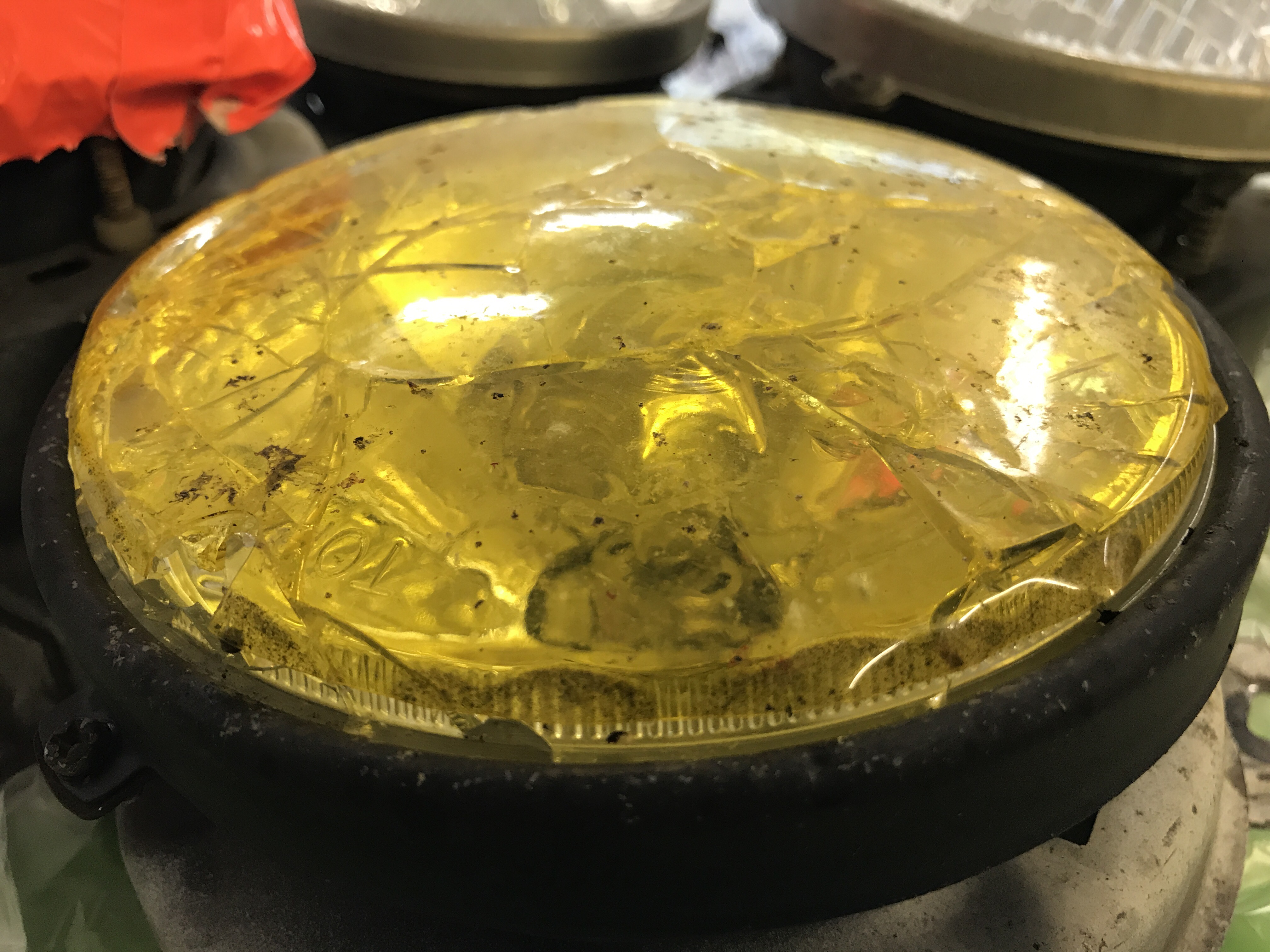
Bugs, rocks, small birds, rubber from tires and even parts from other cars will at some point, leave their mark on your beauty. After this most recent race weekend at Spokane County Raceways, my headlights finally bit the dust.
Doesn’t look too bad, right? Well the high-beams are duct taped because they were completely broken and the Lamin-x film was keeping the low-beams together.
an up-close look reveals a not as pretty picture. Eek!
The fix – new (to me) headlights and new Lamin-x
Although the remaining races for the year are during the day, we are in the Pacific Northwest and that means there is always a chance for rain. When it rains, I prefer to have all the lights on, just to make sure other cars on track can see me.
To fix the headlights, at least for an E30, there are a few different options:
Replace just the light bulb: These light bulbs are old school and thus the whole light bulb and actual headlamp assembly are one-piece. In most modern cars today, there is a headlamp assembly and somehow screwed to the inside, is the actual bulb. So you can replace either the headlamp assembly or the bulb but we don’t have that option here. To buy the integrated headlight, head over to Amazon and you can easily get one, like this one below (click on this link or the image below to go to Amazon and buy). Each bulb will run you about $45/bulb. Check to make sure you are ordering the right thing – the high or low beams. They are not inter-changeable. On the plus side, there are no side dependencies. So the low or high beam bulb can fit on the left or right side of the car.
Replace the whole assembly: You can also choose to replace the whole assembly, which includes the bulbs and the frame that holds the bulbs in place and is screwed into the radiator support area. Normally, this is too much for broken headlights but this is where eBay is your friend. There is an option to buy brand new and even LED and projector headlight assemblies, which are awesome but pricey. Here is an option from Amazon. Beware though, these look awesome but are just as fragile as the OEM stuff. Keep that in mind before buying and taking back on track. 🙂
Ebay to the rescue
As you can see from the Amazon search results, a new, truly new and even aftermarket set of the full assembly headlights can run $200+. Instead, I went to eBay and was able to find a used set of the full headlight assembly for just over $80. This is also less money than buying new (intgrated) bulbs and the already come in the assembly. Click through the banner ad below to see search results that I used to get my new (to me) headlights.
Install in less than 5 minutes
Because I was replacing the whole assembly, all I had to do was:
Remove 6 clips that pinch the headlight assembly to the grill that surrounds the headlights.
Unscrew two screws for each headlight area, that holds the grill to the front area of the car.
Unscrew two other screws that hold the headlight assembly to the radiator support.
Disconnect the bulbs from the wiring harness.
And they’re off!
Out with the old, in with the new (to me)!
Lamin-x for extra protection
While the old bulbs were off, I cleaned off the new bulbs with generic window/glass cleaner and then installed a set of #prospec yellow tinted Lamin-x film covers. These are the same ones I had previously but this time I put them all four headlights. You can get these almost anywhere: Amazon, eBay or where I got them, ECS Tuning. These are the exact product I ordered. But since we fund this site through affiliate marketing, here is a link to Amazon, for the exact same product, of which clicking and buying helps keep this site alive.
Back to looking good for the next race!
In under 10 minutes total, including cleaning, taking pictures and moving slowly as I was recovering that day from minor surgery, old broken headlights were replaced with fresh, low cost, new (to me) headlights with extra protection from Lamin-x.
Back to looking fresh!
I think about headlights and even windshields as almost consumables. If I can go the rest of the year without having to replace them again, that’ll be great. But with the next race at Pacific Raceways, where there is gravel off-track and people love to drop tires, I’m not very hopeful.
The lights that will strike fear into my competitions mind and heart. Move out of the way!!!













 or
or 






 Each bulb will run you about $45/bulb. Check to make sure you are ordering the right thing – the high or low beams. They are not inter-changeable. On the plus side, there are no side dependencies. So the low or high beam bulb can fit on the left or right side of the car.

