Posted on

Race Report 4: Virginia International Raceways SCCA Hoosier Super Tour 2022

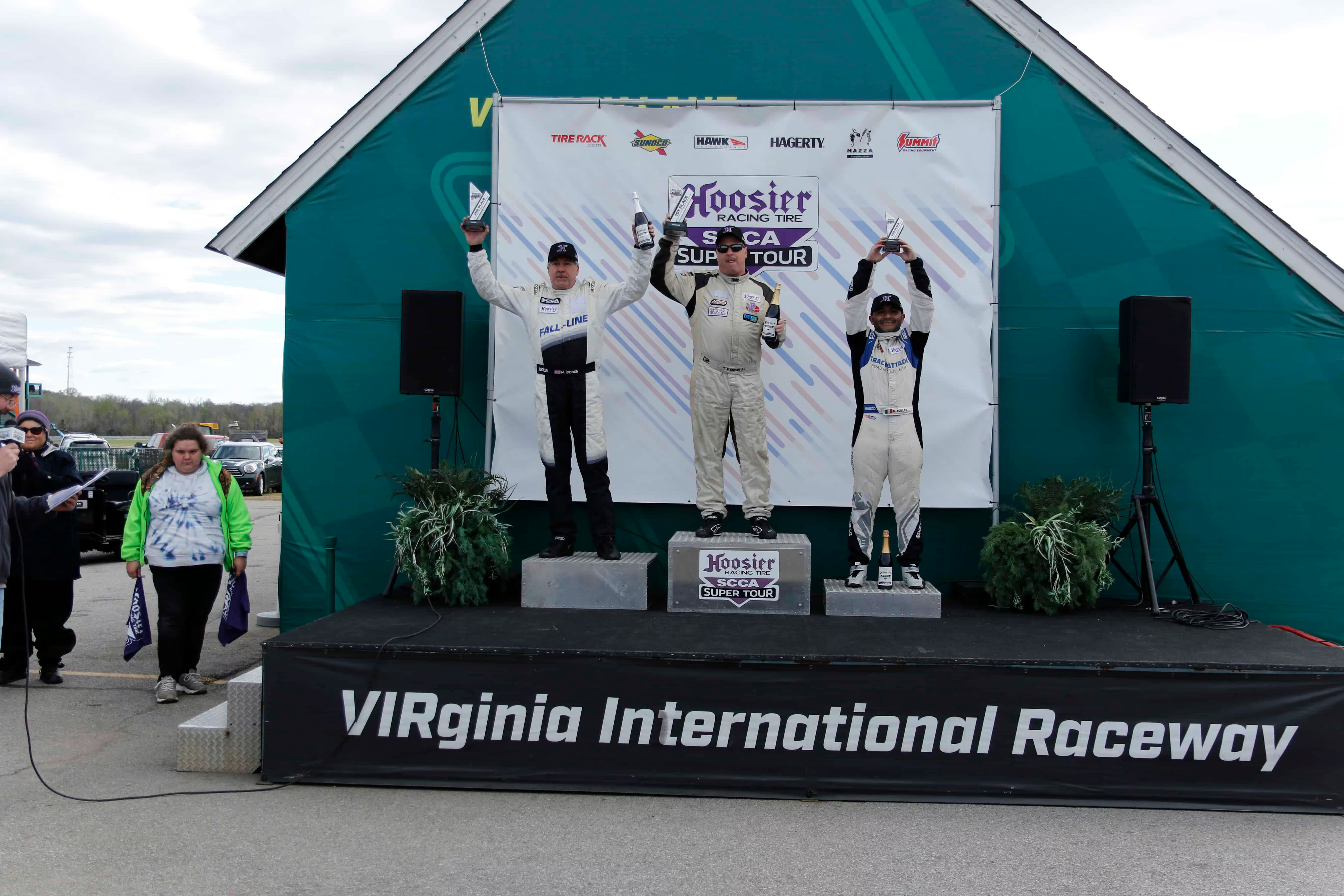
The 4th and final stop of the 2022 Southeast Winter trip for the team was historic Virginia International Raceways, located just north of the Virginia/North Carolina border, in Alton, VA.

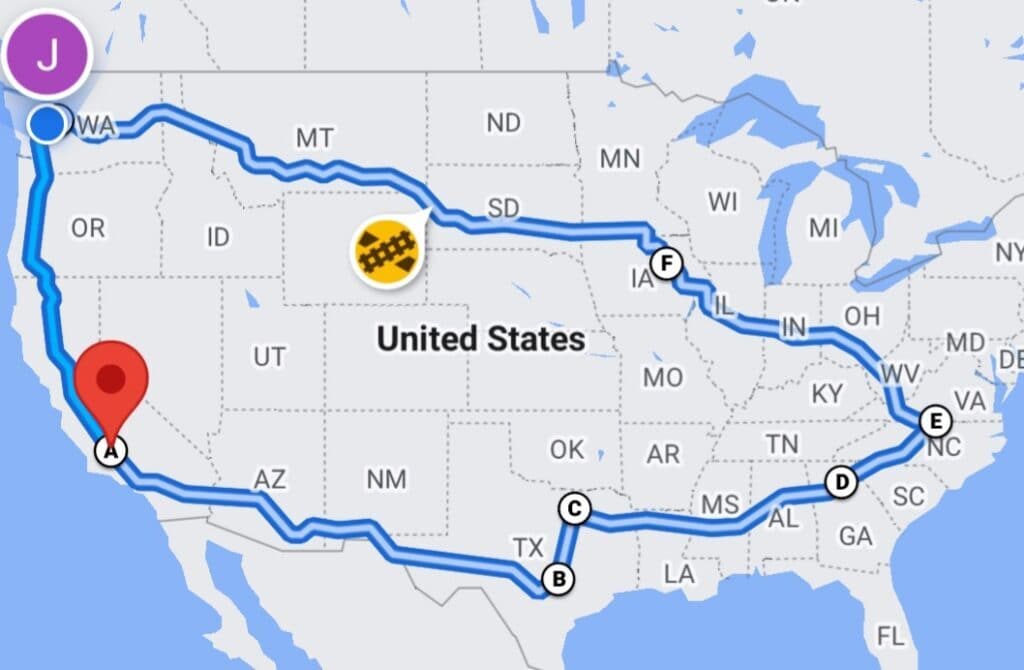
Before dive into the weekend, below is the map we took from January – April and covered nearly 7k miles and through the winter season across most of the country which resulted in catching the cold and wet weather at nearly each stop. Wow!

4 stops and ~7k miles over 4 months. Hats off to Jordan and Memo who drove our trucks, trailers and cars for every single mile.

Preparing for VIR

Road Atlanta ended up being a primer for VIR for the team. VIR is almost like a bigger Road Atlanta in that it is made up of mostly medium and high speed corners. Proper technique and equally proper commitment are critical to get into a groove and start attacking the lap times.

Just as before, each driver logged multiple hours in the simulator so that we all knew the track by heart and could dive into the test day with a focus on establishing a baseline performance and chipping away at the times.

On average, each driver (and crew member) had nearly 100 laps at VIR on Assetto Corsa with similar or the exact same cars as we were driving in real life.

Thursday Test Day – More Inclement Weather (Massive Thunderstorm Edition)

We all arrived and were fully setup on Wednesday night for the weekend and Thursday morning we awoke to some dew on the grass, dry track and chance of a shower here or there throughout the day. The first session was dry and we all got out and started familiarizing ourselves with the track in real life. Conclusion? The simulator model was pretty spot on!
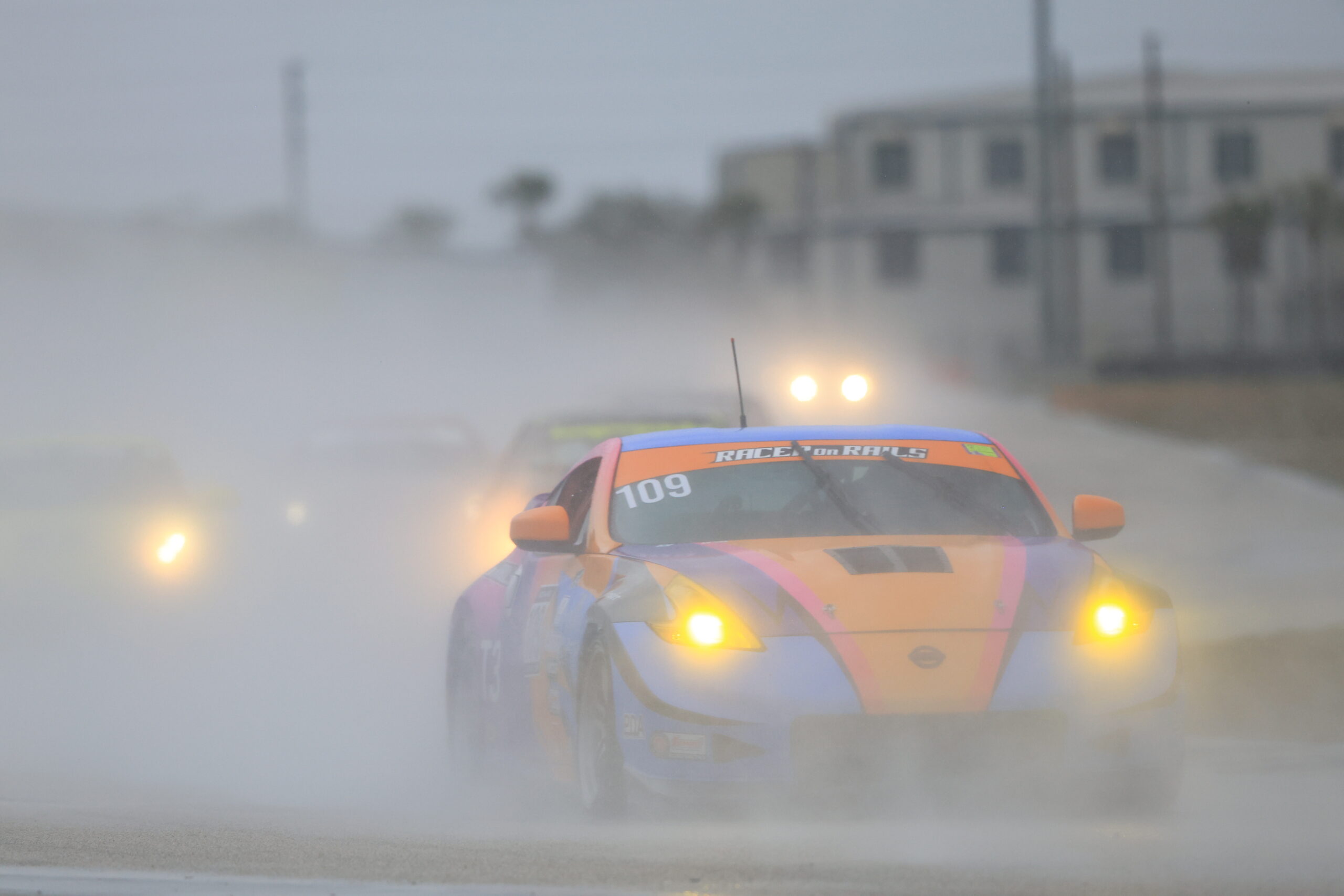
A few minutes after our session ended, a thunder storm rolled in and another, and another, and another. We had 2, maybe 3 cells roll through and the middle two sessions were shot. Not just because it was raining but torrential downpour and the poor souls who decided to go out (and survived) ended up getting black flags in each session as the conditions were just horrible. Further, the forecast didn’t call for rain during the weekend so using up new rain tires under those circumstances wasn’t a good use of the tires.

Completely unedited and it only took a few minutes of rain before we had water running on the ground.

By the afternoon, the cells had passed and the track started drying. We all went out and while times were slower (transitioning to dry conditions), it was valuable time to further familiarize ourselves with the track.

Learning, Improving and Delivering Results!
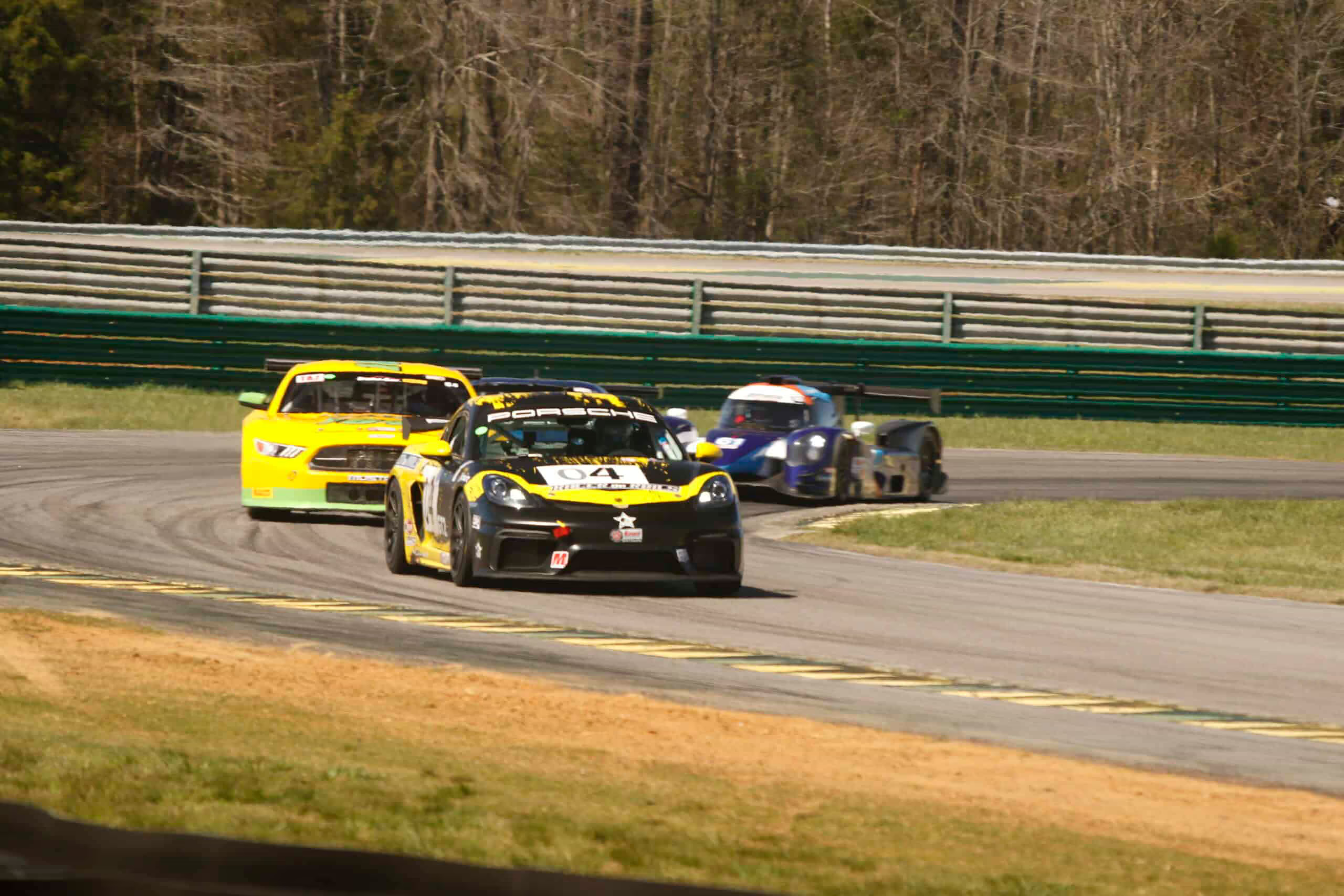
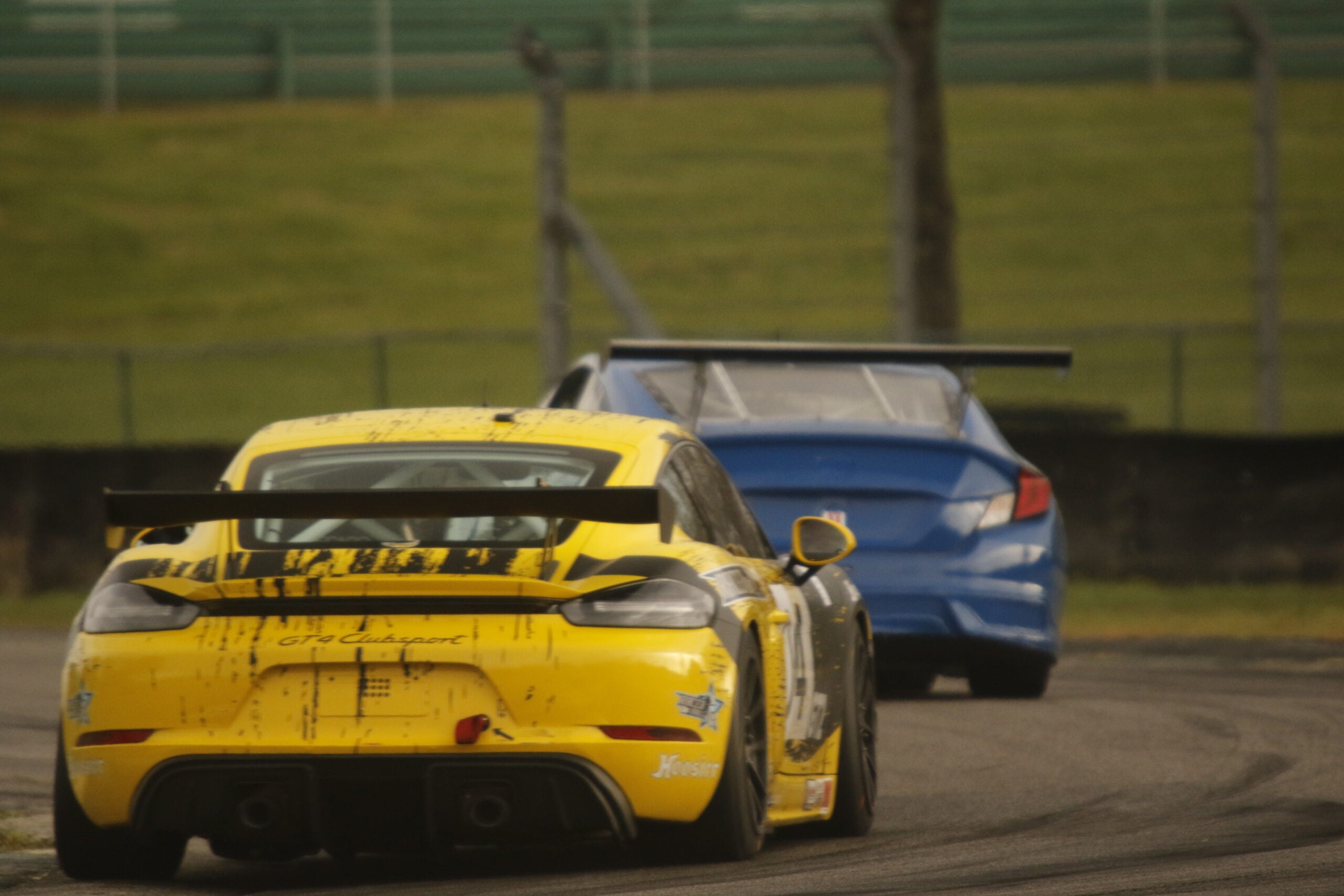
The weekend had a similar progression as we’ve had at the other stops but we arguable started off at the highest point to start the weekend. All three drivers came out strong out of the gate and were within striking distance of podium positions, just needed to put our heads down and keep chipping away at the times.

Every session was an opportunity to learn and while unseasonably cold air rolled through on Friday night, everyone steadily chipped away at the times and at worst, were in a mid-pack battle but still within striking distance for a podium.

BMW Spec E46 Touring 3 SCCA
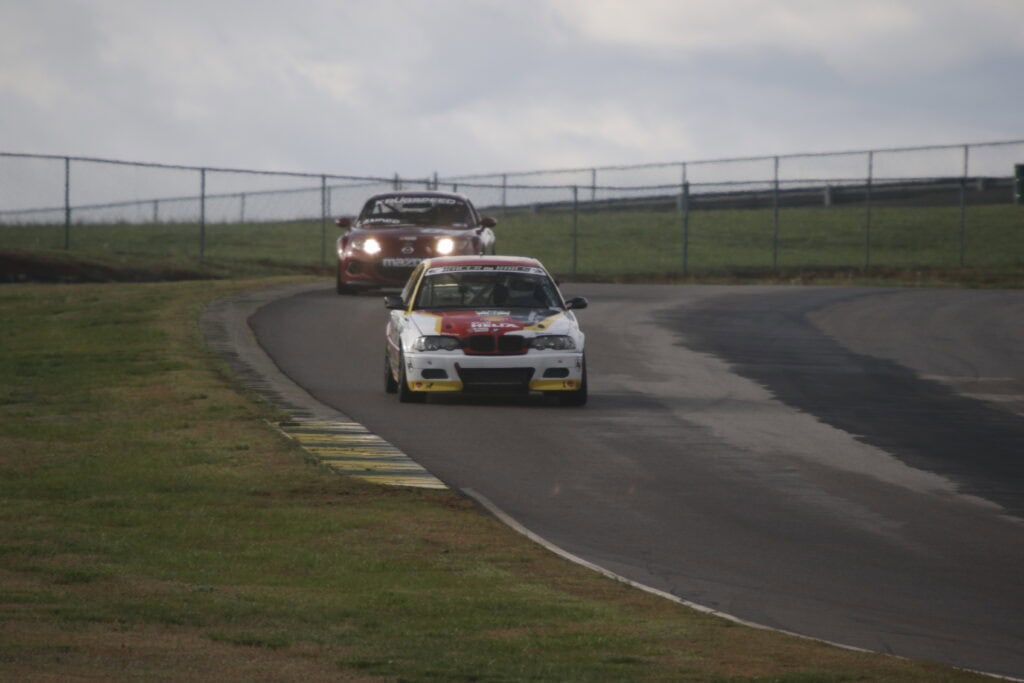
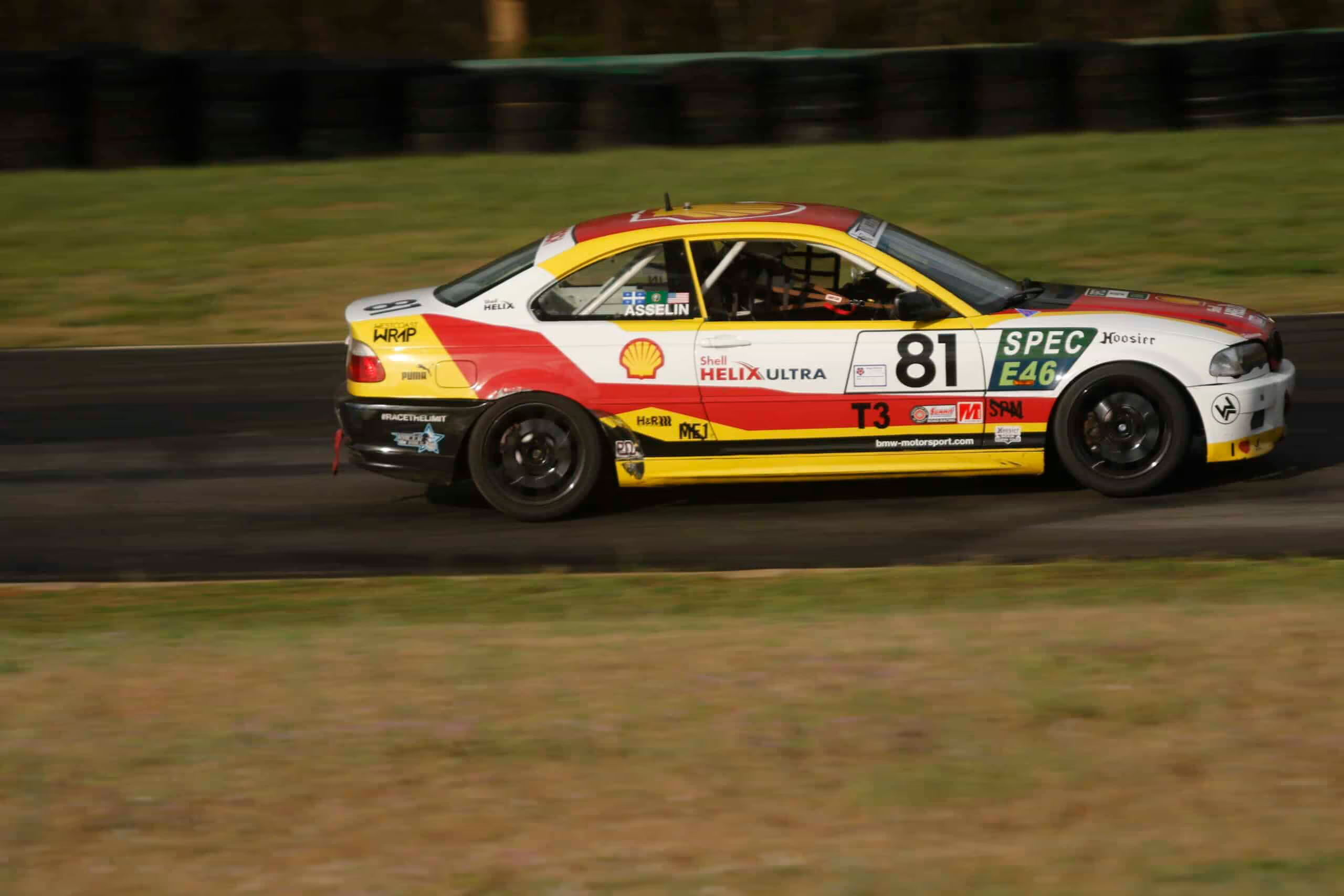
Simon in his Touring 3 Spec E46 managing transitioning conditions.

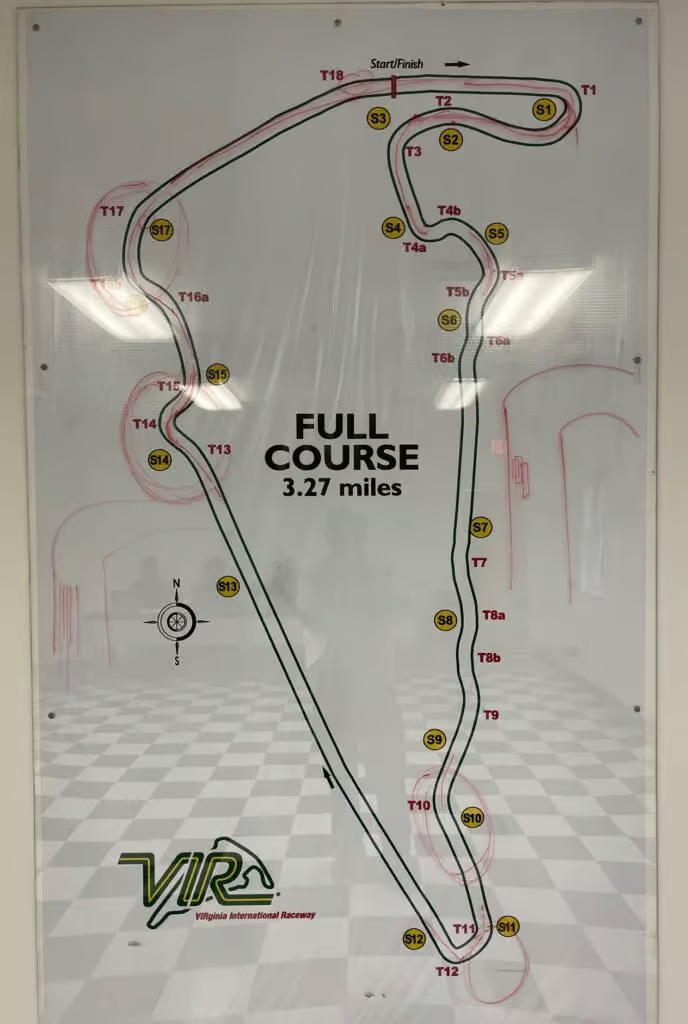
Below is a look at three of the corners we focused on across most drivers.

Sweet track map of VIR full course with a clear plexiglass on top that makes for great white board discussions about lines, markers and passing zones.

VIR Corner Focus 1: NASCAR Bend (Turn 3)

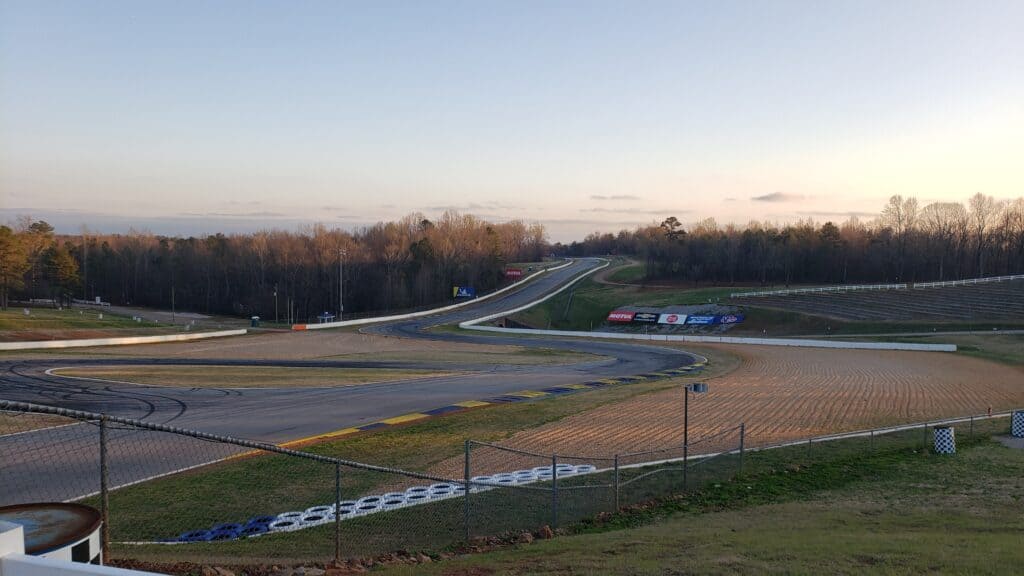
NASCAR Bend is the first left-hand corner/complex of the lap where it’s a bit of an awkward, somewhat off-camber corner where there isn’t a ton of time to be gained but very easy to over-slow and lose time. It feels a lot like Turn 6 at Portland International where it’s key to maintain minimum speeds and spend as little time as possible in the complex.

None of us really felt like we consistently hit the corner right but we aimed at being on-throttle at the apex, ascending to full throttle and carrying enough speed that the car had no choice but to use all of the exit curbing on the right. Getting out on that curbing then gave us a wider arch for the next left hand corner, which then left us track left to setup the run through the esses.

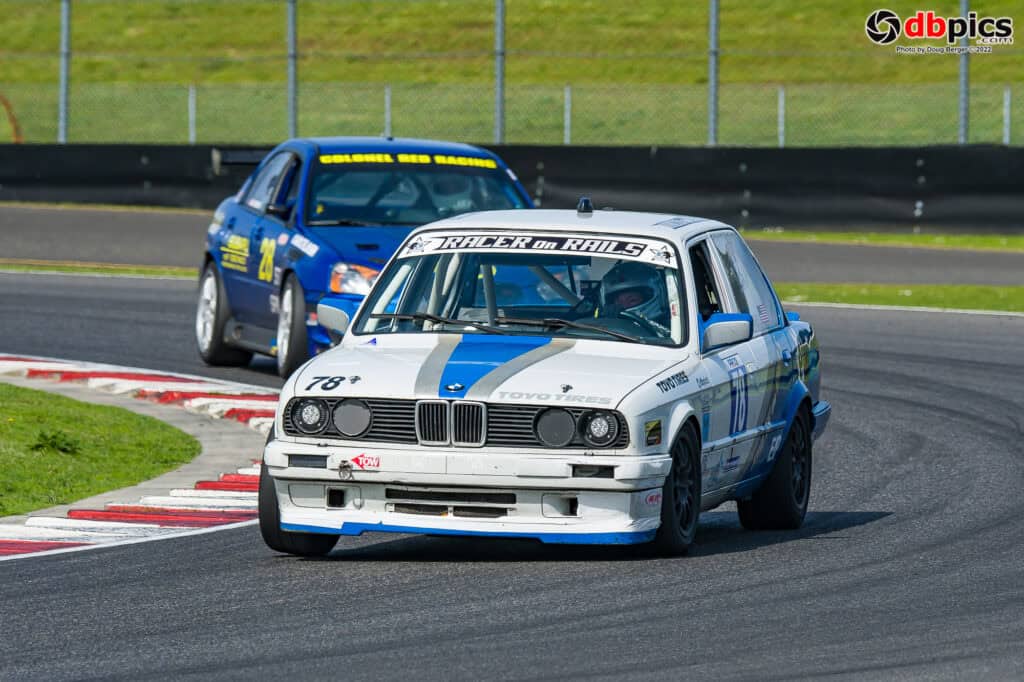
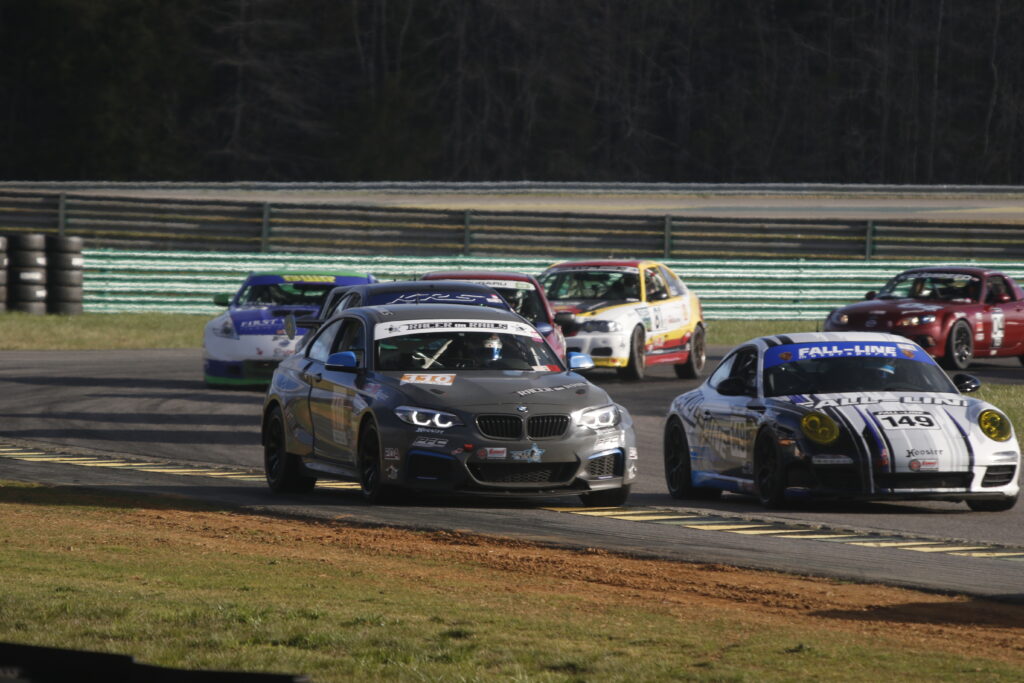
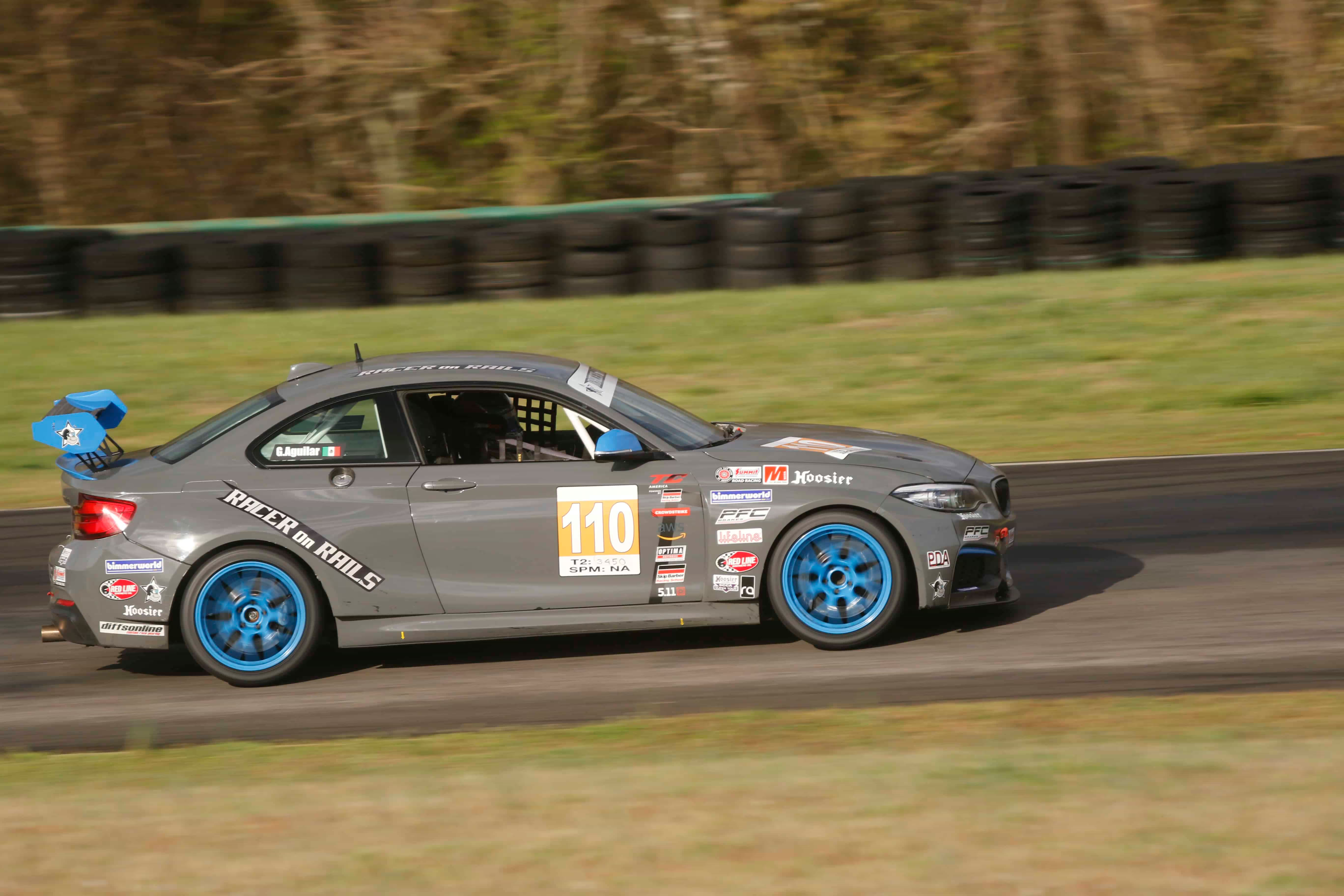
BMW M240iR in Touring 2 class at VIR NASCAR Bend
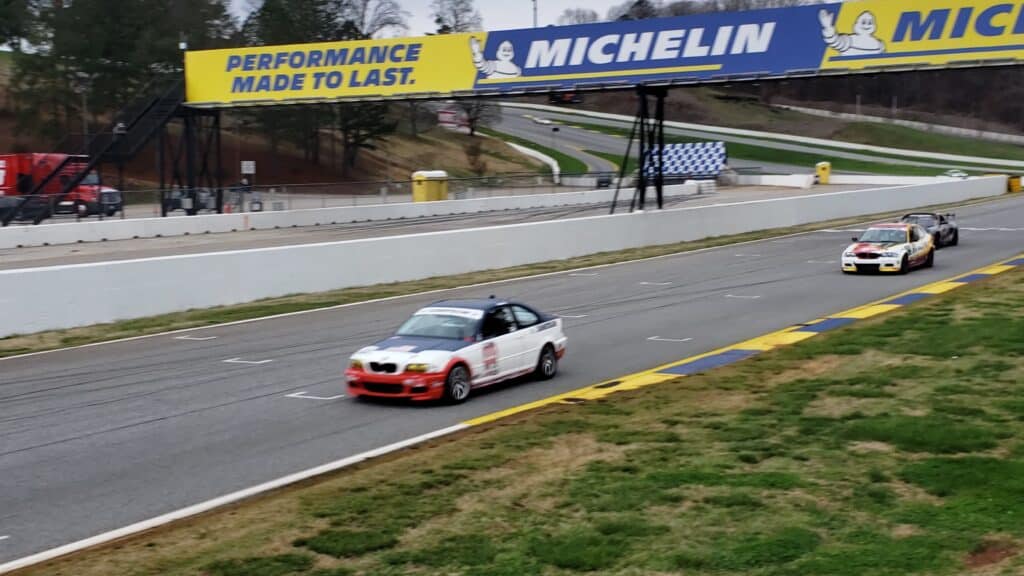
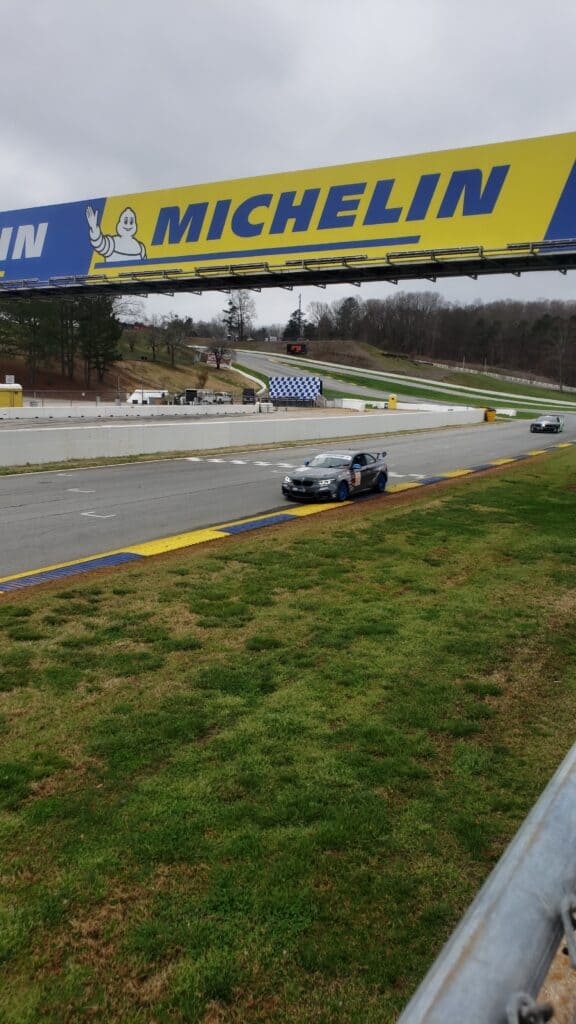
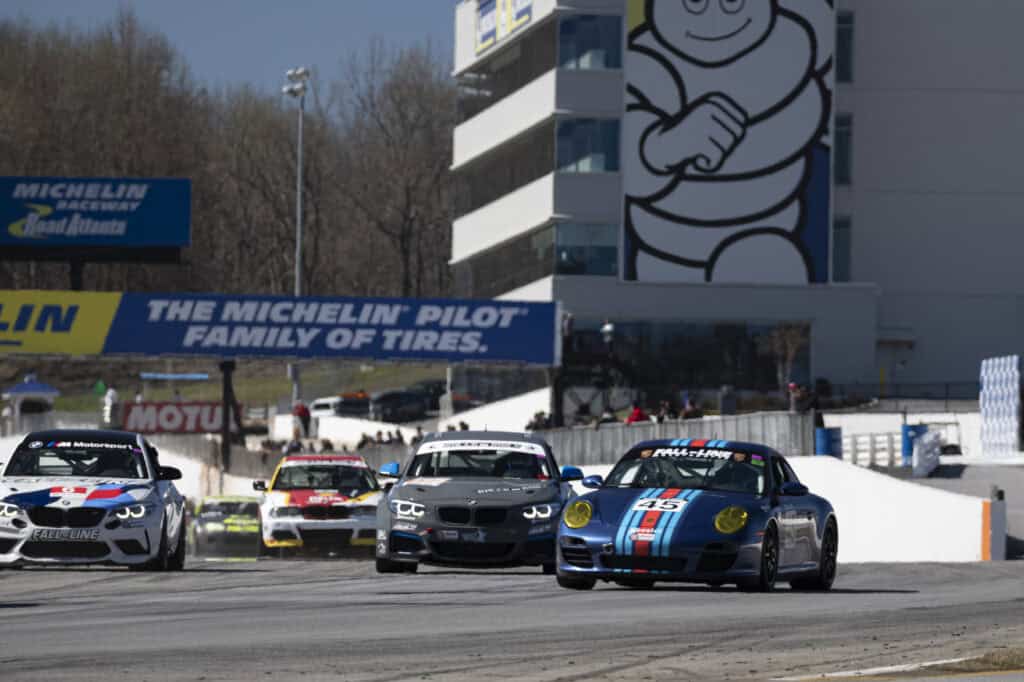
Gama in the Racer on Rails #110 BMW M240iR using all the exit curbing coming out of NASCAR Bend at the start of the Sunday race.

VIR Corner Focus 2: Southbend (exit of the Uphill Esses)

Before there is any controversy, yes – the Uphill Esses (Climbing Esses) are a pretty unique experience. There are few tracks in the world where you are flat out in 5th gear (or 6th gear) and you enter a corner section… without lifting. Thanks to the hours each driver spent in the simulator, after the first few laps in dry conditions, we were all able to take them flat but once you have the right line and rhythm, there’s not much more to them. HOWEVER! What you do on the exit of the Esses is something else.

Check out the Sunday Race 3 video in the M240iR and specifically this video is placed on a flying lap where the car gets light at 129mph and while being flat full throttle. (Note – rewind to start to watch the climb from P5 to P3 in Touring 2 class)

YouTube player

First, yes – it is possible to stay flat through the entire uphill essess complex but doing so compromises the entry into Southbend, of which is a high-speed left hand corner where you’re trying to keep your minimum speed above 90mph.

We found in the simulator that under most conditions, that was the trade-off and instead focused on having the car balanced and turned correctly to brush off minimal speed at Southbend and then carrying that speed into Oak Tree.

VIR Corner Focus 3: Oak Tree

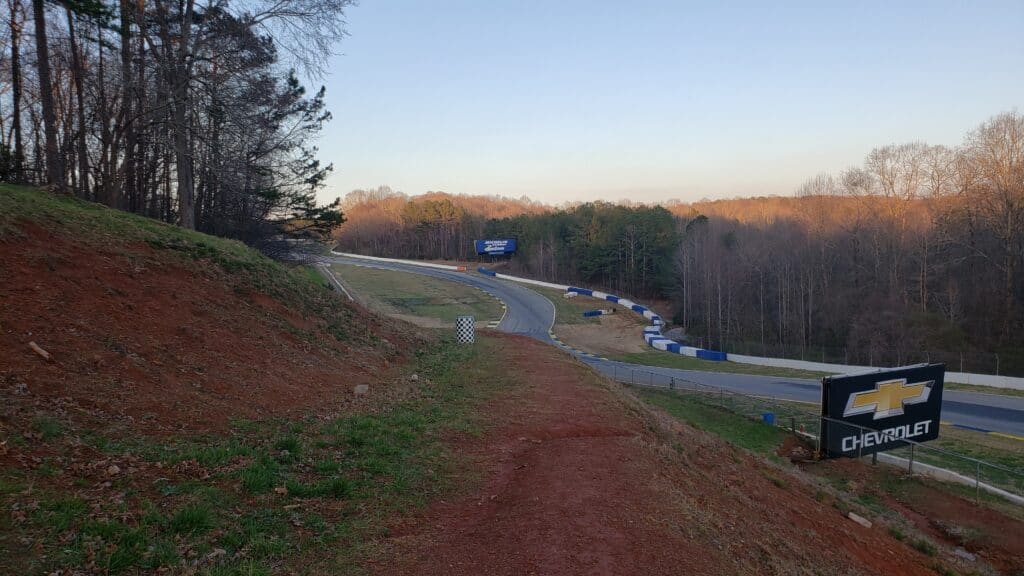
Very much wish we could have been here when Oak Tree had the actual tree still standing. It’s an interesting and challenging corner to begin with but having the tree creating a arch across the corner, would have been majestic. But that’s life and we still enjoyed the scenery and challenge of the corner.

Open wheelers/formula cars showing the line through Oak Tree.

While it’s referred to as a single corner, it’s more like two corners in one and it is *not* a slow speed corner. The entry is best when you can brake into the corner and in a straight line. You can also brake less than you initially think, because the entry is uphill so the grip increases, the further into the corner you go. There is a moment of releasing the brake about mid corner, a focus on getting wide to the left to open up the radius of the corner and then attack the apex with full throttle application right at or before the apex.

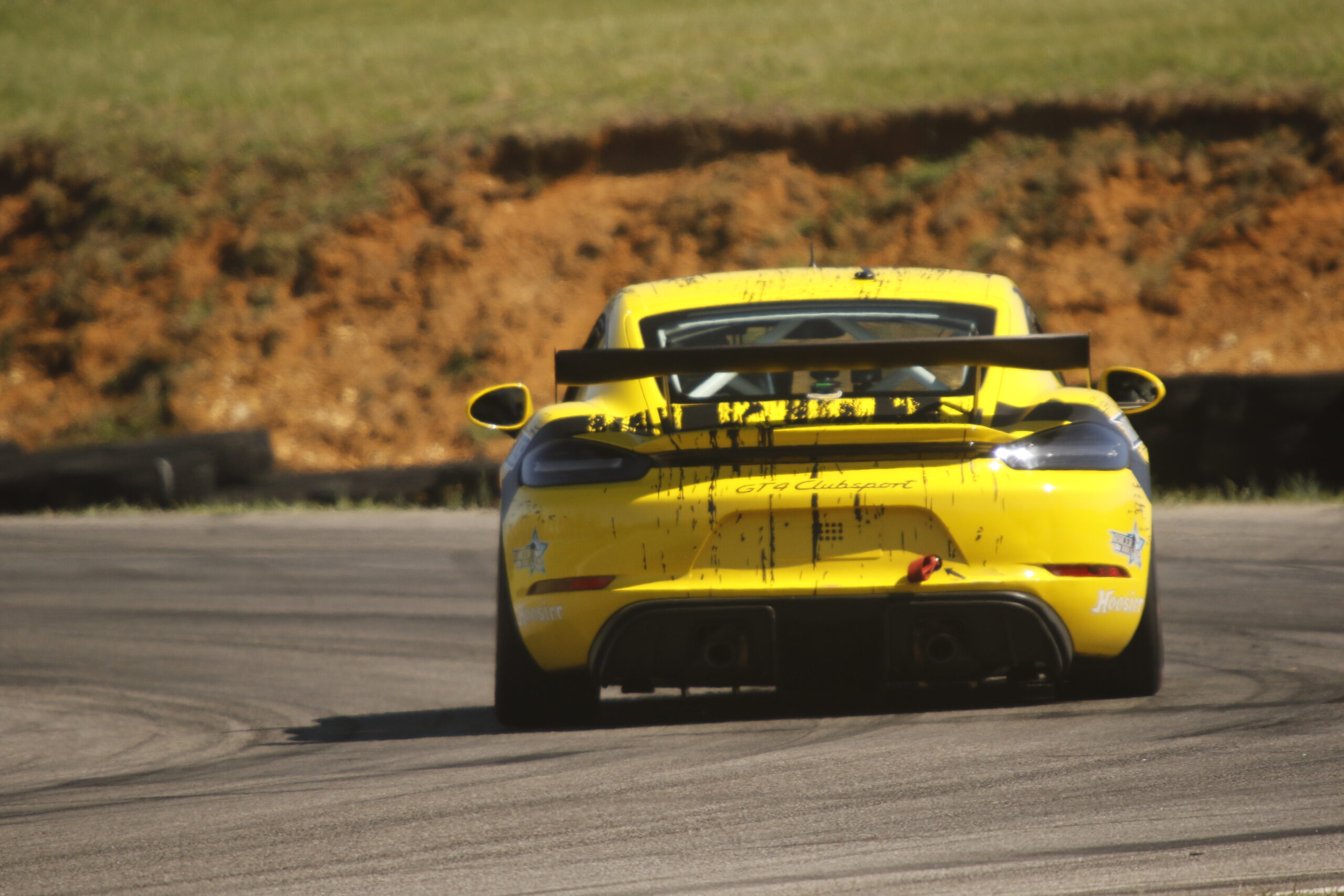
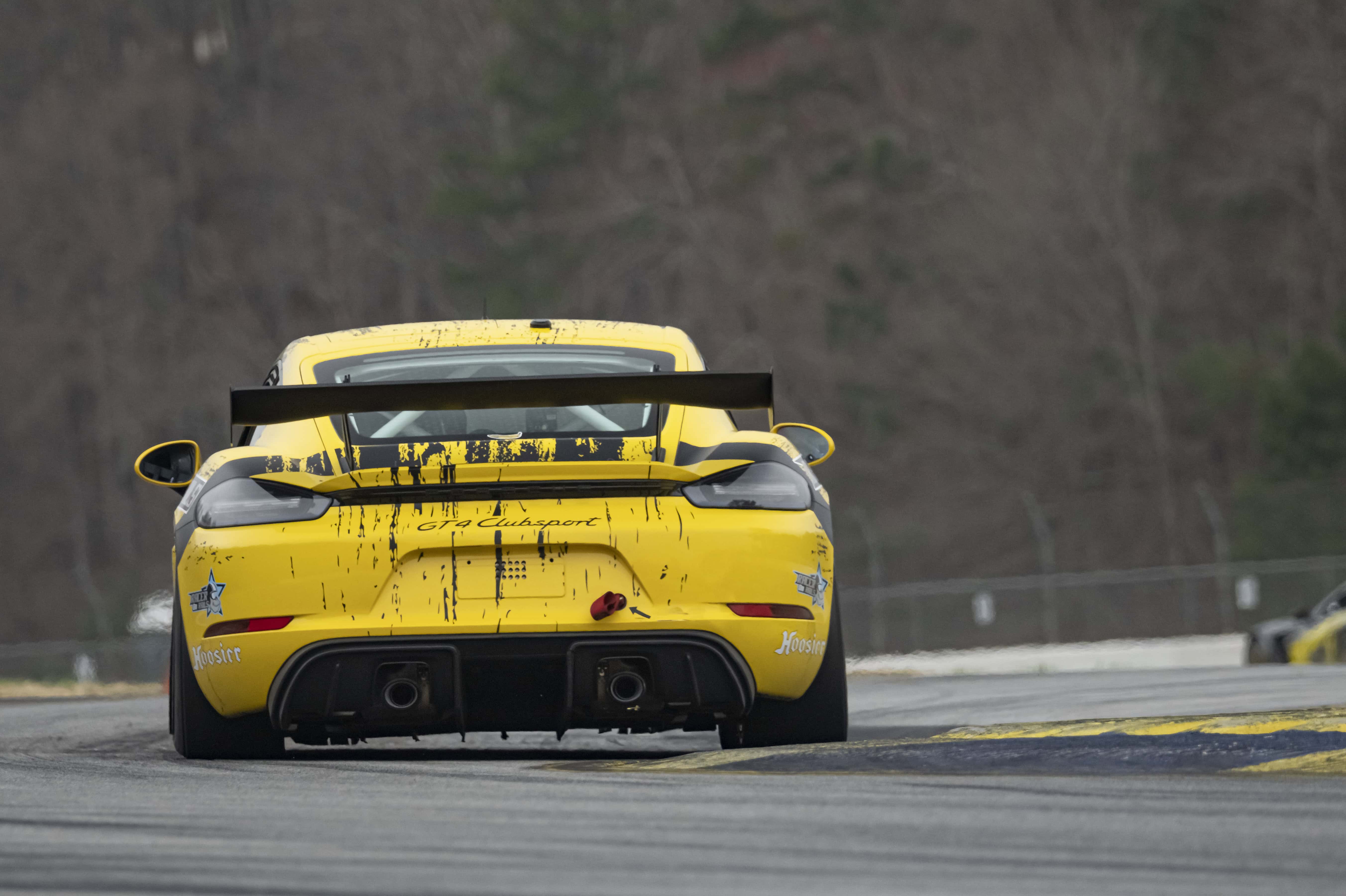
In recent years, VIR has added extra pavement beyond the traditional FIA exit curbs which means more track and thus the ability (and requirement) to use all of that extra track on exit. Oak Tree leads to the longest straight away, which makes it the most important corner to hit well and consistently. In the BMW M240iR, we were hitting in the low 140-142mph without a draft and up to 145mph with a draft. The Porsche Cayman GT4 Clubsport was consistently hitting 150mph+ before braking for “Rollercoaster”, which was indeed, a roller coaster!

Race Results: Gains and Podiums

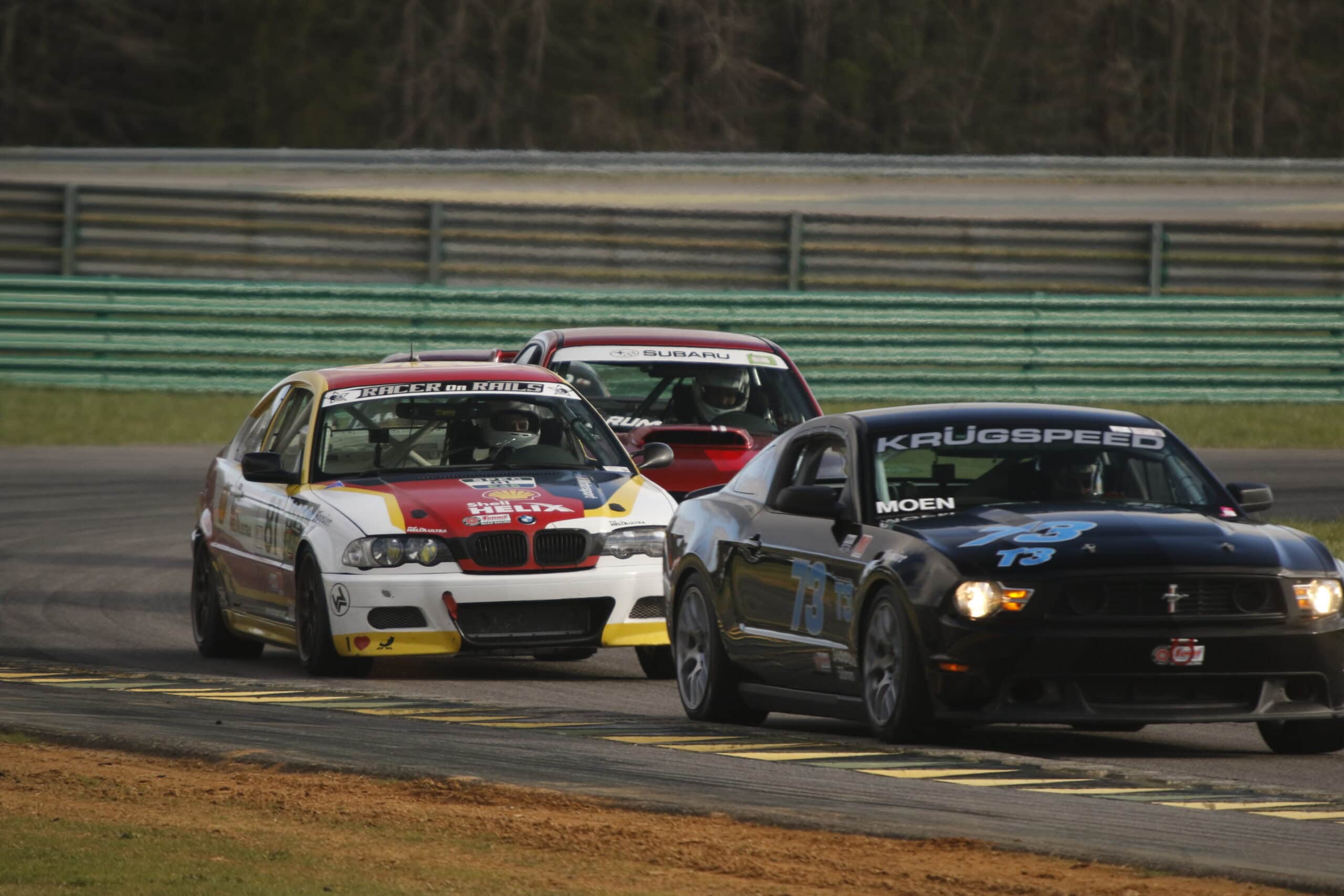
Saturday was a tough day for everyone – full course yellows (not caused by any of our drivers) were rampant, despite dry conditions. There were no gains on personal bests and we all found ourselves battling below the pace we each had demonstrated but struggling to get past cars with better straight line speed.

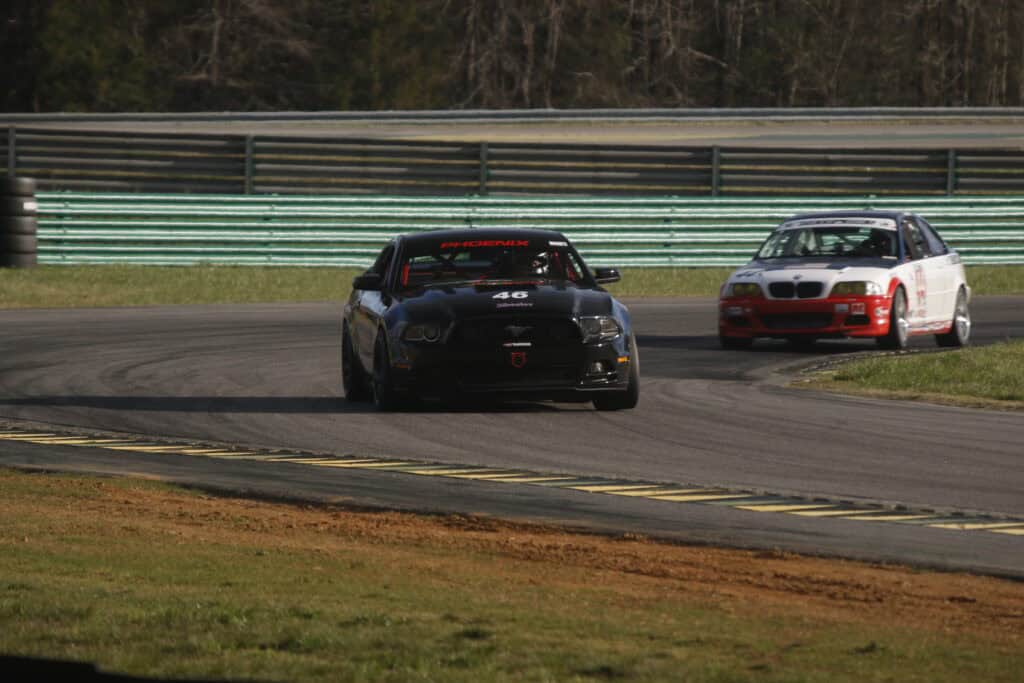
Dave looking for a way past a T3 Mustang at VIR

Sunday, we all hit the reset button and focused on getting solid starts, creating our own track position/space and getting after it.

Touring 3 Race: Dave and Simon both pounced on mistakes by other drivers and picked up a spot individually, putting Simon in P3 and Dave in P7 before a full course yellow came out that eventually ended the race due to an STU car that had gone deep into the tire wall at the end of the back straight away. Driver and car were all okay. Both ended up with their personal best lap times right before the FCY and were it not for the FCY, each felt like they had the rhythm and pace to further improve.

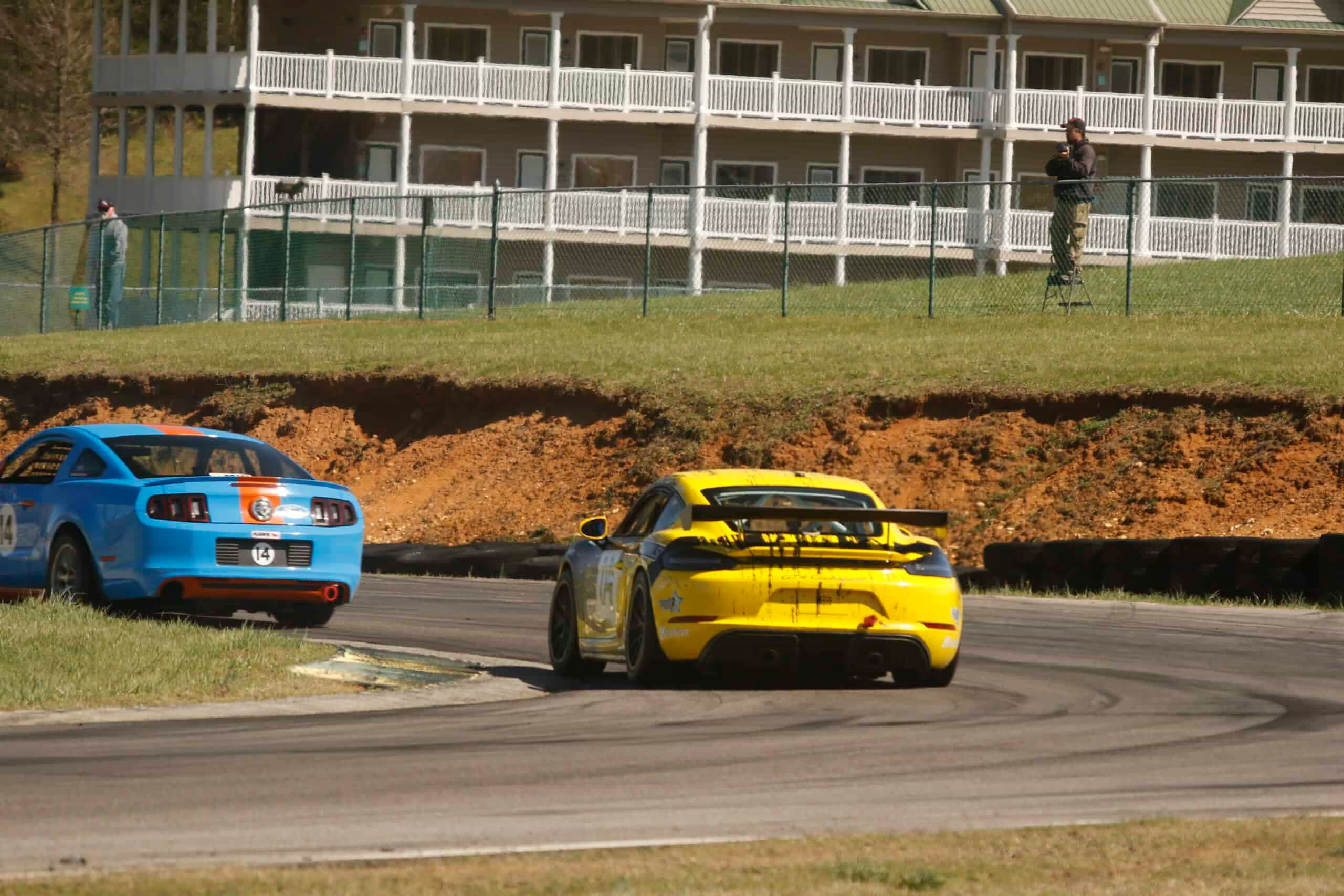
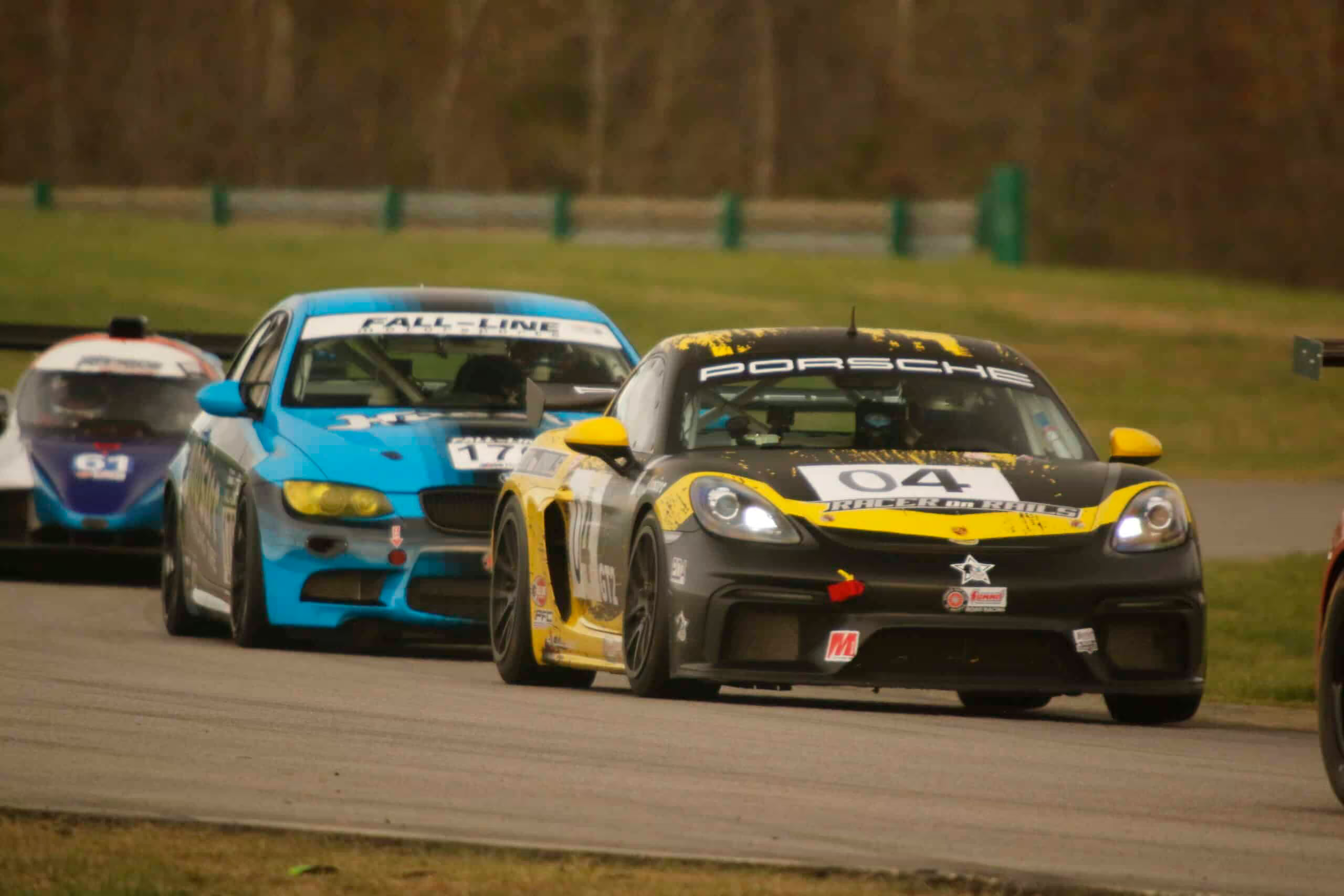
GT2 Race: Ann started in P5 with a mega qualifying effort and quickly jumped into P3 on the first lap with some assertive moves. With a gang of TA2 cars, tube-frame chassis RX7’s and many other ground pounders, her nimble and incredibly impressive under braking, Cayman GT4 Clubsport was under constant attack on the long back and front straight aways but she was able to create distance in the handling sections of the track.

Unfortunately there was a 3 lap long Full Course Yellow which took away the entire gap that she had built up and as soon as the green flag was thrown for the restart, she was back under attack and sitting duck for cars that had nearly a 10mph speed trap advantage.

Ann defended hard but ended up losing two positions by the end to finish in P6 BUT she fired in her fastest lap of the weekend on the final lap of the race.

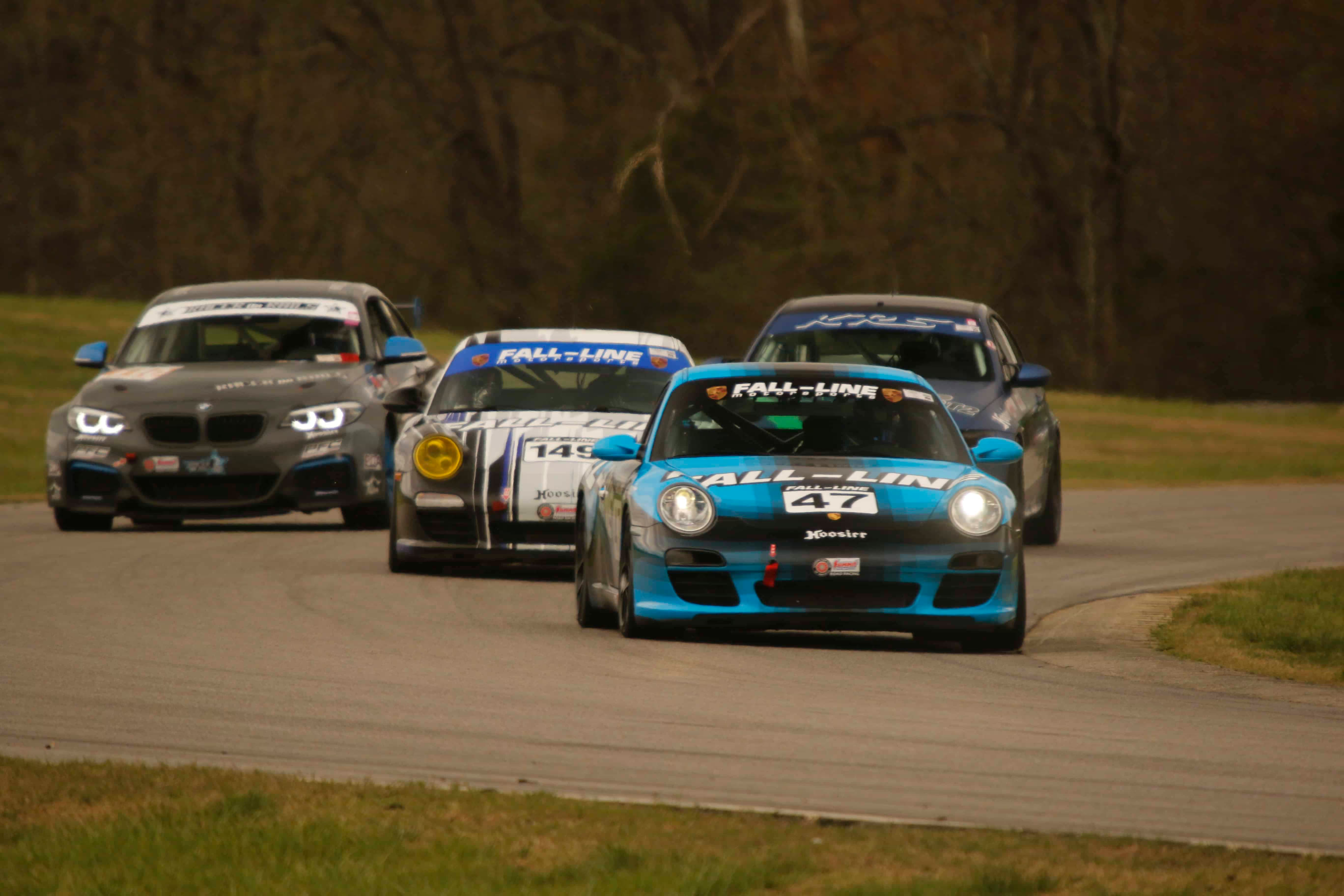
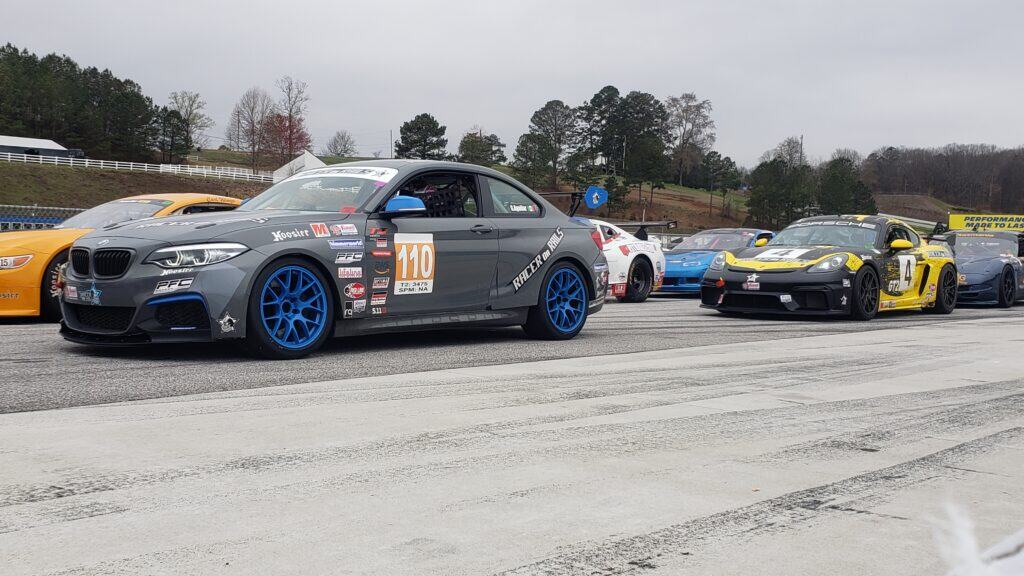
Touring 2 Race: Gama was once again behind the #110 BMW M240iR for this race and faced similar challenges to the previous races – great under braking, handling but lacking 8-10mph to other BMW’s and 10-14mph to the Porsche’s. It became very clear on the Saturday race that if he wasn’t able to keep them behind them before the end of the back straight (coming off of Oak Tree), he’d be stuck behind them for the rest of the race.

The goal was simple – get a solid start (tough with a turbo car), get positions and keep them behind before T13 (Rollercoaster) and then create a gap in the handling sections.

The start was above average but still nothing compared to the naturally aspirated cars. Fortunately, they left a giant gap going into braking for T1 and was able to recover a lost position under braking. The next two laps (switching to first person mode) I was looking for a gap and specifically coming out of the uphill essess because I had noticed the Porsche’s were struggling to carry speed and get a good exit out of Southbend.

In lap 3 of the race, it happened – 997 Porsche got too sideways on the exit and I pounced, getting by him before braking for Oak Tree.

I was getting better exits out of Oak Tree than the Porsche but by about the middle of the straight away, I was a sitting duck so for one lap, I defended like a lion. Right after exiting the corner, I signaled to the Porsche that he’d have to pass me somewhere else on this one lap as I slowly moved from one side of the track to the other so that I could break a draft he might get (not that the Porsche needed it). He got the message and stayed behind.

From then on, I put my head down and carried as much speed as I could through Hog Pen (final corner sequence of the lap) and onto the front straight. I had created just enough of a gap that I didn’t think he could make a credible move into turn 1, so last second, I moved back to the left to brake at normal spot and line. The Porsche ducked in to out-brake me into Turn 1 but the line was WAY too shallow for braking that late and with the additional speed the Porsche’s carry, so he easily washed out and off-track.

From then on, I put my head down and hammered out two new personal best lap times (in the 2:04’s) and was chipping away and making my way through traffic. Aside from a big mistake, I simply didn’t have the straight line speed to compete for better than P3.

Full course yellow came and my gap had been erased. The following 10-12 minutes were some of the most nerve racking of my life – I was sitting duck on the restart so I’d have to pull some magic out again but luckily, the race ended under FCY and for the first time in my life, I was beyond grateful for that result. P3 in Touring 2 class at Virginia International Raceways and against a fleet of Fall Line Porsche’s and BMW’s – what a weekend!

What’s Next?

We’re a little late in publishing this report but after this we make our way back to the Pacific Northwest to start the regional racing season with races at Portland International Raceways, Pacific Raceways and Spokane County Raceway in May.

VIR was an amazing experience overall and great practice and data gathering for when we return in September for the 2022 SCCA Runoffs.

Posted on

Race Report 3: Micheline Raceway Road Atlanta SCCA Hoosier Super Tour

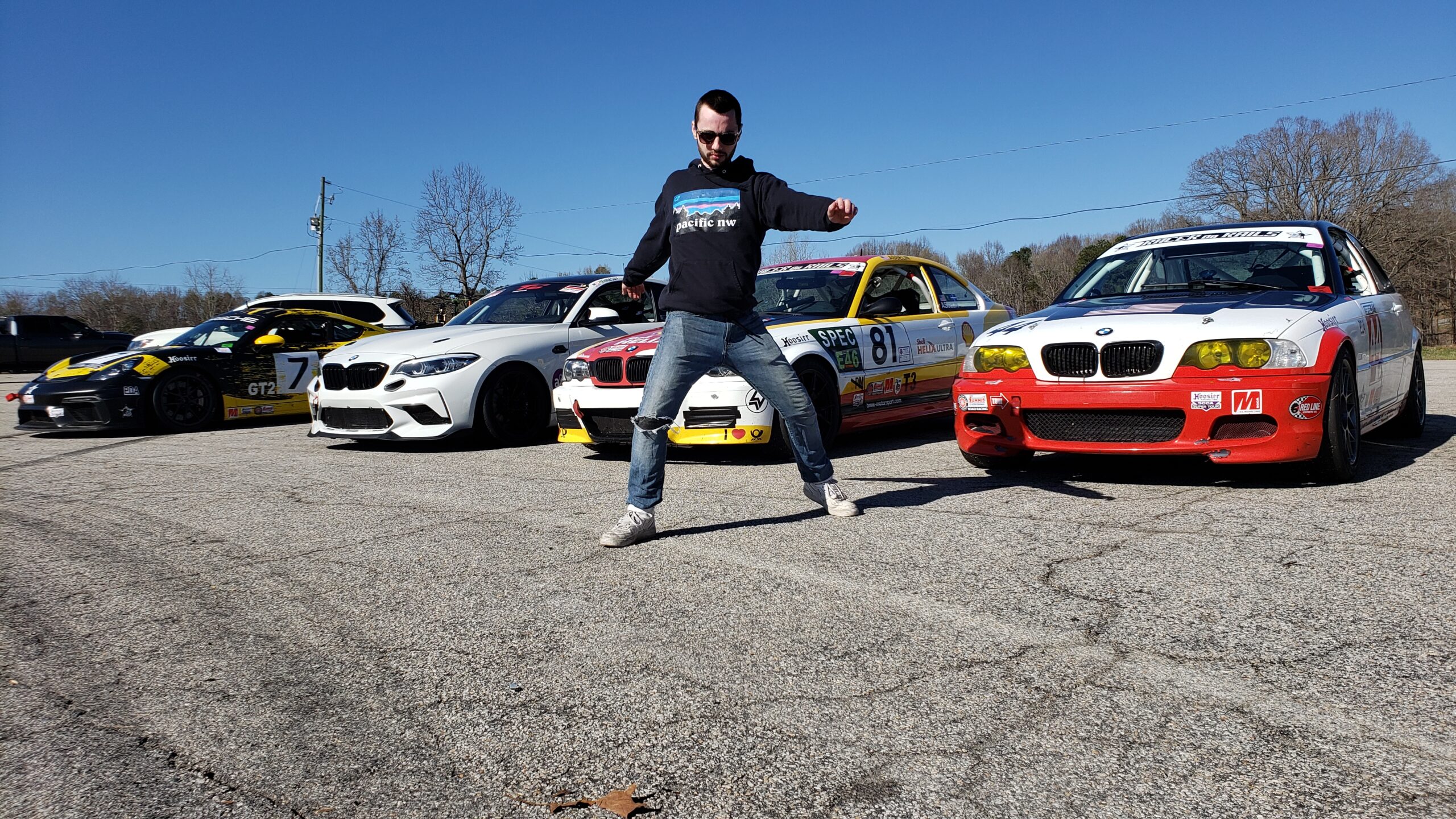
Tyler doing his Road Atlanta Happy Dance

The third stop in our 2022 race schedule and “Winter Sun Bird” trip took us to Michelin Raceway Road Atlanta! Extra emphasis on the quotes re the Sun Bird portion as that was the goal behind the trip – go chase the sun during the winter, warm up and hit some bucket list race tracks.

Want to know how the previous two stops went? Get caught up by checking out our Buttonwillow and Circuit of the Americas Race Reports.

Rolling into the Road Atlanta main paddock on load-in day. Lifetime achievement unlocked!

For the third race in a row, the northern cold decided to chase after us! We landed on Wednesday, got everything staged up and finally got a full day’s worth of testing/practice on Thursday which made a massive difference for each driver in terms of getting up to speed on the track and a baseline direction for a setup.

On Friday we had an AM practice and a first qualifying session but while we were all catching some Z’s overnight, a massive weather system came through the area, dumping rain everywhere and putting on a solid light show. By the time the system had moved through, a deep cold front had settled in and we awoke to 22F air temps and snow flurries throughout the day.

Yes – it was SNOWING throughout the day, coupled with a friendly breeze that included 30-40mph gusts of wind that dropped the windchill into the mid-teens. We still got out there and made progress but that might have been one of the toughest days for drivers and crew to be at the track – bone chilling air temps, super cold track, multiple laps needed to warm up tires and nice and slick grass waiting to give anyone who dares come off the track surface, an express trip into the comfy arms of the walls surrounding the Road Atlanta.

Thoughts on Road Atlanta as a circuit

This was the first time for all but one driver to drive Road Atlanta but that one driver only had a half lap under their belt from the previous experience because of black flag incidents of people going off spectacularly. This ended up being an indicator of things to come for our weekend as well.

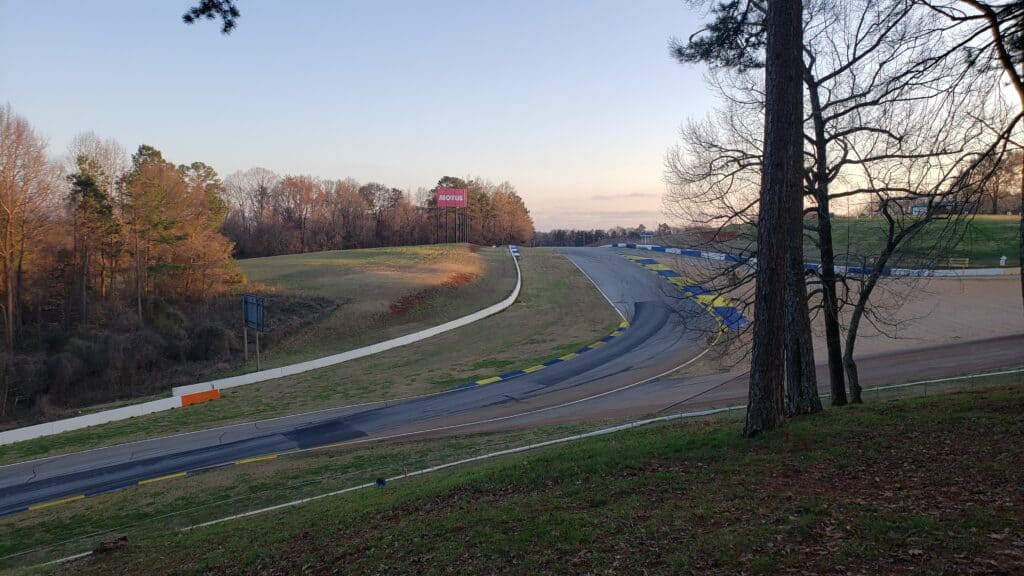
Sunset shot of Turn 5 at Michelin Raceway Road Atlanta – the uphill exit elevation change is MUCH larger than it seems from in-car videos and even this picture.

For those that are from the Pacific Northwest, Road Atlanta has a similar feeling and characteristics to Pacific Raceways – it’s old school. Both tracks were built and opened up in the 1960’s/1970’s and are filled with mostly medium speed to high speed corners. All corners and segments are high commitment with an emphasis on getting into a rhythm and flowing speed into the corner.

The slowest corner at Road Atlanta is Turn 7 with a minimum speed in our cars of around 47-50mph and multiple corners with minimum speeds of 70 and 90mph at the apexes.

The back straight from Turn 7 to Turn 10a is about as long as front straight away of Pacific Raceways – pretty dang near terminal velocity for many cars.

Looking back counter-course to Turns 10a and 10b at the end of the back straight away where the goal is to brake as late as possible while still clipping the apex curbs hard and getting to full throttle as soon as possible past the 10a apex.

While each driver had at least 10 hours of simulator preparation and training before the weekend, everyone had at least a little shock when we finally got on track. Here are a few comments from the drivers after the first couple of sessions:

  • The elevation changes from entering and exiting the esses are real and much more dramatic than it seems from in-car video.
Looking back at the entry of the esses, counter-course. Picture is taken from the hillside on driver’s right and about level elevation to the entry of the esses.
  • Use as much of the exit curbing of Turn 5 is critical but if there’s gravel or the painted surfaces are wet, forget about it. The car is already barely holding on as it goes through bumps and any extra steering input or unanticipated wheel spin and the car can come around real quick.
  • The elevation drop for braking at T10a is real – it takes a few laps to gather the confidence to brake where you can in the simulator but that compression helps slow the car down.
  • The hill at Turn 11 and more importantly, the downhill run from it afterwards is STEEP! Like very, very steep. As you crest over the hill, there is nothing to see but the bridge and the sky – is a similar feeling to the bypass or the crow’s nest at Thunderhill but you stay full throttle flat the whole time and are in 5th gear shortly after the peak.
  • Staying flat at Turn 12 is ‘easy’ in the simulator but not so much in real life. Some drivers got near staying flat throughout the weekend but with it being the first time racing here, slick grass conditions and MANY cars that met their ends on the front straight (and ruined multiple sessions and races), we decided to optimize for completing the weekend and having all the cars in one piece.
Dave and Simon bombing through Start/Finish in their Spec E46’s in Touring 3.

A weekend of massive breakthroughs and results!

The goals for these race weekends have been simple: 1. Have fun and 2. Become better drivers.

We’re firm believers in that when we focus on the improvement process and having fun, the results will come on their own and that belief continues to pay dividends.

Spec E46’s in Touring 3 Class

Both Dave and Simon put in 10+ hours of simulator training before weekend so from the start, they knew where they were going but with the conditions being extremely cold on qualifying day 2 and race 1, the biggest challenge for both was trusting that the car could do what they’ve done in the simulator and seen some of the super talented drivers in the Southeast do on race weekends.

Simon took the approach of picking out one single corner and with the help of Ray Phillips, sending it harder than he had sent it before and more than he felt like the car could do but trusting in the guidance from Ray and that the car could handle it. The result? During Race 1, Simon sent it into Turn 5 faster than he had done in any session and was so committed that he stayed flat through the whole exit and even through an almost opposite lock correction AND that ended up being his best lap time of the race.

From then on, he built on that confidence to establish a new normal, made some moves and ended up with his first race win ever and at Road Atlanta in an SCCA Super Hoosier Tour race! WOW!!!

Simon driving through Start/Finish on the final lap of Race 1 to claim his first race win at Road Atlanta!

Dave had been chipping away at rebuilding his pace after the rollover at Buttonwillow to start the season. It might seem like a simple thing – you have a major incident, no major injuries – just jump right back in right? Well that’s exactly what Dave did but even then, it still takes some time to work through the mental blockers of simply sending it and trusting the car and track will hold.

On Sunday afternoon, the biggest breakthrough came with Seth Thomas on the radio coaching him through traffic and making moves. Unfortunately Dave’s battery was low and when we finally were released from grid, the car wouldn’t fire – so we had to push start his car which meant he’d start the race at the back of the entire field which isn’t great but that might have been the extra fuel for letting things go – what was there to lose?

With Seth’s help, Dave turned it up, made pass after pass, improved his personal best lap time by nearly 3 seconds and finished in P2 after Simon had contact during a FCY restart and did a precautionary drive through the hot pits to make sure the car was safe to continue racing.

Simon and Dave making up a Racer on Rails double podium on Sunday!

To top it all off, we found out after the weekend that P3 on the Saturday race was disqualified so Dave ended up with two podium finishes at Road Atlanta!

Porsche Cayman GT4 Clubsport in GT2 Class

Ann came into the weekend looking to build on the gains she made at Circuit of the Americas and did she ever! Similar to Dave and Simon, Ann had multiple mini moments of simply letting go, trusting the car and driving the pee brains out of her car.

Ann’s Porsche Cayman GT4 Clubsport exiting Turn 3, squatting and putting down the power! Chris Green | ChrisGreenPhoto.com

In each session she found more and more pace. Saturday’s Race 1 looked like it would be the big breakthrough but traffic hurt her start and a high horsepower Corvette got around her which ended up being nearly impossible to get around once it got in straight line. Further, the race had 3 lengthy full course yellows and in the end, there was 5-6 actual flying laps in the race.

For Race 2 on Sunday, the air had warmed up and the races had gone green flag for most racing laps and Ann turned it on. Per Ann, she let her car do her thing and switched from trying to force the car to do things and instead let her free. Her personal best lap time dropped by nearly 2 seconds from the prior day, moved up 4 positions into P9 overall, P5 in GT2 and she had the pace for a P3. At the rate Ann is developing, she’s going to need to start making room in her bags for souvenirs.

BMW M240iR running in Touring 2

This was the second race weekend with the M240iR but the first knowing ahead of time that this would be the car. I (Gama) put in several hours of work in the simulator before the weekend and had a good sense of how the car would handle. At the end of the test day, I got a 4-5 window of traffic free laps to establish a consistent pace and on the prior weekend’s race tires. The pace looked good and we knew there was a bit more on the table with fresh tires and maybe a draft here and there. The big question was the track conditions.

Friday AM we scrubbed in a new set of tires so that they were prime for Qualy 1 on Friday afternoon. The whole day we were watching the weather and knew showers were in the order. Apparently the locals or regulars knew something was up because a race broke out on the out-lap and we completed one flying lap. I ended up backing up to give me space for a lap and potential second one but as we were halfway through the second flying lap (and I was almost a second up on the first lap), black flag came out and back to the hotpits we went. We ended up being released and I went out but the track had too much rain on it and was considerably slower (braking for 10a to test the track limits was “interesting”).

Gama testing the limits of the exit curbs of Turn 12

The Touring 2 field was small and there was a split start between the Touring cars and the ST cars so the net impact was negligible but it was still disappointing to not be able to put together a proper flying lap.

On Saturday, we were the last race group and while the snow flurries had cleared, the cold clear winter air started cooling down and it was a brisk 30F by the race start. It was so cold that the M2CS in P3 of Touring 2 spun right as we exited pit lane and went head first into the wall. Luckily the driver and car were okay and able to make the race but a lap down.

The two Porsche’s in P1 and P2 were well prepared and optimized for Touring 2 class as we saw right away their ability to stretch legs in 4th gear and pull away. It was clear that at the very best we could hope to stick close enough to catch a bit of draft and capitalize on a mistake if it were to come up. The race was plagued with FCY’s and only a couple laps after a restart, a Honda Civic lost it on the exit of T12 and made contact with the walls, ending the race under a black flag all.

Gama and Ann patiently waiting to be let loose at pre-grid during the Thursday test day.

On Sunday we got warmer weather and thankfully, many more racing laps. Started P3 and held P3 at the start with little contention but once again the Porsche’s ran away and there wasn’t much pressure from behind so the focus was on putting down consistent and fast laps. A few laps in, a FCY that last only 3 laps.

On the restart, my goal was to stick with the Porsche’s through the first sector where we had a better shot and be on their heels for the long back straight but as I got a jump on the Cayman, I had to move to the left to avoid tagging his rear. In doing so, I left a lane open on the inside of which the BMW M2CS pounced on and while I quickly reacted and moved to cover the lane, he had already established overlap or close enough to it that I had to concede the space.

Restart 1 of the Sunday race with the BMW M2 CS getting a run and the inside line through Turn 1. Chris Green | ChrisGreenPhoto.com

We went side by side all the way up to Turn 3 but he had the inside and it’s near impossible to go 2-wide into the esses with any speed so I gave up the position.

The rest of the race was a similar story to COTA where I was able to stick with the M2CS, eating up most or all of the gaps in the corners but the M2 having just enough additional straight line speed to pull away.

There was a point with a couple laps to go where we were catching lapped traffic and I saw the opportunity to box him in on the exit of Turn 10a behind the lapped car and impact his ability to accelerate. The move worked but the M2 still had the low end torque to squeeze through the two cars and that was the end of the race – P4 and less than a second away from P3.

Gama on the bumper of the BMW M2CS in the #110 Racer on Rails 2015 BMW M240iR at the finish of Sunday’s Race 2.

The written description not enough? Watch the whole race!

YouTube player

All in all, a great weekend for the Racer on Rails Team as the cars ran well all weekend, drivers improved and we took home a collection of hardware!

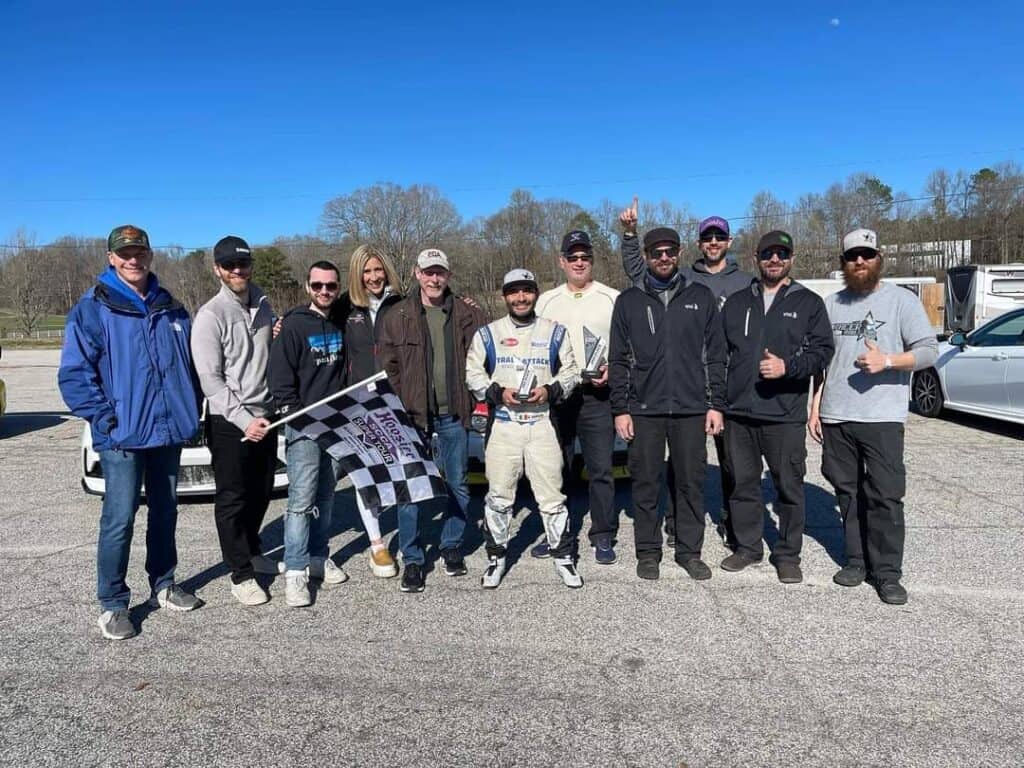
Racer on Rails team signing off from Road Atlanta! From left to right: Seth Thomas, Simon Asselin, Tyler Campbell, Ann Doherty, Ray Phillips, Gama Aguilar, Dave Orem, Bryce Allen, Memo Calderon, Jordan Allen, Reid Morris.

Our next stop takes us to Virginia International Raceways on April 7 – 10, 2022. Can’t wait!

Posted on

Race Report 1: Buttonwillow SCCA US Majors January 14 – 16 2022

Fully loaded team for SCCA weekend at Buttonwillow

2022 is going to be a busy and exciting race schedule for the Racer on Rails crew and the first stop was this past weekend at Buttonwillow Raceway Park.

Note, originally we were supposed to be at Sebring International Raceways for the SCCA Hoosier Super Tour but the beautiful white Christmas we had in the PNW overstayed its welcome and by the time we need to have the trucks on the road to the SE, all the passes out of WA were closed due to blizzard conditions and the alternate route going down the west coast and across the SW was riddled with freezing or snow conditions in New Mexico, Texas and even parts of Alabama.

So with about 10 days’ notice, we made the change to instead to go sunny southern California where last year, we attended this same race but it was held at Autoclub Motor Speedway in Fontana, CA.

The Team

For the first race, we had three Spec E46’s running in Touring 3 (T3) trim and one Porsche Cayman GT4 Clubsport running in GT2 class.

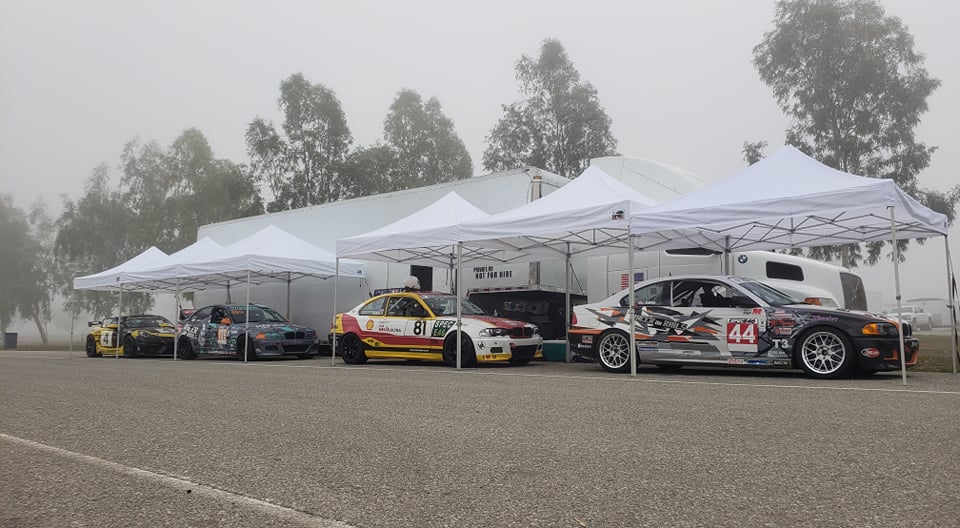
Racer on Rails drivers - 3 Spec E46's and one Porsche Cayman GT4 Clubsport
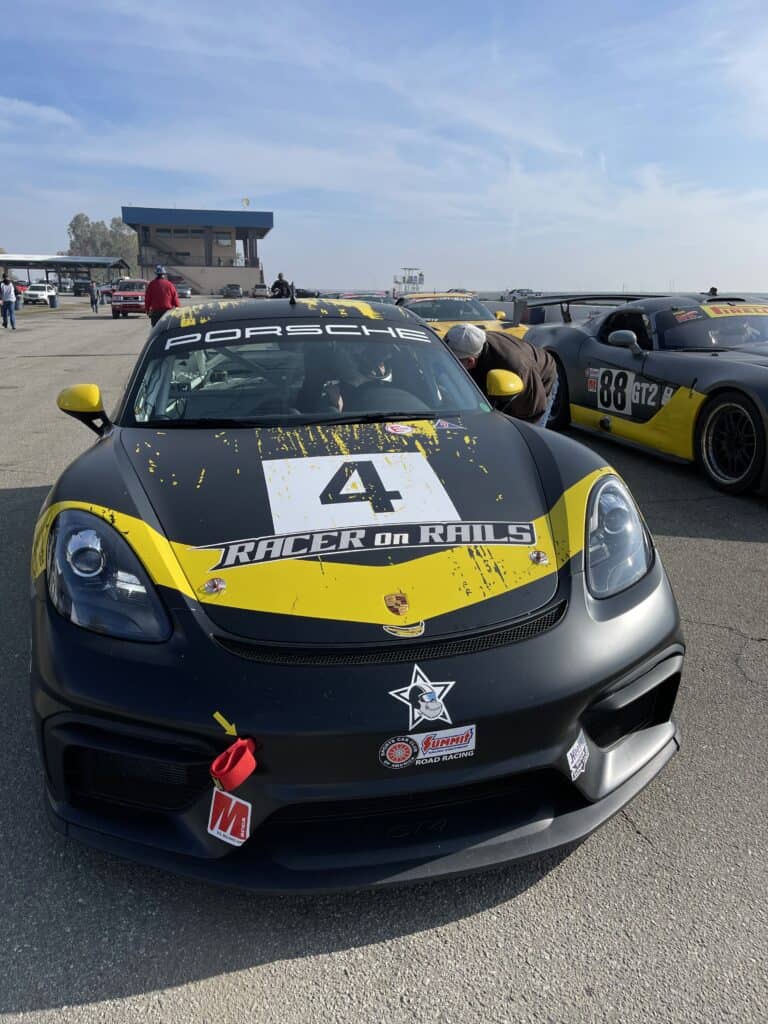
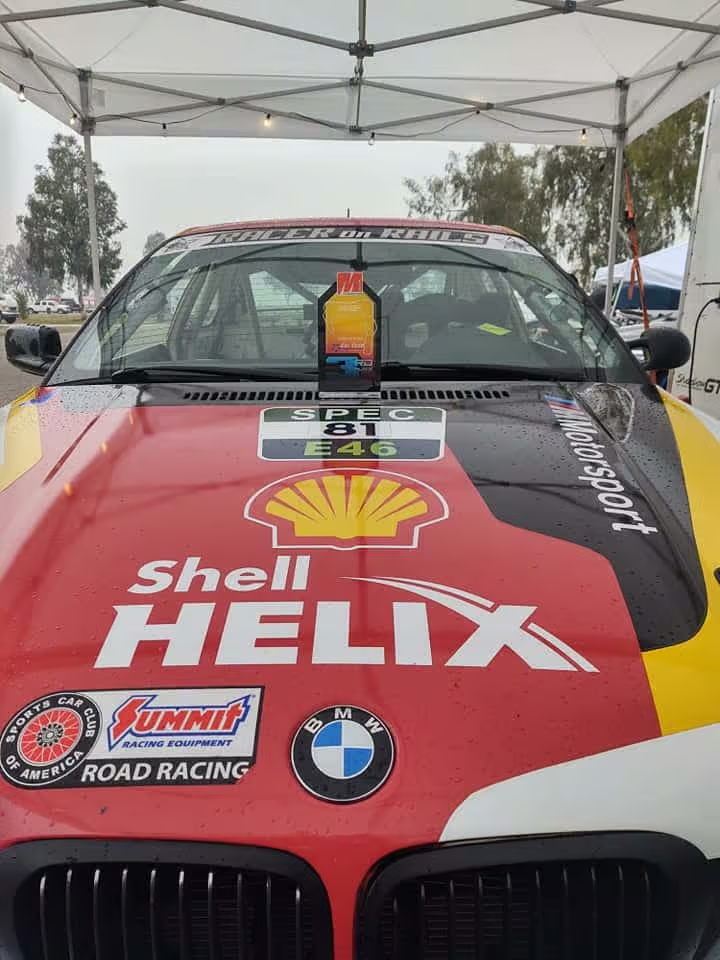
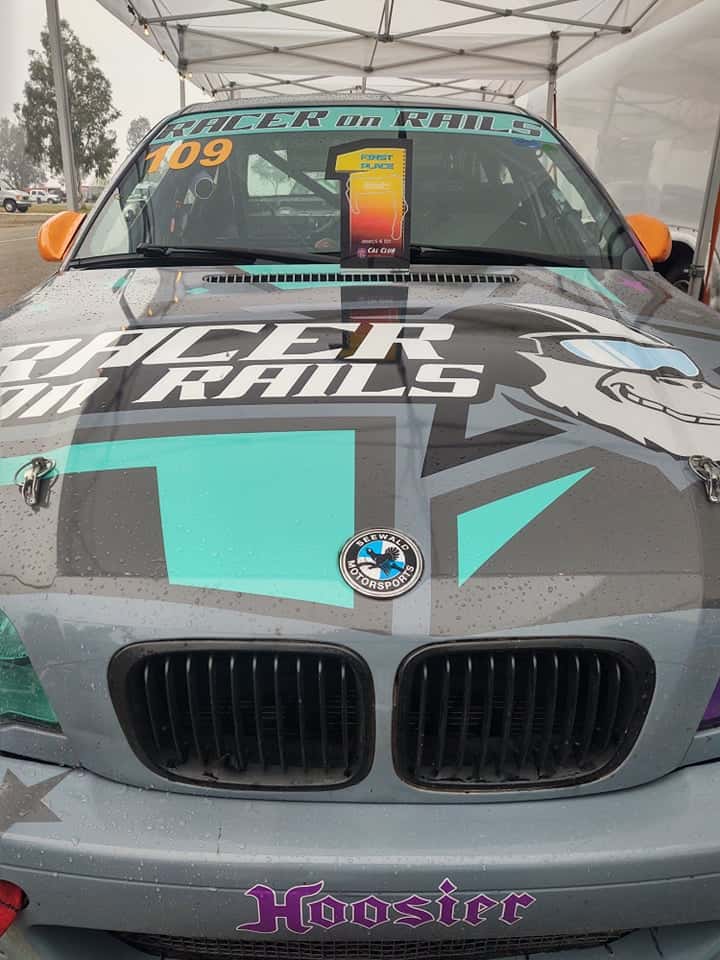
#44 Dave Orem, #81 Simon Asselin, #109 Gama Aguilar and #4 Ann Doherty

The normal crew of Jordan, Bryce and Gama were on hand but this was also the first official race weekend with our new Motorsports Director, Memo Calderon and our service advisor, Reid Morris.

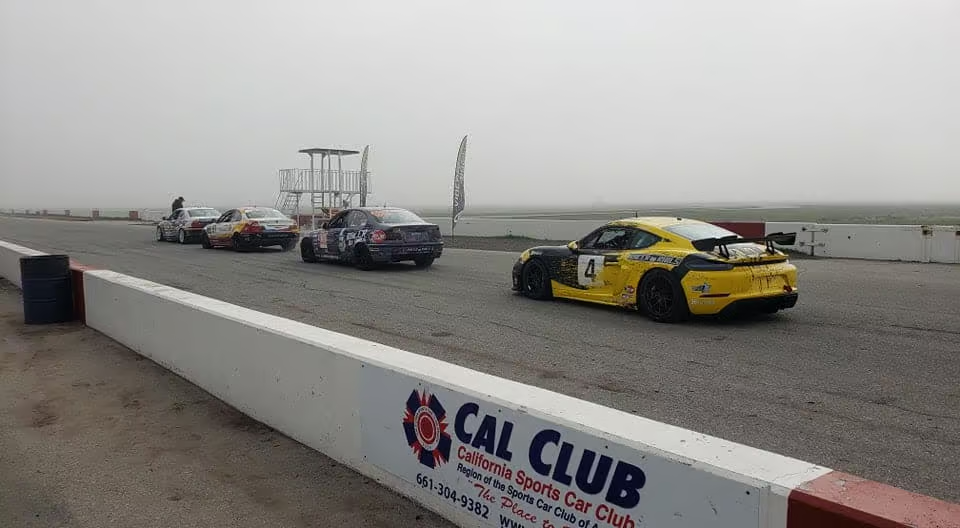
The Fog

Not going to mince words here, it was a tough weekend and mostly due to dense fog that rolled in each night and resulted in each morning’s scheduled run groups to be postponed due to low visibility conditions.  One of the locals at one of the on-site race shops with a retail space mentioned that it had been close to 27 years since they had seen such thick fog and turns out that the volcano eruption in Tonga might have contributed to the fog conditions.

In the end, each day we didn’t get started on-track until 11am – 12noon. On the Friday test day, the run groups ran per the schedule as the organizer simply picked up when we started and had the 3 run groups doing 20 minute sessions each hour, until 5pm.

Racer on Rails cars ready to go on-track but under a fog hold on the Friday test day

Thank You Safety Equipment!

There is never a shortage of reasons to not skimp on safety equipment choices, design and preventative maintenance as we never plan on having an issue where safety equipment is needed but we’re always glad when it’s there and it works.

We had two incidents on the test day:

  1. Failed front-right lower ball joint in the control arm (SE46): The #109 SE36 running in T3 trim got a near complete overhaul prior to the 2021 SCCA Runoffs at Indy, which included brand new lower control arms. Unfortunately it got taken out on lap 1 of the race which resulted in a front end impact with at least energy going through the suspension components but not a direct hit or contact. All in, the control arm and lower ball joint had 1-1.5 hours of run time prior to this weekend. On the very first session when the fog broke, lap 2, braking for Sunset corner (the last corner before s/f), the inner lower ball joint failed and the car went plowing through the corner and came to a stand still on the exit of the corner. On top of needing to make repairs to get the car back up and running, it also caused a black flag which ended running for everyone else.
  2. Rollover on the exit of the kink before Phil Hill: With the fog and being in mid-January, the track was not just green each morning from fog moisture but also stone cold. It was 38F on Friday morning and barely broke 50F once the fog cleared for the afternoon. This meant really tough conditions in terms of finding grip and in the 3rd session of the test day, the #44 took the same line as in previous laps with maybe a tiny bit more steering angle, hit the curb of the kink like normal but this time it upset the car a tad bit too much and the backend came around. The car slid off-track and when it hit the dirt, which with the moisture and temperatures was more like mud, the wheels hooked into the dirt and the car barrel rolled. We’ll have another post in the future to dissect and share how the cage and all the safety equipment faired.

Making Lemonade Out of Lemons

New track, very limited run time and low grip conditions – what do you do? Make the most of it and work on the learning process! Expectations for big results are low, so instead focus on developing and that’s exactly what each driver did, with the help of driver coaches Seth Thomas and Ray Phillips!

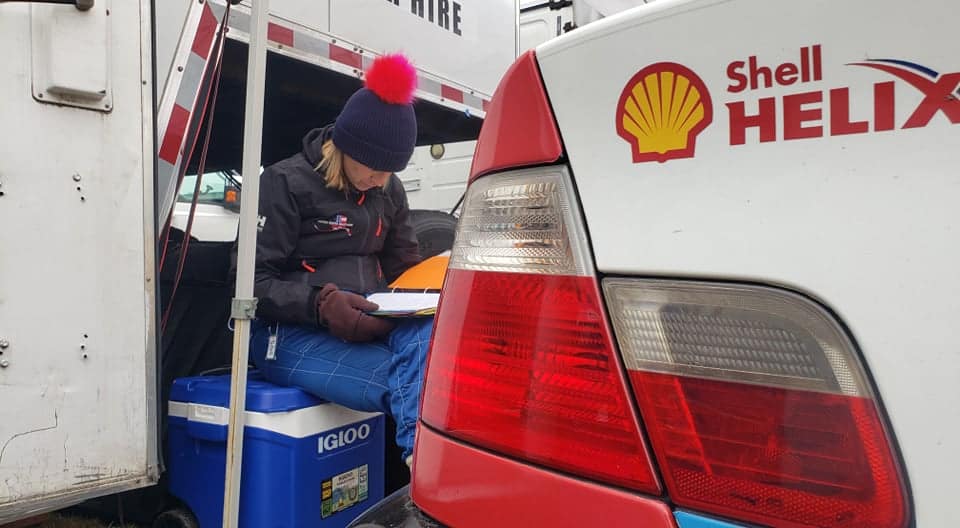
Porsche Cayman GT4 Clubsport driver, Ann Doherty, studying the track notes and areas of improvement.
Ann D studying her track notes and mentally preparing for the next time on-track.

Through the coaching from Seth and Ray, each driver made progress across the limited running and culminated in a podium position for each driver! Below are some areas that were focused on throughout the weekend:

  • Squaring off corners better in low grip/wet conditions and to setup exit of the following straights
  • Timing of transitions from brake to gas and vice versa
  • Establishing a connection or translation layer between what driving Buttonwillow in the simulator felt like relative to real life
  • Mentality to have when going into a race with changing conditions (both getting worse and getting better)
  • How to explore grip when conditions are improving
Ray Phillips doing a quick debrief after a session while in post-session tech.

Moving forward to COTA in February

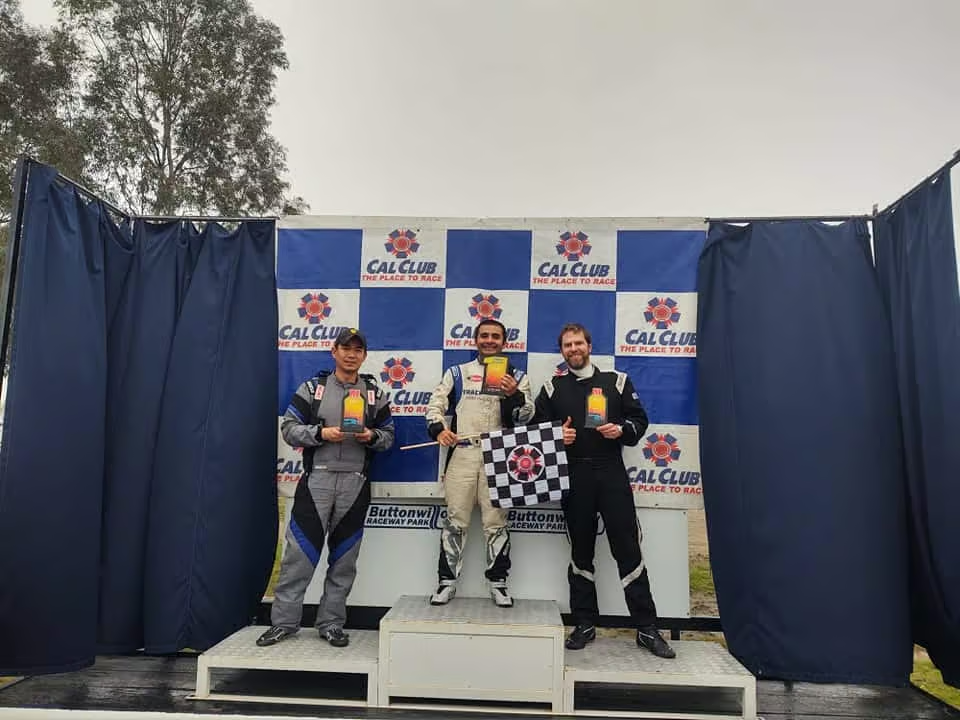
So we came out of Buttonwillow with 3 of the 4 cars running, 4 trophies, 1 race win, 5+ second improvements in dry running lap times from Friday afternoon to Sunday afternoon, a new T3 track record for Buttonwillow CW14 configuration with a 1:55.376 and ready for the next round at Circuit of the Americas February 4 – 6, 2022.

  • Simon made gains across both races and had an epic battle with a T3 Porsche Boxer, having led a good part of Race 2
  • Ann made a massive step from Saturday to Sunday, dropping 8 seconds in one day and snagging two podium positions in GT2
  • Dave had limited running due to the incident but was fully healthy after being checked out by medics and will be back on track for COTA
  • Gama won race 1, broke the track record by multiple seconds and was leading race 2 (and in a battle with an STU car) but the coolant expansion tank failed, resulting in an overheating engine which forced him to retire the race but not before improving on the track record

With one new track for most of our drivers under our belt, we can adjust the preparation in the simulator and the development plans for the test day and each of the on-track race sessions.

Thanks to the team, Ann, Dave, Simon, Ray, Seth and everyone from the Cal Club who made this weekend possible and making the most out of a pretty tough first race of the year.

Stay tuned for more of our adventures in 2022!

Posted on

Track Walk: Portland International Raceways

In a couple weekends, we’re headed back to Portland International Raceways and the first time I’ll get to drive the track for more than one session (in real life) this year and since I was on the Speed Secrets Podcast, earlier in the spring.  I got some live coaching from Ross Bentley and have been excited to implement the tips I heard.  Check out the podcast episode here and subscribe – it’s an awesome podcast with a wide variety of guests and every time, I learn a ton.

So let’s take a lap around the track and go through each sector as defined by the sectors on Track Attack.  Below we’ll be using illustrations from real data from a pair of front-running “spec” racing class cars: my PRO3 and Will Schrader’s Spec Miata.  Both are considered low-power momentum cars but there is enough power and weight difference you’ll see different things happening.

If you are a Spec Miata or PRO3 driver in the Pacific Northwest (or have similar cars), you can request to join the respective teams on Track Attack and get access to the session data that we’re using in these examples. (Link to PRO3 data share team and Northwest Spec Miata Tour)

We’ve broken up PIR w/chicane into 4 sectors.  Each sector is a combination of corners and are split halfway through a ‘straight away’.

Elevation change: None

PIR is like the Lime Rock Park of the west coast.  In the chicane configuration, there are 7 right hand turns, compared to 2.5 left hand turns.  But unlike Lime Rock, the elevation change is near zero.  Check out this video where the data overlay shows the elevation change – there is just under 10 feet of total elevation change.

YouTube player

No real elevation change but there are still some tricks on banking that the track holds.

Segment 1: The festival chicane

The first segment starts at the start/finish line, of which the speed that is carried before the first braking zone is determined heavily by the exit out of T12 on the previous lap and if you might have caught a draft down the front straight.

Braking for T1 will depend on the car and whether its a qualifying lap or a race lap.  In a PRO3 car and a qualifying lap, you can hit the brakes hard right after passing the 400 board and what ends up being right before the 300 marker.  Note, this is hard to replicate lap after lap.  After hitting the brakes hard, start coming off of them and you should already be looking for the apex of T1.  It’s a good practice to put the right-side tires on the FIA curbing at the apex of T1 and even dropping a tire inside of the curbing isn’t bad but puts more stress on the suspension components.

Think about this: When are you releasing the brakes as you enter the corner for T1?  Play around with that.

You’ll want to take a line where you can hit T2 with a late apex.  Why?  There’s a decent straight-away from full-throttle at the exit of T2, all the way until T4.  Focus on doing what you can to get to full-throttle as soon as you possibly can coming out of T2.  Usually when I see data of someone really moving through this segment, it is all about the minimum speed they carry through T1 and how quickly they can get to full-throttle out of T2.  Clearly, there is a trade-off here but that’s the trick – finding the right balance and compromise for you and your car.

Also, the steering input for the change in direction to turn for T2 is relatively abrupt and hard.  Remember, slow speed –> fast hands, fast speed –> slow hands.

Comparing the lines of two front-running cars: Blue is a PRO3 car and Yellow is a Spec Miata.  What differences do you see?

Segment 2: No rest – Attack!

Segment 2 includes T4 – T6 and is one of the areas that separates good from great laps.  It can be easy to coast through this segment, but when you’re looking for the maximum lap time, you need to attack!

Same two cars: Yellow (Spec Miata) and Blue (PRO3). There is a 250-400lbs weight difference depending on the Spec Miata. Why do you think each car may be taking different lines?

T4 is somewhat of a false apex – you don’t absolutely have to hit the curbing but the benefits of staying closer to the curbing is that you travel less distance and you have more room to catch the car, if and when the car is upset by the bumps.  When you brake depends on your car but generally speaking, with the chicane, you can go pretty deep into the braking zone and brake pretty lightly relative to braking for T1.

Think about: As in segment 1, when are you coming off the brakes as you enter T4?

As you dive into the T4, the rear of the car may start sliding, which is a good thing!  Use maintenance throttle to settle it down and slowly start going to full throttle or modulating accordingly.  How much throttle you can give it will depend on the speed you carried through mid-corner and how well the rear-left suspension components are absorbing the bumps.  There is a lot of load on that rear-left, all the way through the exit of T5.  Is your suspension bottoming out?

As you approach T5, you’ll have to either breathe off the throttle to get the car to rotate or give it some very slight braking.  Get turned in and hit that curbing for T5.  Then give it as much throttle as it will take and let the car release to the driver’s left as you approach T6.

T6 has different schools of thought.  One school says sacrifice the corner and run the shortest distance possible.  The other says that you should hit the corner with a wide entry and get an amazing run towards T7, where you don’t flare out as much on the exit of T6.  I’ve seen data from both approaches and it’s really a toss-up.  Find what works best for you and your car.

Just remember that the outside of T6 is off-camber and usually has a ton of marbles.  You don’t want to be caught on the outside of T6 almost ever (save for rain) it will be slow and you will get passed.

Going fast through segment 2 should feel like you are on the ragged edge, having to catch the car slightly throughout the entire complex.  This is no time to rest – attack!

Segment 3: The banana straight!

In my opinion, this is the second most important segment of the track.  T7 leads onto the longest “straight” on the lap, so getting onto full throttle, without backing out is the most important thing here.

Where you determine your braking point will heavily depend on your car but the goal should always be to be at or near full throttle right at the apex of T7.

Can you see the ever so slight differences between the PRO3 (blue) and the Spec Miata (yellow)?

Think about: Where are your eyes when you are on the brakes for T7?  Get them on the apex as soon as you possibly can.

Use one fluid motion to get the steering input for the corner and when you are pointed at the apex, commit and get to full throttle as quickly as you can.  In all of my fastest laps, I have a healthy two tires on the T7 curbing and will have a slight slide on the exit, of which a quick steering correction will get it to stop and doesn’t require a lift.  Over slide on the exit or have to lift after apex and you are dead in the water.

Segment 4: Brown trousers

In my opinion, this is the most important complex of the lap.  It is the scariest and thus, even among good drivers, there is more variance in segment times than in any other segment.

The entry into T10 is the most important and it is much less about how late you can brake and more about how well balanced the car can be, as you carry a higher amount of speed through the corners.

Think about this: Will a car that is stood up on its nose because the driver braked super late, turn better than a car that is balanced front to back because the driver braked maybe a little earlier and lighter?

Some drivers can pull off (in a PRO3 car) braking at the 200 marker and keep the car balanced and others brake at the 300 and it works just as fine.  Figure out what works for you and your car.

Make it your job to always, and I mean always put tires on the drivers-left curbing of T10.  Then make as a straight of a line as you can to brake in a straight-line for T12.  This means that you might miss the curbing on T11.  That’s ok!

Brake in a straight line for T12, focus on when you’re going to release braking for T12 and get just like T7, get your eyes to the apex of T12 as quickly as you can.  Turn in with a single, smooth movement and just nibble or have a full tire on the curbing of T12.  This is slightly less important but if you do this, you’ll know for sure that you’ll have enough track on the exit and avoid hitting the tire walls for the drag strip (of which I’ve hit) or along the main wall.

As Ross suggested during the podcast, the goal is to get to full-throttle as quickly as possible.  If you find yourself near the apex of T12 and at 50-75% full-throttle, just give it the beans!  Go all the way and know that it might slide a little on the exit but you usually don’t need to lift to stop the sliding – a quick steering wheel correction will be plenty.

After that, it’s smooth sailing to start/finish.  Release the car and have the lightest hands on the steering wheel as possible.  Any steering input while at full-throttle is friction and friction means going slower.

Other things to consider

People say that Portland doesn’t use up brakes and tires and that’s sort of true but when you’re pushing, everything makes a difference.  Using the curbs is really important but also has led to pad knock-back for several drivers, which isn’t fun.

Track temperature makes a huge difference on available grip and can swing 20-40 degrees from the morning to the late afternoon.  That could make a difference of up to a second on lap times or more.

Catching a draft can also make a huge difference, upwards of .5 seconds on a lap.  So if you can get a tow early on the main or back straight aways, do it!

Track records are made on <100F surface temps, <80F air temperature, fresh tires, qualifying weight, a draft and putting it all together on the first 2-3 laps of a session.

That’s it!  Let us know what you think about the guide and feel free to comment and share any of your tips and tricks for PIR.  Do you do different things?  If so, share it and tell us why.

Posted on

1st Pro Race, 1st time at Imola and the BMW M235i Racing

Time to finally get into driving and racing at Imola.  Catch up on the story until now by checking out the previous posts on:

I’ve been to Imola before.  2 years ago, we were in Italy for a hackathon week with my teammates on Track Attack, who are based out of the Friuli region, in the northeast area of Italy.  My wife, 1-year old son and I spent a week in a tiny medieval town centrally located to Pisa and Firenze (Florence).  One day, we took a day trip to Autodromo de Enzo I Dino Ferrari, also known as Imola.

Visiting Imola in 2015 during a Lamborghini private event and 100F+ temps.

Lamborghini was holding a private test event, but we were still allowed in, because technically, Imola is a city park.  We walked the grounds, from the outside and inside the track.  My favorite Top Gear episode of all time is the Imola episode, where the crew tries to match the lap time of the Stig’s Italian cousin.  I drove Imola for the fist time in the Formula 1 car simulator at the Imola museum.  I drove the track for 30+ hours in a Mercedes AMG GT3 on iRacing, to prepare.  We did a track walk on Wednesday evening before the Thursday free practice.

It still scared the shit out of me.

Thursday, May 24th, 2018: Optional free practice

We signed up for the optional free practice.  2 sessions.  90-minutes each.  4 drivers.  We decided to give each driver 20 minutes at each session.  Seth would go out first and get a sense for the car and lay down some reference data for us to chase.  And he did just that; a 2:06.XXX and not a single clean lap.

When I played football in high school, I was always scared, and I didn’t suck.  Especially in the games.  One of the coaches could sense it in me and other players, so he said once “half the battle is showing up.  Just show up to compete and your training will take over.”

That is why I raised my hand and asked to go second.  It was surreal, overwhelming and humbling.  I’ve read articles from other first time and regular pro drivers, who have said that in these pro series, the time on track for getting up to speed is limited and regularly interrupted by incidents.  To be honest, I shrugged those stories off and thought, “could it really be much worse than a competitive club racing weekend?”  Yes.  That is exactly how it is.

Not a single driver had a clean 20 minutes.  None of us had a single lap where we weren’t being overtaken by at least a few cars.

YouTube player

This was our new reality and pretty much everything we articulated to explain our pace was an excuse.  Dan Rogers, came up to speed the fastest outside of Seth, having a ton more experience (a 2:10.XXX best lap), then me (2:12.XX) and then Rob (2:16.XXX).

We reviewed data to look for places and ways to get up to speed but it was obvious.  We were driving tentatively, over-slowing on pretty much every corner in general and especially when being overtaken, which was almost every corner.

A common site throughout the weekend. Drive, debrief, data and repeat.  Photo credit: Petr Frýba

All my racing has been multi-class racing, with rarely being in the fastest car on track but this is a whole other level.  The closing speeds and acceleration of pretty much every other car was insane, especially the GT3 cars.  The message from Seth was clear, though he tried to be gentle with us – time to drop excuses and drive.  Yes, the other cars are faster, but we have to figure it out and at least mid-corner speed, we could hang with almost all the cars; Seth had already proved it.  I was driving almost dangerously slow.

When it was time for the second session, it was the same, I got three (3) complete laps over a ~25 minute period. But I was determined to drive confidently and hard.  A couple of 2:10.XXX on the last two laps and on the third lap, where I came into the pits due to another Code 60, I had a 2:09.XXX going, backed up by a rolling best lap of 2:09.269.

Dan would get down to a 2:08.XXX and Rob got down to a 2:10.XXX – we were all progressing!  Seth would not drive the second session, to give us more seat time but he would qualify the next morning and start the race.

By the end of the day, we had no real idea how we stacked up against the competition.  We only knew that we were improving at a good pace and that the 131 car had a stacked lineup of drivers, with one of them being the reigning European BMW Cup champion.  He had been driving a specific M235i Racing car for close to two years and he was/is good.

Code 60: Your new best friend or mortal enemy

Instead of full course yellows, Creventic has “Code 60’s”.  Purple flags come out, with a big circled 60 in the center.  When the Code 60 comes out, all cars a required to slow down, in a smooth deceleration to no more than 60 Kmph.  It’s intended to get cars down to a safe speed so whatever caused the incident can be cleaned up and maintain the gaps between the cars.

See it. Remember it. Respect it. You’ll see it a lot.

In the race, if a Purple 60 comes out and you are near the pits, it gives you an opportunity to swap drivers, change tires and/or fuel up while losing the least amount of track position.  The other side of the blade though is that if you are past the pit exit, it will take up to 4 minutes to make it back to the pit entrance and in that timeframe, the issue might be cleaned up.

Cars do not bunch up for the restart, it’s a simple call for green flags when the Code 60 goes away.  There are random radar guns around the track to check for speeding and they also look at your lap time for a complete lap of a code 60.  If it is faster than a 4:55, you are penalized.  We ended up serving a 12 second penalty one time during the race.

Friday, May 25th, 2018: Practice, qualifying and race part 1 (4 hours)

The next morning, we all went out and made improvements.  I got down to a 2:08.643 in my only complete lap and then a code 60, with a 2:07.XXX on the board. Rob got down to a 2:09.XXX and Dan to a 2:06.XXX.

Next Seth went out to qualify and though we had strict orders to stay off the yellow curbing on all corners, so we could make sure the car survived the 12 hours, the restraints were off for Seth and he went hog wild!  He got down to a 2:02.719, putting is in P2 for the race.

YouTube player

The race started off crazy but mostly clean!  Seth was able to get a good start and stay in P2.  He was in the car for just over 1 hour and 40 minutes and then a Code 60 came out and it was my turn.  Being the driver on-deck, there were several false starts, where it was almost time to go but then not.
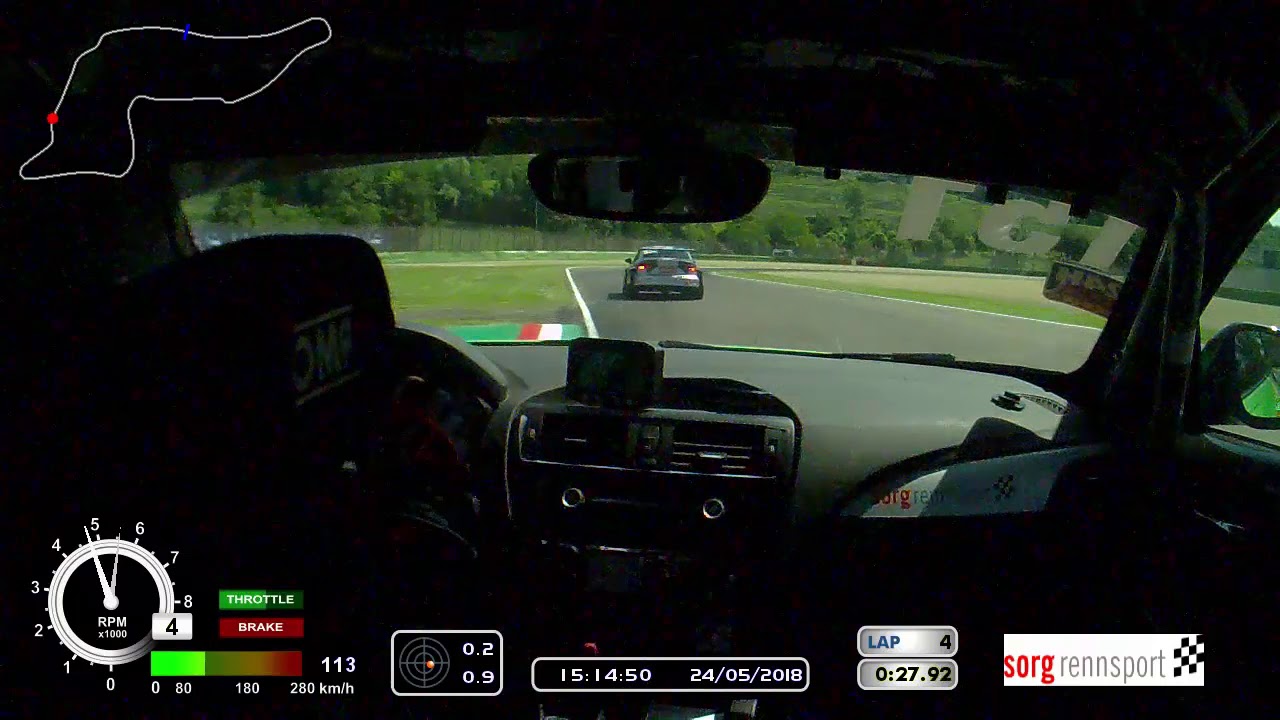
I got in the car, refueled and then got going.  Generally, I was able to get up to my speed quickly, steadily improving lap times and topping out at consistent 2:07.xxx’s regardless of traffic.  When I was at the fuel station, I was told on the radio to have my windows up, but that requirement was only during re-fueling, at the refueling station (we couldn’t refuel at our pit spot).  I interpreted the message as “have them up at all times”, which meant I wasn’t feeding fresh air to the air-conditioned helmet blower.  Somewhere after the 1 hour and 15-minute mark, the heat really started to get to me; everything was hot.  Like a heat I’ve only experienced once before when my cool suit didn’t work in a PRO3 car and 100F weather.  I figured I’d get the call at any minute to pit but no call and no Code 60.  What would end up being about 90 minutes into the stint, I started shaking and getting cold shivers.  I radioed in that I probably only had 10 or so more laps in me.

To be honest, I had no idea what was radioed back but it was not “ok, pit next lap”.  I kept driving, trying to remain focused, keep a semblance of a pace and not crash.  Finally, the call came in to pit.  I thought it was because they realized that I was in bad shape, but it was because I was minutes away from going over the 2-hour at a time driving limit.

Driver change!  Photo credit: Petr Frýba

I come in to the pits, stumble out of the car, Rob goes in and I start looking for any source of hydration.  About five minutes after being out of the car, I do a heart rate check on my Apple Watch and… 136BPM.  Holy crap.  And I am still on fire and can’t seem to drink enough water or the special Italian “Gatorade”.  A few minutes later, back in the trailer changing, I get the news that Rob is in the beach after an incident with a GT3 car.  With only ~4 minutes left in the first 4 hours, the workers do not pull us out of the beach and we can’t get it back to the pits for inspection and repairs.  The first 4 hours come to an end we are down 3 laps from the lead.

The end of our day 1 with less than 5 minutes to go.

An hour or so later, we were able to look at the car, from afar while it sat in parc ferme (impound).

Our chariot in Parc Ferme – dirty and slightly broken

Luckily, the car is in the corner and the Sorg crew checks it out and determines we have some bent and broken suspension components.  This eliminates the option to have Dan start the race with the car as is, shake off the rocks and get a sense for how the car runs.

We decided to take a 10-lap penalty, so we could make repairs before the race restarts Saturday morning.  That night we had an excellent spaghetti dinner at the Villa we stayed at (was built in 1420 and owned at one point by Napoleon Bonaparte’s grandmother) and finalized the plan.

Dinner at Napoleon Bonaparte’s grandmother’s villa. Built in 1420 and furniture from the 1700’s…

We were P1 for a good chunk of part 1 of the race because of good luck with Code 60’s but our fastest pace was still slower than our main competition (#131).  With the 10-lap penalty, all we could really do is put our heads down, put down clean laps, stay out of trouble and hope the endurance gods would punish the competition.

Saturday, May 26th, 2018: Race part 2 (8 hours)

Dan would start the race, put down solid laps, stay out of trouble and then hand over the car to Seth.  Seth would go in and do the same, getting back as many laps as possible – hoping that Seth could match lap times with their fastest driver and we would be faster than the rest of their drivers.

Over the general race pace, that would end up being the case – we steadily clawed back laps from the 2nd place car but slowly we’d lose ground to the first place #131.

Dan Rogers (@epsdan) riding the curbs to get us some laps back.  Photo credit: Petr Frýba

In the third stint, I went back in for what would end up being about 1 hour and 45-50 minutes, safely clear of the 2-hour driving limit. I was able to get up to speed even faster than Friday and in the second half of the stint, when the heat soak returned, and I realized the Camelback with a mix of water and Italian Gatorade was not connected to my helmet, something clicked.  Something that Seth had been preaching to us for the past 24 hours (and will be reserved for another time).  I trusted his advice and just did it, and the car didn’t go off into the dirt or in a wall – it held.  The times started steadily falling, the 2:06’s started coming effortlessly, almost regardless of where traffic was interfering.  And then, a 2:05.xxx!  And then another 2:05 in the predictive lap timer but spoiled by traffic and another, spoiled by… me (I was getting greedy).

Traffic or not, need to make up time!  Photo credit: Petr Frýba

I was ecstatic but drained and as I’ll write about in another post, I didn’t have the stamina to sustain 2:05’s.  I had already started driving with the windows cracked and on the straight-aways, I’d put my hand out of the window to funnel outside air in and help cool me down.  The time went by much faster this stint and before I knew it, the call was in to pit.  There was a Code 60 for a badly damaged car which would take 10-15 minutes to clear up, so though the Code 60 came out right after I had passed the pit entrance, I was able to circle back around and pit, under the Code 60 and Dan was able to get back in the car and on track before the green flag flew.

Dan had a great second stint, consistently hitting 2:07’s and staying out of trouble.  We had clawed back more laps and with Seth going in for the closing stint, it would be close.  Enough green flag running or advantageous Code 60’s is what we needed.  Seth came out with a full head of steam and immediately started putting down 2:03’s and 2:04’s – getting back 8-12 seconds per lap to P2. With an hour left in the race, the cars started falling like flies.  One car after another, breaking down on track or barely limping back to the pits for a repair but no Code 60.  Finally, with about 15 minutes left in the race, one of the leading GT3 cars, a beautiful matte-red Mercedes AMG GT pulled to the side of the track with a collapsed front wheel.  Even though it pulled off in a decently safe area, the Code 60 came out, leaving only a few minutes to finish the race and with that, our chances of P2 washed away.

One of the overall race contenders, broken down with less than 15 minutes to go in the race.

After 8 hours, we had clawed back a full 10 laps and were only 20 seconds away from P2.  Another few laps of green flag running… but that’s racing!

Seth Thomas (@racerseththomas) bringing it home in P3   Photo credit: Petr Frýba

Podium finish to top off a great weekend

Despite not being able to claw back P2, we still made it on the podium and it was also my first experience actually standing on a podium, let alone the same podium and podium room that mega stars of racing have been in and stood on.  Overall it was a great experience and looking forward to the next race, which we’re targeting the 24 hour race at Circuit of the Americas in November or possibly Barcelona in September.

Posted on

BMW M235i Racing – 12 Hours of Imola

Before we get into the actual on-track action and the race, let’s talk about the car we drove for the 12 hours of Imola.

BMW M235i Racing by Sorg Rennsport

The story goes that a prominent leader in BMW Motorsport was at the 24 Hours of The Nürburgring several years ago and noticed that in the sub-GT4 categories, there were several BMW’s competing but they were old (E30’s and E36’s) and took a ton of work to get them race ready and maintained, let alone competitive.

With Mazda having a full factory developed and globally homogulated Global MX-5 Cup Car, BMW decided to build their own solution. Since its launch in 2014, the BMW M235i Racing has seen steady uptake in the marketplace, with BMW Cup Racing series all over Europe, in endurance races like the Creventic 24 Hour Series, VLN and in professional touring classes all over the world, like the TC classes in Pirelli World Challenge. As an entry-level professional race car, its hard to beat the value despite the sticker price and driving experience, as we’ll cover below.

The VLN BMW M235i Racing Cup Series  Photo Credit: VLN

We were originally supposed to drive this car below but in the prior 24 Hour of Nurburgring race, it was wrecked a couple times and was down for repairs. So Sorg prepared and brought out the “Orange Juice car” as my son named.

The car we were originally going to drive but was damaged at the Green Hell. Photo credit: Petr Frýba

The “Orange Juice Car” Photo credit: Petr Frýba

The basics

DIMENSIONS

Length: 4,454mm

Max. width: 1,862mm (without mirrors)

Height: 1,380mm

Wheel base: 2,690mm

Max. track width: 1,608mm

ENGINE / TRANSMISSION

Straight six-cylinder petrol engine

BMW M Performance TwinPower Turbo

Capacity: 2,979ccm

Output: 245kW (333bhp)

Torque: 450Nm

Racing exhaust with racing catalytic converters

Steering wheel with shift paddles and lights on the steering wheel (awesome!!)

BMW M Performance limited-slip differential

TANK Motorsport safety tank

SUSPENSION / STEERING

KW dampers

H&R suspension springs

Front: H&R anti-roll bar (2-way)

Rear: H&R anti-roll bar

BRAKES

Front: High-performance motorsport braking system –

Performance Friction (PFC); 4-pot fixed calliper

Rear: BMW M Performance 2-pot braking system

ABS / DSC / ASC

BMW Motorsport specific racing application

TYRES / WHEELS

18×10 inch alloy rims

265/60/18 tires – we ran Hankook full racing slicks though we’ve seen this car run on Pirelli’s, Dunlops and Michelin’s across the globe

SAFETY COMPONENTS

Cage with DMSB certificate and FIA approval

6-point racing harness from Schroth

Racing seat RECARO Pro Racer SPG (we had an OMP HTC-R carbon seat)

Exterior

The car is built a ‘body in white’ to make it super easy for a great wrap job. It is the 235i body with the body panels from the M2, which presumably provide a variety of aero benefits. Sorg has it outfitted with the optional rear wing, which is adjustable to aid in rear down-force.

Seth Thomas getting acquainted with the car. You can see the body in white and the full body wrap.

Bottom line, it looks awesome in just about every livery I’ve seen. A bit boxy compared to most sports car but expected for a BMW. The aero bits make it look aggressive and with the incredibly meaty 265-wide slicks, it looks beefy from every angle. You’ll notice that in most pictures, we ran with the windows up. It comes with the power windows still and fully functional. It wasn’t until the cockpit got really hot, that we’d crack a window to circulate air and feed cooler air into the helmet blower.

Interior

This car is the standard for every production-based race car, even a club race car. Period.  The interior was clean and tidy with the factory dash just about fully intact. The steering wheel had shift lights, programmed to keep us within the meaty part of the power band and the small LCD screen that read out the amount of fuel we’ve used since the last refill/reset, lap times, water and oil temperatures.

Straight factory look and yes, my eye line is only a couple inches higher than this…

The shifters were in perfect position to shift up and down without readjusting your hands. The OMP HTC-R carbon fiber seat was on sliders, to accommodate several driver heights, of which for us ranged from 5’6″ for me to just over 6′ for Seth Thomas. I normally don’t love sliders but these were solid and provided all of the range we needed.

Much of the interior is trimmed with carbon fiber goodness, which looks great and keeps everything looking clean and professional.

The car still comes with a racing oriented but still operating Driving Stability Control (DSC) of which we turned completely off. I personally didn’t drive with it on on, so I can’t speak directly to the differences but having it fully off was great and I felt like I could easily manage the amount of corner-exit sliding with throttle and steering input.

Sorg outfitted the car with Motorola digital radio system, which was a bit random in its performance throughout the weekend. Imola is a big track, with lots of elevation changes so we rarely had good audio quality at the farthest points from the paddock and saved most critical comms for the front-straight away.

In the center console, you can see the Motorola radio and that on/off switch is for the helmet blower.

This was also the fastest and loudest (though not super loud) car I’ve ever raced, along with racing amongst the fastest and loudest cars I’ve ever raced with (up to GT3 cars). I found that my super awesome Stilo helmet with the ear muffs were simply not enough, so I had an on-track vendor install the additional component so I can have molded ear plugs, in addition to the built-in noise cancelling ear muffs and that seemed to help quite a bit.

Sorg installed an air-conditioned helmet blower, versus the standard air blower I have in my PRO3 car. This thing worked great for the most part. It needs an air intake, then it cools the air before forcing it through the air tube. The issue I ran into was that in my first race stint of nearly 2 hours, I ran the whole time with the windows up. And even though we had the car’s fan circulating air into the cabin, everything got heat soaked and with 40 or so minutes left in my stint, I was heat soaked and the blower was pushing around hot air (which was still better than nothing).

One driver mentioned that the dash was a little tall and he didn’t love not being able to see the hood and thus not having as strong of a sense of where the car body limits were. This is true but for me, I’m used to sitting low and being short, so I never see the hood, so that didn’t bother me.

The cable management, cage design and installation is pristine, though it was interesting to see that the cage is actually a bolt-in cage, versus a welded in cage at the mounting points. I’m sure there is science and logic behind this but that took me by surprise.

Lastly, the car had a full AiM data logging system built in and capturing ECU channels. As usual, we lived and died by the predictive lap timing feature and during practices, we used the Apex Pro Driving Coach tool, where Seth set some baseline laps and then we focused on making the lights as green as possible in the corners.

How did it drive?

Before driving the car, Dan and Seth said that the M235i Racing would drive like a big PRO3 or Spec E46 car, of which are my only two reference points. And after the experience, they were mostly right.

With power steering, ABS and a paddle-shifting automatic transmission, it was the easiest car to race I’ve ever driven. What you do is still the same in terms of driving but it’s just easier. All inputs don’t require much of any force and the seat, seating position and Schroth belts are simply comfortable. For example, I have an Apple Watch and when I drive my PRO3 car (no ABS, power steering and a CAE shifter) I don’t need to ‘start a workout’ on my watch. The amount of work I am doing and vibrations automatically make the watch think I am working out and it logs a workout.

In the BMW M235i Racing? Not so much. After both my racing stints, of which both were nearly 2 hours, I was toast. Overheated, dehydrated, mentally and physically exhausted I looked at my watch and no workout detected. I had to manually have it check my heart rate about 5 minutes after getting out of the car and it was still at 134bpm.

Getting 3-wheel action is easy- peasy in this car! Photo credit: Petr Frýba

So yes, it was the hardest, most exhausting driving I’ve ever done but I might as well had been sitting in a beach chair.

This thing is fast.

With ~330whp and on full racing slicks, this car is easily the fastest car I’ve ever driven in a race. My perspective is a bit skewed because while we were hauling @$$, we were driving in the slowest class of the race. It literally felt like I was driving with an anchor dragging behind because of how stupid fast the TCR, GT4, GT3 and Porsche Cup cars were.

Still, this car is fast and when not over-driven, it is really easy to go fast. The key difference for me was to trust the higher than normal mid-corner speed the car could carry due to it’s more advanced suspension and big/meaty slicks. Seth and Dan mentioned that the Hankook’s were not the fastest slick available but are likely a great value because they tend to last at 90% of the peak grip for a good amount of time.

Bottom line is that this car could hang mid-corner with every car on-track except for the GT3 race cars and possibly the TCR cars. I could definitely feel the additional size and weight of the car transitioning weight from side to side, compared to a 2700 lbs PRO3 car but after a few laps, it felt normal.

Not a mistake – this car can hang with most any car mid-corner! Photo credit: Petr Frýba

Power-wise, it has gobs of torque but not an incredible top-end. Corner exit I could stay on the rears of several TCR cars but then they would slowly pull away, while just about every other car would leave us like if we were parked.

Braking was great and confidence inspiring. Braking for Turn 2 (the first chicane) and Turn 17 are full, 10 out of 10 braking zones. After building up my confidence, I found myself braking at around the 175 meter mark for the 1st chicane and the just before the 50 meter for the last chicane. HOLY CRAP! But the car would slow down, turn in and handle it, with no complaints.

Being a turbo car, there was a tiny bit of lag from throttle application to feeling the grunt. So it was even more critical to get to full throttle as soon as possible. For the most part, the LSD and the Hankook’s would take the full throttle corner after corner and lap after lap. I only got a bit more sideways than I’d want on corner exit a couple of times: once in turn 7 when I was testing the limits carrying speed through the corner and up the hill – simply too early on full throttle with too much steering input and a second time on the exit of the last chicane, when I got a bit more exit curb than the car could hold while try to get full throttle. I didn’t back out, just a simple steering correction as I still had a few inches before getting to the big turtle bumps that were there to eat up suspensions.

Final verdict: It could be the perfect race car for you and me at some point

At around $85k USD brand new, the BMW M235i Racing is seriously a great deal. For reference, to have someone build a top quality Spec E46 race car, it can cost upwards of $60k. $25k gets you a pretty much guaranteed quality and consistency, factory supported race car.

I’ve looked around and still not quite sure what they are going for used but I wouldn’t be surprised to see them available for $40-50k USD.

The driving experience is incredible and consumables are on the low end for a pro-level race car.

The issue for me is that I care most about competition. I want to race in big fields, with closer to spec cars and see how I stack up to the best competition around. And outside of Pirelli World Challenge, there isn’t a ton of these yet in the US and especially in the club racing ranks. If that were a different situation, I would seriously consider finding and racing a BMW M235i Racing.

I’ve heard and read that the BMW M235i Racing Cup is popular, with country and Europe-wide championships that are fielding 20+ cars at a time. If I lived in Europe, this would also be a strong option.

Until any of those things happen, I’ll have to settle for making my in-process, BMW Spec E-46 look and drive as close to this beauty as possible and racing with Sorg Rennsport 1-3 times a year. I can’t wait for the next time!

Posted on

1st Pro Race – 12 Hours of Imola Creventic TCE Series

Going pro racing

My first on-track experience was a 1-day High Performance Driving with Proformance Racing School at Pacific Raceways.  It was a actually a birthday present for my wife.  She had a Mitsubishi Lancer Evolution 9 and I had a 400whp 2008 Subaru Impreza WRX STI.

His and her’s AWD turbo beasts!  I still miss that STI!

That day I learned that I had no clue what I was doing behind the wheel of a car from a ‘racing’ standpoint, especially one with that much power and in general the capabilities of the car.  I also realized that learning to drive a car on-track with skill and being fast was going to take time, but I was up for the challenge.

Over the next 12 months, I did several track days and learned about the then, GRAND-AM Continental Tire Series where production-based race cars, like my Subaru, raced in the GS and ST classes.  Further, here in the PNW, we had several drivers who had started out in local club racing and driven or were driving in series like that at the ‘professional’ level.

I have dreamt and continue to dream of owning and racing cars like this!

Since then, it’s been a goal of mine to at least once, drive in a professional racing series in a production-based sports car.

Getting the invitation

Over the past four years racing in primarily PRO3 class, I’ve met several former PRO3 drivers who have or still do drive professionally.  One of which is Dan Rogers and through him, Seth Thomas, of which they have co-driven in multiple race cars and series over the years.  In 2018, they decided to see about putting together a program to do at least a handful of the Creventic 24/12 Hour Endurance racing series, which has races in the most iconic circuits all over Europe and at Circuit of the Americas.

They reached out to several drivers who presumably have a minimum level of proven speed, ability to keep a car clean and ultimately, afford to take part in all or some of the races.  When I first got the email, I almost brushed it off completely, assuming it would be way too expensive for me to afford but it turned out to be not too bad and in the grand scheme of this type of racing, a solid value.  Coupling this with an extended family vacation and a couple of business meetings, taking part in the race went from a pipe dream to a bucket list reality.

12 Hours in a factory race car | BMW M235i Racing

The race will be a 12-hour race, split over two days.  I’m not exactly sure why this is but having visited Imola a few years ago, I can imagine it being a noise ordinance issue as Imola is actually a city park, with residential buildings right on or next to the track property and park.  I’ve also heard from organizing bodies that holding a race over-night is much more expensive than running during the day due to the required workers and lighting.

The BMW M235i Racing factory race car – raced in professional TC series all over the world.

The weapon of choice is a newest generation BMW M235i Racing 2-door coupe, built and sold directly by BMW motorsports as turn-key solution for the ‘entry levels’ of professional racing.  I don’t know the exact class we’ll be racing in but the car is capable of pace just slightly slower than the new global TCR cars.

Sorg Rennsport’s BMW M235i Racing car in for a pit stop

It has a 3.0L, twin-turbo in-line 6-cylinder engine and a 6-speed automatic transmission, with paddle shifters.  Dan Rogers, who has driven the car previously described it as essentially a bigger PRO3 or Spec E46 car, in terms of handling characteristics.  This is music to my ears as it means, well balanced, plenty of brakes and enough power to have a great time but not so much that you could get into too much trouble.  The car is owned and managed by the Sorg Rennsport Racing Team, out of Germany.

Learning the track

Having never driven Imola in-person, my main resort to learning the track was iRacing!  My simulator is primarily setup for iRacing, so even though I realized a couple weeks ago that Imola and a close sibling to the M235i Racing was available on Assetto Corsa, I decided to do all my training on iRacing and using the Mercedes AMG GT3 race car.  The AMG has a lot more power than what we’ll be driving but I figured it had similar characteristics from previous driving; rear-wheel drive, paddle shifters and more under-steering characteristics relative to something like a 911 GT3 or the Audio R8 GT3.

Over the past 4 months, I’ve logged over 1,000 laps and 30+ hours of seat time.  I’ve also used Virtual Racing School’s data pack feature, to compare myself with one of their coaches with a reference lap time of 1:42.xxx.  The data pack is from a different season where multiple updates to the car, tire model and track have been rolled out, so trying to replicate the lap time exactly isn’t possible but my goal was to get as close to it as I could.  My personal best ended up being a 1:45.2xx but most importantly, the last few weeks I was able to jump in and start hammering away high 1:45’s and low 1:46’s, with relative ease and regardless of fuel load.  In an endurance race, yes being fast is important but being consistent and keeping the car clean is even more important.

Autodromo Enzo e Dino Ferrari – IMOLA!

So how well do I know the track?  We’ll find out for sure but by just closing my eyes, I can recite…

  • Turn 1, full throttle and get ready to straighten the wheel and brake past the 200 marker for the first chicane.
  • Turns 2/3, make sure to hit the backside of turn 2, so that I can square off Turn 3 and get a healthy full-throttle run at apex. Stay off the big bumps on the curbs.
  • Turn 4, slight left hander of which the goal is to stay flat but might need to lift depending on the angle of entry and how well the right rear tire is holding.
  • Turns 5/6, similar chicane but there is more distance between the two turns. Similarly, hit the back side of 5, square off turn 5 and get a healthy full throttle run at apex and use the exit curbing as needed.  Do not touch the big bumps on the inside of the corner, they will destroy your time and your car.
  • Turn 7, very slow left-hander that feels like a decreasing radius corner. Important to get the car turned and then back on throttle quick and somewhat aggressively.
  • Turn 9, very fast left-hand turn with a stab of the brakes and then quickly back on throttle – let the car nibble at the exit curbs but don’t get too greedy. It’s hard to stay full throttle with being too much on the curbs as the rear end tends to kick out.
  • Turns 11, 12, 13 – an interconnected, high-speed and critical sequence of turns. A brush of brakes to do a full ‘send it’ into turn 11 and making sure to hit the apex curb.  A stab of throttle before 6 out of 10 brakes, downshift to 3rd gear and bite off a decent size of the apex curb for turn 12 and then full throttle as quickly as possible to go up the hill and Turn 13 ends up being more of the exit curbing of Turn 12 than anything else.
    • It is very easy to let the car run over the big exit curbing here but iRacing will punish you for track limits so make sure to only get a max of 2 tires over the white line.
  • Turns 14 and 15 make up the last chicane of the lap, that feels a lot like Portland International Raceways. Take a big chunk of the T14 curb, flick the car to the left and get to full throttle at or before the apex of T15.  It’s ok and even sometimes the curbing of T15 helps rotate the car, let the car release to the exit curbing but only go 2 wheels off.
  • Turn 16, a full throttle bend in the road – create a straight line that helps you get to driver’s left to setup for a very tough T17.
  • T17, a very intimidating and high speed right-hand corner, where you are flat and right at shifting to top gear. Position the car for a late apex and be ready for 10 out of 10 braking effort, in a straight line and shifting from 6th to 3rd
  • Turns 18 and 19, the last set of real corners before the front straight away and start/finish. Important to get the curbs on both corners and T19 is the most important to get to and stay full throttle as quickly as possible.  Just a brush of brakes is needed and use all of the exit curbs.
  • Turns 20 and 21 are essentially bends in the road. Take them full throttle and have as little steering input as possible.  Steering input = friction = slowing the car down.  Make down the straight away as quickly and frictionless as possible.

Generally speaking, I think I have 80% or so of the track down in my head and developed muscle memory so that when I get into the car, I can focus on driving the car and figuring out how to go fast, versus figuring out my way through the track.

Physical training

This is an endurance race, in Italy at the start of the summer.  I’ve been in Italy around this time of the year in the past and it can get hot, really hot.  I’ve been working on my cardiovascular endurance – 60+ minute runs and cycling sessions.

I’ll be honest that while I’m in decent shape, I’m nowhere near where I wanted to be.  Life has gotten incredibly busy on all fronts and I’ve been lucky to get in 3 workouts per week and a few simulator sessions.  To top it all off, this past weekend, I did a PRO3 race weekend and only did one run group.  The driving felt great but, I improved my personal best lap time during the actual race but by Sunday afternoon, my lower back, on my left side was sore.  I’ve only experienced this last year, when I was a couple months post a surgery and next to no working out.

No expectations

Overall, I am sitting on this airplane with next to zero expectations.  There will be four total drivers, one of which I know will be faster than me (Seth).  Dan will either be around the same pace or faster because he has a ton more experience in professional races and Rob, the third driver – I don’t know at all.

I will work at being as fast, safe and consistent as I can possibly be but overall, am going to focus on having fun and taking the experience all in.


Posted on

No training or exercise for 2 months = Not great performance

Surgery…

On July 7th, 2017 I went in for what was supposed to be a minor surgery.  I was diagnosed with a non-cancerous cyst, which is quite common except for it was located right on top of my tailbone (not on the tailbone but right next to it).  This meant that I was regularly sitting on it, especially when I would slouch.

It had originally come up 3 or 4 years ago after 6 months of karting all the time.  I thought it was just a result of all that trauma to my tailbone.  It was an annoyance but never very painful until this past June, during the second Portland International Raceways weekend.  After the first day of testing, I woke up sore all over my body and my cyst was really tender.

YouTube player

I ignored all the pain and discomfort and made it through the weekend but went to the doctor the following week.  It turned out that my cyst had gotten so swollen, it was infected and those body aches, were my body fighting the infection.

Long story short, I needed surgery to have it completely removed.  It is a straight-forward procedure and usually within a week, someone can go back to normal activities, but because of the location, the recovery was at least 2 weeks and possibly up to 2 months before feeling ‘normal’ again.  Well for me, it ended up being the 2 months.

+ Bad Decisions

For 2 months, I wasn’t able to workout, do much simulator training and was on various combinations of pain medications.  2 weeks after the surgery, I decided to compete in a race at Pacific Raceways, where I got pole and finished P2 but I needed help getting into the car, out of the car and was icing my incision all day long.

A week after the Pacific race, I was reading to my kiddo and his friend, but I was also laid up, trying to take the load off my incision.

The next couple of weeks were really tough.  I don’t know how differently or faster things would have healed if I had not raced but I think it slowed things down.  A checkup with the surgeon a couple weeks later showed everything looked good but she was surprised to hear that I was in so much pain.

I headed her advice and just tried to rest up, sprinkling in some yoga and days of more walking.  1.5 months after the surgery was the August 19-20 Dash for Kids race, back at Portland International Raceways.

Our setup at Portland International Raceways

= Sub-Par Performance

During the race weekend, we decided to hit the ‘reset’ button on our suspension setup, seeking coaching and advice from the 2016 PRO3 Champion, Olivier Henrichot (a future post on that experience).  We made dramatic changes to the setup, where in the end, I was able to hit the same lap times as before, with less of an effort and more confidence in feedback from the car.

All good things except, I was beat.  On Friday, we had 4 total on-track session and I awoke on Saturday AM, full-body sore.  Saturday, was a typical day of practice, qualifying and the 1-hour race, of which this time, I was splitting seat time with Olivier. We won the race but I again felt beat, after a 30 minute stint.

The next morning, we only had qualifying in the AM and the main race in the afternoon; not a ton of physical workout time.  I qualified P2 and was ready to go for the win during the race.  But about 5 laps into the race, my lower back started hurting.  Halfway through the race, it was throbbing and I was actively thinking about it during the front and back straightaways.  Not a good.

Qualified P2 for the main PRO3 race on Sunday

Long story short, I did not perform anywhere near my full or regular potential and one big reason that I was just not physically fit enough.  Here is the race video from the weekend, of which again, isn’t all bad and 1 year ago, I would have been thrilled to finish P3.

YouTube player

But How Did I Do So Well at Pacific?

I’m not entirely sure but I think that while I was in pain during the race, I still had more of my strength, stamina and was also on lots of Ibuprofen, which could have masked some of the pain.  At Portland, I think my strength, stamina and reflexes were not at the same level.  This variables resulted in a heavier mental toll and it started impacting me even worse.

At the end of the day, it’s not like I really sucked.  I still finished on the podium, against a couple of strong drivers that I’ve battled with all year.  Jeff McAffer, who overtook me for P2, had a really strong race, with the fastest lap of the race.  Olivier and I also won the 1-Hour endurance race!

The main point is that to perform at or near peak levels, you need to be mentally and physically at your peak.  I know there are drivers that aren’t into physical fitness and they are solid, if not incredible drivers.  They have other strengths, such as functional fitness and years and years of experience.  I don’t have more than a few years of racing experience, so I rely on physical fitness as a way to compete.

Moving Forward

For me personally, I am much healthier now and turning my training back up.  It will be some time before I’m as physically as fit as before but that is the goal.  And if in the future, I am injured, I am going to bite the bullet and rest/heal properly before trying to get back into the cockpit.


Posted on

Collateral Damage – Headlights

What: Stuff breaks when you go on track, this time – headlights and driver side mirror.

If I knew then what I know now:  Consider two layers of Lamin-x on your headlights and depending on your car, have a backup set of headlights.  If your OEM headlights are glass, see if there are plastic alternatives.

Check out:


Reality check – stuff will break

It kind of sucks but that is a fact of the track-life.  When you go on a race track, autocross course, rally stage, drag strip, etc. your car is going to be flying through the air at normally illegal speeds and changes in speed.

Bugs, rocks, small birds, rubber from tires and even parts from other cars will at some point, leave their mark on your beauty.  After this most recent race weekend at Spokane County Raceways, my headlights finally bit the dust.

Lamin-x, film, racing, headlights, bmw, e30
Doesn’t look too bad, right? Well the high-beams are duct taped because they were completely broken and the Lamin-x film was keeping the low-beams together.

an up-close look reveals a not as pretty picture. Eek!

The fix – new (to me) headlights and new Lamin-x

Although the remaining races for the year are during the day, we are in the Pacific Northwest and that means there is always a chance for rain.  When it rains, I prefer to have all the lights on, just to make sure other cars on track can see me.

To fix the headlights, at least for an E30, there are a few different options:

    • Replace just the light bulb: These light bulbs are old school and thus the whole light bulb and actual headlamp assembly are one-piece.  In most modern cars today, there is a headlamp assembly and somehow screwed to the inside, is the actual bulb.  So you can replace either the headlamp assembly or the bulb but we don’t have that option here.  To buy the integrated headlight, head over to Amazon and you can easily get one, like this one below (click on this link or the image below to go to Amazon and buy).  Each bulb will run you about $45/bulb.  Check to make sure you are ordering the right thing – the high or low beams.  They are not inter-changeable.  On the plus side, there are no side dependencies.  So the low or high beam bulb can fit on the left or right side of the car.
    • Replace the whole assembly: You can also choose to replace the whole assembly, which includes the bulbs and the frame that holds the bulbs in place and is screwed into the radiator support area.  Normally, this is too much for broken headlights but this is where eBay is your friend.  There is an option to buy brand new and even LED and projector headlight assemblies, which are awesome but pricey.  Here is an option from Amazon.  Beware though, these look awesome but are just as fragile as the OEM stuff.  Keep that in mind before buying and taking back on track.  🙂

Ebay to the rescue

As you can see from the Amazon search results, a new, truly new and even aftermarket set of the full assembly headlights can run $200+. Instead, I went to eBay and was able to find a used set of the full headlight assembly for just over $80. This is also less money than buying new (intgrated) bulbs and the already come in the assembly.  Click through the banner ad below to see search results that I used to get my new (to me) headlights.


Install in less than 5 minutes
Because I was replacing the whole assembly, all I had to do was:

  1. Remove 6 clips that pinch the headlight assembly to the grill that surrounds the headlights.
  2. Unscrew two screws for each headlight area, that holds the grill to the front area of the car.
  3. Unscrew two other screws that hold the headlight assembly to the radiator support.
  4. Disconnect the bulbs from the wiring harness.

And they’re off!

Out with the old, in with the new (to me)!

Lamin-x for extra protection

While the old bulbs were off, I cleaned off the new bulbs with generic window/glass cleaner and then installed a set of #prospec yellow tinted Lamin-x film covers.  These are the same ones I had previously but this time I put them all four headlights.  You can get these almost anywhere: Amazon, eBay or where I got them, ECS Tuning.  These are the exact product I ordered.  But since we fund this site through affiliate marketing, here is a link to Amazon, for the exact same product, of which clicking and buying helps keep this site alive.


Back to looking good for the next race!

In under 10 minutes total, including cleaning, taking pictures and moving slowly as I was recovering that day from minor surgery, old broken headlights were replaced with fresh, low cost, new (to me) headlights with extra protection from Lamin-x.

Back to looking fresh!

I think about headlights and even windshields as almost consumables. If I can go the rest of the year without having to replace them again, that’ll be great. But with the next race at Pacific Raceways, where there is gravel off-track and people love to drop tires, I’m not very hopeful.

The lights that will strike fear into my competitions mind and heart. Move out of the way!!!

Posted on

Burn 1,000 calories in an hour, lower back pain, kidneys and dehydration

What: A small addendum to the cardio training post, let’s expand on it with a real world experience that happened just a few weeks ago at Pacific Raceways.

If I knew then what I know now: Hydration, hydration, hydration – start it at least 5 days prior the first day on track and keep it up while you are on track.  Simply drinking lots of water the weekend of, is not enough.

Check out: 


1 Hour Mini Enduro’s as a Workout

Most of my racing is a sprint format, but each Saturday afternoon, there is a 1 Hour Mini-Endurance race (referred to as Enduro’s but spell check hates this word). During the May 20th 1-Hour Enduro at Pacific Raceways, I decided to start a ‘workout’ using my Apple Watch to track my heart rate and calories burned, more accurately.  In this mode, the watch samples movement, skin temperature, heart rate, etc. at least 1x per second, versus about 1x per minute, while generally going about your day.

So what happened?

First, Pacific Raceways is already a physically demanding race track – super old school, banked turns, big time elevation change and even catching air on all 4 wheels.  Before I even looked at the data, this is how I felt:

Thank Goodness for the Dead Pedal: While you probably aren’t going to be able to tell from the video, the combination of braking, lateral g-forces, camber in the road and downhill ascent of 3a and 3b complex, make it super grueling as you are carrying a good amount of speed.  I found myself hanging on for dear life, thanking my OMP seat, Schroth harnesses and most importantly – the dead pedal.  After each session I found myself thinking – “man, if it weren’t for the dead pedal – I think I would have fallen out of the seat.”

Oh dead pedal, how I love thee!

Dehydration: That day was warm but not ‘hot’ with a high of 72 degrees Fahrenheit.  I have a helmet blower system hooked up to my Stilo ST5 GT Wide Composite SA2015 Helmet with Noise Attenuating Ear Muffs (Large), of which after experiencing this – I don’t know how everyone doesn’t have one.  And we were planning to run the Cool Shirt CS-12 Club System but we forgot to pickup ice.  No worries, we went on regardless.  Well after a day of two qualifying sessions, one 20 minute race and an hour race, I felt drained and truly dehydrated – with my lips feeling chapped, which is a rare occurrence for me.  I’ve probably used chap-stick or lip balm maybe a half-dozen times in my life.  I have a rule that 7 days prior to stepping into a race car, I don’t drink any alcohol (usually wine) and that week, I bent the rules and I think that didn’t help.  While I only had a couple glasses with dinner, I could feel the difference.

Lower-Back Pain: Yeah – even this!  WTF!?!?!  I climbed out of the car with my lower back, not throbbing, but sure as crap not feeling great.  During the race I felt sharp pains and while I’ve had back issues the past few years – a combination of physical therapy, cross-training, plyometrics, stretching and chiropractor visits have my back in pretty good shape. Even still, I had back pain.  One theory, was that this was actually kidney related as it is common to have lower back pain, from your kidneys, when you’re too dehydrated and I felt it.

As an aside, the following morning I was pretty sore – especially on my right foot, calf, lower back, right shoulder, forearm and hand.  These PRO3 cars don’t have power-steering or ABS, so they are quite the analog animal to manhandle.

The data says… holy crap!

Calories burned during an auto race
This is the health data from throughout the day. You can see the spike when I logged a workout during the 1-hour endurance race. I didn’t log a workout during the earlier three sessions (two qualifying sessions and one non-points race)

Here is an hour by hour breakdown of my heart rate – note that during the 1-hour endurance race, my heart rate reached around 160-165 beats per minute.


Think about this – when was the last time you did a workout and burned (approximately) 1,000+ calories?  I am talking about just the logged ‘workout’ because in the previous three sessions, I didn’t have the Apple Watch Nike+ 42mm logging calories or else the full day of calories burned would have been 2,000+.  That is a TON of calories and physical effort.

Conclusion

Competitive racing is a legit, physical sport that is incredibly demanding.  We are using our hand-foot-eye coordination, reflexes, core-strength, neck-strength, arm-strength, leg-strength, cardio stamina and mental stamina, just like happens in many other ‘high intensity sports’.

If you are and an avid racer, actually competing and on a regular basis – I highly encourage you to have a regular training program and eat well at minimum to avoid injury and really, to help improve your performance.  Yes, you need to know what to do with your driver inputs to go fast but you also need to be able to physically do this, consistently and over long periods of time – especially for all those endurance racers.  If you aren’t exhausted when you get out of a race car – you’re just not driving hard/fast enough.